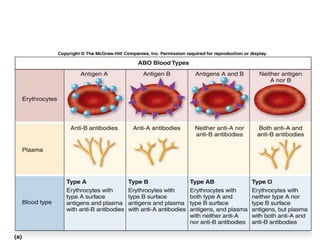
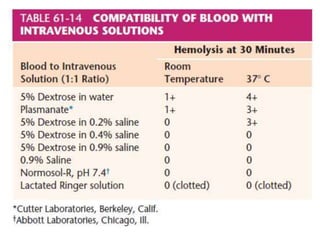
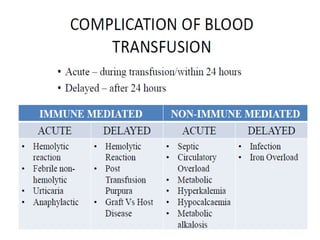
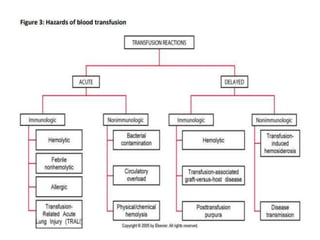
Transfusion of blood and blood
products
Speaker : Dr. Amarnath
Moderator : Dr. Nizamuddeen
Contents
•Definition
•Functions of the blood
•Blood products
•Indication for transfusion
•Massive transfusion.
•Maximum surgery blood order schedule
(MSBOS)
•Blood transfusion reaction and its
management
•Other complications of blood transfusion.
•Red cell subtitutes
•Synthetic o2 carriers.
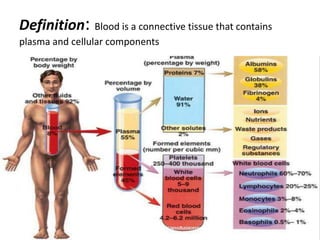
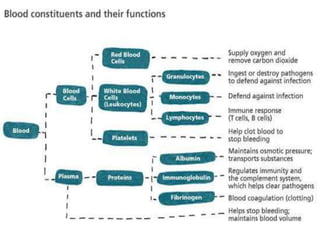
Definition: Blood is a connective tissue that contains
plasma and cellular components
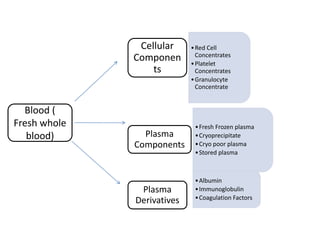
Blood (
Fresh whole
blood)
•Red Cell
Concentrates
•Platelet
Concentrates
•Granulocyte
Concentrate
Cellular
Componen
ts
•Fresh Frozen plasma
•Cryoprecipitate
•Cryo poor plasma
•Stored plasma
Plasma
Components
•Albumin
•Immunoglobulin
•Coagulation Factors
Plasma
Derivatives
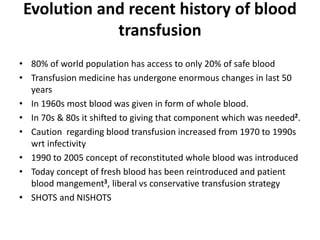
Evolution and recent history of blood
transfusion
• 80% of world population has access to only 20% of safe blood
• Transfusion medicine has undergone enormous changes in last 50
years
• In 1960s most blood was given in form of whole blood.
• In 70s & 80s it shifted to giving that component which was needed2.
• Caution regarding blood transfusion increased from 1970 to 1990s
wrt infectivity
• 1990 to 2005 concept of reconstituted whole blood was introduced
• Today concept of fresh blood has been reintroduced and patient
blood mangement3, liberal vs conservative transfusion strategy
• SHOTS and NISHOTS
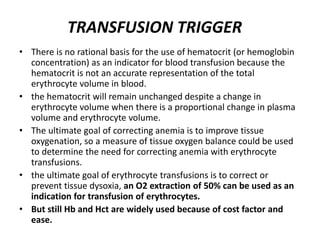
• There is no rational basis for the use of hematocrit (or hemoglobin
concentration) as an indicator for blood transfusion because the
hematocrit is not an accurate representation of the total
erythrocyte volume in blood.
• the hematocrit will remain unchanged despite a change in
erythrocyte volume when there is a proportional change in plasma
volume and erythrocyte volume.
• The ultimate goal of correcting anemia is to improve tissue
oxygenation, so a measure of tissue oxygen balance could be used
to determine the need for correcting anemia with erythrocyte
transfusions.
• the ultimate goal of erythrocyte transfusions is to correct or
prevent tissue dysoxia, an O2 extraction of 50% can be used as an
indication for transfusion of erythrocytes.
• But still Hb and Hct are widely used because of cost factor and
ease.
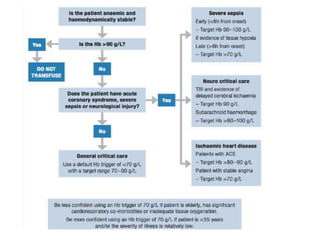
TRANSFUSION TRIGGER
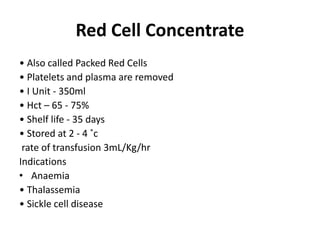
Red Cell Concentrate
• Also called Packed Red Cells
• Platelets and plasma are removed
• I Unit - 350ml
• Hct – 65 - 75%
• Shelf life - 35 days
• Stored at 2 - 4 ˚c
rate of transfusion 3mL/Kg/hr
Indications
• Anaemia
• Thalassemia
• Sickle cell disease
Whole blood
• Description: 450 mL whole blood in 63 mL
anticoagulant‐preservative solution of which Hb will be
approximately 1.2 g/dL and haematocrit (Hct) 35‐45% with
no functional platelets or labile coagulation factors (V and
VIII) when stored at +2°C to +6°C.
• rate of transfusion 3mL/Kg/hr
• Infection risk: Capable of transmitting an agent present in
cells or plasma which was undetected during routine
screening for TTIs, i.e. HIV, hepatitis B & C, syphilis and
malaria.
• Storage: Between +2°C and +6°C in an approved blood bank
refrigerator, fitted with a temperature monitor and alarm.
• Indications: Red cell replacement in acute blood loss with
hypovolaemia , Exchange transfusion.
Contraindications: Risk of volume overload in patients
with:1) Chronic anaemia 2)Incipient cardiac failure
Fresh whole blood
definition of fresh whole blood is based on storage time, which
varies from 1 hour to 5 days before it is administered to
patients.
• fresh whole blood is effective in treating unresponsive life-
threatening hemorrhage.
• Stored blood less than 7 days old is termed “fresh blood”
(WHO)
• Use of fresh blood .
• Renal and liver dysfunction.
• Patient requiring massive blood transfusion.
• Patient with raised plasma potassium due to extensive burns,
or intravascular haemolysis.
• Neonate requiring exchange transfusion.
Platelet concentrates (PC)
• Description: PCs are prepared from units of whole blood that
have not been allowed to cool below +20°C. A single donor unit
consists of 50‐60 mL plasma that should contain ≥55 x 109 platelets.
• Unit of issue: PCs may be supplied as a pooled unit, i.e. platelets
prepared from 4‐6 donor units containing at least 240 x 109
platelets.
• Infection risk: Bacterial contamination affects about 1% of pooled
units.
• Storage: PCs may be stored for up to 5 days at +20°C to +24°C (with
agitation). PCs require continuous agitation during storage, on a
platelet shaker and in an incubator that maintains the required
storage temperature.
• Dosage: one platelet concentrate usually produces an increase of
approximately 7000 to 10,000 platelets/mm3 at 1 hour after
transfusion to the 70-kg adult. Ten units of platelet concentrates are
required to increase the platelet count by 100,000 cells/mm3.
Increment will be less if there is splenomegaly, disseminated
intravascular coagulation (DIC) or septicaemia.
• Indications: Treatment of bleeding due to:
• Thrombocytopenia.
• Platelet function defects.
• Prevention of bleeding due to thrombocytopenia as in bone
marrow failure.
• Contraindications:
• Idiopathic autoimmune thrombocytopenic purpura (ITP).
• Thrombotic thrombocytopenic purpura (TTP).
• Untreated DIC.
• Thrombocytopenia associated with septicaemia, or in cases of
hypersplenism.
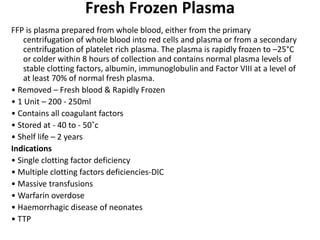
Fresh Frozen Plasma
FFP is plasma prepared from whole blood, either from the primary
centrifugation of whole blood into red cells and plasma or from a secondary
centrifugation of platelet rich plasma. The plasma is rapidly frozen to –25°C
or colder within 8 hours of collection and contains normal plasma levels of
stable clotting factors, albumin, immunoglobulin and Factor VIII at a level of
at least 70% of normal fresh plasma.
• Removed – Fresh blood & Rapidly Frozen
• 1 Unit – 200 - 250ml
• Contains all coagulant factors
• Stored at - 40 to - 50˚c
• Shelf life – 2 years
Indications
• Single clotting factor deficiency
• Multiple clotting factors deficiencies-DIC
• Massive transfusions
• Warfarin overdose
• Haemorrhagic disease of neonates
• TTP
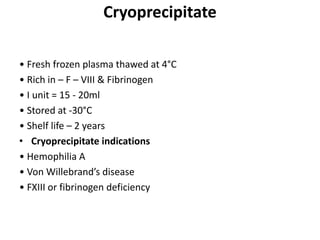
Cryoprecipitate
• Fresh frozen plasma thawed at 4°C
• Rich in – F – VIII & Fibrinogen
• I unit = 15 - 20ml
• Stored at -30°C
• Shelf life – 2 years
• Cryoprecipitate indications
• Hemophilia A
• Von Willebrand’s disease
• FXIII or fibrinogen deficiency
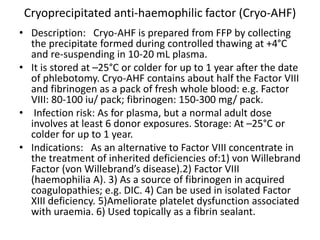
Cryoprecipitated anti‐haemophilic factor (Cryo‐AHF)
• Description: Cryo‐AHF is prepared from FFP by collecting
the precipitate formed during controlled thawing at +4°C
and re‐suspending in 10‐20 mL plasma.
• It is stored at –25°C or colder for up to 1 year after the date
of phlebotomy. Cryo‐AHF contains about half the Factor VIII
and fibrinogen as a pack of fresh whole blood: e.g. Factor
VIII: 80‐100 iu/ pack; fibrinogen: 150‐300 mg/ pack.
• Infection risk: As for plasma, but a normal adult dose
involves at least 6 donor exposures. Storage: At –25°C or
colder for up to 1 year.
• Indications: As an alternative to Factor VIII concentrate in
the treatment of inherited deficiencies of:1) von Willebrand
Factor (von Willebrand’s disease).2) Factor VIII
(haemophilia A). 3) As a source of fibrinogen in acquired
coagulopathies; e.g. DIC. 4) Can be used in isolated Factor
XIII deficiency. 5)Ameliorate platelet dysfunction associated
with uraemia. 6) Used topically as a fibrin sealant.
Massive transfusion
• Massive transfusion is defined as transfusion approximating
or exceeding the patient’s blood volume, or transfusion of
more than 10 units of blood within 24 h.[41]
• Replacement of more than 50% of circulating blood volume
in less than 3 h or transfusion at the rate of more than 150
ml/min is also considered as massive transfusion.
• A blood loss of less then 20% of the total blood volume is
generally well tolerated, while a loss of 20% to 40% will cause
change in the vital signs, with evidence of impaired tissue
perfusion.
• However, loss of more than 40% of blood volume may lead to
frank hemorrhagic shock and progress to circulatory system
failure and cardiac arrest if not corrected.[43]
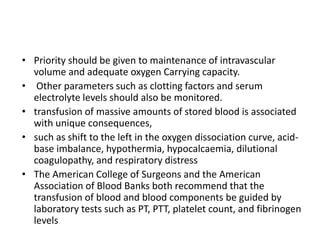
• Priority should be given to maintenance of intravascular
volume and adequate oxygen Carrying capacity.
• Other parameters such as clotting factors and serum
electrolyte levels should also be monitored.
• transfusion of massive amounts of stored blood is associated
with unique consequences,
• such as shift to the left in the oxygen dissociation curve, acid-
base imbalance, hypothermia, hypocalcaemia, dilutional
coagulopathy, and respiratory distress
• The American College of Surgeons and the American
Association of Blood Banks both recommend that the
transfusion of blood and blood components be guided by
laboratory tests such as PT, PTT, platelet count, and fibrinogen
levels
Guidelines typically state that the threshold for
therapeutic or prophylactic FFP in massive transfusion
• a PT 1.5 times the upper limit of normal or the mid-point of
the normal range and a PTT 1.5 times the upper limit of
normal in an appropriate clinical setting.
• In consumptive coagulopathy, a platelet count of less than 50
000/µl and a fibrinogen level less than 100 mg/dl are better
predictors of hemorrhage than PT and aPPT.
• Supplementation with FFP should be considered after one
volume is lost and definitely started before blood loss equals
150% of total volume.
• Some authors suggest that massive transfusion protocols
should utilize a 1:1 ratio of plasma to red blood cells for all
patients who are hypocoagulable following traumatic injuries.
• early administration of high ratios of FFP and platelets
improves survival and decreases overall red blood cell need in
massively transfused patients.
• There was a significant difference in mortality during the first
6 h after admission.
• Although the ideal amounts of plasma, platelet,
cryoprecipitate, and other coagulation factors in relationship
to the red blood cell transfusion volume are not known,
• Current data support a target ratio of plasma : red blood cell :
platelet transfusions of 1:1:1.
End-Points of Resuscitation
• The goal of resuscitation in hemorrhagic shock is to
restore three parameters: blood flow,
• oxygen transport, and tissue oxygenation. The
parameters are defined by the end-points
• shown below.
• 1. Cardiac index = 3 L/min/m2
• 2. Systemic oxygen delivery (DO2) > 500 mL/min/m2
• 3. Systemic oxygen uptake (VO2) > 100 mL/min/m2
• 4. Arterial lactate < 2 mmol/L or base deficit > 22
mmol/L
Info needed for perioperative
transfusion
• Overall condition of the patient, including the vital signs
• Assessment of anticipated blood loss
• Measurement of blood loss
• Quantification of intravenous fluids given overall
• Urine output
• Determination of Hb concentration
Measurement of blood loss
• Maximum Allowable Blood Loss calculation
EBV calculation: body wt (kg) x average blood volume (ml/kg)
• ABL= [EBV x (Hi-Hf)]/Hi
• EBV=Estimated Blood Volume, Hi= initial hemoglobin, Hf=
final hemoglobin.
• Average blood volumes
• Premature Neonates 95 mL/kg
• Full Term Neonates 85 mL/kg
• Infants 80 mL/kg
• Adult Men 75 mL/kg
• Adult Women 65 mL/kg
• Estimating blood loss
• Dry sponges
• 4×4 hold ~ 10 mL blood
• Ray-techs ~ 10-20 mL blood
• Lap sponges ~ 50-100 mL blood
• Pediatric cases should have sponges & gauze weighed
for blood loss
Blood loss replacement
• Replace 1 mL blood with: 3 mL crystalloid (i.e. NS,
Dextrose, LR) 1 mL colloid (i.e. albumin**, Hespan®,
Dextran®) 1 mL whole blood 1 mL PRBC
• Normal Hct Values
• Men 42-52%
• Women 37-47%
• If the patient is obese using IBW or ABW to be used instead of
TBW.
• For males IBW = 50Kg + 2.3 Kg for each inch over 5 feet.
• For females 45.5 Kg + 2.3 Kg for each inch over 5 feet.
• ABW = IBW +0.4(actual weight- IBW)
Preoperative anaemia
• Preoperative anaemia or Hb<13 for men and <12 for women
is an independent risk factor for increases in perioperative
morbidity and mortality .
• The concept of treating anaemia preoperatively with iron
therapy, erythropoiesis stimulating agents decreases the need
for intra operative blood transfusion
Liberal vs restrictive strategy
• Liberal : in which blood is transfused when Hb is 9-10 g/dL.
Most of this directed in anaemia patients who are stable
• Restrictive policy is one wherein blood transfusion is indicated
when Hb is 7-8 g/dL
• It has been found that restictive strategies have decreased the
incidence of health care associated infections.
• Other important factors are status of patient, vital signs, blood
loss.
• Patients with active bleeding with cardiovascular diseases
should be followed with liberal strategy.
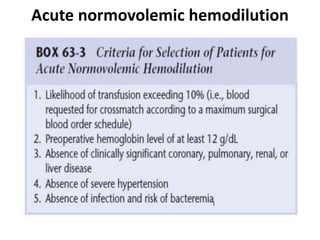
Acute normovolemic hemodilution
• ANH is the removal of whole blood from a patient while
restoring the circulating blood volume with an acellular fluid
shortly before an anticipated significant surgical blood loss.
• blood is then stored at room temperature and reinfused
during surgery after major blood loss has ceased, or sooner if
indicated.
• Simultaneous infusions of crystalloid (3 mL crystalloid for each
1 mL of blood withdrawn) and colloid (dextrans, starches,
gelatin, albumin [1 mL for each 1 mL of blood withdrawn])
have been recommended.
• Blood units are reinfused in the reverse order of collection
because the first unit collected and therefore the last to be
infused will have the highest hematocrit and concentration of
coagulation factors and platelets.
• Withdrawal of whole blood and replacement with crystalloid
or colloid solution decrease arterial oxygen content, but
compensatory hemodynamic mechanisms and the existence
of surplus oxygen delivery capacity make ANH safe.
• sudden decrease in RBC concentration reduces blood
viscosity, thereby decreasing peripheral resistance and
increasing cardiac output.
• cardiac output can effectively compensate, oxygen delivery to
the tissues at a hematocrit of 25% to 30% is as good as, but no
better than, oxygen delivery at a hematocrit of 30% to 35%.
• blood collected by ANH is stored at room temperature and is
usually returned to the patient within 8 hours of collection,
deterioration of platelets or coagulation factors is minimal.
• Blood obtained during ANH does not require the commitment
of the patient’s time, transportation, costs, and loss of work
time that can be associated with PAD.
• autologous blood units procured by ANH require no inventory
or testing costs. Because the blood never leaves the patient’s
room.
• ANH minimizes the possibility of an administrative or clerical
error that could lead to an ABO-incompatible blood
transfusion and death, as well as bacterial contamination
associated with prolonged storage at 4° C.
• Blood must be collected in an aseptic manner, ordinarily into
standard blood collection bags with citrate anticoagulant.
• The label must contain, at a minimum, the patient’s full name,
medical record number, date and time of collection, and the
statement “For Autologous Use Only.
Acute normovolemic hemodilution
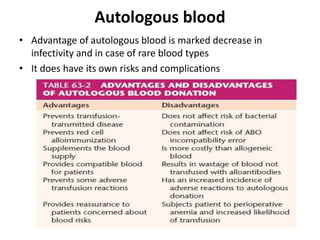
Autologous blood
• Advantage of autologous blood is marked decrease in
infectivity and in case of rare blood types
• It does have its own risks and complications
• It requires donor patient’s hemoglobin be no less than 11
g/dL or the hematocrit be no less than 33% before each
donation.
• No age or weight limits exist, and patients may donate 10.5
mL/kg.
• Donations may be scheduled more than once a week, but the
last donation should occur no less than 72 hours before
surgery, to allow time for restoration of intravascular volume
and for transport and testing of the donated blood.
• Candidates for preoperative blood collection are patients
scheduled for elective surgical procedures in which blood
transfusion is likely.
• most common surgical procedures for which autologous
blood is predonated are total joint replacements.
• PAD can be considered for women with alloantibodies to
multiple or high-incidence antigens or with placenta previa or
other conditions placing them at high risk for antepartum or
intrapartum hemorrhage
• autologous blood donation programs are popular with
patients, the costs associated with autologous blood
collection are higher than are those associated with allogeneic
blood.
• The reduced risk of allogeneic blood transfusions has made
PAD poorly cost effective.
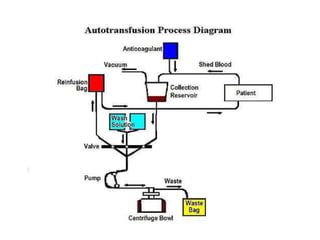
• intraoperative blood collection or recovery or cell salvage
describes the technique of collecting and reinfusing blood lost
by a patient during surgery.
• oxygen transport properties of recovered RBCs are equivalent
to those of stored allogeneic RBCs.
• Intraoperative collection is contraindicated when certain
procoagulant materials (e.g., topical collagen) are applied to
the surgical field because systemic activationof coagulation
may result.
• Microaggregate filters (40μm) are most often used because
recovered blood may contain tissue debris, small blood clots,
or bone fragments.
• Air embolus is a potentially serious problem.
INTRAOPERATIVE CELL SALVAGE
• Hemolysis of recovered blood can occur during suctioning from the surface
instead of from deep pools of shed blood.
• Recommend maximum vacuum setting of no more than 150 mm Hg.
• high suction pressure and surface skimming during aspiration and the
turbulence or mechanical compression that occurs in roller pumps and
plastic tubing make some degree of hemolysis inevitable.
• It exhibit a level of plasma free hemoglobin that is usually higher than after
allogeneic transfusion.
• Positive bacterial cultures from recovered blood are sometimes observed.
• Collection devices that neither concentrate nor wash shed blood before
reinfusion increase the risk of adverse effects.
• Shed blood has undergone varying degrees of coagulation or fibrinolysis
and hemolysis, and infusion of large volumes of washed or unwashed blood
has been described in association with disseminated intravascular
coagulation (DIC).
• High concentrations of free hemoglobin may be nephrotoxic to patients
with impaired renal function.
Postoperative Blood Salvage
• For surgical procedures involving median sternotomy (such as
coronary artery bypass surgery), blood collected from mediastinal
drainage tubes can be reinfused .
• Chest tube drainage from the mediastinum is passed through a
filter at the bedside to trap large clots and cellular debris, and the
filtered blood is then reinfused.
• Because the blood has undergone endogenous defibrination in the
chest, no anticoagulants need to be added.
• Traumatic disruption of cells is common, and the hematocrit of the
reinfused blood is only 15 to 25%. This low hematocrit may explain
why reinfusion of shed mediastinal blood does not always reduce
the number of homologous transfusions.
• It should be transfused within 6 hours.
• Maximum amount transfused is 1400mL since it has high
concentrations of cytokines and creatinine kinase.
Characteristics of salvaged blood
• Free Hb levels of 200-500 mg% is common.
• 2,3-DPG levels are high
• FDP and complement action is present
• Platelets and coagulation factors are deficient.
• Salvaged blood is more alkaline.
Storage of blood
• PRBCs and whole blood can be stored for upto 42 days
• Citrate phosphate dextrose adenine is an anticoagulant preservative
used and stored at 1-6⁰C
• Citrate is an anticoagulant, phosphate is buffer, dextrose is red cell
energy source. Adenine allows resynthesis of ATP by RBCs
• With CPDA-1 the shelf life is 35 days but can be extended with
other substrates .
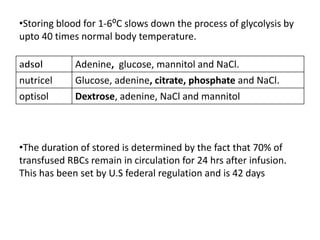
• Others include adsol(AS-1), Nuticel (AS-3), optisol (AS-5)
• Hct in AS-1 is around 60%.
• Disadvantages of using blood that has not been stored between
+2°C and +6°C:
• Increased risk of disease transmission:
• Intracellular pathogens (CMV, HTLV) survive in leukocytes present in
fresh blood.
• Syphilis transmission: Treponema should not survive >96 hours in
stored blood.
• Malaria transmission: malarial parasite should not survive > 7 hours
in stored blood
•Storing blood for 1-6⁰C slows down the process of glycolysis by
upto 40 times normal body temperature.
Adenine, glucose, mannitol and NaCl.
nutricel Glucose, adenine, citrate, phosphate and NaCl.
optisol Dextrose, adenine, NaCl and mannitol
•The duration of stored is determined by the fact that 70% of
transfused RBCs remain in circulation for 24 hrs after infusion.
This has been set by U.S federal regulation and is 42 days
• Transfusion is rarely indicated when the Hb concentration is
more than 10 g/dL and is almost always indicated when it is
less than 6 g/dL.
• For Hb 6-10 g/dL it depends on patient status
• Rule of thumb that administration of 1 unit of PRBCs increases
the Hct by 3-5%.
• Blood loss greater than 20% of blood volume when more than
100mL.
• Hb level less than 8 g/dL.
• Hb levels less than 10 g/dL with major disease like
Emphysema, ischemic heart disease.
• Hb level less than 10 g/dL with autologous blood.
• Hb level less than 11 to 12 g/dL and ventilator dependent.
Compatibility testing
• ABO – Rh typing : the most serious and tragic consequences is
ABO incompatibility which results in complement activation
and with antibodies and rapid hemolysis.
• 60-70% Rh negative patients become immunized if they are
given Rh positive blood.
• Crossmatching : performed in three stages
• Immediate phase : conducted in room temp cross checks ABO
incompatibility
• Incubation phase : incubation of 1st phase reactions in
albumin and low ionic salt sol. These additon aids in deyecting
incomplete antibodies.
• Antiglobulin phase : adding antihuman antibodies to sera to
detect incomplete antibodies
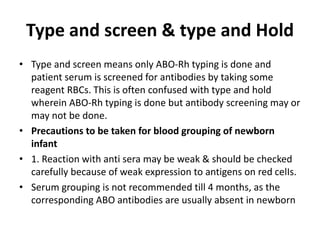
Type and screen & type and Hold
• Type and screen means only ABO-Rh typing is done and
patient serum is screened for antibodies by taking some
reagent RBCs. This is often confused with type and hold
wherein ABO-Rh typing is done but antibody screening may or
may not be done.
• Precautions to be taken for blood grouping of newborn
infant
• 1. Reaction with anti sera may be weak & should be checked
carefully because of weak expression to antigens on red celIs.
• Serum grouping is not recommended till 4 months, as the
corresponding ABO antibodies are usually absent in newborn
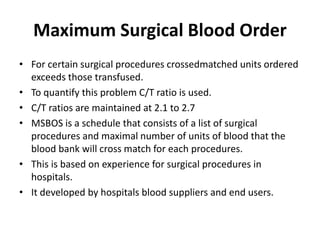
Maximum Surgical Blood Order
• For certain surgical procedures crossedmatched units ordered
exceeds those transfused.
• To quantify this problem C/T ratio is used.
• C/T ratios are maintained at 2.1 to 2.7
• MSBOS is a schedule that consists of a list of surgical
procedures and maximal number of units of blood that the
blood bank will cross match for each procedures.
• This is based on experience for surgical procedures in
hospitals.
• It developed by hospitals blood suppliers and end users.
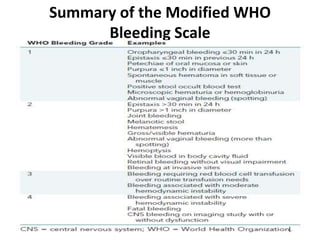
Summary of the Modified WHO
Bleeding Scale
Changes in oxygen transport
• RBCs are transfused primarily to increase transport of O2. to
tissues
• An increase in red cell mass increases O2 uptake by lungs and
probable increase in O2 delivery system.
• RBCs may be impaired during preservation, making it difficult
for them to release O2 to the tissues immediately after
transfusion.
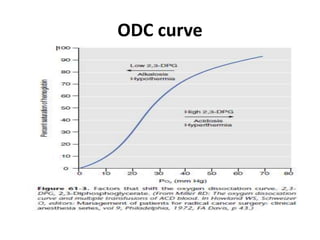
Oxygen dissociation curve
• ODC is determined by plotting the partial pressure of O2 in
blood against the percentage of Hb saturated with O2.
• Left ward shift indicates more decrease in PaO2 makes
considerably more O2 available to the tissues.
• The curve is sigmoid shape because as Hb becomes more
saturated, the affinity of Hb for O2 also increases.
• Shifts in ODC are quantitated by P50.
• As a result blood in critically ill patients to be used if less than
15 days.
ODC curve
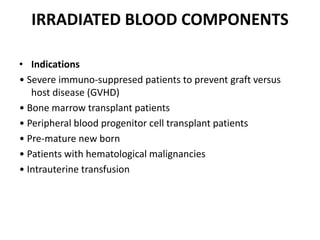
IRRADIATED BLOOD COMPONENTS
• Indications
• Severe immuno-suppresed patients to prevent graft versus
host disease (GVHD)
• Bone marrow transplant patients
• Peripheral blood progenitor cell transplant patients
• Pre-mature new born
• Patients with hematological malignancies
• Intrauterine transfusion
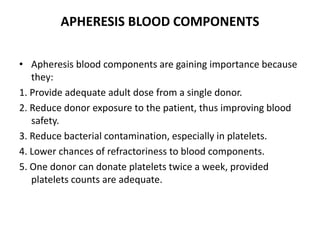
APHERESIS BLOOD COMPONENTS
• Apheresis blood components are gaining importance because
they:
1. Provide adequate adult dose from a single donor.
2. Reduce donor exposure to the patient, thus improving blood
safety.
3. Reduce bacterial contamination, especially in platelets.
4. Lower chances of refractoriness to blood components.
5. One donor can donate platelets twice a week, provided
platelets counts are adequate.
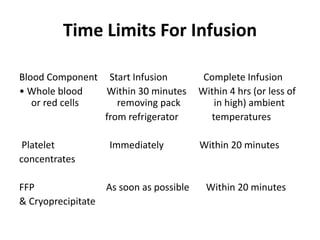
Time Limits For Infusion
Blood Component Start Infusion Complete Infusion
• Whole blood Within 30 minutes Within 4 hrs (or less of
or red cells removing pack in high) ambient
from refrigerator temperatures
Platelet Immediately Within 20 minutes
concentrates
FFP As soon as possible Within 20 minutes
& Cryoprecipitate
Rewarming Strategies
• Rewarming strategies initiated in the emergency department and
operating room are aggressively continued in the intensive care
unit. Strategies include passive and active external rewarming and
active core rewarming.
• Passive External Rewarming : Passive external rewarming involves
removing blood- or saline-soaked dressings or blankets, increasing
ambient room temperature, and decreasing air flow over the
patient by keeping the room doors shut.
• On an average it takes about 30 minutes for blood to reach +10
degree C from 2-6 degree C.
• Cold blood administered at a slow rate does not have any ill effect
on the patient so blood does not require any warming as such prior
to transfusion.
• Warming of blood is only required in large volume rapid
transfusions in Adults where flow rate is greater than 50
ml/kg/hour and in Children where flow rate is greater than 15
ml/kg/hour
Active External Rewarming
• Active external rewarming devices include fluid/air circulating
blankets, aluminum space blankets and overhead radiant warmers.
• Conductive rewarming with fluid-filled heating blankets placed
under the patient is relatively inefficient because of minimal body-
blanket contact, estimated to be less than 30%.
• Convective-air and aluminum space blankets placed over the
patient provide greater heat exchange by creating a 43°C
microenvironment around the patient, which effectively stops heat
loss. Superior warming is achieved when standard cotton blankets
are placed over these blankets and the edges secured, although this
limits patient access.
• Head covering is of prime importance; because significant
vasoconstriction does not occur in scalp vessels, and as much as
50% of radiant heat loss occurs from the neck up.
• During laparotomy, it is recommended that covering exposed
bowel with moist towels be avoided because it can increase
evaporative heat loss by nearly 250%. Dry towels or plastic bags are
superior.( study in orlando surgical care)
Core Rewarming
• The hypothermic trauma patient requires active core
rewarming which may include airway rewarming, heated body
cavity lavage, heated intravenous fluids, continuous
arteriovenous rewarming (CAVR), and extracorporeal
circulatory rewarming.
• Humidified ventilator circuits can be warmed to 41°C. Heated
gastric, bladder, or colonic lavage is relatively ineffective
because of the small surface area for heat transfer.
• Peritoneal lavage is generally not feasible in most trauma
patients undergoing laparotomy.
• Rarely, pleural lavage has been used with the placement of
two ipsilateral chest tubes enabling continuous flow of heated
water
• Dr. Carl waldemar walter first invented the blood bags.
• He is also credited with founding one of the work first blood
banks and invention of the first blood collection bag.
• They are used in collection, proceesing and storage of whole
blood and blood components.
• Help in providing aseptic conditions for the separation of
blood components.
• It acts as a closed system reducing the chamces of
contamination.
• Made of high molecular weight PVC to ensure better tensile
strength and weild strength.
• AABB Standards, 27th ed. 5.26.8: Blood and blood components
shall be transfused through a sterile, pyrogen-free transfusion set
that has a filter designed to retain particles potentially harmful to
the recipient .
• blood components are transfused through a filter designed to
remove clots and aggregates generally a standard 170- to 260-
micron filter.
• Microaggregate filters are not used for routine blood
administration. These second-generation filters were originally
developed to remove leukocytes and to complement or replace the
clot screen.
• More efficient third generation leukocyte reduction filters have a
screen filter of 20 to 40 microns and retain fibrin strands and
clumps of dead cells. Red cells, which are 8 microns in diameter, can
flow through the filters.
• Microaggregate filters are typically used for the reinfusion of shed
autologous blood collected during or after surgery
• Use of warmed intravenous fluids is one of the simplest and
most effective means of providing heat to the core in patients
requiring massive fluid resuscitation.
• Current fluid warmer technology allows large volumes of
warmed fluids to be infused quickly at 42°C, the current
standard recommended by the American Association of Blood
Bank .
• Blood-warming methods include surface-contact warmers,
counter-current warmers, and heated-saline admixture
• In-line microwave bloodwarming technology (in
development) has been shown to heat blood safely to 49°C
and shows great promise for the future.
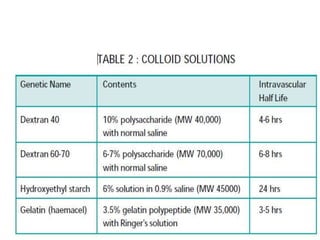
HYDROXYETHYL STARCH (HETASTARCH OR HES)
Indications
• Replacement of blood volume.
• HES is used as an additive to increase granulocyte yields in
leucopheresis by cell separator.
Dosage
• Should not exceed 20 ml/kg body weight in 24 hours.
Side Effects
• Minor allergic reactions due to histamine release.
• Transient increase in bleeding time may occur.
• Hypersensitivity reaction may occur, rarely, severe anaphylactic
reactions.
• Serum amylase level may rise (not significant).
• HES is retained in cells of reticuloendothelial system.
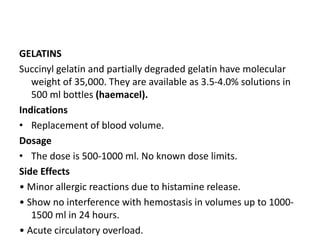
GELATINS
Succinyl gelatin and partially degraded gelatin have molecular
weight of 35,000. They are available as 3.5-4.0% solutions in
500 ml bottles (haemacel).
Indications
• Replacement of blood volume.
Dosage
• The dose is 500-1000 ml. No known dose limits.
Side Effects
• Minor allergic reactions due to histamine release.
• Show no interference with hemostasis in volumes up to 1000-
1500 ml in 24 hours.
• Acute circulatory overload.
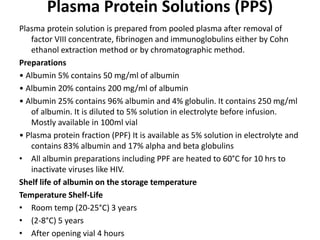
Plasma Protein Solutions (PPS)
Plasma protein solution is prepared from pooled plasma after removal of
factor VIII concentrate, fibrinogen and immunoglobulins either by Cohn
ethanol extraction method or by chromatographic method.
Preparations
• Albumin 5% contains 50 mg/ml of albumin
• Albumin 20% contains 200 mg/ml of albumin
• Albumin 25% contains 96% albumin and 4% globulin. It contains 250 mg/ml
of albumin. It is diluted to 5% solution in electrolyte before infusion.
Mostly available in 100ml vial
• Plasma protein fraction (PPF) It is available as 5% solution in electrolyte and
contains 83% albumin and 17% alpha and beta globulins
• All albumin preparations including PPF are heated to 60°C for 10 hrs to
inactivate viruses like HIV.
Shelf life of albumin on the storage temperature
Temperature Shelf-Life
• Room temp (20-25°C) 3 years
• (2-8°C) 5 years
• After opening vial 4 hours
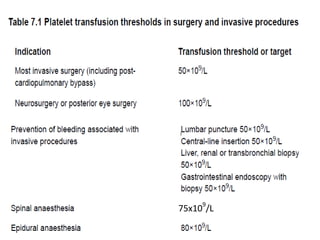
75x10
9
/L
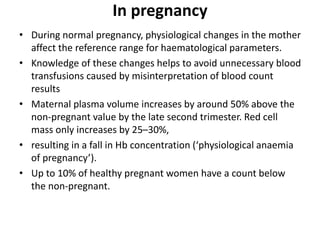
In pregnancy
• During normal pregnancy, physiological changes in the mother
affect the reference range for haematological parameters.
• Knowledge of these changes helps to avoid unnecessary blood
transfusions caused by misinterpretation of blood count
results
• Maternal plasma volume increases by around 50% above the
non-pregnant value by the late second trimester. Red cell
mass only increases by 25–30%,
• resulting in a fall in Hb concentration (‘physiological anaemia
of pregnancy’).
• Up to 10% of healthy pregnant women have a count below
the non-pregnant.
• reference range of 150–400×10 /L at term (‘gestational
thrombocytopenia’). The count rarely falls below 100×10 /L
and there is no increase in bleeding risk.
• Many coagulation factors, including plasma fibrinogen and
Factor VIIIc, are increased in normal pregnancy and the
anticoagulant factor Protein S is reduced. This contributes to
the increased risk of thrombotic complications in pregnancy
Jehovah’s Witnesses
• Some patients object to receiving blood or blood products as
part of their medical treatment.
• These individuals are Jehovah’s Witnesses and refuse the
transfusion of another person’s blood based on strict
interpretations of both Old and New Testament texts that
refer to the sanctity of blood.
• This religious group currently has more than 6 million active
and 14 million associated followers worldwide.
• request of Jehovah’s Witness patients who wanted hospitals
where they could receive the best medical care and have their
desire to avoid allogeneic blood transfusions respected.
Consent of blood transfusion
• Written consent
• Patient should be explained regarding the
benefits and risks of blood transfusion
• Explain:
– Indication
– Complications
• Infection
• Reaction
• The patient’s consent should be obtained for the
planned transfusion and recorded in the patient’s
medical chart.
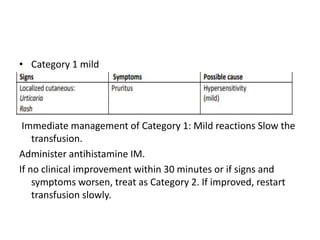
• Category 1 mild
Immediate management of Category 1: Mild reactions Slow the
transfusion.
Administer antihistamine IM.
If no clinical improvement within 30 minutes or if signs and
symptoms worsen, treat as Category 2. If improved, restart
transfusion slowly.
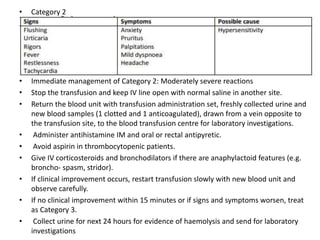
• Category 2
• Immediate management of Category 2: Moderately severe reactions
• Stop the transfusion and keep IV line open with normal saline in another site.
• Return the blood unit with transfusion administration set, freshly collected urine and
new blood samples (1 clotted and 1 anticoagulated), drawn from a vein opposite to
the transfusion site, to the blood transfusion centre for laboratory investigations.
• Administer antihistamine IM and oral or rectal antipyretic.
• Avoid aspirin in thrombocytopenic patients.
• Give IV corticosteroids and bronchodilators if there are anaphylactoid features (e.g.
broncho‐ spasm, stridor).
• If clinical improvement occurs, restart transfusion slowly with new blood unit and
observe carefully.
• If no clinical improvement within 15 minutes or if signs and symptoms worsen, treat
as Category 3.
• Collect urine for next 24 hours for evidence of haemolysis and send for laboratory
investigations
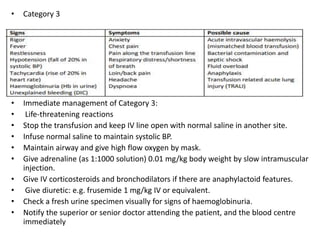
• Category 3
• Immediate management of Category 3:
• Life‐threatening reactions
• Stop the transfusion and keep IV line open with normal saline in another site.
• Infuse normal saline to maintain systolic BP.
• Maintain airway and give high flow oxygen by mask.
• Give adrenaline (as 1:1000 solution) 0.01 mg/kg body weight by slow intramuscular
injection.
• Give IV corticosteroids and bronchodilators if there are anaphylactoid features.
• Give diuretic: e.g. frusemide 1 mg/kg IV or equivalent.
• Check a fresh urine specimen visually for signs of haemoglobinuria.
• Notify the superior or senior doctor attending the patient, and the blood centre
immediately
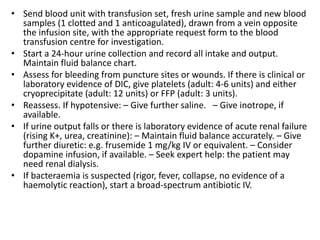
• Send blood unit with transfusion set, fresh urine sample and new blood
samples (1 clotted and 1 anticoagulated), drawn from a vein opposite
the infusion site, with the appropriate request form to the blood
transfusion centre for investigation.
• Start a 24‐hour urine collection and record all intake and output.
Maintain fluid balance chart.
• Assess for bleeding from puncture sites or wounds. If there is clinical or
laboratory evidence of DIC, give platelets (adult: 4‐6 units) and either
cryoprecipitate (adult: 12 units) or FFP (adult: 3 units).
• Reassess. If hypotensive: – Give further saline. – Give inotrope, if
available.
• If urine output falls or there is laboratory evidence of acute renal failure
(rising K+, urea, creatinine): – Maintain fluid balance accurately. – Give
further diuretic: e.g. frusemide 1 mg/kg IV or equivalent. – Consider
dopamine infusion, if available. – Seek expert help: the patient may
need renal dialysis.
• If bacteraemia is suspected (rigor, fever, collapse, no evidence of a
haemolytic reaction), start a broad‐spectrum antibiotic IV.
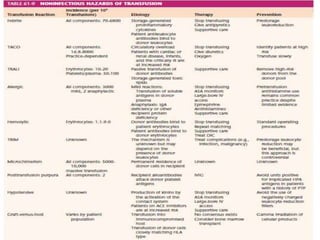
TRALI
• Transfusion-associated acute lung injury (TRALI) is an
inflammatory lung injury that is first apparent during or
within 6 hours after the start of transfusion. The
reported incidence is 1 per 5,000 transfusions.
• The prevailing theory is that antileukocyte antibodies
in donor blood bind to circulating granulocytes in the
recipient and promote
• leukocyte sequestration in the pulmonary
microcirculation. This leads to granulocyte-mediated
lung injury, which presents as acute respiratory distress
syndrome (ARDS). Although this form of lung injury is
fatal in fewer than 10% of patients, it is considered the
leading cause of death from blood transfusions.
• Signs of respiratory compromise (dyspnea, hypoxemia) begin to
develop during or within a few hours after the transfusion begins.
Fever is common, and hypotension has been reported.
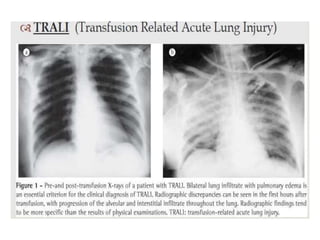
• The chest x-ray film eventually shows diffuse pulmonary infiltrates,
and intubation with mechanical ventilation is often necessary.
Although the acute syndrome can be severe, the process usually
resolves within a week.
• The transfusion should be stopped (if still running) at the first signs
of respiratory compromise. Distinguishing TRALI from hydrostatic
pulmonary edema is often mentioned, but this is not necessary
because RBC transfusions are a viscous load,not a fluid load, and
they do not produce hydrostatic pulmonary edema.
• Future Transfusions
There are no firm recommendations regarding future transfusions in
patients who develop TRALI. Some recommend using washed RBCs
to remove antibodies from the preparation, but the efficacy of this
measure is not known
Transfusion-Associated
Immunomodulation
• Patients who receive blood transfusions have an increased
incidence of nosocomial infections , and this, combined with the
observation that blood transfusions improve the survival of renal
allografts, has led to the proposal that blood transfusions promote
immunosuppression in the recipient.
• The mechanisms for this effect are not known, but one possibility is
that antigenic substances or leukocytes in transfused blood persist
in
• the recipient and induce a down-regulation of the recipient's
immune system.
• Removing leukocytes from RBC products is one consideration, but
universal leukoreduction for RBC preparations is not currently
practiced.
• the increased risk of infection associated with RBC transfusions is
reason to avoid transfusions whenever possible.
DIC
• DIC like syndrome, the clotting system is deranged and this leads to
disseminated fibrin deposition, which renders the fluid blood
unclottable.
• alter the microcirculation and lead to ischemic necrosis in various
organs, particularly the kidney.
• The unclottable blood or circulating serum may induce a severe
hemorrhagic diathesis.
• hypoxic acidotic tissues with stagnant blood flow probably release
tissue thromboplastin directly or through liberation of some toxin
as possibly modulated through the protein C pathway
• This leads to release of tissue plasminogen activator from damaged
tissue may cause fibrinolysis
• The extrinsic route of coagulation is activated by tumor
necrosis factor and endotoxins.
• Presumably, tumor necrosis factor induces tissue factor
expression on the surface of activated monocytes and
possibly by exposure to subendothelially localized tissue
factor in blood.
• triggers the coagulation process, resulting in consumption of
factors I, II, V, and VIII and platelets.
• thrombi and fibrin are deposited in the microcirculation of
vital organs, interrupting their blood flow.
• In an attempt to counteract the hypercoagulable state,
the fibrinolytic system is activated to lyse the excessive
fibrin almost simultaneously; this is called secondary fibrinolysis.
DIC is not separate entity it a sign of preexisting disease.
CITRATE INTOXICATION AND
HYPERKALEMIA
• Citrate intoxication is not caused by the citrate ion per se; it occurs
because citrate binds Ca2+.
• The signs of citrate intoxication are those of hypocalcemia—
hypotension, narrow pulse pressure, and increased intraventricular
enddiastolic pressure and central venous pressure.
• However, citrate intoxication is very rare.
• Having hypothermia, liver disease, liver transplantation, or
hyperventilation or being a pediatric patient increases the
possibility of citrate intoxication.
• The appearance of severe hypocalcemia during liver
transplantation is well documented.
• The rate of citrate metabolism is decreased by 50% when body
temperature is decreased from 37° to 31° C. Excluding these
conditions, infusion of more than 1 unit of blood every 10 minutes
is necessary for ionized Ca2+ levels to begin to decrease.
• serum K+ levels may be as high as 19 to 50 mEq/L in blood
stored for 21 days.
• However, when the loss of K+ via blood loss is compared with
administration of blood, the net gain of K+ is approximately 10
mEq/L.
• The change in serum K+ is usually minor because excess K+
either moves into the cell or is excreted via the urine.
• For significant hyperkalemia to occur clinically, blood must be
given at a rate of 120 mL/minute or more.
• As with citrate intoxication, hyperkalemia is rare and this also
rules against the routine administration of Ca2++.
• Ca2+ may cause cardiac arrhythmias. Ca2+ administration
should be based on diagnostic signs of hyperkalemia (i.e.,peak
T wave).
Red Cell Substitutes
Red cell substitutes having oxygen carrying capacity have been
developed but their clinical applications are limited.
• Unmodified and modified haemoglobin solutions.
• Perfluorochemical compounds.
Unmodified and Modified Haemoglobin Solutions
• Stroma free haemoglobin and cross-linked.
• Microencapsulated haemoglobin.
Stroma free haemoglobin and cross linked
• Stroma free haemoglobin is prepared from outdated red
blood cells. Hb exists as a tetramer of two alpha and two beta
red blood cells. But in solutions it tends to dissociate into
dimers and then monomers.
Synthetic O2 carriers
concept of synthetic blood.
The first approach uses linear binding kinetics, unlike the
nonlinear binding of Hb. The most notable is the
perfluorochemical emulsion called Fluosol-DA.
It had little use because it carries O2 (i.e., a small amount) only
when the Pao2 is more than 300 mmHg.
A newer perfluoro compound,perfluorooctyl bromide, carries
three to four times more O2 and has a longer half-life and
presumably fewer problems than are associated with Fluosol-
DA. Other related products are Oxygent, Oxycyte , and several
other perfluorocarbon emulsions.
• O2 therapeutics are labeled as Hb-based O2 carriers (HBOCs). These
products modify the Hb molecule from humans, animals, or
recombinant technology.
• Hb to be stroma free to prevent nephrotoxicity. The stroma-free Hb
needed to be modified to have a favorable
• O2 affinity and to extend its relatively short intravascular half-life.
Only three products have been undergoing clinical trials.
• Two products are from outdated human RBCs and the third from
bovine RBCs ,these solutions are not without complications.
• The most serious are kidney toxicity, an increase in affinity for O2
(i.e., left shift in the O2 dissociation curve), and arteriolar
vasoconstriction from nitric oxide scavenged by the infused Hb.
• A variety of approaches are being used, including crosslinking,
pyridoxylation and polymerization, and conjugation and
encapsulation, to decrease O2 affinity to increase deposition in the
reticuloendothelial system, and to increase half-life.
• Disadvantages
• • PFCs do not preferentially extract oxygen from air as
haemoglobin does.
• oxygen level in a perflourocarbon solution equilibrates with
oxygen level in the atmosphere.
• concurrent administration of 60-100% oxygen is a must with
PFC administration.
• They are unstable in emulsified state and hence need to be
frozen.
• Its third and serious disadvantage is that it is retained in the
liver and spleen.
Genetic engineering
• Human recombinant Hb (rHb 1.1) was designed as a blood substitute.
• With the use of genetic engineering techniques, it was made from
Escherichia coli.
• It functions as normal Hb in terms of O2-carrying capacity, but it does not
require crossmatching, transmit disease, or become rapidly outdated.
• How much recombinant material can be tolerated by humans remains to
be determined.
• It causes arteriolar vasoconstriction from NO scavenging.
• arterial blood pressure is sustained, at the expense of severe
vasoconstriction of microvascular structures, which is not beneficial for
organ perfusion.
• Recently, rHbg 2.0, which minimizes NO scavenging, caused little arteriolar
vasoconstriction when compared with rHbg 1.1 and diaspirin crosslinked
Hb .
Erythropoietin
• The anemia that develops in ICU patients is associated with
reduced levels of circulating erythropoietin, exo-genously
administered erythropoietin has been evaluated as a possible
means of reducing RBC transfusions in the ICU.
• patients who receive erythropoietin require fewer RBC
transfusions.
• a subcutaneous dose of 40,000 units once weekly is adequate,
and the effects can take 3 weeks to become evident.
• the cost of erythropoietin is a concern
• Erythropoietin stimulates bone marrow to produce more red
cells.
• It is a glycoprotein, it is produced in kidney and liver.
• Normal levels of erythropoietin range from 4 upto 24 mU/mL.
• Erythropoietin can also be given 300 IU/Kg daily for 15 days
• Or 600IU/Kg weekly for 3 weeks
• Or 600 IU/Kg just before surgery. To prevent post operative
anaemia.
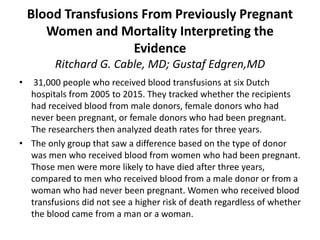
Blood Transfusions From Previously Pregnant
Women and Mortality Interpreting the
Evidence
Ritchard G. Cable, MD; Gustaf Edgren,MD
• 31,000 people who received blood transfusions at six Dutch
hospitals from 2005 to 2015. They tracked whether the recipients
had received blood from male donors, female donors who had
never been pregnant, or female donors who had been pregnant.
The researchers then analyzed death rates for three years.
• The only group that saw a difference based on the type of donor
was men who received blood from women who had been pregnant.
Those men were more likely to have died after three years,
compared to men who received blood from a male donor or from a
woman who had never been pregnant. Women who received blood
transfusions did not see a higher risk of death regardless of whether
the blood came from a man or a woman.
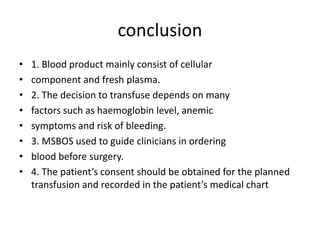
conclusion
• 1. Blood product mainly consist of cellular
• component and fresh plasma.
• 2. The decision to transfuse depends on many
• factors such as haemoglobin level, anemic
• symptoms and risk of bleeding.
• 3. MSBOS used to guide clinicians in ordering
• blood before surgery.
• 4. The patient’s consent should be obtained for the planned
transfusion and recorded in the patient’s medical chart
REFERENCES
• Miller’s 8th edition
• Paul marino ICU book 4th edition
• WHO
• NACO
• National blood transfusion council
• British committe for standards in hematology

Blood

  • 1.
    Transfusion of bloodand blood products Speaker : Dr. Amarnath Moderator : Dr. Nizamuddeen
  • 2.
    Contents •Definition •Functions of theblood •Blood products •Indication for transfusion •Massive transfusion. •Maximum surgery blood order schedule (MSBOS) •Blood transfusion reaction and its management •Other complications of blood transfusion. •Red cell subtitutes •Synthetic o2 carriers.
  • 3.
    Definition: Blood isa connective tissue that contains plasma and cellular components
  • 4.
    Blood ( Fresh whole blood) •RedCell Concentrates •Platelet Concentrates •Granulocyte Concentrate Cellular Componen ts •Fresh Frozen plasma •Cryoprecipitate •Cryo poor plasma •Stored plasma Plasma Components •Albumin •Immunoglobulin •Coagulation Factors Plasma Derivatives
  • 6.
    Evolution and recenthistory of blood transfusion • 80% of world population has access to only 20% of safe blood • Transfusion medicine has undergone enormous changes in last 50 years • In 1960s most blood was given in form of whole blood. • In 70s & 80s it shifted to giving that component which was needed2. • Caution regarding blood transfusion increased from 1970 to 1990s wrt infectivity • 1990 to 2005 concept of reconstituted whole blood was introduced • Today concept of fresh blood has been reintroduced and patient blood mangement3, liberal vs conservative transfusion strategy • SHOTS and NISHOTS
  • 7.
    • There isno rational basis for the use of hematocrit (or hemoglobin concentration) as an indicator for blood transfusion because the hematocrit is not an accurate representation of the total erythrocyte volume in blood. • the hematocrit will remain unchanged despite a change in erythrocyte volume when there is a proportional change in plasma volume and erythrocyte volume. • The ultimate goal of correcting anemia is to improve tissue oxygenation, so a measure of tissue oxygen balance could be used to determine the need for correcting anemia with erythrocyte transfusions. • the ultimate goal of erythrocyte transfusions is to correct or prevent tissue dysoxia, an O2 extraction of 50% can be used as an indication for transfusion of erythrocytes. • But still Hb and Hct are widely used because of cost factor and ease. TRANSFUSION TRIGGER
  • 8.
    Red Cell Concentrate •Also called Packed Red Cells • Platelets and plasma are removed • I Unit - 350ml • Hct – 65 - 75% • Shelf life - 35 days • Stored at 2 - 4 ˚c rate of transfusion 3mL/Kg/hr Indications • Anaemia • Thalassemia • Sickle cell disease
  • 9.
    Whole blood • Description:450 mL whole blood in 63 mL anticoagulant‐preservative solution of which Hb will be approximately 1.2 g/dL and haematocrit (Hct) 35‐45% with no functional platelets or labile coagulation factors (V and VIII) when stored at +2°C to +6°C. • rate of transfusion 3mL/Kg/hr • Infection risk: Capable of transmitting an agent present in cells or plasma which was undetected during routine screening for TTIs, i.e. HIV, hepatitis B & C, syphilis and malaria. • Storage: Between +2°C and +6°C in an approved blood bank refrigerator, fitted with a temperature monitor and alarm. • Indications: Red cell replacement in acute blood loss with hypovolaemia , Exchange transfusion. Contraindications: Risk of volume overload in patients with:1) Chronic anaemia 2)Incipient cardiac failure
  • 10.
    Fresh whole blood definitionof fresh whole blood is based on storage time, which varies from 1 hour to 5 days before it is administered to patients. • fresh whole blood is effective in treating unresponsive life- threatening hemorrhage. • Stored blood less than 7 days old is termed “fresh blood” (WHO) • Use of fresh blood . • Renal and liver dysfunction. • Patient requiring massive blood transfusion. • Patient with raised plasma potassium due to extensive burns, or intravascular haemolysis. • Neonate requiring exchange transfusion.
  • 11.
    Platelet concentrates (PC) •Description: PCs are prepared from units of whole blood that have not been allowed to cool below +20°C. A single donor unit consists of 50‐60 mL plasma that should contain ≥55 x 109 platelets. • Unit of issue: PCs may be supplied as a pooled unit, i.e. platelets prepared from 4‐6 donor units containing at least 240 x 109 platelets. • Infection risk: Bacterial contamination affects about 1% of pooled units. • Storage: PCs may be stored for up to 5 days at +20°C to +24°C (with agitation). PCs require continuous agitation during storage, on a platelet shaker and in an incubator that maintains the required storage temperature. • Dosage: one platelet concentrate usually produces an increase of approximately 7000 to 10,000 platelets/mm3 at 1 hour after transfusion to the 70-kg adult. Ten units of platelet concentrates are required to increase the platelet count by 100,000 cells/mm3. Increment will be less if there is splenomegaly, disseminated intravascular coagulation (DIC) or septicaemia.
  • 12.
    • Indications: Treatmentof bleeding due to: • Thrombocytopenia. • Platelet function defects. • Prevention of bleeding due to thrombocytopenia as in bone marrow failure. • Contraindications: • Idiopathic autoimmune thrombocytopenic purpura (ITP). • Thrombotic thrombocytopenic purpura (TTP). • Untreated DIC. • Thrombocytopenia associated with septicaemia, or in cases of hypersplenism.
  • 13.
    Fresh Frozen Plasma FFPis plasma prepared from whole blood, either from the primary centrifugation of whole blood into red cells and plasma or from a secondary centrifugation of platelet rich plasma. The plasma is rapidly frozen to –25°C or colder within 8 hours of collection and contains normal plasma levels of stable clotting factors, albumin, immunoglobulin and Factor VIII at a level of at least 70% of normal fresh plasma. • Removed – Fresh blood & Rapidly Frozen • 1 Unit – 200 - 250ml • Contains all coagulant factors • Stored at - 40 to - 50˚c • Shelf life – 2 years Indications • Single clotting factor deficiency • Multiple clotting factors deficiencies-DIC • Massive transfusions • Warfarin overdose • Haemorrhagic disease of neonates • TTP
  • 14.
    Cryoprecipitate • Fresh frozenplasma thawed at 4°C • Rich in – F – VIII & Fibrinogen • I unit = 15 - 20ml • Stored at -30°C • Shelf life – 2 years • Cryoprecipitate indications • Hemophilia A • Von Willebrand’s disease • FXIII or fibrinogen deficiency
  • 15.
    Cryoprecipitated anti‐haemophilic factor(Cryo‐AHF) • Description: Cryo‐AHF is prepared from FFP by collecting the precipitate formed during controlled thawing at +4°C and re‐suspending in 10‐20 mL plasma. • It is stored at –25°C or colder for up to 1 year after the date of phlebotomy. Cryo‐AHF contains about half the Factor VIII and fibrinogen as a pack of fresh whole blood: e.g. Factor VIII: 80‐100 iu/ pack; fibrinogen: 150‐300 mg/ pack. • Infection risk: As for plasma, but a normal adult dose involves at least 6 donor exposures. Storage: At –25°C or colder for up to 1 year. • Indications: As an alternative to Factor VIII concentrate in the treatment of inherited deficiencies of:1) von Willebrand Factor (von Willebrand’s disease).2) Factor VIII (haemophilia A). 3) As a source of fibrinogen in acquired coagulopathies; e.g. DIC. 4) Can be used in isolated Factor XIII deficiency. 5)Ameliorate platelet dysfunction associated with uraemia. 6) Used topically as a fibrin sealant.
  • 16.
    Massive transfusion • Massivetransfusion is defined as transfusion approximating or exceeding the patient’s blood volume, or transfusion of more than 10 units of blood within 24 h.[41] • Replacement of more than 50% of circulating blood volume in less than 3 h or transfusion at the rate of more than 150 ml/min is also considered as massive transfusion. • A blood loss of less then 20% of the total blood volume is generally well tolerated, while a loss of 20% to 40% will cause change in the vital signs, with evidence of impaired tissue perfusion. • However, loss of more than 40% of blood volume may lead to frank hemorrhagic shock and progress to circulatory system failure and cardiac arrest if not corrected.[43]
  • 17.
    • Priority shouldbe given to maintenance of intravascular volume and adequate oxygen Carrying capacity. • Other parameters such as clotting factors and serum electrolyte levels should also be monitored. • transfusion of massive amounts of stored blood is associated with unique consequences, • such as shift to the left in the oxygen dissociation curve, acid- base imbalance, hypothermia, hypocalcaemia, dilutional coagulopathy, and respiratory distress • The American College of Surgeons and the American Association of Blood Banks both recommend that the transfusion of blood and blood components be guided by laboratory tests such as PT, PTT, platelet count, and fibrinogen levels
  • 18.
    Guidelines typically statethat the threshold for therapeutic or prophylactic FFP in massive transfusion • a PT 1.5 times the upper limit of normal or the mid-point of the normal range and a PTT 1.5 times the upper limit of normal in an appropriate clinical setting. • In consumptive coagulopathy, a platelet count of less than 50 000/µl and a fibrinogen level less than 100 mg/dl are better predictors of hemorrhage than PT and aPPT. • Supplementation with FFP should be considered after one volume is lost and definitely started before blood loss equals 150% of total volume.
  • 19.
    • Some authorssuggest that massive transfusion protocols should utilize a 1:1 ratio of plasma to red blood cells for all patients who are hypocoagulable following traumatic injuries. • early administration of high ratios of FFP and platelets improves survival and decreases overall red blood cell need in massively transfused patients. • There was a significant difference in mortality during the first 6 h after admission. • Although the ideal amounts of plasma, platelet, cryoprecipitate, and other coagulation factors in relationship to the red blood cell transfusion volume are not known, • Current data support a target ratio of plasma : red blood cell : platelet transfusions of 1:1:1.
  • 20.
    End-Points of Resuscitation •The goal of resuscitation in hemorrhagic shock is to restore three parameters: blood flow, • oxygen transport, and tissue oxygenation. The parameters are defined by the end-points • shown below. • 1. Cardiac index = 3 L/min/m2 • 2. Systemic oxygen delivery (DO2) > 500 mL/min/m2 • 3. Systemic oxygen uptake (VO2) > 100 mL/min/m2 • 4. Arterial lactate < 2 mmol/L or base deficit > 22 mmol/L
  • 21.
    Info needed forperioperative transfusion • Overall condition of the patient, including the vital signs • Assessment of anticipated blood loss • Measurement of blood loss • Quantification of intravenous fluids given overall • Urine output • Determination of Hb concentration
  • 22.
    Measurement of bloodloss • Maximum Allowable Blood Loss calculation EBV calculation: body wt (kg) x average blood volume (ml/kg) • ABL= [EBV x (Hi-Hf)]/Hi • EBV=Estimated Blood Volume, Hi= initial hemoglobin, Hf= final hemoglobin. • Average blood volumes • Premature Neonates 95 mL/kg • Full Term Neonates 85 mL/kg • Infants 80 mL/kg • Adult Men 75 mL/kg • Adult Women 65 mL/kg
  • 23.
    • Estimating bloodloss • Dry sponges • 4×4 hold ~ 10 mL blood • Ray-techs ~ 10-20 mL blood • Lap sponges ~ 50-100 mL blood • Pediatric cases should have sponges & gauze weighed for blood loss Blood loss replacement • Replace 1 mL blood with: 3 mL crystalloid (i.e. NS, Dextrose, LR) 1 mL colloid (i.e. albumin**, Hespan®, Dextran®) 1 mL whole blood 1 mL PRBC
  • 24.
    • Normal HctValues • Men 42-52% • Women 37-47% • If the patient is obese using IBW or ABW to be used instead of TBW. • For males IBW = 50Kg + 2.3 Kg for each inch over 5 feet. • For females 45.5 Kg + 2.3 Kg for each inch over 5 feet. • ABW = IBW +0.4(actual weight- IBW)
  • 25.
    Preoperative anaemia • Preoperativeanaemia or Hb<13 for men and <12 for women is an independent risk factor for increases in perioperative morbidity and mortality . • The concept of treating anaemia preoperatively with iron therapy, erythropoiesis stimulating agents decreases the need for intra operative blood transfusion
  • 26.
    Liberal vs restrictivestrategy • Liberal : in which blood is transfused when Hb is 9-10 g/dL. Most of this directed in anaemia patients who are stable • Restrictive policy is one wherein blood transfusion is indicated when Hb is 7-8 g/dL • It has been found that restictive strategies have decreased the incidence of health care associated infections. • Other important factors are status of patient, vital signs, blood loss. • Patients with active bleeding with cardiovascular diseases should be followed with liberal strategy.
  • 27.
    Acute normovolemic hemodilution •ANH is the removal of whole blood from a patient while restoring the circulating blood volume with an acellular fluid shortly before an anticipated significant surgical blood loss. • blood is then stored at room temperature and reinfused during surgery after major blood loss has ceased, or sooner if indicated. • Simultaneous infusions of crystalloid (3 mL crystalloid for each 1 mL of blood withdrawn) and colloid (dextrans, starches, gelatin, albumin [1 mL for each 1 mL of blood withdrawn]) have been recommended. • Blood units are reinfused in the reverse order of collection because the first unit collected and therefore the last to be infused will have the highest hematocrit and concentration of coagulation factors and platelets.
  • 28.
    • Withdrawal ofwhole blood and replacement with crystalloid or colloid solution decrease arterial oxygen content, but compensatory hemodynamic mechanisms and the existence of surplus oxygen delivery capacity make ANH safe. • sudden decrease in RBC concentration reduces blood viscosity, thereby decreasing peripheral resistance and increasing cardiac output. • cardiac output can effectively compensate, oxygen delivery to the tissues at a hematocrit of 25% to 30% is as good as, but no better than, oxygen delivery at a hematocrit of 30% to 35%. • blood collected by ANH is stored at room temperature and is usually returned to the patient within 8 hours of collection, deterioration of platelets or coagulation factors is minimal. • Blood obtained during ANH does not require the commitment of the patient’s time, transportation, costs, and loss of work time that can be associated with PAD.
  • 29.
    • autologous bloodunits procured by ANH require no inventory or testing costs. Because the blood never leaves the patient’s room. • ANH minimizes the possibility of an administrative or clerical error that could lead to an ABO-incompatible blood transfusion and death, as well as bacterial contamination associated with prolonged storage at 4° C. • Blood must be collected in an aseptic manner, ordinarily into standard blood collection bags with citrate anticoagulant. • The label must contain, at a minimum, the patient’s full name, medical record number, date and time of collection, and the statement “For Autologous Use Only.
  • 30.
  • 31.
    Autologous blood • Advantageof autologous blood is marked decrease in infectivity and in case of rare blood types • It does have its own risks and complications
  • 32.
    • It requiresdonor patient’s hemoglobin be no less than 11 g/dL or the hematocrit be no less than 33% before each donation. • No age or weight limits exist, and patients may donate 10.5 mL/kg. • Donations may be scheduled more than once a week, but the last donation should occur no less than 72 hours before surgery, to allow time for restoration of intravascular volume and for transport and testing of the donated blood. • Candidates for preoperative blood collection are patients scheduled for elective surgical procedures in which blood transfusion is likely. • most common surgical procedures for which autologous blood is predonated are total joint replacements.
  • 33.
    • PAD canbe considered for women with alloantibodies to multiple or high-incidence antigens or with placenta previa or other conditions placing them at high risk for antepartum or intrapartum hemorrhage • autologous blood donation programs are popular with patients, the costs associated with autologous blood collection are higher than are those associated with allogeneic blood. • The reduced risk of allogeneic blood transfusions has made PAD poorly cost effective.
  • 36.
    • intraoperative bloodcollection or recovery or cell salvage describes the technique of collecting and reinfusing blood lost by a patient during surgery. • oxygen transport properties of recovered RBCs are equivalent to those of stored allogeneic RBCs. • Intraoperative collection is contraindicated when certain procoagulant materials (e.g., topical collagen) are applied to the surgical field because systemic activationof coagulation may result. • Microaggregate filters (40μm) are most often used because recovered blood may contain tissue debris, small blood clots, or bone fragments. • Air embolus is a potentially serious problem. INTRAOPERATIVE CELL SALVAGE
  • 37.
    • Hemolysis ofrecovered blood can occur during suctioning from the surface instead of from deep pools of shed blood. • Recommend maximum vacuum setting of no more than 150 mm Hg. • high suction pressure and surface skimming during aspiration and the turbulence or mechanical compression that occurs in roller pumps and plastic tubing make some degree of hemolysis inevitable. • It exhibit a level of plasma free hemoglobin that is usually higher than after allogeneic transfusion. • Positive bacterial cultures from recovered blood are sometimes observed. • Collection devices that neither concentrate nor wash shed blood before reinfusion increase the risk of adverse effects. • Shed blood has undergone varying degrees of coagulation or fibrinolysis and hemolysis, and infusion of large volumes of washed or unwashed blood has been described in association with disseminated intravascular coagulation (DIC). • High concentrations of free hemoglobin may be nephrotoxic to patients with impaired renal function.
  • 38.
    Postoperative Blood Salvage •For surgical procedures involving median sternotomy (such as coronary artery bypass surgery), blood collected from mediastinal drainage tubes can be reinfused . • Chest tube drainage from the mediastinum is passed through a filter at the bedside to trap large clots and cellular debris, and the filtered blood is then reinfused. • Because the blood has undergone endogenous defibrination in the chest, no anticoagulants need to be added. • Traumatic disruption of cells is common, and the hematocrit of the reinfused blood is only 15 to 25%. This low hematocrit may explain why reinfusion of shed mediastinal blood does not always reduce the number of homologous transfusions. • It should be transfused within 6 hours. • Maximum amount transfused is 1400mL since it has high concentrations of cytokines and creatinine kinase.
  • 39.
    Characteristics of salvagedblood • Free Hb levels of 200-500 mg% is common. • 2,3-DPG levels are high • FDP and complement action is present • Platelets and coagulation factors are deficient. • Salvaged blood is more alkaline.
  • 40.
    Storage of blood •PRBCs and whole blood can be stored for upto 42 days • Citrate phosphate dextrose adenine is an anticoagulant preservative used and stored at 1-6⁰C • Citrate is an anticoagulant, phosphate is buffer, dextrose is red cell energy source. Adenine allows resynthesis of ATP by RBCs • With CPDA-1 the shelf life is 35 days but can be extended with other substrates . • Others include adsol(AS-1), Nuticel (AS-3), optisol (AS-5) • Hct in AS-1 is around 60%. • Disadvantages of using blood that has not been stored between +2°C and +6°C: • Increased risk of disease transmission: • Intracellular pathogens (CMV, HTLV) survive in leukocytes present in fresh blood. • Syphilis transmission: Treponema should not survive >96 hours in stored blood. • Malaria transmission: malarial parasite should not survive > 7 hours in stored blood
  • 41.
    •Storing blood for1-6⁰C slows down the process of glycolysis by upto 40 times normal body temperature. Adenine, glucose, mannitol and NaCl. nutricel Glucose, adenine, citrate, phosphate and NaCl. optisol Dextrose, adenine, NaCl and mannitol •The duration of stored is determined by the fact that 70% of transfused RBCs remain in circulation for 24 hrs after infusion. This has been set by U.S federal regulation and is 42 days
  • 42.
    • Transfusion israrely indicated when the Hb concentration is more than 10 g/dL and is almost always indicated when it is less than 6 g/dL. • For Hb 6-10 g/dL it depends on patient status • Rule of thumb that administration of 1 unit of PRBCs increases the Hct by 3-5%. • Blood loss greater than 20% of blood volume when more than 100mL. • Hb level less than 8 g/dL. • Hb levels less than 10 g/dL with major disease like Emphysema, ischemic heart disease. • Hb level less than 10 g/dL with autologous blood. • Hb level less than 11 to 12 g/dL and ventilator dependent.
  • 43.
    Compatibility testing • ABO– Rh typing : the most serious and tragic consequences is ABO incompatibility which results in complement activation and with antibodies and rapid hemolysis. • 60-70% Rh negative patients become immunized if they are given Rh positive blood. • Crossmatching : performed in three stages • Immediate phase : conducted in room temp cross checks ABO incompatibility • Incubation phase : incubation of 1st phase reactions in albumin and low ionic salt sol. These additon aids in deyecting incomplete antibodies. • Antiglobulin phase : adding antihuman antibodies to sera to detect incomplete antibodies
  • 45.
    Type and screen& type and Hold • Type and screen means only ABO-Rh typing is done and patient serum is screened for antibodies by taking some reagent RBCs. This is often confused with type and hold wherein ABO-Rh typing is done but antibody screening may or may not be done. • Precautions to be taken for blood grouping of newborn infant • 1. Reaction with anti sera may be weak & should be checked carefully because of weak expression to antigens on red celIs. • Serum grouping is not recommended till 4 months, as the corresponding ABO antibodies are usually absent in newborn
  • 46.
    Maximum Surgical BloodOrder • For certain surgical procedures crossedmatched units ordered exceeds those transfused. • To quantify this problem C/T ratio is used. • C/T ratios are maintained at 2.1 to 2.7 • MSBOS is a schedule that consists of a list of surgical procedures and maximal number of units of blood that the blood bank will cross match for each procedures. • This is based on experience for surgical procedures in hospitals. • It developed by hospitals blood suppliers and end users.
  • 47.
    Summary of theModified WHO Bleeding Scale
  • 48.
    Changes in oxygentransport • RBCs are transfused primarily to increase transport of O2. to tissues • An increase in red cell mass increases O2 uptake by lungs and probable increase in O2 delivery system. • RBCs may be impaired during preservation, making it difficult for them to release O2 to the tissues immediately after transfusion.
  • 49.
    Oxygen dissociation curve •ODC is determined by plotting the partial pressure of O2 in blood against the percentage of Hb saturated with O2. • Left ward shift indicates more decrease in PaO2 makes considerably more O2 available to the tissues. • The curve is sigmoid shape because as Hb becomes more saturated, the affinity of Hb for O2 also increases. • Shifts in ODC are quantitated by P50. • As a result blood in critically ill patients to be used if less than 15 days.
  • 50.
  • 53.
    IRRADIATED BLOOD COMPONENTS •Indications • Severe immuno-suppresed patients to prevent graft versus host disease (GVHD) • Bone marrow transplant patients • Peripheral blood progenitor cell transplant patients • Pre-mature new born • Patients with hematological malignancies • Intrauterine transfusion
  • 54.
    APHERESIS BLOOD COMPONENTS •Apheresis blood components are gaining importance because they: 1. Provide adequate adult dose from a single donor. 2. Reduce donor exposure to the patient, thus improving blood safety. 3. Reduce bacterial contamination, especially in platelets. 4. Lower chances of refractoriness to blood components. 5. One donor can donate platelets twice a week, provided platelets counts are adequate.
  • 55.
    Time Limits ForInfusion Blood Component Start Infusion Complete Infusion • Whole blood Within 30 minutes Within 4 hrs (or less of or red cells removing pack in high) ambient from refrigerator temperatures Platelet Immediately Within 20 minutes concentrates FFP As soon as possible Within 20 minutes & Cryoprecipitate
  • 56.
    Rewarming Strategies • Rewarmingstrategies initiated in the emergency department and operating room are aggressively continued in the intensive care unit. Strategies include passive and active external rewarming and active core rewarming. • Passive External Rewarming : Passive external rewarming involves removing blood- or saline-soaked dressings or blankets, increasing ambient room temperature, and decreasing air flow over the patient by keeping the room doors shut. • On an average it takes about 30 minutes for blood to reach +10 degree C from 2-6 degree C. • Cold blood administered at a slow rate does not have any ill effect on the patient so blood does not require any warming as such prior to transfusion. • Warming of blood is only required in large volume rapid transfusions in Adults where flow rate is greater than 50 ml/kg/hour and in Children where flow rate is greater than 15 ml/kg/hour
  • 57.
    Active External Rewarming •Active external rewarming devices include fluid/air circulating blankets, aluminum space blankets and overhead radiant warmers. • Conductive rewarming with fluid-filled heating blankets placed under the patient is relatively inefficient because of minimal body- blanket contact, estimated to be less than 30%. • Convective-air and aluminum space blankets placed over the patient provide greater heat exchange by creating a 43°C microenvironment around the patient, which effectively stops heat loss. Superior warming is achieved when standard cotton blankets are placed over these blankets and the edges secured, although this limits patient access. • Head covering is of prime importance; because significant vasoconstriction does not occur in scalp vessels, and as much as 50% of radiant heat loss occurs from the neck up. • During laparotomy, it is recommended that covering exposed bowel with moist towels be avoided because it can increase evaporative heat loss by nearly 250%. Dry towels or plastic bags are superior.( study in orlando surgical care)
  • 58.
    Core Rewarming • Thehypothermic trauma patient requires active core rewarming which may include airway rewarming, heated body cavity lavage, heated intravenous fluids, continuous arteriovenous rewarming (CAVR), and extracorporeal circulatory rewarming. • Humidified ventilator circuits can be warmed to 41°C. Heated gastric, bladder, or colonic lavage is relatively ineffective because of the small surface area for heat transfer. • Peritoneal lavage is generally not feasible in most trauma patients undergoing laparotomy. • Rarely, pleural lavage has been used with the placement of two ipsilateral chest tubes enabling continuous flow of heated water
  • 59.
    • Dr. Carlwaldemar walter first invented the blood bags. • He is also credited with founding one of the work first blood banks and invention of the first blood collection bag. • They are used in collection, proceesing and storage of whole blood and blood components. • Help in providing aseptic conditions for the separation of blood components. • It acts as a closed system reducing the chamces of contamination. • Made of high molecular weight PVC to ensure better tensile strength and weild strength.
  • 60.
    • AABB Standards,27th ed. 5.26.8: Blood and blood components shall be transfused through a sterile, pyrogen-free transfusion set that has a filter designed to retain particles potentially harmful to the recipient . • blood components are transfused through a filter designed to remove clots and aggregates generally a standard 170- to 260- micron filter. • Microaggregate filters are not used for routine blood administration. These second-generation filters were originally developed to remove leukocytes and to complement or replace the clot screen. • More efficient third generation leukocyte reduction filters have a screen filter of 20 to 40 microns and retain fibrin strands and clumps of dead cells. Red cells, which are 8 microns in diameter, can flow through the filters. • Microaggregate filters are typically used for the reinfusion of shed autologous blood collected during or after surgery
  • 61.
    • Use ofwarmed intravenous fluids is one of the simplest and most effective means of providing heat to the core in patients requiring massive fluid resuscitation. • Current fluid warmer technology allows large volumes of warmed fluids to be infused quickly at 42°C, the current standard recommended by the American Association of Blood Bank . • Blood-warming methods include surface-contact warmers, counter-current warmers, and heated-saline admixture • In-line microwave bloodwarming technology (in development) has been shown to heat blood safely to 49°C and shows great promise for the future.
  • 63.
    HYDROXYETHYL STARCH (HETASTARCHOR HES) Indications • Replacement of blood volume. • HES is used as an additive to increase granulocyte yields in leucopheresis by cell separator. Dosage • Should not exceed 20 ml/kg body weight in 24 hours. Side Effects • Minor allergic reactions due to histamine release. • Transient increase in bleeding time may occur. • Hypersensitivity reaction may occur, rarely, severe anaphylactic reactions. • Serum amylase level may rise (not significant). • HES is retained in cells of reticuloendothelial system.
  • 64.
    GELATINS Succinyl gelatin andpartially degraded gelatin have molecular weight of 35,000. They are available as 3.5-4.0% solutions in 500 ml bottles (haemacel). Indications • Replacement of blood volume. Dosage • The dose is 500-1000 ml. No known dose limits. Side Effects • Minor allergic reactions due to histamine release. • Show no interference with hemostasis in volumes up to 1000- 1500 ml in 24 hours. • Acute circulatory overload.
  • 65.
    Plasma Protein Solutions(PPS) Plasma protein solution is prepared from pooled plasma after removal of factor VIII concentrate, fibrinogen and immunoglobulins either by Cohn ethanol extraction method or by chromatographic method. Preparations • Albumin 5% contains 50 mg/ml of albumin • Albumin 20% contains 200 mg/ml of albumin • Albumin 25% contains 96% albumin and 4% globulin. It contains 250 mg/ml of albumin. It is diluted to 5% solution in electrolyte before infusion. Mostly available in 100ml vial • Plasma protein fraction (PPF) It is available as 5% solution in electrolyte and contains 83% albumin and 17% alpha and beta globulins • All albumin preparations including PPF are heated to 60°C for 10 hrs to inactivate viruses like HIV. Shelf life of albumin on the storage temperature Temperature Shelf-Life • Room temp (20-25°C) 3 years • (2-8°C) 5 years • After opening vial 4 hours
  • 66.
  • 69.
    In pregnancy • Duringnormal pregnancy, physiological changes in the mother affect the reference range for haematological parameters. • Knowledge of these changes helps to avoid unnecessary blood transfusions caused by misinterpretation of blood count results • Maternal plasma volume increases by around 50% above the non-pregnant value by the late second trimester. Red cell mass only increases by 25–30%, • resulting in a fall in Hb concentration (‘physiological anaemia of pregnancy’). • Up to 10% of healthy pregnant women have a count below the non-pregnant.
  • 70.
    • reference rangeof 150–400×10 /L at term (‘gestational thrombocytopenia’). The count rarely falls below 100×10 /L and there is no increase in bleeding risk. • Many coagulation factors, including plasma fibrinogen and Factor VIIIc, are increased in normal pregnancy and the anticoagulant factor Protein S is reduced. This contributes to the increased risk of thrombotic complications in pregnancy
  • 72.
    Jehovah’s Witnesses • Somepatients object to receiving blood or blood products as part of their medical treatment. • These individuals are Jehovah’s Witnesses and refuse the transfusion of another person’s blood based on strict interpretations of both Old and New Testament texts that refer to the sanctity of blood. • This religious group currently has more than 6 million active and 14 million associated followers worldwide. • request of Jehovah’s Witness patients who wanted hospitals where they could receive the best medical care and have their desire to avoid allogeneic blood transfusions respected.
  • 73.
    Consent of bloodtransfusion • Written consent • Patient should be explained regarding the benefits and risks of blood transfusion • Explain: – Indication – Complications • Infection • Reaction • The patient’s consent should be obtained for the planned transfusion and recorded in the patient’s medical chart.
  • 77.
    • Category 1mild Immediate management of Category 1: Mild reactions Slow the transfusion. Administer antihistamine IM. If no clinical improvement within 30 minutes or if signs and symptoms worsen, treat as Category 2. If improved, restart transfusion slowly.
  • 78.
    • Category 2 •Immediate management of Category 2: Moderately severe reactions • Stop the transfusion and keep IV line open with normal saline in another site. • Return the blood unit with transfusion administration set, freshly collected urine and new blood samples (1 clotted and 1 anticoagulated), drawn from a vein opposite to the transfusion site, to the blood transfusion centre for laboratory investigations. • Administer antihistamine IM and oral or rectal antipyretic. • Avoid aspirin in thrombocytopenic patients. • Give IV corticosteroids and bronchodilators if there are anaphylactoid features (e.g. broncho‐ spasm, stridor). • If clinical improvement occurs, restart transfusion slowly with new blood unit and observe carefully. • If no clinical improvement within 15 minutes or if signs and symptoms worsen, treat as Category 3. • Collect urine for next 24 hours for evidence of haemolysis and send for laboratory investigations
  • 79.
    • Category 3 •Immediate management of Category 3: • Life‐threatening reactions • Stop the transfusion and keep IV line open with normal saline in another site. • Infuse normal saline to maintain systolic BP. • Maintain airway and give high flow oxygen by mask. • Give adrenaline (as 1:1000 solution) 0.01 mg/kg body weight by slow intramuscular injection. • Give IV corticosteroids and bronchodilators if there are anaphylactoid features. • Give diuretic: e.g. frusemide 1 mg/kg IV or equivalent. • Check a fresh urine specimen visually for signs of haemoglobinuria. • Notify the superior or senior doctor attending the patient, and the blood centre immediately
  • 80.
    • Send bloodunit with transfusion set, fresh urine sample and new blood samples (1 clotted and 1 anticoagulated), drawn from a vein opposite the infusion site, with the appropriate request form to the blood transfusion centre for investigation. • Start a 24‐hour urine collection and record all intake and output. Maintain fluid balance chart. • Assess for bleeding from puncture sites or wounds. If there is clinical or laboratory evidence of DIC, give platelets (adult: 4‐6 units) and either cryoprecipitate (adult: 12 units) or FFP (adult: 3 units). • Reassess. If hypotensive: – Give further saline. – Give inotrope, if available. • If urine output falls or there is laboratory evidence of acute renal failure (rising K+, urea, creatinine): – Maintain fluid balance accurately. – Give further diuretic: e.g. frusemide 1 mg/kg IV or equivalent. – Consider dopamine infusion, if available. – Seek expert help: the patient may need renal dialysis. • If bacteraemia is suspected (rigor, fever, collapse, no evidence of a haemolytic reaction), start a broad‐spectrum antibiotic IV.
  • 83.
    TRALI • Transfusion-associated acutelung injury (TRALI) is an inflammatory lung injury that is first apparent during or within 6 hours after the start of transfusion. The reported incidence is 1 per 5,000 transfusions. • The prevailing theory is that antileukocyte antibodies in donor blood bind to circulating granulocytes in the recipient and promote • leukocyte sequestration in the pulmonary microcirculation. This leads to granulocyte-mediated lung injury, which presents as acute respiratory distress syndrome (ARDS). Although this form of lung injury is fatal in fewer than 10% of patients, it is considered the leading cause of death from blood transfusions.
  • 84.
    • Signs ofrespiratory compromise (dyspnea, hypoxemia) begin to develop during or within a few hours after the transfusion begins. Fever is common, and hypotension has been reported. • The chest x-ray film eventually shows diffuse pulmonary infiltrates, and intubation with mechanical ventilation is often necessary. Although the acute syndrome can be severe, the process usually resolves within a week. • The transfusion should be stopped (if still running) at the first signs of respiratory compromise. Distinguishing TRALI from hydrostatic pulmonary edema is often mentioned, but this is not necessary because RBC transfusions are a viscous load,not a fluid load, and they do not produce hydrostatic pulmonary edema. • Future Transfusions There are no firm recommendations regarding future transfusions in patients who develop TRALI. Some recommend using washed RBCs to remove antibodies from the preparation, but the efficacy of this measure is not known
  • 86.
    Transfusion-Associated Immunomodulation • Patients whoreceive blood transfusions have an increased incidence of nosocomial infections , and this, combined with the observation that blood transfusions improve the survival of renal allografts, has led to the proposal that blood transfusions promote immunosuppression in the recipient. • The mechanisms for this effect are not known, but one possibility is that antigenic substances or leukocytes in transfused blood persist in • the recipient and induce a down-regulation of the recipient's immune system. • Removing leukocytes from RBC products is one consideration, but universal leukoreduction for RBC preparations is not currently practiced. • the increased risk of infection associated with RBC transfusions is reason to avoid transfusions whenever possible.
  • 87.
    DIC • DIC likesyndrome, the clotting system is deranged and this leads to disseminated fibrin deposition, which renders the fluid blood unclottable. • alter the microcirculation and lead to ischemic necrosis in various organs, particularly the kidney. • The unclottable blood or circulating serum may induce a severe hemorrhagic diathesis. • hypoxic acidotic tissues with stagnant blood flow probably release tissue thromboplastin directly or through liberation of some toxin as possibly modulated through the protein C pathway • This leads to release of tissue plasminogen activator from damaged tissue may cause fibrinolysis
  • 88.
    • The extrinsicroute of coagulation is activated by tumor necrosis factor and endotoxins. • Presumably, tumor necrosis factor induces tissue factor expression on the surface of activated monocytes and possibly by exposure to subendothelially localized tissue factor in blood. • triggers the coagulation process, resulting in consumption of factors I, II, V, and VIII and platelets. • thrombi and fibrin are deposited in the microcirculation of vital organs, interrupting their blood flow. • In an attempt to counteract the hypercoagulable state, the fibrinolytic system is activated to lyse the excessive fibrin almost simultaneously; this is called secondary fibrinolysis. DIC is not separate entity it a sign of preexisting disease.
  • 89.
    CITRATE INTOXICATION AND HYPERKALEMIA •Citrate intoxication is not caused by the citrate ion per se; it occurs because citrate binds Ca2+. • The signs of citrate intoxication are those of hypocalcemia— hypotension, narrow pulse pressure, and increased intraventricular enddiastolic pressure and central venous pressure. • However, citrate intoxication is very rare. • Having hypothermia, liver disease, liver transplantation, or hyperventilation or being a pediatric patient increases the possibility of citrate intoxication. • The appearance of severe hypocalcemia during liver transplantation is well documented. • The rate of citrate metabolism is decreased by 50% when body temperature is decreased from 37° to 31° C. Excluding these conditions, infusion of more than 1 unit of blood every 10 minutes is necessary for ionized Ca2+ levels to begin to decrease.
  • 90.
    • serum K+levels may be as high as 19 to 50 mEq/L in blood stored for 21 days. • However, when the loss of K+ via blood loss is compared with administration of blood, the net gain of K+ is approximately 10 mEq/L. • The change in serum K+ is usually minor because excess K+ either moves into the cell or is excreted via the urine. • For significant hyperkalemia to occur clinically, blood must be given at a rate of 120 mL/minute or more. • As with citrate intoxication, hyperkalemia is rare and this also rules against the routine administration of Ca2++. • Ca2+ may cause cardiac arrhythmias. Ca2+ administration should be based on diagnostic signs of hyperkalemia (i.e.,peak T wave).
  • 91.
    Red Cell Substitutes Redcell substitutes having oxygen carrying capacity have been developed but their clinical applications are limited. • Unmodified and modified haemoglobin solutions. • Perfluorochemical compounds. Unmodified and Modified Haemoglobin Solutions • Stroma free haemoglobin and cross-linked. • Microencapsulated haemoglobin. Stroma free haemoglobin and cross linked • Stroma free haemoglobin is prepared from outdated red blood cells. Hb exists as a tetramer of two alpha and two beta red blood cells. But in solutions it tends to dissociate into dimers and then monomers.
  • 92.
    Synthetic O2 carriers conceptof synthetic blood. The first approach uses linear binding kinetics, unlike the nonlinear binding of Hb. The most notable is the perfluorochemical emulsion called Fluosol-DA. It had little use because it carries O2 (i.e., a small amount) only when the Pao2 is more than 300 mmHg. A newer perfluoro compound,perfluorooctyl bromide, carries three to four times more O2 and has a longer half-life and presumably fewer problems than are associated with Fluosol- DA. Other related products are Oxygent, Oxycyte , and several other perfluorocarbon emulsions.
  • 93.
    • O2 therapeuticsare labeled as Hb-based O2 carriers (HBOCs). These products modify the Hb molecule from humans, animals, or recombinant technology. • Hb to be stroma free to prevent nephrotoxicity. The stroma-free Hb needed to be modified to have a favorable • O2 affinity and to extend its relatively short intravascular half-life. Only three products have been undergoing clinical trials. • Two products are from outdated human RBCs and the third from bovine RBCs ,these solutions are not without complications. • The most serious are kidney toxicity, an increase in affinity for O2 (i.e., left shift in the O2 dissociation curve), and arteriolar vasoconstriction from nitric oxide scavenged by the infused Hb. • A variety of approaches are being used, including crosslinking, pyridoxylation and polymerization, and conjugation and encapsulation, to decrease O2 affinity to increase deposition in the reticuloendothelial system, and to increase half-life.
  • 94.
    • Disadvantages • •PFCs do not preferentially extract oxygen from air as haemoglobin does. • oxygen level in a perflourocarbon solution equilibrates with oxygen level in the atmosphere. • concurrent administration of 60-100% oxygen is a must with PFC administration. • They are unstable in emulsified state and hence need to be frozen. • Its third and serious disadvantage is that it is retained in the liver and spleen.
  • 95.
    Genetic engineering • Humanrecombinant Hb (rHb 1.1) was designed as a blood substitute. • With the use of genetic engineering techniques, it was made from Escherichia coli. • It functions as normal Hb in terms of O2-carrying capacity, but it does not require crossmatching, transmit disease, or become rapidly outdated. • How much recombinant material can be tolerated by humans remains to be determined. • It causes arteriolar vasoconstriction from NO scavenging. • arterial blood pressure is sustained, at the expense of severe vasoconstriction of microvascular structures, which is not beneficial for organ perfusion. • Recently, rHbg 2.0, which minimizes NO scavenging, caused little arteriolar vasoconstriction when compared with rHbg 1.1 and diaspirin crosslinked Hb .
  • 96.
    Erythropoietin • The anemiathat develops in ICU patients is associated with reduced levels of circulating erythropoietin, exo-genously administered erythropoietin has been evaluated as a possible means of reducing RBC transfusions in the ICU. • patients who receive erythropoietin require fewer RBC transfusions. • a subcutaneous dose of 40,000 units once weekly is adequate, and the effects can take 3 weeks to become evident. • the cost of erythropoietin is a concern • Erythropoietin stimulates bone marrow to produce more red cells. • It is a glycoprotein, it is produced in kidney and liver. • Normal levels of erythropoietin range from 4 upto 24 mU/mL.
  • 97.
    • Erythropoietin canalso be given 300 IU/Kg daily for 15 days • Or 600IU/Kg weekly for 3 weeks • Or 600 IU/Kg just before surgery. To prevent post operative anaemia.
  • 98.
    Blood Transfusions FromPreviously Pregnant Women and Mortality Interpreting the Evidence Ritchard G. Cable, MD; Gustaf Edgren,MD • 31,000 people who received blood transfusions at six Dutch hospitals from 2005 to 2015. They tracked whether the recipients had received blood from male donors, female donors who had never been pregnant, or female donors who had been pregnant. The researchers then analyzed death rates for three years. • The only group that saw a difference based on the type of donor was men who received blood from women who had been pregnant. Those men were more likely to have died after three years, compared to men who received blood from a male donor or from a woman who had never been pregnant. Women who received blood transfusions did not see a higher risk of death regardless of whether the blood came from a man or a woman.
  • 99.
    conclusion • 1. Bloodproduct mainly consist of cellular • component and fresh plasma. • 2. The decision to transfuse depends on many • factors such as haemoglobin level, anemic • symptoms and risk of bleeding. • 3. MSBOS used to guide clinicians in ordering • blood before surgery. • 4. The patient’s consent should be obtained for the planned transfusion and recorded in the patient’s medical chart
  • 100.
    REFERENCES • Miller’s 8thedition • Paul marino ICU book 4th edition • WHO • NACO • National blood transfusion council • British committe for standards in hematology

Editor's Notes

  • #7 Only 30% of countries have nation wide transfusion network.2) if patient was anaemic only PRBC were given.3)appropiate use of blood and blood products i/v/o minimizing their use.
  • #16 CRYO POOR PLASMA Description Plasma which is deficient in factor VIII & fibrinogen but contains all other plasma Constituents cryo poor plasma
  • #38 excessive free hemoglobin may indicate inadequate washing
  • #40 Semi continuos flow, cannister collection , single use reservoir are method of collection.
  • #58  Aluminized caps are effective warmers, but their use is limited in head injured patients with intracranial pressure (ICP) monitors.
  • #60 Secondary packaging is made of laminated polyester/aluminium/polyethylene. Reduces moisture loss.assures external sterility
  • #72 Guidelines for red cell transfusion in critical care (adapted by courtesy of British Committee for Standards in Haematology)