Every year 5 million people are bitten by a
 snake in the world.

• Mortality ranges from 30,000 to 40,000

• Non poisonous snake may also bite but the
   term snake poisoning refers to the bite of
    poisonous snake only
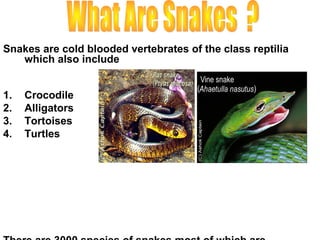
Snakes are cold blooded vertebrates of the class reptilia
   which also include


1.   Crocodile
2.   Alligators
3.   Tortoises
4.   Turtles
Geographic Distribution
                Present All over the world
 except Antarctica and isolated island groups.

Incidence
         Every year 5 million people are bitten
 by a snake in the world. Mortality ranges from
 30,000 to 40,000 per year
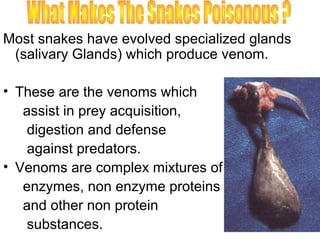
Most snakes have evolved specialized glands
 (salivary Glands) which produce venom.

• These are the venoms which
   assist in prey acquisition,
   digestion and defense
   against predators.
• Venoms are complex mixtures of
   enzymes, non enzyme proteins
   and other non protein
   substances.
• In Pakistan snake bite is common in both
  agricultural area as well as mountains of
  Baluchistan.


• Snake envomation is an acute public health
  problem in Sindh especially in Tharr.
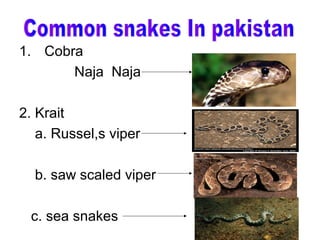
1. Cobra
       Naja Naja

2. Krait
   a. Russel,s viper

  b. saw scaled viper

 c. sea snakes
In Pakistan the peak incidence of snake bite
  occur in the month of June to August

This is because of
              1. Floods and rain
              2. Sleeping in open space
              3.Hatching of kobra and Krait
                  in summer
• Toxic saliva secreted by modified parotid glands of a
  venomous snake
• Amber colored when fresh
• Constituents          Toxins
                         Enzymes
                         Miscellaneous : neurotoxins
                                         cardio toxins
                                           hemolysin etc

• Neurotoxin              cobra, krait
• Hemotoxin               viperidae
• Myotoxin                sea snake

• Krait and russell’s viper is much more toxic than that of
  cobra
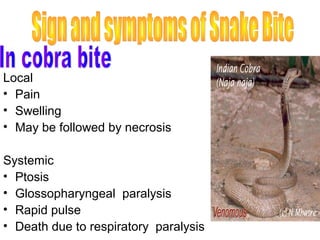
Local
• Pain
• Swelling
• May be followed by necrosis

Systemic
• Ptosis
• Glossopharyngeal paralysis
• Rapid pulse
• Death due to respiratory paralysis
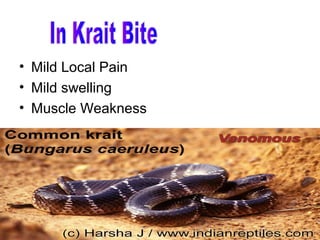
• Mild Local Pain
• Mild swelling
• Muscle Weakness
Local
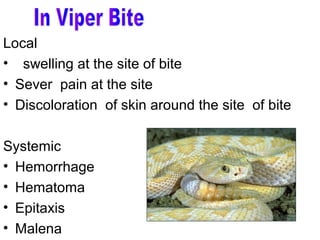
• swelling at the site of bite
• Sever pain at the site
• Discoloration of skin around the site of bite

Systemic
• Hemorrhage
• Hematoma
• Epitaxis
• Malena
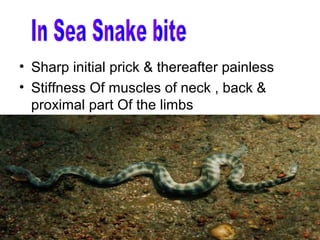
• Sharp initial prick & thereafter painless
• Stiffness Of muscles of neck , back &
  proximal part Of the limbs
•   Although snakes have are consider as one of the
    worlds most dangerous and disgusting creatures on
    the planet, they actually have some benefits:

    1. They save farmers a minimum of seventy-five dollars
       annually by ridding their fields of destructive rodents

    2.Snakes eat harmful rodents (mice, rats, etc.) and insects that
       may carry harmful diseases

    3.Snakes also possess an oil that can be harvested that is
       used to remedy pain in joints, such as rheumatoid arthritis

    4. The fats and the oils extracted from the snakes have a high
        content of Eicosapentaenoic acid (EPA), which has anti
        inflammatory properties.
1. Naag Naagan couple picture theory.

2. Snake as a Indian god.

3. Army crawl theory.

4. News paper 1988 and recently Afghanistan
   man to snake conversion.
5. Once snake bite again every year bite

6. Onion theory    umar coat      25km choor
•  Aims of management
1. Retarding the absorption of venom.

2. Neutralization of venom that has been
   absorbed.

3. Relief of symptoms and prevention of
   complication.
History
• Time of bite
• Description of snake
• Sign and symptoms since bite

Examination
• Examination of bite site
• Neurological defects
• Repeated check up of natural orifices for
Diagnosis of bite

• Finding of fang marks
• Sign and symptoms arising ,giving indication of
  snake bite.
• In sea snake bite hyperkalemia is detected by
  ECG
• Clotting and bleeding time are also helpful.
The venom is detected from a dry swab of the bite site
      using monoclonal antibody techniques
.
    The 20-minute whole blood-clotting test is a useful bedside tool in
        remote areas; a 2-3 ml sample of venous blood from the victim
        is left undisturbed at ambient temperature for at least 20
        minutes.
     The vessel containing the blood is then tipped once & may be
        compared with a normal control.
    If it has not clotted, there is haemostatic disturbance from systemic
        envenoming.
    All patients should have a full blood count, urea/electrolytes, liver
        function tests, creatine kinase, ECG.
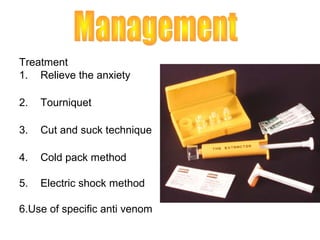
Treatment
1. Relieve the anxiety

2.   Tourniquet

3.   Cut and suck technique

4.   Cold pack method

5.   Electric shock method

6.Use of specific anti venom
Supportive and symptomatic measures

1.   Bed rest
2.   Adrenaline injection
3.   Artificial respiration
4.   Antibiotics etc
• 1. The most useful bed-side test to suggest
  snake bite envenemoation is:

• A. Prothrombin time.

• B.20 minute whole blood clotting test.

• C. ECG.

• D. Electrolytes.
Management of snake bite includes all except
• A.Immobilize the bitten part
.
• B. Apply a firm bandage

• C. Incision & sucking of the bitten site.

• D. Massage over the bitten site to relieve pain
  and prevent edematous swelling

• E.Reassure the patient.
• Q. 10 year-old boy sustains a rattlesnake bite on his
  left ankle. Pain and swelling of the bitten area become
  rapidly intense. While the boy is transported to the
  closest medical facility, which of the following is the
  most appropriate initial step in management ?

  A. Apply ice over the bitten area
  B. Apply a tourniquet proximal to the bitten area
  C. Apply iodine to the bitten area
  D. Immobilize the bitten part in horizontal position
  E. Perform incision and suction on the bite
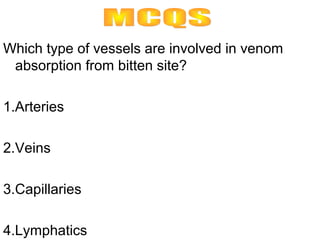
Which type of vessels are involved in venom
 absorption from bitten site?

1.Arteries

2.Veins

3.Capillaries

4.Lymphatics
Snake bite by dr. majid nawaz

Snake bite by dr. majid nawaz

  • 3.
    Every year 5million people are bitten by a snake in the world. • Mortality ranges from 30,000 to 40,000 • Non poisonous snake may also bite but the term snake poisoning refers to the bite of poisonous snake only
  • 4.
    Snakes are coldblooded vertebrates of the class reptilia which also include 1. Crocodile 2. Alligators 3. Tortoises 4. Turtles
  • 5.
    Geographic Distribution Present All over the world except Antarctica and isolated island groups. Incidence Every year 5 million people are bitten by a snake in the world. Mortality ranges from 30,000 to 40,000 per year
  • 6.
    Most snakes haveevolved specialized glands (salivary Glands) which produce venom. • These are the venoms which assist in prey acquisition, digestion and defense against predators. • Venoms are complex mixtures of enzymes, non enzyme proteins and other non protein substances.
  • 7.
    • In Pakistansnake bite is common in both agricultural area as well as mountains of Baluchistan. • Snake envomation is an acute public health problem in Sindh especially in Tharr.
  • 8.
    1. Cobra Naja Naja 2. Krait a. Russel,s viper b. saw scaled viper c. sea snakes
  • 9.
    In Pakistan thepeak incidence of snake bite occur in the month of June to August This is because of 1. Floods and rain 2. Sleeping in open space 3.Hatching of kobra and Krait in summer
  • 10.
    • Toxic salivasecreted by modified parotid glands of a venomous snake • Amber colored when fresh • Constituents Toxins Enzymes Miscellaneous : neurotoxins cardio toxins hemolysin etc • Neurotoxin cobra, krait • Hemotoxin viperidae • Myotoxin sea snake • Krait and russell’s viper is much more toxic than that of cobra
  • 11.
    Local • Pain • Swelling •May be followed by necrosis Systemic • Ptosis • Glossopharyngeal paralysis • Rapid pulse • Death due to respiratory paralysis
  • 12.
    • Mild LocalPain • Mild swelling • Muscle Weakness
  • 13.
    Local • swelling atthe site of bite • Sever pain at the site • Discoloration of skin around the site of bite Systemic • Hemorrhage • Hematoma • Epitaxis • Malena
  • 14.
    • Sharp initialprick & thereafter painless • Stiffness Of muscles of neck , back & proximal part Of the limbs
  • 15.
    Although snakes have are consider as one of the worlds most dangerous and disgusting creatures on the planet, they actually have some benefits: 1. They save farmers a minimum of seventy-five dollars annually by ridding their fields of destructive rodents 2.Snakes eat harmful rodents (mice, rats, etc.) and insects that may carry harmful diseases 3.Snakes also possess an oil that can be harvested that is used to remedy pain in joints, such as rheumatoid arthritis 4. The fats and the oils extracted from the snakes have a high content of Eicosapentaenoic acid (EPA), which has anti inflammatory properties.
  • 16.
    1. Naag Naagancouple picture theory. 2. Snake as a Indian god. 3. Army crawl theory. 4. News paper 1988 and recently Afghanistan man to snake conversion. 5. Once snake bite again every year bite 6. Onion theory umar coat 25km choor
  • 18.
    • Aimsof management 1. Retarding the absorption of venom. 2. Neutralization of venom that has been absorbed. 3. Relief of symptoms and prevention of complication.
  • 19.
    History • Time ofbite • Description of snake • Sign and symptoms since bite Examination • Examination of bite site • Neurological defects • Repeated check up of natural orifices for
  • 20.
    Diagnosis of bite •Finding of fang marks • Sign and symptoms arising ,giving indication of snake bite. • In sea snake bite hyperkalemia is detected by ECG • Clotting and bleeding time are also helpful.
  • 21.
    The venom isdetected from a dry swab of the bite site using monoclonal antibody techniques . The 20-minute whole blood-clotting test is a useful bedside tool in remote areas; a 2-3 ml sample of venous blood from the victim is left undisturbed at ambient temperature for at least 20 minutes. The vessel containing the blood is then tipped once & may be compared with a normal control. If it has not clotted, there is haemostatic disturbance from systemic envenoming. All patients should have a full blood count, urea/electrolytes, liver function tests, creatine kinase, ECG.
  • 22.
    Treatment 1. Relieve theanxiety 2. Tourniquet 3. Cut and suck technique 4. Cold pack method 5. Electric shock method 6.Use of specific anti venom
  • 23.
    Supportive and symptomaticmeasures 1. Bed rest 2. Adrenaline injection 3. Artificial respiration 4. Antibiotics etc
  • 25.
    • 1. Themost useful bed-side test to suggest snake bite envenemoation is: • A. Prothrombin time. • B.20 minute whole blood clotting test. • C. ECG. • D. Electrolytes.
  • 26.
    Management of snakebite includes all except • A.Immobilize the bitten part . • B. Apply a firm bandage • C. Incision & sucking of the bitten site. • D. Massage over the bitten site to relieve pain and prevent edematous swelling • E.Reassure the patient.
  • 27.
    • Q. 10year-old boy sustains a rattlesnake bite on his left ankle. Pain and swelling of the bitten area become rapidly intense. While the boy is transported to the closest medical facility, which of the following is the most appropriate initial step in management ? A. Apply ice over the bitten area B. Apply a tourniquet proximal to the bitten area C. Apply iodine to the bitten area D. Immobilize the bitten part in horizontal position E. Perform incision and suction on the bite
  • 28.
    Which type ofvessels are involved in venom absorption from bitten site? 1.Arteries 2.Veins 3.Capillaries 4.Lymphatics