

JAI NARAIN VYAS
UNIVERSITY, JODHPUR
ASSISTANT PROFESSOR:- ASHWIN SINGH
CHOUHAN
DEPARTMENT:- PHARMACOLOGY
E-MAIL:- anshukavya1993@gmail.com
PULSE RATE AND BLOOD
PRESSURE
Human physiology: Measurement of Pulse Rate and Blood Pressure
Introduction
Human physiology is the science of the mechanical, physical, and biochemical functions of
normal humans or human tissues or organs. The principal level of focus of human physiology
is at the level of organs and systems. In simple terms "Human Physiology" is the study of the
body and its functions in each of the different systems in any living body. Physiological
variables among human beings display a large normal range because the immediate
biological response to any environmental stress is physiological in nature. Individual varies in
their morphological, physiological and genetic traits. The morphological differences are
exhibited in the size, shape and compositions of the body. It is generally accepted that
anthropometric measurements like height, weight, body surface area, chest circumference etc
along with physiological traits like heart rate, pulse rate, blood pressure, lungs functions,
fitness index, grip strength etc. are important factors for studying physiological and
biological variability in the population groups.
Blood pressure
Blood is the specialized tissue of the human body that supplies nourishment especially
oxygen to the cellular elements of the tissues and remove the waste products especially
carbon dioxide from the same, there by maintaining the required temperature of the
body etc. In performing the above functions, blood exerts some type of pressure upon
the walls of the blood vessels which we generally called Blood pressure. It is an
important indicator of cardiovascular functioning. It varies with age, sex, race, body
weight, fitness levels and several other factors. Generally the most acceptable
definition of Blood pressure is - the pressure exerted by circulating blood upon the
walls of blood vessels. Blood pressure" usually refers to the arterial pressure of the
systemic circulation.
The physiological variables are of utmost importance in maintaining homeostasis under
diverse environmental conditions. On the other hand alterations in life style and diet can
bring noticeable and hazardous changes in physiological variables. For example day
today activities and food habits are directly related to problem like high blood pressure,
cardiovascular problem causing ill health.
During each heartbeat, blood pressure varies between a maximum (systolic) and a minimum
(diastolic) pressure. Systolic pressure is the maximum blood pressure in an artery when the
heart muscle contracts. In other words the maximum pressure as the heart beats which
averages to about 120 mmHgthough the normal range is in between 100-130mmHg). Diastolic
pressure is the lowest blood pressure in an artery in the moment between beats when the heart
is relaxed. The normal range is in between 60-90, though the average is 80 mmHg. The
difference between Systolic and Diastolic pressure, named "Pulse Pressure", has been gaining
interest in the research community.
Mean BP is the average pressure throughout the cardiac cycle. Calculated as Diastolic
Pressure+1/3Pulse pressure. Av. 96 mmHg ( Normal range 95-100)
A person’s blood pressure is therefore expressed in terms of the systolic pressure over diastolic
pressure and is measured in millimeters of mercury (mmHg), for example 140/90mmHg. Here
140 is the systolic pressure and 90 is the diastolic pressure.
.
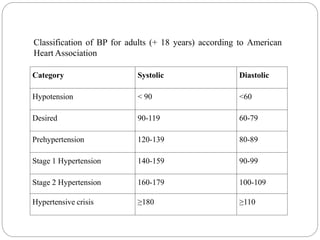
Category Systolic Diastolic
Hypotension < 90 <60
Desired 90-119 60-79
Prehypertension 120-139 80-89
Stage 1 Hypertension 140-159 90-99
Stage 2 Hypertension 160-179 100-109
Hypertensive crisis ≥180 ≥110
Classification of BP for adults (+ 18 years) according to American
Heart Association
High blood pressure is a condition in which the heart exerts more force to
pump the same quantity of blood within the same time and over the years can
harden the arteries thereby weakening your heart.
Factors affecting BP
BP is a one of the very sensitive physiological traits in human life. It is very
easily affected by many different factors. But people do not realize that their
blood pressure is constantly changing from time to time in response to mood,
physical activity, body posture, etc. In fact, simple changes can cause blood
pressure to fluctuate between 5 and 40 mmHg.
Some of the important factor that affect the Blood pressure are:
In normal condition the level of blood pressure gets easily affected by climate, degree of
urbanization, work schedule, activity pattern and varied dietary behavior. It also changes with
age, vary in cultures based on several factors. It is even found to be affected with posture
(standing, sitting, or reclining) and changes in daily location such as going from work place to
home. It is shown that increase in body mass index is even related to increase blood pressure
than racial population groups.
In particular blood pressure is very seriously affected by the following:
1.Too small cuff of the BP instrument: Studies have shown that using too smallcuff
ofsphygmomanometer can cause an individual’s systolic blood pressure measurement to
increase by 10 to 40 mmHg. It is therefore extremely important to make sure that suitable
size blood pressure cuff is used while taking the measurement.
2.Using of blood pressure cuff over the clothing:Blood pressure measured with the cuff
wrapped over the clothing can give an inaccurate measure with a fluctuation of 10 to 50
mmHg. Therefore the cuff should always be wrapped directly on the arm.
3.No interval between successive recording: The subject should relax comfortably for
three to five minutes before a reading is taken. Any activity such as eating, exercise can
affect systolic BP by about 10-20 mmHg
4.Unsupported Arm/Back/Feet: If arms, back and feet are not supported at the time of
recording the measurement, it will show a fluctuation in systolic and diastolic blood
pressure.
5.Talking at the time of taking the measurement may increase the systolic BP by about 10-
15 mmHG
6.Subject should abstain from smoking, consumption of alcohol and caffeine at least 30
minutes before taking the measurements measuring BP immediately after consumption of
such food items may raise the BP.
7.Atmospheric temperature: Blood pressure tends to increase when the subject is exposed
to low temperature. So it should be recorded under the room temperature condition
8.Full bladder: When the urinary bladder is filled , the BP could increase by 10-15 mmHG
9.Age and sex:In children, the normal ranges are lower than for adults and depend on
height. As adults age, systolic pressure tends to rise and diastolic tends to fall. In the
elderly, blood pressure tends to be above the normal adult range. An individual's blood
pressure varies with obesity, stress, sedentary life-style, heredity, excess salt intake,
exercise, emotional reactions, sleep, digestion and time of day.
Procedure for measuring BP
Systemic arterial BP can be measured by two method viz. Direct and indirect method.
Direct method involves the introduction of a cannula into an artery and is therefore unsafe,
inconvenient, and involves high risk of infection. Therefore, this method is used only for
research purposes particularly in measuring BP of Animals,
In indirect method, there are two ways of measuring one through palpation and another
auscultatory. The later is more frequently used as it is more reliable. Auscultatory
method wasintroduced by Russian Physician Korotkoff in 1905.
Apparatus required:
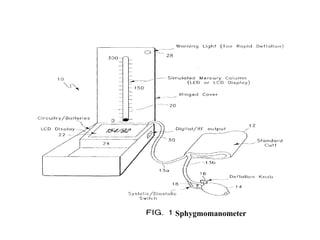
1. Sphygmomanometer :- The comprising of graduated glass tube,mercury
reservoir,lock, rubber pump, valve, rubber tube small and big, rubber bag
(23X12.5 cm) and cloth envelope. an instrument for measuring blood
pressure, typically consisting of an inflatable rubber cuff which is applied to
the arm and connected to a column of mercury next to a graduated scale,
enabling the determination of systolic and diastolic blood pressure by
increasing and gradually releasing the pressure in the cuff.
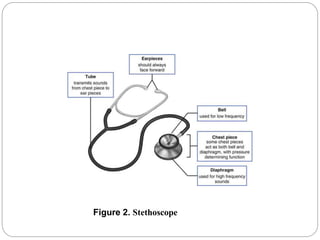
2.Stethoscope :- The stethoscope is an acoustic medical device for auscultation,
or listening to the internal sounds of an animal or human body
Sphygmomanometer
Figure 2. Stethoscope
Procedure
1.Allow the subject to comfortably sit in a chair with back and arm supported and feet
uncrossed or to lie supine for about 5 minutes.
2.The uninflated cuff of sphygmomanometer wrapped around the upper arm about 2.5
to 3 cm above the level of the heart
3.Chest piece of stethoscope be placed over the arm medial to the tendon of biceps
where pulsation of brachial artery is felt
4.Inflate the artery until the pressure in it is well above systolic BP. (nearly upto
200mm) The brachial artery gets occluded by the cuff and no sound can be heard
with the stethoscope.
5.The pressure of the cuff is then lowered by opening the valve slowly till a clear tapping
sound is heard. Thus the systolic pressure is measured and recorded when the pulse is
first heard.
6.This sound will slowly become more distant and finally disappear. The pressure is
measured and recorded at that moment and is the diastolic pressure.
7.Then express the BP as SBP/DBP (mmHg), for example if systolic is 120 and diastolic
is 80, then BP is expressed as 120/80.
8.Take two three readings after an interval of about 3/4 minutes each and take an average
to give Blood pressure measure.
Precaution:
1. Cuff should be properly and firmly wrapped,
2. Cuff should be wrapped 2.5 to 3 cm above the level of heart,
3. Subject should not to talk at the time of taking the measurement,
4. Cuff tubing should lie over the inner side of the arm,
5. Strong pressure should not be applied over the artery as it may cause
obstruction,
6. The cuff should not be kept in inflated state for long period, and
7. For suspected hypertensive individuals cuff pressure should be pumped
above 200 mm Hg
Pulse rate
What is pulse?
Pulse is the rhythmic contraction and expansion of the arteries corresponding to each heart
beat. It is the surge of blood that is pushed through the arteries when the heart beats.
What is pulse rate?
It is the rate at which our heart beats. So it is also called as heart rate. It is the number of
heart beats per minute.
Why do we measure pulse rate?
 By measuring and knowing the pulse rate, we can know the status of our heart and tell us
how well the heart is working. Either more or less heart beats per minute than the normal
rate is indicative of a problem with the heart. It can tell us if the heart is pumping enough
blood.
 Frequent checking of our pulse rate at rest, during exercise, or immediately after the exercise
can give us important information about our general health and overall fitness level.
Range of pulse rate
The average pulse rate ranges between 70 to 100 for individuals below 18 years of
age and 60 to 100 for adults. However, in normal conditions some of the athletes
have below 40, and newborns above 140.
Maximum heart rate or the highest possible pulse rate can be estimated by using the
formula: 220- (Personal age)=(predicted maximum heart rate).
Target heart rate. This is 60 to 85 percent of the maximum heart rate. This is usually
accomplished through exercise.
Factors affecting pulse rate:
Body weight, age, gender, activities and exercise affect the pulse rate. Increase in
body weight results to increase in pulse rate, younger age individuals have higher
pulse rate,
women have higher pulse rate than males, Pulse rate increases just after the food,
during sex and exercise.
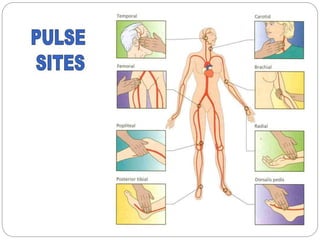
Sites at which pulse can be felt
Pulse can be felt at :
1.
2.
3.
4.
5.
Wrist - Radial artery
Neck-Carotid artery
Grion - Femoral artery
Ankle joint - Posterior tibial artery
Inside of elbow –Brachial artery
Pulse rate is counted by putting slight pressure on any artery in the body where
pulsations can be felt.
The most convenient location is the wrist (radial pulse).
Procedure for measuring Pulse rate
How to count the pulse rate at the wrist?
1. Hold the hand of the subject in palm up position
2. Exert slight pressure with the pads of your index finger and middle finger
to locate the pulse just below the wrist crease at the base of the thumb.
The pulse is felt just like a rhythmic thumping
3. Count the pulse for 15 seconds using a watch or clock having second
hand
4. Multiply the number by 4 to get the count per minute
Tips to be noted:
Never use thumb to locate the pulse as there is a pulse in the thumb which
can interfere when trying to locate pulse on the subject.
If irregularities are observed then we should seek medical help
To take the relaxed pulse rate the subject should be asked to lie down for 1
minute.
THANK YOU

Pulse rate and blood pressure

  • 1.
    JAI NARAIN VYAS UNIVERSITY,JODHPUR ASSISTANT PROFESSOR:- ASHWIN SINGH CHOUHAN DEPARTMENT:- PHARMACOLOGY E-MAIL:- anshukavya1993@gmail.com PULSE RATE AND BLOOD PRESSURE
  • 3.
    Human physiology: Measurementof Pulse Rate and Blood Pressure Introduction Human physiology is the science of the mechanical, physical, and biochemical functions of normal humans or human tissues or organs. The principal level of focus of human physiology is at the level of organs and systems. In simple terms "Human Physiology" is the study of the body and its functions in each of the different systems in any living body. Physiological variables among human beings display a large normal range because the immediate biological response to any environmental stress is physiological in nature. Individual varies in their morphological, physiological and genetic traits. The morphological differences are exhibited in the size, shape and compositions of the body. It is generally accepted that anthropometric measurements like height, weight, body surface area, chest circumference etc along with physiological traits like heart rate, pulse rate, blood pressure, lungs functions, fitness index, grip strength etc. are important factors for studying physiological and biological variability in the population groups.
  • 4.
    Blood pressure Blood isthe specialized tissue of the human body that supplies nourishment especially oxygen to the cellular elements of the tissues and remove the waste products especially carbon dioxide from the same, there by maintaining the required temperature of the body etc. In performing the above functions, blood exerts some type of pressure upon the walls of the blood vessels which we generally called Blood pressure. It is an important indicator of cardiovascular functioning. It varies with age, sex, race, body weight, fitness levels and several other factors. Generally the most acceptable definition of Blood pressure is - the pressure exerted by circulating blood upon the walls of blood vessels. Blood pressure" usually refers to the arterial pressure of the systemic circulation. The physiological variables are of utmost importance in maintaining homeostasis under diverse environmental conditions. On the other hand alterations in life style and diet can bring noticeable and hazardous changes in physiological variables. For example day today activities and food habits are directly related to problem like high blood pressure, cardiovascular problem causing ill health.
  • 5.
    During each heartbeat,blood pressure varies between a maximum (systolic) and a minimum (diastolic) pressure. Systolic pressure is the maximum blood pressure in an artery when the heart muscle contracts. In other words the maximum pressure as the heart beats which averages to about 120 mmHgthough the normal range is in between 100-130mmHg). Diastolic pressure is the lowest blood pressure in an artery in the moment between beats when the heart is relaxed. The normal range is in between 60-90, though the average is 80 mmHg. The difference between Systolic and Diastolic pressure, named "Pulse Pressure", has been gaining interest in the research community. Mean BP is the average pressure throughout the cardiac cycle. Calculated as Diastolic Pressure+1/3Pulse pressure. Av. 96 mmHg ( Normal range 95-100) A person’s blood pressure is therefore expressed in terms of the systolic pressure over diastolic pressure and is measured in millimeters of mercury (mmHg), for example 140/90mmHg. Here 140 is the systolic pressure and 90 is the diastolic pressure. .
  • 6.
    Category Systolic Diastolic Hypotension< 90 <60 Desired 90-119 60-79 Prehypertension 120-139 80-89 Stage 1 Hypertension 140-159 90-99 Stage 2 Hypertension 160-179 100-109 Hypertensive crisis ≥180 ≥110 Classification of BP for adults (+ 18 years) according to American Heart Association
  • 7.
    High blood pressureis a condition in which the heart exerts more force to pump the same quantity of blood within the same time and over the years can harden the arteries thereby weakening your heart. Factors affecting BP BP is a one of the very sensitive physiological traits in human life. It is very easily affected by many different factors. But people do not realize that their blood pressure is constantly changing from time to time in response to mood, physical activity, body posture, etc. In fact, simple changes can cause blood pressure to fluctuate between 5 and 40 mmHg.
  • 8.
    Some of theimportant factor that affect the Blood pressure are: In normal condition the level of blood pressure gets easily affected by climate, degree of urbanization, work schedule, activity pattern and varied dietary behavior. It also changes with age, vary in cultures based on several factors. It is even found to be affected with posture (standing, sitting, or reclining) and changes in daily location such as going from work place to home. It is shown that increase in body mass index is even related to increase blood pressure than racial population groups. In particular blood pressure is very seriously affected by the following: 1.Too small cuff of the BP instrument: Studies have shown that using too smallcuff ofsphygmomanometer can cause an individual’s systolic blood pressure measurement to increase by 10 to 40 mmHg. It is therefore extremely important to make sure that suitable size blood pressure cuff is used while taking the measurement. 2.Using of blood pressure cuff over the clothing:Blood pressure measured with the cuff wrapped over the clothing can give an inaccurate measure with a fluctuation of 10 to 50 mmHg. Therefore the cuff should always be wrapped directly on the arm.
  • 9.
    3.No interval betweensuccessive recording: The subject should relax comfortably for three to five minutes before a reading is taken. Any activity such as eating, exercise can affect systolic BP by about 10-20 mmHg 4.Unsupported Arm/Back/Feet: If arms, back and feet are not supported at the time of recording the measurement, it will show a fluctuation in systolic and diastolic blood pressure. 5.Talking at the time of taking the measurement may increase the systolic BP by about 10- 15 mmHG 6.Subject should abstain from smoking, consumption of alcohol and caffeine at least 30 minutes before taking the measurements measuring BP immediately after consumption of such food items may raise the BP. 7.Atmospheric temperature: Blood pressure tends to increase when the subject is exposed to low temperature. So it should be recorded under the room temperature condition
  • 10.
    8.Full bladder: Whenthe urinary bladder is filled , the BP could increase by 10-15 mmHG 9.Age and sex:In children, the normal ranges are lower than for adults and depend on height. As adults age, systolic pressure tends to rise and diastolic tends to fall. In the elderly, blood pressure tends to be above the normal adult range. An individual's blood pressure varies with obesity, stress, sedentary life-style, heredity, excess salt intake, exercise, emotional reactions, sleep, digestion and time of day. Procedure for measuring BP Systemic arterial BP can be measured by two method viz. Direct and indirect method. Direct method involves the introduction of a cannula into an artery and is therefore unsafe, inconvenient, and involves high risk of infection. Therefore, this method is used only for research purposes particularly in measuring BP of Animals,
  • 11.
    In indirect method,there are two ways of measuring one through palpation and another auscultatory. The later is more frequently used as it is more reliable. Auscultatory method wasintroduced by Russian Physician Korotkoff in 1905. Apparatus required: 1. Sphygmomanometer :- The comprising of graduated glass tube,mercury reservoir,lock, rubber pump, valve, rubber tube small and big, rubber bag (23X12.5 cm) and cloth envelope. an instrument for measuring blood pressure, typically consisting of an inflatable rubber cuff which is applied to the arm and connected to a column of mercury next to a graduated scale, enabling the determination of systolic and diastolic blood pressure by increasing and gradually releasing the pressure in the cuff. 2.Stethoscope :- The stethoscope is an acoustic medical device for auscultation, or listening to the internal sounds of an animal or human body
  • 12.
  • 13.
  • 14.
    Procedure 1.Allow the subjectto comfortably sit in a chair with back and arm supported and feet uncrossed or to lie supine for about 5 minutes. 2.The uninflated cuff of sphygmomanometer wrapped around the upper arm about 2.5 to 3 cm above the level of the heart 3.Chest piece of stethoscope be placed over the arm medial to the tendon of biceps where pulsation of brachial artery is felt 4.Inflate the artery until the pressure in it is well above systolic BP. (nearly upto 200mm) The brachial artery gets occluded by the cuff and no sound can be heard with the stethoscope.
  • 15.
    5.The pressure ofthe cuff is then lowered by opening the valve slowly till a clear tapping sound is heard. Thus the systolic pressure is measured and recorded when the pulse is first heard. 6.This sound will slowly become more distant and finally disappear. The pressure is measured and recorded at that moment and is the diastolic pressure. 7.Then express the BP as SBP/DBP (mmHg), for example if systolic is 120 and diastolic is 80, then BP is expressed as 120/80. 8.Take two three readings after an interval of about 3/4 minutes each and take an average to give Blood pressure measure.
  • 16.
    Precaution: 1. Cuff shouldbe properly and firmly wrapped, 2. Cuff should be wrapped 2.5 to 3 cm above the level of heart, 3. Subject should not to talk at the time of taking the measurement, 4. Cuff tubing should lie over the inner side of the arm, 5. Strong pressure should not be applied over the artery as it may cause obstruction, 6. The cuff should not be kept in inflated state for long period, and 7. For suspected hypertensive individuals cuff pressure should be pumped above 200 mm Hg
  • 17.
    Pulse rate What ispulse? Pulse is the rhythmic contraction and expansion of the arteries corresponding to each heart beat. It is the surge of blood that is pushed through the arteries when the heart beats. What is pulse rate? It is the rate at which our heart beats. So it is also called as heart rate. It is the number of heart beats per minute. Why do we measure pulse rate?  By measuring and knowing the pulse rate, we can know the status of our heart and tell us how well the heart is working. Either more or less heart beats per minute than the normal rate is indicative of a problem with the heart. It can tell us if the heart is pumping enough blood.  Frequent checking of our pulse rate at rest, during exercise, or immediately after the exercise can give us important information about our general health and overall fitness level.
  • 18.
    Range of pulserate The average pulse rate ranges between 70 to 100 for individuals below 18 years of age and 60 to 100 for adults. However, in normal conditions some of the athletes have below 40, and newborns above 140. Maximum heart rate or the highest possible pulse rate can be estimated by using the formula: 220- (Personal age)=(predicted maximum heart rate). Target heart rate. This is 60 to 85 percent of the maximum heart rate. This is usually accomplished through exercise. Factors affecting pulse rate: Body weight, age, gender, activities and exercise affect the pulse rate. Increase in body weight results to increase in pulse rate, younger age individuals have higher pulse rate,
  • 19.
    women have higherpulse rate than males, Pulse rate increases just after the food, during sex and exercise. Sites at which pulse can be felt Pulse can be felt at : 1. 2. 3. 4. 5. Wrist - Radial artery Neck-Carotid artery Grion - Femoral artery Ankle joint - Posterior tibial artery Inside of elbow –Brachial artery Pulse rate is counted by putting slight pressure on any artery in the body where pulsations can be felt. The most convenient location is the wrist (radial pulse).
  • 21.
    Procedure for measuringPulse rate How to count the pulse rate at the wrist? 1. Hold the hand of the subject in palm up position 2. Exert slight pressure with the pads of your index finger and middle finger to locate the pulse just below the wrist crease at the base of the thumb. The pulse is felt just like a rhythmic thumping 3. Count the pulse for 15 seconds using a watch or clock having second hand 4. Multiply the number by 4 to get the count per minute
  • 22.
    Tips to benoted: Never use thumb to locate the pulse as there is a pulse in the thumb which can interfere when trying to locate pulse on the subject. If irregularities are observed then we should seek medical help To take the relaxed pulse rate the subject should be asked to lie down for 1 minute.
  • 23.