PHYSIOLOGY OF BLOOD PRESSURE AND
REGULATION.
BY
MRS.WINCY THIRUMURUGAN
Blood Pressure Basics
Measured by Force of Blood on Artery Walls
Measured in Millimeters of Mercury (mmHg)
Factors Affecting Blood Pressure:
Volume of Water in Body
Salt Content of Body
Condition of Kidneys, Nervous System and Blood Vessels (Arteries and Veins)
Levels of Various Hormones in Body (adrenal hormones eg aldosterone)
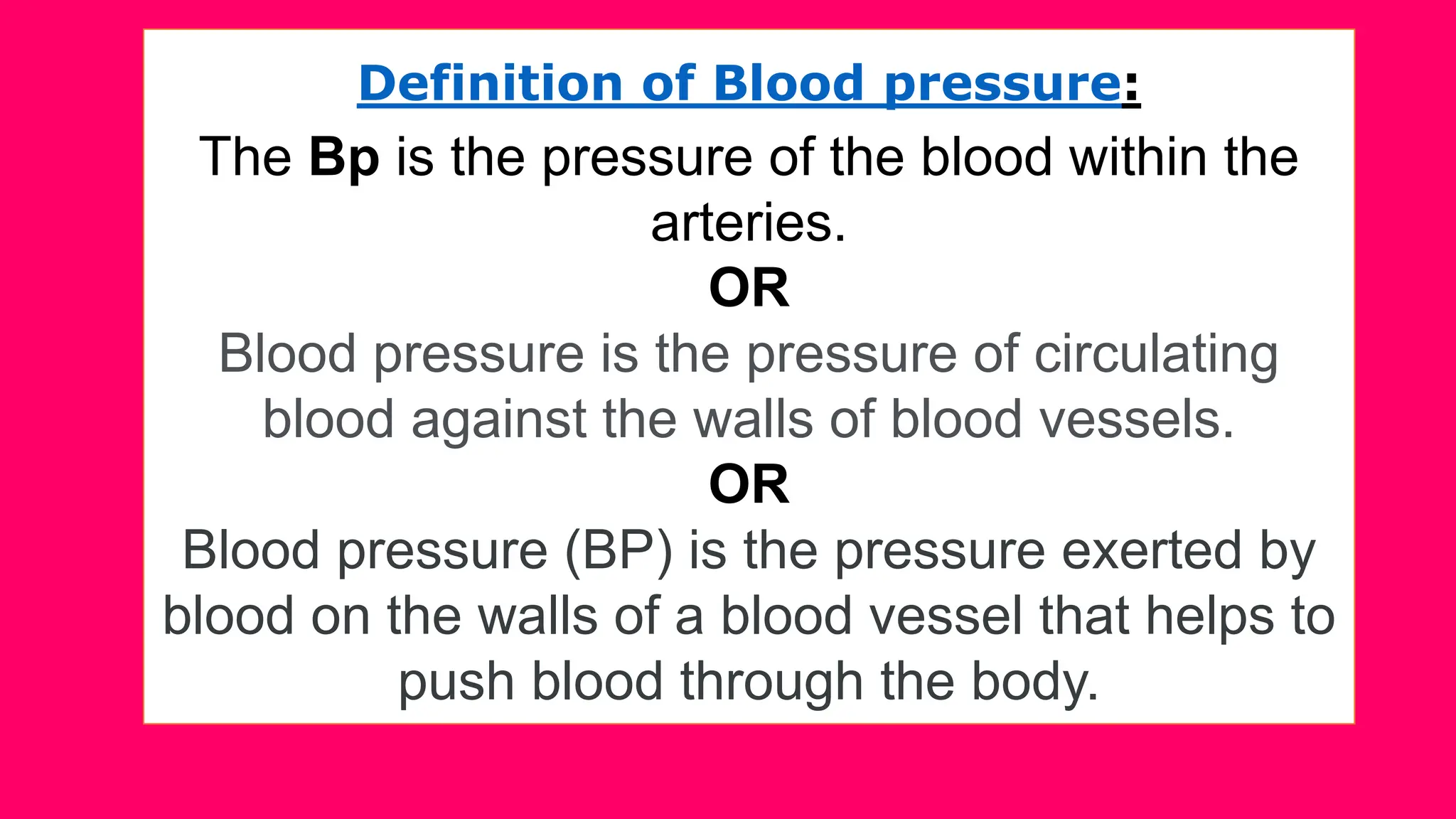
Definition of Blood pressure:
The Bp is the pressure of the blood within the
arteries.
OR
Blood pressure is the pressure of circulating
blood against the walls of blood vessels.
OR
Blood pressure (BP) is the pressure exerted by
blood on the walls of a blood vessel that helps to
push blood through the body.
Arteries take blood
away from the heart.
 Arterial Pressure is
the force exerted by
the blood upon the
walls of the arteries.
 Veins bring blood to the
heart.
 Venous Pressure is the
force exerted by the
blood upon the wall of
the veins.
Arterial vs. Venous Pressure
 Blood Pressure Generally Refers to Arterial
Pressure.
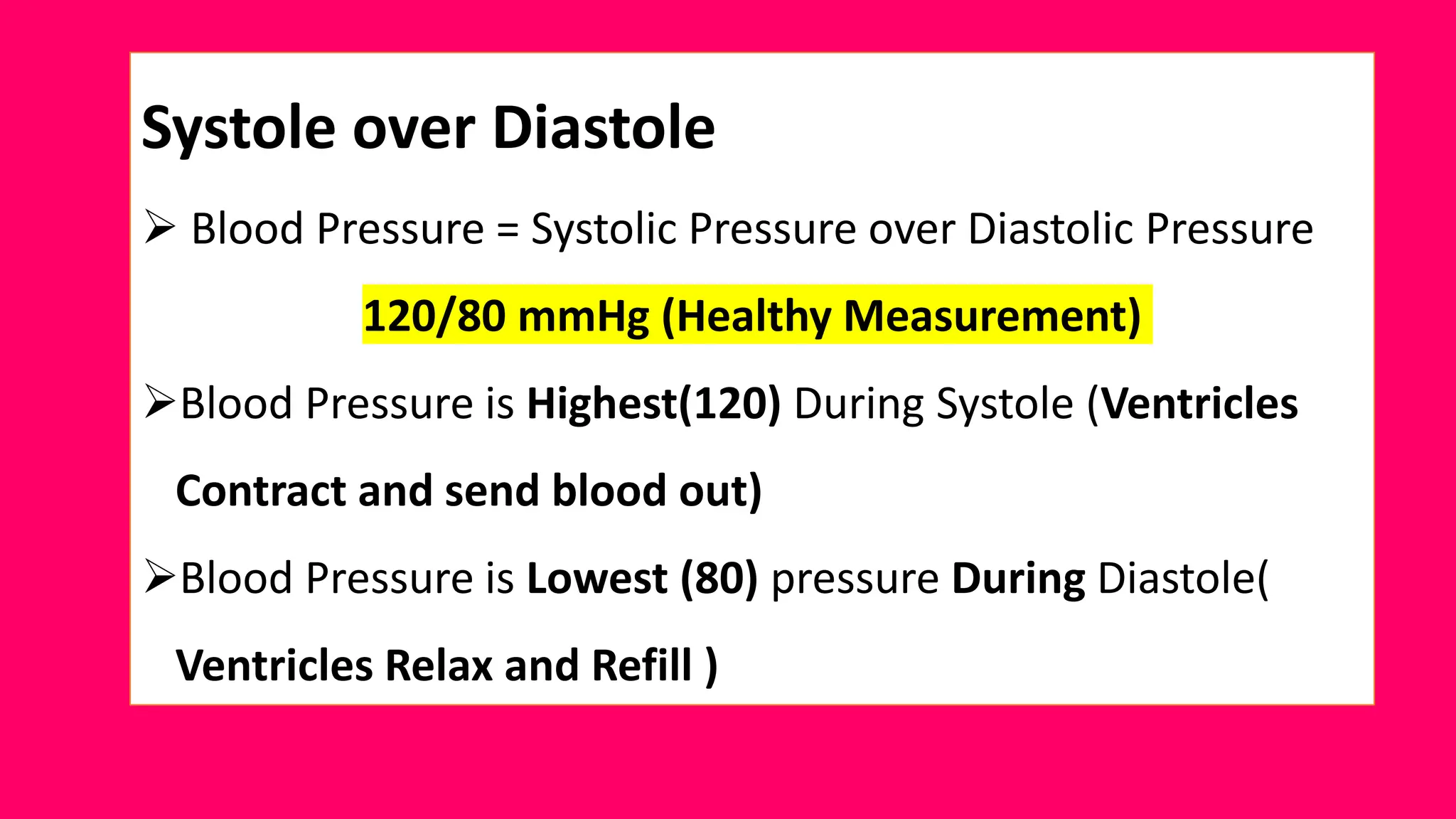
Systole over Diastole
 Blood Pressure = Systolic Pressure over Diastolic Pressure
120/80 mmHg (Healthy Measurement)
Blood Pressure is Highest(120) During Systole (Ventricles
Contract and send blood out)
Blood Pressure is Lowest (80) pressure During Diastole(
Ventricles Relax and Refill )
Systolic blood pressure measures the
amount of pressure that blood exerts on
vessels while the heart is beating(systole).
The optimal systolic blood pressure is 120
mmHg.
Diastolic blood pressure measures the
pressure in the vessels between
heartbeats(diastole). The optimal diastolic
blood pressure is 80 mmHg.
FACTORS AFFECTING BP
•Age. The risk of high blood pressure increases as age. high blood
pressure is more common in men age 64 and Women after age 65.
•Race. High blood pressure is particularly common among people of African
heritage, often developing at an earlier age than Americans and others.
•Family history. High blood pressure tends to run in families.
•Being overweight or obese. The more body weight, the more blood need to
supply oxygen and nutrients to tissues. As the amount of blood flow through
blood vessels increases and increase pressure on artery walls.
•Too much salt (sodium) in diet. Too much sodium in diet can cause body to
retain fluid, which increases blood
pressure.(tomato,cucumber,capsicum,broccoli.carrot,radish,salt)
•Too little potassium in diet. If the person don't get enough potassium in
diet, or lose too much potassium due to dehydration or other health
conditions, sodium can build up in
blood.[Increases)beetroot,greenpees,cabbage,figs,spinach,tendercoconut,cau
liflower.)
•Drinking too much alcohol. Increases the blood pressure.
•Not being physically active. People who are inactive tend to have higher heart
rates.
•Using tobacco. Not only does smoking or chewing tobacco immediately raise
the blood pressure temporarily, but the chemicals in tobacco can damage the
lining of the artery walls.
•Stress. High levels of stress can lead to a temporary increase in blood
pressure. Stress-related habits such as eating more, using tobacco or drinking
alcohol can lead to further increases in blood pressure.
•Certain chronic conditions. Certain conditions also may increase the risk of
high blood pressure, including kidney disease, diabetes and sleep apnea.
REGULATION OF
BLOOD PRESSURE
SHORT-TERM NEURAL CONTROL
Neural or nervous system regulating of blood pressure is achieved through the role of
cardiovascular centers and baroreceptor stimulation.
•Autonomic nervous system: the part of the nervous system that regulates the involuntary
activity of the heart, blood pressure modulation.
 Sympathetic nervous system: under stress raises blood pressure and heart rate,
constricts blood vessels.
 Parasympathetic: inhibits or opposes the effects of the sympathetic nervous system.
•Baroreceptor: a nerve ending that is sensitive to changes in blood pressure in the blood
vessels .
•Norepinephrine: Epinephrine increases arterial pressure.
Baroreceptor Function
Baroreceptors are specialized
stretch receptors located within thin
areas of blood vessels and heart
chambers that respond to the
degree of stretch caused by the
presence of blood.
They send impulses to the
cardiovascular center(medulla
oblangata) to regulate blood
Baroreceptor Reflexes
When blood pressure rises too high, baroreceptors fire at a
higher rate and trigger parasympathetic stimulation of the
heart. As a result, cardiac output falls.
Sympathetic stimulation of the peripheral arterioles will also
decrease, resulting in vasodilation. Combined, these activities
cause blood pressure to fall.
When blood pressure drops too low, the rate of baroreceptor
firing decreases. This triggers an increase in sympathetic
stimulation of the heart, causing cardiac output to increase.
It also triggers sympathetic stimulation of the peripheral vessels,
resulting in vasoconstriction. Combined, these activities cause
blood pressure to rise.
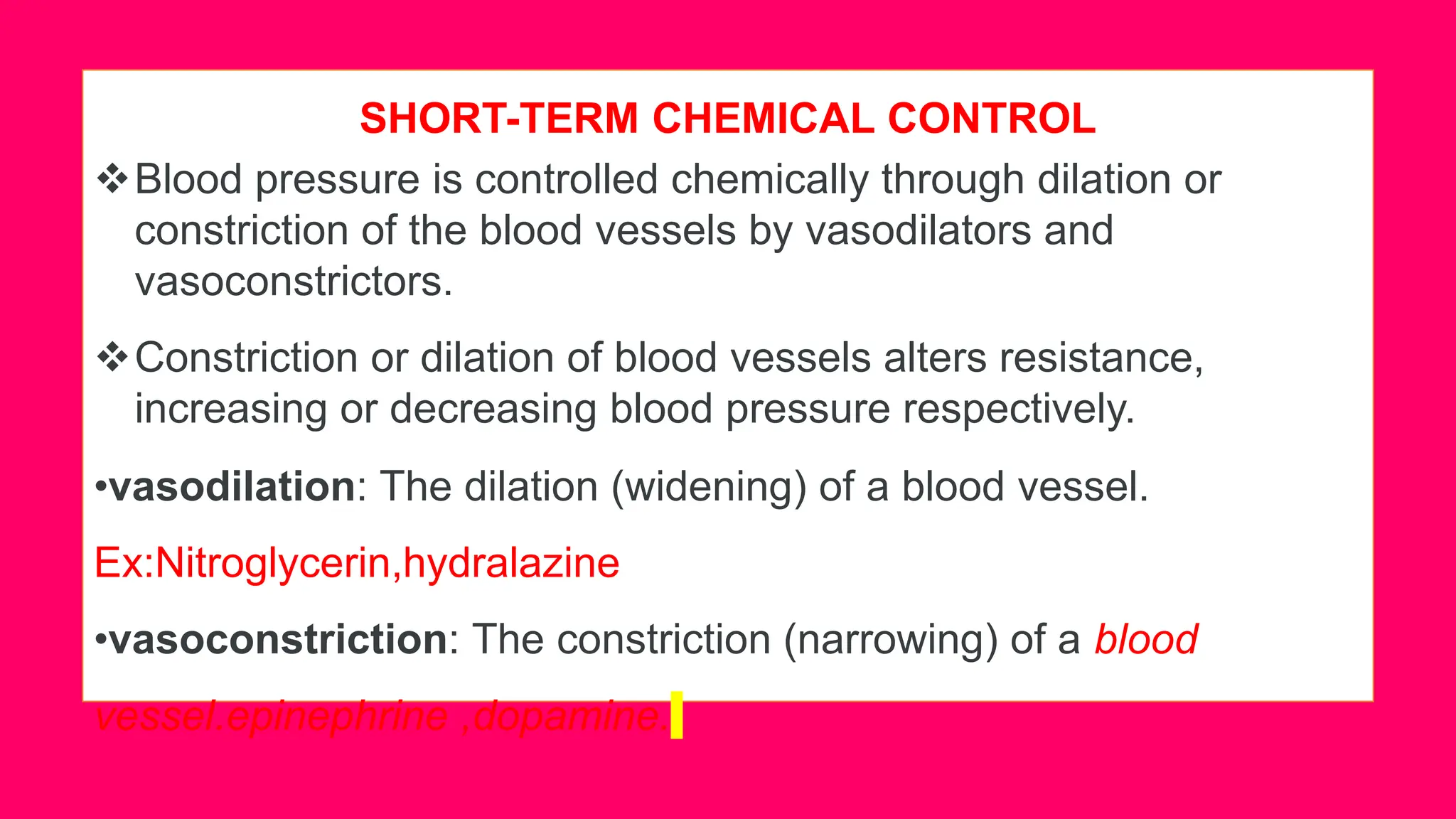
SHORT-TERM CHEMICAL CONTROL
Blood pressure is controlled chemically through dilation or
constriction of the blood vessels by vasodilators and
vasoconstrictors.
Constriction or dilation of blood vessels alters resistance,
increasing or decreasing blood pressure respectively.
•vasodilation: The dilation (widening) of a blood vessel.
Ex:Nitroglycerin,hydralazine
•vasoconstriction: The constriction (narrowing) of a blood
vessel.epinephrine ,dopamine.
INTERMEDIATE AND LONG-TERM REGULATION OF BP.
Renin-angiotensin-aldosterone system (RAAS).
•Juxtaglomerular cells: The juxtaglomerular cells (JG cells, or granular
cells) are cells in the kidney that synthesize, store, and secrete the
enzyme renin.
•Aldosterone: A mineralocorticoid hormone secreted by the adrenal cortex
that regulates the balance of sodium and potassium in the body.
•Adrenal cortex: The outer portion of the adrenal glands that produces
hormones essential to homeostasis.(gluco and mineralo corticoids)
The Classical RAS Pathway Works
The important members of the classical RAS pathway are:
•Renin
•Angiotensin I
•Angiotensin II
•Angiotensin converting enzyme 1 (ACE1)
•Aldosterone
Renin
• When blood pressure drops for any reason, special cells in
the kidney detect the change and release renin into the
bloodstream. Renin by itself does not really affect blood
pressure.
• Instead, it floats around and converts angiotensinogen
into angiotensin I. Angiotensinogen is a molecule that is
primarily produced by the liver and circulates throughout
the bloodstream. It is not able to alter the blood
pressure as a precursor molecule. It must be transformed
Angiotensin I
Angiotensin I also does not affect blood pressure much itself.
Instead, most angiotensin I is converted to angiotensin II, a much
more powerful hormone that does cause large changes in blood pressure.
Angiotensin-converting enzyme 1
This second conversion, which produces angiotensin II, happens mainly
in the lungs via the action of a molecule called an angiotensin-
converting enzyme. More specifically, it is called angiotensin-
converting enzyme 1 (ACE1). This conversion can be blocked by drugs
called ACE Inhibitors, an important type of high blood pressure
medication.
Angiotensin II
Angiotensin II is a very powerful hormone that
can act directly on blood vessels, causing them
to become narrow, or constrict, to increase blood
pressure. It has another important function as
well—stimulating the release of aldosterone.
Aldosterone
Aldosterone is a hormone that helps increase
blood pressure by causing the kidneys to retain
both salt and water, which over time increases
the amount of fluid in the body.2 This increase,
in turn, raises blood pressure.
Renin-angiotensin-aldosterone system (RAAS).
When blood volume is low, juxtaglomerular cells in the kidneys secrete renin
directly into circulation.
Plasma renin then carries out the conversion of angiotensinogen released by
the liver to angiotensin I.
Aldosterone secretion from the adrenal cortex is induced by angiotensin II
Angiotensin II causes the tubules of the kidneys to increase the reabsorption of
sodium and water into the blood, thereby increasing blood volume and blood
ACE is secreted in the lungs
and kidneys by cells in the
endothelium (inner layer) of
blood vessels. And in lungs.
Other Effects of the RAA Pathway: Neural and Renal
Neural effects
Angiotensin II stimulates an area in the brain called the "thirst
center" to help increase blood pressure. This thirst center is located
in a part of the brain called the hypothalamus. When the thirst center
is told by angiotensin II that the blood pressure is too low, it
creates a sensation of thirst. Drinking water, then, increases the
fluid volume in the body and raises blood pressure.
Angiotensin II also stimulates the body's "fight-or-flight response"
to help increase blood pressure. This response, which is usually
activated during stressful situations, causes the heart to pump more
quickly and forcefully to increase the circulating volume and the
Renal effects
Thirst is not the only message from the brain in response to low blood
pressure. Angiotensin II also tells the hypothalamus to increase the
production of a protein called antidiuretic hormone. This hormone travels
from the brain to the kidneys and tells the kidneys to reabsorb water from
the urine.
Angiotensin II also acts directly on the kidneys to further help increase
blood pressure and blood flow by telling the kidneys to:
•Constrict its small blood vessels to help increase blood pressure
•Increase sodium and water retention
•Regulate the rate the kidney filters fluid
RAA Inhibitors and High Blood Pressure.
Several effective high blood pressure treatments have been developed
as a direct result of our understanding of the renin-angiotensin-
aldosterone system.
•ACE inhibitors stop the conversion of angiotensin I to angiotensin
II.
•Angiotensin receptor blockers (ARBs) prevent angiotensin II from
binding to blood vessels and causing vasoconstriction.
•Water pills, or diuretics, help to get rid of fluid by telling the
Alternative RAS Pathway .
While the classical RAS pathway controls blood pressure and body
fluid, it also has a complementary negative effect on the body that promotes
promotes inflammation. Some of the inflammatory responses of the classical
RAS pathway include:
• Blood vessel narrowing, or constriction
•Increase in lung inflammatory responses
•Increase in cell stress responses
•Increase in arrhythmias or abnormal heartbeats
•Increase in insulin resistance
The alternative RAS pathway opposes the effects of
angiotensin II by lowering blood pressure. It also has
anti-inflammatory responses. Some of these responses
include:
•Blood vessel relaxation, or dilation
•Maintains blood flow and oxygenation in the lung
•Reduction in cell stress responses
•Relaxation of the heart’s coronary vessels
•Decrease in insulin resistance
Reference :
1.Sparks MA, Crowley SD, Gurley SB, Mirotsou M, Coffman TM. Classical Renin-
Angiotensin system in kidney physiology. Compr Physiol. 2014;4(3):1201-28.
doi:10.1002/cphy.c130040
2.Harvard Health Publishing. Aldosterone overload: An overlooked cause of high
blood pressure?
3.Coble JP, Grobe JL, Johnson AK, Sigmund CD. Mechanisms of brain renin
angiotensin system-induced drinking and blood pressure: importance of the
subfornical organ. Am J Physiol Regul Integr Comp Physiol. 2015;308(4):R238-R249.
doi:10.1152/ajpregu.00486.2014
4.Miller AJ, Arnold AC. The renin–angiotensin system in cardiovascular autonomic
control: recent developments and clinical implications. Clin Auton Res. 2019;
29(2):231-243. doi:10.1007/s10286-018-0572-5
5.Fountain JH, Lappin SL. Physiology, renin angiotensin system. In: StatPearls.
BLOOD PRESSURE AND REGULATION (RAAS).pptx

BLOOD PRESSURE AND REGULATION (RAAS).pptx

  • 1.
    PHYSIOLOGY OF BLOODPRESSURE AND REGULATION. BY MRS.WINCY THIRUMURUGAN
  • 2.
    Blood Pressure Basics Measuredby Force of Blood on Artery Walls Measured in Millimeters of Mercury (mmHg) Factors Affecting Blood Pressure: Volume of Water in Body Salt Content of Body Condition of Kidneys, Nervous System and Blood Vessels (Arteries and Veins) Levels of Various Hormones in Body (adrenal hormones eg aldosterone)
  • 3.
    Definition of Bloodpressure: The Bp is the pressure of the blood within the arteries. OR Blood pressure is the pressure of circulating blood against the walls of blood vessels. OR Blood pressure (BP) is the pressure exerted by blood on the walls of a blood vessel that helps to push blood through the body.
  • 4.
    Arteries take blood awayfrom the heart.  Arterial Pressure is the force exerted by the blood upon the walls of the arteries.  Veins bring blood to the heart.  Venous Pressure is the force exerted by the blood upon the wall of the veins. Arterial vs. Venous Pressure  Blood Pressure Generally Refers to Arterial Pressure.
  • 5.
    Systole over Diastole Blood Pressure = Systolic Pressure over Diastolic Pressure 120/80 mmHg (Healthy Measurement) Blood Pressure is Highest(120) During Systole (Ventricles Contract and send blood out) Blood Pressure is Lowest (80) pressure During Diastole( Ventricles Relax and Refill )
  • 6.
    Systolic blood pressuremeasures the amount of pressure that blood exerts on vessels while the heart is beating(systole). The optimal systolic blood pressure is 120 mmHg. Diastolic blood pressure measures the pressure in the vessels between heartbeats(diastole). The optimal diastolic blood pressure is 80 mmHg.
  • 7.
  • 8.
    •Age. The riskof high blood pressure increases as age. high blood pressure is more common in men age 64 and Women after age 65. •Race. High blood pressure is particularly common among people of African heritage, often developing at an earlier age than Americans and others. •Family history. High blood pressure tends to run in families. •Being overweight or obese. The more body weight, the more blood need to supply oxygen and nutrients to tissues. As the amount of blood flow through blood vessels increases and increase pressure on artery walls.
  • 9.
    •Too much salt(sodium) in diet. Too much sodium in diet can cause body to retain fluid, which increases blood pressure.(tomato,cucumber,capsicum,broccoli.carrot,radish,salt) •Too little potassium in diet. If the person don't get enough potassium in diet, or lose too much potassium due to dehydration or other health conditions, sodium can build up in blood.[Increases)beetroot,greenpees,cabbage,figs,spinach,tendercoconut,cau liflower.) •Drinking too much alcohol. Increases the blood pressure.
  • 10.
    •Not being physicallyactive. People who are inactive tend to have higher heart rates. •Using tobacco. Not only does smoking or chewing tobacco immediately raise the blood pressure temporarily, but the chemicals in tobacco can damage the lining of the artery walls. •Stress. High levels of stress can lead to a temporary increase in blood pressure. Stress-related habits such as eating more, using tobacco or drinking alcohol can lead to further increases in blood pressure. •Certain chronic conditions. Certain conditions also may increase the risk of high blood pressure, including kidney disease, diabetes and sleep apnea.
  • 11.
  • 12.
    SHORT-TERM NEURAL CONTROL Neuralor nervous system regulating of blood pressure is achieved through the role of cardiovascular centers and baroreceptor stimulation. •Autonomic nervous system: the part of the nervous system that regulates the involuntary activity of the heart, blood pressure modulation.  Sympathetic nervous system: under stress raises blood pressure and heart rate, constricts blood vessels.  Parasympathetic: inhibits or opposes the effects of the sympathetic nervous system. •Baroreceptor: a nerve ending that is sensitive to changes in blood pressure in the blood vessels . •Norepinephrine: Epinephrine increases arterial pressure.
  • 13.
    Baroreceptor Function Baroreceptors arespecialized stretch receptors located within thin areas of blood vessels and heart chambers that respond to the degree of stretch caused by the presence of blood. They send impulses to the cardiovascular center(medulla oblangata) to regulate blood
  • 16.
    Baroreceptor Reflexes When bloodpressure rises too high, baroreceptors fire at a higher rate and trigger parasympathetic stimulation of the heart. As a result, cardiac output falls. Sympathetic stimulation of the peripheral arterioles will also decrease, resulting in vasodilation. Combined, these activities cause blood pressure to fall.
  • 17.
    When blood pressuredrops too low, the rate of baroreceptor firing decreases. This triggers an increase in sympathetic stimulation of the heart, causing cardiac output to increase. It also triggers sympathetic stimulation of the peripheral vessels, resulting in vasoconstriction. Combined, these activities cause blood pressure to rise.
  • 18.
    SHORT-TERM CHEMICAL CONTROL Bloodpressure is controlled chemically through dilation or constriction of the blood vessels by vasodilators and vasoconstrictors. Constriction or dilation of blood vessels alters resistance, increasing or decreasing blood pressure respectively. •vasodilation: The dilation (widening) of a blood vessel. Ex:Nitroglycerin,hydralazine •vasoconstriction: The constriction (narrowing) of a blood vessel.epinephrine ,dopamine.
  • 19.
    INTERMEDIATE AND LONG-TERMREGULATION OF BP. Renin-angiotensin-aldosterone system (RAAS). •Juxtaglomerular cells: The juxtaglomerular cells (JG cells, or granular cells) are cells in the kidney that synthesize, store, and secrete the enzyme renin. •Aldosterone: A mineralocorticoid hormone secreted by the adrenal cortex that regulates the balance of sodium and potassium in the body. •Adrenal cortex: The outer portion of the adrenal glands that produces hormones essential to homeostasis.(gluco and mineralo corticoids)
  • 20.
    The Classical RASPathway Works The important members of the classical RAS pathway are: •Renin •Angiotensin I •Angiotensin II •Angiotensin converting enzyme 1 (ACE1) •Aldosterone
  • 21.
    Renin • When bloodpressure drops for any reason, special cells in the kidney detect the change and release renin into the bloodstream. Renin by itself does not really affect blood pressure. • Instead, it floats around and converts angiotensinogen into angiotensin I. Angiotensinogen is a molecule that is primarily produced by the liver and circulates throughout the bloodstream. It is not able to alter the blood pressure as a precursor molecule. It must be transformed
  • 22.
    Angiotensin I Angiotensin Ialso does not affect blood pressure much itself. Instead, most angiotensin I is converted to angiotensin II, a much more powerful hormone that does cause large changes in blood pressure. Angiotensin-converting enzyme 1 This second conversion, which produces angiotensin II, happens mainly in the lungs via the action of a molecule called an angiotensin- converting enzyme. More specifically, it is called angiotensin- converting enzyme 1 (ACE1). This conversion can be blocked by drugs called ACE Inhibitors, an important type of high blood pressure medication.
  • 23.
    Angiotensin II Angiotensin IIis a very powerful hormone that can act directly on blood vessels, causing them to become narrow, or constrict, to increase blood pressure. It has another important function as well—stimulating the release of aldosterone. Aldosterone Aldosterone is a hormone that helps increase blood pressure by causing the kidneys to retain both salt and water, which over time increases the amount of fluid in the body.2 This increase, in turn, raises blood pressure.
  • 24.
    Renin-angiotensin-aldosterone system (RAAS). Whenblood volume is low, juxtaglomerular cells in the kidneys secrete renin directly into circulation. Plasma renin then carries out the conversion of angiotensinogen released by the liver to angiotensin I. Aldosterone secretion from the adrenal cortex is induced by angiotensin II Angiotensin II causes the tubules of the kidneys to increase the reabsorption of sodium and water into the blood, thereby increasing blood volume and blood
  • 26.
    ACE is secretedin the lungs and kidneys by cells in the endothelium (inner layer) of blood vessels. And in lungs.
  • 29.
    Other Effects ofthe RAA Pathway: Neural and Renal Neural effects Angiotensin II stimulates an area in the brain called the "thirst center" to help increase blood pressure. This thirst center is located in a part of the brain called the hypothalamus. When the thirst center is told by angiotensin II that the blood pressure is too low, it creates a sensation of thirst. Drinking water, then, increases the fluid volume in the body and raises blood pressure. Angiotensin II also stimulates the body's "fight-or-flight response" to help increase blood pressure. This response, which is usually activated during stressful situations, causes the heart to pump more quickly and forcefully to increase the circulating volume and the
  • 30.
    Renal effects Thirst isnot the only message from the brain in response to low blood pressure. Angiotensin II also tells the hypothalamus to increase the production of a protein called antidiuretic hormone. This hormone travels from the brain to the kidneys and tells the kidneys to reabsorb water from the urine. Angiotensin II also acts directly on the kidneys to further help increase blood pressure and blood flow by telling the kidneys to: •Constrict its small blood vessels to help increase blood pressure •Increase sodium and water retention •Regulate the rate the kidney filters fluid
  • 31.
    RAA Inhibitors andHigh Blood Pressure. Several effective high blood pressure treatments have been developed as a direct result of our understanding of the renin-angiotensin- aldosterone system. •ACE inhibitors stop the conversion of angiotensin I to angiotensin II. •Angiotensin receptor blockers (ARBs) prevent angiotensin II from binding to blood vessels and causing vasoconstriction. •Water pills, or diuretics, help to get rid of fluid by telling the
  • 32.
    Alternative RAS Pathway. While the classical RAS pathway controls blood pressure and body fluid, it also has a complementary negative effect on the body that promotes promotes inflammation. Some of the inflammatory responses of the classical RAS pathway include: • Blood vessel narrowing, or constriction •Increase in lung inflammatory responses •Increase in cell stress responses •Increase in arrhythmias or abnormal heartbeats •Increase in insulin resistance
  • 33.
    The alternative RASpathway opposes the effects of angiotensin II by lowering blood pressure. It also has anti-inflammatory responses. Some of these responses include: •Blood vessel relaxation, or dilation •Maintains blood flow and oxygenation in the lung •Reduction in cell stress responses •Relaxation of the heart’s coronary vessels •Decrease in insulin resistance
  • 34.
    Reference : 1.Sparks MA,Crowley SD, Gurley SB, Mirotsou M, Coffman TM. Classical Renin- Angiotensin system in kidney physiology. Compr Physiol. 2014;4(3):1201-28. doi:10.1002/cphy.c130040 2.Harvard Health Publishing. Aldosterone overload: An overlooked cause of high blood pressure? 3.Coble JP, Grobe JL, Johnson AK, Sigmund CD. Mechanisms of brain renin angiotensin system-induced drinking and blood pressure: importance of the subfornical organ. Am J Physiol Regul Integr Comp Physiol. 2015;308(4):R238-R249. doi:10.1152/ajpregu.00486.2014 4.Miller AJ, Arnold AC. The renin–angiotensin system in cardiovascular autonomic control: recent developments and clinical implications. Clin Auton Res. 2019; 29(2):231-243. doi:10.1007/s10286-018-0572-5 5.Fountain JH, Lappin SL. Physiology, renin angiotensin system. In: StatPearls.