DIFFERENT BLOOD GROUPS
AND THEIR SIGNIFICANCE
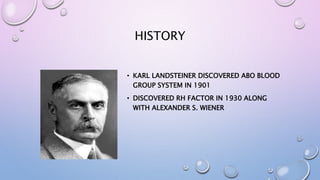
HISTORY
• KARL LANDSTEINER DISCOVERED ABO BLOOD
GROUP SYSTEM IN 1901
• DISCOVERED RH FACTOR IN 1930 ALONG
WITH ALEXANDER S. WIENER
LANDSTEINERS RULE
• If an antigen /agglutinogen is present on the red cell membrane of
an individual, the corresponding antibody/agglutinin will be absent
in the plasma.
• If an antigen / agglutinogen is absent on the red cell membrane of
an individual, the corresponding antibody / agglutinin will be
present in the plasma.
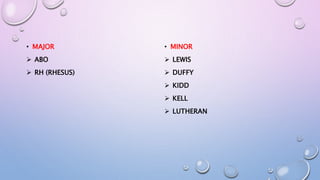
• MAJOR
 ABO
 RH (RHESUS)
• MINOR
 LEWIS
 DUFFY
 KIDD
 KELL
 LUTHERAN
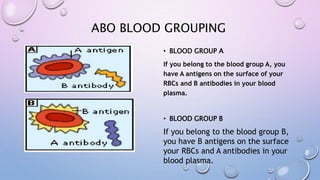
ABO BLOOD GROUPING
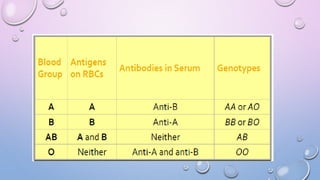
• BLOOD GROUP A
If you belong to the blood group A, you
have A antigens on the surface of your
RBCs and B antibodies in your blood
plasma.
• BLOOD GROUP B
If you belong to the blood group B,
you have B antigens on the surface
your RBCs and A antibodies in your
blood plasma.
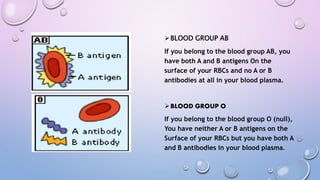
BLOOD GROUP AB
If you belong to the blood group AB, you
have both A and B antigens On the
surface of your RBCs and no A or B
antibodies at all in your blood plasma.
BLOOD GROUP O
If you belong to the blood group O (null),
You have neither A or B antigens on the
Surface of your RBCs but you have both A
and B antibodies in your blood plasma.
PRINCIPLE OF BLOOD GROUPING
• Blood grouping is done on the basis of agglutination. Agglutination
means the collection of separate particles like RBCs into clumps or
masses.
• Agglutination occurs if an antigen is mixed with its corresponding
antibody which is called isoagglutinin, i.e. Occurs when A antigen is
mixed with anti-A or when B antigen is mixed with anti-B.
• Almost all normal healthy individuals above 3-6 months of age have
“ naturally occurring antibodys” to the ABO antigens that they lack.
These antibodys termed naturally occurring because they were
thought to arise without antigenic stimulation
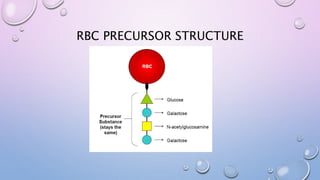
RBC PRECURSOR STRUCTURE
FORMATION OF H ANTIGEN
• The H antigen is the foundation upon
which A and B antigens are built
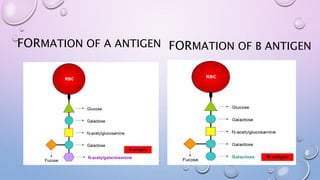
• A and B genes code for enzymes that
add a sugar to the H antigen
• Immunodominant sugars are present
at the terminal ends of the chains and
confer the ABO antigen.
FORMATION OF A ANTIGEN FORMATION OF B ANTIGEN
BOMBAY BLOOD GROUP
• RBCs with no H, A, or B antigen (patient types as O)
• Bombay RBCs are NOT agglutinated with anti- A, anti-B, or
anti-H (no antigens present)
• Bombay serum has strong anti-A, anti-B and anti-H, agglutinating all
ABO blood groups
• What blood group would you use to transfuse this patient??
• ANOTHER BOMBAY
• Group O RBCs cannot be given because they still have the H antigen
you have to transfuse the patient with blood that contains No H
antigen
Rh GROUPING
• It is the most important blood group system after ABO.
• All Rh antigens are controlled by 2 genes – RHD gene– determines
expression of D , RHCE – encodes for C,c and E,e.
• RhD is a strong antigen (immunogenic) and other antigen are less
antigenic than D and are of less clinical significance.
• Therefore , in practice Rh negative and Rh positive depends on
presence of D antigen on the surface of red cells which is detected
by strong anti-D serum. Occasionally, anti – C,E,c,e may develop
in case of pregnancy or transfusion.
• Unlike ABO system there is no naturally occuring antibodies against
Rh antigens in Rh negative individuals. Immune ANTIBODYS develop
against Rh antigen after exposure to it following transfusion or
pregnancy.
• It can be detected by enzyme treatment or coombs test(antiglobulin
test)
• SIGNIFICANCE: Rh incompatibility results in haemolytic tranfusion
reaction. Haemolytic disease of newborn.
IMPORTANCE OF BLOOD GROUPING AND RH
TYPING
• IN BLOOD TRANSFUSION
• HAEMOLYTIC DISEASE OF NEWBORN.
• PATERNITY DISPUTE
• MEDICOLEGAL ISSUES
• IMMUNOLOGY,GENETICS
• SUSCEPTIBILITY TO VARIOUS DISEASES (BLOOD GROUP O – PEPTIC ULCER, BLOOD
GROUP A – GASTRIC ULCER)
MINOR BLOOD GROUPS AND SIGNIFICANCE
1.Duffy blood group- lack glycoprotein DARC, which is receptor for
plasmodium vivax. So this blood group patients are not susceptible to
malaria.
2. Kell blood group- very immunogenic . increased hemolytic disease
of new born.
3.Kidd blood group- increased hemolytic transfusion reaction.
UNIVERSAL DONOR AND RECIPIENT
UNIVERSAL DONOR
 GROUP O
 NEITHER A OR B ANTIGENS
UNIVERSAL RECEIPIENT
 GROUP AB
 PATIENT HAS NO ANTI A/ANTI B
PRESENT.
 CANNOT LYSE ANY TRANSFUSED
CELL

Different blood groups and their significance

  • 1.
    DIFFERENT BLOOD GROUPS ANDTHEIR SIGNIFICANCE
  • 2.
    HISTORY • KARL LANDSTEINERDISCOVERED ABO BLOOD GROUP SYSTEM IN 1901 • DISCOVERED RH FACTOR IN 1930 ALONG WITH ALEXANDER S. WIENER
  • 3.
    LANDSTEINERS RULE • Ifan antigen /agglutinogen is present on the red cell membrane of an individual, the corresponding antibody/agglutinin will be absent in the plasma. • If an antigen / agglutinogen is absent on the red cell membrane of an individual, the corresponding antibody / agglutinin will be present in the plasma.
  • 4.
    • MAJOR  ABO RH (RHESUS) • MINOR  LEWIS  DUFFY  KIDD  KELL  LUTHERAN
  • 5.
    ABO BLOOD GROUPING •BLOOD GROUP A If you belong to the blood group A, you have A antigens on the surface of your RBCs and B antibodies in your blood plasma. • BLOOD GROUP B If you belong to the blood group B, you have B antigens on the surface your RBCs and A antibodies in your blood plasma.
  • 6.
    BLOOD GROUP AB Ifyou belong to the blood group AB, you have both A and B antigens On the surface of your RBCs and no A or B antibodies at all in your blood plasma. BLOOD GROUP O If you belong to the blood group O (null), You have neither A or B antigens on the Surface of your RBCs but you have both A and B antibodies in your blood plasma.
  • 8.
    PRINCIPLE OF BLOODGROUPING • Blood grouping is done on the basis of agglutination. Agglutination means the collection of separate particles like RBCs into clumps or masses. • Agglutination occurs if an antigen is mixed with its corresponding antibody which is called isoagglutinin, i.e. Occurs when A antigen is mixed with anti-A or when B antigen is mixed with anti-B. • Almost all normal healthy individuals above 3-6 months of age have “ naturally occurring antibodys” to the ABO antigens that they lack. These antibodys termed naturally occurring because they were thought to arise without antigenic stimulation
  • 9.
  • 10.
    FORMATION OF HANTIGEN • The H antigen is the foundation upon which A and B antigens are built • A and B genes code for enzymes that add a sugar to the H antigen • Immunodominant sugars are present at the terminal ends of the chains and confer the ABO antigen.
  • 11.
    FORMATION OF AANTIGEN FORMATION OF B ANTIGEN
  • 12.
    BOMBAY BLOOD GROUP •RBCs with no H, A, or B antigen (patient types as O) • Bombay RBCs are NOT agglutinated with anti- A, anti-B, or anti-H (no antigens present)
  • 13.
    • Bombay serumhas strong anti-A, anti-B and anti-H, agglutinating all ABO blood groups • What blood group would you use to transfuse this patient?? • ANOTHER BOMBAY • Group O RBCs cannot be given because they still have the H antigen you have to transfuse the patient with blood that contains No H antigen
  • 14.
    Rh GROUPING • Itis the most important blood group system after ABO. • All Rh antigens are controlled by 2 genes – RHD gene– determines expression of D , RHCE – encodes for C,c and E,e. • RhD is a strong antigen (immunogenic) and other antigen are less antigenic than D and are of less clinical significance. • Therefore , in practice Rh negative and Rh positive depends on presence of D antigen on the surface of red cells which is detected by strong anti-D serum. Occasionally, anti – C,E,c,e may develop in case of pregnancy or transfusion.
  • 15.
    • Unlike ABOsystem there is no naturally occuring antibodies against Rh antigens in Rh negative individuals. Immune ANTIBODYS develop against Rh antigen after exposure to it following transfusion or pregnancy. • It can be detected by enzyme treatment or coombs test(antiglobulin test) • SIGNIFICANCE: Rh incompatibility results in haemolytic tranfusion reaction. Haemolytic disease of newborn.
  • 16.
    IMPORTANCE OF BLOODGROUPING AND RH TYPING • IN BLOOD TRANSFUSION • HAEMOLYTIC DISEASE OF NEWBORN. • PATERNITY DISPUTE • MEDICOLEGAL ISSUES • IMMUNOLOGY,GENETICS • SUSCEPTIBILITY TO VARIOUS DISEASES (BLOOD GROUP O – PEPTIC ULCER, BLOOD GROUP A – GASTRIC ULCER)
  • 17.
    MINOR BLOOD GROUPSAND SIGNIFICANCE 1.Duffy blood group- lack glycoprotein DARC, which is receptor for plasmodium vivax. So this blood group patients are not susceptible to malaria. 2. Kell blood group- very immunogenic . increased hemolytic disease of new born. 3.Kidd blood group- increased hemolytic transfusion reaction.
  • 18.
    UNIVERSAL DONOR ANDRECIPIENT UNIVERSAL DONOR  GROUP O  NEITHER A OR B ANTIGENS UNIVERSAL RECEIPIENT  GROUP AB  PATIENT HAS NO ANTI A/ANTI B PRESENT.  CANNOT LYSE ANY TRANSFUSED CELL