Blended Learning:
The way ahead for
learning organisations
200+ Clients In 13 Countries
Established In 2004
US
India
Australia
Middle East
New Zealand
S.Africa
Nigeria Kenya Singapore
Venezuela
UK
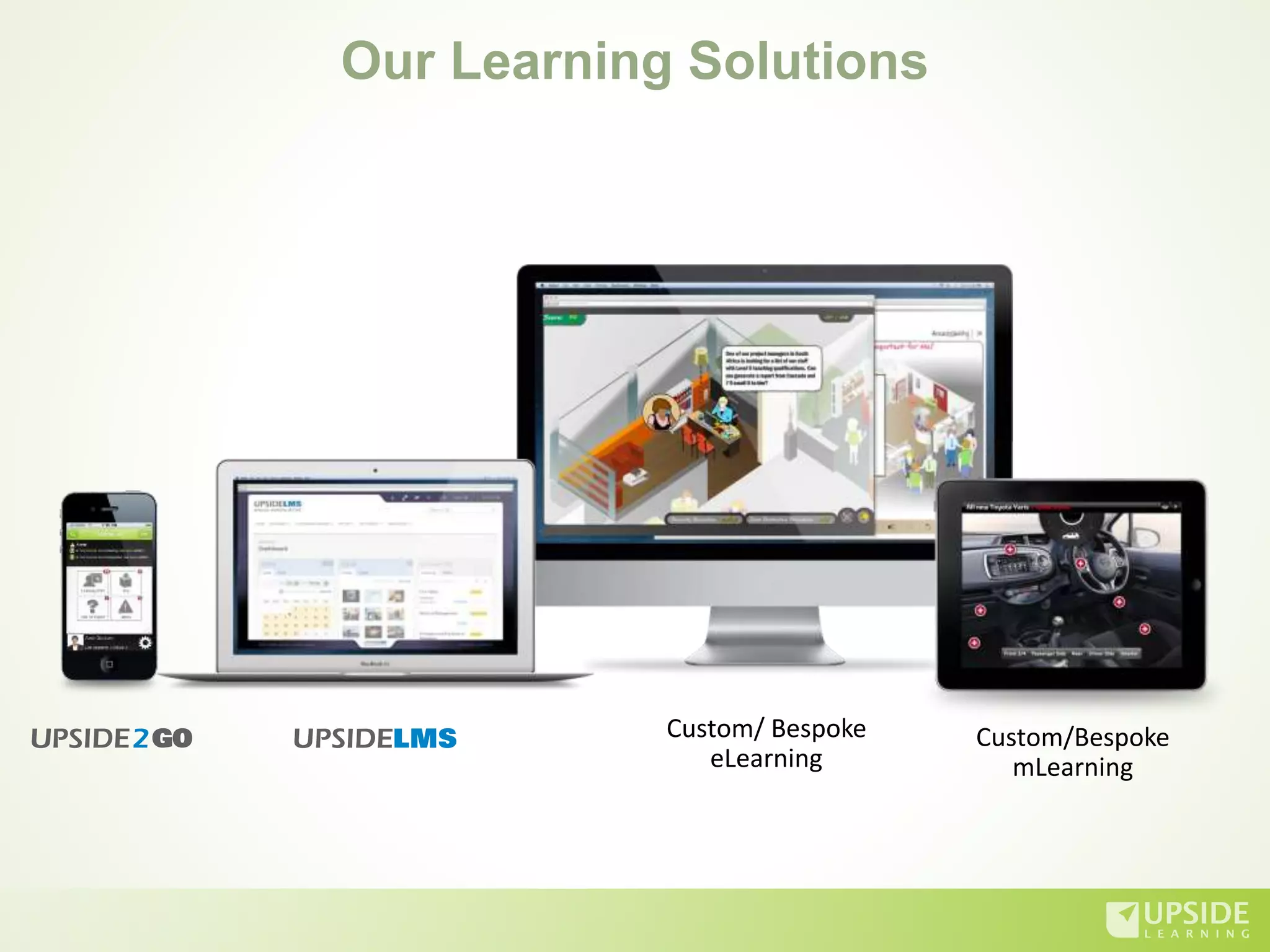
Our Learning Solutions
Custom/ Bespoke
eLearning
Custom/Bespoke
mLearning
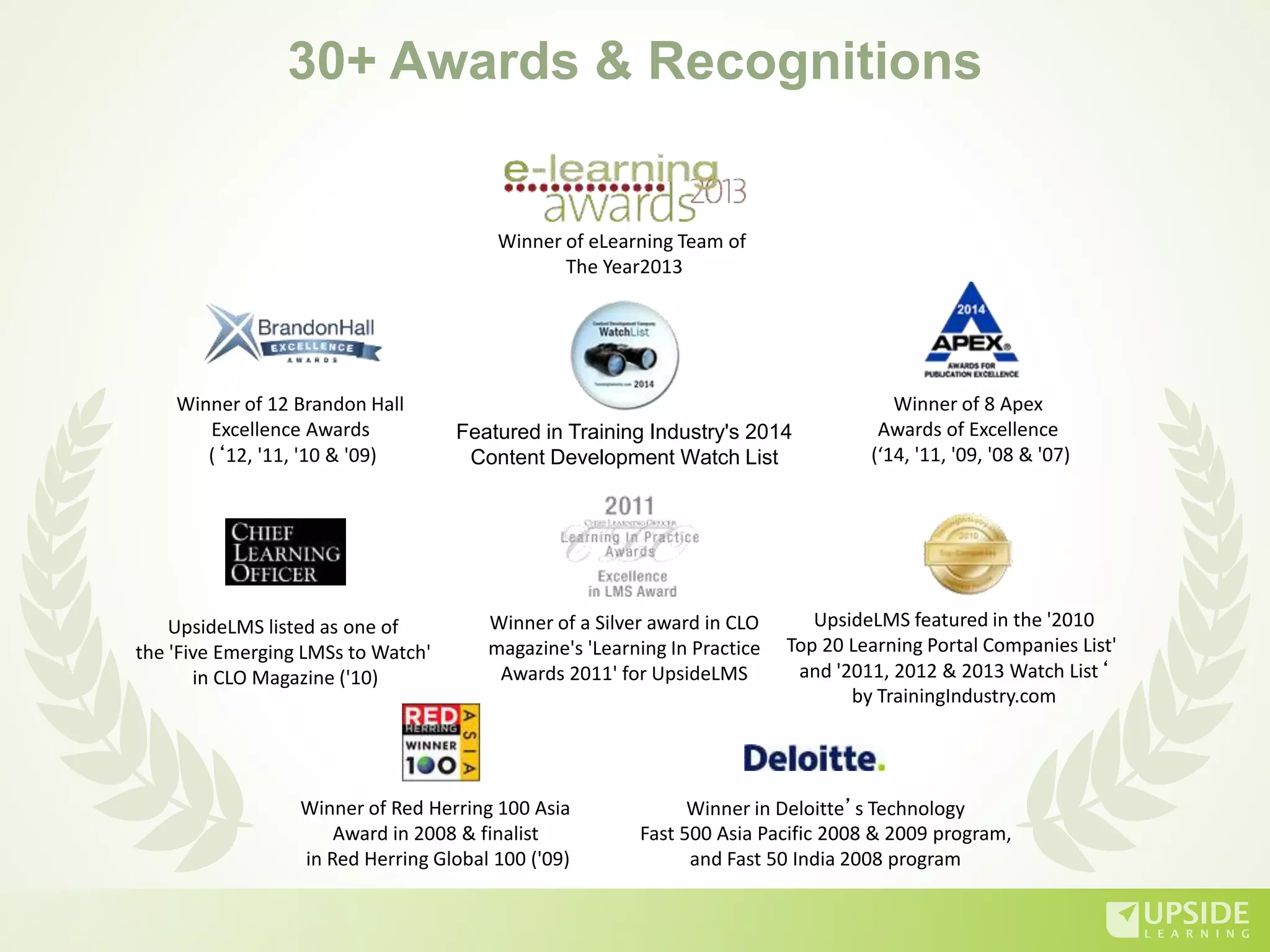
30+ Awards & Recognitions
Winner of a Silver award in CLO
magazine's 'Learning In Practice
Awards 2011' for UpsideLMS
UpsideLMS listed as one of
the 'Five Emerging LMSs to Watch'
in CLO Magazine ('10)
Winner of 8 Apex
Awards of Excellence
(‘14, '11, '09, '08 & '07)
Winner of 12 Brandon Hall
Excellence Awards
(‘12, '11, '10 & '09)
UpsideLMS featured in the '2010
Top 20 Learning Portal Companies List'
and '2011, 2012 & 2013 Watch List‘
by TrainingIndustry.com
Winner of Red Herring 100 Asia
Award in 2008 & finalist
in Red Herring Global 100 ('09)
Winner in Deloitte’s Technology
Fast 500 Asia Pacific 2008 & 2009 program,
and Fast 50 India 2008 program
Winner of eLearning Team of
The Year2013
Featured in Training Industry's 2014
Content Development Watch List
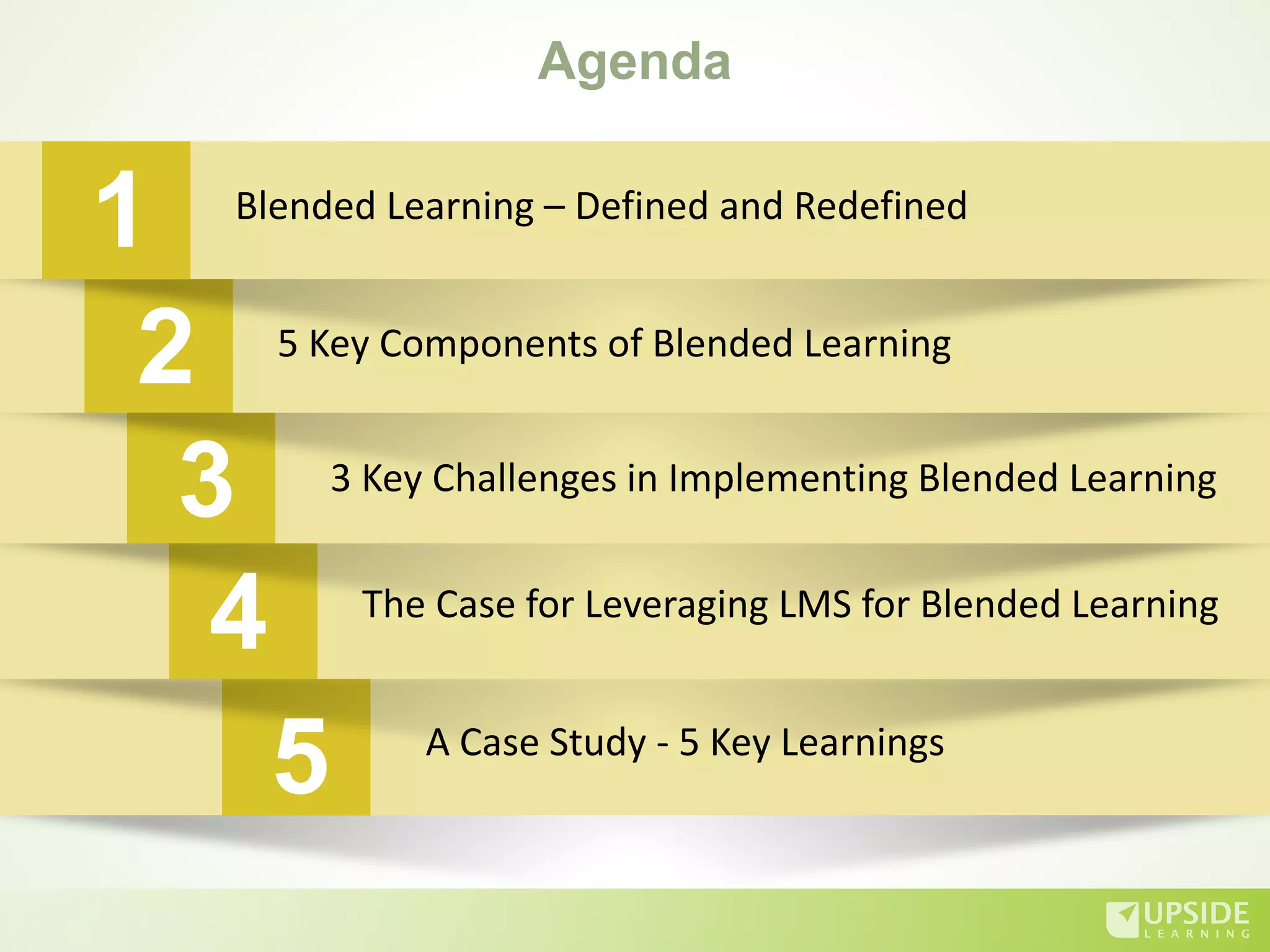
5 A Case Study - 5 Key Learnings
4 The Case for Leveraging LMS for Blended Learning
1 Blended Learning – Defined and Redefined
5 Key Components of Blended Learning
3 Key Challenges in Implementing Blended Learning
2
3
Agenda
Blended Learning
An Overview
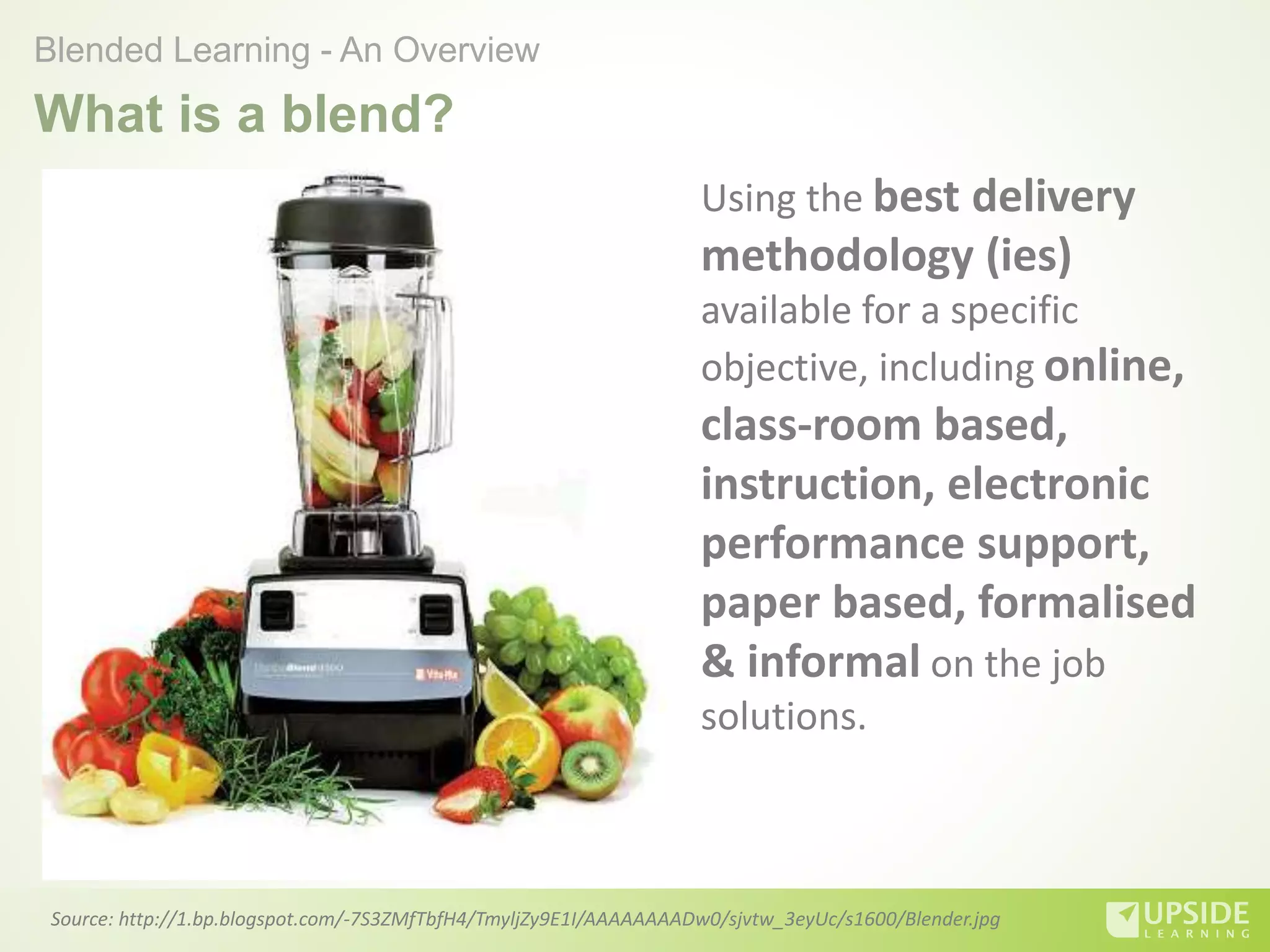
What is a blend?
Source: http://1.bp.blogspot.com/-7S3ZMfTbfH4/TmyljZy9E1I/AAAAAAAADw0/sjvtw_3eyUc/s1600/Blender.jpg
Blended Learning - An Overview
Using the best delivery
methodology (ies)
available for a specific
objective, including online,
class-room based,
instruction, electronic
performance support,
paper based, formalised
& informal on the job
solutions.
Blended Learning - An Overview
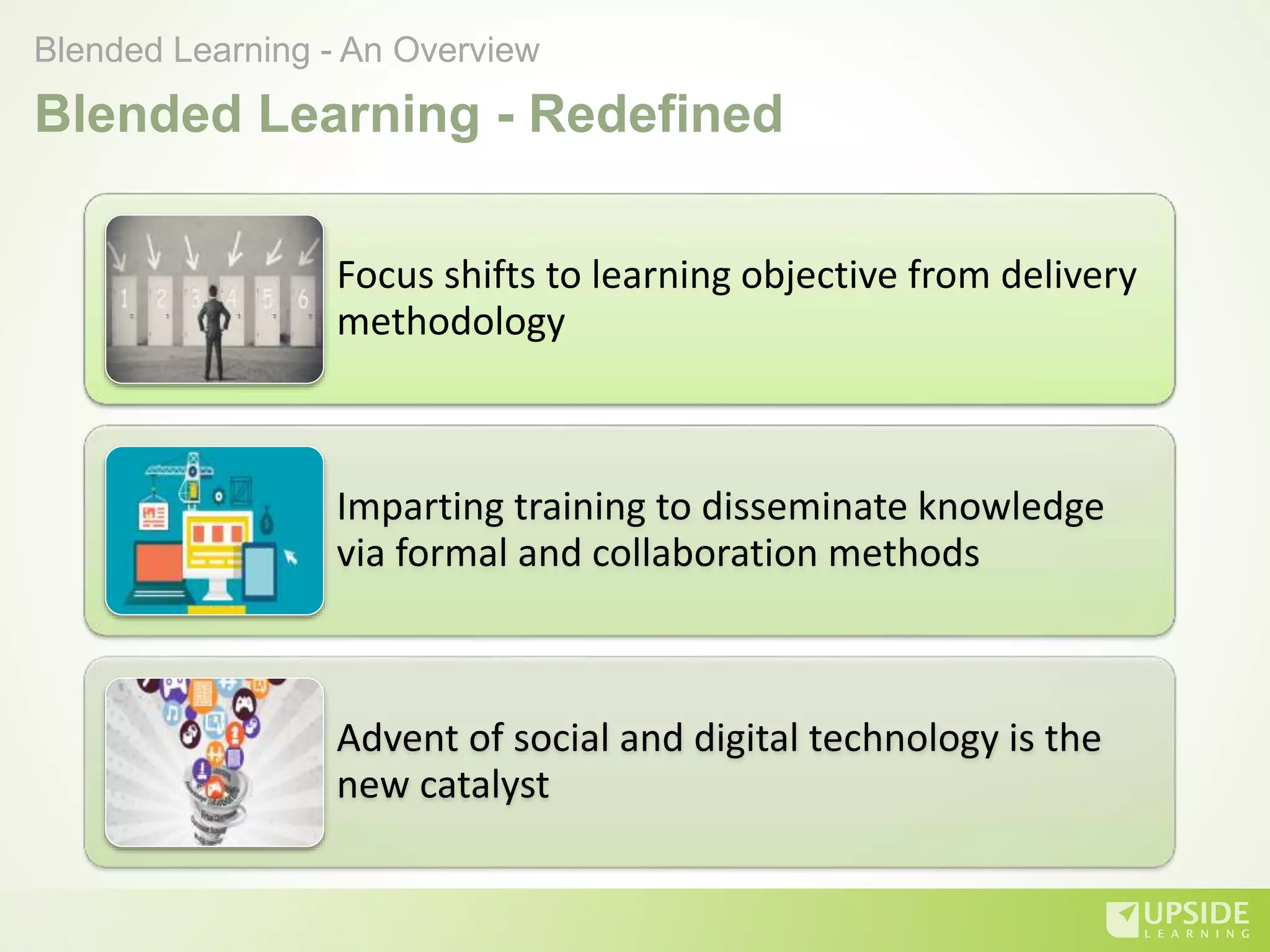
Blended Learning - Redefined
Focus shifts to learning objective from delivery
methodology
Imparting training to disseminate knowledge
via formal and collaboration methods
Advent of social and digital technology is the
new catalyst
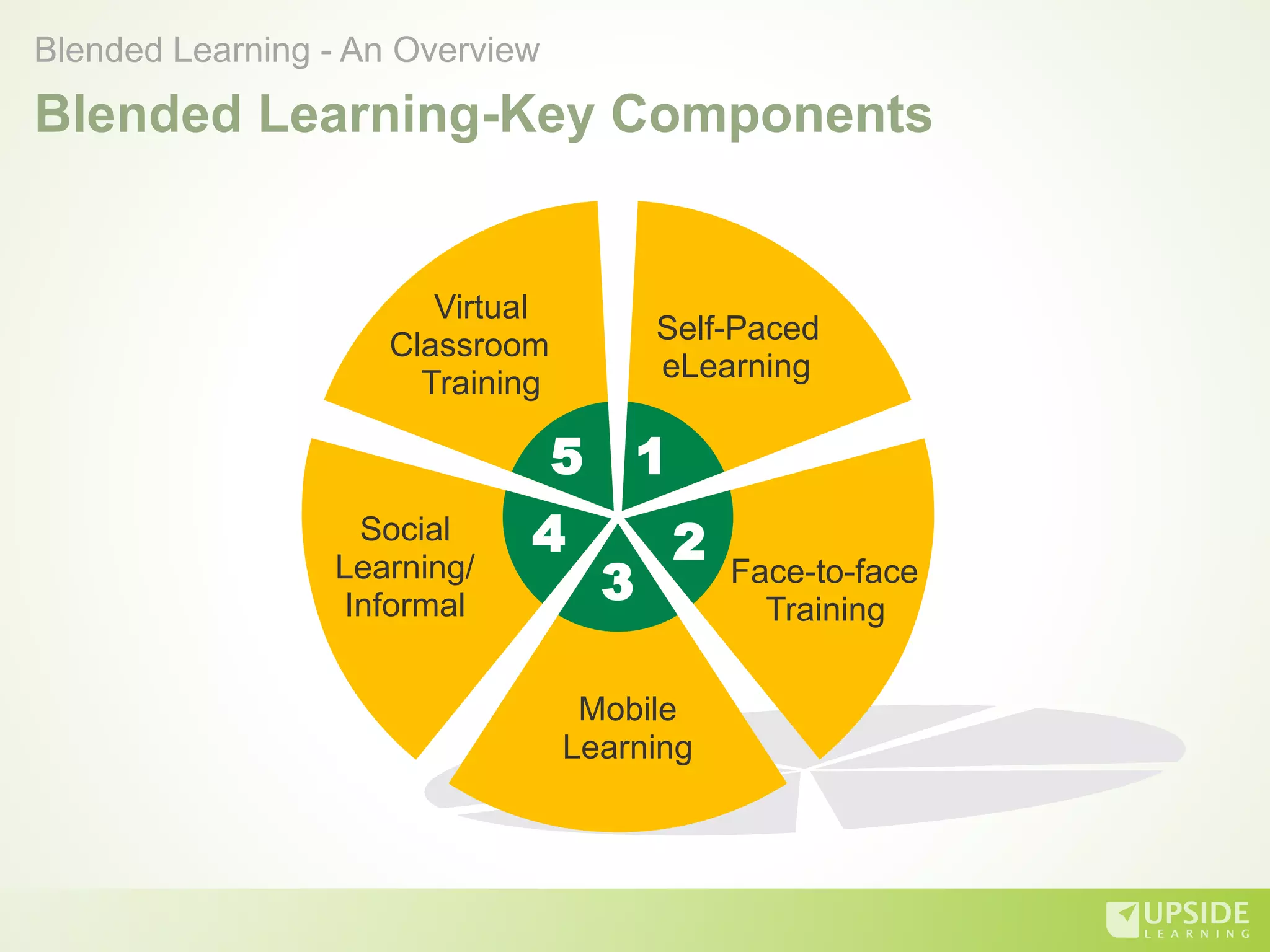
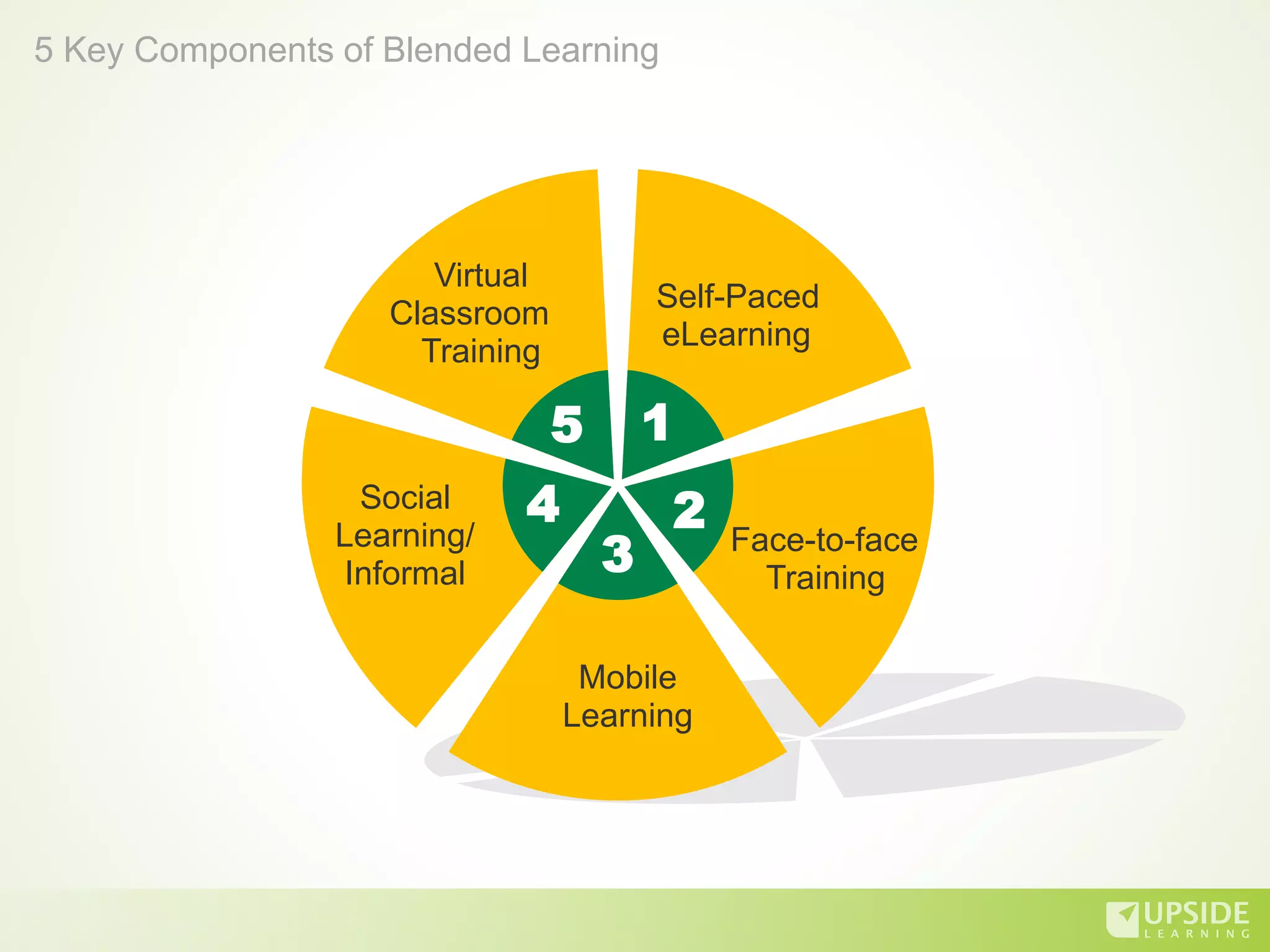
Blended Learning-Key Components
Self-Paced
eLearning
5 1
2
3
4
Face-to-face
Training
Mobile
Learning
Social
Learning/
Informal
Virtual
Classroom
Training
Blended Learning - An Overview
Poll # 1
Does your organisation currently use blended learning
to deliver training?
- Yes
- No
- Can’t say
Poll # 2
Is blended learning the way ahead for your organisation?
- Yes
- No
- Can’t say
5 Key Components of
Blended Learning
Self-Paced
eLearning
5 1
2
3
4
Face-to-face
Training
Mobile
Learning
Social
Learning/
Informal
Virtual
Classroom
Training
5 Key Components of Blended Learning
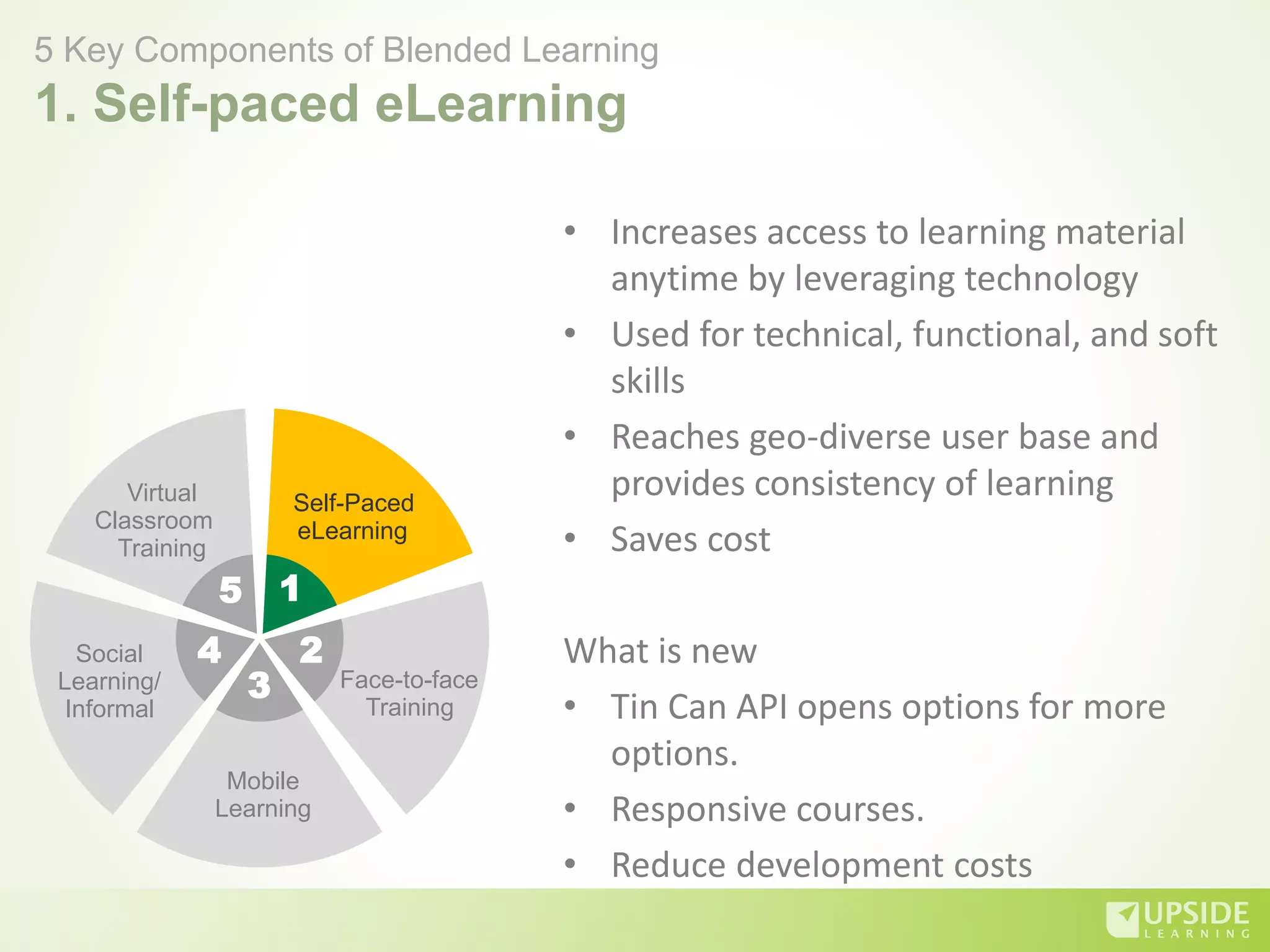
• Increases access to learning material
anytime by leveraging technology
• Used for technical, functional, and soft
skills
• Reaches geo-diverse user base and
provides consistency of learning
• Saves cost
What is new
• Tin Can API opens options for more
options.
• Responsive courses.
• Reduce development costs
5 Key Components of Blended Learning
1. Self-paced eLearning
Self-Paced
eLearning
5 1
2
3
4
Face-to-face
Training
Mobile
Learning
Social
Learning/
Informal
Virtual
Classroom
Training
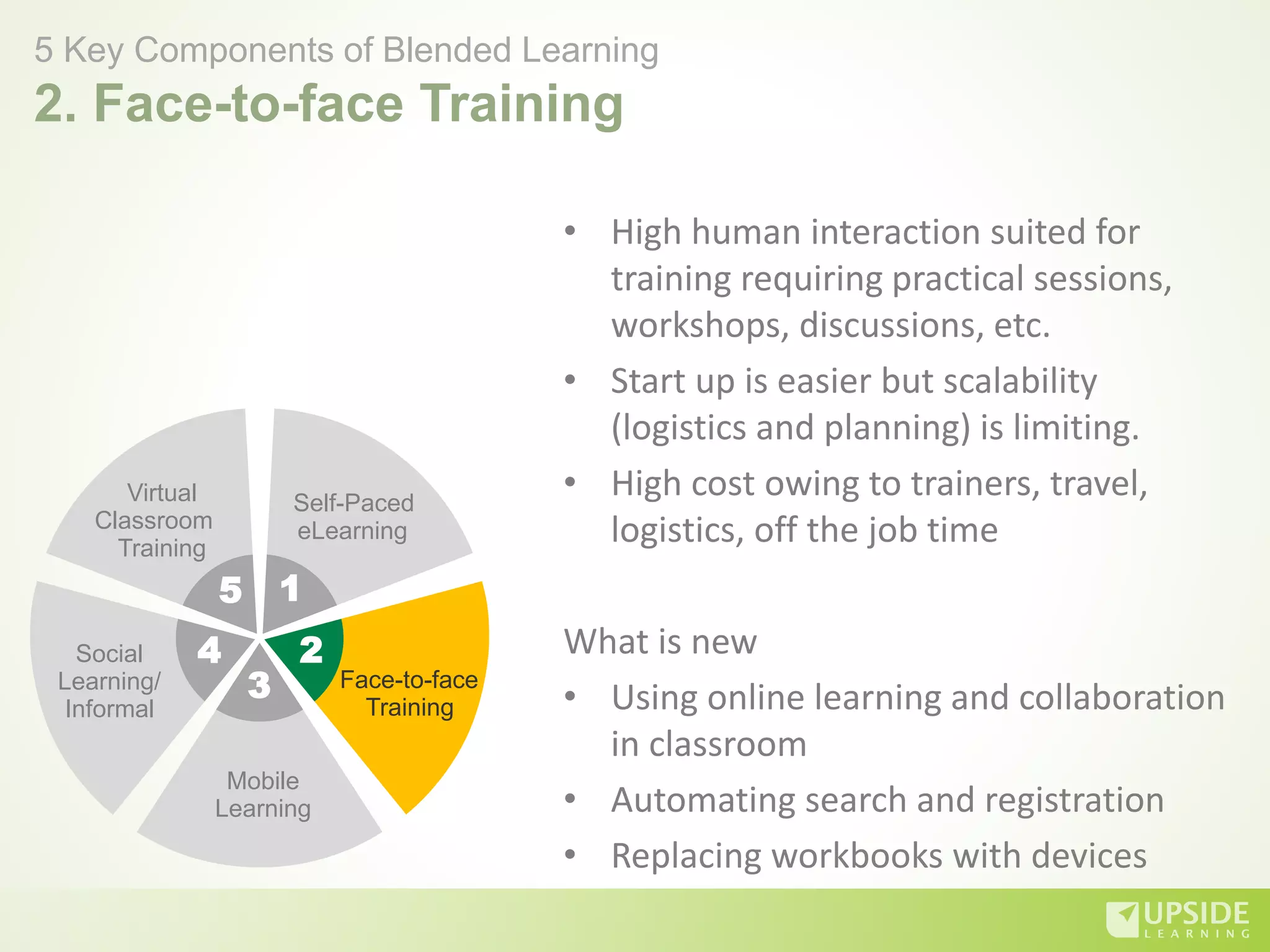
• High human interaction suited for
training requiring practical sessions,
workshops, discussions, etc.
• Start up is easier but scalability
(logistics and planning) is limiting.
• High cost owing to trainers, travel,
logistics, off the job time
What is new
• Using online learning and collaboration
in classroom
• Automating search and registration
• Replacing workbooks with devices
5 Key Components of Blended Learning
2. Face-to-face Training
Self-Paced
eLearning
5 1
2
3
4
Face-to-face
Training
Mobile
Learning
Social
Learning/
Informal
Virtual
Classroom
Training
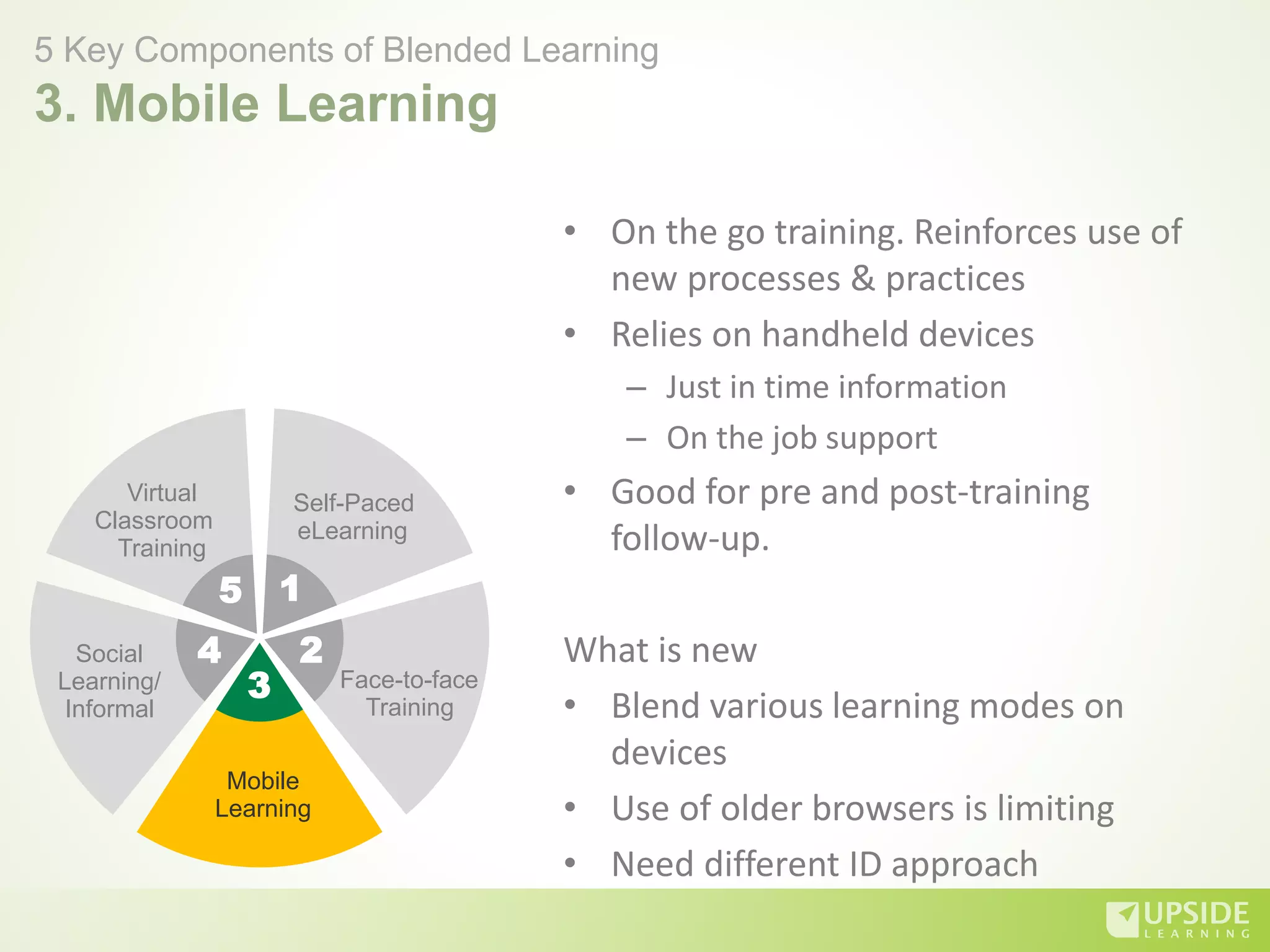
• On the go training. Reinforces use of
new processes & practices
• Relies on handheld devices
– Just in time information
– On the job support
• Good for pre and post-training
follow-up.
What is new
• Blend various learning modes on
devices
• Use of older browsers is limiting
• Need different ID approach
5 Key Components of Blended Learning
3. Mobile Learning
Self-Paced
eLearning
5 1
2
3
4
Face-to-face
Training
Mobile
Learning
Social
Learning/
Informal
Virtual
Classroom
Training
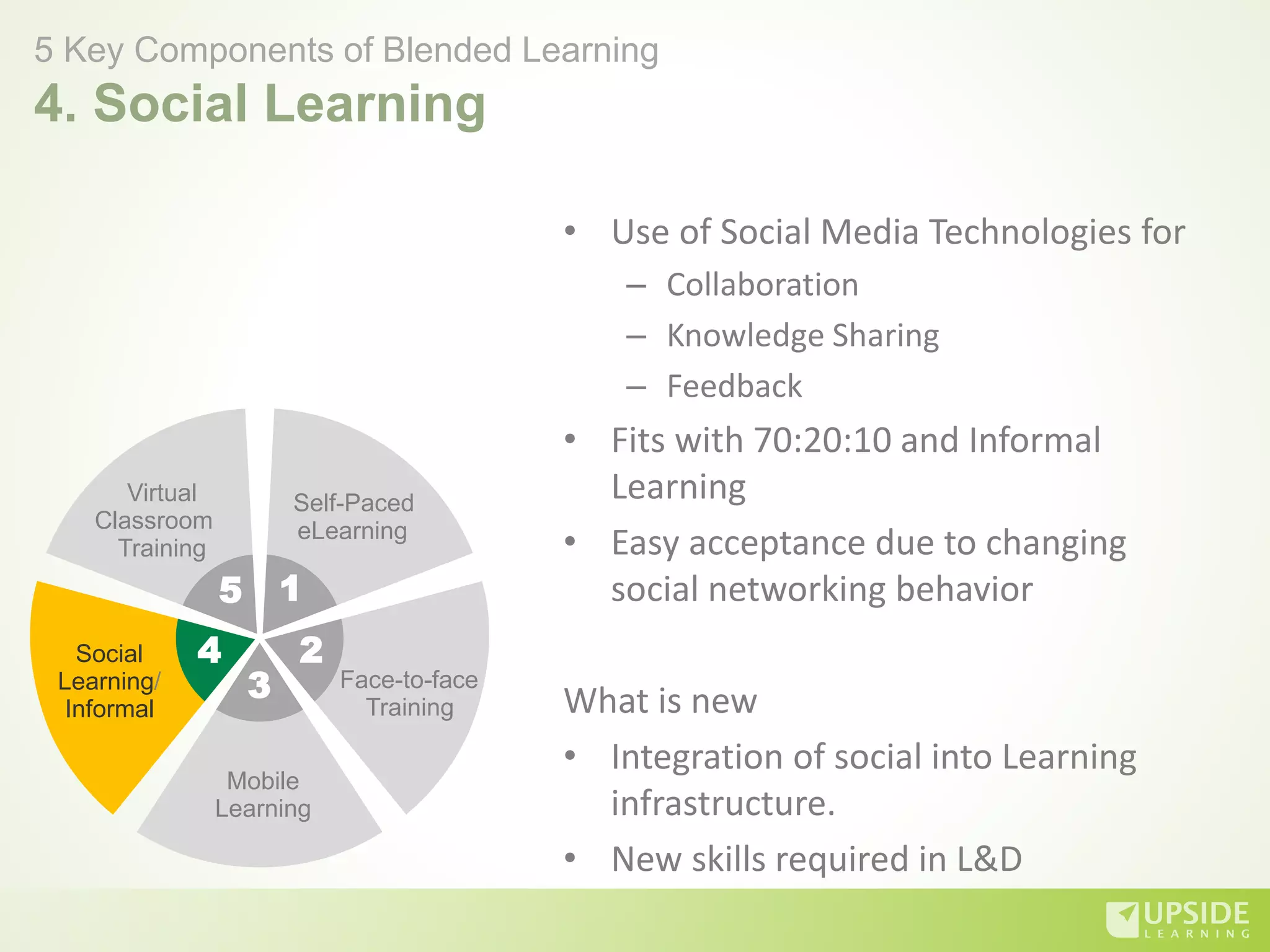
• Use of Social Media Technologies for
– Collaboration
– Knowledge Sharing
– Feedback
• Fits with 70:20:10 and Informal
Learning
• Easy acceptance due to changing
social networking behavior
What is new
• Integration of social into Learning
infrastructure.
• New skills required in L&D
5 Key Components of Blended Learning
4. Social Learning
Self-Paced
eLearning
5 1
2
3
4
Face-to-face
Training
Mobile
Learning
Social
Learning/
Informal
Virtual
Classroom
Training
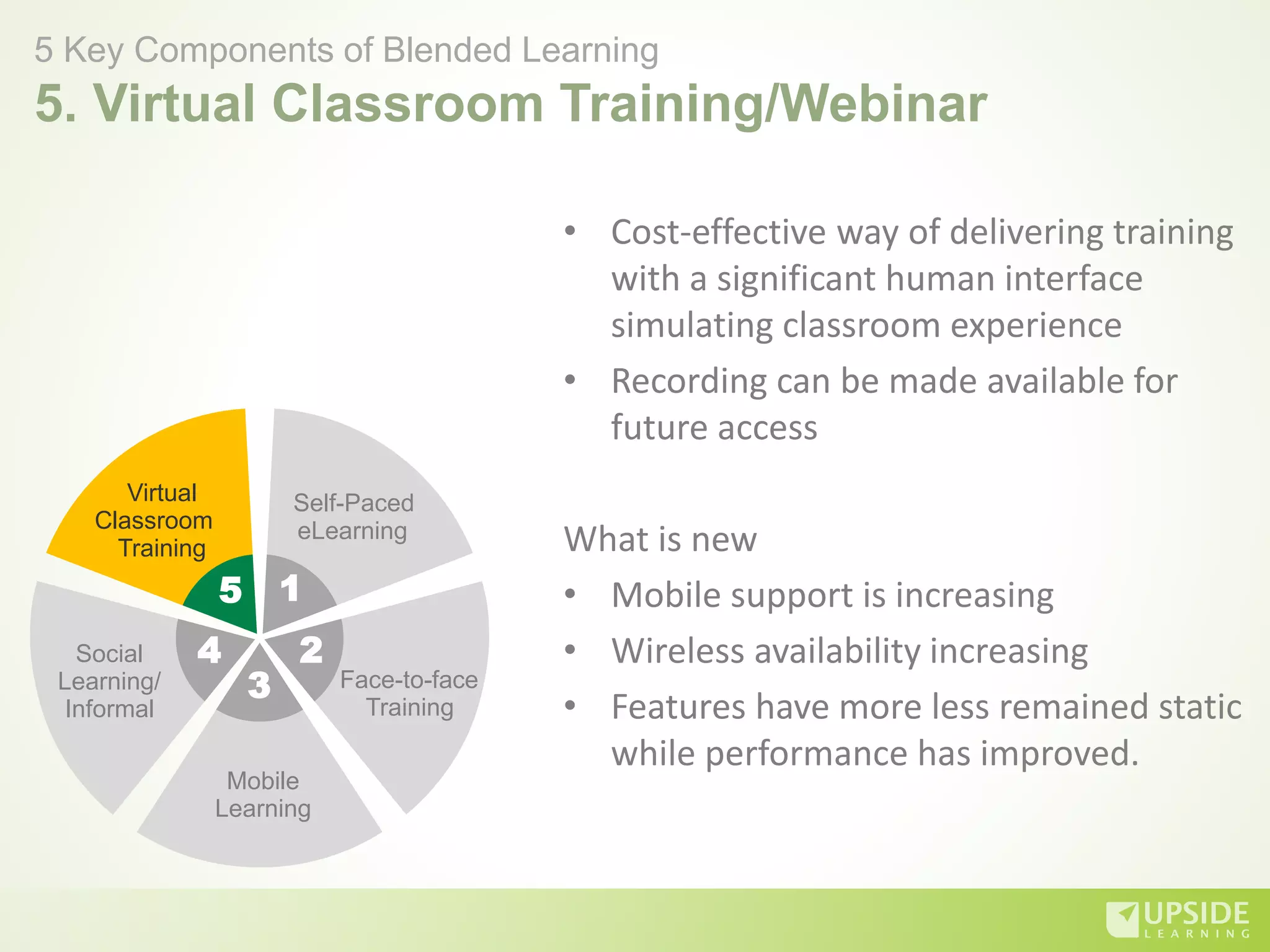
• Cost-effective way of delivering training
with a significant human interface
simulating classroom experience
• Recording can be made available for
future access
What is new
• Mobile support is increasing
• Wireless availability increasing
• Features have more less remained static
while performance has improved.
5 Key Components of Blended Learning
5. Virtual Classroom Training/Webinar
Self-Paced
eLearning
5 1
2
3
4
Face-to-face
Training
Mobile
Learning
Social
Learning/
Informal
Virtual
Classroom
Training
Poll # 3
What are the top challenges in blended learning for your
organisation?
- Management buy-in
- Unable or unwilling to leverage technology
- Not required given the size of organisation
- Lack of human resources to manage
- Absence of a good system to manage centrally
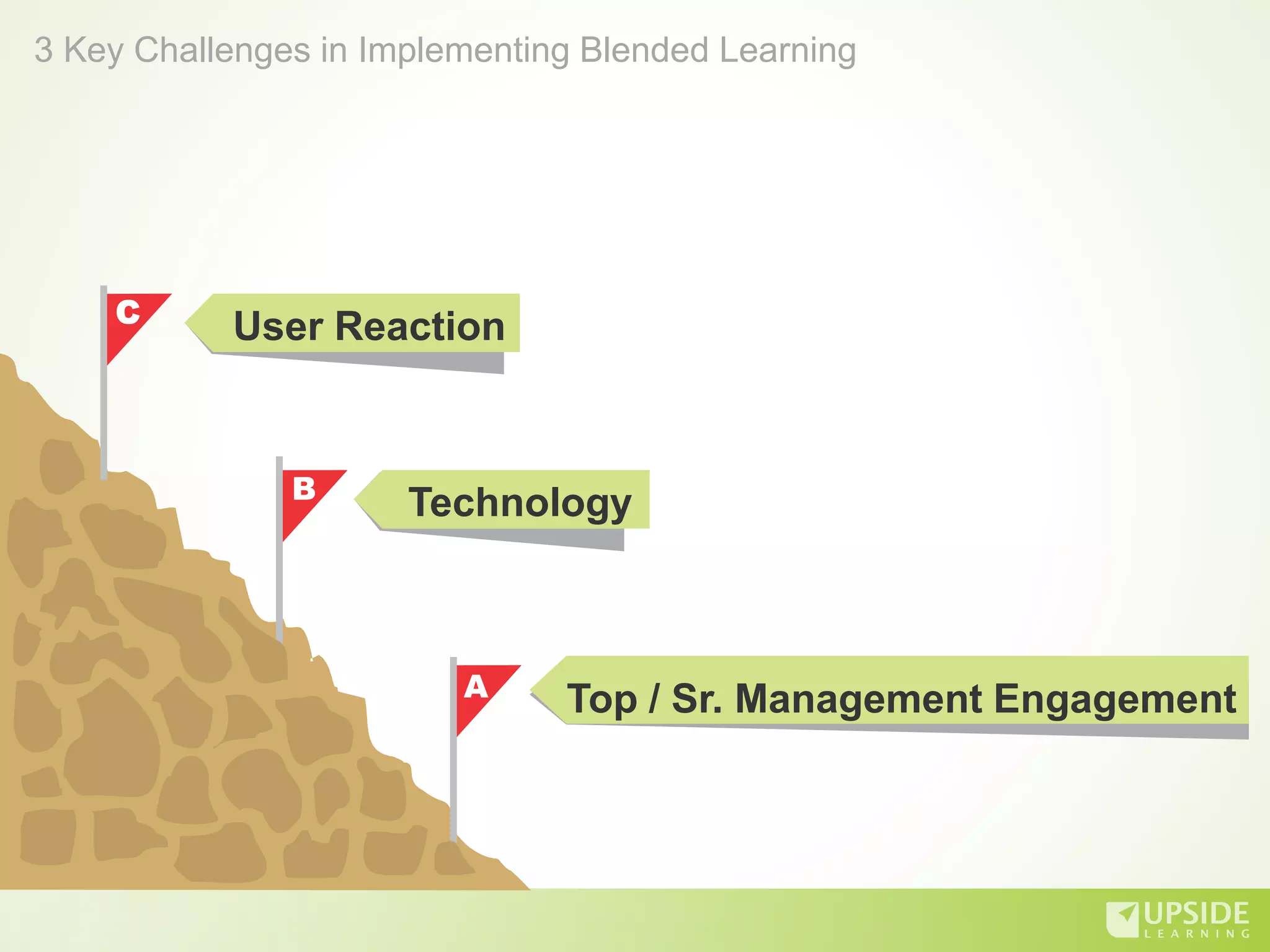
3 Key Challenges in Implementing
Blended Learning
TechnologyB
Top / Sr. Management EngagementA
C
User Reaction
3 Key Challenges in Implementing Blended Learning
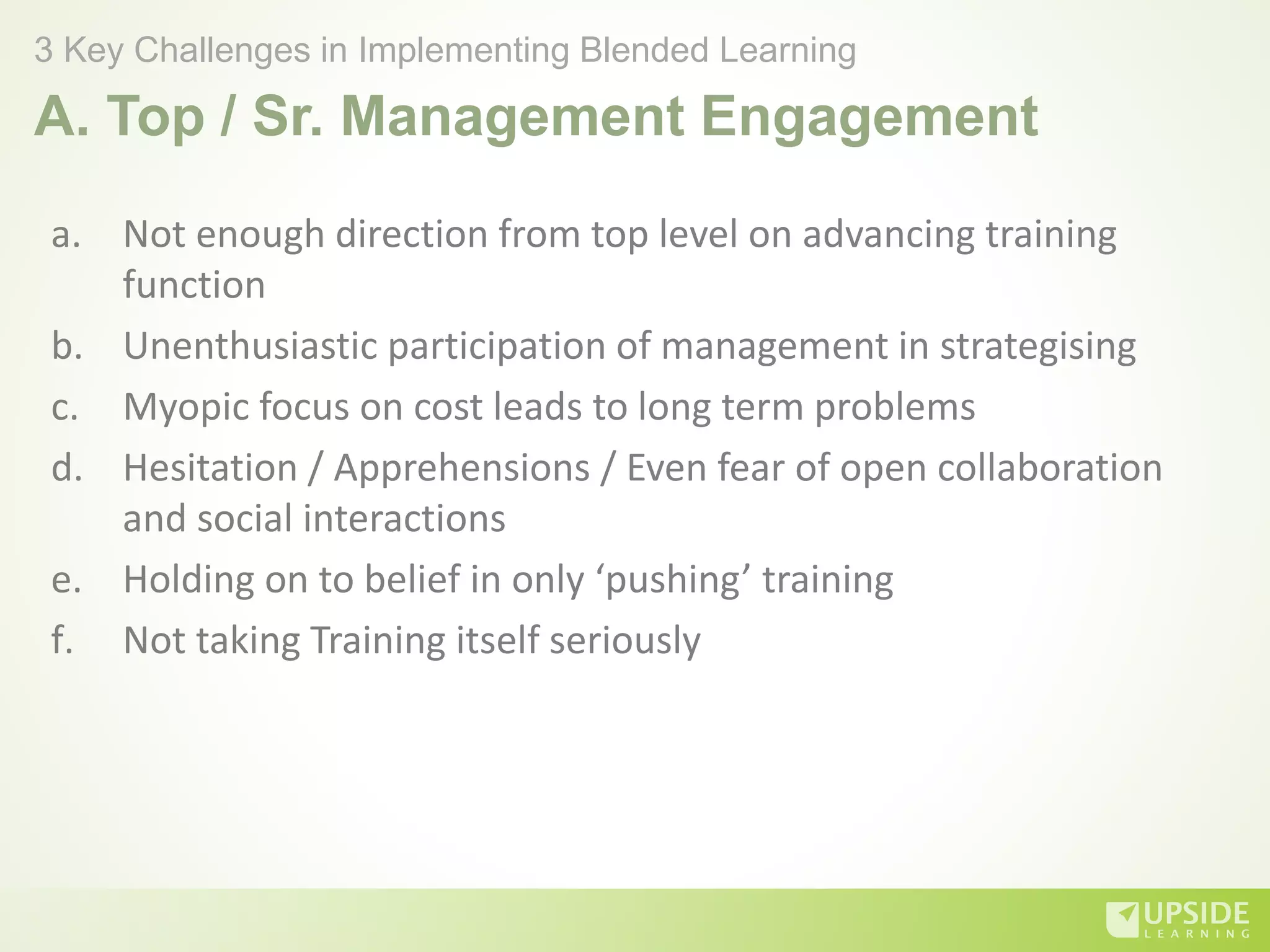
A. Top / Sr. Management Engagement
a. Not enough direction from top level on advancing training
function
b. Unenthusiastic participation of management in strategising
c. Myopic focus on cost leads to long term problems
d. Hesitation / Apprehensions / Even fear of open collaboration
and social interactions
e. Holding on to belief in only ‘pushing’ training
f. Not taking Training itself seriously
3 Key Challenges in Implementing Blended Learning
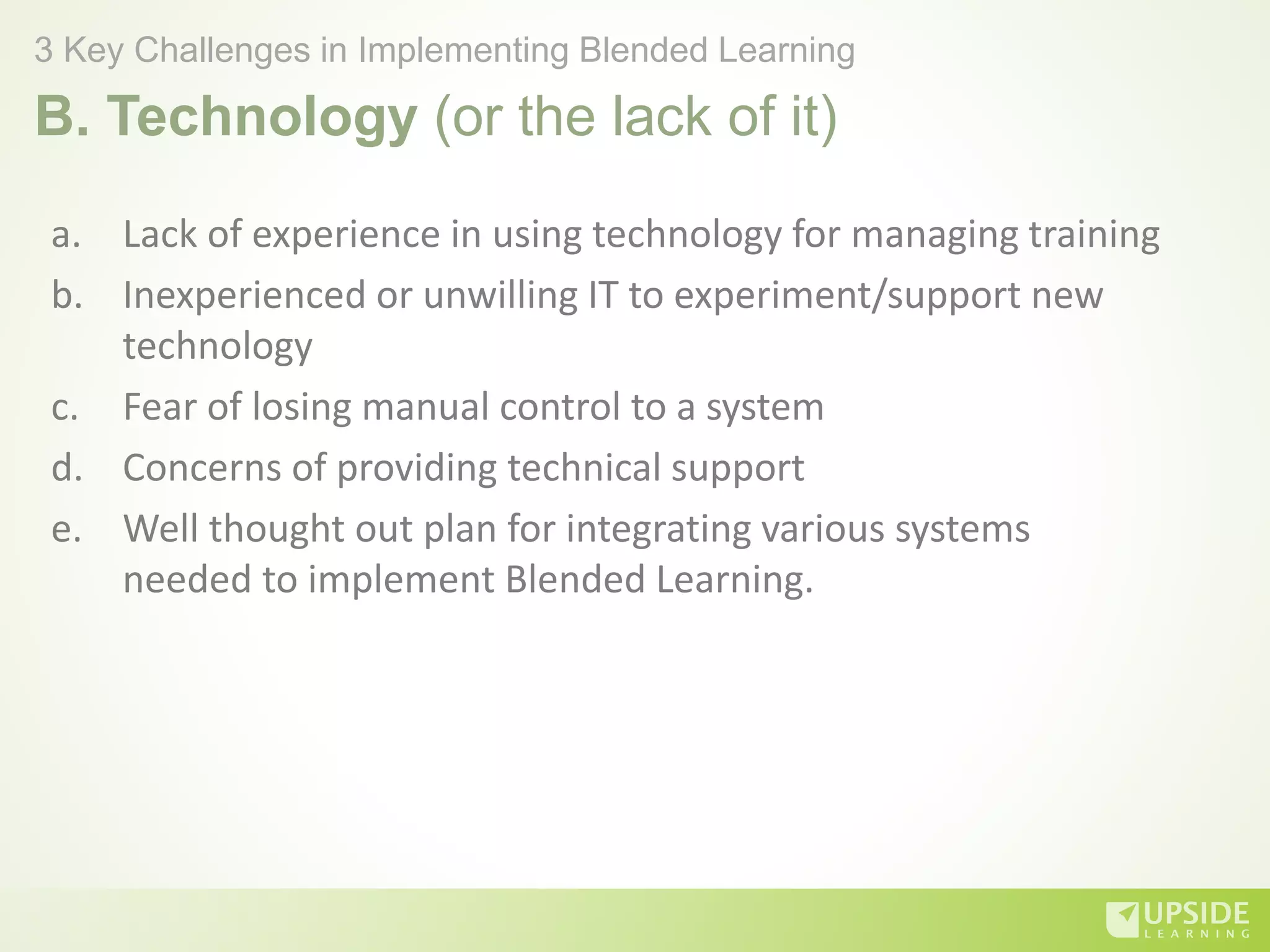
B. Technology (or the lack of it)
a. Lack of experience in using technology for managing training
b. Inexperienced or unwilling IT to experiment/support new
technology
c. Fear of losing manual control to a system
d. Concerns of providing technical support
e. Well thought out plan for integrating various systems
needed to implement Blended Learning.
3 Key Challenges in Implementing Blended Learning
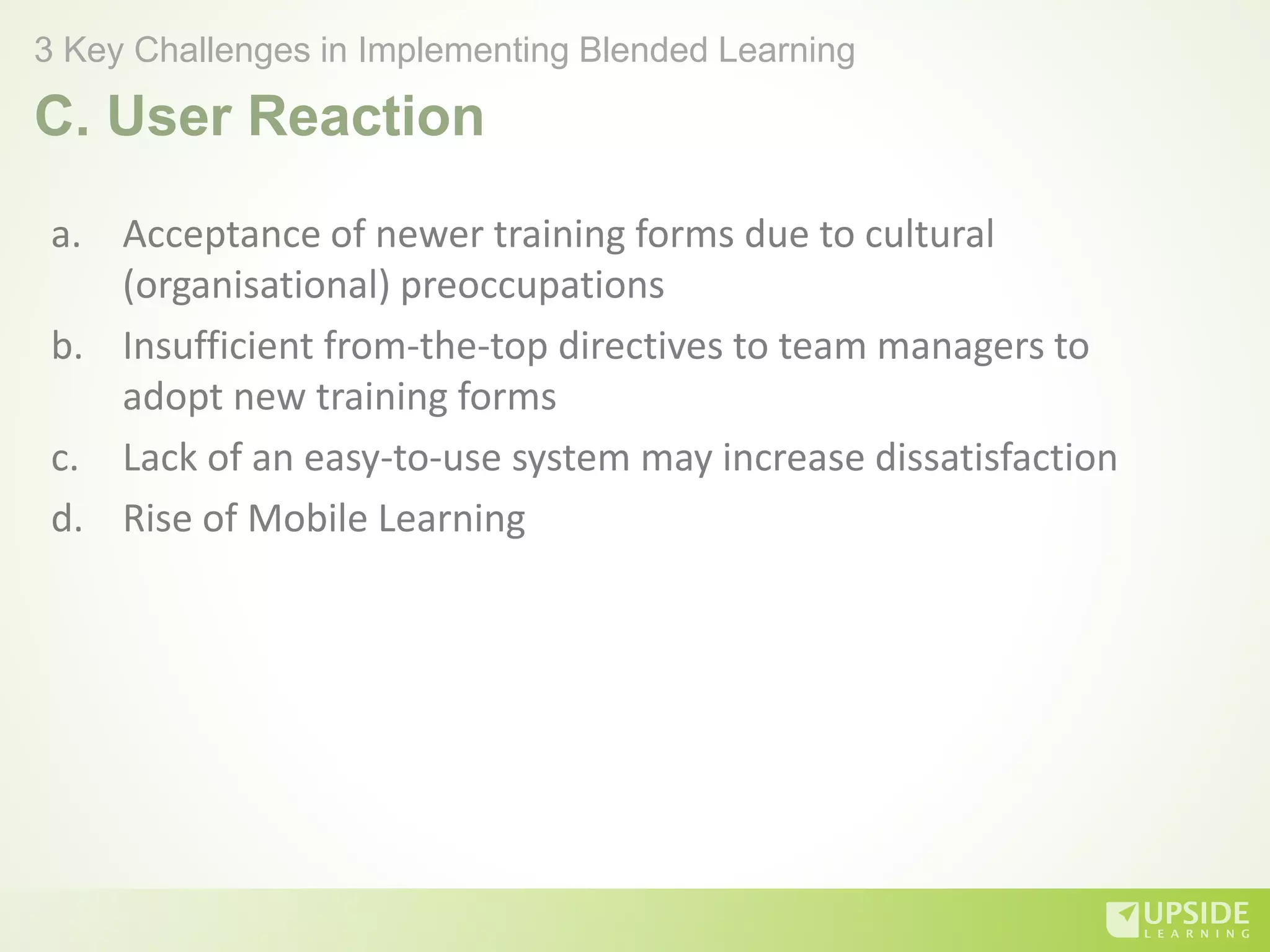
C. User Reaction
a. Acceptance of newer training forms due to cultural
(organisational) preoccupations
b. Insufficient from-the-top directives to team managers to
adopt new training forms
c. Lack of an easy-to-use system may increase dissatisfaction
d. Rise of Mobile Learning
3 Key Challenges in Implementing Blended Learning
The Case for Leveraging LMS for
Blended Learning
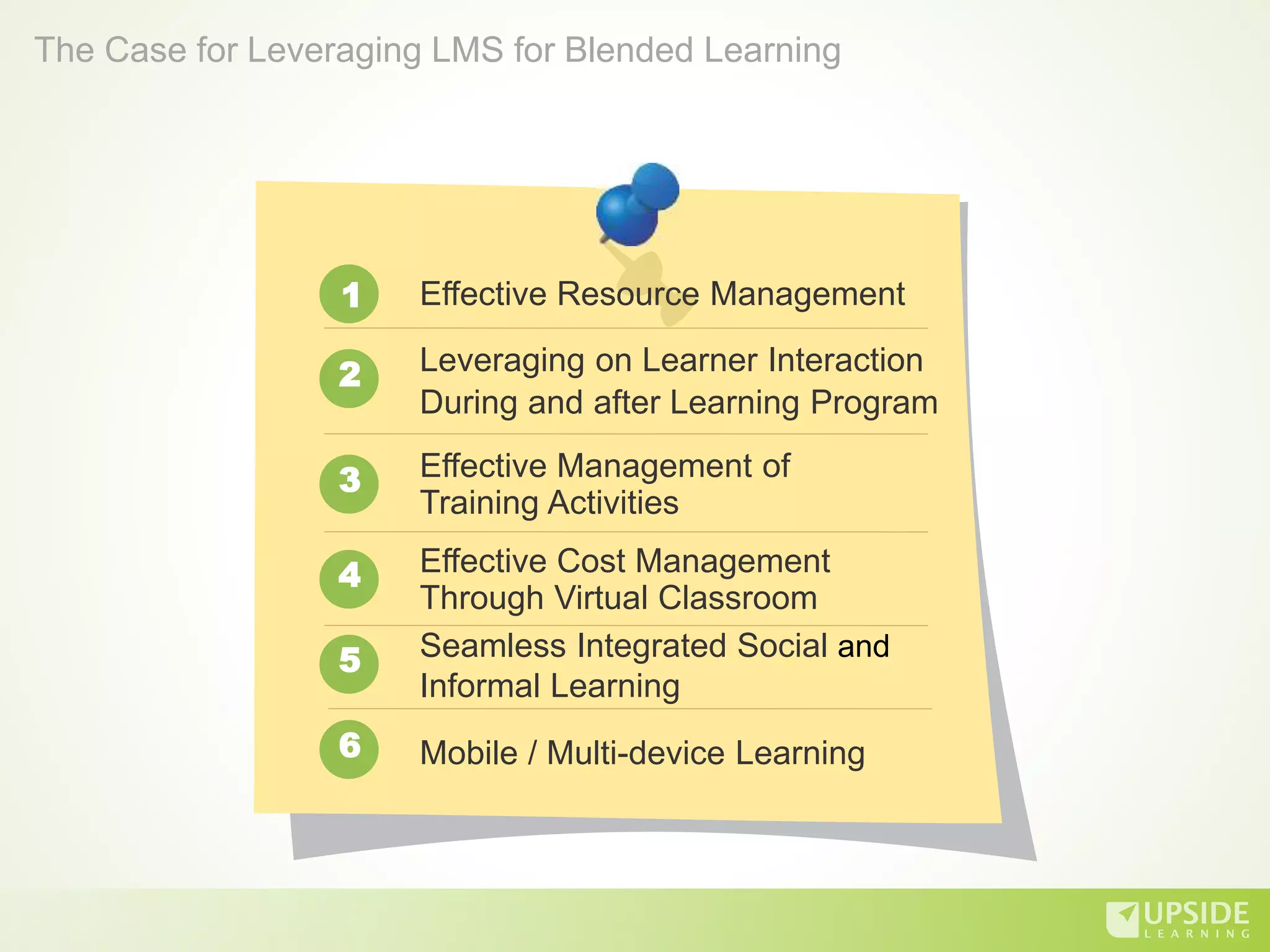
Effective Resource Management
Leveraging on Learner Interaction
During and after Learning Program
Effective Management of
Training Activities
Effective Cost Management
Through Virtual Classroom
Seamless Integrated Social and
Informal Learning
1
2
3
4
5
The Case for Leveraging LMS for Blended Learning
Mobile / Multi-device Learning6
1. Effective Resource Management
• Ease in Creation of Training Program using Single System
• Enabling Learners Through Engaging & Dynamic Content
• Effective Inventory Management
• Pre-Training & Post-Training Evaluation
• Centralised Administrative Management
– Easy Authentication
– Centralised User Management
– Easy Assignment & Delivery of Training
– Reports for Better Analytics & Decision Making
The Case for Leveraging LMS for Blended Learning
2. Leveraging Learner Interaction During
and After Learning Program
• Notifications
• Sharing & Collaboration
• Feedback
• Surveys
• Evaluation
• Communities & Discussion Forum
The Case for Leveraging LMS for Blended Learning
3. Training Activity Management
• Scheduling
• Announcements
• Reminders
• Follow ups
• Logistic Arrangements
The Case for Leveraging LMS for Blended Learning
4. Effective Training Delivery Through Virtual
Classroom for Remote Location Users
• Training to Distributed Workforce remotely
• Avoid remote location travels
• Less logistic hassles
• Better control over the class for effective delivery of training
The Case for Leveraging LMS for Blended Learning
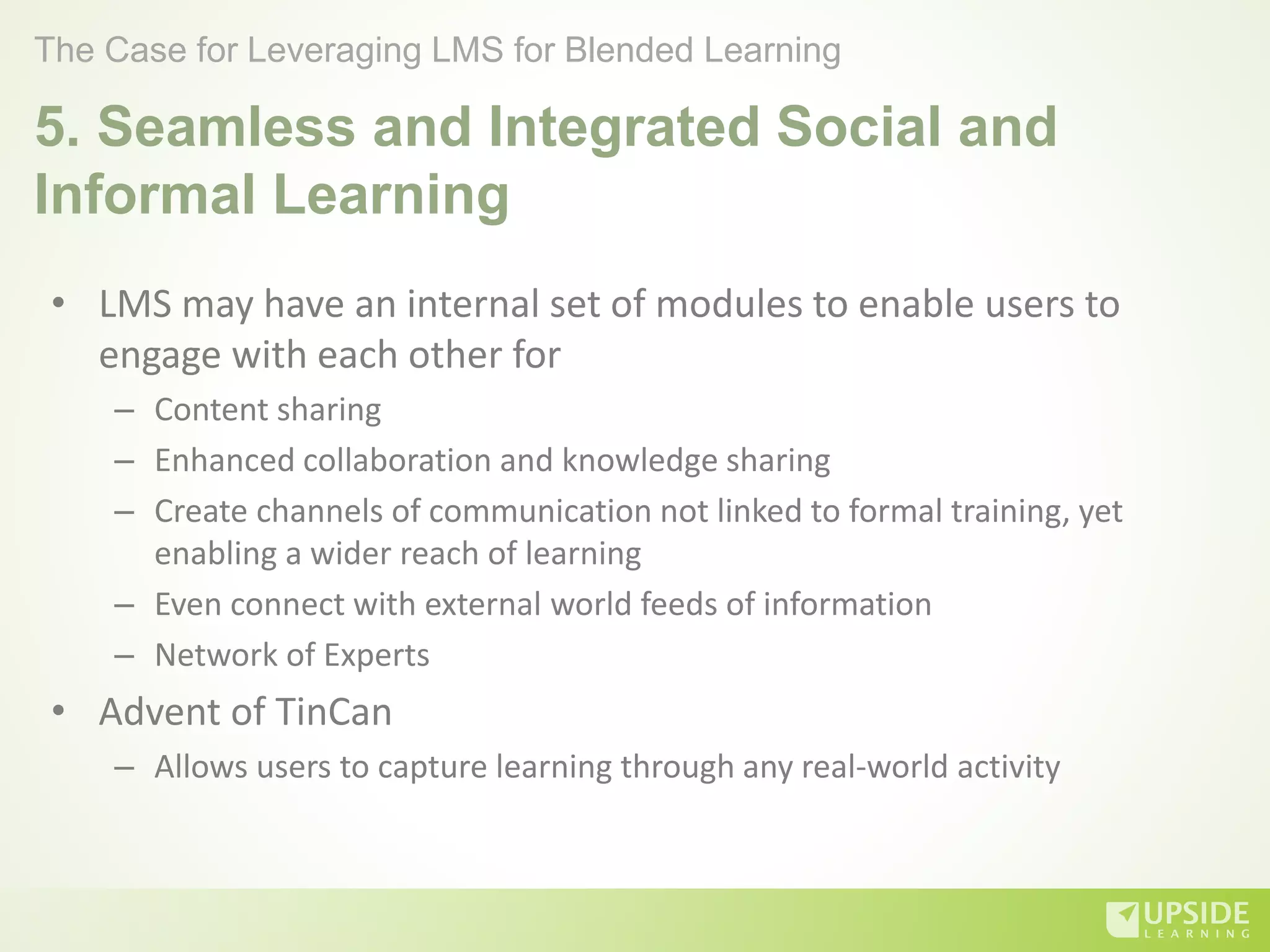
5. Seamless and Integrated Social and
Informal Learning
• LMS may have an internal set of modules to enable users to
engage with each other for
– Content sharing
– Enhanced collaboration and knowledge sharing
– Create channels of communication not linked to formal training, yet
enabling a wider reach of learning
– Even connect with external world feeds of information
– Network of Experts
• Advent of TinCan
– Allows users to capture learning through any real-world activity
The Case for Leveraging LMS for Blended Learning
6. Multi-device and Mobile Learning
• LMSs are increasingly becoming responsive to multiple devices
including handheld ones
• Mobile Learning is about both
– A delivery medium [more around technology]
– A learning methodology
• Videos
• Nuggets
• On-demand access and even offline access to content at time of need
• Performance Support (pre and post learning activities)
The Case for Leveraging LMS for Blended Learning
Poll # 4
How many systems does your organisation currently
use to manage the training function?
- One
- Two
- Three
- More than Three
- None
Self-Paced
eLearning
5 1
2
3
4
Face-to-face
Training
Mobile
Learning
Social
Learning/
Informal
Virtual
Classroom
Training
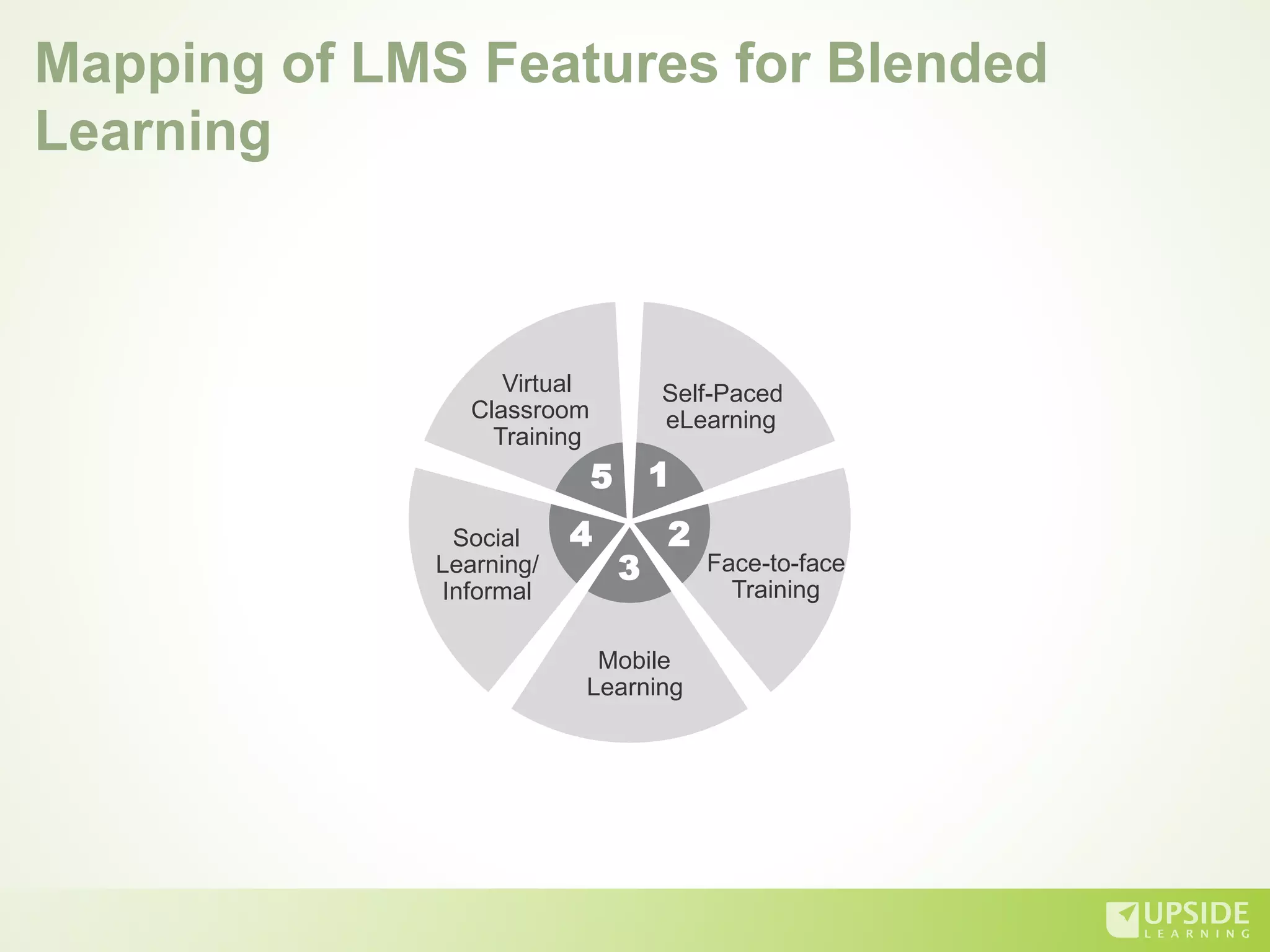
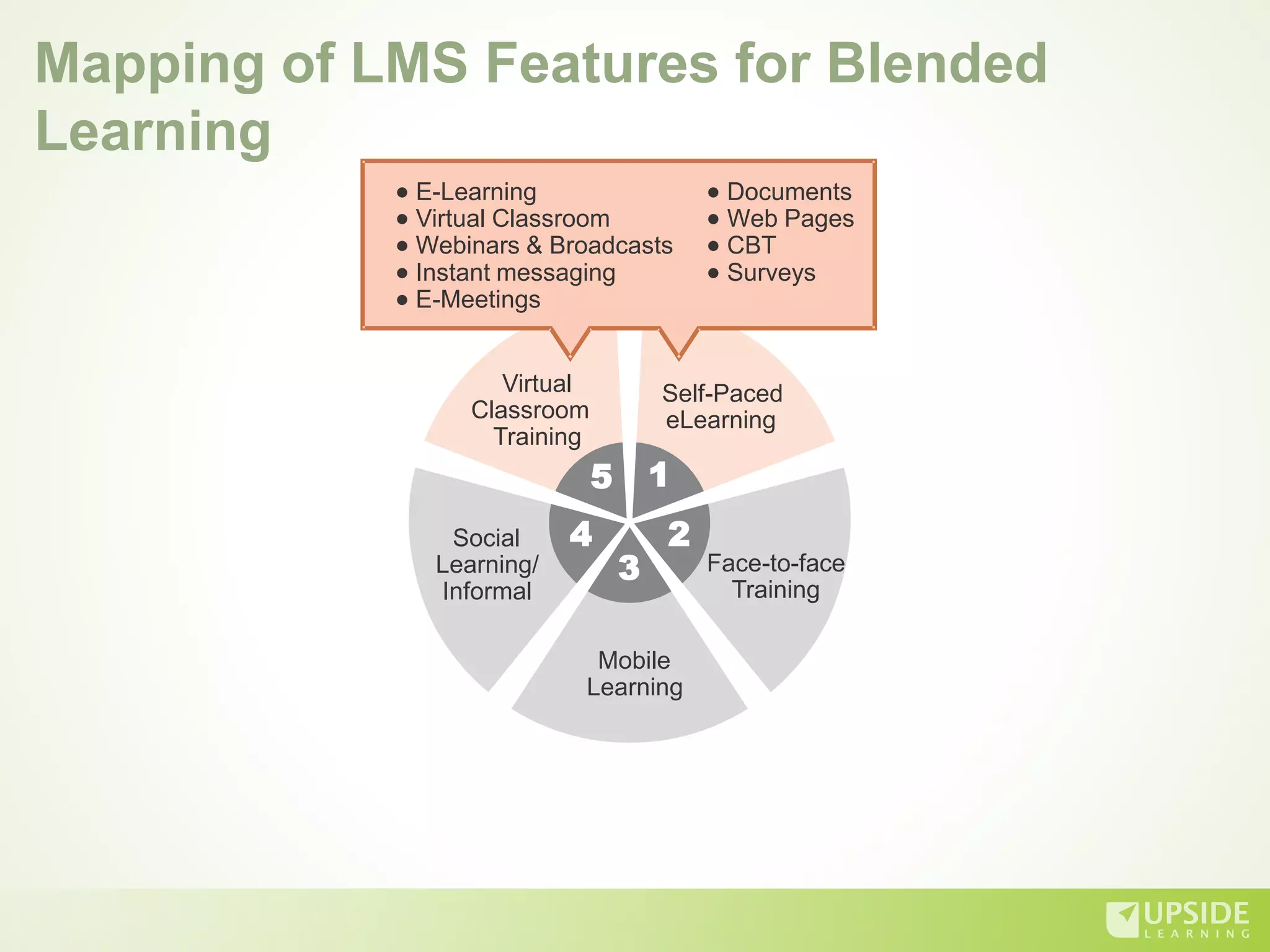
Mapping of LMS Features for Blended
Learning
Self-Paced
eLearning
5 1
2
3
4
Face-to-face
Training
Mobile
Learning
Social
Learning/
Informal
Virtual
Classroom
Training
l E-Learning
Virtual Classroom
Webinars & Broadcasts
Instant messaging
E-Meetings
l
l
l
l
l Documents
Web Pages
Surveys
l
l
l
CBT
Mapping of LMS Features for Blended
Learning
Self-Paced
eLearning
5 1
2
3
4
Face-to-face
Training
Mobile
Learning
Social
Learning/
Informal
Virtual
Classroom
Training
l Classroom Training
Workshopsl
l E-Learning
Virtual Classroom
Webinars & Broadcasts
Instant messaging
E-Meetings
l
l
l
l
l Documents
Web Pages
Surveys
l
l
l
CBT
Mapping of LMS Features for Blended
Learning
Self-Paced
eLearning
5 1
2
3
4
Face-to-face
Training
Mobile
Learning
Social
Learning/
Informal
Virtual
Classroom
Training
l Nuggets
Short Video Courses
JIT Information
l
l
l Classroom Training
Workshopsl
l E-Learning
Virtual Classroom
Webinars & Broadcasts
Instant messaging
E-Meetings
l
l
l
l
l Documents
Web Pages
Surveys
l
l
l
CBT
Mapping of LMS Features for Blended
Learning
Self-Paced
eLearning
5 1
2
3
4
Face-to-face
Training
Mobile
Learning
Social
Learning/
Informal
Virtual
Classroom
Training
l Online Communities
Forums
Discussion Boards
Wiki
Twitter
Blog
l
l
l
l
l
l Nuggets
Short Video Courses
JIT Information
l
l
l Classroom Training
Workshopsl
l E-Learning
Virtual Classroom
Webinars & Broadcasts
Instant messaging
E-Meetings
l
l
l
l
l Documents
Web Pages
Surveys
l
l
l
CBT
Mapping of LMS Features for Blended
Learning
Responsivel
A Case Study
5 Key Learnings
• Diversified geographies & demographics
• Different methodologies required to deliver training to this
diversified target audience
• Flexibility to choose the right blend of learning by each center
(located nationwide) for their target audience
• Maximise use of available technology mediums to deliver the
blended learning
• Centralised administrative controls
5 Key Learnings from Our Client
Challenges
• Expanded the curriculum structure to include all the training
methods
• The learner could choose a training programme from a varied
catalogue
• Flexibility to create a programme in any desired sequence by
Classroom Training Manager (CTM) based on the target
audience
• Centralised resource & inventory management
• Centralised reporting available to each CTM
• Use of Virtual Classroom to delivery remote trainings
5 Key Learnings from Our Client
Solution
Poll # 5
Would you prefer to use a single system to manage
blended learning?
- Yes
- No
- Can’t Say
Benefits of using an LMS for managing
Blended Learning
• Seamless, cohesive, unified experience for learners for all
their training
• Ability to generate comprehensive reports without the need
to collate data from various systems or sources thus saving
significant time and cost
• More effective learning design focused on leveraging the
unique benefits of various components
Benefits of using LMS for managing Blended
Learning (contd.)
• Learner engagement can start much earlier and continue till
much later, not just during the training activity
• An LMS provides several opportunities for increased
collaboration
• Cost-effectively reach out to a geographically diverse user
base
• Centralised learning resources leads to better knowledge
management
• Able to access through a variety of devices
Summary
• Blended Learning is already in place – largely
• A great need for a single easy-to-use system to manage
blended learning in one place
• The system should make it easy for the users and
administrators to adapt to the new training forms
• An LMS is a great choice for such a system. The LMS needs to
be well designed to cater to various components in an
integrated manner
Let’s Meet
Performance Support Symposium 2014
October 27 - 29 | Sydney, Australia
September 8 - 9 | Boston, USA
Learning@Work 2014
Blended Learning - The Way Ahead For Learning Organisations

Blended Learning - The Way Ahead For Learning Organisations

  • 1.
    Blended Learning: The wayahead for learning organisations
  • 2.
    200+ Clients In13 Countries Established In 2004 US India Australia Middle East New Zealand S.Africa Nigeria Kenya Singapore Venezuela UK
  • 3.
    Our Learning Solutions Custom/Bespoke eLearning Custom/Bespoke mLearning
  • 4.
    30+ Awards &Recognitions Winner of a Silver award in CLO magazine's 'Learning In Practice Awards 2011' for UpsideLMS UpsideLMS listed as one of the 'Five Emerging LMSs to Watch' in CLO Magazine ('10) Winner of 8 Apex Awards of Excellence (‘14, '11, '09, '08 & '07) Winner of 12 Brandon Hall Excellence Awards (‘12, '11, '10 & '09) UpsideLMS featured in the '2010 Top 20 Learning Portal Companies List' and '2011, 2012 & 2013 Watch List‘ by TrainingIndustry.com Winner of Red Herring 100 Asia Award in 2008 & finalist in Red Herring Global 100 ('09) Winner in Deloitte’s Technology Fast 500 Asia Pacific 2008 & 2009 program, and Fast 50 India 2008 program Winner of eLearning Team of The Year2013 Featured in Training Industry's 2014 Content Development Watch List
  • 5.
    5 A CaseStudy - 5 Key Learnings 4 The Case for Leveraging LMS for Blended Learning 1 Blended Learning – Defined and Redefined 5 Key Components of Blended Learning 3 Key Challenges in Implementing Blended Learning 2 3 Agenda
  • 6.
  • 7.
    What is ablend? Source: http://1.bp.blogspot.com/-7S3ZMfTbfH4/TmyljZy9E1I/AAAAAAAADw0/sjvtw_3eyUc/s1600/Blender.jpg Blended Learning - An Overview Using the best delivery methodology (ies) available for a specific objective, including online, class-room based, instruction, electronic performance support, paper based, formalised & informal on the job solutions.
  • 8.
    Blended Learning -An Overview Blended Learning - Redefined Focus shifts to learning objective from delivery methodology Imparting training to disseminate knowledge via formal and collaboration methods Advent of social and digital technology is the new catalyst
  • 9.
    Blended Learning-Key Components Self-Paced eLearning 51 2 3 4 Face-to-face Training Mobile Learning Social Learning/ Informal Virtual Classroom Training Blended Learning - An Overview
  • 10.
    Poll # 1 Doesyour organisation currently use blended learning to deliver training? - Yes - No - Can’t say
  • 11.
    Poll # 2 Isblended learning the way ahead for your organisation? - Yes - No - Can’t say
  • 12.
    5 Key Componentsof Blended Learning
  • 13.
  • 14.
    • Increases accessto learning material anytime by leveraging technology • Used for technical, functional, and soft skills • Reaches geo-diverse user base and provides consistency of learning • Saves cost What is new • Tin Can API opens options for more options. • Responsive courses. • Reduce development costs 5 Key Components of Blended Learning 1. Self-paced eLearning Self-Paced eLearning 5 1 2 3 4 Face-to-face Training Mobile Learning Social Learning/ Informal Virtual Classroom Training
  • 15.
    • High humaninteraction suited for training requiring practical sessions, workshops, discussions, etc. • Start up is easier but scalability (logistics and planning) is limiting. • High cost owing to trainers, travel, logistics, off the job time What is new • Using online learning and collaboration in classroom • Automating search and registration • Replacing workbooks with devices 5 Key Components of Blended Learning 2. Face-to-face Training Self-Paced eLearning 5 1 2 3 4 Face-to-face Training Mobile Learning Social Learning/ Informal Virtual Classroom Training
  • 16.
    • On thego training. Reinforces use of new processes & practices • Relies on handheld devices – Just in time information – On the job support • Good for pre and post-training follow-up. What is new • Blend various learning modes on devices • Use of older browsers is limiting • Need different ID approach 5 Key Components of Blended Learning 3. Mobile Learning Self-Paced eLearning 5 1 2 3 4 Face-to-face Training Mobile Learning Social Learning/ Informal Virtual Classroom Training
  • 17.
    • Use ofSocial Media Technologies for – Collaboration – Knowledge Sharing – Feedback • Fits with 70:20:10 and Informal Learning • Easy acceptance due to changing social networking behavior What is new • Integration of social into Learning infrastructure. • New skills required in L&D 5 Key Components of Blended Learning 4. Social Learning Self-Paced eLearning 5 1 2 3 4 Face-to-face Training Mobile Learning Social Learning/ Informal Virtual Classroom Training
  • 18.
    • Cost-effective wayof delivering training with a significant human interface simulating classroom experience • Recording can be made available for future access What is new • Mobile support is increasing • Wireless availability increasing • Features have more less remained static while performance has improved. 5 Key Components of Blended Learning 5. Virtual Classroom Training/Webinar Self-Paced eLearning 5 1 2 3 4 Face-to-face Training Mobile Learning Social Learning/ Informal Virtual Classroom Training
  • 19.
    Poll # 3 Whatare the top challenges in blended learning for your organisation? - Management buy-in - Unable or unwilling to leverage technology - Not required given the size of organisation - Lack of human resources to manage - Absence of a good system to manage centrally
  • 20.
    3 Key Challengesin Implementing Blended Learning
  • 21.
    TechnologyB Top / Sr.Management EngagementA C User Reaction 3 Key Challenges in Implementing Blended Learning
  • 22.
    A. Top /Sr. Management Engagement a. Not enough direction from top level on advancing training function b. Unenthusiastic participation of management in strategising c. Myopic focus on cost leads to long term problems d. Hesitation / Apprehensions / Even fear of open collaboration and social interactions e. Holding on to belief in only ‘pushing’ training f. Not taking Training itself seriously 3 Key Challenges in Implementing Blended Learning
  • 23.
    B. Technology (orthe lack of it) a. Lack of experience in using technology for managing training b. Inexperienced or unwilling IT to experiment/support new technology c. Fear of losing manual control to a system d. Concerns of providing technical support e. Well thought out plan for integrating various systems needed to implement Blended Learning. 3 Key Challenges in Implementing Blended Learning
  • 24.
    C. User Reaction a.Acceptance of newer training forms due to cultural (organisational) preoccupations b. Insufficient from-the-top directives to team managers to adopt new training forms c. Lack of an easy-to-use system may increase dissatisfaction d. Rise of Mobile Learning 3 Key Challenges in Implementing Blended Learning
  • 25.
    The Case forLeveraging LMS for Blended Learning
  • 26.
    Effective Resource Management Leveragingon Learner Interaction During and after Learning Program Effective Management of Training Activities Effective Cost Management Through Virtual Classroom Seamless Integrated Social and Informal Learning 1 2 3 4 5 The Case for Leveraging LMS for Blended Learning Mobile / Multi-device Learning6
  • 27.
    1. Effective ResourceManagement • Ease in Creation of Training Program using Single System • Enabling Learners Through Engaging & Dynamic Content • Effective Inventory Management • Pre-Training & Post-Training Evaluation • Centralised Administrative Management – Easy Authentication – Centralised User Management – Easy Assignment & Delivery of Training – Reports for Better Analytics & Decision Making The Case for Leveraging LMS for Blended Learning
  • 28.
    2. Leveraging LearnerInteraction During and After Learning Program • Notifications • Sharing & Collaboration • Feedback • Surveys • Evaluation • Communities & Discussion Forum The Case for Leveraging LMS for Blended Learning
  • 29.
    3. Training ActivityManagement • Scheduling • Announcements • Reminders • Follow ups • Logistic Arrangements The Case for Leveraging LMS for Blended Learning
  • 30.
    4. Effective TrainingDelivery Through Virtual Classroom for Remote Location Users • Training to Distributed Workforce remotely • Avoid remote location travels • Less logistic hassles • Better control over the class for effective delivery of training The Case for Leveraging LMS for Blended Learning
  • 31.
    5. Seamless andIntegrated Social and Informal Learning • LMS may have an internal set of modules to enable users to engage with each other for – Content sharing – Enhanced collaboration and knowledge sharing – Create channels of communication not linked to formal training, yet enabling a wider reach of learning – Even connect with external world feeds of information – Network of Experts • Advent of TinCan – Allows users to capture learning through any real-world activity The Case for Leveraging LMS for Blended Learning
  • 32.
    6. Multi-device andMobile Learning • LMSs are increasingly becoming responsive to multiple devices including handheld ones • Mobile Learning is about both – A delivery medium [more around technology] – A learning methodology • Videos • Nuggets • On-demand access and even offline access to content at time of need • Performance Support (pre and post learning activities) The Case for Leveraging LMS for Blended Learning
  • 33.
    Poll # 4 Howmany systems does your organisation currently use to manage the training function? - One - Two - Three - More than Three - None
  • 34.
  • 35.
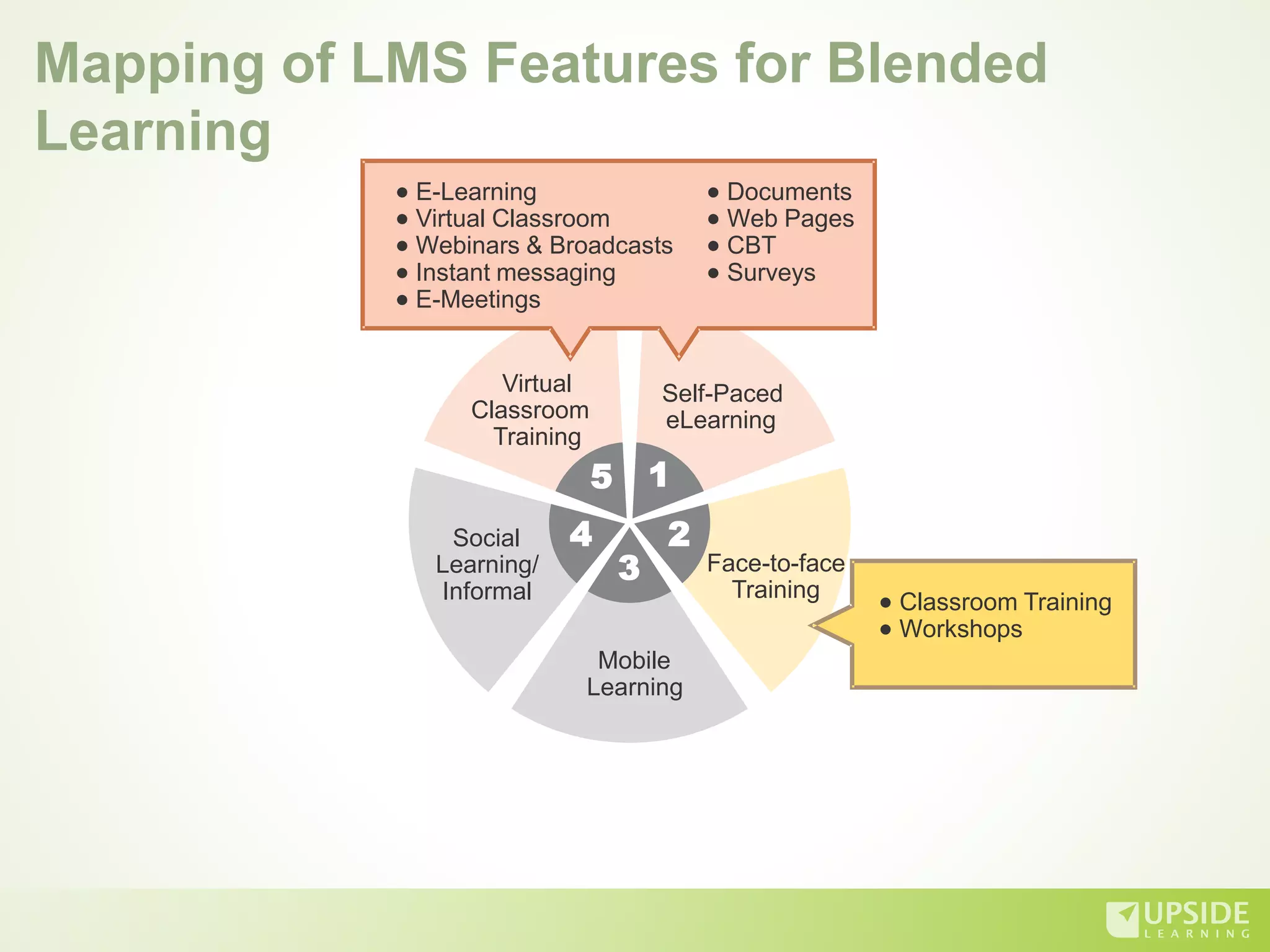
    Self-Paced eLearning 5 1 2 3 4 Face-to-face Training Mobile Learning Social Learning/ Informal Virtual Classroom Training l E-Learning VirtualClassroom Webinars & Broadcasts Instant messaging E-Meetings l l l l l Documents Web Pages Surveys l l l CBT Mapping of LMS Features for Blended Learning
  • 36.
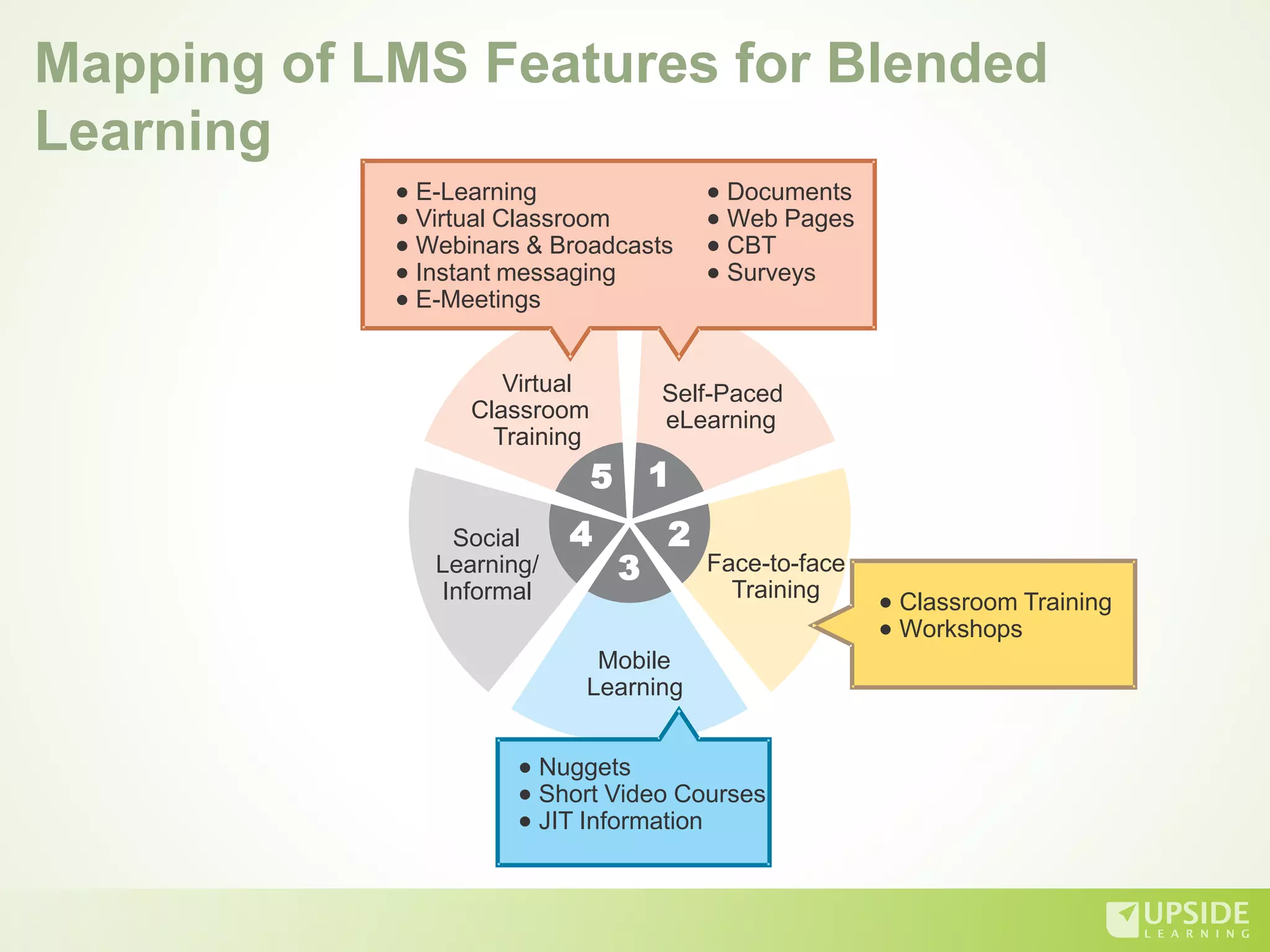
    Self-Paced eLearning 5 1 2 3 4 Face-to-face Training Mobile Learning Social Learning/ Informal Virtual Classroom Training l ClassroomTraining Workshopsl l E-Learning Virtual Classroom Webinars & Broadcasts Instant messaging E-Meetings l l l l l Documents Web Pages Surveys l l l CBT Mapping of LMS Features for Blended Learning
  • 37.
    Self-Paced eLearning 5 1 2 3 4 Face-to-face Training Mobile Learning Social Learning/ Informal Virtual Classroom Training l Nuggets ShortVideo Courses JIT Information l l l Classroom Training Workshopsl l E-Learning Virtual Classroom Webinars & Broadcasts Instant messaging E-Meetings l l l l l Documents Web Pages Surveys l l l CBT Mapping of LMS Features for Blended Learning
  • 38.
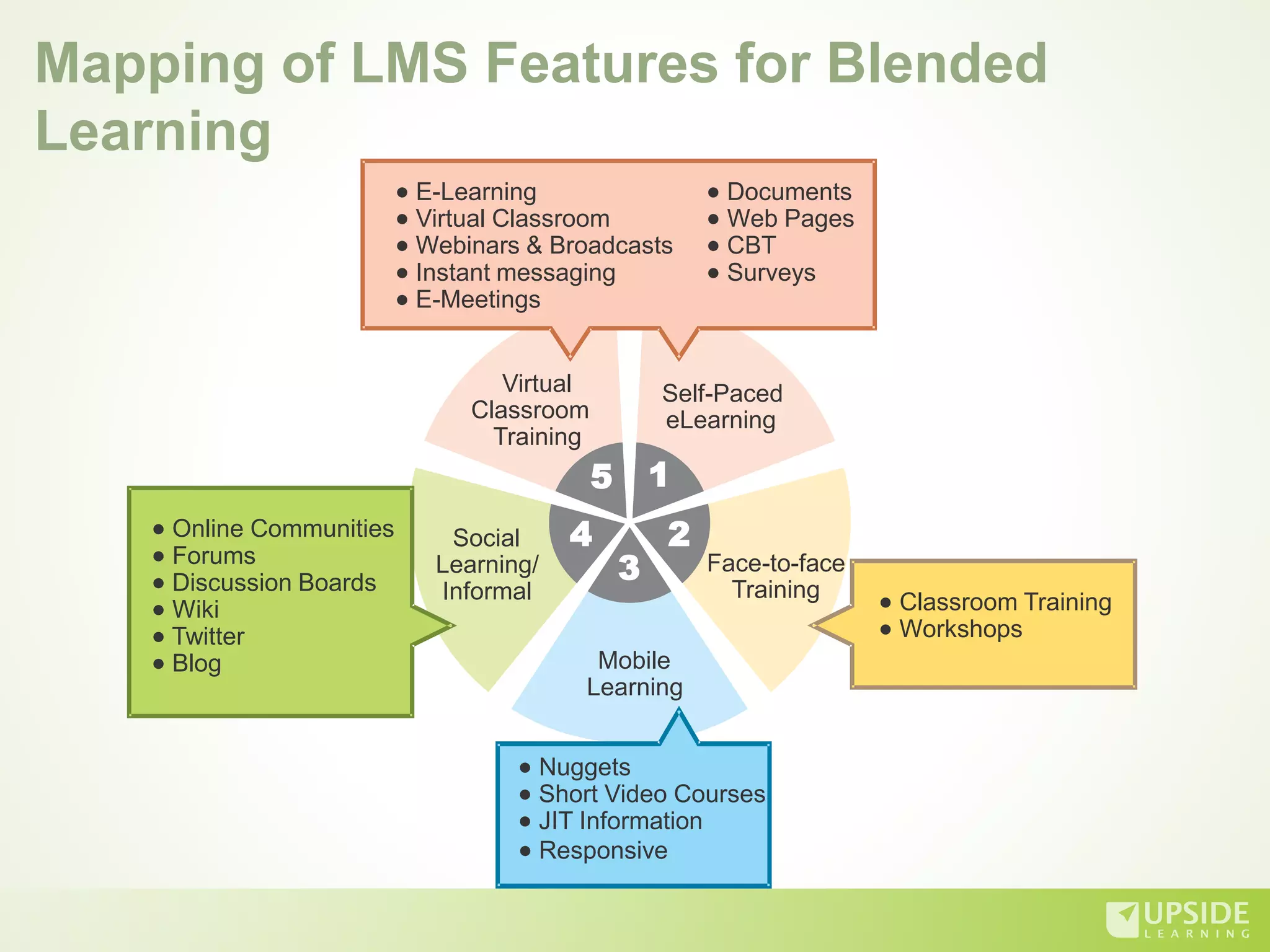
    Self-Paced eLearning 5 1 2 3 4 Face-to-face Training Mobile Learning Social Learning/ Informal Virtual Classroom Training l OnlineCommunities Forums Discussion Boards Wiki Twitter Blog l l l l l l Nuggets Short Video Courses JIT Information l l l Classroom Training Workshopsl l E-Learning Virtual Classroom Webinars & Broadcasts Instant messaging E-Meetings l l l l l Documents Web Pages Surveys l l l CBT Mapping of LMS Features for Blended Learning Responsivel
  • 39.
    A Case Study 5Key Learnings
  • 40.
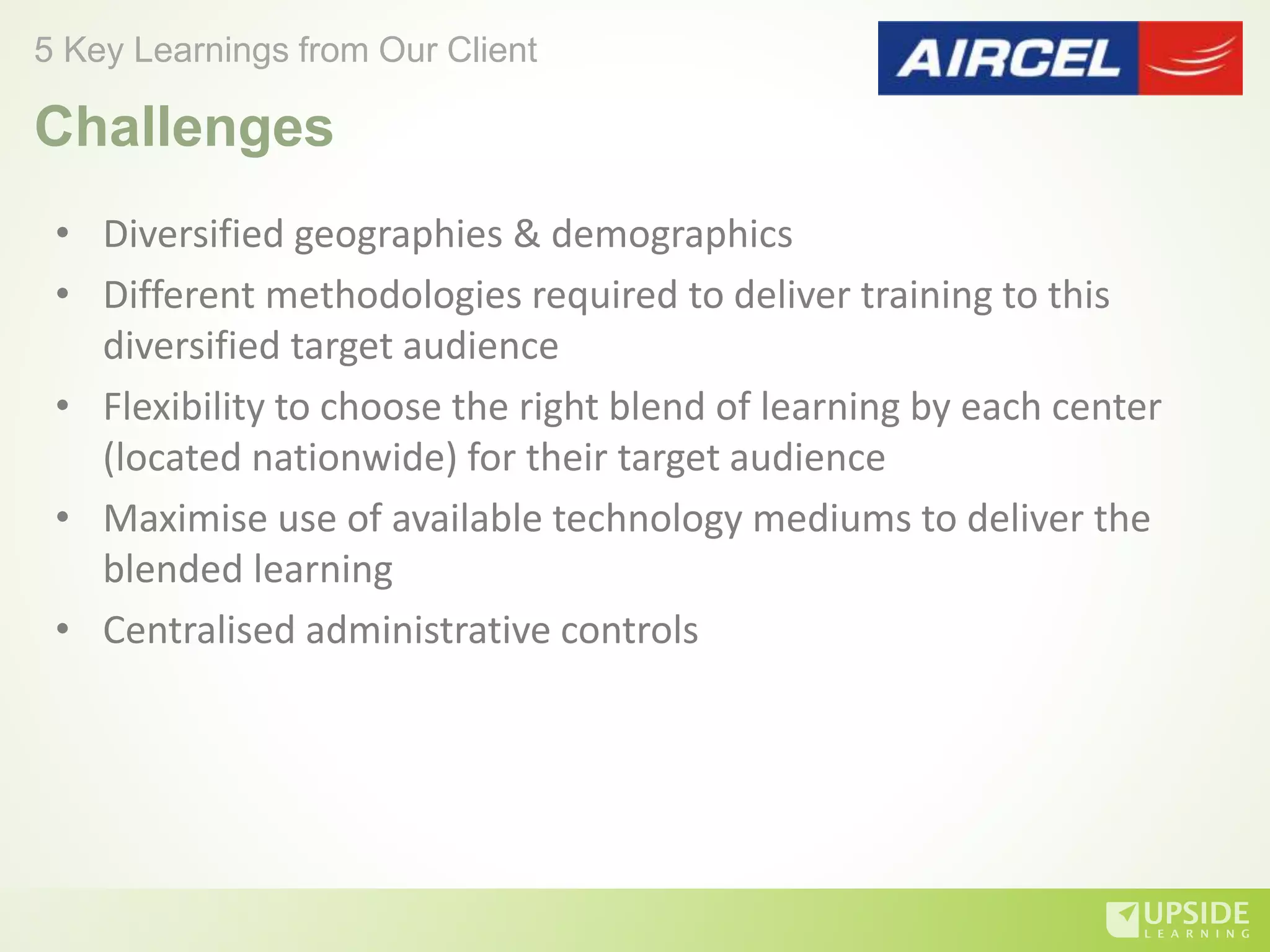
    • Diversified geographies& demographics • Different methodologies required to deliver training to this diversified target audience • Flexibility to choose the right blend of learning by each center (located nationwide) for their target audience • Maximise use of available technology mediums to deliver the blended learning • Centralised administrative controls 5 Key Learnings from Our Client Challenges
  • 41.
    • Expanded thecurriculum structure to include all the training methods • The learner could choose a training programme from a varied catalogue • Flexibility to create a programme in any desired sequence by Classroom Training Manager (CTM) based on the target audience • Centralised resource & inventory management • Centralised reporting available to each CTM • Use of Virtual Classroom to delivery remote trainings 5 Key Learnings from Our Client Solution
  • 42.
    Poll # 5 Wouldyou prefer to use a single system to manage blended learning? - Yes - No - Can’t Say
  • 43.
    Benefits of usingan LMS for managing Blended Learning • Seamless, cohesive, unified experience for learners for all their training • Ability to generate comprehensive reports without the need to collate data from various systems or sources thus saving significant time and cost • More effective learning design focused on leveraging the unique benefits of various components
  • 44.
    Benefits of usingLMS for managing Blended Learning (contd.) • Learner engagement can start much earlier and continue till much later, not just during the training activity • An LMS provides several opportunities for increased collaboration • Cost-effectively reach out to a geographically diverse user base • Centralised learning resources leads to better knowledge management • Able to access through a variety of devices
  • 45.
    Summary • Blended Learningis already in place – largely • A great need for a single easy-to-use system to manage blended learning in one place • The system should make it easy for the users and administrators to adapt to the new training forms • An LMS is a great choice for such a system. The LMS needs to be well designed to cater to various components in an integrated manner
  • 46.
    Let’s Meet Performance SupportSymposium 2014 October 27 - 29 | Sydney, Australia September 8 - 9 | Boston, USA Learning@Work 2014

Editor's Notes

  • #8 Picture of a blender http://1.bp.blogspot.com/-7S3ZMfTbfH4/TmyljZy9E1I/AAAAAAAADw0/sjvtw_3eyUc/s1600/Blender.jpg
  • #9 Ambient Insight has last month released a report on how the global market for self-paced eLearning products and services will grow through till 2014. It estimates the market had reached US $ 27.1 billion in 2009. The demand is growing at a 5 year compound annual growth rate of 12.8% and will take the world market to US $ 49.6 billion by 2014. Key highlights (as shared in the executive summary are): - North America will continue to be the biggest market. - By 2014 Asia (which includes Australia and New Zealand in this report) would overtake Western Europe to become the second largest market after North America. The compound annual growth rate in Asia is a very healthy 33.5%. - East Europe is second fastest in growth terms at 23.0%. Vibrant outsourcing hubs have come up in countries such as Belarus and the Ukraine. - There is resistance in regional markets to content that has been translated but not localized. This is creating demand for local content in each region. - There’s virtually no self-paced eLearning being used in primary and secondary education in Japan, proving that it is a ‘myth’ to assume technologically advanced regions are more likely to adopt self-paced eLearning. In contrast 100% of primary and secondary schools in Korea and Singapore offer some type of online education. Link: http://trends.learning-managers.net/trends-reports/learning-reports - Adoption of self-paced eLearning is now wide spread across buying segments. North America where corporate are still the top buyers, will see academic buyers emerge as top buyers in next five years. - New tool and learning platform suppliers are entering the market at a steady rate in each region even in more mature markets like North America.”
  • #21 Thank you Jeevan. Now, let us have a look at what challenges organizations face while implementing Blended Learning. We will go through the 3 key challenges.
  • #22 Here they are. The top 3 challenges, we believe are: A. Top/Sr. Management Engagement B. Technology and C. User Reaction This is a culmination of what we have observed over the past so many years while implementing a variety of learning solutions for our customers and also comes from our own interactions with the industry through various events we hold and studies we actively engage in. Let us look at these in a little more detail.
  • #23 This particular challenge is most of the times the biggest one, and for obvious reasons. The investments and the will to implement such an approach flows top-down and lack of engagement or the understanding in top and senior management could be the biggest roadblock to implement true blended learning. This happens due to a number of reasons. It could be as simple and unfortunate as seriousness around training itself. In a few cases, we have seen organizations looking at training only as a cost and not as an investment in their human capital. They fail to understand the long term consequences of such a mindset, specially in post 2008 world. At times, even though this is not the concern there is a strong level of apprehension and even fear in letting people interact on their own through technology-enabled social setting. This leads on to holding a firm, and again unfortunate, belief that training works only by pushing and getting people under one roof. Then sometimes, short term cost benefits of not disturbing the status quo is the problem. Getting to invest in new technologies with slightly high upfront investments and demand on time leads to retaining the status quo longer than needed. Top and Senior management needs to overcome this and it is primarily a mindset which needs to change.
  • #24 The second key challenge is Technology / IT or the lack of it. All aspects of blended learning, namely the components Jeevan talked about earlier are technology enabled and the IT department of the company plays a vital role in implementing blended learning. Right from selecting the right technology to providing 24x7 technical support to the users it is a daunting task. Inexperienced IT team or understaffed IT team could lead to a problem here. In medium or large and specially non IT businesses the apprehensions of using so much of technology is also a concern. At times, there need to be multiple systems to implement blended learning and IT needs to plan well in advance and think through how these systems will interact with each other to provide an excellent experience to the users and also the right information to the management.
  • #25 Among the three challenges, this one is perhaps the trickiest to comprehend, understand and even address. Bigger the size of the organization, stronger this challenge is. The reaction of the end users to various forms of learning methods being used. The initial one is always the resistance to anything new that changes how users work or learn. Due to the organizational cultural preoccupations this is usually the hard one. This challenge could be further enhanced by a visible lack of enthusiasm and focus from top-down. It is crucial that the team managers have the same vision as the top and senior management in terms of blended learning. This will help faster and stronger adoption across teams. In the end, it boils down to the system or systems. Like any other initiative, if the system isnt easy or good enough the whole initiative is at risk. A new factor in this challenge is the rise of mobiles and their place in workplace learning. Users expect, demand and need access to everything on mobile devices making it all the more complex to manage.