0
1
2
Target Participants:
TUELC Instructors.
Blended Learning.
Workshop Title:
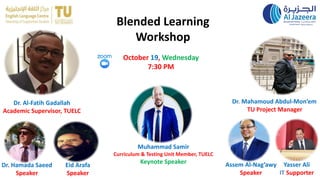
Blended Learning
Workshop
Dr. Hamada Saeed
Speaker
Dr. Al-Fatih Gadallah
Academic Supervisor, TUELC
Dr. Mahamoud Abdul-Mon’em
TU Project Manager
Muhammad Samir
Curriculum & Testing Unit Member, TUELC
Keynote Speaker
Eid Arafa
Speaker
Assem Al-Nag’awy
Speaker
Yasser Ali
IT Supporter
October 19, Wednesday
7:30 PM
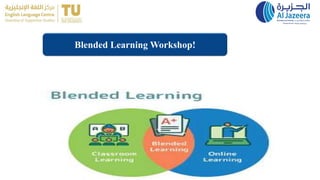
Blended Learning Workshop!
Blended Learning.
• Workshop Objectives:
• What? Why? How?
• Needed Skills.
• Benefits of Blended Learning
• Unexpected benefits!
• Important elements gained from online learning.
• Models of Blended Learning.
• Barriers /Challenges.
• Recommendations.
5
Blended Learning
6
It has been around for a long time, but its terminology was not
firmly established until around the last decade of the 20th and
the beginning of the 21st century.
What is Blended Learning?
 Blended learning, sometimes known as hybrid learning, is a
teaching and learning model that has a face-to-face class or
tutorial component combined with an online learning
component.
Why do we need Blended Learning?
Blended learning helps the learning process to:
• Be more effective for adult learners than only face-to-face
learning.
• Run “Make up” classes.
• Make homework more convenient and appealing.
• Enable easier monitoring of student progress.
• Enable students to acquire digital literacy/digital readiness, and
needed skills for “Online Learning”. 7
How to use Blended learning.
Using Blended learning depends on:
• What technology and web access you have in your classroom, and
what kinds of technology and web access students have at home,
work; at their public library, community computing center, or
elsewhere.
You could give directions for how to do these digital tasks:
• Get a unique educational email address, e.g. Gmail.
• Log onto the web page for the first time.
• Access your online web page with assignments and learning resources.
• Navigate to assignments or relevant learning resources.
• Find weekly assignments, learning resources, and assessments. 8
Needed Skills for Online Learning
• How to click on a link that takes one outside the learning site.
• Know how to scroll down a page.
• Know how to save written work.
• Quickly access an online dictionary and encyclopedia.
• Know conventions of websites & how to navigate them.
• Create, save and find an effective user ID & password.
• Know how to return to the learning online site.
• Know how to use tab browsing. 9
Benefits of Blended Learning
• For learners:
• Increased flexibility to fit learning around their lives, other commitments, own preferences.
• Increased opportunities to develop digital skills.
• Increased opportunities to develop independent learning skills .
• Easier access to resources & material to support their learning.
• Wider access to learning; more inclusive, ‘location agnostic’ .
10
For academic staff :
• More effective use of digital tools.
• More improvement in staff digital skills & confidence.
• Courses continuity.
• Professional collaboration.
• Cross-site collaboration.
Unexpected benefits!
 Take up virtual counselling and support services higher than expected.
 For the more motivated learners, this provides opportunities to progress
at a faster pace.
 Use of digital technologies to support teaching practitioners’ reflection
and peer review (recording & reviewing lessons).
 Share experiences such as guest speakers and virtual visits.
 Enable instructors to create viable courses by working across
geographical boundaries.
11
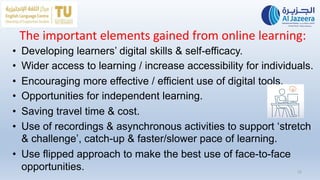
The important elements gained from online learning:
• Developing learners’ digital skills & self-efficacy.
• Wider access to learning / increase accessibility for individuals.
• Encouraging more effective / efficient use of digital tools.
• Opportunities for independent learning.
• Saving travel time & cost.
• Use of recordings & asynchronous activities to support ‘stretch
& challenge’, catch-up & faster/slower pace of learning.
• Use flipped approach to make the best use of face-to-face
opportunities. 12
13
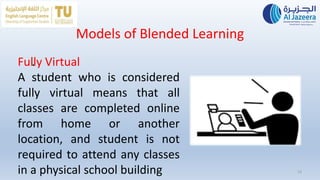
Models of Blended Learning
.
Fully Virtual
A student who is considered
fully virtual means that all
classes are completed online
from home or another
location, and student is not
required to attend any classes
in a physical school building
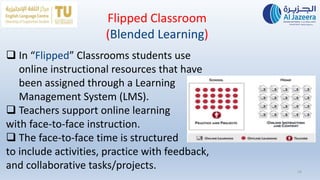
Flipped Classroom
(Blended Learning)
14
 In “Flipped” Classrooms students use
online instructional resources that have
been assigned through a Learning
Management System (LMS).
 Teachers support online learning
with face-to-face instruction.
 The face-to-face time is structured
to include activities, practice with feedback,
and collaborative tasks/projects.
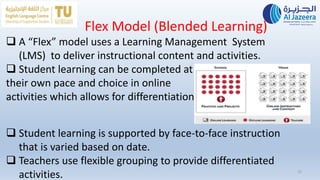
Flex Model (Blended Learning)
15
 A “Flex” model uses a Learning Management System
(LMS) to deliver instructional content and activities.
 Student learning can be completed at
their own pace and choice in online
activities which allows for differentiation.
 Student learning is supported by face-to-face instruction
that is varied based on date.
 Teachers use flexible grouping to provide differentiated
activities.
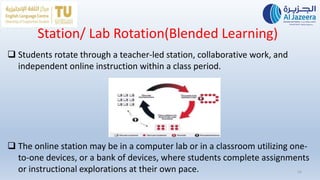
Station/ Lab Rotation(Blended Learning)
16
 Students rotate through a teacher-led station, collaborative work, and
independent online instruction within a class period.
 The online station may be in a computer lab or in a classroom utilizing one-
to-one devices, or a bank of devices, where students complete assignments
or instructional explorations at their own pace.
Barriers to effective use of blended learning
 Digital access for users (e.g. equipment / connectivity).
 Lack of access to appropriate study spaces (for learners).
 Digital infrastructure (onsite and/or remote).
 Staff skills & confidence.
 ‘Hidden costs’ & resourcing challenges .
 Culture and perceptions regarding blended learning, online learning & remote
working.
 “Some learners don’t suit remote learning; may have complex needs and chaotic
environments. Being in a face-to-face class is important as an escape from home
situations, opportunity for social interaction etc.” 17
Recommendations
• Use Blended Learning in developing Language skills in the field of
talented students and learning disabilities.
• Ensure reliability of quizzes on online platforms.
• Make Blended Learning more engaging for students without boring
them.
• we need more workshops in different topics like:
 Needed Skills for English instructors to confront the barriers of
Blended Learning.
How English instructors acquire new skills to develop EFL
learner.
18
Thank you
for
Fruitful
participation 19

Blended Learning Workshop1.ppsx

  • 1.
  • 2.
  • 3.
  • 4.
    Blended Learning Workshop Dr. HamadaSaeed Speaker Dr. Al-Fatih Gadallah Academic Supervisor, TUELC Dr. Mahamoud Abdul-Mon’em TU Project Manager Muhammad Samir Curriculum & Testing Unit Member, TUELC Keynote Speaker Eid Arafa Speaker Assem Al-Nag’awy Speaker Yasser Ali IT Supporter October 19, Wednesday 7:30 PM
  • 5.
  • 6.
    Blended Learning. • WorkshopObjectives: • What? Why? How? • Needed Skills. • Benefits of Blended Learning • Unexpected benefits! • Important elements gained from online learning. • Models of Blended Learning. • Barriers /Challenges. • Recommendations. 5
  • 7.
    Blended Learning 6 It hasbeen around for a long time, but its terminology was not firmly established until around the last decade of the 20th and the beginning of the 21st century. What is Blended Learning?  Blended learning, sometimes known as hybrid learning, is a teaching and learning model that has a face-to-face class or tutorial component combined with an online learning component.
  • 8.
    Why do weneed Blended Learning? Blended learning helps the learning process to: • Be more effective for adult learners than only face-to-face learning. • Run “Make up” classes. • Make homework more convenient and appealing. • Enable easier monitoring of student progress. • Enable students to acquire digital literacy/digital readiness, and needed skills for “Online Learning”. 7
  • 9.
    How to useBlended learning. Using Blended learning depends on: • What technology and web access you have in your classroom, and what kinds of technology and web access students have at home, work; at their public library, community computing center, or elsewhere. You could give directions for how to do these digital tasks: • Get a unique educational email address, e.g. Gmail. • Log onto the web page for the first time. • Access your online web page with assignments and learning resources. • Navigate to assignments or relevant learning resources. • Find weekly assignments, learning resources, and assessments. 8
  • 10.
    Needed Skills forOnline Learning • How to click on a link that takes one outside the learning site. • Know how to scroll down a page. • Know how to save written work. • Quickly access an online dictionary and encyclopedia. • Know conventions of websites & how to navigate them. • Create, save and find an effective user ID & password. • Know how to return to the learning online site. • Know how to use tab browsing. 9
  • 11.
    Benefits of BlendedLearning • For learners: • Increased flexibility to fit learning around their lives, other commitments, own preferences. • Increased opportunities to develop digital skills. • Increased opportunities to develop independent learning skills . • Easier access to resources & material to support their learning. • Wider access to learning; more inclusive, ‘location agnostic’ . 10 For academic staff : • More effective use of digital tools. • More improvement in staff digital skills & confidence. • Courses continuity. • Professional collaboration. • Cross-site collaboration.
  • 12.
    Unexpected benefits!  Takeup virtual counselling and support services higher than expected.  For the more motivated learners, this provides opportunities to progress at a faster pace.  Use of digital technologies to support teaching practitioners’ reflection and peer review (recording & reviewing lessons).  Share experiences such as guest speakers and virtual visits.  Enable instructors to create viable courses by working across geographical boundaries. 11
  • 13.
    The important elementsgained from online learning: • Developing learners’ digital skills & self-efficacy. • Wider access to learning / increase accessibility for individuals. • Encouraging more effective / efficient use of digital tools. • Opportunities for independent learning. • Saving travel time & cost. • Use of recordings & asynchronous activities to support ‘stretch & challenge’, catch-up & faster/slower pace of learning. • Use flipped approach to make the best use of face-to-face opportunities. 12
  • 14.
    13 Models of BlendedLearning . Fully Virtual A student who is considered fully virtual means that all classes are completed online from home or another location, and student is not required to attend any classes in a physical school building
  • 15.
    Flipped Classroom (Blended Learning) 14 In “Flipped” Classrooms students use online instructional resources that have been assigned through a Learning Management System (LMS).  Teachers support online learning with face-to-face instruction.  The face-to-face time is structured to include activities, practice with feedback, and collaborative tasks/projects.
  • 16.
    Flex Model (BlendedLearning) 15  A “Flex” model uses a Learning Management System (LMS) to deliver instructional content and activities.  Student learning can be completed at their own pace and choice in online activities which allows for differentiation.  Student learning is supported by face-to-face instruction that is varied based on date.  Teachers use flexible grouping to provide differentiated activities.
  • 17.
    Station/ Lab Rotation(BlendedLearning) 16  Students rotate through a teacher-led station, collaborative work, and independent online instruction within a class period.  The online station may be in a computer lab or in a classroom utilizing one- to-one devices, or a bank of devices, where students complete assignments or instructional explorations at their own pace.
  • 18.
    Barriers to effectiveuse of blended learning  Digital access for users (e.g. equipment / connectivity).  Lack of access to appropriate study spaces (for learners).  Digital infrastructure (onsite and/or remote).  Staff skills & confidence.  ‘Hidden costs’ & resourcing challenges .  Culture and perceptions regarding blended learning, online learning & remote working.  “Some learners don’t suit remote learning; may have complex needs and chaotic environments. Being in a face-to-face class is important as an escape from home situations, opportunity for social interaction etc.” 17
  • 19.
    Recommendations • Use BlendedLearning in developing Language skills in the field of talented students and learning disabilities. • Ensure reliability of quizzes on online platforms. • Make Blended Learning more engaging for students without boring them. • we need more workshops in different topics like:  Needed Skills for English instructors to confront the barriers of Blended Learning. How English instructors acquire new skills to develop EFL learner. 18
  • 20.