
BLENDED
LEARNING
DR.V.S.SUMI
ASST PROF
MANUU
HYDERABAD
Meaning
Blended learning combines the best of two training environments—
traditional face-to-face classroom training and high-tech eLearning.
By covering all the bases, you can engage all types of learners—those who
learn better in a structured environment that includes face-to-face
interaction with an instructor, and independent types who learn better with
semi-autonomous, computer-based training.
Why Blended Learning
1. Accounting for Everyone
Blended learning takes every type of learner into account, whether they prefer
the familiar traditional classroom, would rather learn online, or try a mixture of
both. Without the limitations of a classroom or all-online course, blended
learning utilizes a variety of methodologies so the content can be customized
to the learner and optimized for the subject matter. While not all face-to-face
training is easily translated to digital content, it’s possible to re-engineer
existing content for online delivery in a way that complements the existing
training.
2. Learning Trends and Feedback
Blended learning uses online and offline technologies in tandem, allowing
instructors to quickly adopt the latest learning trends and modalities into
the curriculum. Instructors can also use built-in reporting features in most
LMS software programs for deeper, data driven insights into student
progress and success.
For learners, blended learning also offers the unique opportunity to discuss, model, and practice their new
skills in a safe space, so they’re not just watching or hearing—they’re doing. By applying the new
knowledge shortly after they’ve left the physical or virtual classroom, learners retain what they’ve learned.
3. Lower Costs
In-class training may seem like a cheaper option when compared to
eLearning development, but consider the true cost of face-to-face sessions:
Time away from work, paying instructors, and flying in remote employees can
eat up a significant amount of the L&D budget. A blended eLearning approach
cuts down on travel costs and can be used again and again, which reduces
instructor time as well.
4. Fun and Engagement
Blended learning is an interactive experience in every sense of the word.
Learners reinforce the offline lessons by practicing online through a
variety of different content media, each geared to suit a certain learning
style. Learners can choose which type of content they want to interact
with, practice what they learn, and communicate with instructors and
other learners any time and on any device. The community experience
keeps learners engaged and informs teachers about their progress and
areas needing more attention.
5. Reach and Personalization
Global organizations face the challenges of making learning universal, no matter
the branch location. Language interpretation and travel can also be concerns, both
of which are easily addressed by blended eLearning that brings training to all
employees, whether they work in another country or from home.
Diverse reach also means diverse individuals. If all learners have different levels of
understanding and expertise, then why force them into the same training
program? Blended eLearning creates a buffet-style approach to training, allowing
learners to lead and choose how and when they interact with the material. Being
able to test out of a familiar topic or listening to the same podcast a few times
means each learner gets the training they need (and want).
Features of Blended Learning environment
★ Increased student engagement in learning.
★ Enhanced teacher and student interaction.
★ Responsibility for learning.
★ Time management and flexibility
★ Improved student learning outcomes
★ Enhanced institutional reputation.
★ More flexible teaching and learning environment
★ More amenable for self and continuous learning
★ Better opportunities for experiential learning
Blended Learning Models
A blended learning model can help you
personalize your subject matter for time
considerations, learning techniques and even
personal preferences, but implementing a
blended learning model it requires big
changes to how the way you think about
training.
#1
● Face-to-Face: Traditional instructor-led learning sessions supplemented with
technology to allow learners to control their own learning pace. Benefits are
role-play, mentoring, hands-on practice, and feedback.
#2
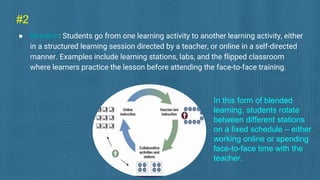
● Rotation: Students go from one learning activity to another learning activity, either
in a structured learning session directed by a teacher, or online in a self-directed
manner. Examples include learning stations, labs, and the flipped classroom
where learners practice the lesson before attending the face-to-face training.
In this form of blended
learning, students rotate
between different stations
on a fixed schedule – either
working online or spending
face-to-face time with the
teacher.
#3
● Flex: Flex learning is a term that can be used interchangeably with personalized
learning. By accessing means of integration of learning in a Learning
Management System (LMS.), the students control their learning path, choosing
what they to learn. The instructor is usually present in a mentoring capacity, to
answer questions.
● With this approach, material is primarily delivered online. Although teachers are in the
room to provide on-site support as needed, learning is primarily self-guided, as
students independently learn and practice new concepts in a digital environment. The
flex model is an approach used by the AdvancePath Academy, a blended learning
school, which works with school district partners to address the needs of students with
behavioral, academic and/or socio-economic challenges.
#4
● Online Lab: This blended learning model is entirely digital, with little or no
instructor interaction, and takes place either before, during or after a
training. Learners can access content on mobile phones (mLearning),
laptops or tablets. This modality engages and solidifies learning.
● In this scenario, students learn entirely online but travel to a dedicated
computer lab to complete their coursework. Adults supervise the lab, but they
are not trained teachers. This not only allows schools to offer courses for
which they have no teacher or not enough teachers, but also allows students
to work at a pace and in a subject area that suits them without affecting the
learning environment of other students.
#5
● Self-Blend: Self-blended learning is supplemental content—either in the form
of webinars, white papers, industry blogs, or video tutorials—that help self-
motivated learners delve deeper into a subject. A robust LMS can combine
diverse content sources under one system to encourage curiosity and growth.
● Self-blend is ideal for the student who wants to take additional Advanced
Placement courses, or who has interest in a subject area that is not
covered in the traditional course catalog.
#6
● Online Driver: This blended learning model is entirely self-directed and takes place
in a digital environment. Learners can engage with an instructor through chat,
email or message board. It provides a flexible schedule and personalized learning,
but lacks the face-to-face interaction of other types of blended learning. An LMS is
the best way to encourage users to direct their own learning while still monitoring
their process as they enjoy media and eventually, engage in classroom discussion.
You can choose from existing learning management systems or opt to have an
LMS developed specifically for your purposes.
Role of teacher in BL environment
BL shifts the teacher’s role from knowledge provider to coach and mentor. This shift
does not mean that teachers play a passive or less important role in students’
education. Quite the contrary—with BL, teachers can have an even more profound
influence and effect on students’ learning.
BL, is more student-driven, bottom-up, and customized, with differentiation as a main
feature. Much of this new learning dynamic is due to the enhanced role technology
plays in instruction.
BL provides an appropriate balance between online instructions, which offers the
interactive, tech-based learning, individualized pacing, and privacy that keep students
continuously engaged and motivated, and teacher-led instruction, which personalizes
the learning experience and adds the human elements of encouragement,
compassion, and caring guidance that only teachers can give.
Role of teacher in BL environment
Giving students permission and space to become active learners who gain knowledge directly lets them
assume some control over their learning and helps them develop self-reliance.
As more students are working independently, time opens up for teachers to provide face-to-face support and
individualized instruction more frequently for more students, effectively improving differentiation.
BL provides teachers with a fuller, more accurate picture of how each student is doing. BL yields more
frequent and more personal teacher 6 interaction with individual students, teachers have the opportunity to
deepen and strengthen student/teacher relationships. The trust that comes with close relationships can give
teachers insights into students’ personal struggles and needs -insights which empower teachers to comfort
and coach students through challenges that often serve as obstacles to learning.
In summary, BL combines the best aspects of online learning with the best aspects of direct instruction,
helping teachers easily manage to do much more to meet student needs without adding to an already
weighty workload.
Role of a Learner in the BL Environment
Increase student interest: When technology is integrated into school lessons,
learners are more likely to be interested in, focused on, and excited about the
subjects they are studying.
Keep students focused for longer: The use of computers to look up information
& data is a tremendous lifesaver, combined with access to resources such as the
internet to conduct research. This engagement and interaction with the resources
keeps students focused for longer periods then they would be with books or paper
resources, this engagement also helps develop learning through exploration and
research.
Role of a Learner in the BL Environment
Provides student autonomy: The use of eLearning materials increases a
student’s ability to set appropriate learning goals and take charge of his or
her own learning, which develops an ability that will be translatable across
all subjects.
Instill a disposition of self-advocacy: Students become self-driven and
responsible, tracking their individual achievements, which helps develop the
ability to find the resources or get the help they need, self-advocating so
they can reach their goals.
Promote student ownership: BL instills a sense of ‘student ownership over
learning’ which can be a powerful force propelling the learning, It’s this
feeling of responsibility that helps the feeling of ownership.
Role of a Learner in the BL Environment
Allow instant diagnostic information and student feedback: The ability to
rapidly analyze, review and give feedback to student work, gives the teacher
the ability to tailor his teaching methods and feedback for each student
while improving time efficiency.
Enables students to learn at their own pace: Due to the flexibility of BL and
the ability to access internet resources allows students to learn at their own
pace, meaning a teacher can help speed up the learning process or give
more advanced resources if necessary.
Role of a Learner in the BL Environment
Prepares students for the future: BL offers a multitude of real-world skills,
that directly translate into life skills, from: Research skills Self-learning
Self-engagement Helps to develop a ‘self-driving force’ Better decision
making Offers a larger sense of responsibility Computer literacy
Benefits of BL for students
➔ e increased learning skills,
➔ greater access to information,
➔ improved satisfaction and learning outcomes,
➔ and opportunities both to learn with others and to teach others.
Benefits of BL
● Opportunity for collaboration at a distance: Individual students work together
virtually in an intellectual endeavour as a learning practice.
● Increased flexibility: Technology-enabled learning allows for learning anytime
and anywhere, letting students learn without the barriers of time and location
but with the possible support of in-person engagement. (Any speed, any
mode, any language)
● Increased interaction: BL offers a platform to facilitate greater interactivity
between students, as well as between students and teachers.
Benefits of BL
● Enhanced learning: Additional types of learning activities improve
engagement and can help students achieve higher and more meaningful
levels of learning.
● Learning to be virtual citizens: Learners practice the ability to project
themselves socially and academically in an online community of inquiry.
Digital learning skills are becoming essential to be a lifelong learner, and
blended courses help learners master the skills for using a variety of
technologies.
● Making BL Work Technology integration in itself is not necessarily BL.
● BL provides making learning resources and experiences repeatable, reliable
and reproducible.
References
https://elmlearning.com/blended-learning-everything-need-know/
https://www.teachthought.com/learning/the-definition-of-blended-learning/
https://www.ugc.ac.in/pdfnews/6100340_Concept-Note-Blended-Mode-of-Teaching-and-
Learning.pdf
Feedback:
Email: drsumi@manuu.edu.in

Blended learning

  • 1.
  • 2.
    Meaning Blended learning combinesthe best of two training environments— traditional face-to-face classroom training and high-tech eLearning. By covering all the bases, you can engage all types of learners—those who learn better in a structured environment that includes face-to-face interaction with an instructor, and independent types who learn better with semi-autonomous, computer-based training.
  • 3.
    Why Blended Learning 1.Accounting for Everyone Blended learning takes every type of learner into account, whether they prefer the familiar traditional classroom, would rather learn online, or try a mixture of both. Without the limitations of a classroom or all-online course, blended learning utilizes a variety of methodologies so the content can be customized to the learner and optimized for the subject matter. While not all face-to-face training is easily translated to digital content, it’s possible to re-engineer existing content for online delivery in a way that complements the existing training.
  • 4.
    2. Learning Trendsand Feedback Blended learning uses online and offline technologies in tandem, allowing instructors to quickly adopt the latest learning trends and modalities into the curriculum. Instructors can also use built-in reporting features in most LMS software programs for deeper, data driven insights into student progress and success. For learners, blended learning also offers the unique opportunity to discuss, model, and practice their new skills in a safe space, so they’re not just watching or hearing—they’re doing. By applying the new knowledge shortly after they’ve left the physical or virtual classroom, learners retain what they’ve learned.
  • 5.
    3. Lower Costs In-classtraining may seem like a cheaper option when compared to eLearning development, but consider the true cost of face-to-face sessions: Time away from work, paying instructors, and flying in remote employees can eat up a significant amount of the L&D budget. A blended eLearning approach cuts down on travel costs and can be used again and again, which reduces instructor time as well.
  • 6.
    4. Fun andEngagement Blended learning is an interactive experience in every sense of the word. Learners reinforce the offline lessons by practicing online through a variety of different content media, each geared to suit a certain learning style. Learners can choose which type of content they want to interact with, practice what they learn, and communicate with instructors and other learners any time and on any device. The community experience keeps learners engaged and informs teachers about their progress and areas needing more attention.
  • 7.
    5. Reach andPersonalization Global organizations face the challenges of making learning universal, no matter the branch location. Language interpretation and travel can also be concerns, both of which are easily addressed by blended eLearning that brings training to all employees, whether they work in another country or from home. Diverse reach also means diverse individuals. If all learners have different levels of understanding and expertise, then why force them into the same training program? Blended eLearning creates a buffet-style approach to training, allowing learners to lead and choose how and when they interact with the material. Being able to test out of a familiar topic or listening to the same podcast a few times means each learner gets the training they need (and want).
  • 8.
    Features of BlendedLearning environment ★ Increased student engagement in learning. ★ Enhanced teacher and student interaction. ★ Responsibility for learning. ★ Time management and flexibility ★ Improved student learning outcomes ★ Enhanced institutional reputation. ★ More flexible teaching and learning environment ★ More amenable for self and continuous learning ★ Better opportunities for experiential learning
  • 9.
    Blended Learning Models Ablended learning model can help you personalize your subject matter for time considerations, learning techniques and even personal preferences, but implementing a blended learning model it requires big changes to how the way you think about training.
  • 10.
    #1 ● Face-to-Face: Traditionalinstructor-led learning sessions supplemented with technology to allow learners to control their own learning pace. Benefits are role-play, mentoring, hands-on practice, and feedback.
  • 11.
    #2 ● Rotation: Studentsgo from one learning activity to another learning activity, either in a structured learning session directed by a teacher, or online in a self-directed manner. Examples include learning stations, labs, and the flipped classroom where learners practice the lesson before attending the face-to-face training. In this form of blended learning, students rotate between different stations on a fixed schedule – either working online or spending face-to-face time with the teacher.
  • 12.
    #3 ● Flex: Flexlearning is a term that can be used interchangeably with personalized learning. By accessing means of integration of learning in a Learning Management System (LMS.), the students control their learning path, choosing what they to learn. The instructor is usually present in a mentoring capacity, to answer questions. ● With this approach, material is primarily delivered online. Although teachers are in the room to provide on-site support as needed, learning is primarily self-guided, as students independently learn and practice new concepts in a digital environment. The flex model is an approach used by the AdvancePath Academy, a blended learning school, which works with school district partners to address the needs of students with behavioral, academic and/or socio-economic challenges.
  • 13.
    #4 ● Online Lab:This blended learning model is entirely digital, with little or no instructor interaction, and takes place either before, during or after a training. Learners can access content on mobile phones (mLearning), laptops or tablets. This modality engages and solidifies learning. ● In this scenario, students learn entirely online but travel to a dedicated computer lab to complete their coursework. Adults supervise the lab, but they are not trained teachers. This not only allows schools to offer courses for which they have no teacher or not enough teachers, but also allows students to work at a pace and in a subject area that suits them without affecting the learning environment of other students.
  • 14.
    #5 ● Self-Blend: Self-blendedlearning is supplemental content—either in the form of webinars, white papers, industry blogs, or video tutorials—that help self- motivated learners delve deeper into a subject. A robust LMS can combine diverse content sources under one system to encourage curiosity and growth. ● Self-blend is ideal for the student who wants to take additional Advanced Placement courses, or who has interest in a subject area that is not covered in the traditional course catalog.
  • 15.
    #6 ● Online Driver:This blended learning model is entirely self-directed and takes place in a digital environment. Learners can engage with an instructor through chat, email or message board. It provides a flexible schedule and personalized learning, but lacks the face-to-face interaction of other types of blended learning. An LMS is the best way to encourage users to direct their own learning while still monitoring their process as they enjoy media and eventually, engage in classroom discussion. You can choose from existing learning management systems or opt to have an LMS developed specifically for your purposes.
  • 16.
    Role of teacherin BL environment BL shifts the teacher’s role from knowledge provider to coach and mentor. This shift does not mean that teachers play a passive or less important role in students’ education. Quite the contrary—with BL, teachers can have an even more profound influence and effect on students’ learning. BL, is more student-driven, bottom-up, and customized, with differentiation as a main feature. Much of this new learning dynamic is due to the enhanced role technology plays in instruction. BL provides an appropriate balance between online instructions, which offers the interactive, tech-based learning, individualized pacing, and privacy that keep students continuously engaged and motivated, and teacher-led instruction, which personalizes the learning experience and adds the human elements of encouragement, compassion, and caring guidance that only teachers can give.
  • 17.
    Role of teacherin BL environment Giving students permission and space to become active learners who gain knowledge directly lets them assume some control over their learning and helps them develop self-reliance. As more students are working independently, time opens up for teachers to provide face-to-face support and individualized instruction more frequently for more students, effectively improving differentiation. BL provides teachers with a fuller, more accurate picture of how each student is doing. BL yields more frequent and more personal teacher 6 interaction with individual students, teachers have the opportunity to deepen and strengthen student/teacher relationships. The trust that comes with close relationships can give teachers insights into students’ personal struggles and needs -insights which empower teachers to comfort and coach students through challenges that often serve as obstacles to learning. In summary, BL combines the best aspects of online learning with the best aspects of direct instruction, helping teachers easily manage to do much more to meet student needs without adding to an already weighty workload.
  • 18.
    Role of aLearner in the BL Environment Increase student interest: When technology is integrated into school lessons, learners are more likely to be interested in, focused on, and excited about the subjects they are studying. Keep students focused for longer: The use of computers to look up information & data is a tremendous lifesaver, combined with access to resources such as the internet to conduct research. This engagement and interaction with the resources keeps students focused for longer periods then they would be with books or paper resources, this engagement also helps develop learning through exploration and research.
  • 19.
    Role of aLearner in the BL Environment Provides student autonomy: The use of eLearning materials increases a student’s ability to set appropriate learning goals and take charge of his or her own learning, which develops an ability that will be translatable across all subjects. Instill a disposition of self-advocacy: Students become self-driven and responsible, tracking their individual achievements, which helps develop the ability to find the resources or get the help they need, self-advocating so they can reach their goals. Promote student ownership: BL instills a sense of ‘student ownership over learning’ which can be a powerful force propelling the learning, It’s this feeling of responsibility that helps the feeling of ownership.
  • 20.
    Role of aLearner in the BL Environment Allow instant diagnostic information and student feedback: The ability to rapidly analyze, review and give feedback to student work, gives the teacher the ability to tailor his teaching methods and feedback for each student while improving time efficiency. Enables students to learn at their own pace: Due to the flexibility of BL and the ability to access internet resources allows students to learn at their own pace, meaning a teacher can help speed up the learning process or give more advanced resources if necessary.
  • 21.
    Role of aLearner in the BL Environment Prepares students for the future: BL offers a multitude of real-world skills, that directly translate into life skills, from: Research skills Self-learning Self-engagement Helps to develop a ‘self-driving force’ Better decision making Offers a larger sense of responsibility Computer literacy
  • 22.
    Benefits of BLfor students ➔ e increased learning skills, ➔ greater access to information, ➔ improved satisfaction and learning outcomes, ➔ and opportunities both to learn with others and to teach others.
  • 23.
    Benefits of BL ●Opportunity for collaboration at a distance: Individual students work together virtually in an intellectual endeavour as a learning practice. ● Increased flexibility: Technology-enabled learning allows for learning anytime and anywhere, letting students learn without the barriers of time and location but with the possible support of in-person engagement. (Any speed, any mode, any language) ● Increased interaction: BL offers a platform to facilitate greater interactivity between students, as well as between students and teachers.
  • 24.
    Benefits of BL ●Enhanced learning: Additional types of learning activities improve engagement and can help students achieve higher and more meaningful levels of learning. ● Learning to be virtual citizens: Learners practice the ability to project themselves socially and academically in an online community of inquiry. Digital learning skills are becoming essential to be a lifelong learner, and blended courses help learners master the skills for using a variety of technologies. ● Making BL Work Technology integration in itself is not necessarily BL. ● BL provides making learning resources and experiences repeatable, reliable and reproducible.
  • 25.