Husnul atiyah
Lily Meilia
Hari suci
Akhmad Riyanto
 Definition of Blended Learning
 The Reason of using blended Learning
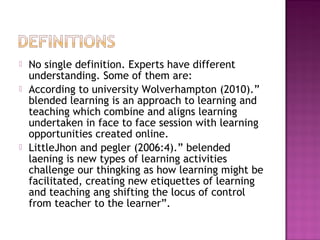
 No single definition. Experts have different
understanding. Some of them are:
 According to university Wolverhampton (2010).”
blended learning is an approach to learning and
teaching which combine and aligns learning
undertaken in face to face session with learning
opportunities created online.
 LittleJhon and pegler (2006:4).” belended
laening is new types of learning activities
challenge our thingking as how learning might be
facilitated, creating new etiquettes of learning
and teaching ang shifting the locus of control
from teacher to the learner”.
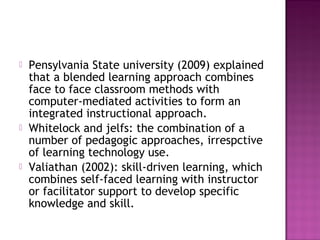
 Pensylvania State university (2009) explained
that a blended learning approach combines
face to face classroom methods with
computer-mediated activities to form an
integrated instructional approach.
 Whitelock and jelfs: the combination of a
number of pedagogic approaches, irrespctive
of learning technology use.
 Valiathan (2002): skill-driven learning, which
combines self-faced learning with instructor
or facilitator support to develop specific
knowledge and skill.
 Activity level
 Class level
 Program level
 Institution level
Why Blended
Learning?
 Enriching education
 Knowledge access
 Social interaction
 Personal agent
 Efficiency
 Ease of revision
(Osguthrope and Graham)
 Accessibility and flexibility
 Less face to face learning
 Enhancing learning
independency
 Various types of learning
experience
 Retaining social interaction
between students
 Promoting participation for
introverts
 Full provision of module related documents
in electronic format.
 Regular formative assessment with feedback
 Opportunities to learn from each other
collaboratively
 Electronic personal
development planning
 The opportunity to submit
all appropriate summative
assessments electronically.
 Face to face learning is
interactive
 Have 24/7 access to all learning content, and
equality of access
 Gauge their progress against the learning
outcomes
 Participate in
 Use asynchronous collaborative learning
 Understand students’ learning process
 Save time and paper (Hartoyo)
 Live face to face
* Instructor- led classroom
* Workshops
* Coaching/ Mentoring
* On-the-job (OTJ) training
 Live face-to-face (informal)
 Collegial connections
 Work teams
 Role modeling
 Virtual Collaboration/ Synchronous
 Live e-learning class.
 E-mentoring
 Virtual Collaboration/ asynchronous
 Email
 Online bulletin boards
 Online communties
 Self Paced Learning
 Web-learning modules
 Online resources learning
 Simulations
 Scenarios
 Video and audio CD/ DVDs
 Online self-assessments
 workbooks
 Performance Support
 Help systems
 Print job aids knowledge databases
 Documentation
 Performance/ decision support tools
By Hari Suci Sulistiawati
2.5. Blended Learning application in

Language Learning
The purpose of blended learning is
to enhance language learning
quality.
There are so many methods, strategy,
and approaches emerge as the rapid
growth of science and technology. One
of those strategies is “blended e-
learning cooperative approach”.
There are four communicative competences which
are used at the same time according to Tarigan
(1984)
A.Blended e-learning (BeL)
Blended learning term describes learning
experience which integrates some methods.
B.Cooperative Learning (CL)
Cooperative learning was firstly introduced by
Johnson and Johnson (1998). They defined
cooperative learning as a learning process which
students learn in pairs or groups.
C. Blended e-learning cooperative approach (BeLCA)
This approach combines face-to-face learning, the
utilisation of technology in learning, and learning
activity in pairs or groups.
Three types of interaction:
1. Social interaction,
2. Material, and
3. Teacher interaction.
BeLCA offers some disadvantages, such as:
1.Internet cost,
2.Computer availability in a great number of
schools,
3.Many teachers do not have enough technology
literacy,
4.Students readiness,
5.Teachers’ workload,
6.Institution support, and
7.Internet abuse anxiety.
2.6. Blended Learning Prospect
Ministry of Education and Culture of Indonesia
promotes:
1.The utilisation of Ict in learning
2.On-line courses
3.Content development training
4.E-learning services
5.E-learning devices
The steps to design and develop
Blended Learning (Dick, Carey and Carey,
2001):
1. Analyses
2. Design
3. Development
4. Implementation
5. Evaluation
7 phases of ADDIE model:
1.Analysis
2.Design
3.Development
4.Implementation
5.Execution(try out)
6.Evaluation
7.Feed back
Education has mingled with technology for years.
Technology utilization in education is increasing and appreciated
Not only in advance countries, the develop countries
also utilise this apporach in learning like Indonesia, Egypt
Minister of Education and Culture of Indonesia has established
the education reform that promotes the utilixation of ICT in learning
On-line courses, content development training, e-learning managemnt
E-learning services, and e-learning devices.
Blended e-learning cooperative approach
comprises three types of interaction:
1.Social Interaction
2.Material
3.Teacher interaction
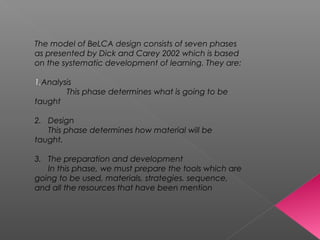
The model of BeLCA design consists of seven phases
as presented by Dick and Carey 2002 which is based
on the systematic development of learning. They are:
1.Analysis
This phase determines what is going to be
taught
2. Design
This phase determines how material will be
taught.
3. The preparation and development
In this phase, we must prepare the tools which are
going to be used, materials, strategies, sequence,
and all the resources that have been mention
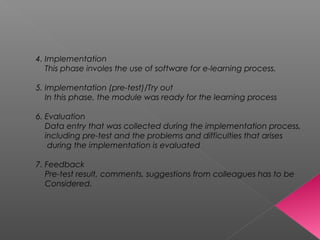
4. Implementation
This phase involes the use of software for e-learning process.
5. Implementation (pre-test)/Try out
In this phase, the module was ready for the learning process
6. Evaluation
Data entry that was collected during the implementation process,
including pre-test and the problems and difficulties that arises
during the implementation is evaluated
7. Feedback
Pre-test result, comments, suggestions from colleagues has to be
Considered.
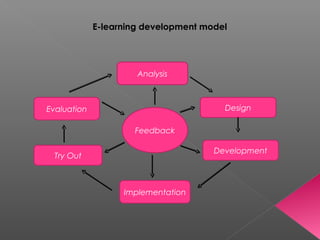
E-learning development model
Analysis
DesignEvaluation
Development
Try Out
Implementation
Feedback
Factors that Promote Successful Blended Learning:
1.Institutional success factors
2.Regarding teachers
3.Regarding students
1. Institutional success factors:
a. Blended learning models are developed that respond
to local, community or organisational needs rather than
using generic approach
b. Institution buliding blocks includes organizational readiness
sufficient technical resources, motivated faculty, good
communication and feedback channels with students
(Tabor, 2007)
c. There is a room for staff to develop their own meaning
for blended learning (Sharpe et al. 2006)
d. Blended learning should be introduced as a scholarly and
transformative redesign process within the institution that
rebuilds the course rather than simply adding on technology
(Sharpe et. al, 2008)
e. Carrying out regular evaluations and publicising the results
(Sharpe, Befield, Robert and Francis).
Regarding Teachers:
a.The importance of, and need for, continuing professional
development for teachers with sufficient time for development
should be acknowledge (Vaughan, 2007)
b.On-going pedagogical and technical support through
membership of a blended community of pracitce is a proven
model that sustains such teacher innovation
(Garrison and Vaughan, 2008)
c.The importance of dealing with teachers’ fears of losing control
lower student feedback grades and general uneasiness
about the impact of online learning on classroom
relationships should be considered (Vaughan, 2007)
d. The impact on teachers’ workloads mus be taken into account.
Regarding Students:
a.Students’ learning maturity and readiness for blended learning with
its demands for independent learning must be considered (Tabor, 2007)
b. Students’ expectations, especially their ideas that fewer face-to-face
classes mean less work and the need to develop more responsibility for
their learning and time management skills must be taken into account
(Vaughan, 2007; Tagor, 2007)
c. Consistent and transparent communication around the new expectations
is needed in order to help students understand the blended learning
process. (Sharpe et. al., 2006).
THANK YOU

ICT Group Presentation - Blended Learning

  • 1.
    Husnul atiyah Lily Meilia Harisuci Akhmad Riyanto
  • 2.
     Definition ofBlended Learning  The Reason of using blended Learning
  • 3.
     No singledefinition. Experts have different understanding. Some of them are:  According to university Wolverhampton (2010).” blended learning is an approach to learning and teaching which combine and aligns learning undertaken in face to face session with learning opportunities created online.  LittleJhon and pegler (2006:4).” belended laening is new types of learning activities challenge our thingking as how learning might be facilitated, creating new etiquettes of learning and teaching ang shifting the locus of control from teacher to the learner”.
  • 4.
     Pensylvania Stateuniversity (2009) explained that a blended learning approach combines face to face classroom methods with computer-mediated activities to form an integrated instructional approach.  Whitelock and jelfs: the combination of a number of pedagogic approaches, irrespctive of learning technology use.  Valiathan (2002): skill-driven learning, which combines self-faced learning with instructor or facilitator support to develop specific knowledge and skill.
  • 5.
     Activity level Class level  Program level  Institution level
  • 6.
  • 7.
     Enriching education Knowledge access  Social interaction
  • 8.
     Personal agent Efficiency  Ease of revision (Osguthrope and Graham)
  • 9.
     Accessibility andflexibility  Less face to face learning  Enhancing learning independency
  • 10.
     Various typesof learning experience  Retaining social interaction between students  Promoting participation for introverts
  • 11.
     Full provisionof module related documents in electronic format.  Regular formative assessment with feedback  Opportunities to learn from each other collaboratively
  • 12.
     Electronic personal developmentplanning  The opportunity to submit all appropriate summative assessments electronically.  Face to face learning is interactive
  • 13.
     Have 24/7access to all learning content, and equality of access  Gauge their progress against the learning outcomes  Participate in  Use asynchronous collaborative learning  Understand students’ learning process  Save time and paper (Hartoyo)
  • 14.
     Live faceto face * Instructor- led classroom * Workshops * Coaching/ Mentoring * On-the-job (OTJ) training
  • 15.
     Live face-to-face(informal)  Collegial connections  Work teams  Role modeling
  • 16.
     Virtual Collaboration/Synchronous  Live e-learning class.  E-mentoring  Virtual Collaboration/ asynchronous  Email  Online bulletin boards  Online communties
  • 17.
     Self PacedLearning  Web-learning modules  Online resources learning  Simulations  Scenarios  Video and audio CD/ DVDs  Online self-assessments  workbooks
  • 18.
     Performance Support Help systems  Print job aids knowledge databases  Documentation  Performance/ decision support tools
  • 19.
    By Hari SuciSulistiawati
  • 20.
    2.5. Blended Learningapplication in Language Learning The purpose of blended learning is to enhance language learning quality. There are so many methods, strategy, and approaches emerge as the rapid growth of science and technology. One of those strategies is “blended e- learning cooperative approach”.
  • 21.
    There are fourcommunicative competences which are used at the same time according to Tarigan (1984) A.Blended e-learning (BeL) Blended learning term describes learning experience which integrates some methods. B.Cooperative Learning (CL) Cooperative learning was firstly introduced by Johnson and Johnson (1998). They defined cooperative learning as a learning process which students learn in pairs or groups.
  • 22.
    C. Blended e-learningcooperative approach (BeLCA) This approach combines face-to-face learning, the utilisation of technology in learning, and learning activity in pairs or groups. Three types of interaction: 1. Social interaction, 2. Material, and 3. Teacher interaction.
  • 23.
    BeLCA offers somedisadvantages, such as: 1.Internet cost, 2.Computer availability in a great number of schools, 3.Many teachers do not have enough technology literacy, 4.Students readiness, 5.Teachers’ workload, 6.Institution support, and 7.Internet abuse anxiety.
  • 24.
    2.6. Blended LearningProspect Ministry of Education and Culture of Indonesia promotes: 1.The utilisation of Ict in learning 2.On-line courses 3.Content development training 4.E-learning services 5.E-learning devices
  • 25.
    The steps todesign and develop Blended Learning (Dick, Carey and Carey, 2001): 1. Analyses 2. Design 3. Development 4. Implementation 5. Evaluation
  • 26.
    7 phases ofADDIE model: 1.Analysis 2.Design 3.Development 4.Implementation 5.Execution(try out) 6.Evaluation 7.Feed back
  • 28.
    Education has mingledwith technology for years. Technology utilization in education is increasing and appreciated Not only in advance countries, the develop countries also utilise this apporach in learning like Indonesia, Egypt Minister of Education and Culture of Indonesia has established the education reform that promotes the utilixation of ICT in learning On-line courses, content development training, e-learning managemnt E-learning services, and e-learning devices.
  • 29.
    Blended e-learning cooperativeapproach comprises three types of interaction: 1.Social Interaction 2.Material 3.Teacher interaction
  • 30.
    The model ofBeLCA design consists of seven phases as presented by Dick and Carey 2002 which is based on the systematic development of learning. They are: 1.Analysis This phase determines what is going to be taught 2. Design This phase determines how material will be taught. 3. The preparation and development In this phase, we must prepare the tools which are going to be used, materials, strategies, sequence, and all the resources that have been mention
  • 31.
    4. Implementation This phaseinvoles the use of software for e-learning process. 5. Implementation (pre-test)/Try out In this phase, the module was ready for the learning process 6. Evaluation Data entry that was collected during the implementation process, including pre-test and the problems and difficulties that arises during the implementation is evaluated 7. Feedback Pre-test result, comments, suggestions from colleagues has to be Considered.
  • 32.
  • 33.
    Factors that PromoteSuccessful Blended Learning: 1.Institutional success factors 2.Regarding teachers 3.Regarding students
  • 34.
    1. Institutional successfactors: a. Blended learning models are developed that respond to local, community or organisational needs rather than using generic approach b. Institution buliding blocks includes organizational readiness sufficient technical resources, motivated faculty, good communication and feedback channels with students (Tabor, 2007)
  • 35.
    c. There isa room for staff to develop their own meaning for blended learning (Sharpe et al. 2006) d. Blended learning should be introduced as a scholarly and transformative redesign process within the institution that rebuilds the course rather than simply adding on technology (Sharpe et. al, 2008) e. Carrying out regular evaluations and publicising the results (Sharpe, Befield, Robert and Francis).
  • 36.
    Regarding Teachers: a.The importanceof, and need for, continuing professional development for teachers with sufficient time for development should be acknowledge (Vaughan, 2007) b.On-going pedagogical and technical support through membership of a blended community of pracitce is a proven model that sustains such teacher innovation (Garrison and Vaughan, 2008) c.The importance of dealing with teachers’ fears of losing control lower student feedback grades and general uneasiness about the impact of online learning on classroom relationships should be considered (Vaughan, 2007) d. The impact on teachers’ workloads mus be taken into account.
  • 37.
    Regarding Students: a.Students’ learningmaturity and readiness for blended learning with its demands for independent learning must be considered (Tabor, 2007) b. Students’ expectations, especially their ideas that fewer face-to-face classes mean less work and the need to develop more responsibility for their learning and time management skills must be taken into account (Vaughan, 2007; Tagor, 2007) c. Consistent and transparent communication around the new expectations is needed in order to help students understand the blended learning process. (Sharpe et. al., 2006).
  • 38.