




Amit Gautam
@amitgautam
Amol Shinde
@amolbshinde
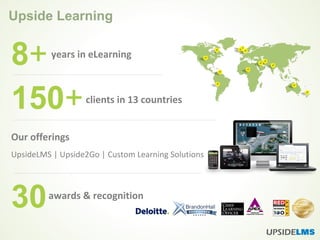
Upside Learning
years in eLearning
8+
clients in 13 countries
150+
awards & recognition
30
Our offerings
UpsideLMS | Upside2Go | Custom Learning Solutions
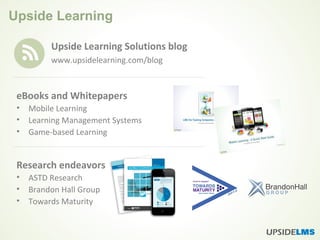
Upside Learning
Upside Learning Solutions blog
www.upsidelearning.com/blog
eBooks and Whitepapers
• Mobile Learning
• Learning Management Systems
• Game-based Learning
Research endeavors
• ASTD Research
• Brandon Hall Group
• Towards Maturity
Presenters
Amit Gautam
Amol Shinde
Founder & Director - Technology Solutions
12+ years in eLearning domain
Engg (Computer Science), MBA
Learning technologist, Internet addict
AVP Sales (India)
8+ years in Software Services & eLearning domain
eLearning enthusiast
5 5 Key Learnings from Our Client
4 5 Tips to leverage LMS for Blended Learning
1 Blended Learning – An Overview
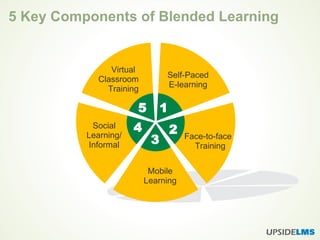
5 Key Components of Blended Learning
9 Key Challenges in Implementing Blended Learning
2
3
Agenda
Blended Learning
An Overview
What is a blend?
Source: http://1.bp.blogspot.com/-7S3ZMfTbfH4/TmyljZy9E1I/AAAAAAAADw0/sjvtw_3eyUc/s1600/Blender.jpg
Blended Learning – An Overview
Defining Blended Learning
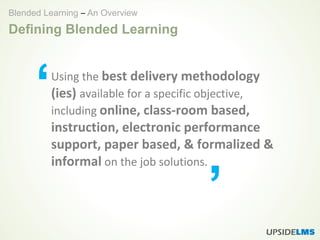
Using the best delivery methodology
(ies) available for a specific objective,
including online, class-room based,
instruction, electronic performance
support, paper based, & formalized &
informal on the job solutions.
‘
’
Blended Learning – An Overview
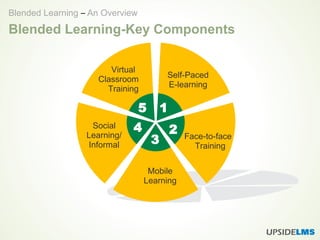
Blended Learning-Key Components
Blended Learning – An Overview
Self-Paced
E-learning
5 1
2
3
4
Face-to-face
Training
Mobile
Learning
Social
Learning/
Informal
Virtual
Classroom
Training
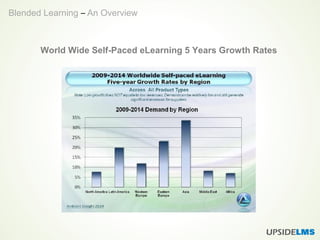
World Wide Self-Paced eLearning 5 Years Growth Rates
Blended Learning – An Overview
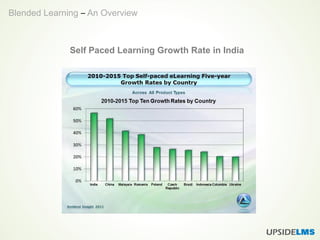
Self Paced Learning Growth Rate in India
Blended Learning – An Overview
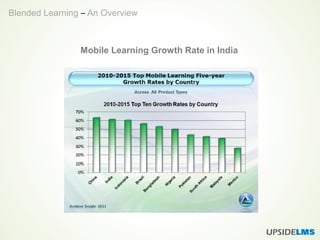
Mobile Learning Growth Rate in India
Blended Learning – An Overview
Poll # 1
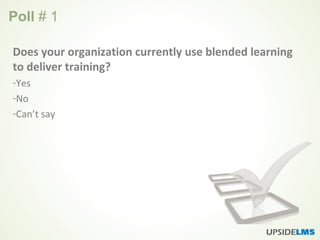
Does your organization currently use blended learning
to deliver training?
-Yes
-No
-Can’t say
Poll # 2
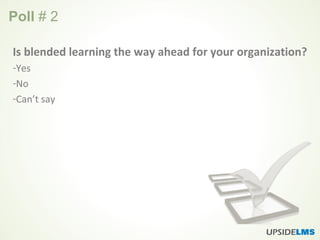
Is blended learning the way ahead for your organization?
-Yes
-No
-Can’t say
5 Key Components of
Blended Learning
5 Key Components of Blended Learning
Self-Paced
E-learning
5 1
2
3
4
Face-to-face
Training
Mobile
Learning
Social
Learning/
Informal
Virtual
Classroom
Training
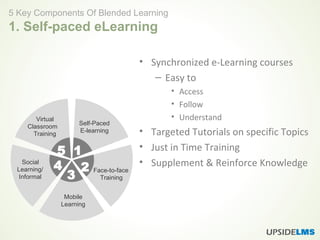
• Synchronized e-Learning courses
– Easy to
• Access
• Follow
• Understand
• Targeted Tutorials on specific Topics
• Just in Time Training
• Supplement & Reinforce Knowledge
5 Key Components Of Blended Learning
1. Self-paced eLearning
Self-Paced
E-learning
5 1
2
3
4 Face-to-face
Training
Mobile
Learning
Social
Learning/
Informal
Virtual
Classroom
Training
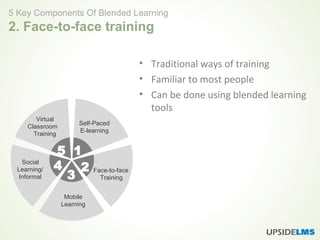
• Traditional ways of training
• Familiar to most people
• Can be done using blended learning
tools
5 Key Components Of Blended Learning
2. Face-to-face training
Self-Paced
E-learning
5 1
2
3
4 Face-to-face
Training
Mobile
Learning
Social
Learning/
Informal
Virtual
Classroom
Training
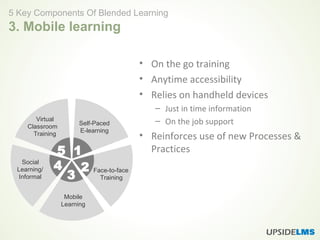
• On the go training
• Anytime accessibility
• Relies on handheld devices
– Just in time information
– On the job support
• Reinforces use of new Processes &
Practices
5 Key Components Of Blended Learning
3. Mobile learning
Self-Paced
E-learning
5 1
2
3
4 Face-to-face
Training
Mobile
Learning
Social
Learning/
Informal
Virtual
Classroom
Training
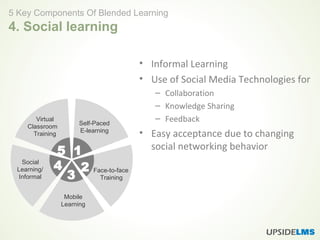
• Informal Learning
• Use of Social Media Technologies for
– Collaboration
– Knowledge Sharing
– Feedback
• Easy acceptance due to changing
social networking behavior
5 Key Components Of Blended Learning
4. Social learning
Self-Paced
E-learning
5 1
2
3
4 Face-to-face
Training
Mobile
Learning
Social
Learning/
Informal
Virtual
Classroom
Training
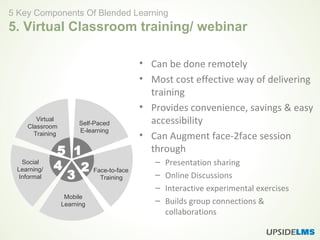
• Can be done remotely
• Most cost effective way of delivering
training
• Provides convenience, savings & easy
accessibility
• Can Augment face-2face session
through
– Presentation sharing
– Online Discussions
– Interactive experimental exercises
– Builds group connections &
collaborations
5 Key Components Of Blended Learning
5. Virtual Classroom training/ webinar
Self-Paced
E-learning
5 1
2
3
4 Face-to-face
Training
Mobile
Learning
Social
Learning/
Informal
Virtual
Classroom
Training
Poll # 3
What are the top challenges in blended learning for your
organization?
-Organization’s vision
-Organization culture
9 Key Challenges in Implementing
Blended Learning
Top 9 Challenges in Blended Learning
These Challenges can further be categorized in 3
categories
A.Technological Challenges
B. Organizational Challenges
C. Instructional Challenges
9 Key Challenges in Implementing Blended Learning
A. Technological Challenges
1. Ensuring the successful use of technology by
the participants
2. Resisting the urge to use the technology
simply because it is available
9 Key Challenges in Implementing Blended Learning
B. Organizational Challenges
3. Getting Conviction on Blended Learning is
More effective than f2f Training
4. Redefining the Role of Facilitator
5. Managing & Monitoring Participants Progress
9 Key Challenges in Implementing Blended Learning
C. Instructional Challenges
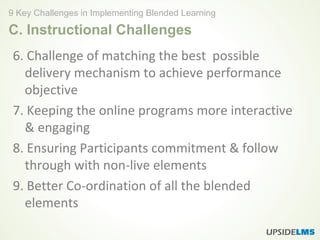
6. Challenge of matching the best possible
delivery mechanism to achieve performance
objective
7. Keeping the online programs more interactive
& engaging
8. Ensuring Participants commitment & follow
through with non-live elements
9. Better Co-ordination of all the blended
elements
9 Key Challenges in Implementing Blended Learning
5 Tips to Leverage LMS for
Blended Learning
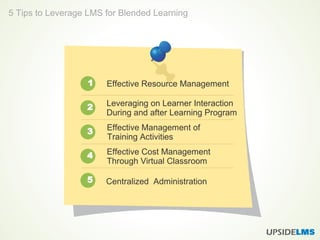
Effective Resource Management
Leveraging on Learner Interaction
During and after Learning Program
Effective Management of
Training Activities
Effective Cost Management
Through Virtual Classroom
Centralized Administration
1
2
3
4
5
5 Tips to Leverage LMS for Blended Learning
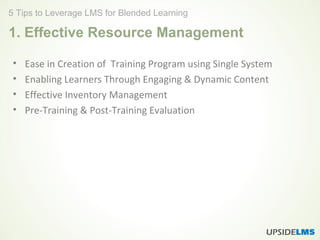
1. Effective Resource Management
• Ease in Creation of Training Program using Single System
• Enabling Learners Through Engaging & Dynamic Content
• Effective Inventory Management
• Pre-Training & Post-Training Evaluation
5 Tips to Leverage LMS for Blended Learning
2. Leveraging on Learner Interaction During
and After Learning Program
• Notifications
• Sharing & Collaboration
• Feedback
• Surveys
• Evaluation
• Communities & Discussion Forum
5 Tips to Leverage LMS for Blended Learning
3. Training Activity Management
• Scheduling
• Announcements
• Reminders
• Follow ups
• Logistic Arrangements
5 Tips to Leverage LMS for Blended Learning
4. Effective Training Delivery Through
Virtual Classroom for Remote Location
Users• Training to Distributed Workforce remotely
• Avoid remote location travels
• Less logistic hassles
• Better control over the class for effective delivery of training
5 Tips to Leverage LMS for Blended Learning
5. Centralised Administrative Management
• Easy Authentication
• Centralized User Management
• Easy Assignment & Delivery of Training
• Reports for Better Analytics & Decision Making
5 Tips to Leverage LMS for Blended Learning
Poll # 4
How many systems currently your organisation uses
to manage the training program?
- One
- Two
- Three
- More than Three
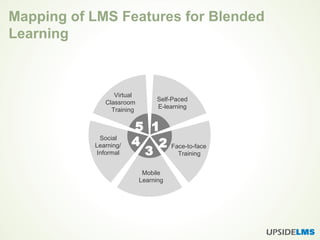
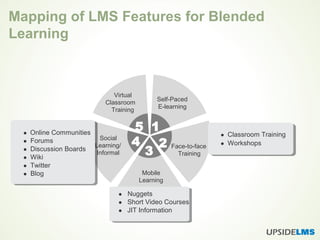
Mapping of LMS Features for Blended
Learning
Self-Paced
E-learning
5 1
2
3
4 Face-to-face
Training
Mobile
Learning
Social
Learning/
Informal
Virtual
Classroom
Training
Mapping of LMS Features for Blended
Learning
Self-Paced
E-learning
5 1
2
3
4 Face-to-face
Training
Mobile
Learning
Social
Learning/
Informal
Virtual
Classroom
Training
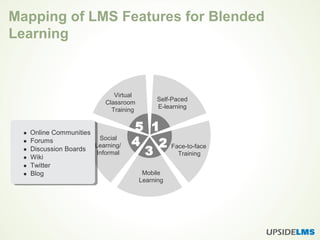
 Online Communities
Forums
Discussion Boards
Wiki
Twitter
Blog





Mapping of LMS Features for Blended
Learning
Self-Paced
E-learning
5 1
2
3
4 Face-to-face
Training
Mobile
Learning
Social
Learning/
Informal
Virtual
Classroom
Training
 Online Communities
Forums
Discussion Boards
Wiki
Twitter
Blog





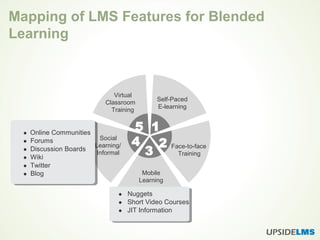
 Nuggets
Short Video Courses
JIT Information


Mapping of LMS Features for Blended
Learning
Self-Paced
E-learning
5 1
2
3
4 Face-to-face
Training
Mobile
Learning
Social
Learning/
Informal
Virtual
Classroom
Training
 Online Communities
Forums
Discussion Boards
Wiki
Twitter
Blog





 Nuggets
Short Video Courses
JIT Information


 Classroom Training
Workshops
Mapping of LMS Features for Blended
Learning
Self-Paced
E-learning
5 1
2
3
4 Face-to-face
Training
Mobile
Learning
Social
Learning/
Informal
Virtual
Classroom
Training
 Online Communities
Forums
Discussion Boards
Wiki
Twitter
Blog





 Nuggets
Short Video Courses
JIT Information


 Classroom Training
Workshops
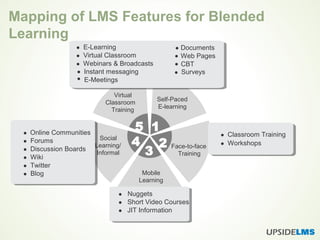
Instant messaging
E-Meetings
 E-Learning
Virtual Classroom
Webinars & Broadcasts




Documents
Web Pages
CBT
Surveys



5 Key Learnings From
Our Client
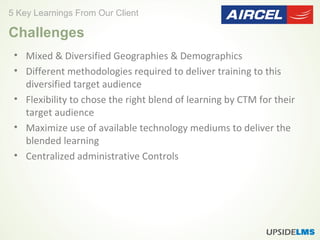
• Mixed & Diversified Geographies & Demographics
• Different methodologies required to deliver training to this
diversified target audience
• Flexibility to chose the right blend of learning by CTM for their
target audience
• Maximize use of available technology mediums to deliver the
blended learning
• Centralized administrative Controls
5 Key Learnings From Our Client
Challenges
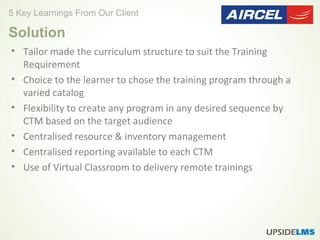
• Tailor made the curriculum structure to suit the Training
Requirement
• Choice to the learner to chose the training program through a
varied catalog
• Flexibility to create any program in any desired sequence by
CTM based on the target audience
• Centralised resource & inventory management
• Centralised reporting available to each CTM
• Use of Virtual Classroom to delivery remote trainings
5 Key Learnings From Our Client
Solution
Poll # 5
Will you prefer to use a single system to manage
the Blended Learning?
- Yes
- No
- Can’t Say
5 Benefits of Blended Learning
• Leveraging multiple mediums for the Unique benefits of
Learner
• Extend Learning Beyond Classroom
• Addressing Diversity in the Learner Base arising out of
Demographics & Geographies Learning Experience for Users
based on their needs
• Makes it easy & possible to extend the learning interaction
• Easy Accessibility & Convenience
• Time & Cost saving
Poll # 6
Will you consider an LMS for your Blended Learning
Strategy?
-Yes
-No
-Can’t Say
Upside Learning Solutions Pvt.
Ltd
www.upsidelearning.com/upsidelms
Email : upside.lms@upsidelearning.com

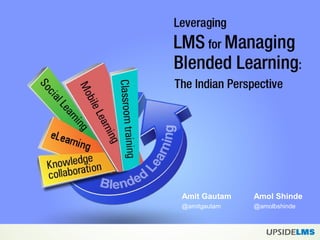
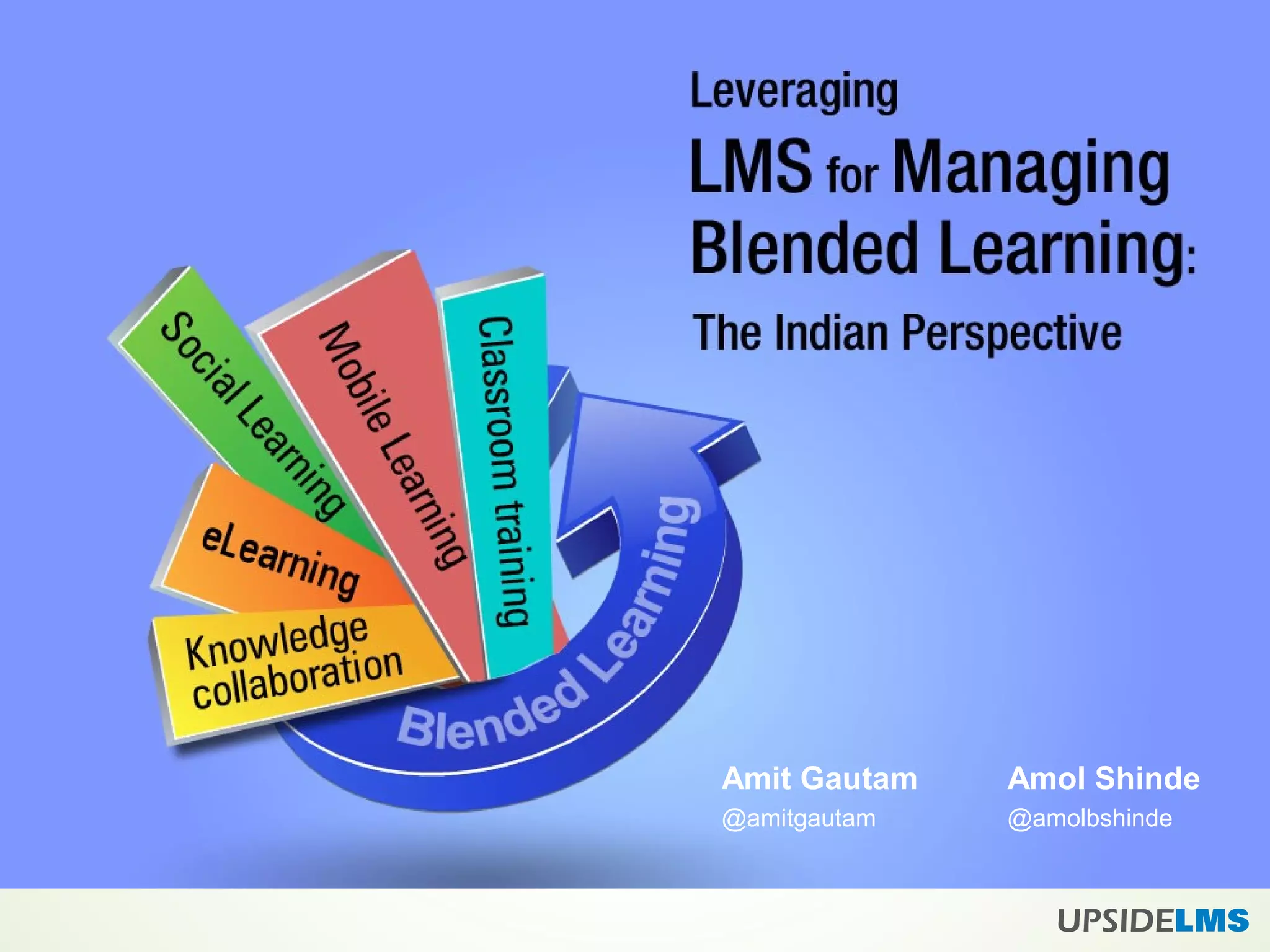
Leveraging LMS for Managing Blended Learning - The Indian Perspective

  • 1.
  • 2.
    Upside Learning years ineLearning 8+ clients in 13 countries 150+ awards & recognition 30 Our offerings UpsideLMS | Upside2Go | Custom Learning Solutions
  • 3.
    Upside Learning Upside LearningSolutions blog www.upsidelearning.com/blog eBooks and Whitepapers • Mobile Learning • Learning Management Systems • Game-based Learning Research endeavors • ASTD Research • Brandon Hall Group • Towards Maturity
  • 4.
    Presenters Amit Gautam Amol Shinde Founder& Director - Technology Solutions 12+ years in eLearning domain Engg (Computer Science), MBA Learning technologist, Internet addict AVP Sales (India) 8+ years in Software Services & eLearning domain eLearning enthusiast
  • 5.
    5 5 KeyLearnings from Our Client 4 5 Tips to leverage LMS for Blended Learning 1 Blended Learning – An Overview 5 Key Components of Blended Learning 9 Key Challenges in Implementing Blended Learning 2 3 Agenda
  • 6.
  • 7.
    What is ablend? Source: http://1.bp.blogspot.com/-7S3ZMfTbfH4/TmyljZy9E1I/AAAAAAAADw0/sjvtw_3eyUc/s1600/Blender.jpg Blended Learning – An Overview
  • 8.
    Defining Blended Learning Usingthe best delivery methodology (ies) available for a specific objective, including online, class-room based, instruction, electronic performance support, paper based, & formalized & informal on the job solutions. ‘ ’ Blended Learning – An Overview
  • 9.
    Blended Learning-Key Components BlendedLearning – An Overview Self-Paced E-learning 5 1 2 3 4 Face-to-face Training Mobile Learning Social Learning/ Informal Virtual Classroom Training
  • 10.
    World Wide Self-PacedeLearning 5 Years Growth Rates Blended Learning – An Overview
  • 11.
    Self Paced LearningGrowth Rate in India Blended Learning – An Overview
  • 12.
    Mobile Learning GrowthRate in India Blended Learning – An Overview
  • 13.
    Poll # 1 Doesyour organization currently use blended learning to deliver training? -Yes -No -Can’t say
  • 14.
    Poll # 2 Isblended learning the way ahead for your organization? -Yes -No -Can’t say
  • 15.
    5 Key Componentsof Blended Learning
  • 16.
    5 Key Componentsof Blended Learning Self-Paced E-learning 5 1 2 3 4 Face-to-face Training Mobile Learning Social Learning/ Informal Virtual Classroom Training
  • 17.
    • Synchronized e-Learningcourses – Easy to • Access • Follow • Understand • Targeted Tutorials on specific Topics • Just in Time Training • Supplement & Reinforce Knowledge 5 Key Components Of Blended Learning 1. Self-paced eLearning Self-Paced E-learning 5 1 2 3 4 Face-to-face Training Mobile Learning Social Learning/ Informal Virtual Classroom Training
  • 18.
    • Traditional waysof training • Familiar to most people • Can be done using blended learning tools 5 Key Components Of Blended Learning 2. Face-to-face training Self-Paced E-learning 5 1 2 3 4 Face-to-face Training Mobile Learning Social Learning/ Informal Virtual Classroom Training
  • 19.
    • On thego training • Anytime accessibility • Relies on handheld devices – Just in time information – On the job support • Reinforces use of new Processes & Practices 5 Key Components Of Blended Learning 3. Mobile learning Self-Paced E-learning 5 1 2 3 4 Face-to-face Training Mobile Learning Social Learning/ Informal Virtual Classroom Training
  • 20.
    • Informal Learning •Use of Social Media Technologies for – Collaboration – Knowledge Sharing – Feedback • Easy acceptance due to changing social networking behavior 5 Key Components Of Blended Learning 4. Social learning Self-Paced E-learning 5 1 2 3 4 Face-to-face Training Mobile Learning Social Learning/ Informal Virtual Classroom Training
  • 21.
    • Can bedone remotely • Most cost effective way of delivering training • Provides convenience, savings & easy accessibility • Can Augment face-2face session through – Presentation sharing – Online Discussions – Interactive experimental exercises – Builds group connections & collaborations 5 Key Components Of Blended Learning 5. Virtual Classroom training/ webinar Self-Paced E-learning 5 1 2 3 4 Face-to-face Training Mobile Learning Social Learning/ Informal Virtual Classroom Training
  • 22.
    Poll # 3 Whatare the top challenges in blended learning for your organization? -Organization’s vision -Organization culture
  • 23.
    9 Key Challengesin Implementing Blended Learning
  • 24.
    Top 9 Challengesin Blended Learning These Challenges can further be categorized in 3 categories A.Technological Challenges B. Organizational Challenges C. Instructional Challenges 9 Key Challenges in Implementing Blended Learning
  • 25.
    A. Technological Challenges 1.Ensuring the successful use of technology by the participants 2. Resisting the urge to use the technology simply because it is available 9 Key Challenges in Implementing Blended Learning
  • 26.
    B. Organizational Challenges 3.Getting Conviction on Blended Learning is More effective than f2f Training 4. Redefining the Role of Facilitator 5. Managing & Monitoring Participants Progress 9 Key Challenges in Implementing Blended Learning
  • 27.
    C. Instructional Challenges 6.Challenge of matching the best possible delivery mechanism to achieve performance objective 7. Keeping the online programs more interactive & engaging 8. Ensuring Participants commitment & follow through with non-live elements 9. Better Co-ordination of all the blended elements 9 Key Challenges in Implementing Blended Learning
  • 28.
    5 Tips toLeverage LMS for Blended Learning
  • 29.
    Effective Resource Management Leveragingon Learner Interaction During and after Learning Program Effective Management of Training Activities Effective Cost Management Through Virtual Classroom Centralized Administration 1 2 3 4 5 5 Tips to Leverage LMS for Blended Learning
  • 30.
    1. Effective ResourceManagement • Ease in Creation of Training Program using Single System • Enabling Learners Through Engaging & Dynamic Content • Effective Inventory Management • Pre-Training & Post-Training Evaluation 5 Tips to Leverage LMS for Blended Learning
  • 31.
    2. Leveraging onLearner Interaction During and After Learning Program • Notifications • Sharing & Collaboration • Feedback • Surveys • Evaluation • Communities & Discussion Forum 5 Tips to Leverage LMS for Blended Learning
  • 32.
    3. Training ActivityManagement • Scheduling • Announcements • Reminders • Follow ups • Logistic Arrangements 5 Tips to Leverage LMS for Blended Learning
  • 33.
    4. Effective TrainingDelivery Through Virtual Classroom for Remote Location Users• Training to Distributed Workforce remotely • Avoid remote location travels • Less logistic hassles • Better control over the class for effective delivery of training 5 Tips to Leverage LMS for Blended Learning
  • 34.
    5. Centralised AdministrativeManagement • Easy Authentication • Centralized User Management • Easy Assignment & Delivery of Training • Reports for Better Analytics & Decision Making 5 Tips to Leverage LMS for Blended Learning
  • 35.
    Poll # 4 Howmany systems currently your organisation uses to manage the training program? - One - Two - Three - More than Three
  • 36.
    Mapping of LMSFeatures for Blended Learning Self-Paced E-learning 5 1 2 3 4 Face-to-face Training Mobile Learning Social Learning/ Informal Virtual Classroom Training
  • 37.
    Mapping of LMSFeatures for Blended Learning Self-Paced E-learning 5 1 2 3 4 Face-to-face Training Mobile Learning Social Learning/ Informal Virtual Classroom Training  Online Communities Forums Discussion Boards Wiki Twitter Blog     
  • 38.
    Mapping of LMSFeatures for Blended Learning Self-Paced E-learning 5 1 2 3 4 Face-to-face Training Mobile Learning Social Learning/ Informal Virtual Classroom Training  Online Communities Forums Discussion Boards Wiki Twitter Blog       Nuggets Short Video Courses JIT Information  
  • 39.
    Mapping of LMSFeatures for Blended Learning Self-Paced E-learning 5 1 2 3 4 Face-to-face Training Mobile Learning Social Learning/ Informal Virtual Classroom Training  Online Communities Forums Discussion Boards Wiki Twitter Blog       Nuggets Short Video Courses JIT Information    Classroom Training Workshops
  • 40.
    Mapping of LMSFeatures for Blended Learning Self-Paced E-learning 5 1 2 3 4 Face-to-face Training Mobile Learning Social Learning/ Informal Virtual Classroom Training  Online Communities Forums Discussion Boards Wiki Twitter Blog       Nuggets Short Video Courses JIT Information    Classroom Training Workshops Instant messaging E-Meetings  E-Learning Virtual Classroom Webinars & Broadcasts     Documents Web Pages CBT Surveys   
  • 41.
    5 Key LearningsFrom Our Client
  • 42.
    • Mixed &Diversified Geographies & Demographics • Different methodologies required to deliver training to this diversified target audience • Flexibility to chose the right blend of learning by CTM for their target audience • Maximize use of available technology mediums to deliver the blended learning • Centralized administrative Controls 5 Key Learnings From Our Client Challenges
  • 43.
    • Tailor madethe curriculum structure to suit the Training Requirement • Choice to the learner to chose the training program through a varied catalog • Flexibility to create any program in any desired sequence by CTM based on the target audience • Centralised resource & inventory management • Centralised reporting available to each CTM • Use of Virtual Classroom to delivery remote trainings 5 Key Learnings From Our Client Solution
  • 44.
    Poll # 5 Willyou prefer to use a single system to manage the Blended Learning? - Yes - No - Can’t Say
  • 45.
    5 Benefits ofBlended Learning • Leveraging multiple mediums for the Unique benefits of Learner • Extend Learning Beyond Classroom • Addressing Diversity in the Learner Base arising out of Demographics & Geographies Learning Experience for Users based on their needs • Makes it easy & possible to extend the learning interaction • Easy Accessibility & Convenience • Time & Cost saving
  • 46.
    Poll # 6 Willyou consider an LMS for your Blended Learning Strategy? -Yes -No -Can’t Say
  • 47.
    Upside Learning SolutionsPvt. Ltd www.upsidelearning.com/upsidelms Email : upside.lms@upsidelearning.com

Editor's Notes

  • #8 Picture of a blenderhttp://1.bp.blogspot.com/-7S3ZMfTbfH4/TmyljZy9E1I/AAAAAAAADw0/sjvtw_3eyUc/s1600/Blender.jpg
  • #9 Blended learning means many things to many people, even within our relatively small online learning community. It is referred to as both blended and hybrid learning, with little or no difference in the meaning of the terms among most educators. In general terms, blended learning combines online delivery of educational content with the best features of classroom interaction and live instruction to personalize learning, allow thoughtful reflection, and differentiate instruction from student to student across a diverse group of learners. Blended learning, combining the best elements of online and face-to-face education, is likely to emerge as the predominant teaching model of the future. Blending Learning: The Convergence of Online and F 5 ace-to-Face Education Definitions of blended learning range from some so broad that practically any learning experience that integrates some use of educational technology might qualify, to others that focus on a specific percentage combination of online curriculum and instruction in a face-to-face setting. A few of the many definitions of blended learning include: „. The integration of face-to-face and online learning to help enhance the classroom experience and extend learning through the innovative use of information and communications technology. Blended strategies enhance student engagement and learning through online activities to the course curriculum, and improve effectiveness and efficiencies by reducing lecture time.1 „. “A course that blends online and face-to-face delivery. Substantial proportion of the content is delivered online, typically uses online discussions, and typically has some face-to-face meetings.” The Sloan Consortium defines blended courses as having between 30 percent and 79 percent of their content delivered online, with the remaining portion of the course content delivered by face-to-face instruction or other non web-based methods, such as paper textbooks.2 „. The combination of multiple approaches to learning. Blended learning can be accomplished through the use of ‘blended’ virtual and physical resources.3 Ultimately, the exact definition of blended learning, beyond some combination of online and faceto- face, may not matter. Along these lines, Dziuban, Hartman and Moskal (2004) in a research brief for EDUCAUSE titled “Blended Learning” noted: “Blended learning should be viewed as a pedagogical approach that combines the effectiveness and socialization opportunities of the classroom with the technologically enhanced active learning possibilities of the online environment, rather than a ratio of delivery modalities. In other words, blended learning should be approached not merely as a temporal construct, but rather as a fundamental redesign of the instructional model with the following characteristics: „. A shift from lecture- to student-centered instruction in which students become active and interactive learners (this shift should apply to the entire course, including face-to-face contact sessions); „. Increases in interaction between student-instructor, student-student, student-content, and student-outside resources; „. Integrated formative and summative assessment mechanisms for students and instructor.”4 Most importantly, in this view, blended learning represents a shift in instructional strategy. Just as online learning represents a fundamental shift in the delivery and instructional model of distance learning, blended learning offers the possibility to significantly change how teachers and administrators view online learning in the face-to-face setting. “The widespread adoption and availability of digital learning technologies has led to increased levels of integration of computermediated instructional elements into the traditional F2F [face to face] learning experience. Link: http://www.inacol.org/research/promisingpractices/NACOL_PP-BlendedLearning-lr.pdf
  • #11 Ambient Insight has last month released a report on how the global market for self-paced eLearning products and services will grow through till 2014. It estimates the market had reached US $ 27.1 billion in 2009. The demand is growing at a 5 year compound annual growth rate of 12.8% and will take the world market to US $ 49.6 billion by 2014. Key highlights (as shared in the executive summary are): - North America will continue to be the biggest market. - By 2014 Asia (which includes Australia and New Zealand in this report) would overtake Western Europe to become the second largest market after North America. The compound annual growth rate in Asia is a very healthy 33.5%. - East Europe is second fastest in growth terms at 23.0%. Vibrant outsourcing hubs have come up in countries such as Belarus and the Ukraine. - There is resistance in regional markets to content that has been translated but not localized. This is creating demand for local content in each region. - There’s virtually no self-paced eLearning being used in primary and secondary education in Japan, proving that it is a ‘myth’ to assume technologically advanced regions are more likely to adopt self-paced eLearning. In contrast 100% of primary and secondary schools in Korea and Singapore offer some type of online education. Link: http://trends.learning-managers.net/trends-reports/learning-reports - Adoption of self-paced eLearning is now wide spread across buying segments. North America where corporate are still the top buyers, will see academic buyers emerge as top buyers in next five years. - New tool and learning platform suppliers are entering the market at a steady rate in each region even in more mature markets like North America.”
  • #12 Link: http://www.ambientinsight.com/Resources/Documents/Ambient-Insight-2010-2015-Worldwide-eLearning-Market-Executive-Overview.pdf
  • #25 Botts to give content
  • #26 Botts to give content
  • #27 Botts to give content
  • #28 Botts to give content