
 The aim of bleaching is to transfer colored
substances in the fibers into uncolored
substances and/or to make them removable by
the washing.
 By that the following effects should be reached
 The degree of whiteness shall be high and even
enough for the intend use of the textile goods.
 The textile good shall not be damaged if possible
 The degree of whiteness shall be stable in storage
 The absorptive capacity shall be high and uniform
 For achieving this mainly oxidative and rarely
reductive bleaching systems are used.
 Bleaching is important, in case of white, pastel
shades, or printed background, but can be
optional in case of dark shades.
 Dyeing an unbleached fabric in pastel shades
might mask the brightness of applied color.
 Bleaching also removes residual impurities left
by other pretreatment processes like deszing,
scouring etc.
 In case of cotton, the motes or the seed coat
fragments are visible as specks of brown or black
colors on fabric.The color of these motes is also
destroyed by bleaching.
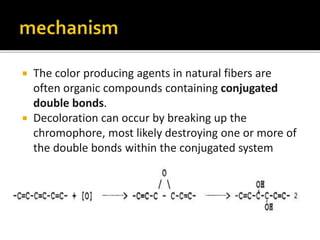
 The color producing agents in natural fibers are
often organic compounds containing conjugated
double bonds.
 Decoloration can occur by breaking up the
chromophore, most likely destroying one or more of
the double bonds within the conjugated system
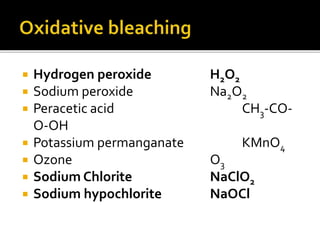
 Hydrogen peroxide H2O2
 Sodium peroxide Na2O2
 Peracetic acid CH3-CO-
O-OH
 Potassium permanganate KMnO4
 Ozone O3
 Sodium Chlorite NaClO2
 Sodium hypochlorite NaOCl
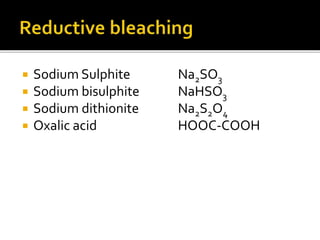
 Sodium Sulphite Na2SO3
 Sodium bisulphite NaHSO3
 Sodium dithionite Na2S2O4
 Oxalic acid HOOC-COOH
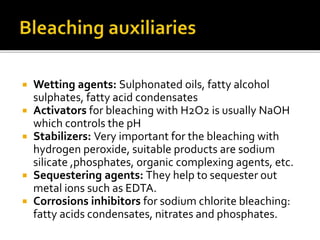
 Wetting agents: Sulphonated oils, fatty alcohol
sulphates, fatty acid condensates
 Activators for bleaching with H2O2 is usually NaOH
which controls the pH
 Stabilizers: Very important for the bleaching with
hydrogen peroxide, suitable products are sodium
silicate ,phosphates, organic complexing agents, etc.
 Sequestering agents: They help to sequester out
metal ions such as EDTA.
 Corrosions inhibitors for sodium chlorite bleaching:
fatty acids condensates, nitrates and phosphates.
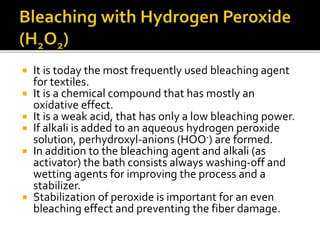
 It is today the most frequently used bleaching agent
for textiles.
 It is a chemical compound that has mostly an
oxidative effect.
 It is a weak acid, that has only a low bleaching power.
 If alkali is added to an aqueous hydrogen peroxide
solution, perhydroxyl-anions (HOO-) are formed.
 In addition to the bleaching agent and alkali (as
activator) the bath consists always washing-off and
wetting agents for improving the process and a
stabilizer.
 Stabilization of peroxide is important for an even
bleaching effect and preventing the fiber damage.
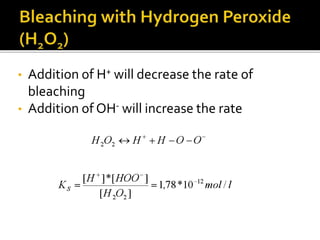
• Addition of H+ will decrease the rate of
bleaching
• Addition of OH- will increase the rate
 Effect of pH
 Caustic neutralizes the proton and shifts the reaction
to the right.
 pH <10, H2O2 is the major species and hence
ineffective or no bleaching occurs
 pH = 10 -11, moderate conc. of perhydroxyl ions.
 pH >11, rapid generation of perhydroxyl ion.
 pH 11.8 all H2O2 is converted to HOO- and reaction
will be out of control
 Effect of temperature
 Stabilized H2O2 does not decompose at high
temperature therefore faster and better bleaching
occurs at 95 to 100 ⁰C
 Temp↑ - rate of bleaching ↑ … but solution
becomes unstable and degradation of cotton
increases.
 Below 80 ⁰C the evolution of perhydroxyl ion is very
slow so also the rate of bleaching is slow.
 Time for process decreases at high temperature
Hypochlorite bleaching (OCl-) is the oldest industrial
method of bleaching cotton.
Until 1940 most cotton fabrics were bleached with
NaOCl … today only 10 % of the cotton.
 It is however the main stay of home laundry
bleaching products.
Their use is declining because of anti-chlorine lobby
and environmental pressures.
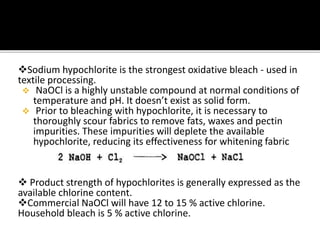
Sodium hypochlorite is the strongest oxidative bleach - used in
textile processing.
 NaOCl is a highly unstable compound at normal conditions of
temperature and pH. It doesn’t exist as solid form.
 Prior to bleaching with hypochlorite, it is necessary to
thoroughly scour fabrics to remove fats, waxes and pectin
impurities. These impurities will deplete the available
hypochlorite, reducing its effectiveness for whitening fabric
 Product strength of hypochlorites is generally expressed as the
available chlorine content.
Commercial NaOCl will have 12 to 15 % active chlorine.
Household bleach is 5 % active chlorine.
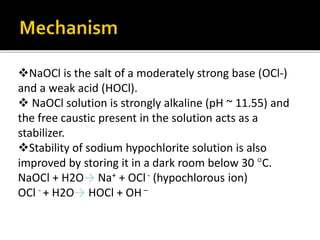
NaOCl is the salt of a moderately strong base (OCl-)
and a weak acid (HOCl).
 NaOCl solution is strongly alkaline (pH ~ 11.55) and
the free caustic present in the solution acts as a
stabilizer.
Stability of sodium hypochlorite solution is also
improved by storing it in a dark room below 30 °C.
NaOCl + H2O→ Na+ + OCl- (hypochlorous ion)
OCl - + H2O→ HOCl + OH –
 Effect of pH
pH has a profound effect on bleaching with hypochlorite.
 Addition of caustic favors the formation of OCl- ion.
 Na2CO3 is used to buffer the bleach bath to pH 9 - 10.
 At pH > 10, little to no bleaching takes place.
 When acid is added, the HOCl concentration increases.
 pH 5 - 8.5, HOCl is the major species present … very
rapid bleaching takes place, … but rapid degradation of
fiber.
 When the pH drops below 5, chlorine gas is liberated and
the solution has no bleaching effectiveness at all.
 The optimum pH for bleaching is between 9 and 10.
Effect of Time and Temperature
Time and temperature of bleaching are interrelated.
• Concentration is also interrelated with time and temperature.
•1 hr at 40 ⁰C is satisfactory for effective bleaching.
Effect of Metals
• Copper and iron catalyze the oxidation of cellulose by sodium
hypochlorite degrading the fiber. .
• Stainless steel equipment is required and care must be taken that
the water supply be free of metal ions and rust from pipes.
Antichlor
• Fabrics bleached with hypochlorite will develop a distinctive chlorine
odor
• An antichlor treatment with sodium bisulfite and acetic acid removes
any residual chlorine from the cloth
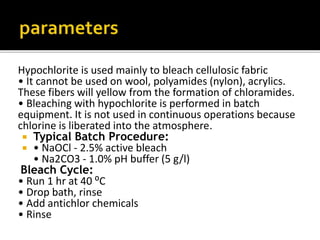
Hypochlorite is used mainly to bleach cellulosic fabric
• It cannot be used on wool, polyamides (nylon), acrylics.
These fibers will yellow from the formation of chloramides.
• Bleaching with hypochlorite is performed in batch
equipment. It is not used in continuous operations because
chlorine is liberated into the atmosphere.
 Typical Batch Procedure:
 • NaOCl - 2.5% active bleach
• Na2CO3 - 1.0% pH buffer (5 g/l)
Bleach Cycle:
• Run 1 hr at 40 ⁰C
• Drop bath, rinse
• Add antichlor chemicals
• Rinse
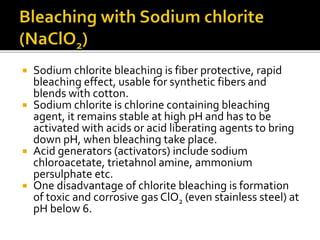
 Sodium chlorite bleaching is fiber protective, rapid
bleaching effect, usable for synthetic fibers and
blends with cotton.
 Sodium chlorite is chlorine containing bleaching
agent, it remains stable at high pH and has to be
activated with acids or acid liberating agents to bring
down pH, when bleaching take place.
 Acid generators (activators) include sodium
chloroacetate, trietahnol amine, ammonium
persulphate etc.
 One disadvantage of chlorite bleaching is formation
of toxic and corrosive gas ClO2 (even stainless steel) at
pH below 6.
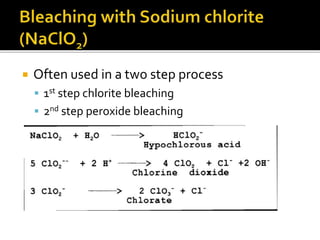
 Often used in a two step process
 1st step chlorite bleaching
 2nd step peroxide bleaching
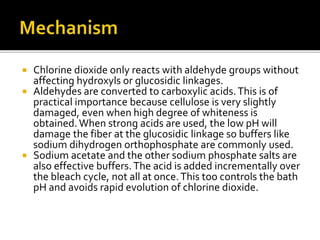
 Chlorine dioxide only reacts with aldehyde groups without
affecting hydroxyls or glucosidic linkages.
 Aldehydes are converted to carboxylic acids.This is of
practical importance because cellulose is very slightly
damaged, even when high degree of whiteness is
obtained.When strong acids are used, the low pH will
damage the fiber at the glucosidic linkage so buffers like
sodium dihydrogen orthophosphate are commonly used.
 Sodium acetate and the other sodium phosphate salts are
also effective buffers.The acid is added incrementally over
the bleach cycle, not all at once.This too controls the bath
pH and avoids rapid evolution of chlorine dioxide.
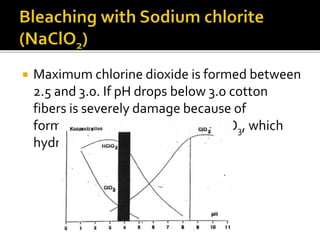
 Maximum chlorine dioxide is formed between
2.5 and 3.0. If pH drops below 3.0 cotton
fibers is severely damage because of
formation of HClO2 and HCL, HClO3, which
hydrolyze the cellulose
 Advantages
 Can be used for both cotton and synthetic fibers, suitable
for fibers, which are unstable at alkaline pH.
 As it takes place at acidic pH, hardness of water and metal
ions do not impair the process.
 Cause low or no cellulose damage.
 Disadvantages
 More expensive than NaOCl or H2O2.
 It can not used to bleach silk and wool (pink coloration).
 ClO2 corrosive and toxic gas.
 It takes place at acidic pH, so removal of wax is not
satisfactory.

Bleaching of Textiles

  • 2.
     The aimof bleaching is to transfer colored substances in the fibers into uncolored substances and/or to make them removable by the washing.  By that the following effects should be reached  The degree of whiteness shall be high and even enough for the intend use of the textile goods.  The textile good shall not be damaged if possible  The degree of whiteness shall be stable in storage  The absorptive capacity shall be high and uniform  For achieving this mainly oxidative and rarely reductive bleaching systems are used.
  • 3.
     Bleaching isimportant, in case of white, pastel shades, or printed background, but can be optional in case of dark shades.  Dyeing an unbleached fabric in pastel shades might mask the brightness of applied color.  Bleaching also removes residual impurities left by other pretreatment processes like deszing, scouring etc.  In case of cotton, the motes or the seed coat fragments are visible as specks of brown or black colors on fabric.The color of these motes is also destroyed by bleaching.
  • 4.
     The colorproducing agents in natural fibers are often organic compounds containing conjugated double bonds.  Decoloration can occur by breaking up the chromophore, most likely destroying one or more of the double bonds within the conjugated system
  • 5.
     Hydrogen peroxideH2O2  Sodium peroxide Na2O2  Peracetic acid CH3-CO- O-OH  Potassium permanganate KMnO4  Ozone O3  Sodium Chlorite NaClO2  Sodium hypochlorite NaOCl
  • 6.
     Sodium SulphiteNa2SO3  Sodium bisulphite NaHSO3  Sodium dithionite Na2S2O4  Oxalic acid HOOC-COOH
  • 7.
     Wetting agents:Sulphonated oils, fatty alcohol sulphates, fatty acid condensates  Activators for bleaching with H2O2 is usually NaOH which controls the pH  Stabilizers: Very important for the bleaching with hydrogen peroxide, suitable products are sodium silicate ,phosphates, organic complexing agents, etc.  Sequestering agents: They help to sequester out metal ions such as EDTA.  Corrosions inhibitors for sodium chlorite bleaching: fatty acids condensates, nitrates and phosphates.
  • 8.
     It istoday the most frequently used bleaching agent for textiles.  It is a chemical compound that has mostly an oxidative effect.  It is a weak acid, that has only a low bleaching power.  If alkali is added to an aqueous hydrogen peroxide solution, perhydroxyl-anions (HOO-) are formed.  In addition to the bleaching agent and alkali (as activator) the bath consists always washing-off and wetting agents for improving the process and a stabilizer.  Stabilization of peroxide is important for an even bleaching effect and preventing the fiber damage.
  • 9.
    • Addition ofH+ will decrease the rate of bleaching • Addition of OH- will increase the rate
  • 10.
     Effect ofpH  Caustic neutralizes the proton and shifts the reaction to the right.  pH <10, H2O2 is the major species and hence ineffective or no bleaching occurs  pH = 10 -11, moderate conc. of perhydroxyl ions.  pH >11, rapid generation of perhydroxyl ion.  pH 11.8 all H2O2 is converted to HOO- and reaction will be out of control
  • 11.
     Effect oftemperature  Stabilized H2O2 does not decompose at high temperature therefore faster and better bleaching occurs at 95 to 100 ⁰C  Temp↑ - rate of bleaching ↑ … but solution becomes unstable and degradation of cotton increases.  Below 80 ⁰C the evolution of perhydroxyl ion is very slow so also the rate of bleaching is slow.  Time for process decreases at high temperature
  • 12.
    Hypochlorite bleaching (OCl-)is the oldest industrial method of bleaching cotton. Until 1940 most cotton fabrics were bleached with NaOCl … today only 10 % of the cotton.  It is however the main stay of home laundry bleaching products. Their use is declining because of anti-chlorine lobby and environmental pressures.
  • 13.
    Sodium hypochlorite isthe strongest oxidative bleach - used in textile processing.  NaOCl is a highly unstable compound at normal conditions of temperature and pH. It doesn’t exist as solid form.  Prior to bleaching with hypochlorite, it is necessary to thoroughly scour fabrics to remove fats, waxes and pectin impurities. These impurities will deplete the available hypochlorite, reducing its effectiveness for whitening fabric  Product strength of hypochlorites is generally expressed as the available chlorine content. Commercial NaOCl will have 12 to 15 % active chlorine. Household bleach is 5 % active chlorine.
  • 14.
    NaOCl is thesalt of a moderately strong base (OCl-) and a weak acid (HOCl).  NaOCl solution is strongly alkaline (pH ~ 11.55) and the free caustic present in the solution acts as a stabilizer. Stability of sodium hypochlorite solution is also improved by storing it in a dark room below 30 °C. NaOCl + H2O→ Na+ + OCl- (hypochlorous ion) OCl - + H2O→ HOCl + OH –
  • 15.
     Effect ofpH pH has a profound effect on bleaching with hypochlorite.  Addition of caustic favors the formation of OCl- ion.  Na2CO3 is used to buffer the bleach bath to pH 9 - 10.  At pH > 10, little to no bleaching takes place.  When acid is added, the HOCl concentration increases.  pH 5 - 8.5, HOCl is the major species present … very rapid bleaching takes place, … but rapid degradation of fiber.  When the pH drops below 5, chlorine gas is liberated and the solution has no bleaching effectiveness at all.  The optimum pH for bleaching is between 9 and 10.
  • 16.
    Effect of Timeand Temperature Time and temperature of bleaching are interrelated. • Concentration is also interrelated with time and temperature. •1 hr at 40 ⁰C is satisfactory for effective bleaching. Effect of Metals • Copper and iron catalyze the oxidation of cellulose by sodium hypochlorite degrading the fiber. . • Stainless steel equipment is required and care must be taken that the water supply be free of metal ions and rust from pipes. Antichlor • Fabrics bleached with hypochlorite will develop a distinctive chlorine odor • An antichlor treatment with sodium bisulfite and acetic acid removes any residual chlorine from the cloth
  • 17.
    Hypochlorite is usedmainly to bleach cellulosic fabric • It cannot be used on wool, polyamides (nylon), acrylics. These fibers will yellow from the formation of chloramides. • Bleaching with hypochlorite is performed in batch equipment. It is not used in continuous operations because chlorine is liberated into the atmosphere.  Typical Batch Procedure:  • NaOCl - 2.5% active bleach • Na2CO3 - 1.0% pH buffer (5 g/l) Bleach Cycle: • Run 1 hr at 40 ⁰C • Drop bath, rinse • Add antichlor chemicals • Rinse
  • 18.
     Sodium chloritebleaching is fiber protective, rapid bleaching effect, usable for synthetic fibers and blends with cotton.  Sodium chlorite is chlorine containing bleaching agent, it remains stable at high pH and has to be activated with acids or acid liberating agents to bring down pH, when bleaching take place.  Acid generators (activators) include sodium chloroacetate, trietahnol amine, ammonium persulphate etc.  One disadvantage of chlorite bleaching is formation of toxic and corrosive gas ClO2 (even stainless steel) at pH below 6.
  • 19.
     Often usedin a two step process  1st step chlorite bleaching  2nd step peroxide bleaching
  • 20.
     Chlorine dioxideonly reacts with aldehyde groups without affecting hydroxyls or glucosidic linkages.  Aldehydes are converted to carboxylic acids.This is of practical importance because cellulose is very slightly damaged, even when high degree of whiteness is obtained.When strong acids are used, the low pH will damage the fiber at the glucosidic linkage so buffers like sodium dihydrogen orthophosphate are commonly used.  Sodium acetate and the other sodium phosphate salts are also effective buffers.The acid is added incrementally over the bleach cycle, not all at once.This too controls the bath pH and avoids rapid evolution of chlorine dioxide.
  • 21.
     Maximum chlorinedioxide is formed between 2.5 and 3.0. If pH drops below 3.0 cotton fibers is severely damage because of formation of HClO2 and HCL, HClO3, which hydrolyze the cellulose
  • 22.
     Advantages  Canbe used for both cotton and synthetic fibers, suitable for fibers, which are unstable at alkaline pH.  As it takes place at acidic pH, hardness of water and metal ions do not impair the process.  Cause low or no cellulose damage.  Disadvantages  More expensive than NaOCl or H2O2.  It can not used to bleach silk and wool (pink coloration).  ClO2 corrosive and toxic gas.  It takes place at acidic pH, so removal of wax is not satisfactory.