Mass coloration
unit -1
• The difficulties of dyeing synthetic fibres
forced colourist to search for alternate
methods of coloration.
• One such method is mass coloration , mass
pigmentation or dope dyeing.
• Also known as solution –dyed or spun dyed.
• This method is applicable for all man made
fibres- regenerated (viscose) and synthetic.
Mass-Colored
• Mass-Colored: A term to describe a
manufactured fiber (yarn, staple, or tow) that
has been colored by the introduction of
pigments or insoluble dyes into the polymer
melt or spinning solution prior to extrusion.
• Viscose was first man made fibre used
commercially for mass coloration method.
• Mass pigmentation or spun dyeing, is ideal from the
environmental point of view.
• Most convention method of coloring fibres consist of
so called ‘topical dyeing’ in which colorant are applied
to the substrate from the solution.
• In this technology the affinity or reactivity of the
colorant towards the substrate is an important issue.
• Pigments are also used for the coloration of fabrics.
• Because of their lack of affinity for the substrate they
are fixed on to the fabric using binder.
• Natural fibres which can only be colored using
conventional dyeing process.
• Synthetic or regenerated fibres can also be colored
using so called ‘solution’ dyeing , dope dyeing, spun
dyeing and mass pigmentation process.
• According to the process colorants are incorporated in
to the polymer spinning mass during polymerization
process or to the spinning time.
• Both pigments and polymer soluble colorants are used
for this application.
• Colorants used in mass coloration are more
demanding than for topical dyeing.
• They must posses high physical and chemical
purity and must have suitable stability.
Dope Dyed
• Dope dyeing is also known as solution dyeing or spun
dyeing, this is the process of adding pigments or insoluble
dyes to the spinning solution before the solution is
extruded through the spinneret.
• Only manufactured fibers can be solution dyed.
• This is very good application which require excellent
colour-fastness properties. Because the color pigments
become a part of the fiber, solution dyed materials have
excellent colorfastness to light, washing, crocking
(rubbing), perspiration and bleach.
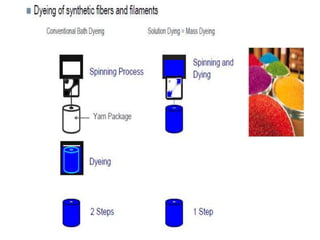
• Dope dyed is an ideal solution to replace dyeing process in
manufacturing process.
• This will affect directly on the cost of production.
• As a result of this reduce time
• reduce number of processes.
• capacity will automatically get increased.
Mass Coloration Techniques
• There are mainly six methods to produce mass
colored textiles synthetic fibres.
Addition of colorants during polymerization
Chips coating
Chip dyeing
Master batch addition
Injecting color in to the polymer chips in the
extruder
Melt in melt metering system
Addition of Colorants during
polymerization
• Carbon black (1.5-2.5%) is mainly used for the
production of black colored polyester.
• Some heat stable colorants which need no
dispersing and grinding are available namely
sandoz, ciba, ICI.
• Nylon has a powerful reducing action on
colorants and very few colorants are stable
under high temperatures of the molten
polymers.
• Acrylic are spun with both wet and dry processes
using certain solvents. Thus solvent soluble dyes
cannot be used for the two processes.
• The best method is to add coloring matter during
dope preparation. Suitable pigment dispersion is
added to the dope and after proper mixing, the
dope is spun.
• Low water soluble special cationic dyes may also
be added to the dope.
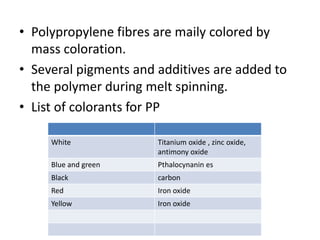
• Polypropylene fibres are maily colored by
mass coloration.
• Several pigments and additives are added to
the polymer during melt spinning.
• List of colorants for PP
White Titanium oxide , zinc oxide,
antimony oxide
Blue and green Pthalocynanin es
Black carbon
Red Iron oxide
Yellow Iron oxide
Chips Coating
In chips coating colorants in one form or another
are applied to the surfaces of the chips uniformly
without the necessity for special mixing
procedures.
• Generally acid dyes are used for nylon chips. The
chips are thoroughly dried and melt spun to get
the coloured polyester and nylon filaments.
Alternatively , coating may be carried out by
taking the colorant (dispersion) in a
• Volatile solvent which eliminates the dusting
of the colorant during tumble drying . Polymer
degradation may be avoided by chips coating
method due to reduced time of contact of the
colorant with the molten polymer.
CHIP DYEING
• The idea of chip dyeing seems to have originated
polymer chips.
• This method is not used commercially for
polyester chips, but it is frequently used for nylon
6 and to a less extent for nylon 6,6. nylon 6
production requires aqueous monomer
extraction and it is convenient to combine dying
of the chips with acid and metal-complex azo
dyes during monomer extraction and the
subsequent drying operation.
Master batch addition
• In this system colored polyster or nylon chips
containg 10-15% of disperse and acid dyes are
first produce using a polymer such as
polythene or nylon6.
• Colored chips are commercially avaliable .
• The colored chips are then blended with white
chips in desired proportion and then spun to
get colored fibres.
• Master batch system is used for nylon
polyester and polypropylene by a variety of
mixing techniques.
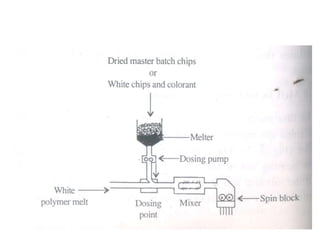
• Here are two process :-
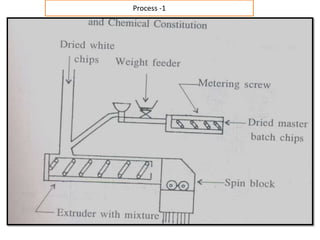
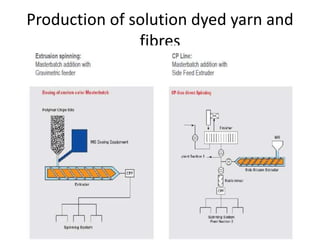
• Process -1: dried master chips are intruduced
in to the spinning block via metereing screw
and weight feeder that are placed in front of
extruder.
Process -1
Process 2
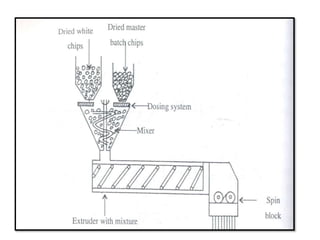
• Dried master batch chips and white chips are
blended in mixer after passing through the
dosing system.
• The homogeneous mixture is then passed
directly to the extruder for spinning.
• Advantages of this method is the polymeriser ,
drier and other units are not contaminated by
the colorants.
•
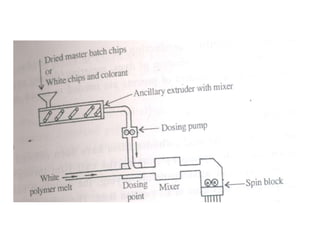
Injecting color in to the polymer chips
in to the extruder
• Polymer soluble dyestuff powder is directly
added to the polyester or nylon chips stream
just before spinning extruder.
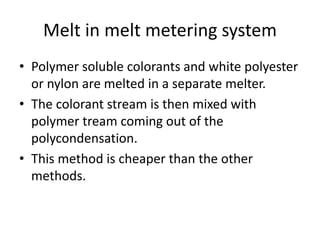
Melt in melt metering system
• Polymer soluble colorants and white polyester
or nylon are melted in a separate melter.
• The colorant stream is then mixed with
polymer tream coming out of the
polycondensation.
• This method is cheaper than the other
methods.
5-
Production of solution dyed yarn and
fibres
Method of spinning
• Different methods are employed for
converting the solid polymers into liquid form.
Accordingly the extrusion also differs. Based
on these, three methods can be evolved for
production of man-made and synthetic fibres.
These are termed as ‘chemical spinning’ or
‘extrusion’.
• Melt spinning
• Dry /solvent spinning
• Gel spinning
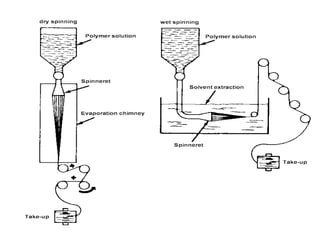
• Dry/Solvent spinning: When a polymer
cannot transform into liquid through melting,
an alternative method is employed, wherein
the polymer is dissolved in a suitable solvent.
If the solvent is volatile, it leaves the polymer
in a desired shape when the solvent dries.
Therefore this method is termed as dry
spinning.
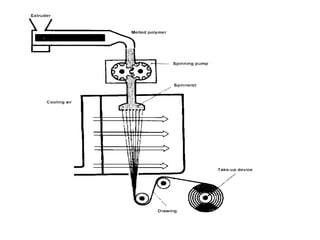
• Melt spinning: Melt spinning is applicable to the
polymers which are capable of melting at elevated
temperatures. This is the simplest and most
inexpensive process, as it involves only melting,
extrusion and cooling. The polymer is melted, extruded
through the holes of a spinnerette which is a
perforated metal plate of small diameter. Each hole
may be as small as 0.5 mm diameter or even smaller.
Each spinnerette may contain 1 to 100 holes depending
on the type of yarn or tow produced. A tow is a rope of
filaments collected from different spinnerettes that are
used for making staple fibres for blending.
Why Mass Coloration?
• The simplicity of the process
• A tendency for popular shades and seasonal shades has
been existing for sometime.
• Large productions today require dope dyeing of textile.
• The fibers obtained exhibit excellent ,their quality equals
that of the uncolored fiber, since no additional processing
is required.
• Savings in production time, energy, and dyeing chemicals
• make the process economical, and also wastage of
colorants can be neglected.
• High flexibility in finishing and end-uses are achieved
because of higher fastness compared with conventional
dyeing methods.
• Mass coloration consists in the introduction of
a coloring material into a polymer before
transforming it into threads or fibers.
• This transformation is realized by extrusion of
the molten polymer, through a spinneret at a
temperature between 280 - 300” C.
The Technology of Mass Coloration
Methods
• Continuous
• Discontinuous
• During the continuous process (for large
tonnages) the molten polymer enters directly
into the Pumps and the spinnerett after
polycondensation in the continuous reactors.
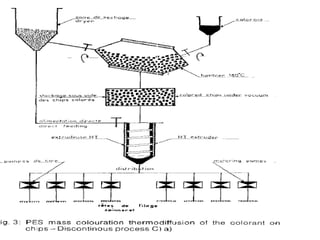
• In the discontinuous process the polymer
leaves the poly-condensation reactor is cooled
and transformed into Chips.
• These granules are stored in dried condition
and furnished on demand to the melters.
• This procedure is more easily adaptabted to
small quantities.
The Coloration Procedure
A) The Oldest of all Method
• For large tonnage in the same shade, this
consists of incorporation of organic or mineral
pigments during polycondensation.
• In this case Pigments must resist many hours
at 280 – 300o C.
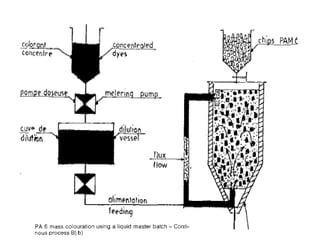
Continuous Process
The colorant is added to the polymer eighter as a powder
or in master batch form.
The colorant is distributed continuously with the help of a
doser, mixed with Chips, before the melter (screw type
extruder or static melter) or it can be added directly to
the molten polymer.
• The colorant can also be added in Paste or liquid form
• In both cases the polymer is injected continuously
• into a molten polymer, with the help of a secondary
extruder during a continuous process.
Mass coloration of synthetic fibres
• The term mass coloration is used for the
process of producing colored fibres and
filament by incorporating coloring matter
during or after polymerisation but before the
polymer is converyted in to filaments by a
spinning process.

mass colaration

  • 1.
    Mass coloration unit -1 •The difficulties of dyeing synthetic fibres forced colourist to search for alternate methods of coloration. • One such method is mass coloration , mass pigmentation or dope dyeing. • Also known as solution –dyed or spun dyed. • This method is applicable for all man made fibres- regenerated (viscose) and synthetic.
  • 2.
    Mass-Colored • Mass-Colored: Aterm to describe a manufactured fiber (yarn, staple, or tow) that has been colored by the introduction of pigments or insoluble dyes into the polymer melt or spinning solution prior to extrusion. • Viscose was first man made fibre used commercially for mass coloration method.
  • 3.
    • Mass pigmentationor spun dyeing, is ideal from the environmental point of view. • Most convention method of coloring fibres consist of so called ‘topical dyeing’ in which colorant are applied to the substrate from the solution. • In this technology the affinity or reactivity of the colorant towards the substrate is an important issue. • Pigments are also used for the coloration of fabrics. • Because of their lack of affinity for the substrate they are fixed on to the fabric using binder.
  • 4.
    • Natural fibreswhich can only be colored using conventional dyeing process. • Synthetic or regenerated fibres can also be colored using so called ‘solution’ dyeing , dope dyeing, spun dyeing and mass pigmentation process. • According to the process colorants are incorporated in to the polymer spinning mass during polymerization process or to the spinning time. • Both pigments and polymer soluble colorants are used for this application.
  • 5.
    • Colorants usedin mass coloration are more demanding than for topical dyeing. • They must posses high physical and chemical purity and must have suitable stability.
  • 6.
    Dope Dyed • Dopedyeing is also known as solution dyeing or spun dyeing, this is the process of adding pigments or insoluble dyes to the spinning solution before the solution is extruded through the spinneret. • Only manufactured fibers can be solution dyed. • This is very good application which require excellent colour-fastness properties. Because the color pigments become a part of the fiber, solution dyed materials have excellent colorfastness to light, washing, crocking (rubbing), perspiration and bleach. • Dope dyed is an ideal solution to replace dyeing process in manufacturing process. • This will affect directly on the cost of production. • As a result of this reduce time • reduce number of processes. • capacity will automatically get increased.
  • 7.
    Mass Coloration Techniques •There are mainly six methods to produce mass colored textiles synthetic fibres. Addition of colorants during polymerization Chips coating Chip dyeing Master batch addition Injecting color in to the polymer chips in the extruder Melt in melt metering system
  • 8.
    Addition of Colorantsduring polymerization • Carbon black (1.5-2.5%) is mainly used for the production of black colored polyester. • Some heat stable colorants which need no dispersing and grinding are available namely sandoz, ciba, ICI. • Nylon has a powerful reducing action on colorants and very few colorants are stable under high temperatures of the molten polymers.
  • 9.
    • Acrylic arespun with both wet and dry processes using certain solvents. Thus solvent soluble dyes cannot be used for the two processes. • The best method is to add coloring matter during dope preparation. Suitable pigment dispersion is added to the dope and after proper mixing, the dope is spun. • Low water soluble special cationic dyes may also be added to the dope.
  • 10.
    • Polypropylene fibresare maily colored by mass coloration. • Several pigments and additives are added to the polymer during melt spinning. • List of colorants for PP White Titanium oxide , zinc oxide, antimony oxide Blue and green Pthalocynanin es Black carbon Red Iron oxide Yellow Iron oxide
  • 11.
    Chips Coating In chipscoating colorants in one form or another are applied to the surfaces of the chips uniformly without the necessity for special mixing procedures. • Generally acid dyes are used for nylon chips. The chips are thoroughly dried and melt spun to get the coloured polyester and nylon filaments. Alternatively , coating may be carried out by taking the colorant (dispersion) in a
  • 12.
    • Volatile solventwhich eliminates the dusting of the colorant during tumble drying . Polymer degradation may be avoided by chips coating method due to reduced time of contact of the colorant with the molten polymer.
  • 13.
    CHIP DYEING • Theidea of chip dyeing seems to have originated polymer chips. • This method is not used commercially for polyester chips, but it is frequently used for nylon 6 and to a less extent for nylon 6,6. nylon 6 production requires aqueous monomer extraction and it is convenient to combine dying of the chips with acid and metal-complex azo dyes during monomer extraction and the subsequent drying operation.
  • 14.
    Master batch addition •In this system colored polyster or nylon chips containg 10-15% of disperse and acid dyes are first produce using a polymer such as polythene or nylon6. • Colored chips are commercially avaliable . • The colored chips are then blended with white chips in desired proportion and then spun to get colored fibres.
  • 15.
    • Master batchsystem is used for nylon polyester and polypropylene by a variety of mixing techniques. • Here are two process :- • Process -1: dried master chips are intruduced in to the spinning block via metereing screw and weight feeder that are placed in front of extruder.
  • 16.
  • 17.
    Process 2 • Driedmaster batch chips and white chips are blended in mixer after passing through the dosing system. • The homogeneous mixture is then passed directly to the extruder for spinning. • Advantages of this method is the polymeriser , drier and other units are not contaminated by the colorants. •
  • 19.
    Injecting color into the polymer chips in to the extruder • Polymer soluble dyestuff powder is directly added to the polyester or nylon chips stream just before spinning extruder.
  • 20.
    Melt in meltmetering system • Polymer soluble colorants and white polyester or nylon are melted in a separate melter. • The colorant stream is then mixed with polymer tream coming out of the polycondensation. • This method is cheaper than the other methods.
  • 23.
  • 24.
    Production of solutiondyed yarn and fibres
  • 25.
    Method of spinning •Different methods are employed for converting the solid polymers into liquid form. Accordingly the extrusion also differs. Based on these, three methods can be evolved for production of man-made and synthetic fibres. These are termed as ‘chemical spinning’ or ‘extrusion’.
  • 26.
    • Melt spinning •Dry /solvent spinning • Gel spinning
  • 27.
    • Dry/Solvent spinning:When a polymer cannot transform into liquid through melting, an alternative method is employed, wherein the polymer is dissolved in a suitable solvent. If the solvent is volatile, it leaves the polymer in a desired shape when the solvent dries. Therefore this method is termed as dry spinning.
  • 28.
    • Melt spinning:Melt spinning is applicable to the polymers which are capable of melting at elevated temperatures. This is the simplest and most inexpensive process, as it involves only melting, extrusion and cooling. The polymer is melted, extruded through the holes of a spinnerette which is a perforated metal plate of small diameter. Each hole may be as small as 0.5 mm diameter or even smaller. Each spinnerette may contain 1 to 100 holes depending on the type of yarn or tow produced. A tow is a rope of filaments collected from different spinnerettes that are used for making staple fibres for blending.
  • 29.
    Why Mass Coloration? •The simplicity of the process • A tendency for popular shades and seasonal shades has been existing for sometime. • Large productions today require dope dyeing of textile. • The fibers obtained exhibit excellent ,their quality equals that of the uncolored fiber, since no additional processing is required. • Savings in production time, energy, and dyeing chemicals • make the process economical, and also wastage of colorants can be neglected. • High flexibility in finishing and end-uses are achieved because of higher fastness compared with conventional dyeing methods.
  • 32.
    • Mass colorationconsists in the introduction of a coloring material into a polymer before transforming it into threads or fibers. • This transformation is realized by extrusion of the molten polymer, through a spinneret at a temperature between 280 - 300” C. The Technology of Mass Coloration
  • 33.
    Methods • Continuous • Discontinuous •During the continuous process (for large tonnages) the molten polymer enters directly into the Pumps and the spinnerett after polycondensation in the continuous reactors.
  • 34.
    • In thediscontinuous process the polymer leaves the poly-condensation reactor is cooled and transformed into Chips. • These granules are stored in dried condition and furnished on demand to the melters. • This procedure is more easily adaptabted to small quantities.
  • 35.
    The Coloration Procedure A)The Oldest of all Method • For large tonnage in the same shade, this consists of incorporation of organic or mineral pigments during polycondensation. • In this case Pigments must resist many hours at 280 – 300o C.
  • 36.
    Continuous Process The colorantis added to the polymer eighter as a powder or in master batch form. The colorant is distributed continuously with the help of a doser, mixed with Chips, before the melter (screw type extruder or static melter) or it can be added directly to the molten polymer. • The colorant can also be added in Paste or liquid form • In both cases the polymer is injected continuously • into a molten polymer, with the help of a secondary extruder during a continuous process.
  • 40.
    Mass coloration ofsynthetic fibres • The term mass coloration is used for the process of producing colored fibres and filament by incorporating coloring matter during or after polymerisation but before the polymer is converyted in to filaments by a spinning process.