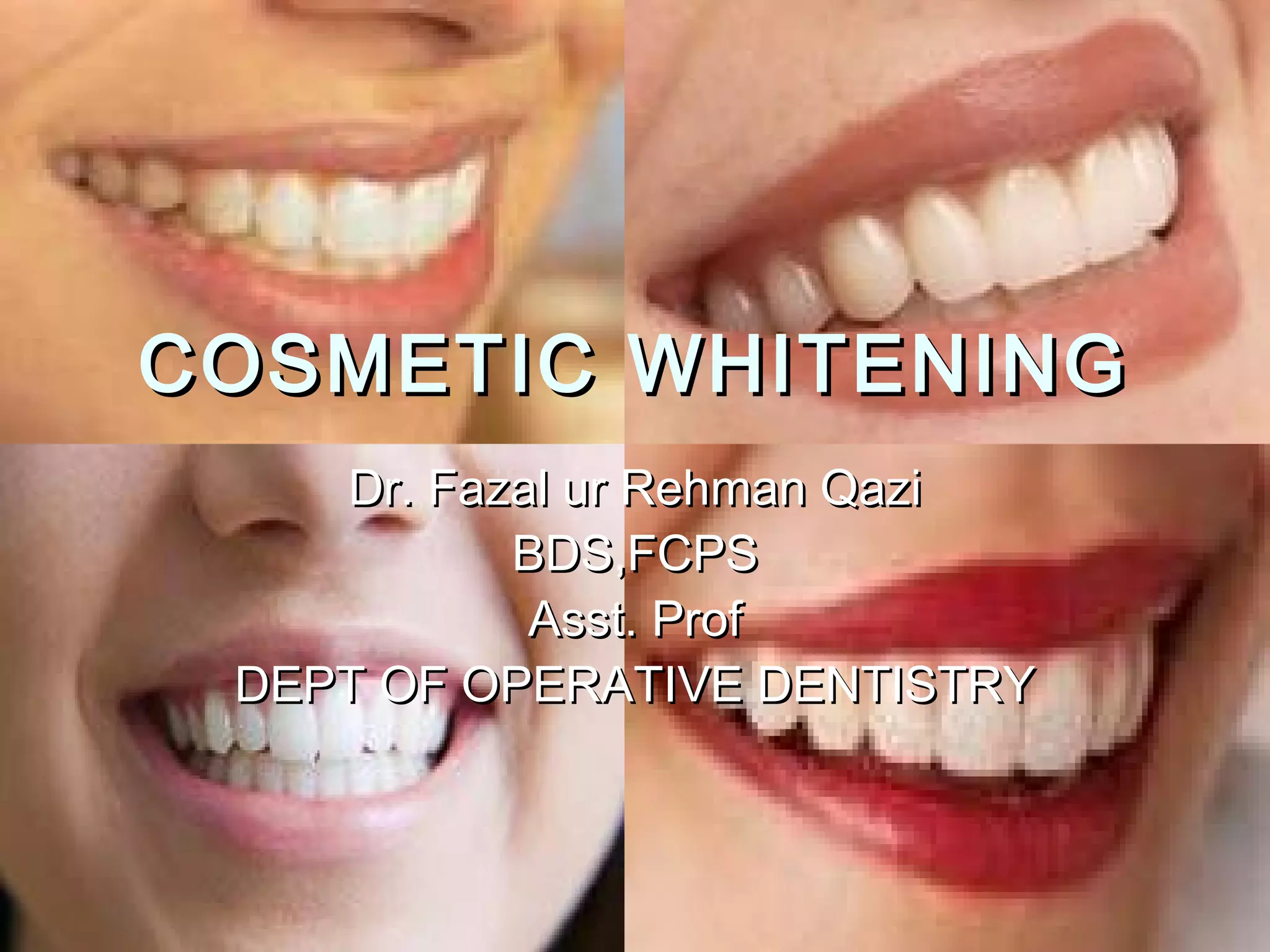
COSMETIC WHITENINGCOSMETIC WHITENING
Dr. Fazal ur Rehman QaziDr. Fazal ur Rehman Qazi
BDS,FCPSBDS,FCPS
Asst. ProfAsst. Prof
DEPT OF OPERATIVE DENTISTRYDEPT OF OPERATIVE DENTISTRY
Discoloration of teethDiscoloration of teeth
 Intrinsic discoloration
 Extrinsic discoloration
Extrinsic stains
““located on the surface of the toothlocated on the surface of the tooth
and are most easily removed byand are most easily removed by
external cleaning.”external cleaning.”
 Extrinsic color changes may be due to:Extrinsic color changes may be due to:
 poor oral hygienepoor oral hygiene
 ingestion of chromatogenic foods and drinksingestion of chromatogenic foods and drinks
 tobacco use.tobacco use.
Intrinsic stainsIntrinsic stains
““located within the tooth and arelocated within the tooth and are
accessible only by bleaching.”accessible only by bleaching.”
 Intrinsic color changes may be caused by :Intrinsic color changes may be caused by :
 agingaging
 ingestion of chromatogenic foods and drinkingestion of chromatogenic foods and drink
 tobacco usagetobacco usage
 microcracks in the enamelmicrocracks in the enamel
 tetracycline medicationtetracycline medication
 excessive fluoride ingestionexcessive fluoride ingestion
 severe jaundice in infancysevere jaundice in infancy
 dental cariesdental caries
 restorationsrestorations
FEW FACTSFEW FACTS
 Aging is most common cause ofAging is most common cause of
discoloration.discoloration.
 Yellow discoloration of aging respondsYellow discoloration of aging responds
quickly to bleaching.quickly to bleaching.
 Tetracycline stained teeth are the slowestTetracycline stained teeth are the slowest
to respond to bleaching.to respond to bleaching.
 Brown-fluoresced teeth are moderatelyBrown-fluoresced teeth are moderately
responsive.responsive.
Tetracycline StainingTetracycline Staining
• First degreeFirst degree
Light yellow, brown or gray uniformly distributedLight yellow, brown or gray uniformly distributed
throughout the crown, with no evident banding.throughout the crown, with no evident banding.
• Second degreeSecond degree
Darker or gray uniform staining, with no banding.Darker or gray uniform staining, with no banding.
• Third degreeThird degree
Dark gray or blue staining with marked banding.Dark gray or blue staining with marked banding.
• Fourth degreeFourth degree
These stains are too dark.These stains are too dark.
VITAL BLEACHINGVITAL BLEACHING
Commonly known as,Commonly known as, tooth whiteningtooth whitening is ais a
noninvasive method of lightening dark ornoninvasive method of lightening dark or
discolored teeth.discolored teeth.
Vital BleachingVital Bleaching
AdvantagesAdvantages
 Low costLow cost
 High success rateHigh success rate
 No tooth alterationNo tooth alteration
Vital BleachingVital Bleaching
DisadvantagesDisadvantages
 Unpredictable resultsUnpredictable results
 Need Re-treatmentNeed Re-treatment
 Possible side effectsPossible side effects
 Transient sensitivitysensitivity
Dental bleaching agentsDental bleaching agents
 CompositionComposition
 Carbamide peroxideCarbamide peroxide 5% to 40%5% to 40%
 Carbopol ( slow oxygen releasing)Carbopol ( slow oxygen releasing)
 Glycerin (thickening agent)Glycerin (thickening agent)
 Sodium hydroxideSodium hydroxide
 Flavors and fluorideFlavors and fluoride
Mode of actionMode of action
 In saliva Carbamide peroxide converts toIn saliva Carbamide peroxide converts to
hydrogen peroxide, the active bleaching agent,hydrogen peroxide, the active bleaching agent,
and urea.and urea.
 Hydrogen peroxide, typically generates short-Hydrogen peroxide, typically generates short-
lived oxygen intermediates, such as hydroxyllived oxygen intermediates, such as hydroxyl
radicalradical
 It enters enamel or dentine and diffuse to areasIt enters enamel or dentine and diffuse to areas
of discoloration and breaks down some of theof discoloration and breaks down some of the
double bonds in discolored or staineddouble bonds in discolored or stained
compounds, results in whitened appearance.compounds, results in whitened appearance.
Hydrogen
peroxide
URE
ACarbamide
peroxide
hydroxyl
radical
DOUBLE
BONDS
Bleaching Techniques
 In-office bleaching technique
 Laser bleaching
 Dentist-prescribed, home applied bleaching
tray method
whitestrips method
 Non vital bleaching
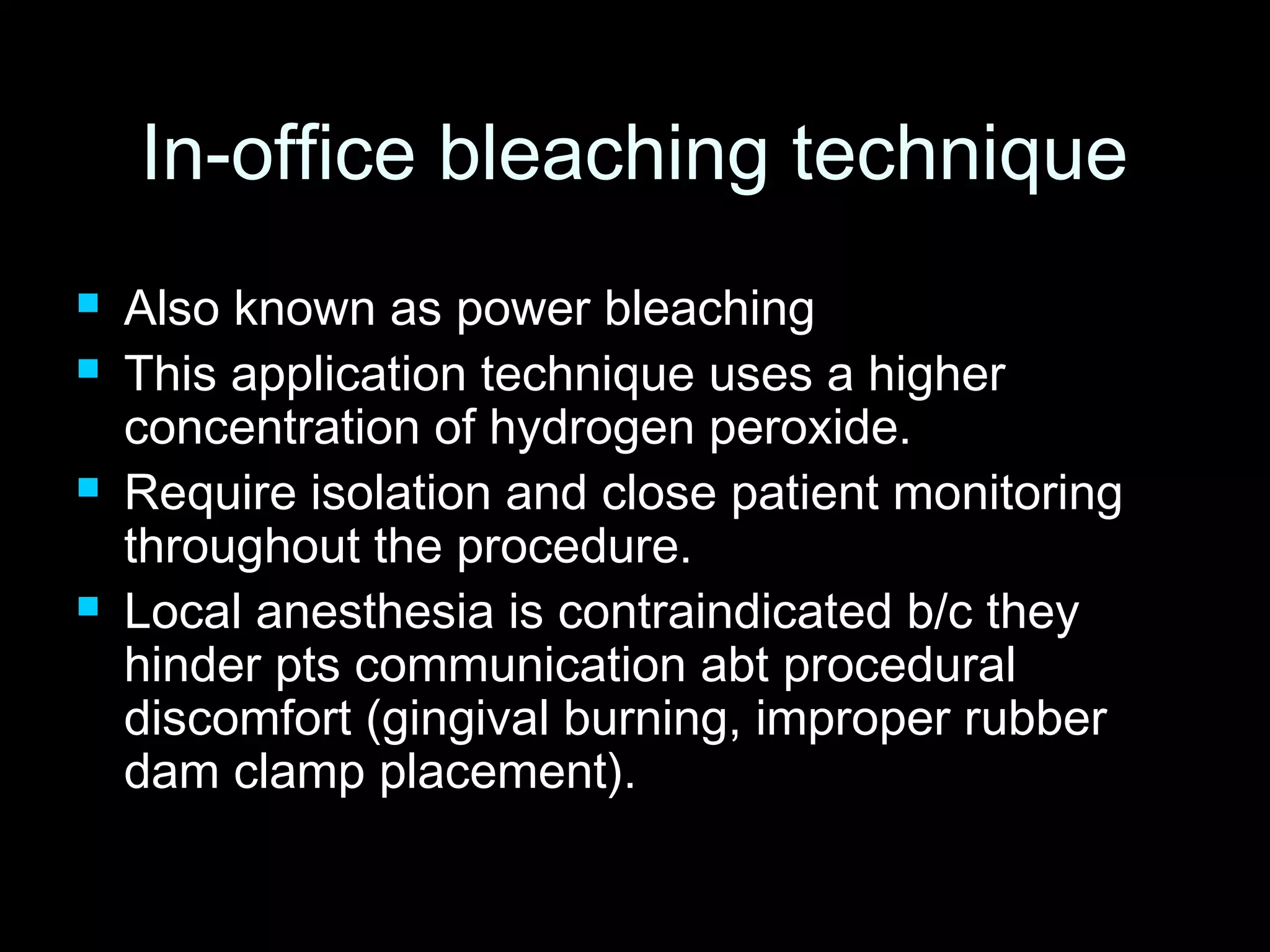
In-office bleaching technique
 Also known as power bleachingAlso known as power bleaching
 This application technique uses a higherThis application technique uses a higher
concentration of hydrogen peroxide.concentration of hydrogen peroxide.
 Require isolation and close patient monitoringRequire isolation and close patient monitoring
throughout the procedure.throughout the procedure.
 Local anesthesia is contraindicated b/c theyLocal anesthesia is contraindicated b/c they
hinder pts communication abt proceduralhinder pts communication abt procedural
discomfort (gingival burning, improper rubberdiscomfort (gingival burning, improper rubber
dam clamp placement).dam clamp placement).
In-office bleaching technique
 Ideal for pts who need quick results or forIdeal for pts who need quick results or for
those who have stubborn unresolvedthose who have stubborn unresolved
stains.stains.
In-office BleachingIn-office Bleaching
(Clinical Protocol)(Clinical Protocol)
 Clean teeth with pumiceClean teeth with pumice
 Record pre-op shadeRecord pre-op shade
 Isolate teeth as close to theIsolate teeth as close to the
gingival margin asgingival margin as
possible with rubber dampossible with rubber dam
(no tears, leakage, fully(no tears, leakage, fully
inverted)inverted)
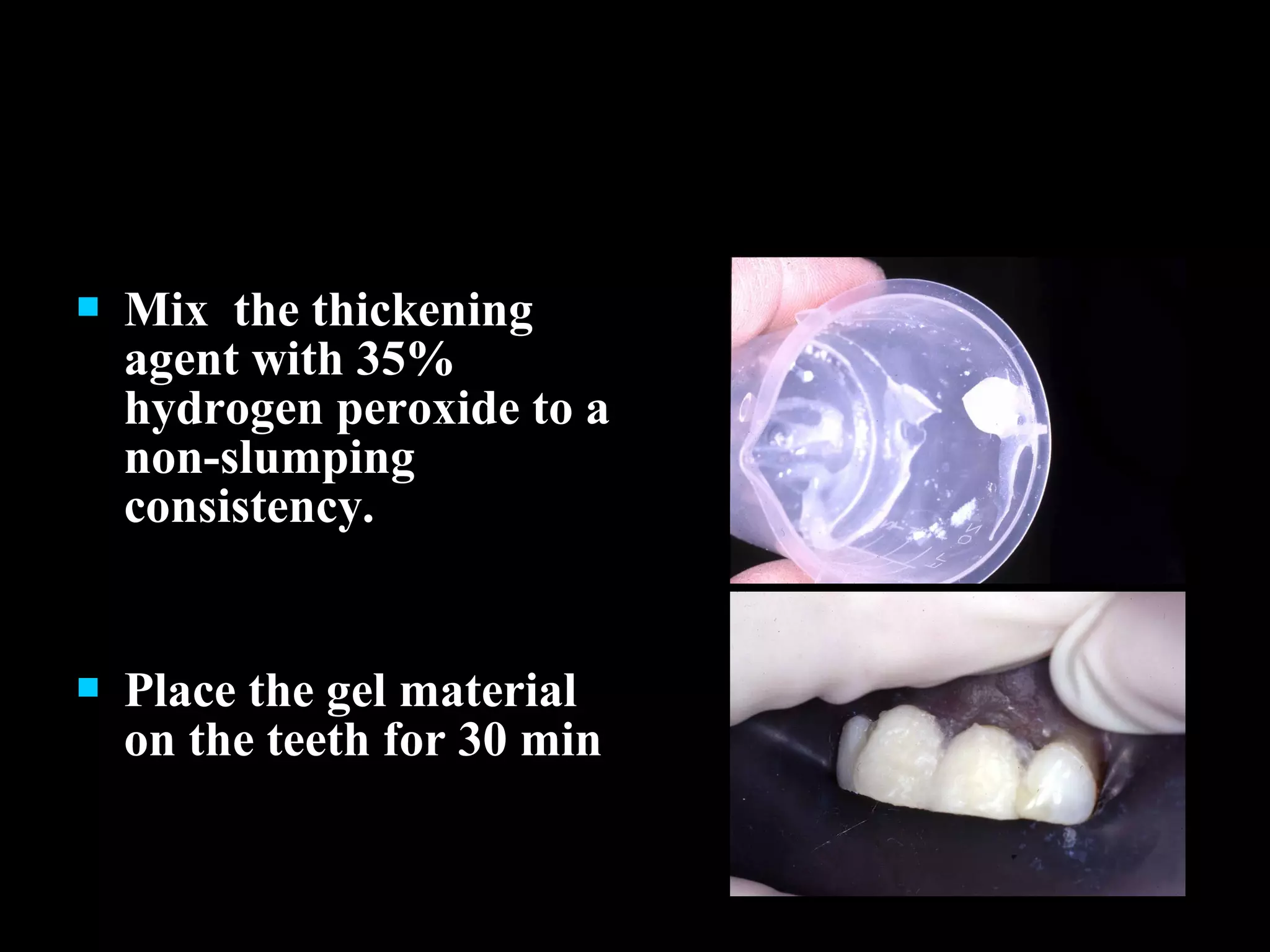
 Mix the thickeningMix the thickening
agent with 35%agent with 35%
hydrogen peroxide to ahydrogen peroxide to a
non-slumpingnon-slumping
consistency.consistency.
 Place the gel materialPlace the gel material
on the teeth for 30 minon the teeth for 30 min
 May need to “refresh”May need to “refresh”
with hydrogenwith hydrogen
peroxide liquid if theperoxide liquid if the
gel appear too drygel appear too dry
 Rinse and clean;Rinse and clean;
remove rubber damremove rubber dam
and record post-opand record post-op
shadeshade
Laser bleaching
 Lasers are also used within the clinicalLasers are also used within the clinical
setting for dental bleaching.setting for dental bleaching.
 The laser generates heat that increasesThe laser generates heat that increases
the resorption rate of hydrogen peroxidethe resorption rate of hydrogen peroxide
 Time-consumingTime-consuming
 Quick resultsQuick results
 Very expensiveVery expensive
Dentist-prescribed, home applied
bleaching
Tray method
 First step is fabrication of
trays
 Tray design include soft
or rigid, reservoir or
nonreservoir, and
scalloped or non-
scalloped trays
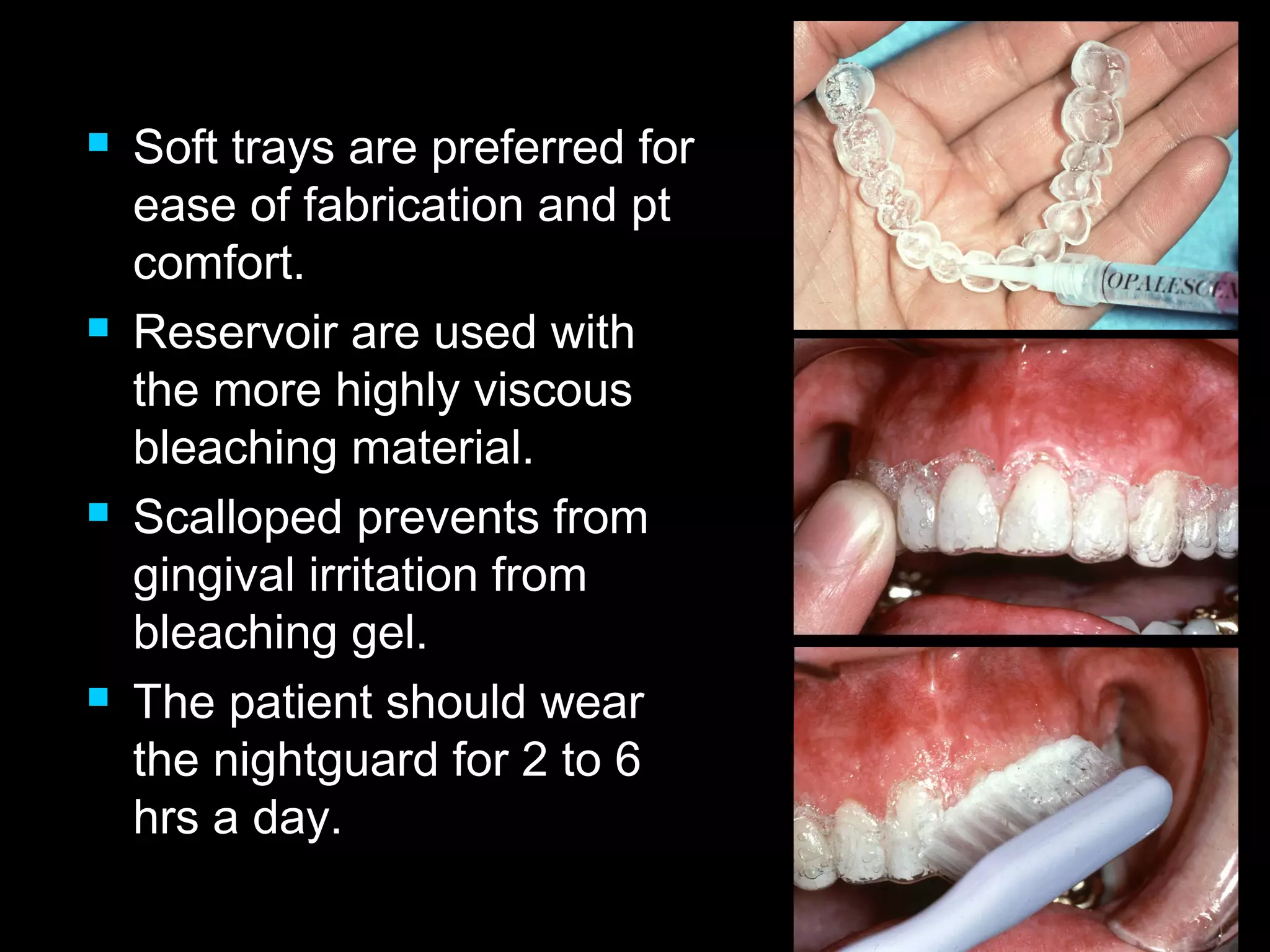
 Soft trays are preferred forSoft trays are preferred for
ease of fabrication and ptease of fabrication and pt
comfort.comfort.
 Reservoir are used withReservoir are used with
the more highly viscousthe more highly viscous
bleaching material.bleaching material.
 Scalloped prevents fromScalloped prevents from
gingival irritation fromgingival irritation from
bleaching gel.bleaching gel.
 The patient should wearThe patient should wear
the nightguard for 2 to 6the nightguard for 2 to 6
hrs a day.hrs a day.
Side effects of home bleachingSide effects of home bleaching
 Thermal sensitivityThermal sensitivity ;;
result of permeation of peroxide into dentinalresult of permeation of peroxide into dentinal
tubules.tubules.
can be prevented by decreasing the wearcan be prevented by decreasing the wear
time, decreasing solution concentration.time, decreasing solution concentration.
 Gingival irritationGingival irritation ;;
result of contact with bleaching solution andresult of contact with bleaching solution and
ill fitted tray.ill fitted tray.
can be prevented by well fitted tray ofcan be prevented by well fitted tray of
trayless methods.trayless methods.
whitestrips method
 Trayless methodTrayless method
 Each applicationEach application
involves theinvolves the
alignment and foldingalignment and folding
of the strip into place.of the strip into place.
whitestrips method
 AdvantagesAdvantages
convenienceconvenience
ease of useease of use
potential for betterpotential for better
tolerabilitytolerability
costcost
 DisadvantagedDisadvantaged
less tooth coverageless tooth coverage
potential difficulty inpotential difficulty in
keeping strips inkeeping strips in
placeplace
Recommended agents forRecommended agents for
bleachingbleaching
 35% hydrogen peroxide for in office35% hydrogen peroxide for in office
bleachingbleaching
 10% carbamide peroxide for home10% carbamide peroxide for home
bleachingbleaching
Factors affecting bleachingFactors affecting bleaching
(in office and at home)(in office and at home)
 Surface cleanlinessSurface cleanliness
 Concentration of peroxideConcentration of peroxide
 Temperature (in-office)Temperature (in-office)
 pHpH
 TimeTime
 AdditivesAdditives
 Sealed environment (non-vital)Sealed environment (non-vital)
Safety factorsSafety factors
 Tooth and pulpal problemsTooth and pulpal problems
 SensitivitySensitivity
 Mineral lossMineral loss
 Soft tissue responseSoft tissue response
 Systemic effectsSystemic effects
Contraindications of bleachingContraindications of bleaching
 Discoloration due to restorationsDiscoloration due to restorations
 Children with large pulp horns andChildren with large pulp horns and
cracks(In office)cracks(In office)
 Pregnant and allergic pts (homePregnant and allergic pts (home
bleaching)bleaching)
 exposed roots and severe enamel loss(inexposed roots and severe enamel loss(in
office)office)
 Pts with TMD (home bleaching)Pts with TMD (home bleaching)
Interference with compositeInterference with composite
restorationsrestorations
 Hydrogen peroxide interferes with bondingHydrogen peroxide interferes with bonding
so a delay of 7-10 days is advisedso a delay of 7-10 days is advised
 Existing composite restorations may beExisting composite restorations may be
disked back to allow maximum exposuredisked back to allow maximum exposure
of tooth surface for bleachingof tooth surface for bleaching
Non vital bleaching
   When the discolorationWhen the discoloration
is from within the pulpis from within the pulp
chamber, from necroticchamber, from necrotic
pulp tissue or frompulp tissue or from
staining agents that arestaining agents that are
present in the pulppresent in the pulp
chamber, the bleachingchamber, the bleaching
treatment need to taketreatment need to take
place within the pulpplace within the pulp
chamberchamber
Techniques for non vitalTechniques for non vital
bleachingbleaching
 Thermocatalytic techniqueThermocatalytic technique
 Walking bleachingWalking bleaching
 Inside-outside bleachingInside-outside bleaching
RecommendationsRecommendations
SodiumSodium
perborate mixedperborate mixed
with waterwith water
OROR
10% carbamide10% carbamide
peroxideperoxide
Cervical resorptionCervical resorption
 Occurs in 7% of casesOccurs in 7% of cases
 Young ageYoung age
 Deficiency in cementumDeficiency in cementum
 Injury to PDLInjury to PDL
 InfectionInfection
 Lack of seal over GPLack of seal over GP
 High conc. Of peroxideHigh conc. Of peroxide
 HeatHeat
Potential ResultsPotential Results
Alternatives to bleachingAlternatives to bleaching
 MicroabrasionMicroabrasion
 MacroabrasionMacroabrasion
 Veneers (Direct and Indirect)Veneers (Direct and Indirect)
 CrownsCrowns
Direct Composite VeneersDirect Composite Veneers
Bleaching before and afterBleaching before and after
veneersveneers

Bleaching

  • 1.
    COSMETIC WHITENINGCOSMETIC WHITENING Dr.Fazal ur Rehman QaziDr. Fazal ur Rehman Qazi BDS,FCPSBDS,FCPS Asst. ProfAsst. Prof DEPT OF OPERATIVE DENTISTRYDEPT OF OPERATIVE DENTISTRY
  • 2.
    Discoloration of teethDiscolorationof teeth  Intrinsic discoloration  Extrinsic discoloration
  • 3.
    Extrinsic stains ““located onthe surface of the toothlocated on the surface of the tooth and are most easily removed byand are most easily removed by external cleaning.”external cleaning.”  Extrinsic color changes may be due to:Extrinsic color changes may be due to:  poor oral hygienepoor oral hygiene  ingestion of chromatogenic foods and drinksingestion of chromatogenic foods and drinks  tobacco use.tobacco use.
  • 4.
    Intrinsic stainsIntrinsic stains ““locatedwithin the tooth and arelocated within the tooth and are accessible only by bleaching.”accessible only by bleaching.”  Intrinsic color changes may be caused by :Intrinsic color changes may be caused by :  agingaging  ingestion of chromatogenic foods and drinkingestion of chromatogenic foods and drink  tobacco usagetobacco usage  microcracks in the enamelmicrocracks in the enamel  tetracycline medicationtetracycline medication  excessive fluoride ingestionexcessive fluoride ingestion  severe jaundice in infancysevere jaundice in infancy  dental cariesdental caries  restorationsrestorations
  • 5.
    FEW FACTSFEW FACTS Aging is most common cause ofAging is most common cause of discoloration.discoloration.  Yellow discoloration of aging respondsYellow discoloration of aging responds quickly to bleaching.quickly to bleaching.  Tetracycline stained teeth are the slowestTetracycline stained teeth are the slowest to respond to bleaching.to respond to bleaching.  Brown-fluoresced teeth are moderatelyBrown-fluoresced teeth are moderately responsive.responsive.
  • 7.
    Tetracycline StainingTetracycline Staining •First degreeFirst degree Light yellow, brown or gray uniformly distributedLight yellow, brown or gray uniformly distributed throughout the crown, with no evident banding.throughout the crown, with no evident banding. • Second degreeSecond degree Darker or gray uniform staining, with no banding.Darker or gray uniform staining, with no banding. • Third degreeThird degree Dark gray or blue staining with marked banding.Dark gray or blue staining with marked banding. • Fourth degreeFourth degree These stains are too dark.These stains are too dark.
  • 8.
    VITAL BLEACHINGVITAL BLEACHING Commonlyknown as,Commonly known as, tooth whiteningtooth whitening is ais a noninvasive method of lightening dark ornoninvasive method of lightening dark or discolored teeth.discolored teeth.
  • 9.
    Vital BleachingVital Bleaching AdvantagesAdvantages Low costLow cost  High success rateHigh success rate  No tooth alterationNo tooth alteration
  • 10.
    Vital BleachingVital Bleaching DisadvantagesDisadvantages Unpredictable resultsUnpredictable results  Need Re-treatmentNeed Re-treatment  Possible side effectsPossible side effects  Transient sensitivitysensitivity
  • 11.
    Dental bleaching agentsDentalbleaching agents  CompositionComposition  Carbamide peroxideCarbamide peroxide 5% to 40%5% to 40%  Carbopol ( slow oxygen releasing)Carbopol ( slow oxygen releasing)  Glycerin (thickening agent)Glycerin (thickening agent)  Sodium hydroxideSodium hydroxide  Flavors and fluorideFlavors and fluoride
  • 12.
    Mode of actionModeof action  In saliva Carbamide peroxide converts toIn saliva Carbamide peroxide converts to hydrogen peroxide, the active bleaching agent,hydrogen peroxide, the active bleaching agent, and urea.and urea.  Hydrogen peroxide, typically generates short-Hydrogen peroxide, typically generates short- lived oxygen intermediates, such as hydroxyllived oxygen intermediates, such as hydroxyl radicalradical  It enters enamel or dentine and diffuse to areasIt enters enamel or dentine and diffuse to areas of discoloration and breaks down some of theof discoloration and breaks down some of the double bonds in discolored or staineddouble bonds in discolored or stained compounds, results in whitened appearance.compounds, results in whitened appearance.
  • 13.
  • 14.
    Bleaching Techniques  In-officebleaching technique  Laser bleaching  Dentist-prescribed, home applied bleaching tray method whitestrips method  Non vital bleaching
  • 15.
    In-office bleaching technique Also known as power bleachingAlso known as power bleaching  This application technique uses a higherThis application technique uses a higher concentration of hydrogen peroxide.concentration of hydrogen peroxide.  Require isolation and close patient monitoringRequire isolation and close patient monitoring throughout the procedure.throughout the procedure.  Local anesthesia is contraindicated b/c theyLocal anesthesia is contraindicated b/c they hinder pts communication abt proceduralhinder pts communication abt procedural discomfort (gingival burning, improper rubberdiscomfort (gingival burning, improper rubber dam clamp placement).dam clamp placement).
  • 16.
    In-office bleaching technique Ideal for pts who need quick results or forIdeal for pts who need quick results or for those who have stubborn unresolvedthose who have stubborn unresolved stains.stains.
  • 17.
    In-office BleachingIn-office Bleaching (ClinicalProtocol)(Clinical Protocol)  Clean teeth with pumiceClean teeth with pumice  Record pre-op shadeRecord pre-op shade  Isolate teeth as close to theIsolate teeth as close to the gingival margin asgingival margin as possible with rubber dampossible with rubber dam (no tears, leakage, fully(no tears, leakage, fully inverted)inverted)
  • 18.
     Mix thethickeningMix the thickening agent with 35%agent with 35% hydrogen peroxide to ahydrogen peroxide to a non-slumpingnon-slumping consistency.consistency.  Place the gel materialPlace the gel material on the teeth for 30 minon the teeth for 30 min
  • 19.
     May needto “refresh”May need to “refresh” with hydrogenwith hydrogen peroxide liquid if theperoxide liquid if the gel appear too drygel appear too dry  Rinse and clean;Rinse and clean; remove rubber damremove rubber dam and record post-opand record post-op shadeshade
  • 20.
    Laser bleaching  Lasersare also used within the clinicalLasers are also used within the clinical setting for dental bleaching.setting for dental bleaching.  The laser generates heat that increasesThe laser generates heat that increases the resorption rate of hydrogen peroxidethe resorption rate of hydrogen peroxide  Time-consumingTime-consuming  Quick resultsQuick results  Very expensiveVery expensive
  • 21.
    Dentist-prescribed, home applied bleaching Traymethod  First step is fabrication of trays  Tray design include soft or rigid, reservoir or nonreservoir, and scalloped or non- scalloped trays
  • 22.
     Soft traysare preferred forSoft trays are preferred for ease of fabrication and ptease of fabrication and pt comfort.comfort.  Reservoir are used withReservoir are used with the more highly viscousthe more highly viscous bleaching material.bleaching material.  Scalloped prevents fromScalloped prevents from gingival irritation fromgingival irritation from bleaching gel.bleaching gel.  The patient should wearThe patient should wear the nightguard for 2 to 6the nightguard for 2 to 6 hrs a day.hrs a day.
  • 23.
    Side effects ofhome bleachingSide effects of home bleaching  Thermal sensitivityThermal sensitivity ;; result of permeation of peroxide into dentinalresult of permeation of peroxide into dentinal tubules.tubules. can be prevented by decreasing the wearcan be prevented by decreasing the wear time, decreasing solution concentration.time, decreasing solution concentration.  Gingival irritationGingival irritation ;; result of contact with bleaching solution andresult of contact with bleaching solution and ill fitted tray.ill fitted tray. can be prevented by well fitted tray ofcan be prevented by well fitted tray of trayless methods.trayless methods.
  • 24.
    whitestrips method  TraylessmethodTrayless method  Each applicationEach application involves theinvolves the alignment and foldingalignment and folding of the strip into place.of the strip into place.
  • 25.
    whitestrips method  AdvantagesAdvantages convenienceconvenience easeof useease of use potential for betterpotential for better tolerabilitytolerability costcost  DisadvantagedDisadvantaged less tooth coverageless tooth coverage potential difficulty inpotential difficulty in keeping strips inkeeping strips in placeplace
  • 26.
    Recommended agents forRecommendedagents for bleachingbleaching  35% hydrogen peroxide for in office35% hydrogen peroxide for in office bleachingbleaching  10% carbamide peroxide for home10% carbamide peroxide for home bleachingbleaching
  • 27.
    Factors affecting bleachingFactorsaffecting bleaching (in office and at home)(in office and at home)  Surface cleanlinessSurface cleanliness  Concentration of peroxideConcentration of peroxide  Temperature (in-office)Temperature (in-office)  pHpH  TimeTime  AdditivesAdditives  Sealed environment (non-vital)Sealed environment (non-vital)
  • 28.
    Safety factorsSafety factors Tooth and pulpal problemsTooth and pulpal problems  SensitivitySensitivity  Mineral lossMineral loss  Soft tissue responseSoft tissue response  Systemic effectsSystemic effects
  • 29.
    Contraindications of bleachingContraindicationsof bleaching  Discoloration due to restorationsDiscoloration due to restorations  Children with large pulp horns andChildren with large pulp horns and cracks(In office)cracks(In office)  Pregnant and allergic pts (homePregnant and allergic pts (home bleaching)bleaching)  exposed roots and severe enamel loss(inexposed roots and severe enamel loss(in office)office)  Pts with TMD (home bleaching)Pts with TMD (home bleaching)
  • 30.
    Interference with compositeInterferencewith composite restorationsrestorations  Hydrogen peroxide interferes with bondingHydrogen peroxide interferes with bonding so a delay of 7-10 days is advisedso a delay of 7-10 days is advised  Existing composite restorations may beExisting composite restorations may be disked back to allow maximum exposuredisked back to allow maximum exposure of tooth surface for bleachingof tooth surface for bleaching
  • 31.
    Non vital bleaching   When the discolorationWhen the discoloration is from within the pulpis from within the pulp chamber, from necroticchamber, from necrotic pulp tissue or frompulp tissue or from staining agents that arestaining agents that are present in the pulppresent in the pulp chamber, the bleachingchamber, the bleaching treatment need to taketreatment need to take place within the pulpplace within the pulp chamberchamber
  • 32.
    Techniques for nonvitalTechniques for non vital bleachingbleaching  Thermocatalytic techniqueThermocatalytic technique  Walking bleachingWalking bleaching  Inside-outside bleachingInside-outside bleaching
  • 33.
    RecommendationsRecommendations SodiumSodium perborate mixedperborate mixed withwaterwith water OROR 10% carbamide10% carbamide peroxideperoxide
  • 34.
    Cervical resorptionCervical resorption Occurs in 7% of casesOccurs in 7% of cases  Young ageYoung age  Deficiency in cementumDeficiency in cementum  Injury to PDLInjury to PDL  InfectionInfection  Lack of seal over GPLack of seal over GP  High conc. Of peroxideHigh conc. Of peroxide  HeatHeat
  • 36.
  • 38.
    Alternatives to bleachingAlternativesto bleaching  MicroabrasionMicroabrasion  MacroabrasionMacroabrasion  Veneers (Direct and Indirect)Veneers (Direct and Indirect)  CrownsCrowns
  • 39.
  • 44.
    Bleaching before andafterBleaching before and after veneersveneers