Introduction to Textile Dyeing


       RAJEEV SHARAN
NATIONAL INSTITUTE OF FASHION
        TECHNOLOGY
            DFT-05


                                 1
Basic Textile Terms and Definitions
Dyestuff is organic or inorganic substances
which can absorb light and reflect some lights
to show color. Actually, the dyestuff is water
soluble substances.
Pigment is a substance that can absorb light
and reflect some lights to show color but it is
water insoluble substances. Normally it is
used for printing (with the presence of binder)
or mass-coloration of the synthetic fibers.


                                                  2
Staining is an unpleasant of dyeing in the
area that we do not want.
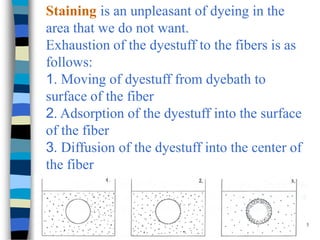
Exhaustion of the dyestuff to the fibers is as
follows:
1. Moving of dyestuff from dyebath to
surface of the fiber
2. Adsorption of the dyestuff into the surface
of the fiber
3. Diffusion of the dyestuff into the center of
the fiber


                                                  3
Classification of Dyestuffs
Dyestuffs can be classified by many methods
as follows:
1. by their ionic (e.g. cationic, anionic and
non-ionic)
2. by their fiber dyeabilities (e.g. on
cellulosic, protein, polyester, polyamide etc.)
3. by their names (e.g. acid, direct, disperse,
reactive, basic etc.)
4. by their chemical structures (e.g. azo,
anthraquinone, stilbene etc.)
5. by their origins (e.g. natural, synthetic)
6. by their colors (e.g. red, green, black etc.) 4
Dyeing Processes can be applied in many
stages such as
1. Mass-coloration of the molten fibers
This method is for dyeing the molten
fibers or plastic chips or textile polymers
with pigment dyes. After that, the molten
or polymers will extrude from a spinneret
to form fibers.
Normally, the synthetic fibers are added
with white pigment in order to give a
hiding power (non-see through fabrics).
Advantage: give excellent fastness
Disadvantage: very difficult to clean         5
2. Fiber Dyeing is the method of dyeing
fibers before blending with other colors to
give fancy yarns or fabrics.
Note: This is used for special purposes only.
3. Yarn Dyeing is the method of dyeing yarns
in forms of hanks or packages dyeing. This
will give Scottish’s style fabrics, carpet with
many colors and styles.
Note: This is used in hand loom weaving in
the Northern and North-eastern parts of
Thailand.

                                              6
4. Fabric Dyeing is the method after
weaving, knitting, or non-woven to make
fabrics. This is very popular method of
dyeing as the dyed fabrics will be processed
further to garment industries very easily.
Dyeing forms of the fabric dyeing can be
used in 2 ways:
1. Open width form using the fabrics to
spread without any creases and dye them.
2. Rope form using the fabrics with the
form like a rope (many creases and look
like “a rope”)
                                               7
Some people classify into:
 1. Exhaustion Process
 This method is using lot of water as shown
 in “Liquor Ratio (ratio between water and
 goods)” This should immerge the goods
 into dye solution for a long time in order to
 let the dye penetrate into the goods. This
 will lead to produce more waste water than
 the continuous process.
Advantage: inexpensive, no need to train the
worker to look after and run them properly.
Disadvantage: lots of water needed, very
slow process (60-120 min/batch.)               8
2. Continuous Process
This method is designed by putting different
machinery into a sequence so that it can
produce the dyed fabric in one pass.
Advantage: very fast process (10-100
m/min), small amount of water in the
process.
Disadvantage: very expensive, need to train
the worker to look after and run them
properly.


                                               9
6. Garment Dyeing
This method is the last process of the
dyeing of goods. However, the penetration
of the dye solution may not be completely
passed to the fibers such as between the
seams, buttons, zippers etc. Normally, it is
used for lingerie, socks, sweater dyeing etc.


                                                10
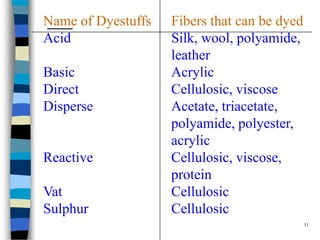
Name of Dyestuffs   Fibers that can be dyed
Acid                Silk, wool, polyamide,
                    leather
Basic               Acrylic
Direct              Cellulosic, viscose
Disperse            Acetate, triacetate,
                    polyamide, polyester,
                    acrylic
Reactive            Cellulosic, viscose,
                    protein
Vat                 Cellulosic
Sulphur             Cellulosic
                                              11
Factors that give some choices of the
dyestuffs
1. Cheap
2. Non-toxic
3. Compatible to other dyes and chemicals
4. High color strength
5. Better brightness
6. Better fastness
7. Good levelness on the materials


                                        12
Dyes for Cellulosic Fibers

            Direct Dyes (Anionic)
They can be dyed directly on cellulosic
fibers. Without the presence of salt, when
the fibers are immerged in water, it will show
anionic charge which repels the dyes.
Adding salt into the dye bath, it will reduce
anionic on the fibers so the dyes can get
closer and adsorb into the fibers.
Advantage: cheap, easily dyed on fibers
Disadvantage: poor wet fastness and some
dyes have poor light fastness.                13
Textile Auxiliaries
1. Salt - reduce negative charges on the
fibers
2. Water - dyeing media
3. Fixing Agent - enhance wet fastness but
usually reduce light fastness

Dyeing Conditions (Exhaustion)
dyeing 100oC x 30-90 min
fixing 60oC x 20 min
(Continuous)
pad --> dry --> steam --> wash --> soap -->
                                              14
dry
Reactive Dyes (Anionic)
They can be dyed on cellulosic fibers. The
mechanism is nearly the same as described in
Direct dyes.
Advantage: high wet fastness due to covalent
bonding (Chemical Bonding) between fibers
and dyes, easily dyed on fibers
Disadvantage: Expensive


                                           15
Dyeing Conditions
1. Continuous Process
1.1 Pad-dry-bake
This is very easy method for cotton or cotton
blends fibers.
1.2 Pad-dry-Pad (Chemical)-Steam
This will give brighter and more intense
color than method 1.1.
1.3 Pad-batch
This will put the goods into the dye solution
and squeeze with 2 rubber rollers to get rid of
excess water and then batch at room
temperature for 1-2 days.                      16
2. Exhaustion Process
This method will be used in small factory.
Dyeing conditions will be 40-80oC for 30-90
min depending to the types and structures of
the dyes.


                                           17
Textile Auxilaries
1. Salt - reduce negative charges on the
fibers
2. Water - dyeing media
3. Soda Ash - excite the dye to link with the
fibers with covalent bonding. Therefore, it
enhances wet fastness
4. Fixing Agent - enhance wet fastness for
heavy shade but usually reduce light fastness.


                                             18
Vat Dye (Anionic when soluble)
The dye is named from the container (Vat)
that used for rotting the dye with alkali
solution. This crucial process will reduce the
dye from insoluble to soluble dye (suitable
for exhaustion in the cellulosic fibers). Now
the manufacturer can synthesize man-made
vat dye.


                                                 19
Dyeing Process
1. Dissolve dye into water (insoluble dye)
2. Vatting process by reducing the insoluble
dye in alkali condition. (soluble dye)
3. Absorb into fibers (soluble dye)
4. After dyeing, oxidize the dye with
oxidizing agent (insoluble dye)
5. Wash and soap the goods


                                               20
Dyeing Conditions
1. Continuous Process
1.1 Pad-dry-Pad (Chemical)
The solution of the dye is prepared without
adding reducing agent to ensure leveling
dyeing. After that, the goods are passed to
chemical bath to reduce the dye into soluble
dye and fix within the goods. Oxidizing
agent is added to the goods and converted to
insoluble dyes.


                                               21
1.2 Pad-oxidize-pad-oxidize (many times)
This will put the goods into the dye solution
and squeeze with 2 rubber rollers to get rid of
excess water, oxidize with the air and then
immerse into the dye solution again and
again to allow the dye penetrate into the
goods.


                                              22
Textile Auxilaries
1. Salt - reduce the negative charges on the
fibers
2. Sodium hydroxide - adjust pH to the
dyeing bath and make the suitable conditions
for reducing agent.
3. Sodium hydrosulfite - reducing agent for
the vat dyes.
4. Water - dyeing media
5. Oxidizing agents - (Hydrogen peroxide or
Acetic acid or Air) oxidize the soluble to
insoluble dye
                                               23
Sulfur Dye (Anionic when soluble)
The dyeing process has the same process as
described in the vat dye except that using
Sodium sulfide instead of Sodium
hydrosulfide.


                                             24
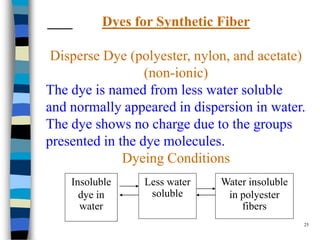
Dyes for Synthetic Fiber

 Disperse Dye (polyester, nylon, and acetate)
                  (non-ionic)
The dye is named from less water soluble
and normally appeared in dispersion in water.
The dye shows no charge due to the groups
presented in the dye molecules.
              Dyeing Conditions
    Insoluble    Less water   Water insoluble
      dye in      soluble      in polyester
      water                       fibers
                                                25
1. Exhaustion Process
1.1 At boil with carrier
This process is suitable for acetate fiber and
pale shade polyester fiber dyeing. Carrier is
an auxiliary for swollen fiber in order to
allow more dyes absorbing in. Now the use
of carrier is reduced because it may be a
carcinogen.
1.2 At 130oC without carrier
With the high temperature, the dyes will be
dissolved into smaller molecules and the void
in fiber structure will be opened. This will
give heavy shade.                              26
2. Continuous Process
Pad --> Pre-dry (100oC x 30 sec) -->
Thermofixation (180oC x 30 sec) -->
reduction clearing (RC) --> wash --> dry
        Printing with Disperse Dyes
With the sublimation property, the dyes can
be printed on paper, place the fabric with a
printed paper and then using an iron with
high temperature pressed on the paper. The
dyes will transfer from paper to polyester
fiber. This is called “Transfer Printing”.     27
Textile Auxilaries
1. Dispersing Agent - make the dye solution
stable and disperse in the dye bath.
2. Acid - adjust pH to the suitable condition
for the dye bath.
3. Carrier - swell the fiber and dissolve the
dye to make the dye getting into fiber.
4. Leveling agent - make more leveling
dyeing (some will have adverse effect on
slower dyeing)
5. Water - dyeing media
                                                28
Reduction Clearing (R.C.)
After dyeing process, the dyed goods should
be removed excess dyes on the fiber surface.
R.C. will give higher washing and rubbing
fastness of the dyed goods.
Using alkali solution, sodium hydrosulfide
and dispersing agent, the R.C. will be done at
60oC x 20 min.
Note: Do not use more than the
recommended temperature because sodium
hydrosulfide can be decomposed.
                                             29
Acid Dye (Anionic)
The dye is called acid because it needs acidic
dyeing condition. It can be dyed on protein
fibers (silk, wool, other animal fibers) and on
polyamide fibers.
Acidic condition will give the fibers showing
positive charge. As the negative charge will
attach directly to positive charge, and
penetrate into the fibers.
               Dyeing conditions
100oC x 30-60 min

                                                  30
Textile Auxiliaries
1. Leveling agent - for levelness dyeing
2. Retarding agent - for inhibiting the dye not
attach to fibers too fast
3. Acid - adjust the dyeing condition and
make the fibers to show positive charges
4. Water - dyeing media


                                                  31
Basic Dye (Cationic)
The dye shows positive charge. Normally,
the dye can be applied on wool, silk and
polyacrylonitrile (acrylic).
             Dyeing Conditions
100oC x 30-60 min


                                           32
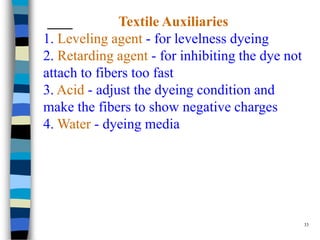
Textile Auxiliaries
1. Leveling agent - for levelness dyeing
2. Retarding agent - for inhibiting the dye not
attach to fibers too fast
3. Acid - adjust the dyeing condition and
make the fibers to show negative charges
4. Water - dyeing media


                                                  33
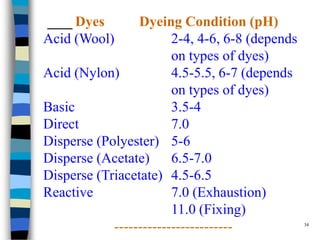
Dyes        Dyeing Condition (pH)
Acid (Wool)             2-4, 4-6, 6-8 (depends
                        on types of dyes)
Acid (Nylon)            4.5-5.5, 6-7 (depends
                        on types of dyes)
Basic                   3.5-4
Direct                  7.0
Disperse (Polyester) 5-6
Disperse (Acetate)      6.5-7.0
Disperse (Triacetate) 4.5-6.5
Reactive                7.0 (Exhaustion)
                        11.0 (Fixing)
                                                 34
            -------------------------

Introduction to dyeing

  • 1.
    Introduction to TextileDyeing RAJEEV SHARAN NATIONAL INSTITUTE OF FASHION TECHNOLOGY DFT-05 1
  • 2.
    Basic Textile Termsand Definitions Dyestuff is organic or inorganic substances which can absorb light and reflect some lights to show color. Actually, the dyestuff is water soluble substances. Pigment is a substance that can absorb light and reflect some lights to show color but it is water insoluble substances. Normally it is used for printing (with the presence of binder) or mass-coloration of the synthetic fibers. 2
  • 3.
    Staining is anunpleasant of dyeing in the area that we do not want. Exhaustion of the dyestuff to the fibers is as follows: 1. Moving of dyestuff from dyebath to surface of the fiber 2. Adsorption of the dyestuff into the surface of the fiber 3. Diffusion of the dyestuff into the center of the fiber 3
  • 4.
    Classification of Dyestuffs Dyestuffscan be classified by many methods as follows: 1. by their ionic (e.g. cationic, anionic and non-ionic) 2. by their fiber dyeabilities (e.g. on cellulosic, protein, polyester, polyamide etc.) 3. by their names (e.g. acid, direct, disperse, reactive, basic etc.) 4. by their chemical structures (e.g. azo, anthraquinone, stilbene etc.) 5. by their origins (e.g. natural, synthetic) 6. by their colors (e.g. red, green, black etc.) 4
  • 5.
    Dyeing Processes canbe applied in many stages such as 1. Mass-coloration of the molten fibers This method is for dyeing the molten fibers or plastic chips or textile polymers with pigment dyes. After that, the molten or polymers will extrude from a spinneret to form fibers. Normally, the synthetic fibers are added with white pigment in order to give a hiding power (non-see through fabrics). Advantage: give excellent fastness Disadvantage: very difficult to clean 5
  • 6.
    2. Fiber Dyeingis the method of dyeing fibers before blending with other colors to give fancy yarns or fabrics. Note: This is used for special purposes only. 3. Yarn Dyeing is the method of dyeing yarns in forms of hanks or packages dyeing. This will give Scottish’s style fabrics, carpet with many colors and styles. Note: This is used in hand loom weaving in the Northern and North-eastern parts of Thailand. 6
  • 7.
    4. Fabric Dyeingis the method after weaving, knitting, or non-woven to make fabrics. This is very popular method of dyeing as the dyed fabrics will be processed further to garment industries very easily. Dyeing forms of the fabric dyeing can be used in 2 ways: 1. Open width form using the fabrics to spread without any creases and dye them. 2. Rope form using the fabrics with the form like a rope (many creases and look like “a rope”) 7
  • 8.
    Some people classifyinto: 1. Exhaustion Process This method is using lot of water as shown in “Liquor Ratio (ratio between water and goods)” This should immerge the goods into dye solution for a long time in order to let the dye penetrate into the goods. This will lead to produce more waste water than the continuous process. Advantage: inexpensive, no need to train the worker to look after and run them properly. Disadvantage: lots of water needed, very slow process (60-120 min/batch.) 8
  • 9.
    2. Continuous Process Thismethod is designed by putting different machinery into a sequence so that it can produce the dyed fabric in one pass. Advantage: very fast process (10-100 m/min), small amount of water in the process. Disadvantage: very expensive, need to train the worker to look after and run them properly. 9
  • 10.
    6. Garment Dyeing Thismethod is the last process of the dyeing of goods. However, the penetration of the dye solution may not be completely passed to the fibers such as between the seams, buttons, zippers etc. Normally, it is used for lingerie, socks, sweater dyeing etc. 10
  • 11.
    Name of Dyestuffs Fibers that can be dyed Acid Silk, wool, polyamide, leather Basic Acrylic Direct Cellulosic, viscose Disperse Acetate, triacetate, polyamide, polyester, acrylic Reactive Cellulosic, viscose, protein Vat Cellulosic Sulphur Cellulosic 11
  • 12.
    Factors that givesome choices of the dyestuffs 1. Cheap 2. Non-toxic 3. Compatible to other dyes and chemicals 4. High color strength 5. Better brightness 6. Better fastness 7. Good levelness on the materials 12
  • 13.
    Dyes for CellulosicFibers Direct Dyes (Anionic) They can be dyed directly on cellulosic fibers. Without the presence of salt, when the fibers are immerged in water, it will show anionic charge which repels the dyes. Adding salt into the dye bath, it will reduce anionic on the fibers so the dyes can get closer and adsorb into the fibers. Advantage: cheap, easily dyed on fibers Disadvantage: poor wet fastness and some dyes have poor light fastness. 13
  • 14.
    Textile Auxiliaries 1. Salt- reduce negative charges on the fibers 2. Water - dyeing media 3. Fixing Agent - enhance wet fastness but usually reduce light fastness Dyeing Conditions (Exhaustion) dyeing 100oC x 30-90 min fixing 60oC x 20 min (Continuous) pad --> dry --> steam --> wash --> soap --> 14 dry
  • 15.
    Reactive Dyes (Anionic) Theycan be dyed on cellulosic fibers. The mechanism is nearly the same as described in Direct dyes. Advantage: high wet fastness due to covalent bonding (Chemical Bonding) between fibers and dyes, easily dyed on fibers Disadvantage: Expensive 15
  • 16.
    Dyeing Conditions 1. ContinuousProcess 1.1 Pad-dry-bake This is very easy method for cotton or cotton blends fibers. 1.2 Pad-dry-Pad (Chemical)-Steam This will give brighter and more intense color than method 1.1. 1.3 Pad-batch This will put the goods into the dye solution and squeeze with 2 rubber rollers to get rid of excess water and then batch at room temperature for 1-2 days. 16
  • 17.
    2. Exhaustion Process Thismethod will be used in small factory. Dyeing conditions will be 40-80oC for 30-90 min depending to the types and structures of the dyes. 17
  • 18.
    Textile Auxilaries 1. Salt- reduce negative charges on the fibers 2. Water - dyeing media 3. Soda Ash - excite the dye to link with the fibers with covalent bonding. Therefore, it enhances wet fastness 4. Fixing Agent - enhance wet fastness for heavy shade but usually reduce light fastness. 18
  • 19.
    Vat Dye (Anionicwhen soluble) The dye is named from the container (Vat) that used for rotting the dye with alkali solution. This crucial process will reduce the dye from insoluble to soluble dye (suitable for exhaustion in the cellulosic fibers). Now the manufacturer can synthesize man-made vat dye. 19
  • 20.
    Dyeing Process 1. Dissolvedye into water (insoluble dye) 2. Vatting process by reducing the insoluble dye in alkali condition. (soluble dye) 3. Absorb into fibers (soluble dye) 4. After dyeing, oxidize the dye with oxidizing agent (insoluble dye) 5. Wash and soap the goods 20
  • 21.
    Dyeing Conditions 1. ContinuousProcess 1.1 Pad-dry-Pad (Chemical) The solution of the dye is prepared without adding reducing agent to ensure leveling dyeing. After that, the goods are passed to chemical bath to reduce the dye into soluble dye and fix within the goods. Oxidizing agent is added to the goods and converted to insoluble dyes. 21
  • 22.
    1.2 Pad-oxidize-pad-oxidize (manytimes) This will put the goods into the dye solution and squeeze with 2 rubber rollers to get rid of excess water, oxidize with the air and then immerse into the dye solution again and again to allow the dye penetrate into the goods. 22
  • 23.
    Textile Auxilaries 1. Salt- reduce the negative charges on the fibers 2. Sodium hydroxide - adjust pH to the dyeing bath and make the suitable conditions for reducing agent. 3. Sodium hydrosulfite - reducing agent for the vat dyes. 4. Water - dyeing media 5. Oxidizing agents - (Hydrogen peroxide or Acetic acid or Air) oxidize the soluble to insoluble dye 23
  • 24.
    Sulfur Dye (Anionicwhen soluble) The dyeing process has the same process as described in the vat dye except that using Sodium sulfide instead of Sodium hydrosulfide. 24
  • 25.
    Dyes for SyntheticFiber Disperse Dye (polyester, nylon, and acetate) (non-ionic) The dye is named from less water soluble and normally appeared in dispersion in water. The dye shows no charge due to the groups presented in the dye molecules. Dyeing Conditions Insoluble Less water Water insoluble dye in soluble in polyester water fibers 25
  • 26.
    1. Exhaustion Process 1.1At boil with carrier This process is suitable for acetate fiber and pale shade polyester fiber dyeing. Carrier is an auxiliary for swollen fiber in order to allow more dyes absorbing in. Now the use of carrier is reduced because it may be a carcinogen. 1.2 At 130oC without carrier With the high temperature, the dyes will be dissolved into smaller molecules and the void in fiber structure will be opened. This will give heavy shade. 26
  • 27.
    2. Continuous Process Pad--> Pre-dry (100oC x 30 sec) --> Thermofixation (180oC x 30 sec) --> reduction clearing (RC) --> wash --> dry Printing with Disperse Dyes With the sublimation property, the dyes can be printed on paper, place the fabric with a printed paper and then using an iron with high temperature pressed on the paper. The dyes will transfer from paper to polyester fiber. This is called “Transfer Printing”. 27
  • 28.
    Textile Auxilaries 1. DispersingAgent - make the dye solution stable and disperse in the dye bath. 2. Acid - adjust pH to the suitable condition for the dye bath. 3. Carrier - swell the fiber and dissolve the dye to make the dye getting into fiber. 4. Leveling agent - make more leveling dyeing (some will have adverse effect on slower dyeing) 5. Water - dyeing media 28
  • 29.
    Reduction Clearing (R.C.) Afterdyeing process, the dyed goods should be removed excess dyes on the fiber surface. R.C. will give higher washing and rubbing fastness of the dyed goods. Using alkali solution, sodium hydrosulfide and dispersing agent, the R.C. will be done at 60oC x 20 min. Note: Do not use more than the recommended temperature because sodium hydrosulfide can be decomposed. 29
  • 30.
    Acid Dye (Anionic) Thedye is called acid because it needs acidic dyeing condition. It can be dyed on protein fibers (silk, wool, other animal fibers) and on polyamide fibers. Acidic condition will give the fibers showing positive charge. As the negative charge will attach directly to positive charge, and penetrate into the fibers. Dyeing conditions 100oC x 30-60 min 30
  • 31.
    Textile Auxiliaries 1. Levelingagent - for levelness dyeing 2. Retarding agent - for inhibiting the dye not attach to fibers too fast 3. Acid - adjust the dyeing condition and make the fibers to show positive charges 4. Water - dyeing media 31
  • 32.
    Basic Dye (Cationic) Thedye shows positive charge. Normally, the dye can be applied on wool, silk and polyacrylonitrile (acrylic). Dyeing Conditions 100oC x 30-60 min 32
  • 33.
    Textile Auxiliaries 1. Levelingagent - for levelness dyeing 2. Retarding agent - for inhibiting the dye not attach to fibers too fast 3. Acid - adjust the dyeing condition and make the fibers to show negative charges 4. Water - dyeing media 33
  • 34.
    Dyes Dyeing Condition (pH) Acid (Wool) 2-4, 4-6, 6-8 (depends on types of dyes) Acid (Nylon) 4.5-5.5, 6-7 (depends on types of dyes) Basic 3.5-4 Direct 7.0 Disperse (Polyester) 5-6 Disperse (Acetate) 6.5-7.0 Disperse (Triacetate) 4.5-6.5 Reactive 7.0 (Exhaustion) 11.0 (Fixing) 34 -------------------------