Blast Load and
Its Analysis
Design of Blast Resistant Structures
Khobar Towers bombing in Saudi Arabia
25/06/1996
Need
:
Increase in number of terrorist attacks.
To minimize damage to the assets
To minimize the loss of life.
To protect historical monuments and important buildings
To subside social panic
Moving
vehicle
attack
Stationary
vehicle
bomb
Exterior
attack
Arsons
Others
Ballistic
attacks
What is blast ?
The detonation of a condensed high explosive generates
hot gases under pressure upto 300 kilobar and a
temperature about 3000-4000°C. The resulted compressed
air expands outward from the centre of the blast and
causes formation of wave in a wind medium having a
velocity greater than sound. So this blast wave causes air
pressure to rise and which is known as side on
overpressure. As the blast wave or shock wave traverses
path the overpressure gradually decreases. Now a vaccum
pressure zone gets generated behind the shock wave.
An explosion is a rapid release of potential energy characterized by eruption
enormous energy to the atmosphere.
A part of energy is converted to thermal energy radiation (flash) and a part
is coupled as air blast and shock waves which expand radially
Response of blast at various distances from the
source of explosion
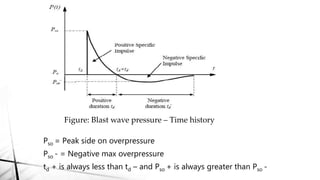
Figure: Blast wave pressure – Time history
Pso = Peak side on overpressure
Pso - = Negative max overpressure
td + is always less than td – and Pso + is always greater than Pso -
Design Consideration
As the impulse of the negative zone is less than the impulse of the positive
zone, the negative face is usually not taken into account for the design
purpose.
1.Explosive charge weight
2.Stand off distance
This is the distance from the source of explosion at which the blast effect
caused by standard charge weight is just equivalent to as caused by W
charge at distance R .
Scaled distance Z =
𝑅
𝑊
(
1
3)
Empirical relationships :
1.Brode (1955) :
2. Newmark and Hansen (1961) :
3. Mills (1987) :
Dynamic pressure:
The air behind the front of the blast wave
moves along the same direction as wind
but with smaller velocity. These winds
result in loading of duration more than
positive phase. So the pressure caused
by these winds is called dynamic
pressure.
q(t) =qo * f(t)
The maximum value of dynamic pressure
=
Fig: Positive phase duration of over pressure
(parentheses) and dynamic pressure for 1 KN burst
The positive phase duration for overpressure and
dynamic pressure can be selected from fig
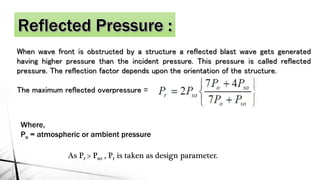
When wave front is obstructed by a structure a reflected blast wave gets generated
having higher pressure than the incident pressure. This pressure is called reflected
pressure. The reflection factor depends upon the orientation of the structure.
The maximum reflected overpressure =
Where,
Po = atmospheric or ambient pressure
As Pr > Pso , Pr is taken as design parameter.
Fig : Reflected overpressure
IS Code provision:
As per IS 4991 – 1968 , the value of
the Pso, qs , Pr computed from
Table 1 for 1 tonne detonation
amount.
The pressure time relationship in
the positive phase are idealised by
using a straight line starting with
the maximum pressure value but
terminating at a time td or tq .
Fig : Assumed Plot
Fig : Actual Plot
Closed Rectangular Structure
Open or Drag type structures
There are two types of structures :
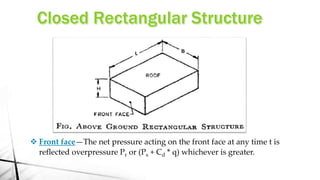
 Front face—The net pressure acting on the front face at any time t is
reflected overpressure Pr or (Ps + Cd * q) whichever is greater.
Cd = drag coefficient given in Table – 2 of IS 4991 - 1968
Pr = reflected overpressure which drops from the peak value Pro to overpressure
(Ps + Cd * q) in clearance time tc
tc =
3𝑆
𝑈
Where
S = H or B/2 whichever is less
U = Shock front velocity = M.a
Where
a= velocity of sound in air which may be taken as 344m/s at mean sea level at 20° C
and
M = Mach no. of the incident pulse given by 1 + 6𝑃so/7𝑃a
The value of the M for various conditions are also tabulated in
Table -1 of IS 4991 - 1968
The maximum reflected overpressure,
The net average loading on the front face (B X H) as function of time is shown in fig
depending on whether tc is smaller than or equal to td. The pressure Pro, Pso and qo
and time td are for actual explosion determined according to the Scaling laws.
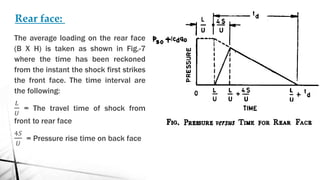
The average loading on the rear face
(B X H) is taken as shown in Fig.-7
where the time has been reckoned
from the instant the shock first strikes
the front face. The time interval are
the following:
𝐿
𝑈
= The travel time of shock from
front to rear face
4𝑆
𝑈
= Pressure rise time on back face
Rear face:
Roof and side walls :
When tr > td ,the load on
roof and side walls may
be considered as moving
triangular pulse having
the peak value of
overpressure Pro or (Ps0 +
Cd * q0) and time td as
shown in fig 7b.
When td > Transit time (tr) =
𝐿
𝑈
,the pressure diagram is given in fig.
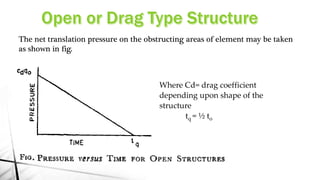
The net translation pressure on the obstructing areas of element may be taken
as shown in fig.
Where Cd= drag coefficient
depending upon shape of the
structure
tq = ½ to
Problem
on
Problem : Calculate the impulse of a blast load on a building
for positive phase using the given parameters.
Given Parameters
Detonation Amount 0.1tonne
Distance from ground Zero 30m
Height of Building 3m
Width of Building 10m
Length of Building 8m
Pa (ambient pressure) 1kg/cm2
a) Characteristics of the blast
Scaled Distance 64.63304m
From table -1 Assume Pa=1 kg/cm2
Pso 0.35367kg/cm2
Pro 0.806452kg/cm2
Qo 0.04219kg/cm2
to 37.70826mil sec
td 28.32257mil sec
Actual to 17.50262mil sec
Actual td 13.14617mil sec
M (Mach No.) 1.141554
Velocity of sound 344m/s
Shock front velocity (U) 392.6946m/s 0.392695m/mil sec
b)Pressures on the building
S (H or B/2 whichever is less) 3 m
Clearance time(t𝑐) 22.91858mil sec
> tdTransit time (t𝑡) 20.37207mil sec
Pressure rise time on back face (t𝑟) 30.5581mil sec
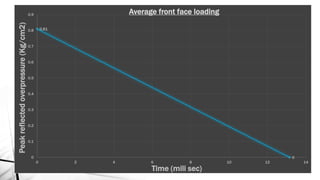
0.81
00
0.1
0.2
0.3
0.4
0.5
0.6
0.7
0.8
0.9
0 2 4 6 8 10 12 14
Peakreflectedoverpressure(Kg/cm2)
Time (mili sec)
Average front face loading
Solution:
From the graph-
Total impulse of force = 0
𝑡
𝑃(𝑡)𝑑𝑡
=
1
2
(0.81+0) * 13.15 * 102 *(Area)
=
1
2
(0.81+0) * 13.15 * 102 *10*3 N-Sec
= 15977 N-sec
Problem: A 25m high full water tank is subjected to a force as
shown in the previous graph. Natural time period Tn = 1.12 sec.
The force is caused by above ground explosion. Neglecting effect of
damping, calculate base shear & moment at the base of tower
supporting the tank. The mass of the water tank = 10000 kg.
Lateral deflection at any time, u =
1
𝑚𝑤 0
Ƭ
𝑃 Ƭ 𝑆𝑖𝑛 𝑤 𝑡 − Ƭ 𝑑Ƭ =
umax =
1
𝑚𝑤 0
Ƭ
𝑃 Ƭ 𝑑Ƭ
=
159277
10000∗(2 /1.12)
= 0.285 m
Base Shear = K*umax = mw2 *umax
= 10000 * (2∏/1.12)2 * 0.285
= 89604 N = 89.6 KN
Maximum Bending Moment = Base Shear * Height
= 89.6 * 25
= 2240 KN-m
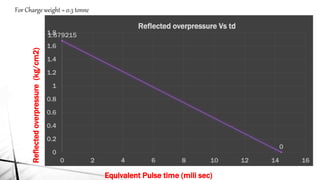
Charge
Weight
(tonne)
Pro
(kg/cm2)
td
(mil sec)
t 𝐜
(mil sec)
0.2 1.266034 13.91818 21.72694
0.3 1.679215 14.40166 20.87335
0.4 2.102653 14.5682 20.13651
0.5 2.468371 14.83824 19.58105
1 4.2 15.39 17.63895
Stand off Distance = 30m
0
1.266034
0
0.2
0.4
0.6
0.8
1
1.2
1.4
0 2 4 6 8 10 12 14 16
Reflectedoverpressure(kg/cm2)
Equivalent Pulse time (mili sec)
Reflected overpressure Vs td
For Charge weight = 0.2 tonne
0
1.679215
0
0.2
0.4
0.6
0.8
1
1.2
1.4
1.6
1.8
0 2 4 6 8 10 12 14 16
Reflected overpressure Vs td
For Charge weight = 0.3 tonne
Reflectedoverpressure(kg/cm2)
Equivalent Pulse time (mili sec)
2.102653
0
0
0.5
1
1.5
2
2.5
0 2 4 6 8 10 12 14 16
Reflected overpressure Vs td
For Charge weight = 0.4 tonne
Reflectedoverpressure(kg/cm2)
Equivalent Pulse time (mili sec)
For Charge weight = 0.5 tonne
Reflectedoverpressure(kg/cm2)
Equivalent Pulse time (mili sec)
2.468371
0
0
0.5
1
1.5
2
2.5
3
0 2 4 6 8 10 12 14 16
Reflected overpressure Vs td
0
15.39
0
2
4
6
8
10
12
14
16
18
0 0.5 1 1.5 2 2.5 3 3.5 4 4.5
Reflected overpressure Vs td
For Charge weight = 1 tonne
Reflectedoverpressure(kg/cm2)
Equivalent Pulse time (mili sec)
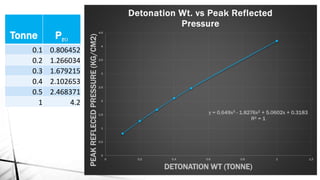
Tonne Pro
0.1 0.806452
0.2 1.266034
0.3 1.679215
0.4 2.102653
0.5 2.468371
1 4.2
y = 0.649x3 - 1.8276x2 + 5.0602x + 0.3183
R² = 1
0
0.5
1
1.5
2
2.5
3
3.5
4
4.5
0 0.2 0.4 0.6 0.8 1 1.2
PEAKREFLECEDPRESSURE(KG/CM2)
DETONATION WT (TONNE)
Detonation Wt. vs Peak Reflected
Pressure
Stand off
Distance
(m)
Pro
(kg/cm2)
td
(mil sec)
t 𝐜
(mil sec)
10 12.13074 4.48978 13.6224
15 3.62087 7.473143 18.19483
20 1.857502 9.611829 20.55338
25 1.146493 11.4432 22.0064
30 0.806452 13.14617 22.91858
Detonation amount = 0.1 tonne
For stand off Distance = 10 m
Reflectedoverpressure(kg/cm2)
Equivalent Pulse time (mili sec)
12.13074
0
0
2
4
6
8
10
12
14
0 1 2 3 4 5
Reflected overpressure Vs td
Reflectedoverpressure(kg/cm2)
Equivalent Pulse time (mili sec)
For stand off Distance = 15 m
0
7.473143
0
1
2
3
4
5
6
7
8
0 0.5 1 1.5 2 2.5 3 3.5 4
Reflected overpressure Vs td
Reflectedoverpressure(kg/cm2)
Equivalent Pulse time (mili sec)
For stand off Distance = 20 m
0
9.611829
0
2
4
6
8
10
12
0 0.5 1 1.5 2
Reflectedoverpressure(kg/cm2)
Equivalent Pulse time (mili sec)
For stand off Distance = 25 m
0
11.4432
0
2
4
6
8
10
12
14
0 0.2 0.4 0.6 0.8 1 1.2 1.4
Reflected overpressure Vs td
Reflectedoverpressure(kg/cm2)
Equivalent Pulse time (mili sec)
For stand off Distance = 30 m
0
13.14617
0
2
4
6
8
10
12
14
0 0.2 0.4 0.6 0.8 1
Reflected overpressure Vs td
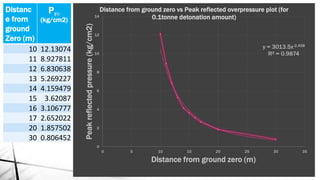
Distanc
e from
ground
Zero (m)
Pro
(kg/cm2)
10 12.13074
11 8.927811
12 6.830638
13 5.269227
14 4.159479
15 3.62087
16 3.106777
17 2.652022
20 1.857502
30 0.806452
y = 3013.5x-2.458
R² = 0.9874
0
2
4
6
8
10
12
14
0 5 10 15 20 25 30 35
Peakreflectedpressure(kg/cm2)
Distance from ground zero (m)
Distance from ground zero vs Peak reflected overpressure plot (for
0.1tonne detonation amount)
Scope of the Work :
• The main objective of the present study is to design a G+6
storey RCC building considering blast load, earth quake
load, wind load.
• It is required to compare the design of the same building
without blast load and including the blast load.
• Ductile detailing of the structural members need to be
done.
References:
• Ngo, T., Mendis, P., Gupta, A. & Ramsay, J.
“Blast Loading and Blast Effects on Structures – An Overview”
The University of Melbourne, Australia (2007)
• Activity A5 - Blast Simulation Technology Development
“Calculation of Blast Loads for Application to Structural Components”
Administrative Arrangement No JRC 32253-2011 with DG-HOME (2013)
• IS 4991 ‘‘CRITERIA FOR BLAST RESISTANT DESIGN OF
STRUCTURES FOR EXPLOSIONS ABOVE GROUND” (1968)
• Remennikov, A
“A Review of Methods for Predicting Bomb Blast Effects on Buildings”
University of Wollongong (2003), alexrem@uow.edu.au
• Draganić, H., Sigmund V.
“BLAST LOADING ON STRUCTURES” (2003)
• NBM Media article on “Blast Loading and Its Effects on Structures”
Blast load and its analysis

Blast load and its analysis

  • 1.
    Blast Load and ItsAnalysis Design of Blast Resistant Structures
  • 4.
    Khobar Towers bombingin Saudi Arabia 25/06/1996
  • 6.
    Need : Increase in numberof terrorist attacks. To minimize damage to the assets To minimize the loss of life. To protect historical monuments and important buildings To subside social panic
  • 7.
  • 8.
    What is blast? The detonation of a condensed high explosive generates hot gases under pressure upto 300 kilobar and a temperature about 3000-4000°C. The resulted compressed air expands outward from the centre of the blast and causes formation of wave in a wind medium having a velocity greater than sound. So this blast wave causes air pressure to rise and which is known as side on overpressure. As the blast wave or shock wave traverses path the overpressure gradually decreases. Now a vaccum pressure zone gets generated behind the shock wave.
  • 9.
    An explosion isa rapid release of potential energy characterized by eruption enormous energy to the atmosphere. A part of energy is converted to thermal energy radiation (flash) and a part is coupled as air blast and shock waves which expand radially
  • 10.
    Response of blastat various distances from the source of explosion
  • 11.
    Figure: Blast wavepressure – Time history Pso = Peak side on overpressure Pso - = Negative max overpressure td + is always less than td – and Pso + is always greater than Pso -
  • 12.
    Design Consideration As theimpulse of the negative zone is less than the impulse of the positive zone, the negative face is usually not taken into account for the design purpose. 1.Explosive charge weight 2.Stand off distance
  • 13.
    This is thedistance from the source of explosion at which the blast effect caused by standard charge weight is just equivalent to as caused by W charge at distance R . Scaled distance Z = 𝑅 𝑊 ( 1 3)
  • 14.
    Empirical relationships : 1.Brode(1955) : 2. Newmark and Hansen (1961) : 3. Mills (1987) :
  • 15.
    Dynamic pressure: The airbehind the front of the blast wave moves along the same direction as wind but with smaller velocity. These winds result in loading of duration more than positive phase. So the pressure caused by these winds is called dynamic pressure. q(t) =qo * f(t) The maximum value of dynamic pressure = Fig: Positive phase duration of over pressure (parentheses) and dynamic pressure for 1 KN burst The positive phase duration for overpressure and dynamic pressure can be selected from fig
  • 16.
    When wave frontis obstructed by a structure a reflected blast wave gets generated having higher pressure than the incident pressure. This pressure is called reflected pressure. The reflection factor depends upon the orientation of the structure. The maximum reflected overpressure = Where, Po = atmospheric or ambient pressure As Pr > Pso , Pr is taken as design parameter.
  • 17.
    Fig : Reflectedoverpressure
  • 18.
    IS Code provision: Asper IS 4991 – 1968 , the value of the Pso, qs , Pr computed from Table 1 for 1 tonne detonation amount. The pressure time relationship in the positive phase are idealised by using a straight line starting with the maximum pressure value but terminating at a time td or tq .
  • 19.
    Fig : AssumedPlot Fig : Actual Plot
  • 20.
    Closed Rectangular Structure Openor Drag type structures There are two types of structures :
  • 21.
     Front face—Thenet pressure acting on the front face at any time t is reflected overpressure Pr or (Ps + Cd * q) whichever is greater.
  • 22.
    Cd = dragcoefficient given in Table – 2 of IS 4991 - 1968 Pr = reflected overpressure which drops from the peak value Pro to overpressure (Ps + Cd * q) in clearance time tc tc = 3𝑆 𝑈 Where S = H or B/2 whichever is less U = Shock front velocity = M.a Where a= velocity of sound in air which may be taken as 344m/s at mean sea level at 20° C and M = Mach no. of the incident pulse given by 1 + 6𝑃so/7𝑃a The value of the M for various conditions are also tabulated in Table -1 of IS 4991 - 1968
  • 23.
    The maximum reflectedoverpressure, The net average loading on the front face (B X H) as function of time is shown in fig depending on whether tc is smaller than or equal to td. The pressure Pro, Pso and qo and time td are for actual explosion determined according to the Scaling laws.
  • 24.
    The average loadingon the rear face (B X H) is taken as shown in Fig.-7 where the time has been reckoned from the instant the shock first strikes the front face. The time interval are the following: 𝐿 𝑈 = The travel time of shock from front to rear face 4𝑆 𝑈 = Pressure rise time on back face Rear face:
  • 25.
    Roof and sidewalls : When tr > td ,the load on roof and side walls may be considered as moving triangular pulse having the peak value of overpressure Pro or (Ps0 + Cd * q0) and time td as shown in fig 7b. When td > Transit time (tr) = 𝐿 𝑈 ,the pressure diagram is given in fig.
  • 26.
    The net translationpressure on the obstructing areas of element may be taken as shown in fig. Where Cd= drag coefficient depending upon shape of the structure tq = ½ to
  • 27.
  • 28.
    Problem : Calculatethe impulse of a blast load on a building for positive phase using the given parameters. Given Parameters Detonation Amount 0.1tonne Distance from ground Zero 30m Height of Building 3m Width of Building 10m Length of Building 8m Pa (ambient pressure) 1kg/cm2
  • 29.
    a) Characteristics ofthe blast Scaled Distance 64.63304m From table -1 Assume Pa=1 kg/cm2 Pso 0.35367kg/cm2 Pro 0.806452kg/cm2 Qo 0.04219kg/cm2 to 37.70826mil sec td 28.32257mil sec Actual to 17.50262mil sec Actual td 13.14617mil sec M (Mach No.) 1.141554 Velocity of sound 344m/s Shock front velocity (U) 392.6946m/s 0.392695m/mil sec b)Pressures on the building S (H or B/2 whichever is less) 3 m Clearance time(t𝑐) 22.91858mil sec > tdTransit time (t𝑡) 20.37207mil sec Pressure rise time on back face (t𝑟) 30.5581mil sec
  • 30.
    0.81 00 0.1 0.2 0.3 0.4 0.5 0.6 0.7 0.8 0.9 0 2 46 8 10 12 14 Peakreflectedoverpressure(Kg/cm2) Time (mili sec) Average front face loading
  • 31.
    Solution: From the graph- Totalimpulse of force = 0 𝑡 𝑃(𝑡)𝑑𝑡 = 1 2 (0.81+0) * 13.15 * 102 *(Area) = 1 2 (0.81+0) * 13.15 * 102 *10*3 N-Sec = 15977 N-sec
  • 32.
    Problem: A 25mhigh full water tank is subjected to a force as shown in the previous graph. Natural time period Tn = 1.12 sec. The force is caused by above ground explosion. Neglecting effect of damping, calculate base shear & moment at the base of tower supporting the tank. The mass of the water tank = 10000 kg.
  • 33.
    Lateral deflection atany time, u = 1 𝑚𝑤 0 Ƭ 𝑃 Ƭ 𝑆𝑖𝑛 𝑤 𝑡 − Ƭ 𝑑Ƭ = umax = 1 𝑚𝑤 0 Ƭ 𝑃 Ƭ 𝑑Ƭ = 159277 10000∗(2 /1.12) = 0.285 m Base Shear = K*umax = mw2 *umax = 10000 * (2∏/1.12)2 * 0.285 = 89604 N = 89.6 KN Maximum Bending Moment = Base Shear * Height = 89.6 * 25 = 2240 KN-m
  • 35.
    Charge Weight (tonne) Pro (kg/cm2) td (mil sec) t 𝐜 (milsec) 0.2 1.266034 13.91818 21.72694 0.3 1.679215 14.40166 20.87335 0.4 2.102653 14.5682 20.13651 0.5 2.468371 14.83824 19.58105 1 4.2 15.39 17.63895 Stand off Distance = 30m
  • 36.
    0 1.266034 0 0.2 0.4 0.6 0.8 1 1.2 1.4 0 2 46 8 10 12 14 16 Reflectedoverpressure(kg/cm2) Equivalent Pulse time (mili sec) Reflected overpressure Vs td For Charge weight = 0.2 tonne
  • 37.
    0 1.679215 0 0.2 0.4 0.6 0.8 1 1.2 1.4 1.6 1.8 0 2 46 8 10 12 14 16 Reflected overpressure Vs td For Charge weight = 0.3 tonne Reflectedoverpressure(kg/cm2) Equivalent Pulse time (mili sec)
  • 38.
    2.102653 0 0 0.5 1 1.5 2 2.5 0 2 46 8 10 12 14 16 Reflected overpressure Vs td For Charge weight = 0.4 tonne Reflectedoverpressure(kg/cm2) Equivalent Pulse time (mili sec)
  • 39.
    For Charge weight= 0.5 tonne Reflectedoverpressure(kg/cm2) Equivalent Pulse time (mili sec) 2.468371 0 0 0.5 1 1.5 2 2.5 3 0 2 4 6 8 10 12 14 16 Reflected overpressure Vs td
  • 40.
    0 15.39 0 2 4 6 8 10 12 14 16 18 0 0.5 11.5 2 2.5 3 3.5 4 4.5 Reflected overpressure Vs td For Charge weight = 1 tonne Reflectedoverpressure(kg/cm2) Equivalent Pulse time (mili sec)
  • 41.
    Tonne Pro 0.1 0.806452 0.21.266034 0.3 1.679215 0.4 2.102653 0.5 2.468371 1 4.2 y = 0.649x3 - 1.8276x2 + 5.0602x + 0.3183 R² = 1 0 0.5 1 1.5 2 2.5 3 3.5 4 4.5 0 0.2 0.4 0.6 0.8 1 1.2 PEAKREFLECEDPRESSURE(KG/CM2) DETONATION WT (TONNE) Detonation Wt. vs Peak Reflected Pressure
  • 43.
    Stand off Distance (m) Pro (kg/cm2) td (mil sec) t𝐜 (mil sec) 10 12.13074 4.48978 13.6224 15 3.62087 7.473143 18.19483 20 1.857502 9.611829 20.55338 25 1.146493 11.4432 22.0064 30 0.806452 13.14617 22.91858 Detonation amount = 0.1 tonne
  • 44.
    For stand offDistance = 10 m Reflectedoverpressure(kg/cm2) Equivalent Pulse time (mili sec) 12.13074 0 0 2 4 6 8 10 12 14 0 1 2 3 4 5 Reflected overpressure Vs td
  • 45.
    Reflectedoverpressure(kg/cm2) Equivalent Pulse time(mili sec) For stand off Distance = 15 m 0 7.473143 0 1 2 3 4 5 6 7 8 0 0.5 1 1.5 2 2.5 3 3.5 4 Reflected overpressure Vs td
  • 46.
    Reflectedoverpressure(kg/cm2) Equivalent Pulse time(mili sec) For stand off Distance = 20 m 0 9.611829 0 2 4 6 8 10 12 0 0.5 1 1.5 2
  • 47.
    Reflectedoverpressure(kg/cm2) Equivalent Pulse time(mili sec) For stand off Distance = 25 m 0 11.4432 0 2 4 6 8 10 12 14 0 0.2 0.4 0.6 0.8 1 1.2 1.4 Reflected overpressure Vs td
  • 48.
    Reflectedoverpressure(kg/cm2) Equivalent Pulse time(mili sec) For stand off Distance = 30 m 0 13.14617 0 2 4 6 8 10 12 14 0 0.2 0.4 0.6 0.8 1 Reflected overpressure Vs td
  • 49.
    Distanc e from ground Zero (m) Pro (kg/cm2) 1012.13074 11 8.927811 12 6.830638 13 5.269227 14 4.159479 15 3.62087 16 3.106777 17 2.652022 20 1.857502 30 0.806452 y = 3013.5x-2.458 R² = 0.9874 0 2 4 6 8 10 12 14 0 5 10 15 20 25 30 35 Peakreflectedpressure(kg/cm2) Distance from ground zero (m) Distance from ground zero vs Peak reflected overpressure plot (for 0.1tonne detonation amount)
  • 50.
    Scope of theWork : • The main objective of the present study is to design a G+6 storey RCC building considering blast load, earth quake load, wind load. • It is required to compare the design of the same building without blast load and including the blast load. • Ductile detailing of the structural members need to be done.
  • 51.
    References: • Ngo, T.,Mendis, P., Gupta, A. & Ramsay, J. “Blast Loading and Blast Effects on Structures – An Overview” The University of Melbourne, Australia (2007) • Activity A5 - Blast Simulation Technology Development “Calculation of Blast Loads for Application to Structural Components” Administrative Arrangement No JRC 32253-2011 with DG-HOME (2013) • IS 4991 ‘‘CRITERIA FOR BLAST RESISTANT DESIGN OF STRUCTURES FOR EXPLOSIONS ABOVE GROUND” (1968) • Remennikov, A “A Review of Methods for Predicting Bomb Blast Effects on Buildings” University of Wollongong (2003), alexrem@uow.edu.au
  • 52.
    • Draganić, H.,Sigmund V. “BLAST LOADING ON STRUCTURES” (2003) • NBM Media article on “Blast Loading and Its Effects on Structures”