BLAST RESISTANT STRUCTURES
Guided by,
Ms. Rona Maria P James
Asst. Professor
VJEC
Presented by,
Ms. Anitta P. Sunny
VML17CESC04
M3 CE 1
OVER VIEW
• INTRODUCTION
• LITERATURE REVIEW
• OBJECTIVE OF BLAST DESIGN
• TYPES OF BLAST
• MAJOR CAUSES OF LIFE LOSS AFTER THE BLAST
• BLAST LOADING
• BLAST WAVE
• ASSESSMENT OF PERFORMANCE OF STRUCTURES AGAINST BLAST
• BLAST RESPONSE MITIGATION
• ARCHITECTURAL ASPECT OF BLAST RESISTANT BUILDING
DESIGN
• SEISMIC VERSUS BLAST LOAD
• BLAST RESISTANCE DESIGN TECHNIQUES
• CONCLUSION
• REFERENCE
2
INTRODUCTION
• Blast loads-one of the most popular design issue.
• Increase in number of terrorist attacks, storage of
explosives, bursting of gas cylinders, road
accidents.
• Earlier knowledge about blast-resistant design of
structures remains limited to military setups
• Subject is popularly applied in modern and
important buildings.
• Emerging branch in the field of structural
engineering 3
LITERATURE REVIEW
AUTHOR YEAR CONTENT
Cromwell, J.R., K.A.
Harries and B.M.
Shahrooz
2011 Environmental durability of externally bonded
FRP materials intended for repair of concrete
structures
Goel, M.D. and V.A.
Matsagar
2014 Blast-Resistant Design of Structures
Goel, M.D., D. Agrawall
and A. Chouby
2017 Collapse Behaviour of R.C.C. Building Under
Blast Load
Paul B. Summer,
Guzhao Li and Zonglei
Mu
2017 Evaluation and Design of Blast-Resistant
Buildings at Refineries and Petrochemical
Facilities
Syed, Z.I., O.A
Mohamed and K. Murad
2017 Performance of Earthquake-resistant RCC
Frame Structures under Blast Explosions
Warn, G.P. and M.
Bruneau
2009 Blast Resistance of Steel Plate Shear Walls
Designed for Seismic Loading
4
OBJECTIVE OF BLAST DESIGN
The primary objectives for providing blast
resistant design for buildings are:
• Reduce the severity of injury
• Facilitate rescue
• Expedite repair
• Accelerate the speed of return to full
operations
5
6
MAJOR CAUSES OF LIFE LOSS
AFTER THE BLAST
• Flying debris
• Broken glass
• Smoke and fire
• Power loss
• Communications breakdown
• Progressive collapse of structure
7
BLAST LOADING
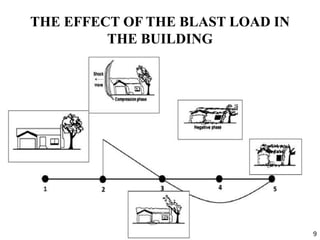
• Blasts are not always caused by combustion;
• They can also result from any rapid release of energy that creates
a blast wave, such as a
– bursting pressure vessel from which compressed air expands
– rapid phase transition of a liquid to a gas.
• The loads resulting from a blast are created by the
• Rapid expansion of the energetic material, creating a pressure
disturbance or blast wave radiating away from the explosion
source.
• Blast pressure is more properly called overpressure because it is
relative to ambient conditions.
8
THE EFFECT OF THE BLAST LOAD IN
THE BUILDING
9
10
BLAST WAVE
• Several empirical approaches to compute and
define the blast pressure profile have been
proposed
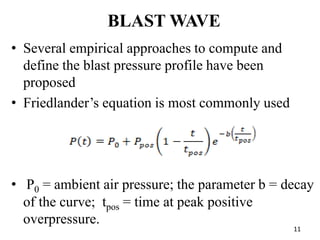
• Friedlander’s equation is most commonly used
• P0 = ambient air pressure; the parameter b = decay
of the curve; tpos = time at peak positive
overpressure.
11
ASSESSMENT OF PERFORMANCE OF
STRUCTURES AGAINST BLAST
• As specified by the task committee on blast-resistant
building design in petrochemical facilities, structural
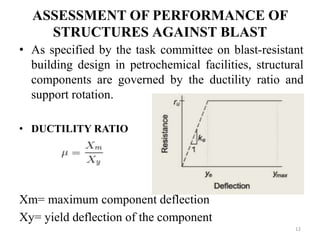
components are governed by the ductility ratio and
support rotation.
• DUCTILITY RATIO
Xm= maximum component deflection
Xy= yield deflection of the component
12
• SUPPORT ROTATION
The angle formed between the axis of a member loaded
between its endpoints and a straight line between one
endpoint and the point of maximum deflection. This value
is a key measure of dynamic response
13
BLAST RESPONSE MITIGATION
• Maintain safe separation of attackers and
targets, i.e. STAND-OFF zones.
• Design to sustain and contain certain amount of
bomb damage. Avoid progressive collapse of the
building
• Allow for limited localized damage of members
• Minimize the quantity and hazard of broken
glass and blast induced debris.
• Facilitate rescue and recovery operation with
adequate time of evacuation of occupants. 14
15
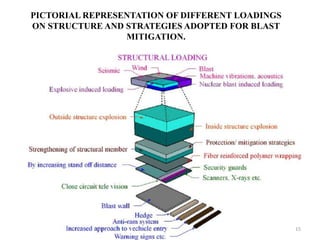
PICTORIAL REPRESENTATION OF DIFFERENT LOADINGS
ON STRUCTURE AND STRATEGIES ADOPTED FOR BLAST
MITIGATION.
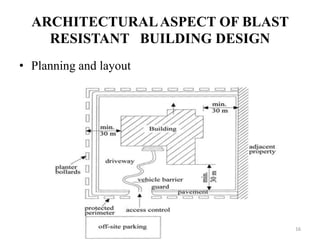
ARCHITECTURALASPECT OF BLAST
RESISTANT BUILDING DESIGN
• Planning and layout
16
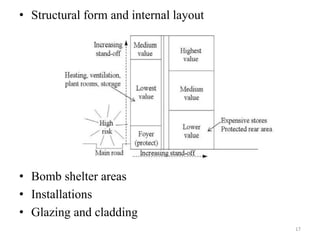
• Structural form and internal layout
• Bomb shelter areas
• Installations
• Glazing and cladding
17
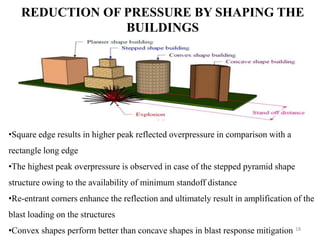
REDUCTION OF PRESSURE BY SHAPING THE
BUILDINGS
18
•Square edge results in higher peak reflected overpressure in comparison with a
rectangle long edge
•The highest peak overpressure is observed in case of the stepped pyramid shape
structure owing to the availability of minimum standoff distance
•Re-entrant corners enhance the reflection and ultimately result in amplification of the
blast loading on the structures
•Convex shapes perform better than concave shapes in blast response mitigation
19
•The interaction of the waves may increase resulting peak pressures
on the buildings.
•It depends on shapes of the buildings, their separation distance, and
location of the blast.
•The structural geometry should be as simple as possible, and the
use of lightweight, energy-absorbing materials is recommended so
that they do not add to the fragmentation projectile after the blast.
20
BLAST RESISTANCE DESIGN
TECHNIQUES
• Methods which were mentioned in various studies utilized
for the blast resistance of structures are below
• MASONRY STRUCTURE
• Goel M.D. et al [4] presented the Sacrificial Blast Wall against
explosion
21
CONCRETE STRUCTURES
• Cromwell et al.[3] performed experiments to investigate
the conduct of 3 FRP systems exposed to 9 different
environmental conditions.
• Four different experimental techniques were used. It was
found that Carbon Fibre Reinforced Polymer (CFRP) plate
excelled in all the different conditions.
• Manually placed GFRP material executed like the CFRP
fabric but a marked debasement was observed for saline
water and alkaline environmental conditions.
• It was concluded that FRP wraps utilized for retrofitting
columns are effective to increase the endurance of
buildings exposed to blast loads. 22
23
 STEEL STRUCTURES
• Warn et al.[10] Studied on the use of Steel plate shear
walls(SPSW)s to resist blast loading
• To investigate this, two 0.4-scale single story SPSW
specimens, representing the first story of a four story
prototype SPSW, were fabricated and subjected to
explosive charges.
• Results of the experimental investigation showed the
SPSW had a limited capacity to resist out-of-plane blast
loading and that the typical detail for connecting the
infill plate to the boundary frame might not be
appropriate for blast applications.
24
25
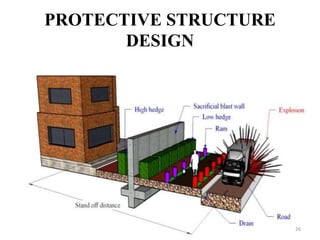
PROTECTIVE STRUCTURE
DESIGN
26
CONCLUSION
Blast response mitigation strategies can be incorporated
in the structural design at concept stage, This requires
knowledge of
1. intelligent strategies in the form of blast source
isolation strategies
2. using advanced engineered materials, material
behaviour under such loading
3. post explosion functioning of the structure and its
elements.
Strategies to protect against the blast are
1. strengthening of members
2. protection or mitigation strategies
27
CONCLUSION
• FRP retrofit technique in blast protection is an effective tool
• It is not practical to design buildings to withstand any blast that
occurs
• It is possible to improve the performance of structures
• Design process to ensure that appropriate threat conditions and
levels of protection are being incorporated.
• Designing the structures to be fully blast resistant is not an realistic
and economical option, however current engineering and
architectural knowledge can enhance the new and existing buildings
to mitigate the effects of an explosion. 28
REFERENCE
1. Andrews, E.W. and N.A. Moussa (2009), “Failure mode
maps for composite sandwich panels subjected to air blast
loading”, International Journal of Impact Engineering, 36,
418–425.
2. Bounds, W.L., A. Ganpatye and G. Miller (2011), “Blast
Resistant Design: Engineering Level Frame Analysis”,
Structures Congress, ASCE, 2432 – 2442.
3. Cromwell, J.R., K.A. Harries and B.M. Shahrooz (2011),
“Environmental durability of externally bonded FRP
materials intended for repair of concrete structures”,
Construction and Building Materials, 25, 2528–2539.
4. Goel, M.D. and V.A. Matsagar (2014), “Blast-Resistant
Design of Structures”,Practice Periodical on Structural
Design and Construction, ASCE, 19(2), 1-7.
5. Goel, M.D., D. Agrawall and A. Chouby (2017), “Collapse
Behavior of R.C.C. Building Under Blast Load”, Procedia
Engineering 173, 1943 – 1950. 29
6. Malvar, L.J., J.E. Crawford and K.B. Morrill (2007), “Use
of Composites to Resist Blast”, Journal of Composites for
Construction, 11, 601-610.
7. Muszynski, L.C. and M.R. Purcell (2003), “Use of Composite
Reinforcement to Strengthen Concrete and Air-Entrained
Concrete Masonry Walls against Air Blast”,
Journal of Composites for Construction, 7, 98-108.
8. Syed, Z.I., O.A Mohamed and K. Murad (2017), “Performance
of Earthquake-resistant RCC Frame Structures under Blast
Explosions”, Procedia Engineering 180, 82 – 90.
9. Tan, K.H. and M.K. Patoary (2009), “Blast Resistance of FRP-
Strengthened Masonry Walls. I: Approximate Analysis and Field
Explosion Test”, Journal of Composites for
Construction, 13, 422-430.
10. Warn, G.P. and M. Bruneau (2009), “Blast Resistance of Steel
Plate Shear Walls Designed for Seismic Loading”, Journal of
Structural Engineering, 135, 1222-1230.
REFERENCE
30
31
THANK YOU…..

blast resistant structures

  • 1.
    BLAST RESISTANT STRUCTURES Guidedby, Ms. Rona Maria P James Asst. Professor VJEC Presented by, Ms. Anitta P. Sunny VML17CESC04 M3 CE 1
  • 2.
    OVER VIEW • INTRODUCTION •LITERATURE REVIEW • OBJECTIVE OF BLAST DESIGN • TYPES OF BLAST • MAJOR CAUSES OF LIFE LOSS AFTER THE BLAST • BLAST LOADING • BLAST WAVE • ASSESSMENT OF PERFORMANCE OF STRUCTURES AGAINST BLAST • BLAST RESPONSE MITIGATION • ARCHITECTURAL ASPECT OF BLAST RESISTANT BUILDING DESIGN • SEISMIC VERSUS BLAST LOAD • BLAST RESISTANCE DESIGN TECHNIQUES • CONCLUSION • REFERENCE 2
  • 3.
    INTRODUCTION • Blast loads-oneof the most popular design issue. • Increase in number of terrorist attacks, storage of explosives, bursting of gas cylinders, road accidents. • Earlier knowledge about blast-resistant design of structures remains limited to military setups • Subject is popularly applied in modern and important buildings. • Emerging branch in the field of structural engineering 3
  • 4.
    LITERATURE REVIEW AUTHOR YEARCONTENT Cromwell, J.R., K.A. Harries and B.M. Shahrooz 2011 Environmental durability of externally bonded FRP materials intended for repair of concrete structures Goel, M.D. and V.A. Matsagar 2014 Blast-Resistant Design of Structures Goel, M.D., D. Agrawall and A. Chouby 2017 Collapse Behaviour of R.C.C. Building Under Blast Load Paul B. Summer, Guzhao Li and Zonglei Mu 2017 Evaluation and Design of Blast-Resistant Buildings at Refineries and Petrochemical Facilities Syed, Z.I., O.A Mohamed and K. Murad 2017 Performance of Earthquake-resistant RCC Frame Structures under Blast Explosions Warn, G.P. and M. Bruneau 2009 Blast Resistance of Steel Plate Shear Walls Designed for Seismic Loading 4
  • 5.
    OBJECTIVE OF BLASTDESIGN The primary objectives for providing blast resistant design for buildings are: • Reduce the severity of injury • Facilitate rescue • Expedite repair • Accelerate the speed of return to full operations 5
  • 6.
  • 7.
    MAJOR CAUSES OFLIFE LOSS AFTER THE BLAST • Flying debris • Broken glass • Smoke and fire • Power loss • Communications breakdown • Progressive collapse of structure 7
  • 8.
    BLAST LOADING • Blastsare not always caused by combustion; • They can also result from any rapid release of energy that creates a blast wave, such as a – bursting pressure vessel from which compressed air expands – rapid phase transition of a liquid to a gas. • The loads resulting from a blast are created by the • Rapid expansion of the energetic material, creating a pressure disturbance or blast wave radiating away from the explosion source. • Blast pressure is more properly called overpressure because it is relative to ambient conditions. 8
  • 9.
    THE EFFECT OFTHE BLAST LOAD IN THE BUILDING 9
  • 10.
  • 11.
    BLAST WAVE • Severalempirical approaches to compute and define the blast pressure profile have been proposed • Friedlander’s equation is most commonly used • P0 = ambient air pressure; the parameter b = decay of the curve; tpos = time at peak positive overpressure. 11
  • 12.
    ASSESSMENT OF PERFORMANCEOF STRUCTURES AGAINST BLAST • As specified by the task committee on blast-resistant building design in petrochemical facilities, structural components are governed by the ductility ratio and support rotation. • DUCTILITY RATIO Xm= maximum component deflection Xy= yield deflection of the component 12
  • 13.
    • SUPPORT ROTATION Theangle formed between the axis of a member loaded between its endpoints and a straight line between one endpoint and the point of maximum deflection. This value is a key measure of dynamic response 13
  • 14.
    BLAST RESPONSE MITIGATION •Maintain safe separation of attackers and targets, i.e. STAND-OFF zones. • Design to sustain and contain certain amount of bomb damage. Avoid progressive collapse of the building • Allow for limited localized damage of members • Minimize the quantity and hazard of broken glass and blast induced debris. • Facilitate rescue and recovery operation with adequate time of evacuation of occupants. 14
  • 15.
    15 PICTORIAL REPRESENTATION OFDIFFERENT LOADINGS ON STRUCTURE AND STRATEGIES ADOPTED FOR BLAST MITIGATION.
  • 16.
    ARCHITECTURALASPECT OF BLAST RESISTANTBUILDING DESIGN • Planning and layout 16
  • 17.
    • Structural formand internal layout • Bomb shelter areas • Installations • Glazing and cladding 17
  • 18.
    REDUCTION OF PRESSUREBY SHAPING THE BUILDINGS 18 •Square edge results in higher peak reflected overpressure in comparison with a rectangle long edge •The highest peak overpressure is observed in case of the stepped pyramid shape structure owing to the availability of minimum standoff distance •Re-entrant corners enhance the reflection and ultimately result in amplification of the blast loading on the structures •Convex shapes perform better than concave shapes in blast response mitigation
  • 19.
    19 •The interaction ofthe waves may increase resulting peak pressures on the buildings. •It depends on shapes of the buildings, their separation distance, and location of the blast. •The structural geometry should be as simple as possible, and the use of lightweight, energy-absorbing materials is recommended so that they do not add to the fragmentation projectile after the blast.
  • 20.
  • 21.
    BLAST RESISTANCE DESIGN TECHNIQUES •Methods which were mentioned in various studies utilized for the blast resistance of structures are below • MASONRY STRUCTURE • Goel M.D. et al [4] presented the Sacrificial Blast Wall against explosion 21
  • 22.
    CONCRETE STRUCTURES • Cromwellet al.[3] performed experiments to investigate the conduct of 3 FRP systems exposed to 9 different environmental conditions. • Four different experimental techniques were used. It was found that Carbon Fibre Reinforced Polymer (CFRP) plate excelled in all the different conditions. • Manually placed GFRP material executed like the CFRP fabric but a marked debasement was observed for saline water and alkaline environmental conditions. • It was concluded that FRP wraps utilized for retrofitting columns are effective to increase the endurance of buildings exposed to blast loads. 22
  • 23.
  • 24.
     STEEL STRUCTURES •Warn et al.[10] Studied on the use of Steel plate shear walls(SPSW)s to resist blast loading • To investigate this, two 0.4-scale single story SPSW specimens, representing the first story of a four story prototype SPSW, were fabricated and subjected to explosive charges. • Results of the experimental investigation showed the SPSW had a limited capacity to resist out-of-plane blast loading and that the typical detail for connecting the infill plate to the boundary frame might not be appropriate for blast applications. 24
  • 25.
  • 26.
  • 27.
    CONCLUSION Blast response mitigationstrategies can be incorporated in the structural design at concept stage, This requires knowledge of 1. intelligent strategies in the form of blast source isolation strategies 2. using advanced engineered materials, material behaviour under such loading 3. post explosion functioning of the structure and its elements. Strategies to protect against the blast are 1. strengthening of members 2. protection or mitigation strategies 27
  • 28.
    CONCLUSION • FRP retrofittechnique in blast protection is an effective tool • It is not practical to design buildings to withstand any blast that occurs • It is possible to improve the performance of structures • Design process to ensure that appropriate threat conditions and levels of protection are being incorporated. • Designing the structures to be fully blast resistant is not an realistic and economical option, however current engineering and architectural knowledge can enhance the new and existing buildings to mitigate the effects of an explosion. 28
  • 29.
    REFERENCE 1. Andrews, E.W.and N.A. Moussa (2009), “Failure mode maps for composite sandwich panels subjected to air blast loading”, International Journal of Impact Engineering, 36, 418–425. 2. Bounds, W.L., A. Ganpatye and G. Miller (2011), “Blast Resistant Design: Engineering Level Frame Analysis”, Structures Congress, ASCE, 2432 – 2442. 3. Cromwell, J.R., K.A. Harries and B.M. Shahrooz (2011), “Environmental durability of externally bonded FRP materials intended for repair of concrete structures”, Construction and Building Materials, 25, 2528–2539. 4. Goel, M.D. and V.A. Matsagar (2014), “Blast-Resistant Design of Structures”,Practice Periodical on Structural Design and Construction, ASCE, 19(2), 1-7. 5. Goel, M.D., D. Agrawall and A. Chouby (2017), “Collapse Behavior of R.C.C. Building Under Blast Load”, Procedia Engineering 173, 1943 – 1950. 29
  • 30.
    6. Malvar, L.J.,J.E. Crawford and K.B. Morrill (2007), “Use of Composites to Resist Blast”, Journal of Composites for Construction, 11, 601-610. 7. Muszynski, L.C. and M.R. Purcell (2003), “Use of Composite Reinforcement to Strengthen Concrete and Air-Entrained Concrete Masonry Walls against Air Blast”, Journal of Composites for Construction, 7, 98-108. 8. Syed, Z.I., O.A Mohamed and K. Murad (2017), “Performance of Earthquake-resistant RCC Frame Structures under Blast Explosions”, Procedia Engineering 180, 82 – 90. 9. Tan, K.H. and M.K. Patoary (2009), “Blast Resistance of FRP- Strengthened Masonry Walls. I: Approximate Analysis and Field Explosion Test”, Journal of Composites for Construction, 13, 422-430. 10. Warn, G.P. and M. Bruneau (2009), “Blast Resistance of Steel Plate Shear Walls Designed for Seismic Loading”, Journal of Structural Engineering, 135, 1222-1230. REFERENCE 30
  • 31.