Chapter-09
Masonry Structures under
later loads
Siddharth shankar
Department of Civil(structure)
Engineering
Pulchowk Campus
Earthquake
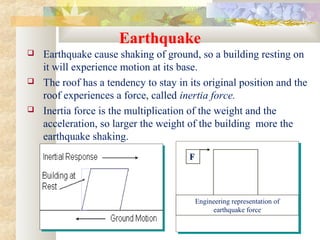
 Earthquake cause shaking of ground, so a building resting on
it will experience motion at its base.
 The roof has a tendency to stay in its original position and the
roof experiences a force, called inertia force.
 Inertia force is the multiplication of the weight and the
acceleration, so larger the weight of the building more the
earthquake shaking.
Engineering representation of
earthquake force
Masonry Structures
Masonry is brittle and tensile and shear
strength is very low.
Due to Large mass of masonry structures,
heavy weight attracts large amounts of seismic
forces.
Wall to wall connection and roof connection is
generally weak.
Stress concentration occurs at the corners of
windows and doors.
 Out of plane failure
 In plane failure
 Diaphragm failure
 Connection Failure
 Failure due to opening of wall
 Pounding
 Non-structural component failure
Failure Modes of a Masonry buildings
Out of Plane Failure
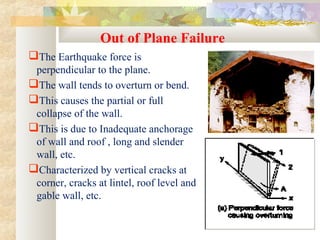
The Earthquake force is
perpendicular to the plane.
The wall tends to overturn or bend.
This causes the partial or full
collapse of the wall.
This is due to Inadequate anchorage
of wall and roof , long and slender
wall, etc.
Characterized by vertical cracks at
corner, cracks at lintel, roof level and
gable wall, etc.
In Plane Failure
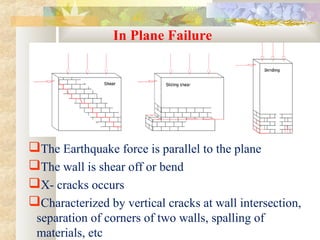
The Earthquake force is parallel to the plane
The wall is shear off or bend
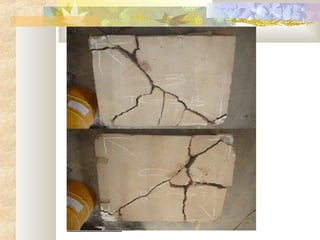
X- cracks occurs
Characterized by vertical cracks at wall intersection,
separation of corners of two walls, spalling of
materials, etc
Diaphragm Failure
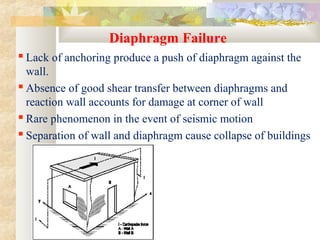
 Lack of anchoring produce a push of diaphragm against the
wall.
 Absence of good shear transfer between diaphragms and
reaction wall accounts for damage at corner of wall
 Rare phenomenon in the event of seismic motion
 Separation of wall and diaphragm cause collapse of buildings
Connection failure
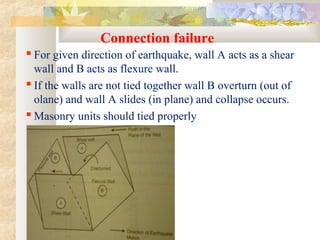
 For given direction of earthquake, wall A acts as a shear
wall and B acts as flexure wall.
 If the walls are not tied together wall B overturn (out of
olane) and wall A slides (in plane) and collapse occurs.
 Masonry units should tied properly
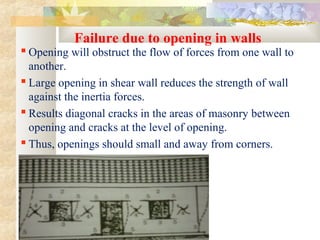
Failure due to opening in walls
 Opening will obstruct the flow of forces from one wall to
another.
 Large opening in shear wall reduces the strength of wall
against the inertia forces.
 Results diagonal cracks in the areas of masonry between
opening and cracks at the level of opening.
 Thus, openings should small and away from corners.
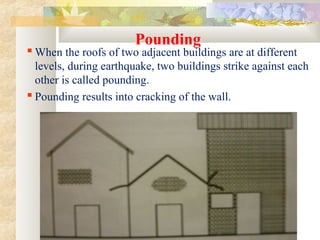
Pounding
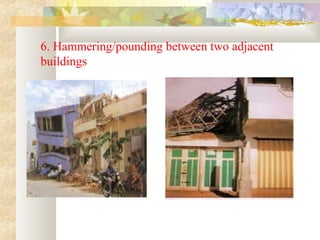
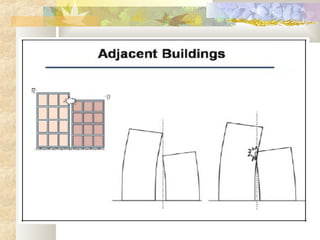
 When the roofs of two adjacent buildings are at different
levels, during earthquake, two buildings strike against each
other is called pounding.
 Pounding results into cracking of the wall.
Non Structural components failure
Falling of plaster from walls and ceiling.
Cracking and overturning of parapets,
chimneys, etc.
Cracking and overturning of partition walls.
Cracking of glasses.
Falling of loosely placed objects.
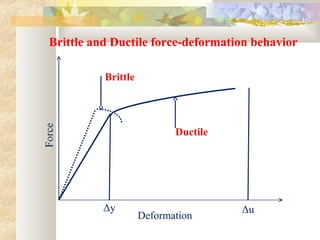
Ductile behaviour of reinforced & unreinforced masonry
 It is the capacity of an element or structure to undergo large
deformation without failure.
 Masonry is brittle in nature.
 Ductility of masonry structure is governed by the ductility
of masonry units & properties of mortar.
 Unreinforced masonry cannot withstand tension so cracks
develops.
 In-plane & out-of-plane failure is also due to ductility of
masonry.
 To improve ductility reinforcing bars are embedded in the
masonry, called reinforced masonry which can resist the
seismic force more than unreinforced masonry.
Brittle and Ductile force-deformation behavior
Brittle
Ductile
Δy Δu
Deformation
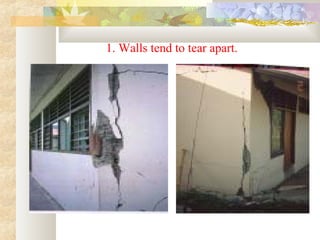
1. Walls tend to tear apart.
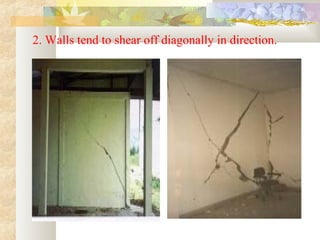
2. Walls tend to shear off diagonally in direction.
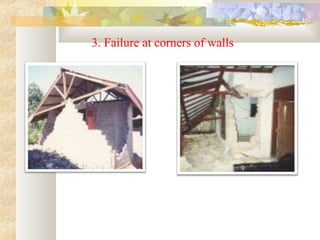
3. Failure at corners of walls
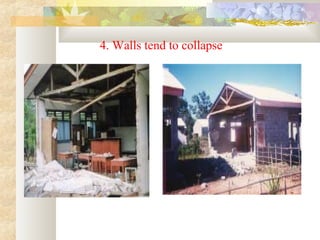
4. Walls tend to collapse
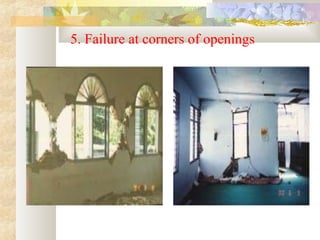
5. Failure at corners of openings
6. Hammering/pounding between two adjacent
buildings
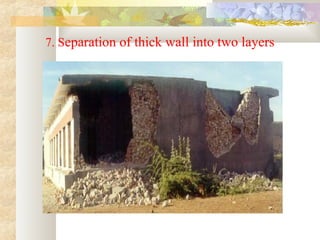
7. Separation of thick wall into two layers
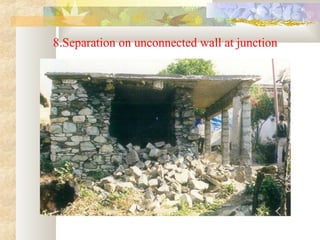
8.Separation on unconnected wall at junction
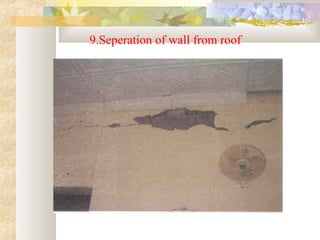
9.Seperation of wall from roof
 Non-integrity of wall floor and roof.
 Configuration – irregularity of building causes
torsional effect.
 Large opening of the building.
 Inappropriate position of opening.
 Lack of cross wall in large length of wall.
 Lack of reinforcement make the masonry building
brittle.
 Pounding effect.
 Lack of anchoring element between two walls.
Major causes of failure of masonry buildings
Elements of Lateral Load
Resisting Masonry
System
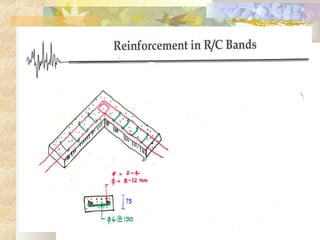
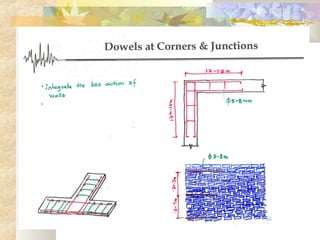
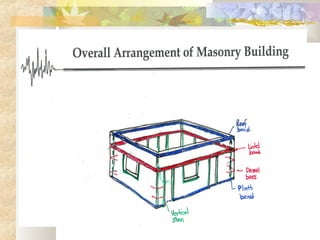
Horizontal bands for integrity
Connecting peripheral walls for
structural robustness and integrity
 Plinth band
 Lintel band
 Roof band
 Gable band
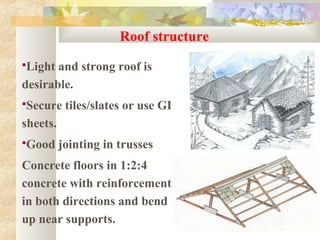
Roof structure
Light and strong roof is
desirable.
Secure tiles/slates or use GI
sheets.
Good jointing in trusses
Concrete floors in 1:2:4
concrete with reinforcement
in both directions and bend
up near supports.
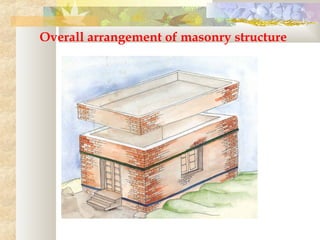
Overall arrangement of masonry structure
Chapter-10
Testing of masonry
elements
siddharth shankar
Pulchowk Campus
Department of Civil Engineering
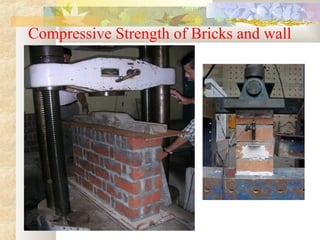
Compressive Strength of Bricks and wall
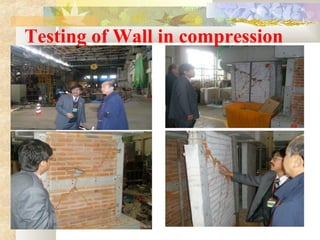
Testing of Wall in compression
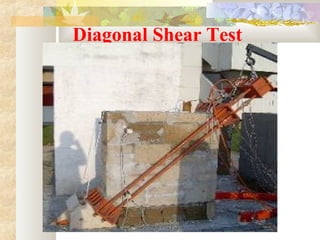
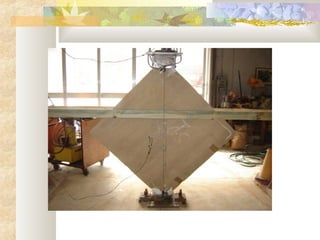
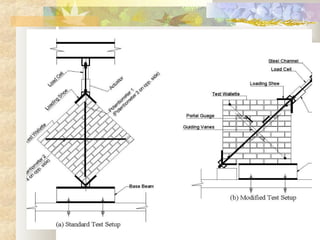
Diagonal Shear Test
Normally carried out:
1. Periodically to evaluate the performance of
building
2.To gather information on old building in
order to ascertain the methods of repair or
to demolish
3. To ascertain the strength of concrete if
cube tests failed.
NON DESTRUCTIVE TEST (NDT)
 Elastic wave tomography
 Rebound Hammer / Schmidt Hammer
 Ultrasonic Pulse Velocity
 Impact Echo Test
 X-Rays
 Flat Jack Test
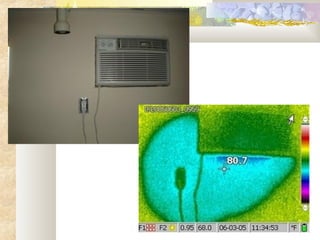
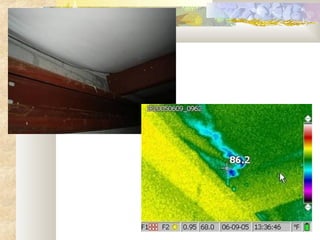
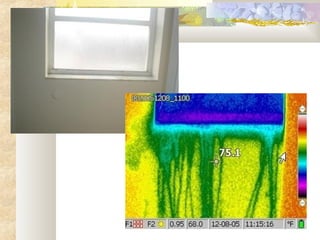
Elastic wave tomography
 Technique used for locating shallow delaminations,
cracks, and voids.
 Elastic wave tomography is based on two basic
principles from heat transfer: conduction and
radiation. Sound materials with no voids, gaps, or
cracks are more thermally conductive than materials
that are delaminated or contain moisture.
 This allows rapid areal mapping of internal
conditions. It should be noted that the IT method is
most useful for the detection of shallow defects and
flaws.
 Tests For: Voids, Cracks, Moisture.
Rebound Method
 Can be used to determine the in-place compressive
strength of concrete within a range of 1500 – 8000 psi
(10-55MPa)
 A quick and simple mean of checking concrete
uniformity.
 Measure the distance of rebound of a spring-loaded
plunger after it struck a smooth concrete surface.
 Results of the test can be affected by factors such as
smoothness of concrete surface, size, shape, rigidity of
specimen, age & moisture condition.
 Type of coarse aggregate & the carbonation of the
surface.
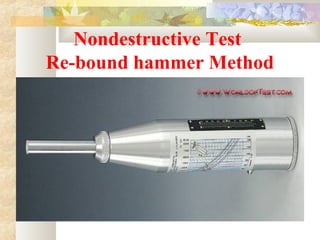
Nondestructive Test
Re-bound hammer Method
Nondestructive Test Methods
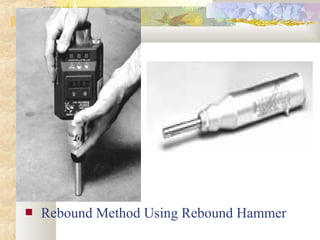
 Rebound Hammer Tests
 Schmidt Hammer
 Rebound Method Using Rebound Hammer
Ultrasonic Pulse Velocity
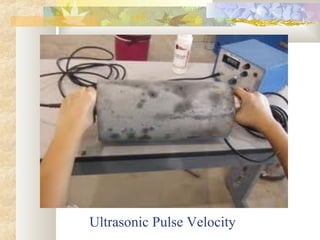
 It uses measurement of the speed of ultrasonic
pulses through the concrete to correlate concrete
strength to standard strength.
 Allows the determination of compressive concrete
strength and location of cracks.
 It will identify non homogenous condition in the
structure such as honeycomb, voids and cracks.
 Size of cracks can also be determined.
Ultrasonic Pulse Velocity
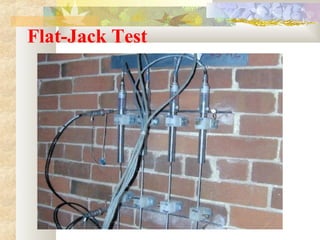
Flat Jack Test
 Flat jack testing is a nondestructive test of
evaluating existing masonry structure. It does
not require removal of masonry units - only
the removal of small portions of mortar is
enough. The flat jack test uses small, thin,
hydraulic jacks to apply a force to a section of
an existing masonry wall, and the method
uses measuring devices to determine the
resulting displacement of the masonry.
Flat jack testing has many useful applications:
 It can be used to determine masonry
compressive modulus, which is the stress/strain
relationship of the masonry, or axial stress by
applying axial load and measuring resulting axial
deformation.
 It can be used to estimate compressive strength
and measure the shear strength.
 If the destruction of the masonry units is
acceptable, it can be used to directly measure the
compressive strength by testing the masonry to
Flat-Jack Test
Push Shear Test
 Prepare the test location by removing the brick,
including the mortar, on one side of the brick to be
tested. The head joint on the opposite side of the
brick to be tested is also removed. Care must be
exercised so that the mortar joint above or below the
brick to be tested is not damaged.
 The hydraulic ram is inserted in the space where the
brick was removed. A steel loading block is placed
between the ram and the brick to be tested so that the
ram will distribute its load over the end face of the
brick. The dial gauge can also be inserted in the
space.
Push Shear Test
 The brick is then loaded with the ram until the
first indication of cracking or movement of
the brick.
 The ram force and associated deflection on
the dial gauge are recorded to develop a
force-deflection plot on which the first
cracking or movement should be indicated. A
dial gauge can be used to calculate a rough
estimate of shear stiffness
Push Shear Test
Masonry structures -_chapter_9_and_10

Masonry structures -_chapter_9_and_10

  • 1.
    Chapter-09 Masonry Structures under laterloads Siddharth shankar Department of Civil(structure) Engineering Pulchowk Campus
  • 2.
    Earthquake  Earthquake causeshaking of ground, so a building resting on it will experience motion at its base.  The roof has a tendency to stay in its original position and the roof experiences a force, called inertia force.  Inertia force is the multiplication of the weight and the acceleration, so larger the weight of the building more the earthquake shaking. Engineering representation of earthquake force
  • 3.
    Masonry Structures Masonry isbrittle and tensile and shear strength is very low. Due to Large mass of masonry structures, heavy weight attracts large amounts of seismic forces. Wall to wall connection and roof connection is generally weak. Stress concentration occurs at the corners of windows and doors.
  • 4.
     Out ofplane failure  In plane failure  Diaphragm failure  Connection Failure  Failure due to opening of wall  Pounding  Non-structural component failure Failure Modes of a Masonry buildings
  • 5.
    Out of PlaneFailure The Earthquake force is perpendicular to the plane. The wall tends to overturn or bend. This causes the partial or full collapse of the wall. This is due to Inadequate anchorage of wall and roof , long and slender wall, etc. Characterized by vertical cracks at corner, cracks at lintel, roof level and gable wall, etc.
  • 6.
    In Plane Failure TheEarthquake force is parallel to the plane The wall is shear off or bend X- cracks occurs Characterized by vertical cracks at wall intersection, separation of corners of two walls, spalling of materials, etc
  • 7.
    Diaphragm Failure  Lackof anchoring produce a push of diaphragm against the wall.  Absence of good shear transfer between diaphragms and reaction wall accounts for damage at corner of wall  Rare phenomenon in the event of seismic motion  Separation of wall and diaphragm cause collapse of buildings
  • 8.
    Connection failure  Forgiven direction of earthquake, wall A acts as a shear wall and B acts as flexure wall.  If the walls are not tied together wall B overturn (out of olane) and wall A slides (in plane) and collapse occurs.  Masonry units should tied properly
  • 9.
    Failure due toopening in walls  Opening will obstruct the flow of forces from one wall to another.  Large opening in shear wall reduces the strength of wall against the inertia forces.  Results diagonal cracks in the areas of masonry between opening and cracks at the level of opening.  Thus, openings should small and away from corners.
  • 10.
    Pounding  When theroofs of two adjacent buildings are at different levels, during earthquake, two buildings strike against each other is called pounding.  Pounding results into cracking of the wall.
  • 11.
    Non Structural componentsfailure Falling of plaster from walls and ceiling. Cracking and overturning of parapets, chimneys, etc. Cracking and overturning of partition walls. Cracking of glasses. Falling of loosely placed objects.
  • 12.
    Ductile behaviour ofreinforced & unreinforced masonry  It is the capacity of an element or structure to undergo large deformation without failure.  Masonry is brittle in nature.  Ductility of masonry structure is governed by the ductility of masonry units & properties of mortar.  Unreinforced masonry cannot withstand tension so cracks develops.  In-plane & out-of-plane failure is also due to ductility of masonry.  To improve ductility reinforcing bars are embedded in the masonry, called reinforced masonry which can resist the seismic force more than unreinforced masonry.
  • 13.
    Brittle and Ductileforce-deformation behavior Brittle Ductile Δy Δu Deformation
  • 14.
    1. Walls tendto tear apart.
  • 15.
    2. Walls tendto shear off diagonally in direction.
  • 16.
    3. Failure atcorners of walls
  • 17.
    4. Walls tendto collapse
  • 18.
    5. Failure atcorners of openings
  • 19.
    6. Hammering/pounding betweentwo adjacent buildings
  • 21.
    7. Separation ofthick wall into two layers
  • 22.
  • 23.
  • 24.
     Non-integrity ofwall floor and roof.  Configuration – irregularity of building causes torsional effect.  Large opening of the building.  Inappropriate position of opening.  Lack of cross wall in large length of wall.  Lack of reinforcement make the masonry building brittle.  Pounding effect.  Lack of anchoring element between two walls. Major causes of failure of masonry buildings
  • 25.
    Elements of LateralLoad Resisting Masonry System
  • 26.
    Horizontal bands forintegrity Connecting peripheral walls for structural robustness and integrity  Plinth band  Lintel band  Roof band  Gable band
  • 30.
    Roof structure Light andstrong roof is desirable. Secure tiles/slates or use GI sheets. Good jointing in trusses Concrete floors in 1:2:4 concrete with reinforcement in both directions and bend up near supports.
  • 32.
    Overall arrangement ofmasonry structure
  • 33.
    Chapter-10 Testing of masonry elements siddharthshankar Pulchowk Campus Department of Civil Engineering
  • 34.
    Compressive Strength ofBricks and wall
  • 35.
    Testing of Wallin compression
  • 36.
  • 40.
    Normally carried out: 1.Periodically to evaluate the performance of building 2.To gather information on old building in order to ascertain the methods of repair or to demolish 3. To ascertain the strength of concrete if cube tests failed.
  • 41.
    NON DESTRUCTIVE TEST(NDT)  Elastic wave tomography  Rebound Hammer / Schmidt Hammer  Ultrasonic Pulse Velocity  Impact Echo Test  X-Rays  Flat Jack Test
  • 42.
    Elastic wave tomography Technique used for locating shallow delaminations, cracks, and voids.  Elastic wave tomography is based on two basic principles from heat transfer: conduction and radiation. Sound materials with no voids, gaps, or cracks are more thermally conductive than materials that are delaminated or contain moisture.  This allows rapid areal mapping of internal conditions. It should be noted that the IT method is most useful for the detection of shallow defects and flaws.  Tests For: Voids, Cracks, Moisture.
  • 46.
    Rebound Method  Canbe used to determine the in-place compressive strength of concrete within a range of 1500 – 8000 psi (10-55MPa)  A quick and simple mean of checking concrete uniformity.  Measure the distance of rebound of a spring-loaded plunger after it struck a smooth concrete surface.  Results of the test can be affected by factors such as smoothness of concrete surface, size, shape, rigidity of specimen, age & moisture condition.  Type of coarse aggregate & the carbonation of the surface.
  • 47.
  • 48.
    Nondestructive Test Methods Rebound Hammer Tests  Schmidt Hammer
  • 49.
     Rebound MethodUsing Rebound Hammer
  • 50.
    Ultrasonic Pulse Velocity It uses measurement of the speed of ultrasonic pulses through the concrete to correlate concrete strength to standard strength.  Allows the determination of compressive concrete strength and location of cracks.  It will identify non homogenous condition in the structure such as honeycomb, voids and cracks.  Size of cracks can also be determined.
  • 51.
  • 52.
    Flat Jack Test Flat jack testing is a nondestructive test of evaluating existing masonry structure. It does not require removal of masonry units - only the removal of small portions of mortar is enough. The flat jack test uses small, thin, hydraulic jacks to apply a force to a section of an existing masonry wall, and the method uses measuring devices to determine the resulting displacement of the masonry.
  • 53.
    Flat jack testinghas many useful applications:  It can be used to determine masonry compressive modulus, which is the stress/strain relationship of the masonry, or axial stress by applying axial load and measuring resulting axial deformation.  It can be used to estimate compressive strength and measure the shear strength.  If the destruction of the masonry units is acceptable, it can be used to directly measure the compressive strength by testing the masonry to
  • 54.
  • 55.
  • 56.
     Prepare thetest location by removing the brick, including the mortar, on one side of the brick to be tested. The head joint on the opposite side of the brick to be tested is also removed. Care must be exercised so that the mortar joint above or below the brick to be tested is not damaged.  The hydraulic ram is inserted in the space where the brick was removed. A steel loading block is placed between the ram and the brick to be tested so that the ram will distribute its load over the end face of the brick. The dial gauge can also be inserted in the space. Push Shear Test
  • 57.
     The brickis then loaded with the ram until the first indication of cracking or movement of the brick.  The ram force and associated deflection on the dial gauge are recorded to develop a force-deflection plot on which the first cracking or movement should be indicated. A dial gauge can be used to calculate a rough estimate of shear stiffness Push Shear Test