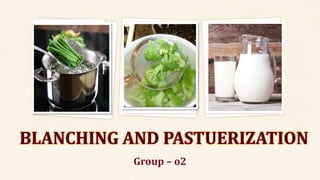
Group – o2
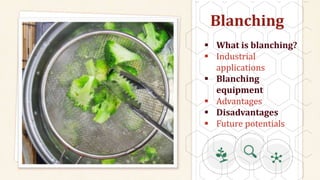
Blanching
 What is blanching?
 Industrial
applications
 Blanching
equipment
 Advantages
 Disadvantages
 Future potentials
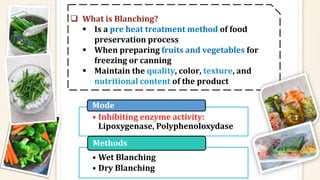
 What is Blanching?
 Is a pre heat treatment method of food
preservation process
 When preparing fruits and vegetables for
freezing or canning
 Maintain the quality, color, texture, and
nutritional content of the product
• Inhibiting enzyme activity:
Lipoxygenase, Polyphenoloxydase
Mode
• Wet Blanching
• Dry Blanching
Methods
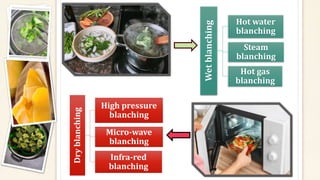
Wet
blanching
Hot water
blanching
Steam
blanching
Hot gas
blanching
Dry
blanching
High pressure
blanching
Micro-wave
blanching
Infra-red
blanching
Industrial Applications of Blanching
1. Frozen Food Industry: Blanched
broccoli, carrots, peas, and berries
2. Seafood Processing: Blanching
shrimp, crab, or lobster
3. Canned Food Production
4. Ready-to-Eat Meals: Stir-Fry Meals
5. Nut Processing: Almonds, peanuts, or
cashews
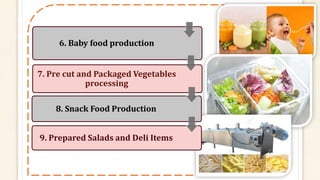
6. Baby food production
7. Pre cut and Packaged Vegetables
processing
8. Snack Food Production
9. Prepared Salads and Deli Items
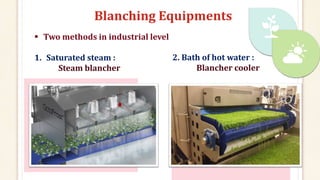
Blanching Equipments
 Two methods in industrial level
1. Saturated steam :
Steam blancher
2. Bath of hot water :
Blancher cooler
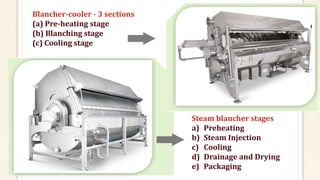
Blancher-cooler - 3 sections
(a) Pre-heating stage
(b) Blanching stage
(c) Cooling stage
Steam blancher stages
a) Preheating
b) Steam Injection
c) Cooling
d) Drainage and Drying
e) Packaging
1. Texture Preservation
2. Color Preservation and
easy peeling
3. Improved Nutrient
Retention
4. Microbial Load Reduction
5. Enzyme Control in
Fermentation
6. Reduction of non enzymatic
Oxidation
7. Extended shelf life
Advantages of Blanching
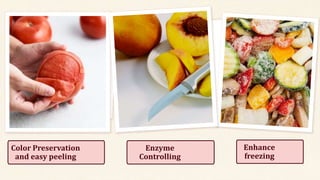
Color Preservation
and easy peeling
Enzyme
Controlling
Enhance
freezing
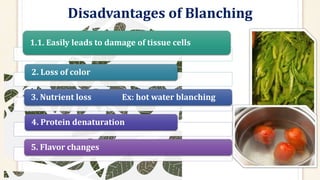
Disadvantages of Blanching
1.1. Easily leads to damage of tissue cells
2. Loss of color
3. Nutrient loss Ex: hot water blanching
4. Protein denaturation
5. Flavor changes
Modern Trends of Blanching
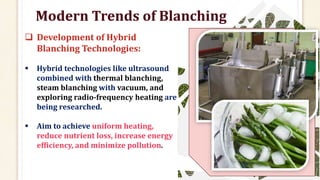
 Development of Hybrid
Blanching Technologies:
 Hybrid technologies like ultrasound
combined with thermal blanching,
steam blanching with vacuum, and
exploring radio-frequency heating are
being researched.
 Aim to achieve uniform heating,
reduce nutrient loss, increase energy
efficiency, and minimize pollution.
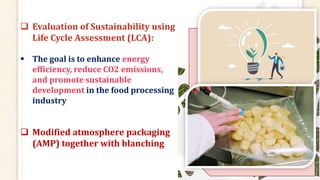
 Evaluation of Sustainability using
Life Cycle Assessment (LCA):
 The goal is to enhance energy
efficiency, reduce CO2 emissions,
and promote sustainable
development in the food processing
industry
 Modified atmosphere packaging
(AMP) together with blanching
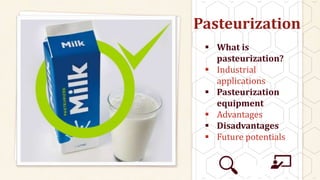
Pasteurization
 What is
pasteurization?
 Industrial
applications
 Pasteurization
equipment
 Advantages
 Disadvantages
 Future potentials
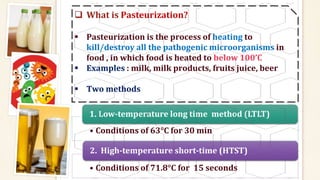
 What is Pasteurization?
 Pasteurization is the process of heating to
kill/destroy all the pathogenic microorganisms in
food , in which food is heated to below 100’C
 Examples : milk, milk products, fruits juice, beer
 Two methods
• Conditions of 63°C for 30 min
1. Low-temperature long time method (LTLT)
• Conditions of 71.8°C for 15 seconds
2. High-temperature short-time (HTST)
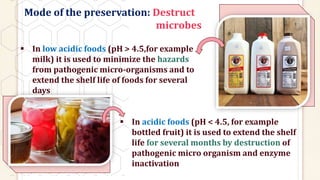
Mode of the preservation: Destruct
microbes
 In low acidic foods (pH > 4.5,for example
milk) it is used to minimize the hazards
from pathogenic micro-organisms and to
extend the shelf life of foods for several
days
 In acidic foods (pH < 4.5, for example
bottled fruit) it is used to extend the shelf
life for several months by destruction of
pathogenic micro organism and enzyme
inactivation
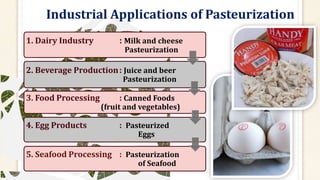
Industrial Applications of Pasteurization
1. Dairy Industry : Milk and cheese
Pasteurization
2. Beverage Production: Juice and beer
Pasteurization
3. Food Processing : Canned Foods
(fruit and vegetables)
4. Egg Products : Pasteurized
Eggs
5. Seafood Processing : Pasteurization
of Seafood
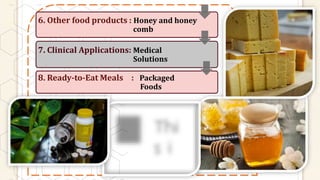
6. Other food products : Honey and honey
comb
7. Clinical Applications: Medical
Solutions
8. Ready-to-Eat Meals : Packaged
Foods
Pasteurization Equipments
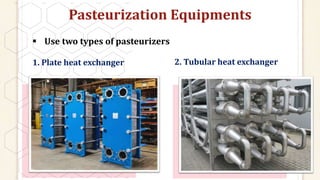
 Use two types of pasteurizers
1. Plate heat exchanger 2. Tubular heat exchanger
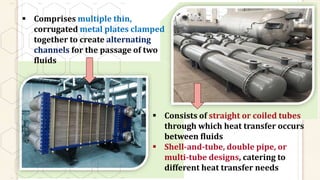
 Comprises multiple thin,
corrugated metal plates clamped
together to create alternating
channels for the passage of two
fluids
 Consists of straight or coiled tubes
through which heat transfer occurs
between fluids
 Shell-and-tube, double pipe, or
multi-tube designs, catering to
different heat transfer needs
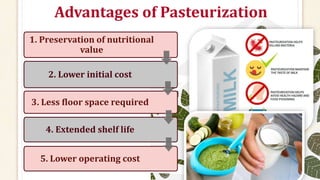
Advantages of Pasteurization
1. Preservation of nutritional
value
2. Lower initial cost
3. Less floor space required
4. Extended shelf life
5. Lower operating cost
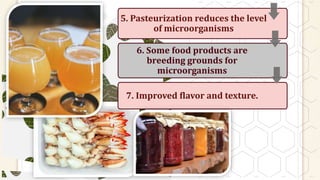
5. Pasteurization reduces the level
of microorganisms
6. Some food products are
breeding grounds for
microorganisms
7. Improved flavor and texture.
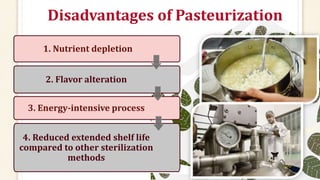
Disadvantages of Pasteurization
1. Nutrient depletion
2. Flavor alteration
3. Energy-intensive process
4. Reduced extended shelf life
compared to other sterilization
methods
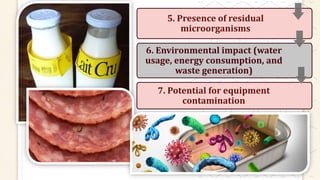
5. Presence of residual
microorganisms
6. Environmental impact (water
usage, energy consumption, and
waste generation)
7. Potential for equipment
contamination
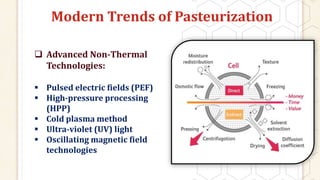
Modern Trends of Pasteurization
 Advanced Non-Thermal
Technologies:
 Pulsed electric fields (PEF)
 High-pressure processing
(HPP)
 Cold plasma method
 Ultra-violet (UV) light
 Oscillating magnetic field
technologies
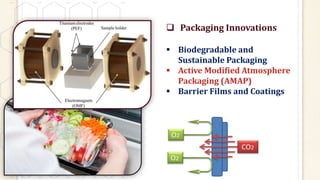
 Packaging Innovations
 Biodegradable and
Sustainable Packaging
 Active Modified Atmosphere
Packaging (AMAP)
 Barrier Films and Coatings
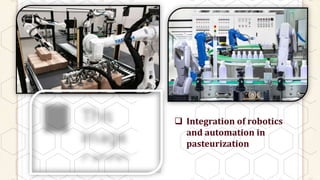
 Integration of robotics
and automation in
pasteurization
BLANCHING AND PASTUERIZATION  introduction

BLANCHING AND PASTUERIZATION introduction

  • 1.
  • 2.
    Blanching  What isblanching?  Industrial applications  Blanching equipment  Advantages  Disadvantages  Future potentials
  • 3.
     What isBlanching?  Is a pre heat treatment method of food preservation process  When preparing fruits and vegetables for freezing or canning  Maintain the quality, color, texture, and nutritional content of the product • Inhibiting enzyme activity: Lipoxygenase, Polyphenoloxydase Mode • Wet Blanching • Dry Blanching Methods
  • 4.
    Wet blanching Hot water blanching Steam blanching Hot gas blanching Dry blanching Highpressure blanching Micro-wave blanching Infra-red blanching
  • 5.
    Industrial Applications ofBlanching 1. Frozen Food Industry: Blanched broccoli, carrots, peas, and berries 2. Seafood Processing: Blanching shrimp, crab, or lobster 3. Canned Food Production 4. Ready-to-Eat Meals: Stir-Fry Meals 5. Nut Processing: Almonds, peanuts, or cashews
  • 6.
    6. Baby foodproduction 7. Pre cut and Packaged Vegetables processing 8. Snack Food Production 9. Prepared Salads and Deli Items
  • 7.
    Blanching Equipments  Twomethods in industrial level 1. Saturated steam : Steam blancher 2. Bath of hot water : Blancher cooler
  • 8.
    Blancher-cooler - 3sections (a) Pre-heating stage (b) Blanching stage (c) Cooling stage Steam blancher stages a) Preheating b) Steam Injection c) Cooling d) Drainage and Drying e) Packaging
  • 9.
    1. Texture Preservation 2.Color Preservation and easy peeling 3. Improved Nutrient Retention 4. Microbial Load Reduction 5. Enzyme Control in Fermentation 6. Reduction of non enzymatic Oxidation 7. Extended shelf life Advantages of Blanching
  • 10.
    Color Preservation and easypeeling Enzyme Controlling Enhance freezing
  • 11.
    Disadvantages of Blanching 1.1.Easily leads to damage of tissue cells 2. Loss of color 3. Nutrient loss Ex: hot water blanching 4. Protein denaturation 5. Flavor changes
  • 12.
    Modern Trends ofBlanching  Development of Hybrid Blanching Technologies:  Hybrid technologies like ultrasound combined with thermal blanching, steam blanching with vacuum, and exploring radio-frequency heating are being researched.  Aim to achieve uniform heating, reduce nutrient loss, increase energy efficiency, and minimize pollution.
  • 13.
     Evaluation ofSustainability using Life Cycle Assessment (LCA):  The goal is to enhance energy efficiency, reduce CO2 emissions, and promote sustainable development in the food processing industry  Modified atmosphere packaging (AMP) together with blanching
  • 14.
    Pasteurization  What is pasteurization? Industrial applications  Pasteurization equipment  Advantages  Disadvantages  Future potentials
  • 15.
     What isPasteurization?  Pasteurization is the process of heating to kill/destroy all the pathogenic microorganisms in food , in which food is heated to below 100’C  Examples : milk, milk products, fruits juice, beer  Two methods • Conditions of 63°C for 30 min 1. Low-temperature long time method (LTLT) • Conditions of 71.8°C for 15 seconds 2. High-temperature short-time (HTST)
  • 16.
    Mode of thepreservation: Destruct microbes  In low acidic foods (pH > 4.5,for example milk) it is used to minimize the hazards from pathogenic micro-organisms and to extend the shelf life of foods for several days  In acidic foods (pH < 4.5, for example bottled fruit) it is used to extend the shelf life for several months by destruction of pathogenic micro organism and enzyme inactivation
  • 17.
    Industrial Applications ofPasteurization 1. Dairy Industry : Milk and cheese Pasteurization 2. Beverage Production: Juice and beer Pasteurization 3. Food Processing : Canned Foods (fruit and vegetables) 4. Egg Products : Pasteurized Eggs 5. Seafood Processing : Pasteurization of Seafood
  • 18.
    6. Other foodproducts : Honey and honey comb 7. Clinical Applications: Medical Solutions 8. Ready-to-Eat Meals : Packaged Foods
  • 19.
    Pasteurization Equipments  Usetwo types of pasteurizers 1. Plate heat exchanger 2. Tubular heat exchanger
  • 20.
     Comprises multiplethin, corrugated metal plates clamped together to create alternating channels for the passage of two fluids  Consists of straight or coiled tubes through which heat transfer occurs between fluids  Shell-and-tube, double pipe, or multi-tube designs, catering to different heat transfer needs
  • 21.
    Advantages of Pasteurization 1.Preservation of nutritional value 2. Lower initial cost 3. Less floor space required 4. Extended shelf life 5. Lower operating cost
  • 22.
    5. Pasteurization reducesthe level of microorganisms 6. Some food products are breeding grounds for microorganisms 7. Improved flavor and texture.
  • 23.
    Disadvantages of Pasteurization 1.Nutrient depletion 2. Flavor alteration 3. Energy-intensive process 4. Reduced extended shelf life compared to other sterilization methods
  • 24.
    5. Presence ofresidual microorganisms 6. Environmental impact (water usage, energy consumption, and waste generation) 7. Potential for equipment contamination
  • 25.
    Modern Trends ofPasteurization  Advanced Non-Thermal Technologies:  Pulsed electric fields (PEF)  High-pressure processing (HPP)  Cold plasma method  Ultra-violet (UV) light  Oscillating magnetic field technologies
  • 26.
     Packaging Innovations Biodegradable and Sustainable Packaging  Active Modified Atmosphere Packaging (AMAP)  Barrier Films and Coatings
  • 27.
     Integration ofrobotics and automation in pasteurization

Editor's Notes

  • #2 CATATAN: Untuk mengganti gambar, cukup pilih dan hapus. Lalu gunakan ikon Sisipkan Gambar untuk menggantinya dengan gambar milik Anda!
  • #11 CATATAN: Untuk mengganti gambar, cukup pilih dan hapus. Lalu gunakan ikon Sisipkan Gambar untuk menggantinya dengan gambar milik Anda!