TOPIC:
FOOD QUALITY PARAMETERS

By:
Maryum Atique
M. Phill chemistry
University of Agriculture
FSD.
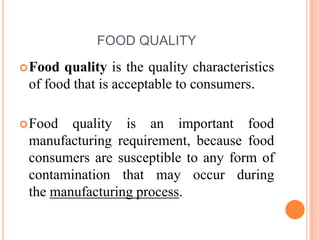
FOOD QUALITY
 Food

quality is the quality characteristics
of food that is acceptable to consumers.

 Food

quality is an important food
manufacturing requirement, because food
consumers are susceptible to any form of
contamination that may occur during
the manufacturing process.
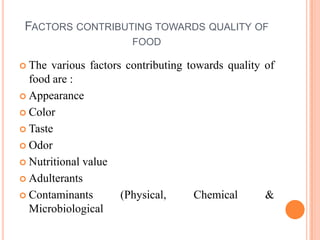
FACTORS CONTRIBUTING TOWARDS QUALITY OF
FOOD
 The

various factors contributing towards quality of
food are :
 Appearance
 Color
 Taste
 Odor
 Nutritional value
 Adulterants
 Contaminants
(Physical,
Chemical
&
Microbiological
WHY IS IT NECESSARY TO ANALYZE
FOOD PRODUCTS BEFORE OR AFTER
PROCESSING?
 To

know the quality of raw materials and final
products.
 To
understand
occurrence
of
any
physicochemical changes during processing or
storage.
 To ensure purity, freshness and safety of the food
products at the time of consumption.
VARIOUS PARAMETERS EVALUATED FOR
CERTIFYING QUALITY OF FOOD
 In

order to ensure the right quality of various
food products, several parameters are
evaluated as by different methods:
 Physical
 Chemical
 Packaging materials
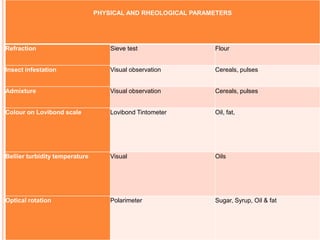
PHYSICAL AND RHEOLOGICAL PARAMETERS

Refraction

Sieve test

Flour

Insect infestation

Visual observation

Cereals, pulses

Admixture

Visual observation

Cereals, pulses

Colour on Lovibond scale

Lovibond Tintometer

Oil, fat,

Bellier turbidity temperature

Visual

Oils

Optical rotation

Polarimeter

Sugar, Syrup, Oil & fat
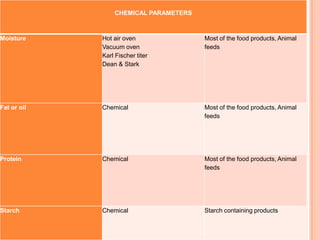
CHEMICAL PARAMETERS

Moisture

Hot air oven
Vacuum oven
Karl Fischer titer
Dean & Stark

Most of the food products, Animal
feeds

Fat or oil

Chemical

Most of the food products, Animal
feeds

Protein

Chemical

Most of the food products, Animal
feeds

Starch

Chemical

Starch containing products
PACKAGING MATERIALS

Tin, Chromium

AAS

Tin plate

Sulphide stain

Chemical

Food cans

Laquer

Physical Chemical

Tin cans

Migration tests

Chemical

Food grade plastics

Heavy metals like Pb, As, Cd, Se, AAS
Ba,

Coloured plastics

Water vapour permeability

Plastics

Humidity chamber
BENEFITS OF FOOD QUALITY PARAMETERS
 Benefits

of food processing include toxin
removal, preservation, easing marketing
and distribution tasks, and increasing food
consistency.
 To increases yearly availability of many
foods, enables transportation of foods
across long distances and makes many
kinds of foods safe to spoilage and microorganisms.
 To reduce the incidence of food borne
disease.
CONTINUE;
 To

improve the quality of life for people with
allergies, diabetics, and other people who cannot
consume some common food elements.
 To add extra nutrients such as vitamins.
 To offer products that fulfill many different needs:
for example fully prepared ready meals that can be
heated up in the microwave oven within a few
minutes.
INSTRUMENTAL TECHNIQUES USED FOR
ASSESSMENT OF FOOD QUALITY
Classical approach in evaluation of organoleptic quality
of food products is the only method used on this purpose.
 Classical methods are mainly based on the sensory
analysis. This analysis is a perfect tool in carrying out
marketing tests of consumers but the limitation is a good
complement in the evaluation of organoleptic food
properties in instrumental analysis.
 The use of appropriate instrumental methods allow for
identification of the volatile compounds which influence
on the flavor composition of food products.

GAS CHROMATOGRAPHY-OLFACTOMETRY (GCO)


GC-O is a technique based on sensory evaluation of the
eluate from the chromatographic column by trained
assessor or group of assessors.



Identification of aroma active compounds is possible on
the basis of simultaneous use of second detector.
Mostly, second detector function performs mass
spectrometer (MS) or flame-ionization detector (FID).
SCHEMATIC DIAGRAM OF GC-O



Fig. 1. Scheme of gas chromatograph coupled with
olfactometric detector
METHODS OF GC-O
ELECTRONIC NOSE


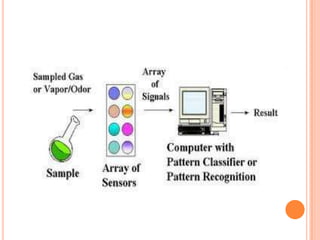
Electronic nose is a device consisting of a set (matrix) of
electrochemical sensors, selective for certain volatile
compounds.



The instrument is equipped with appropriate system of
pattern recognition capable of identification of simple
and complex odors.
SCHEMATIC DIAGRAM
ELECTRONIC NOSE


For the odor of a tested product responsible are not only
single aromatic compounds but also their complex mixtures.
They give a resultant aromatic effect which is present in
perfumes.

It has a number of gas sensors that form matrix . These
sensors act as sensory neurons and Artificial Neural
Networks (ANN) constitute its main part . Microprocessor or
computer play a role of a brain.
 There is a resultant signal from all the sensors collected in
the computer and an electronic pattern of the odor is
created.




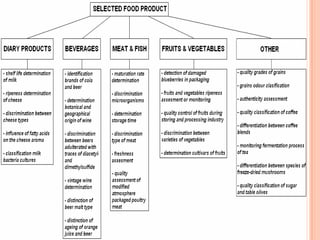
Practical applications of electronic nose in food industry
FEATURES AND DISADVANTAGES OF THESE
TECHNIQUES









Both presented techniques are better than classically
applied in the industry. However, more promising seems
to be e-nose. It is due to the following features:
Short time of analysis, high sensitivity and
reproducibility, objective, identification of odors, possible
in situ analysis (portable devise).
E-nose system has also a few disadvantages,
Ageing material of sensors, possibility of sensors
poisoning, in some cases humidity influence to sensor
responses.
The use of these methods also allow for discrimination
raw material used in the production.
DRAWBACKS

Food quality parameters includes the following
drawbacks,
 To
affect its nutritional density, the amount of
nutrients lost depending on the food and method of
processing.
 Vitamin C, is destroyed by heat and therefore canned
fruits have a lower content of vitamin C than fresh
ones.
 Large mixing, grinding, chopping and emulsifying
equipment, inherently introduce a number of
contamination risks.
 Large food processors will utilize many metal within
the processing stream, metals may be dangerous for
our health.

Food quality parameters

Food quality parameters

  • 1.
    TOPIC: FOOD QUALITY PARAMETERS By: MaryumAtique M. Phill chemistry University of Agriculture FSD.
  • 2.
    FOOD QUALITY  Food qualityis the quality characteristics of food that is acceptable to consumers.  Food quality is an important food manufacturing requirement, because food consumers are susceptible to any form of contamination that may occur during the manufacturing process.
  • 3.
    FACTORS CONTRIBUTING TOWARDSQUALITY OF FOOD  The various factors contributing towards quality of food are :  Appearance  Color  Taste  Odor  Nutritional value  Adulterants  Contaminants (Physical, Chemical & Microbiological
  • 4.
    WHY IS ITNECESSARY TO ANALYZE FOOD PRODUCTS BEFORE OR AFTER PROCESSING?  To know the quality of raw materials and final products.  To understand occurrence of any physicochemical changes during processing or storage.  To ensure purity, freshness and safety of the food products at the time of consumption.
  • 5.
    VARIOUS PARAMETERS EVALUATEDFOR CERTIFYING QUALITY OF FOOD  In order to ensure the right quality of various food products, several parameters are evaluated as by different methods:  Physical  Chemical  Packaging materials
  • 6.
    PHYSICAL AND RHEOLOGICALPARAMETERS Refraction Sieve test Flour Insect infestation Visual observation Cereals, pulses Admixture Visual observation Cereals, pulses Colour on Lovibond scale Lovibond Tintometer Oil, fat, Bellier turbidity temperature Visual Oils Optical rotation Polarimeter Sugar, Syrup, Oil & fat
  • 7.
    CHEMICAL PARAMETERS Moisture Hot airoven Vacuum oven Karl Fischer titer Dean & Stark Most of the food products, Animal feeds Fat or oil Chemical Most of the food products, Animal feeds Protein Chemical Most of the food products, Animal feeds Starch Chemical Starch containing products
  • 8.
    PACKAGING MATERIALS Tin, Chromium AAS Tinplate Sulphide stain Chemical Food cans Laquer Physical Chemical Tin cans Migration tests Chemical Food grade plastics Heavy metals like Pb, As, Cd, Se, AAS Ba, Coloured plastics Water vapour permeability Plastics Humidity chamber
  • 9.
    BENEFITS OF FOODQUALITY PARAMETERS  Benefits of food processing include toxin removal, preservation, easing marketing and distribution tasks, and increasing food consistency.  To increases yearly availability of many foods, enables transportation of foods across long distances and makes many kinds of foods safe to spoilage and microorganisms.  To reduce the incidence of food borne disease.
  • 10.
    CONTINUE;  To improve thequality of life for people with allergies, diabetics, and other people who cannot consume some common food elements.  To add extra nutrients such as vitamins.  To offer products that fulfill many different needs: for example fully prepared ready meals that can be heated up in the microwave oven within a few minutes.
  • 11.
    INSTRUMENTAL TECHNIQUES USEDFOR ASSESSMENT OF FOOD QUALITY Classical approach in evaluation of organoleptic quality of food products is the only method used on this purpose.  Classical methods are mainly based on the sensory analysis. This analysis is a perfect tool in carrying out marketing tests of consumers but the limitation is a good complement in the evaluation of organoleptic food properties in instrumental analysis.  The use of appropriate instrumental methods allow for identification of the volatile compounds which influence on the flavor composition of food products. 
  • 12.
    GAS CHROMATOGRAPHY-OLFACTOMETRY (GCO)  GC-Ois a technique based on sensory evaluation of the eluate from the chromatographic column by trained assessor or group of assessors.  Identification of aroma active compounds is possible on the basis of simultaneous use of second detector. Mostly, second detector function performs mass spectrometer (MS) or flame-ionization detector (FID).
  • 13.
    SCHEMATIC DIAGRAM OFGC-O  Fig. 1. Scheme of gas chromatograph coupled with olfactometric detector
  • 14.
  • 15.
    ELECTRONIC NOSE  Electronic noseis a device consisting of a set (matrix) of electrochemical sensors, selective for certain volatile compounds.  The instrument is equipped with appropriate system of pattern recognition capable of identification of simple and complex odors.
  • 16.
  • 18.
     For the odorof a tested product responsible are not only single aromatic compounds but also their complex mixtures. They give a resultant aromatic effect which is present in perfumes. It has a number of gas sensors that form matrix . These sensors act as sensory neurons and Artificial Neural Networks (ANN) constitute its main part . Microprocessor or computer play a role of a brain.  There is a resultant signal from all the sensors collected in the computer and an electronic pattern of the odor is created.   Practical applications of electronic nose in food industry
  • 20.
    FEATURES AND DISADVANTAGESOF THESE TECHNIQUES      Both presented techniques are better than classically applied in the industry. However, more promising seems to be e-nose. It is due to the following features: Short time of analysis, high sensitivity and reproducibility, objective, identification of odors, possible in situ analysis (portable devise). E-nose system has also a few disadvantages, Ageing material of sensors, possibility of sensors poisoning, in some cases humidity influence to sensor responses. The use of these methods also allow for discrimination raw material used in the production.
  • 21.
    DRAWBACKS Food quality parametersincludes the following drawbacks,  To affect its nutritional density, the amount of nutrients lost depending on the food and method of processing.  Vitamin C, is destroyed by heat and therefore canned fruits have a lower content of vitamin C than fresh ones.  Large mixing, grinding, chopping and emulsifying equipment, inherently introduce a number of contamination risks.  Large food processors will utilize many metal within the processing stream, metals may be dangerous for our health. 