EMERGING TECHNOLOGIES IN FOOD
PROCESSING
Presented by:
Sheshrao Kautkar
Dept. of Post Harvest Process & Food Engg.
G. B. Pant University of Agril. & Tech., Pantnagar (U. K.)
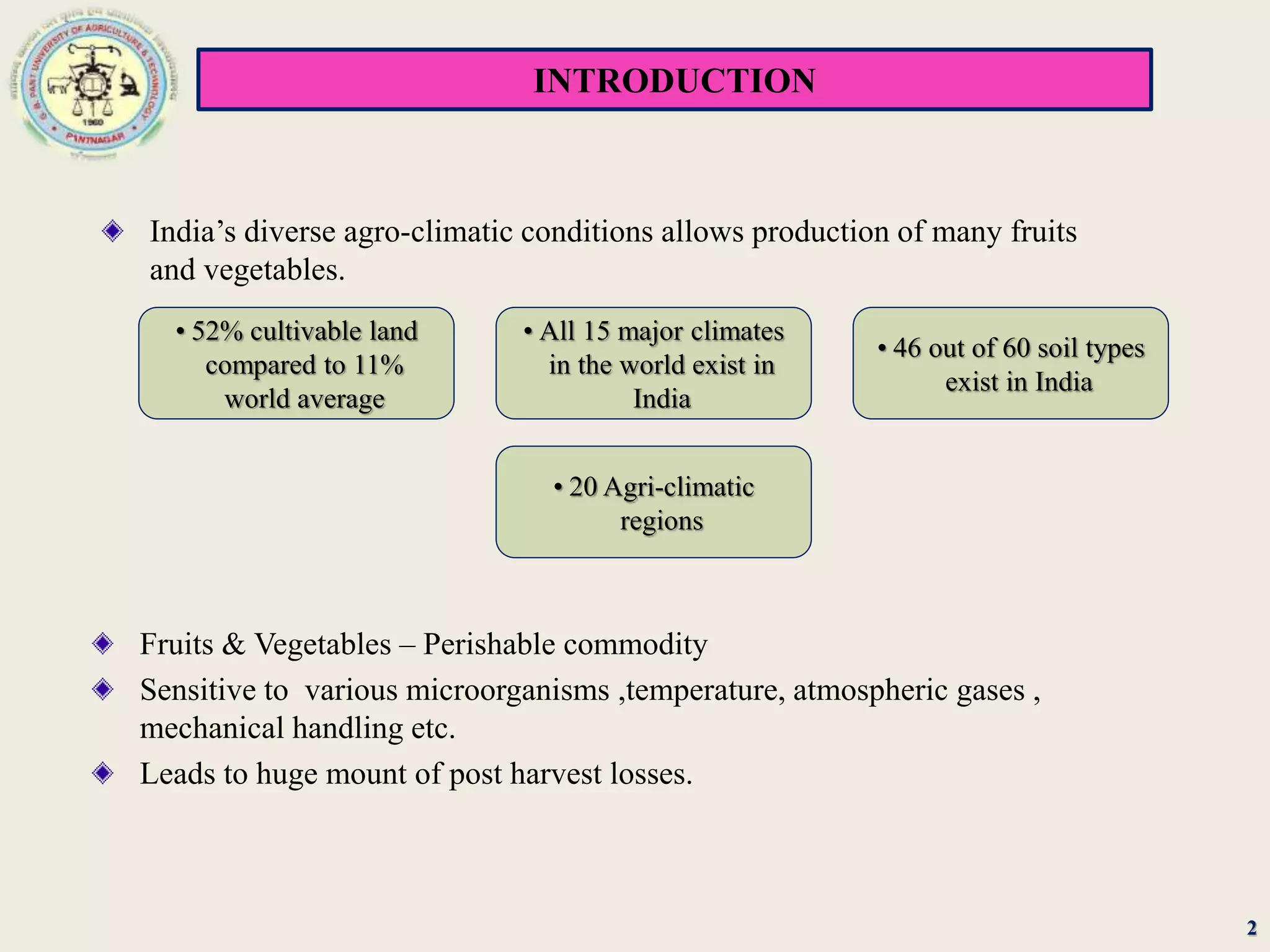
INTRODUCTION
2
Fruits & Vegetables – Perishable commodity
Sensitive to various microorganisms ,temperature, atmospheric gases ,
mechanical handling etc.
Leads to huge mount of post harvest losses.
• 52% cultivable land
compared to 11%
world average
• All 15 major climates
in the world exist in
India
• 46 out of 60 soil types
exist in India
• 20 Agri-climatic
regions
India’s diverse agro-climatic conditions allows production of many fruits
and vegetables.
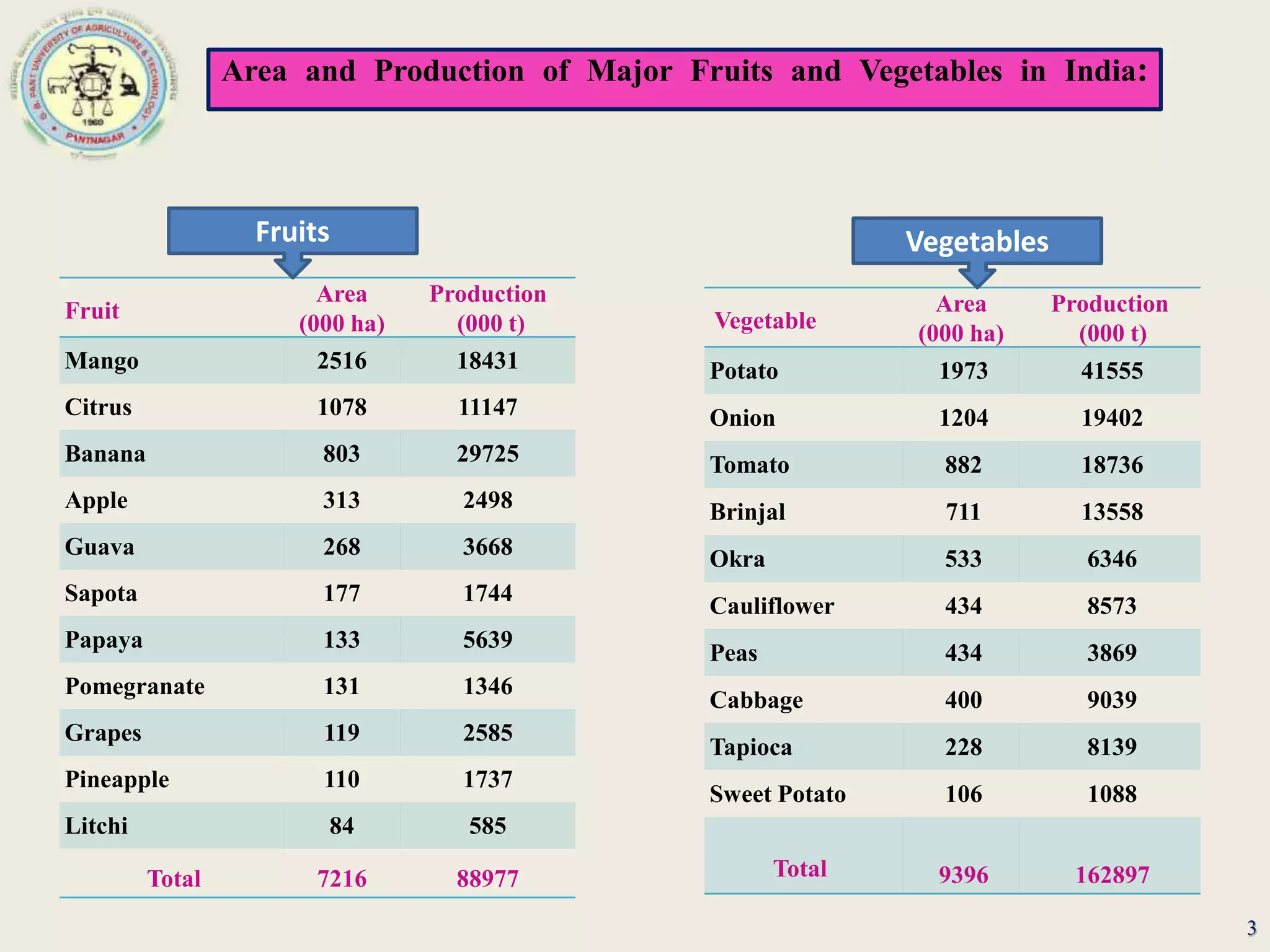
Area and Production of Major Fruits and Vegetables in India:
3
Fruit
Area
(000 ha)
Production
(000 t)
Mango 2516 18431
Citrus 1078 11147
Banana 803 29725
Apple 313 2498
Guava 268 3668
Sapota 177 1744
Papaya 133 5639
Pomegranate 131 1346
Grapes 119 2585
Pineapple 110 1737
Litchi 84 585
Total 7216 88977
Vegetable
Area
(000 ha)
Production
(000 t)
Potato 1973 41555
Onion 1204 19402
Tomato 882 18736
Brinjal 711 13558
Okra 533 6346
Cauliflower 434 8573
Peas 434 3869
Cabbage 400 9039
Tapioca 228 8139
Sweet Potato 106 1088
Total 9396 162897
Fruits Vegetables
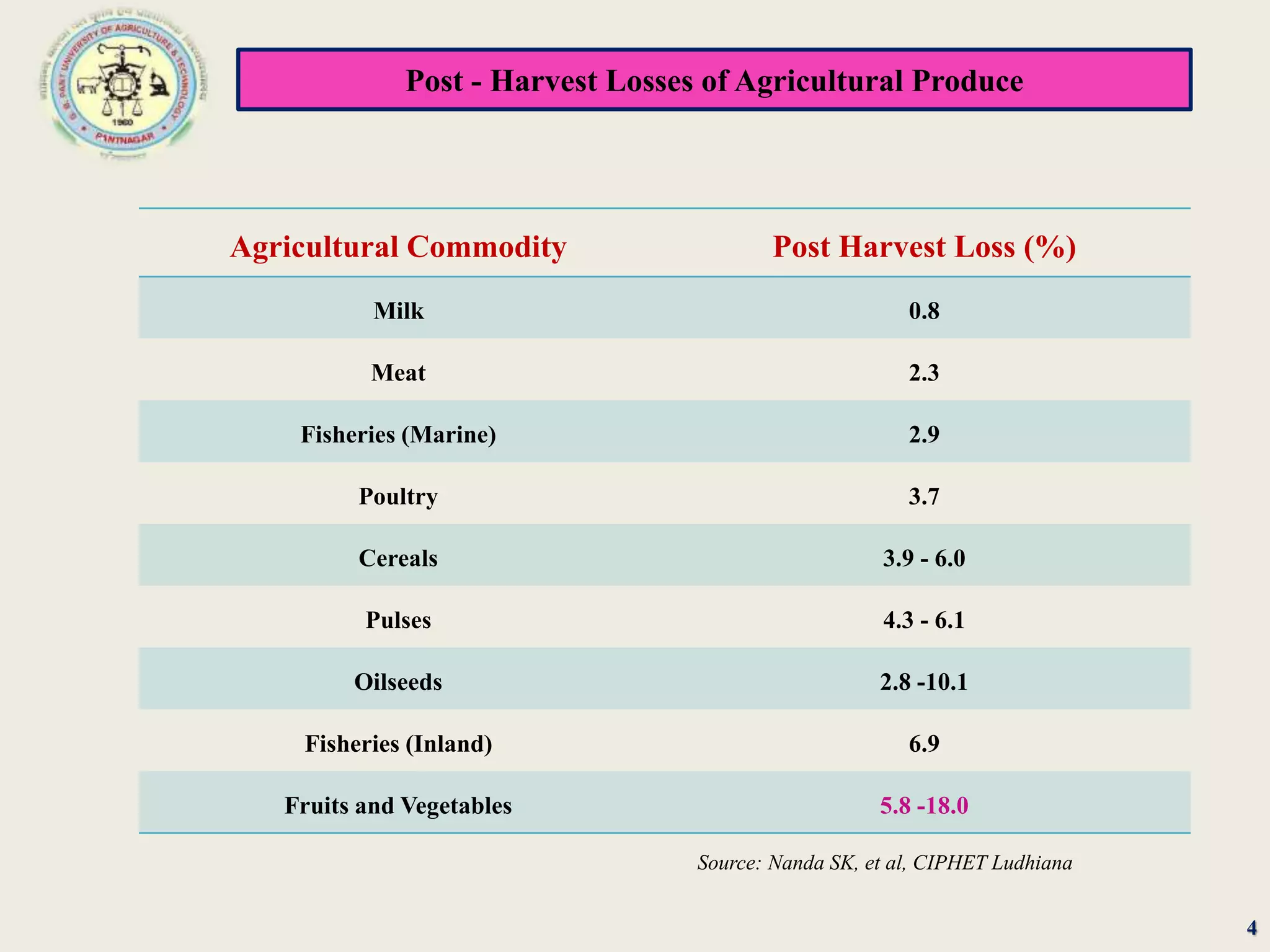
Post - Harvest Losses of Agricultural Produce
4
Agricultural Commodity Post Harvest Loss (%)
Milk 0.8
Meat 2.3
Fisheries (Marine) 2.9
Poultry 3.7
Cereals 3.9 - 6.0
Pulses 4.3 - 6.1
Oilseeds 2.8 -10.1
Fisheries (Inland) 6.9
Fruits and Vegetables 5.8 -18.0
Source: Nanda SK, et al, CIPHET Ludhiana
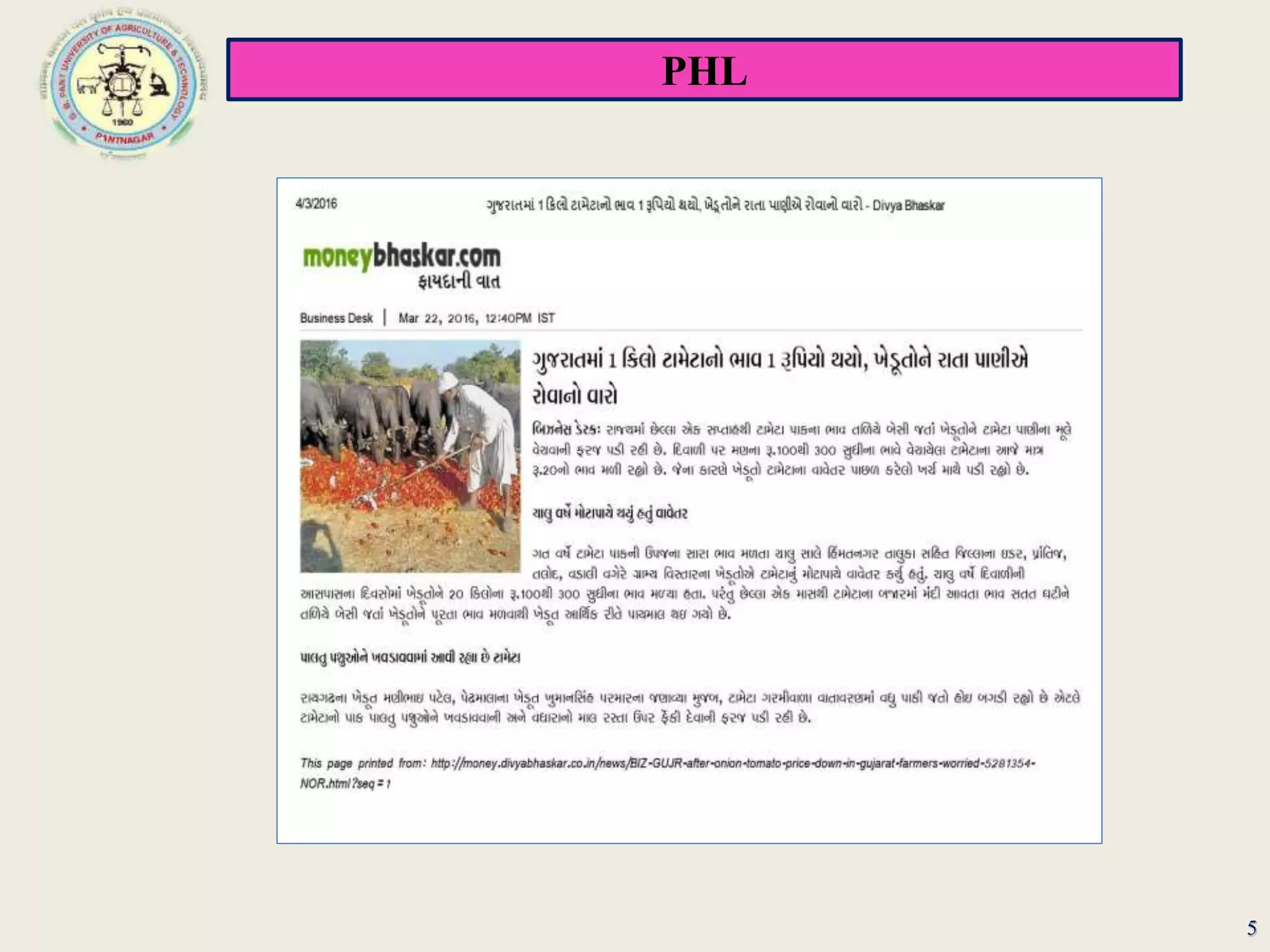
PHL
5
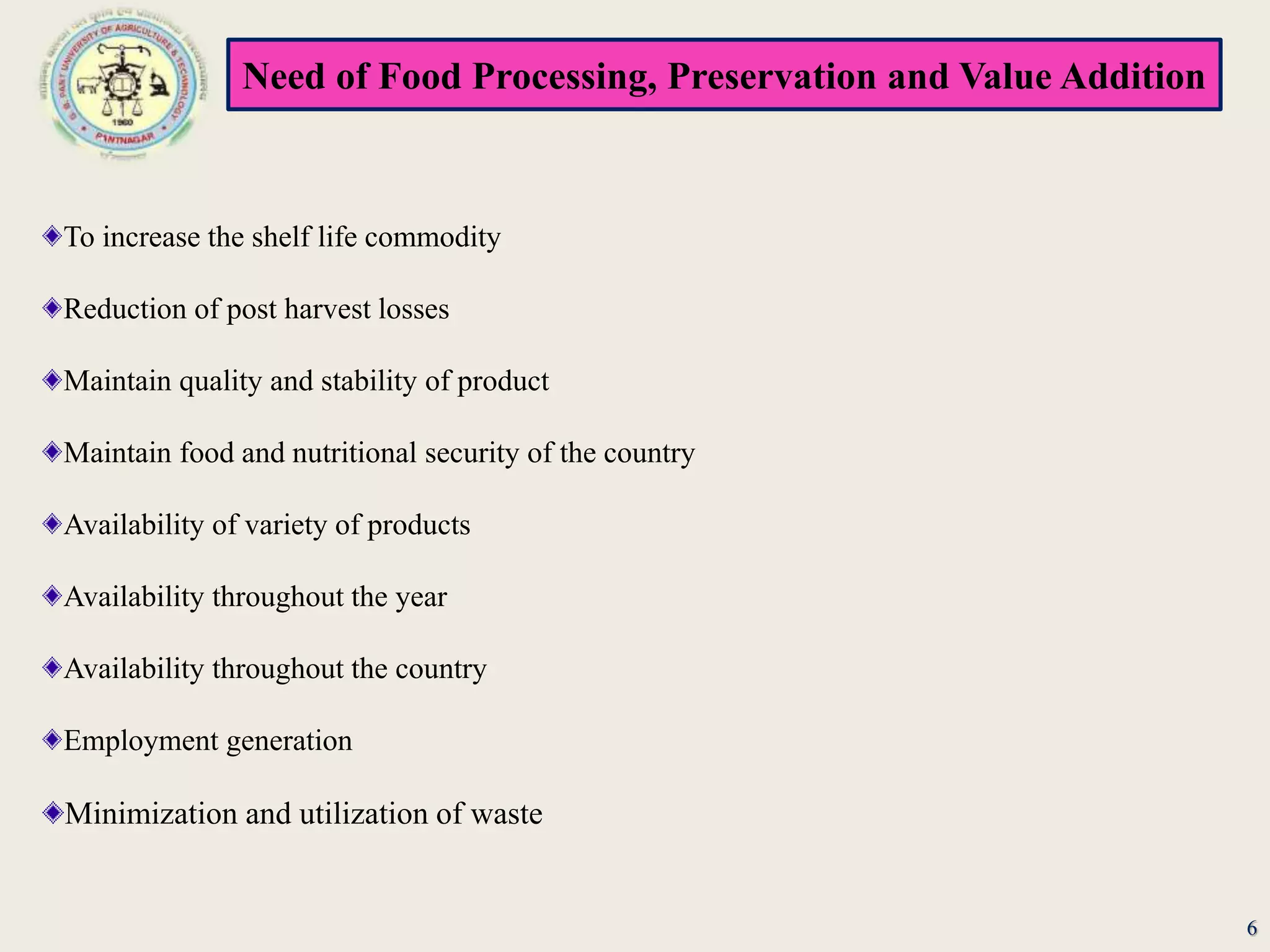
Need of Food Processing, Preservation and Value Addition
To increase the shelf life commodity
Reduction of post harvest losses
Maintain quality and stability of product
Maintain food and nutritional security of the country
Availability of variety of products
Availability throughout the year
Availability throughout the country
Employment generation
Minimization and utilization of waste
6
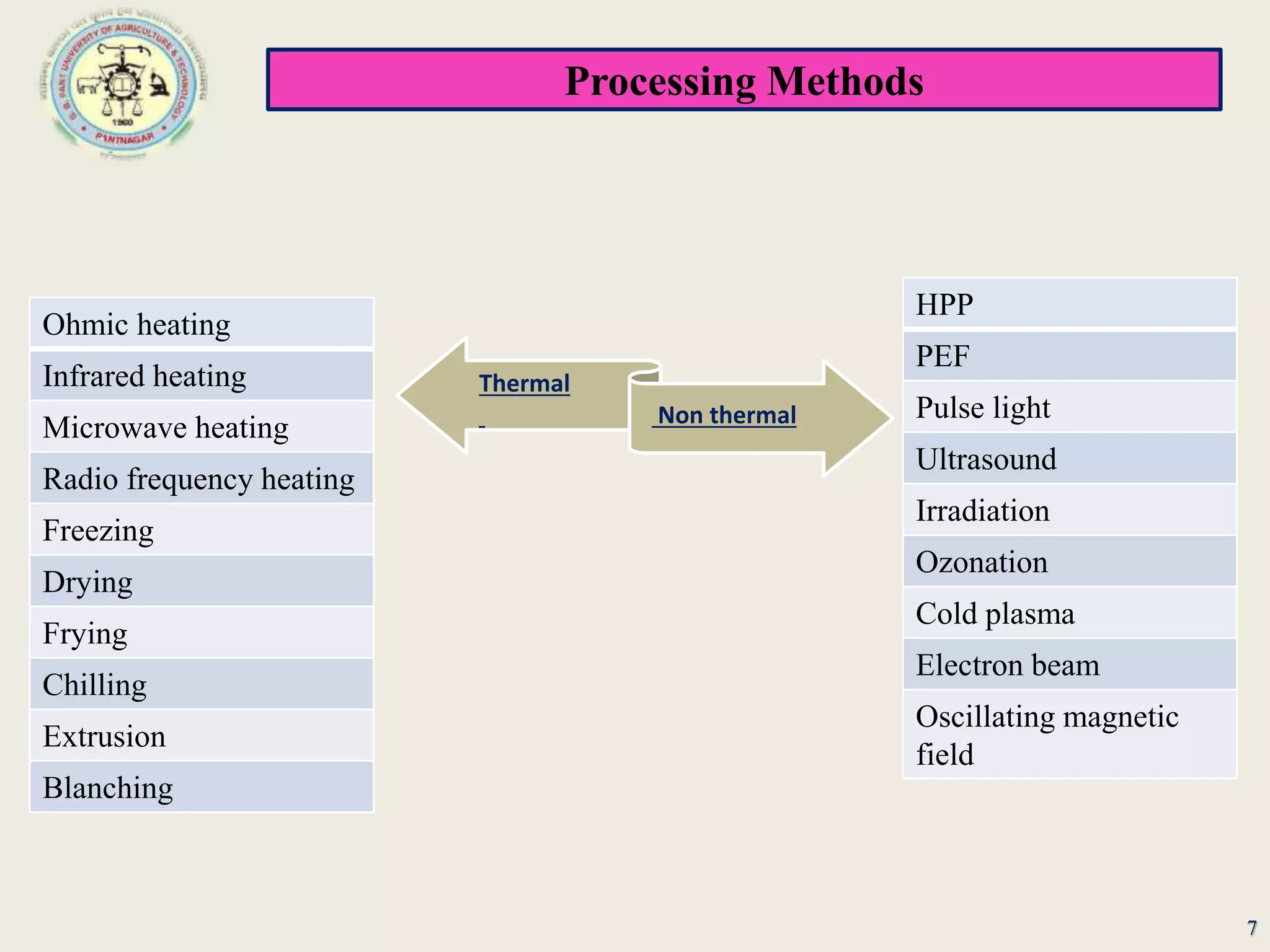
Processing Methods
7
Ohmic heating
Infrared heating
Microwave heating
Radio frequency heating
Freezing
Drying
Frying
Chilling
Extrusion
Blanching
HPP
PEF
Pulse light
Ultrasound
Irradiation
Ozonation
Cold plasma
Electron beam
Oscillating magnetic
field
Thermal
Non thermal
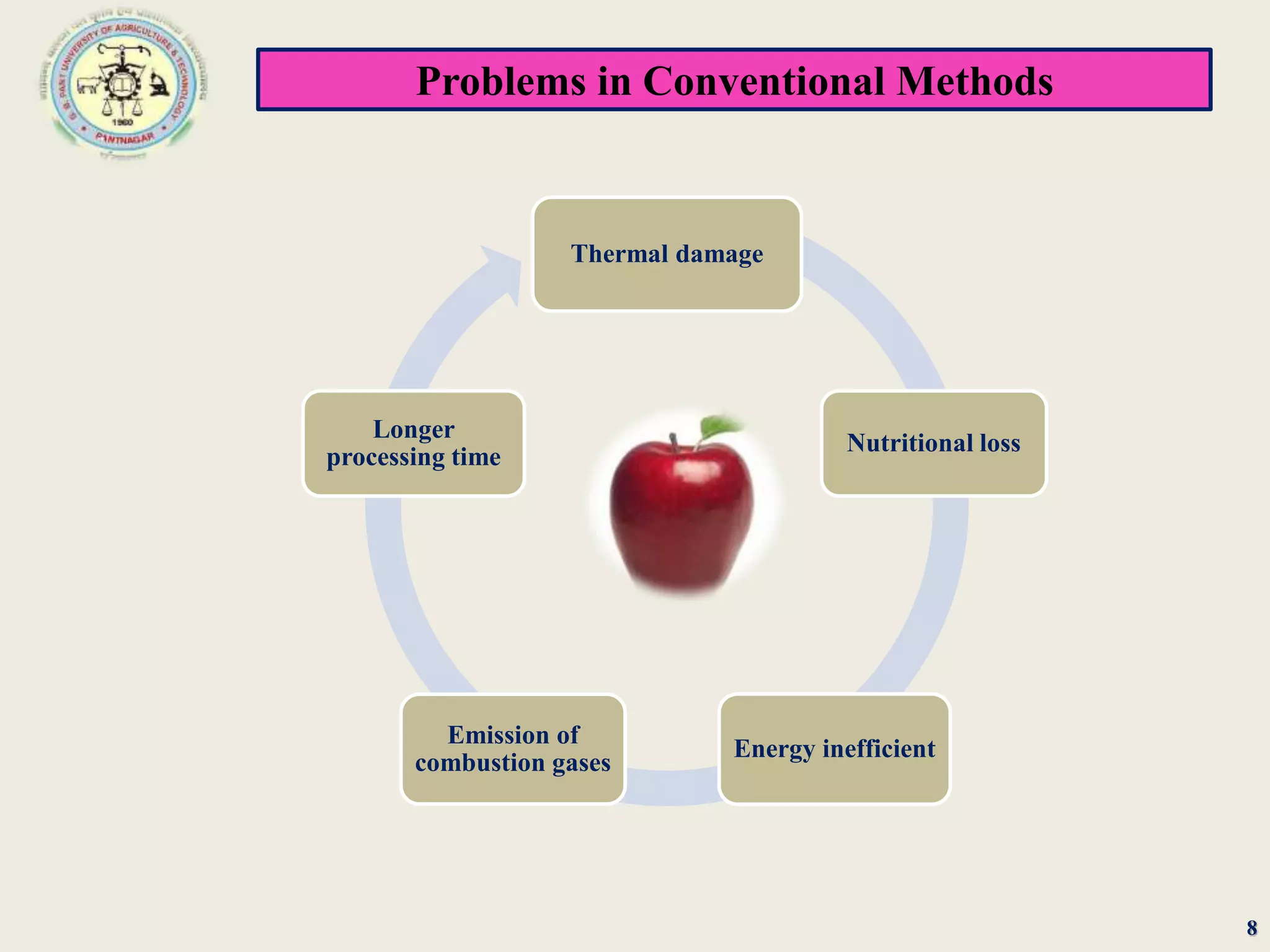
Problems in Conventional Methods
8
Thermal damage
Nutritional loss
Energy inefficient
Emission of
combustion gases
Longer
processing time
Emerging Food Processing Technologies
9
 Ohmic Heating, Microwave Heating, Pulsed Electric Field, Pulsed Light
Technology, High Pressure Processing, Ultrasound.
 Maintains nutritional quality of the produce by processing at mild
temperatures
 Energy efficient processes
 Do not emits combustion gases in the atmosphere
 Shorter processing time
 Automatic control
 Higher heat transfer efficiency
 Uniform heating
Ohmic Heating
10
Advanced thermal processing method
Developed by United Kingdom Electricity Research and Development Center
Licensed to APV Baker Ltd for commercial exploitation
Also called electrical resistance heating, Joule heating, or electro-heating
Green technology.
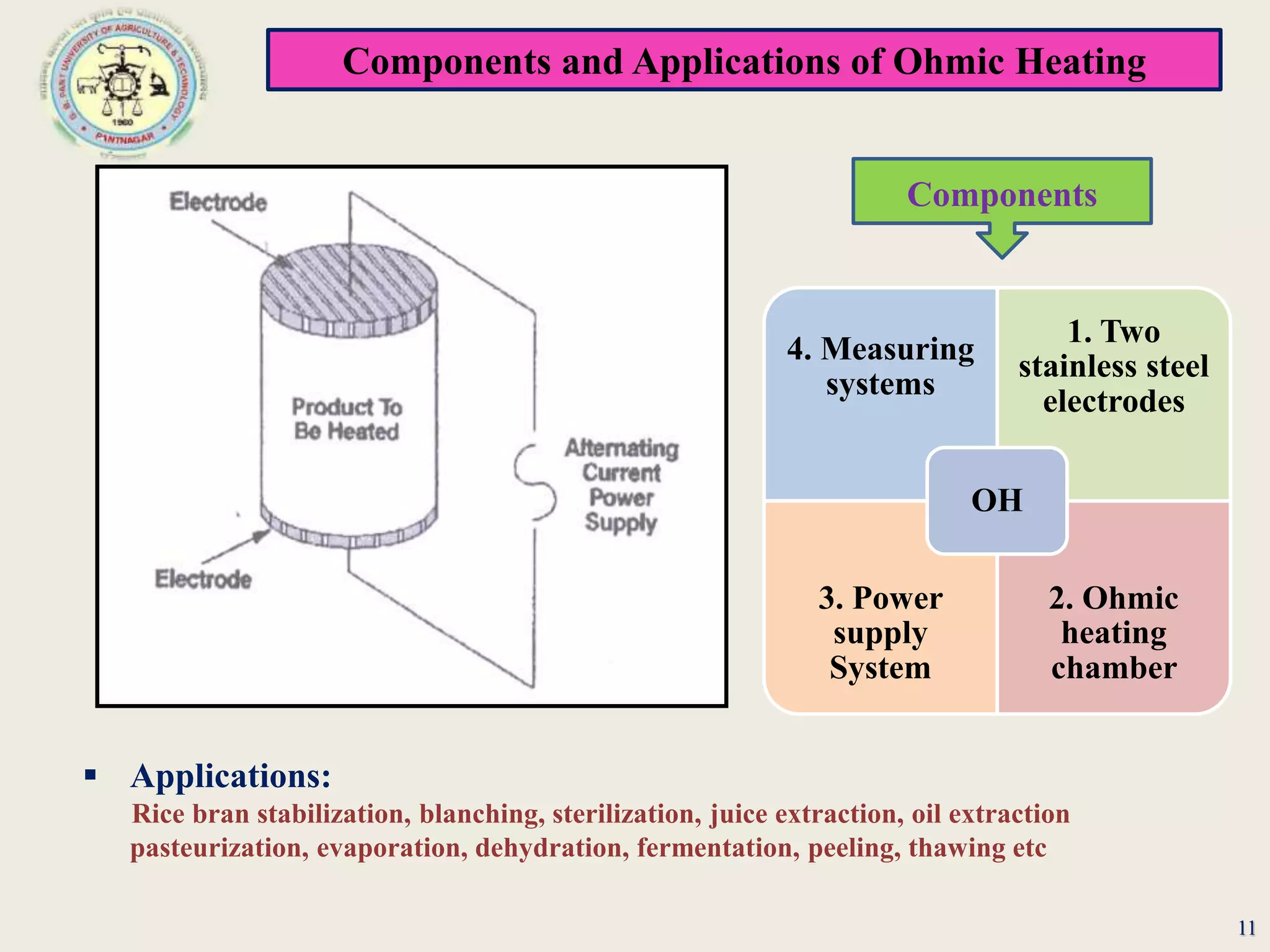
Food material is heated by passing electric current through it
Electrical resistance of the food causes the power to be translated directly into heat
Electrical energy is dissipated into heat, which results in rapid and uniform heating
Components and Applications of Ohmic Heating
11
4. Measuring
systems
1. Two
stainless steel
electrodes
3. Power
supply
System
2. Ohmic
heating
chamber
OH
Components
 Applications:
Rice bran stabilization, blanching, sterilization, juice extraction, oil extraction
pasteurization, evaporation, dehydration, fermentation, peeling, thawing etc
Advantages and Limitations of Ohmic Heating
12
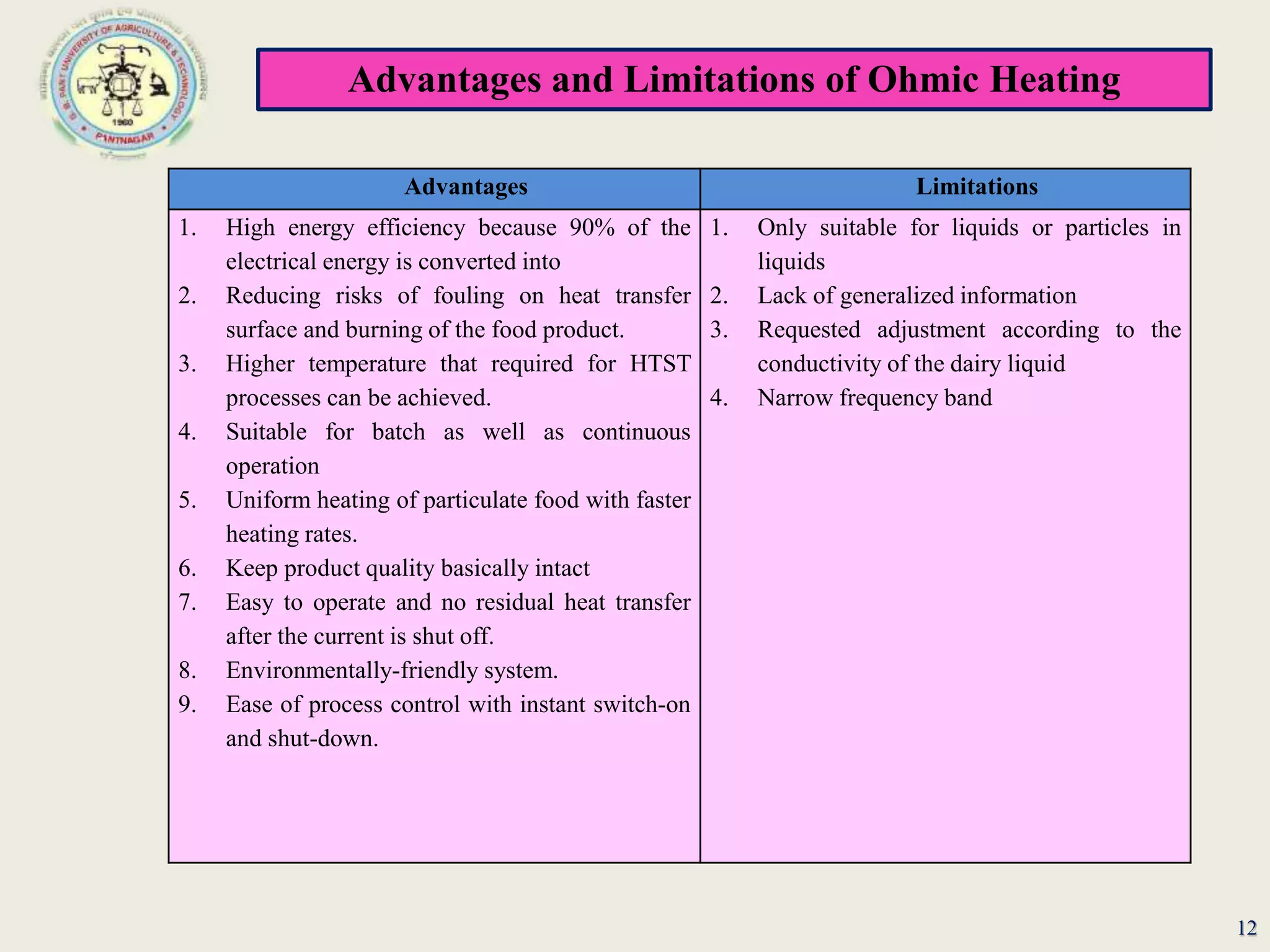
Advantages Limitations
1. High energy efficiency because 90% of the
electrical energy is converted into
2. Reducing risks of fouling on heat transfer
surface and burning of the food product.
3. Higher temperature that required for HTST
processes can be achieved.
4. Suitable for batch as well as continuous
operation
5. Uniform heating of particulate food with faster
heating rates.
6. Keep product quality basically intact
7. Easy to operate and no residual heat transfer
after the current is shut off.
8. Environmentally-friendly system.
9. Ease of process control with instant switch-on
and shut-down.
1. Only suitable for liquids or particles in
liquids
2. Lack of generalized information
3. Requested adjustment according to the
conductivity of the dairy liquid
4. Narrow frequency band
Microwave Heating
13
Principle of MW heating:
It uses electromagnetic waves of frequencies in microwave range (3MHz to 300GHz)
Polar water molecules will rotate according to the alternating electromagnetic field
The water molecule is a “dipole”
“Dipoles” will orient themselves when they are subject to electromagnetic field
Rotate at about 24 billion times per second
Ionic compounds in food can also be accelerated by the electromagnetic field
This orientation of water molecule causes huge friction inside the product and hence
generation of heat take place inside the product.
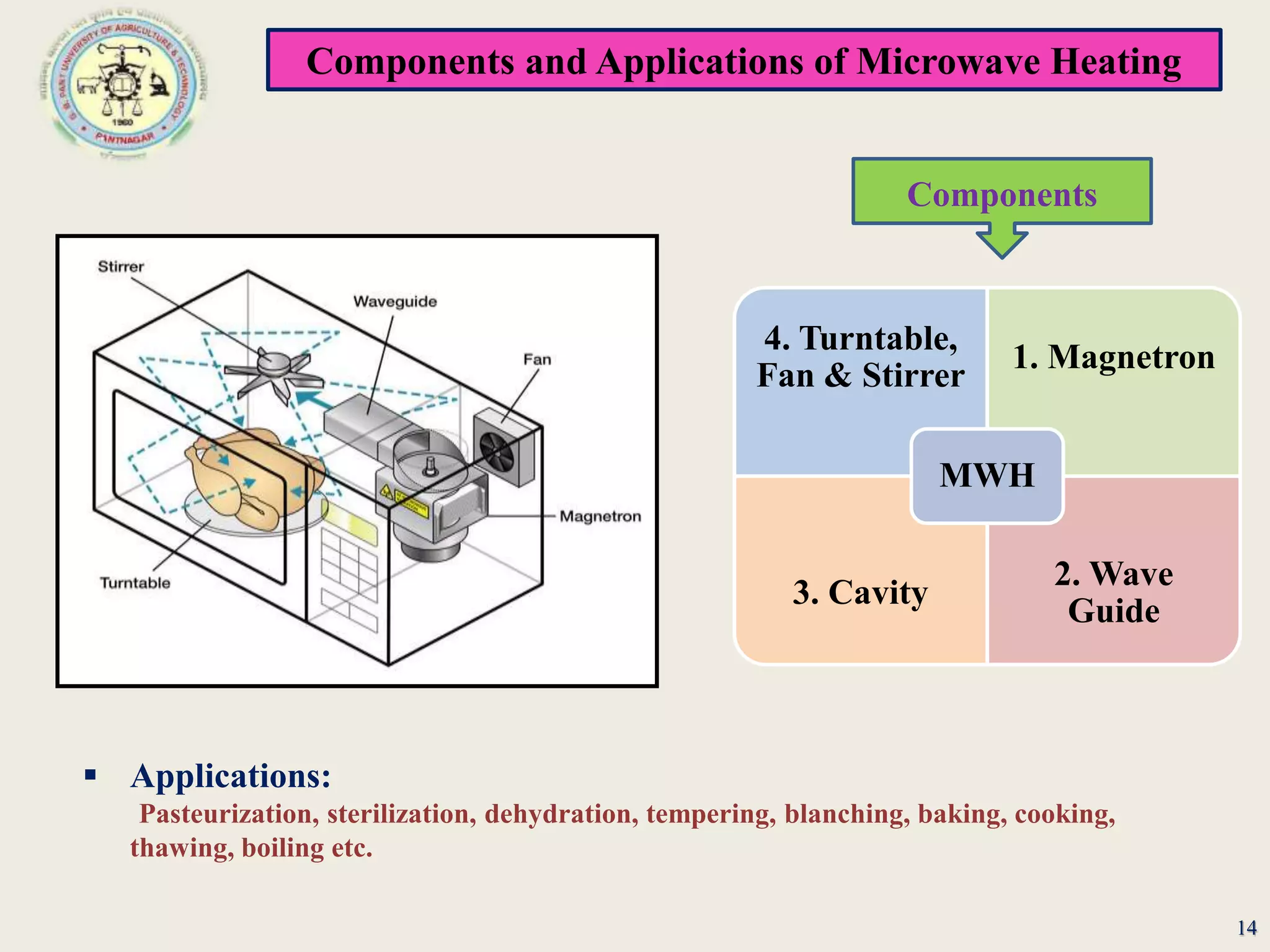
Components and Applications of Microwave Heating
14
Components
 Applications:
Pasteurization, sterilization, dehydration, tempering, blanching, baking, cooking,
thawing, boiling etc.
4. Turntable,
Fan & Stirrer
1. Magnetron
3. Cavity
2. Wave
Guide
MWH
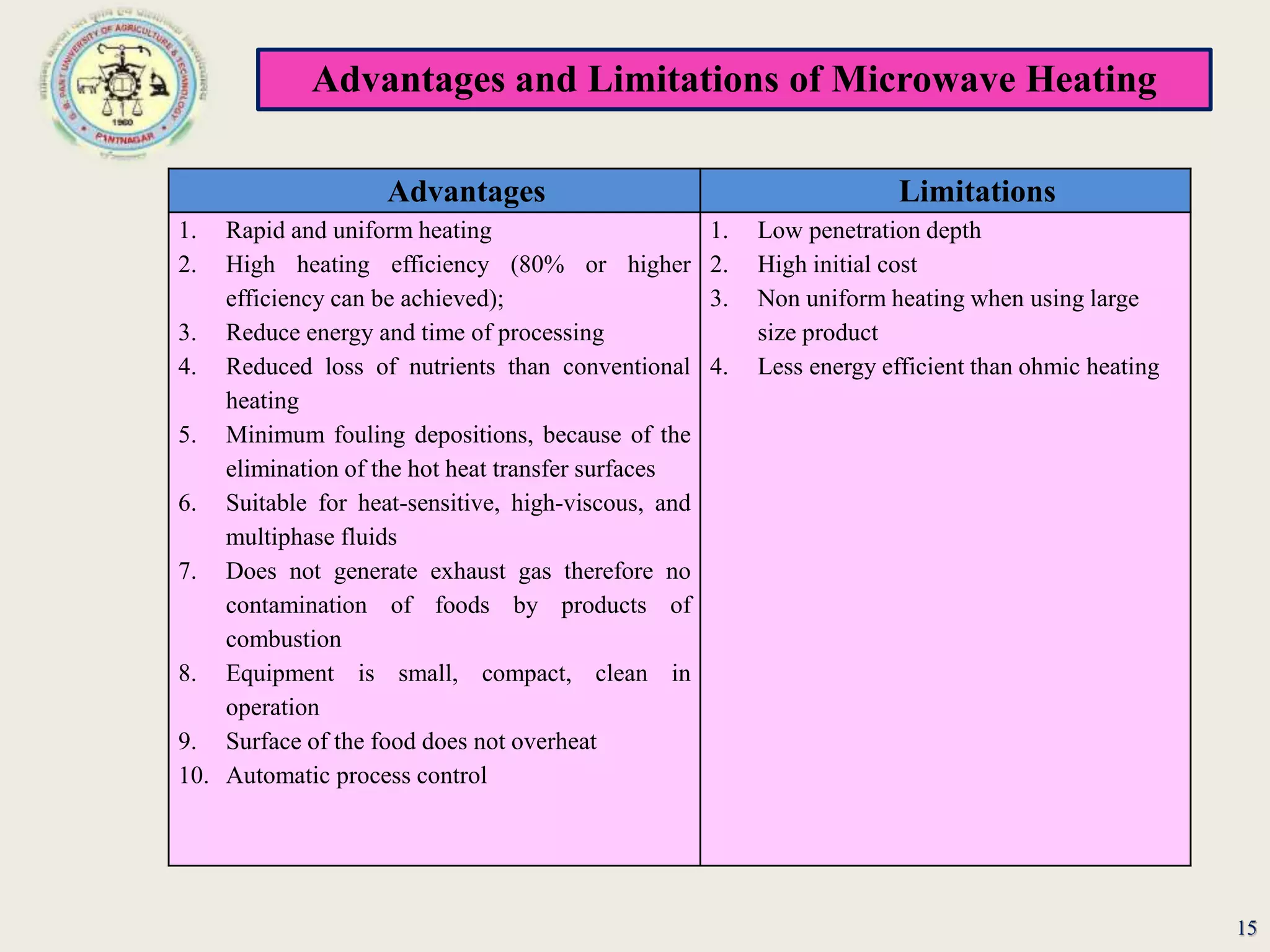
Advantages and Limitations of Microwave Heating
15
Advantages Limitations
1. Rapid and uniform heating
2. High heating efficiency (80% or higher
efficiency can be achieved);
3. Reduce energy and time of processing
4. Reduced loss of nutrients than conventional
heating
5. Minimum fouling depositions, because of the
elimination of the hot heat transfer surfaces
6. Suitable for heat-sensitive, high-viscous, and
multiphase fluids
7. Does not generate exhaust gas therefore no
contamination of foods by products of
combustion
8. Equipment is small, compact, clean in
operation
9. Surface of the food does not overheat
10. Automatic process control
1. Low penetration depth
2. High initial cost
3. Non uniform heating when using large
size product
4. Less energy efficient than ohmic heating
Pulsed Electric Field
16
Principle of PEF:
Also called as High Intensity Pulsed Electric Field
Mainly used to inactivate the deteriorative microorganisms
Pulses of high voltage (20– 80 kV/cm) passed over the product placed between a pair of
electrodes for an extremely short period of time (1–100 µs)
Resistance heating, electrolysis and disruption of cell membranes (electroporation) can
occur contributing to the inactivation of microorganisms.
The gap between two electrodes is called as the treatment gap
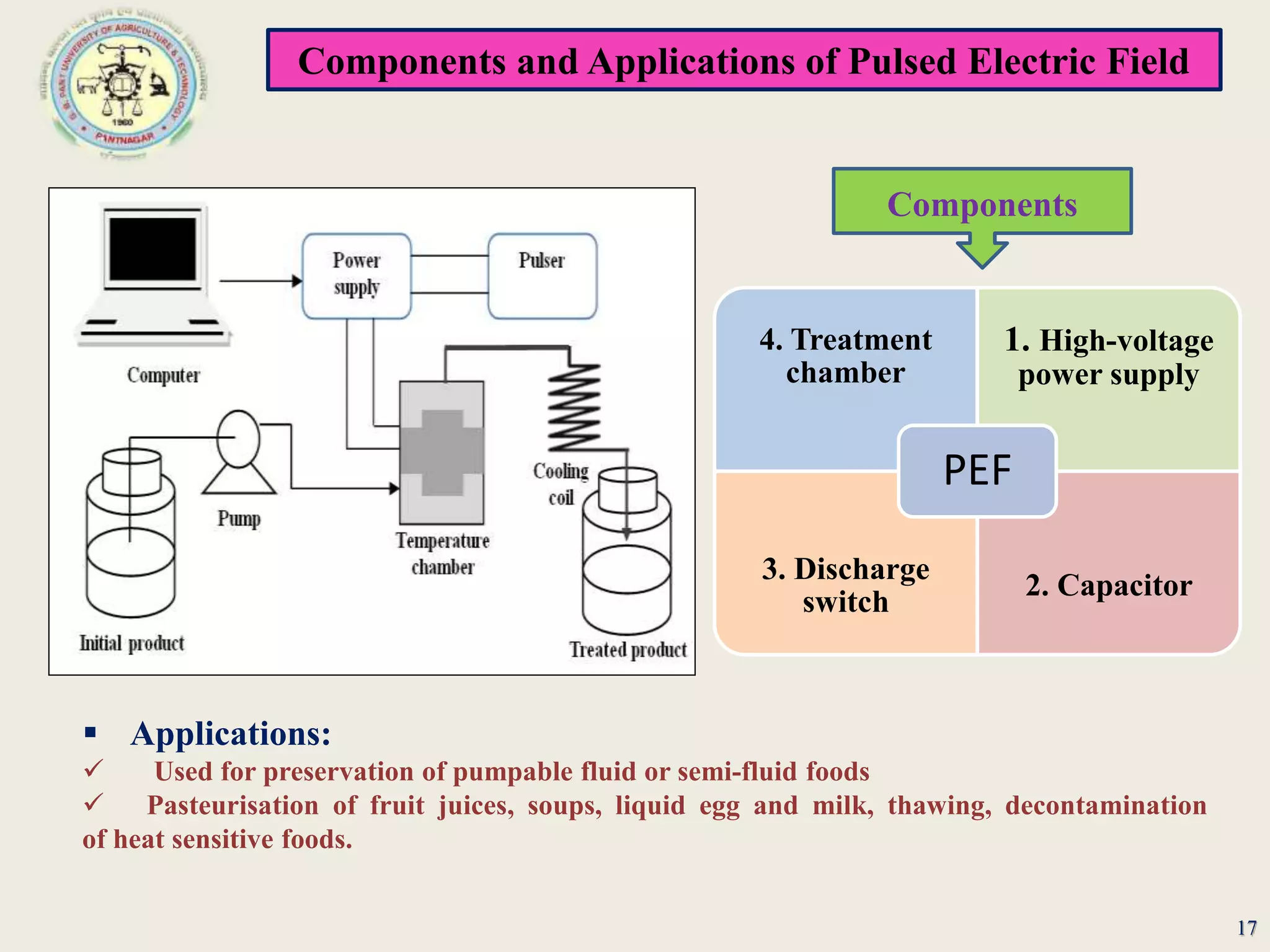
Components and Applications of Pulsed Electric Field
17
Components
 Applications:
 Used for preservation of pumpable fluid or semi-fluid foods
 Pasteurisation of fruit juices, soups, liquid egg and milk, thawing, decontamination
of heat sensitive foods.
4. Treatment
chamber
1. High-voltage
power supply
3. Discharge
switch
2. Capacitor
PEF
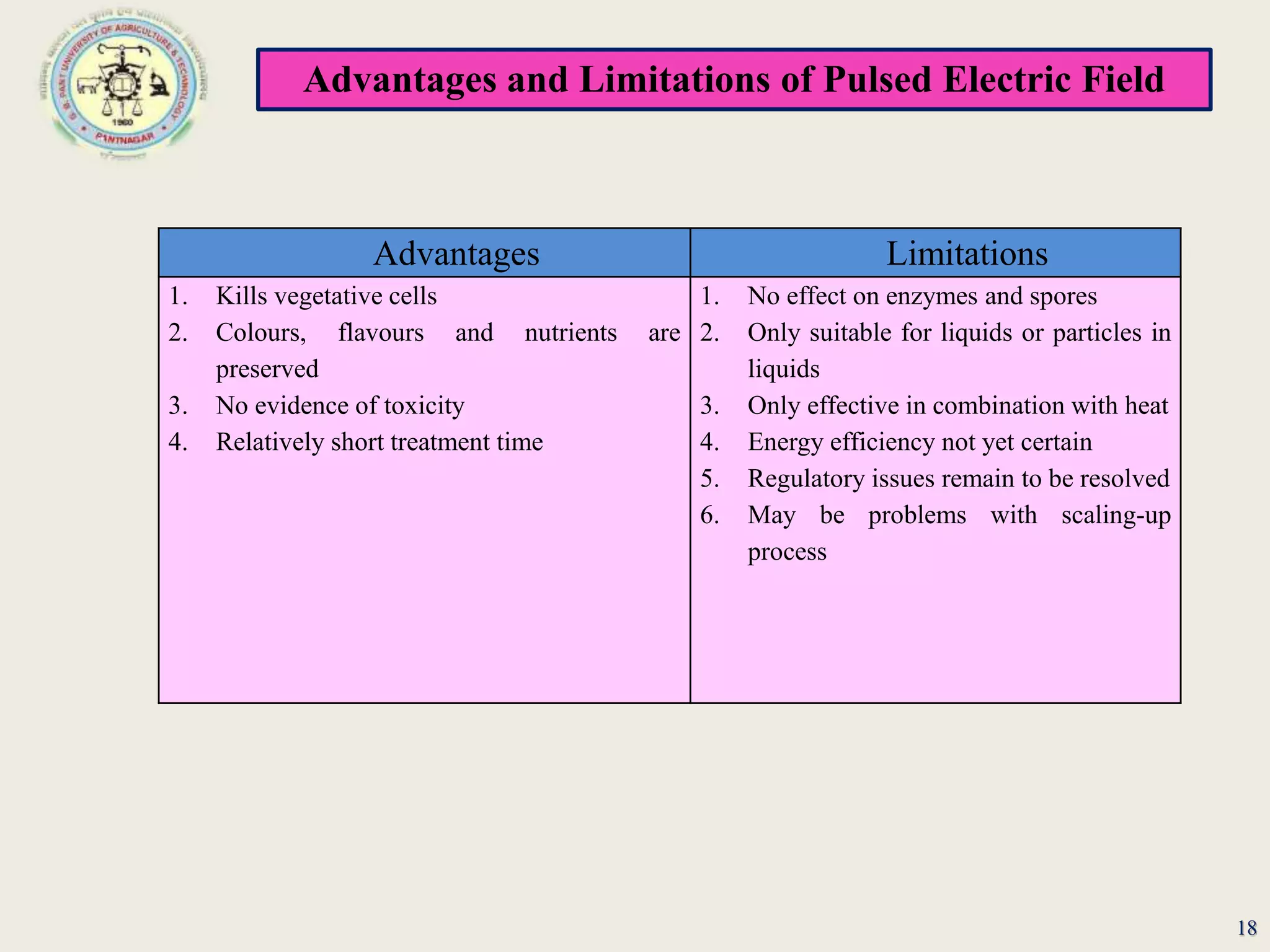
Advantages and Limitations of Pulsed Electric Field
18
Advantages Limitations
1. Kills vegetative cells
2. Colours, flavours and nutrients are
preserved
3. No evidence of toxicity
4. Relatively short treatment time
1. No effect on enzymes and spores
2. Only suitable for liquids or particles in
liquids
3. Only effective in combination with heat
4. Energy efficiency not yet certain
5. Regulatory issues remain to be resolved
6. May be problems with scaling-up
process
High Pressure Processing
19
Principle of HPP:
Also called as High Hydrostatic Pressure Processing
High pressures, up to 1000 MPa (Mainly 400-600 MPa) are applied to food packages
submerged in a liquid
High pressures, up to 1000 MPa are applied to food packages submerged in a liquid
Pressure causes destruction of micro-organisms
Bacteria in the log phase of growth are more barosensitive than cells in the stationary,
dormant or death phases.
High pressure is applied in an “isostatic” manner such that all regions of food
experience a uniform pressure
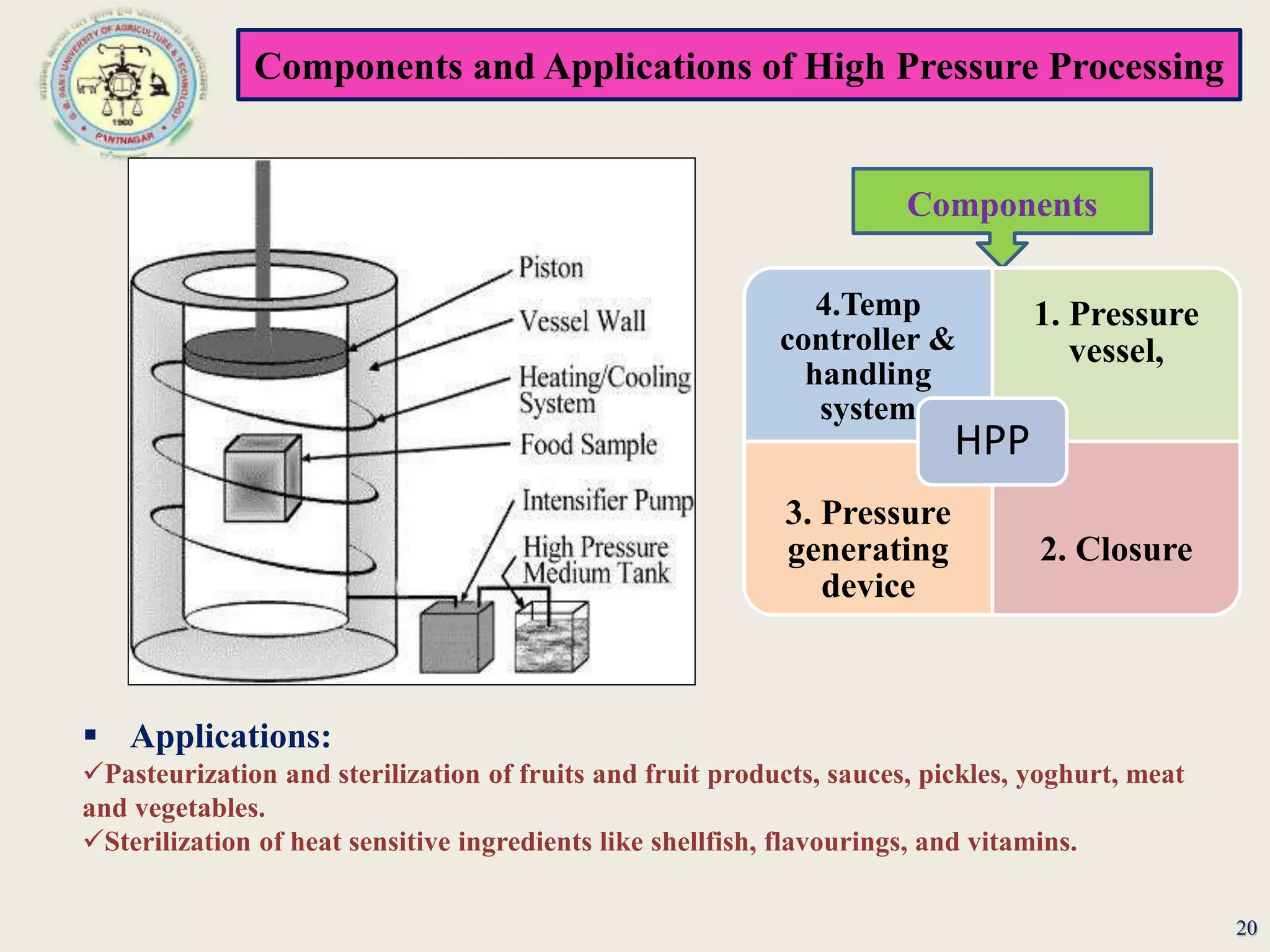
Components and Applications of High Pressure Processing
20
Components
 Applications:
Pasteurization and sterilization of fruits and fruit products, sauces, pickles, yoghurt, meat
and vegetables.
Sterilization of heat sensitive ingredients like shellfish, flavourings, and vitamins.
4.Temp
controller &
handling
system
1. Pressure
vessel,
3. Pressure
generating
device
2. Closure
HPP
Advantages and Limitations of Pulsed Electric Field
21
Advantages Limitations
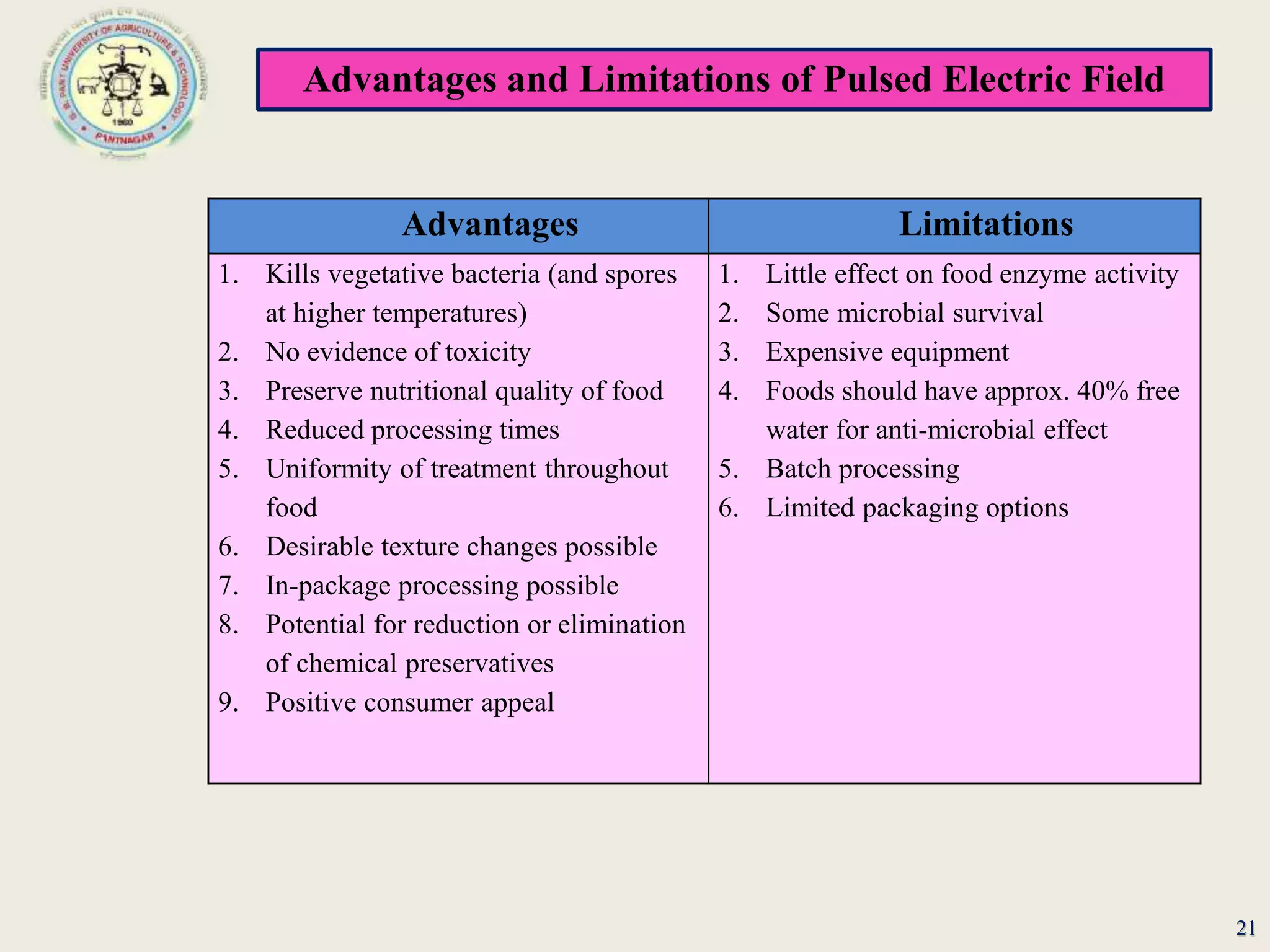
1. Kills vegetative bacteria (and spores
at higher temperatures)
2. No evidence of toxicity
3. Preserve nutritional quality of food
4. Reduced processing times
5. Uniformity of treatment throughout
food
6. Desirable texture changes possible
7. In-package processing possible
8. Potential for reduction or elimination
of chemical preservatives
9. Positive consumer appeal
1. Little effect on food enzyme activity
2. Some microbial survival
3. Expensive equipment
4. Foods should have approx. 40% free
water for anti-microbial effect
5. Batch processing
6. Limited packaging options
Pulsed Light Technology
22
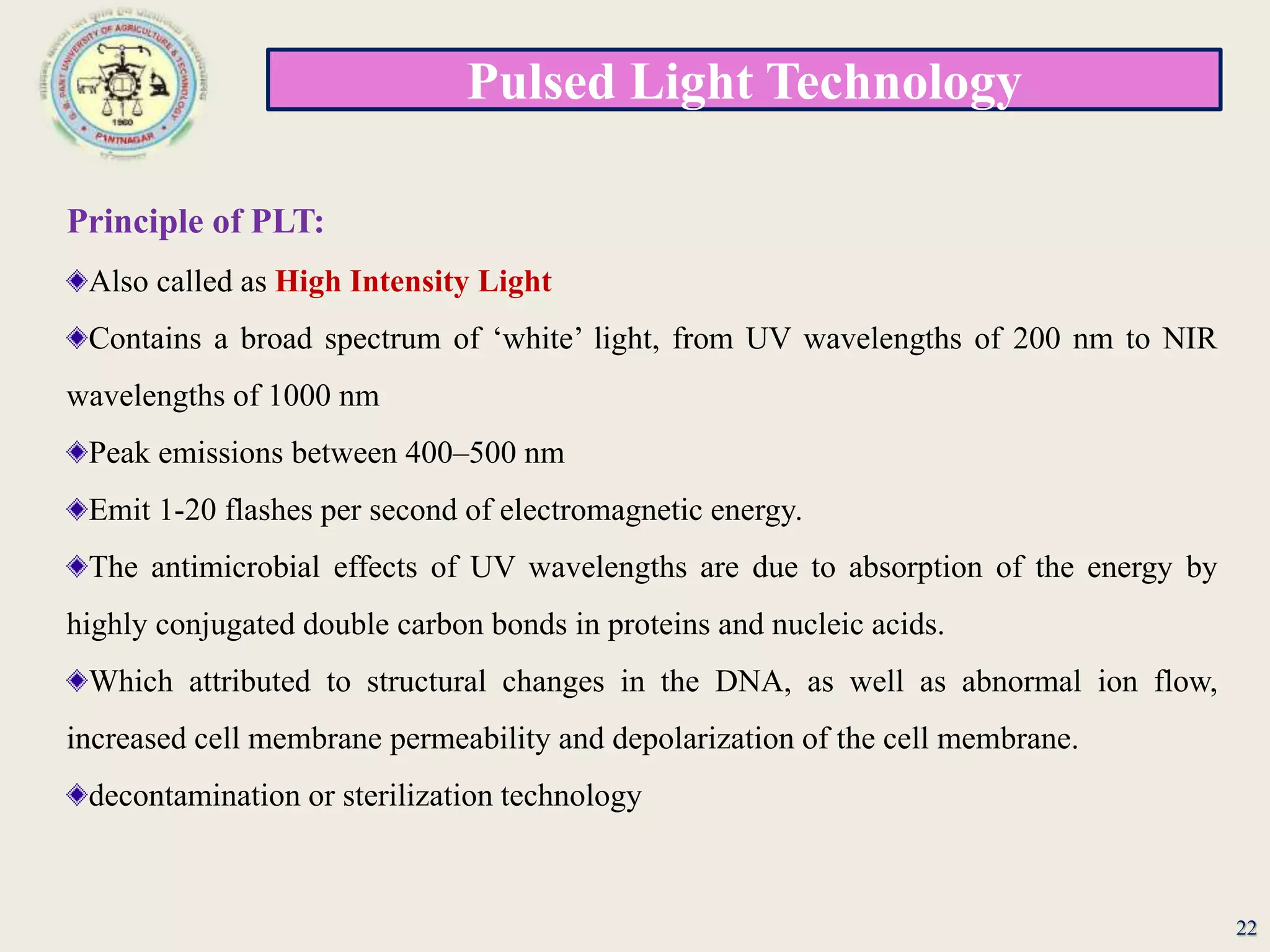
Principle of PLT:
Also called as High Intensity Light
Contains a broad spectrum of ‘white’ light, from UV wavelengths of 200 nm to NIR
wavelengths of 1000 nm
Peak emissions between 400–500 nm
Emit 1-20 flashes per second of electromagnetic energy.
The antimicrobial effects of UV wavelengths are due to absorption of the energy by
highly conjugated double carbon bonds in proteins and nucleic acids.
Which attributed to structural changes in the DNA, as well as abnormal ion flow,
increased cell membrane permeability and depolarization of the cell membrane.
decontamination or sterilization technology
Components and Applications of Pulsed Light Technology
23
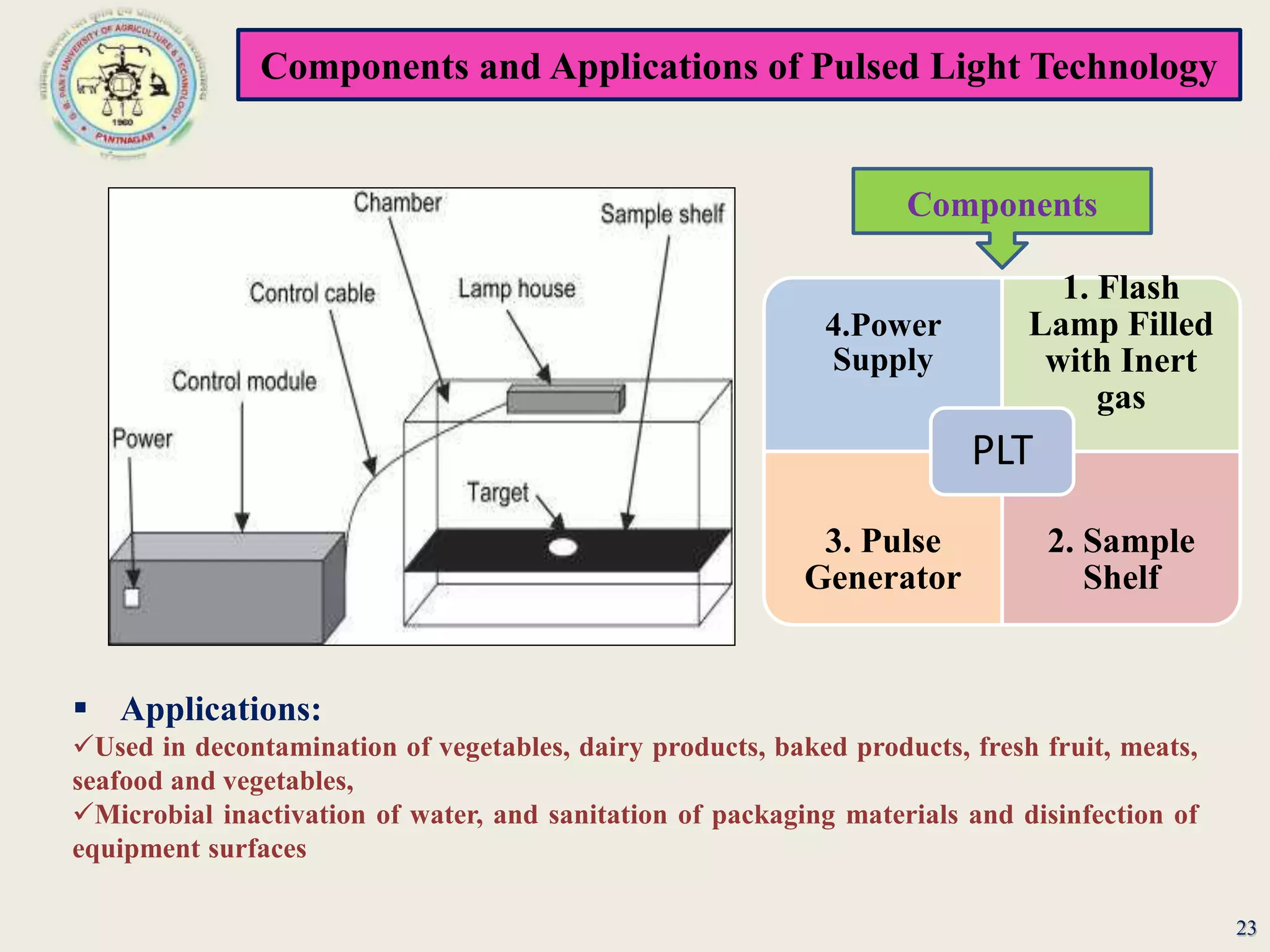
Components
 Applications:
Used in decontamination of vegetables, dairy products, baked products, fresh fruit, meats,
seafood and vegetables,
Microbial inactivation of water, and sanitation of packaging materials and disinfection of
equipment surfaces
4.Power
Supply
1. Flash
Lamp Filled
with Inert
gas
3. Pulse
Generator
2. Sample
Shelf
PLT
Advantages and Limitations of Pulsed Light Technology
24
Advantages Limitations
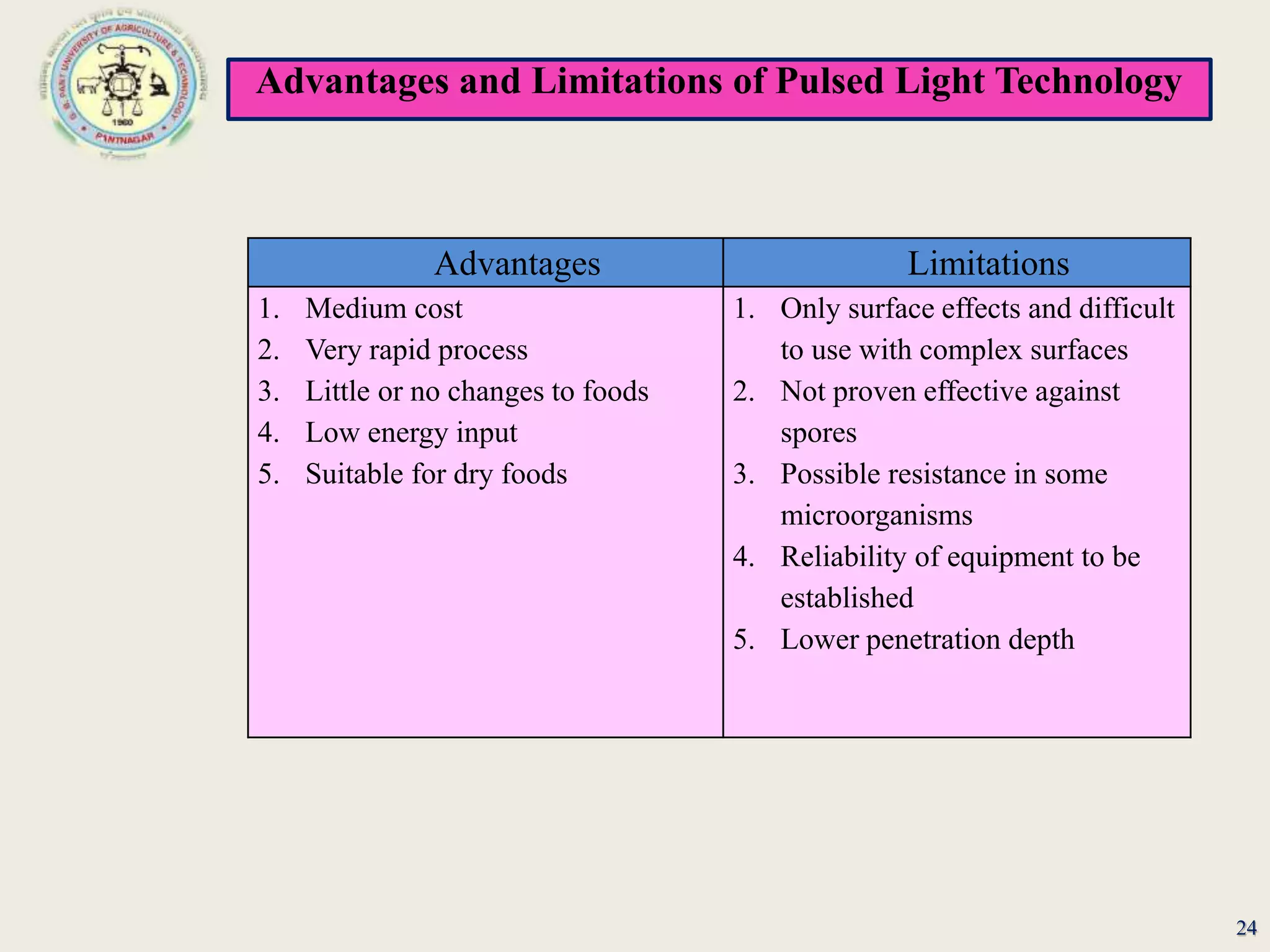
1. Medium cost
2. Very rapid process
3. Little or no changes to foods
4. Low energy input
5. Suitable for dry foods
1. Only surface effects and difficult
to use with complex surfaces
2. Not proven effective against
spores
3. Possible resistance in some
microorganisms
4. Reliability of equipment to be
established
5. Lower penetration depth
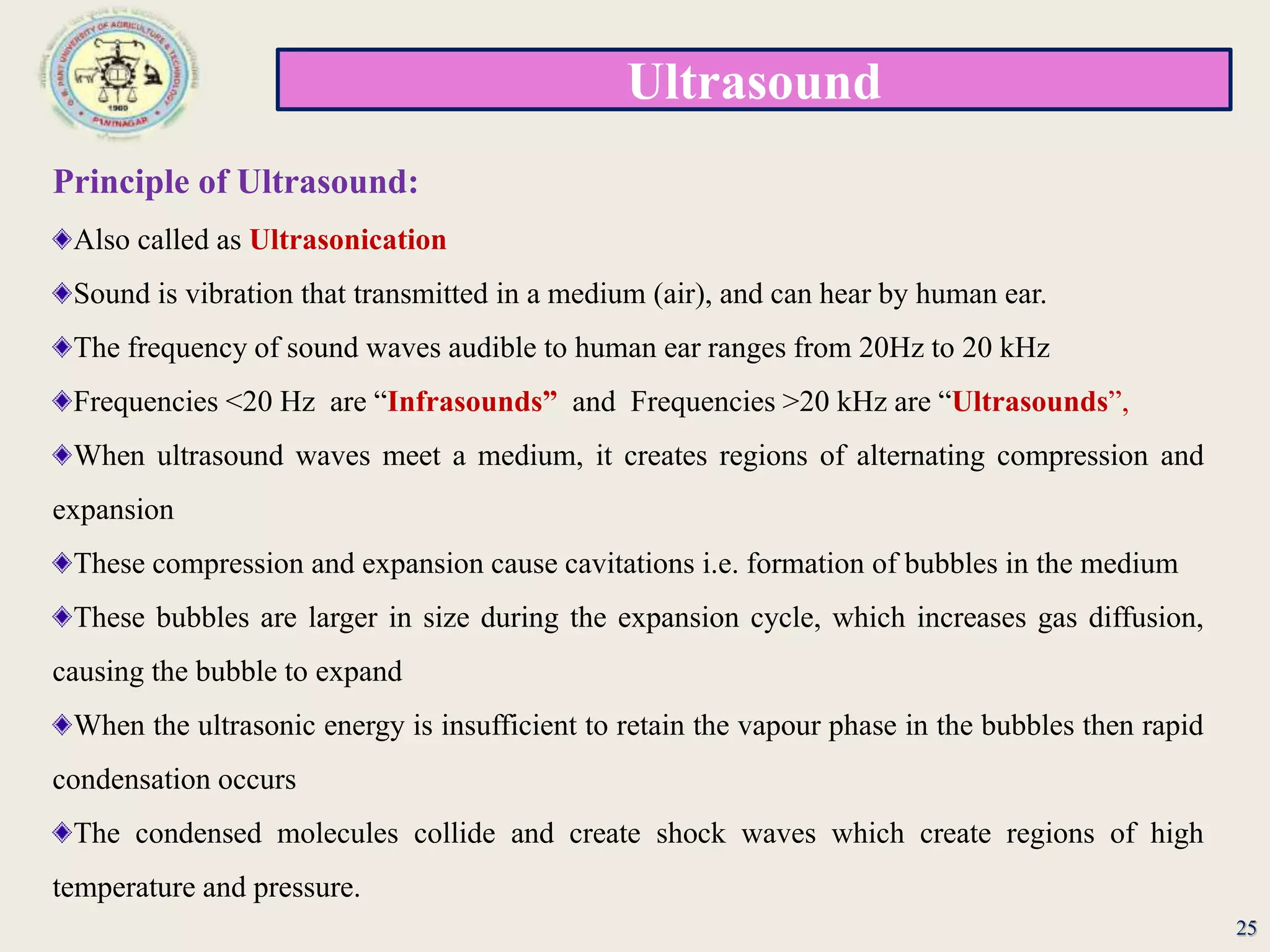
Ultrasound
25
Principle of Ultrasound:
Also called as Ultrasonication
Sound is vibration that transmitted in a medium (air), and can hear by human ear.
The frequency of sound waves audible to human ear ranges from 20Hz to 20 kHz
Frequencies <20 Hz are “Infrasounds” and Frequencies >20 kHz are “Ultrasounds”,
When ultrasound waves meet a medium, it creates regions of alternating compression and
expansion
These compression and expansion cause cavitations i.e. formation of bubbles in the medium
These bubbles are larger in size during the expansion cycle, which increases gas diffusion,
causing the bubble to expand
When the ultrasonic energy is insufficient to retain the vapour phase in the bubbles then rapid
condensation occurs
The condensed molecules collide and create shock waves which create regions of high
temperature and pressure.
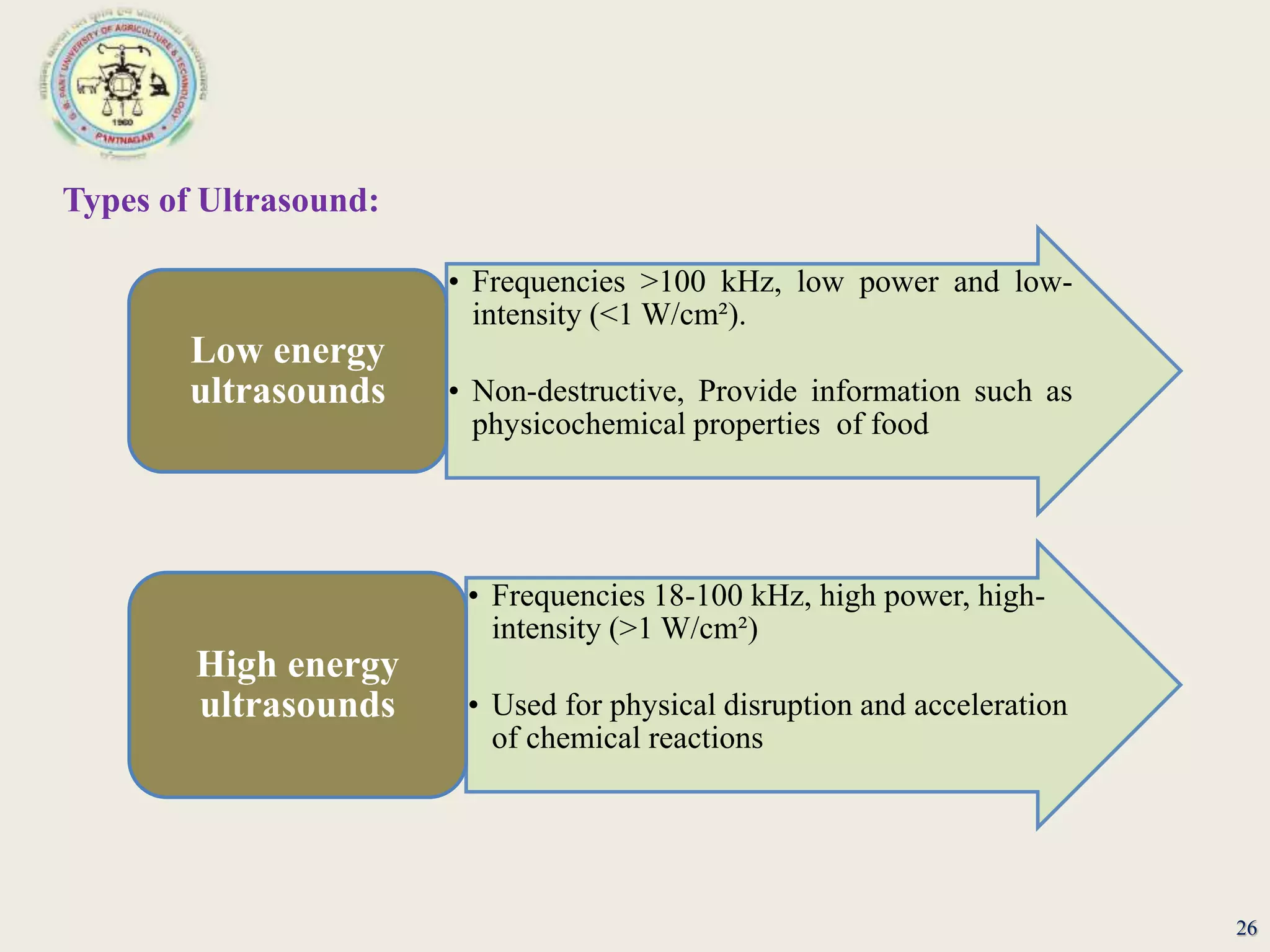
26
Types of Ultrasound:
• Frequencies >100 kHz, low power and low-
intensity (<1 W/cm²).
• Non-destructive, Provide information such as
physicochemical properties of food
Low energy
ultrasounds
• Frequencies 18-100 kHz, high power, high-
intensity (>1 W/cm²)
• Used for physical disruption and acceleration
of chemical reactions
High energy
ultrasounds
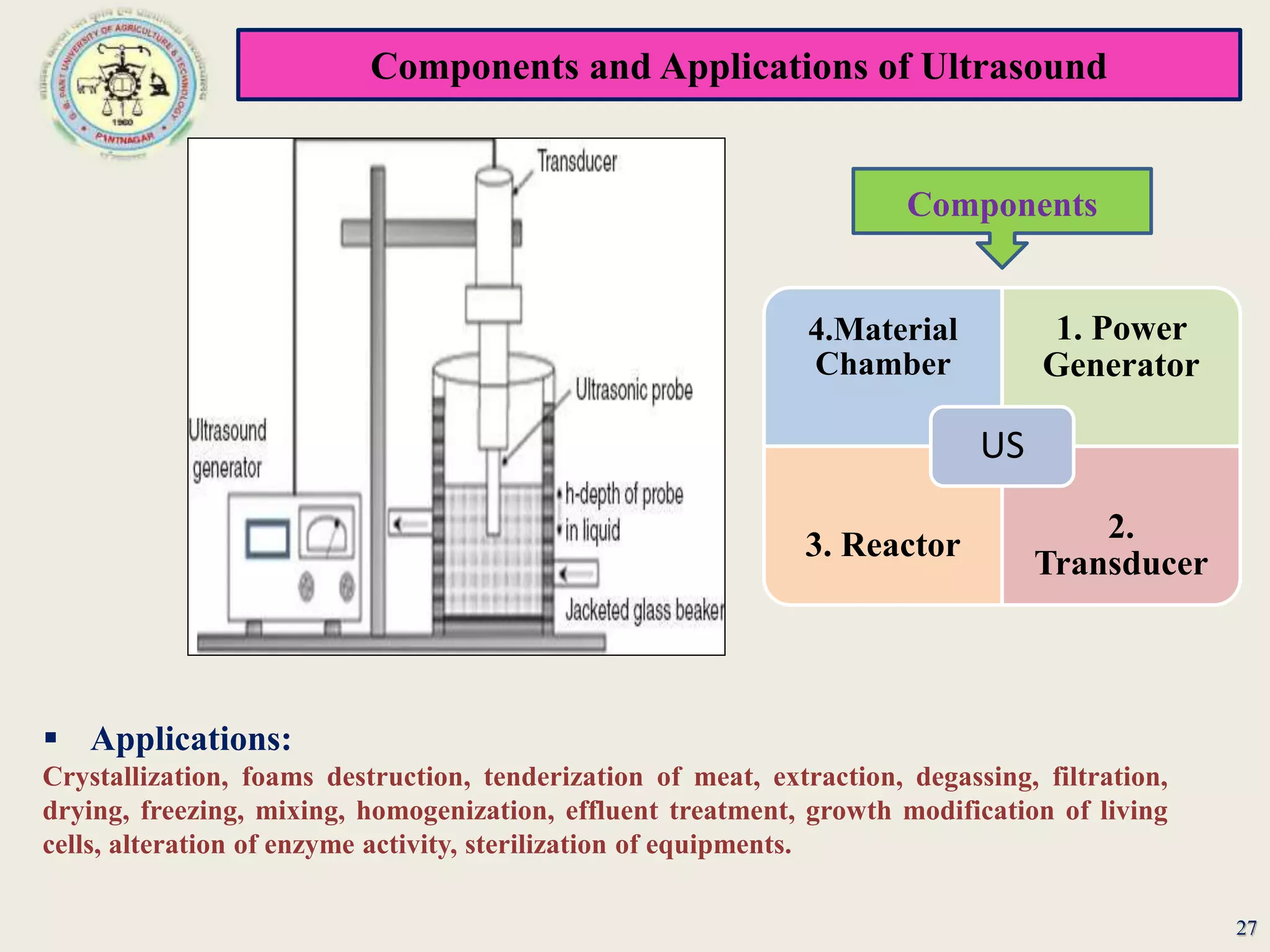
Components and Applications of Ultrasound
27
Components
 Applications:
Crystallization, foams destruction, tenderization of meat, extraction, degassing, filtration,
drying, freezing, mixing, homogenization, effluent treatment, growth modification of living
cells, alteration of enzyme activity, sterilization of equipments.
4.Material
Chamber
1. Power
Generator
3. Reactor
2.
Transducer
US
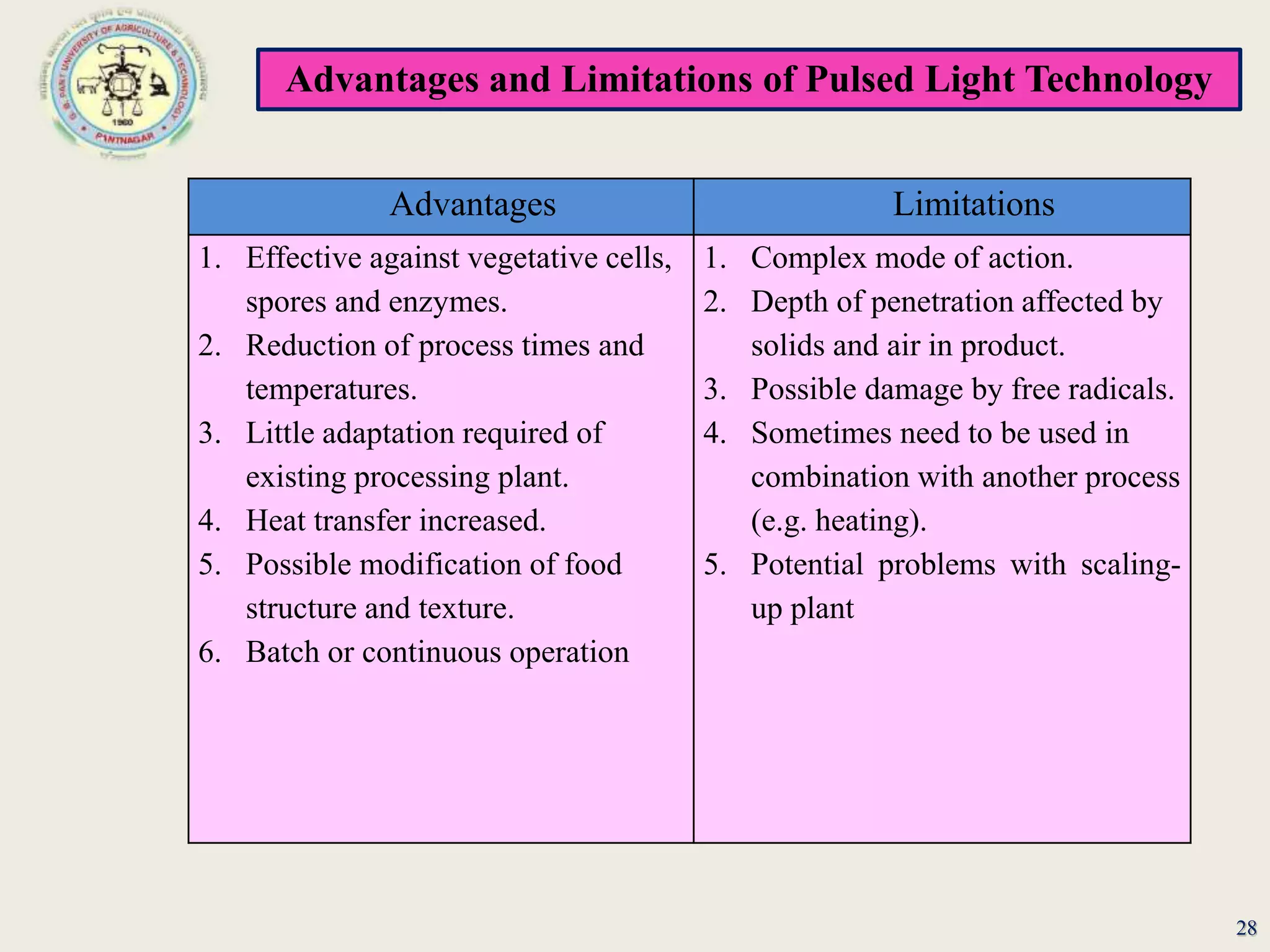
Advantages and Limitations of Pulsed Light Technology
28
Advantages Limitations
1. Effective against vegetative cells,
spores and enzymes.
2. Reduction of process times and
temperatures.
3. Little adaptation required of
existing processing plant.
4. Heat transfer increased.
5. Possible modification of food
structure and texture.
6. Batch or continuous operation
1. Complex mode of action.
2. Depth of penetration affected by
solids and air in product.
3. Possible damage by free radicals.
4. Sometimes need to be used in
combination with another process
(e.g. heating).
5. Potential problems with scaling-
up plant
CONCLUSION
29
Conventional Processing Methods:
Cause thermal degradation of food
loss of volatile compounds, nutrients, colour, texture and flavour.
Longer processing time, Higher fuel and energy required, combustion gasses.
 may generate environmental pollution.
Emerging Food Processing Technologies:
Produce food with better quality, acceptance and shelf life
Reduce the problems of environmental pollution
Higher heating rates and energy efficient processes
Mainly used in the large scale production.
After minimising the investment costs it can also be employed in small scale industries
Commercial adaptation is necessary

Emerging technologies in food processing

  • 1.
    EMERGING TECHNOLOGIES INFOOD PROCESSING Presented by: Sheshrao Kautkar Dept. of Post Harvest Process & Food Engg. G. B. Pant University of Agril. & Tech., Pantnagar (U. K.)
  • 2.
    INTRODUCTION 2 Fruits & Vegetables– Perishable commodity Sensitive to various microorganisms ,temperature, atmospheric gases , mechanical handling etc. Leads to huge mount of post harvest losses. • 52% cultivable land compared to 11% world average • All 15 major climates in the world exist in India • 46 out of 60 soil types exist in India • 20 Agri-climatic regions India’s diverse agro-climatic conditions allows production of many fruits and vegetables.
  • 3.
    Area and Productionof Major Fruits and Vegetables in India: 3 Fruit Area (000 ha) Production (000 t) Mango 2516 18431 Citrus 1078 11147 Banana 803 29725 Apple 313 2498 Guava 268 3668 Sapota 177 1744 Papaya 133 5639 Pomegranate 131 1346 Grapes 119 2585 Pineapple 110 1737 Litchi 84 585 Total 7216 88977 Vegetable Area (000 ha) Production (000 t) Potato 1973 41555 Onion 1204 19402 Tomato 882 18736 Brinjal 711 13558 Okra 533 6346 Cauliflower 434 8573 Peas 434 3869 Cabbage 400 9039 Tapioca 228 8139 Sweet Potato 106 1088 Total 9396 162897 Fruits Vegetables
  • 4.
    Post - HarvestLosses of Agricultural Produce 4 Agricultural Commodity Post Harvest Loss (%) Milk 0.8 Meat 2.3 Fisheries (Marine) 2.9 Poultry 3.7 Cereals 3.9 - 6.0 Pulses 4.3 - 6.1 Oilseeds 2.8 -10.1 Fisheries (Inland) 6.9 Fruits and Vegetables 5.8 -18.0 Source: Nanda SK, et al, CIPHET Ludhiana
  • 5.
  • 6.
    Need of FoodProcessing, Preservation and Value Addition To increase the shelf life commodity Reduction of post harvest losses Maintain quality and stability of product Maintain food and nutritional security of the country Availability of variety of products Availability throughout the year Availability throughout the country Employment generation Minimization and utilization of waste 6
  • 7.
    Processing Methods 7 Ohmic heating Infraredheating Microwave heating Radio frequency heating Freezing Drying Frying Chilling Extrusion Blanching HPP PEF Pulse light Ultrasound Irradiation Ozonation Cold plasma Electron beam Oscillating magnetic field Thermal Non thermal
  • 8.
    Problems in ConventionalMethods 8 Thermal damage Nutritional loss Energy inefficient Emission of combustion gases Longer processing time
  • 9.
    Emerging Food ProcessingTechnologies 9  Ohmic Heating, Microwave Heating, Pulsed Electric Field, Pulsed Light Technology, High Pressure Processing, Ultrasound.  Maintains nutritional quality of the produce by processing at mild temperatures  Energy efficient processes  Do not emits combustion gases in the atmosphere  Shorter processing time  Automatic control  Higher heat transfer efficiency  Uniform heating
  • 10.
    Ohmic Heating 10 Advanced thermalprocessing method Developed by United Kingdom Electricity Research and Development Center Licensed to APV Baker Ltd for commercial exploitation Also called electrical resistance heating, Joule heating, or electro-heating Green technology. Food material is heated by passing electric current through it Electrical resistance of the food causes the power to be translated directly into heat Electrical energy is dissipated into heat, which results in rapid and uniform heating
  • 11.
    Components and Applicationsof Ohmic Heating 11 4. Measuring systems 1. Two stainless steel electrodes 3. Power supply System 2. Ohmic heating chamber OH Components  Applications: Rice bran stabilization, blanching, sterilization, juice extraction, oil extraction pasteurization, evaporation, dehydration, fermentation, peeling, thawing etc
  • 12.
    Advantages and Limitationsof Ohmic Heating 12 Advantages Limitations 1. High energy efficiency because 90% of the electrical energy is converted into 2. Reducing risks of fouling on heat transfer surface and burning of the food product. 3. Higher temperature that required for HTST processes can be achieved. 4. Suitable for batch as well as continuous operation 5. Uniform heating of particulate food with faster heating rates. 6. Keep product quality basically intact 7. Easy to operate and no residual heat transfer after the current is shut off. 8. Environmentally-friendly system. 9. Ease of process control with instant switch-on and shut-down. 1. Only suitable for liquids or particles in liquids 2. Lack of generalized information 3. Requested adjustment according to the conductivity of the dairy liquid 4. Narrow frequency band
  • 13.
    Microwave Heating 13 Principle ofMW heating: It uses electromagnetic waves of frequencies in microwave range (3MHz to 300GHz) Polar water molecules will rotate according to the alternating electromagnetic field The water molecule is a “dipole” “Dipoles” will orient themselves when they are subject to electromagnetic field Rotate at about 24 billion times per second Ionic compounds in food can also be accelerated by the electromagnetic field This orientation of water molecule causes huge friction inside the product and hence generation of heat take place inside the product.
  • 14.
    Components and Applicationsof Microwave Heating 14 Components  Applications: Pasteurization, sterilization, dehydration, tempering, blanching, baking, cooking, thawing, boiling etc. 4. Turntable, Fan & Stirrer 1. Magnetron 3. Cavity 2. Wave Guide MWH
  • 15.
    Advantages and Limitationsof Microwave Heating 15 Advantages Limitations 1. Rapid and uniform heating 2. High heating efficiency (80% or higher efficiency can be achieved); 3. Reduce energy and time of processing 4. Reduced loss of nutrients than conventional heating 5. Minimum fouling depositions, because of the elimination of the hot heat transfer surfaces 6. Suitable for heat-sensitive, high-viscous, and multiphase fluids 7. Does not generate exhaust gas therefore no contamination of foods by products of combustion 8. Equipment is small, compact, clean in operation 9. Surface of the food does not overheat 10. Automatic process control 1. Low penetration depth 2. High initial cost 3. Non uniform heating when using large size product 4. Less energy efficient than ohmic heating
  • 16.
    Pulsed Electric Field 16 Principleof PEF: Also called as High Intensity Pulsed Electric Field Mainly used to inactivate the deteriorative microorganisms Pulses of high voltage (20– 80 kV/cm) passed over the product placed between a pair of electrodes for an extremely short period of time (1–100 µs) Resistance heating, electrolysis and disruption of cell membranes (electroporation) can occur contributing to the inactivation of microorganisms. The gap between two electrodes is called as the treatment gap
  • 17.
    Components and Applicationsof Pulsed Electric Field 17 Components  Applications:  Used for preservation of pumpable fluid or semi-fluid foods  Pasteurisation of fruit juices, soups, liquid egg and milk, thawing, decontamination of heat sensitive foods. 4. Treatment chamber 1. High-voltage power supply 3. Discharge switch 2. Capacitor PEF
  • 18.
    Advantages and Limitationsof Pulsed Electric Field 18 Advantages Limitations 1. Kills vegetative cells 2. Colours, flavours and nutrients are preserved 3. No evidence of toxicity 4. Relatively short treatment time 1. No effect on enzymes and spores 2. Only suitable for liquids or particles in liquids 3. Only effective in combination with heat 4. Energy efficiency not yet certain 5. Regulatory issues remain to be resolved 6. May be problems with scaling-up process
  • 19.
    High Pressure Processing 19 Principleof HPP: Also called as High Hydrostatic Pressure Processing High pressures, up to 1000 MPa (Mainly 400-600 MPa) are applied to food packages submerged in a liquid High pressures, up to 1000 MPa are applied to food packages submerged in a liquid Pressure causes destruction of micro-organisms Bacteria in the log phase of growth are more barosensitive than cells in the stationary, dormant or death phases. High pressure is applied in an “isostatic” manner such that all regions of food experience a uniform pressure
  • 20.
    Components and Applicationsof High Pressure Processing 20 Components  Applications: Pasteurization and sterilization of fruits and fruit products, sauces, pickles, yoghurt, meat and vegetables. Sterilization of heat sensitive ingredients like shellfish, flavourings, and vitamins. 4.Temp controller & handling system 1. Pressure vessel, 3. Pressure generating device 2. Closure HPP
  • 21.
    Advantages and Limitationsof Pulsed Electric Field 21 Advantages Limitations 1. Kills vegetative bacteria (and spores at higher temperatures) 2. No evidence of toxicity 3. Preserve nutritional quality of food 4. Reduced processing times 5. Uniformity of treatment throughout food 6. Desirable texture changes possible 7. In-package processing possible 8. Potential for reduction or elimination of chemical preservatives 9. Positive consumer appeal 1. Little effect on food enzyme activity 2. Some microbial survival 3. Expensive equipment 4. Foods should have approx. 40% free water for anti-microbial effect 5. Batch processing 6. Limited packaging options
  • 22.
    Pulsed Light Technology 22 Principleof PLT: Also called as High Intensity Light Contains a broad spectrum of ‘white’ light, from UV wavelengths of 200 nm to NIR wavelengths of 1000 nm Peak emissions between 400–500 nm Emit 1-20 flashes per second of electromagnetic energy. The antimicrobial effects of UV wavelengths are due to absorption of the energy by highly conjugated double carbon bonds in proteins and nucleic acids. Which attributed to structural changes in the DNA, as well as abnormal ion flow, increased cell membrane permeability and depolarization of the cell membrane. decontamination or sterilization technology
  • 23.
    Components and Applicationsof Pulsed Light Technology 23 Components  Applications: Used in decontamination of vegetables, dairy products, baked products, fresh fruit, meats, seafood and vegetables, Microbial inactivation of water, and sanitation of packaging materials and disinfection of equipment surfaces 4.Power Supply 1. Flash Lamp Filled with Inert gas 3. Pulse Generator 2. Sample Shelf PLT
  • 24.
    Advantages and Limitationsof Pulsed Light Technology 24 Advantages Limitations 1. Medium cost 2. Very rapid process 3. Little or no changes to foods 4. Low energy input 5. Suitable for dry foods 1. Only surface effects and difficult to use with complex surfaces 2. Not proven effective against spores 3. Possible resistance in some microorganisms 4. Reliability of equipment to be established 5. Lower penetration depth
  • 25.
    Ultrasound 25 Principle of Ultrasound: Alsocalled as Ultrasonication Sound is vibration that transmitted in a medium (air), and can hear by human ear. The frequency of sound waves audible to human ear ranges from 20Hz to 20 kHz Frequencies <20 Hz are “Infrasounds” and Frequencies >20 kHz are “Ultrasounds”, When ultrasound waves meet a medium, it creates regions of alternating compression and expansion These compression and expansion cause cavitations i.e. formation of bubbles in the medium These bubbles are larger in size during the expansion cycle, which increases gas diffusion, causing the bubble to expand When the ultrasonic energy is insufficient to retain the vapour phase in the bubbles then rapid condensation occurs The condensed molecules collide and create shock waves which create regions of high temperature and pressure.
  • 26.
    26 Types of Ultrasound: •Frequencies >100 kHz, low power and low- intensity (<1 W/cm²). • Non-destructive, Provide information such as physicochemical properties of food Low energy ultrasounds • Frequencies 18-100 kHz, high power, high- intensity (>1 W/cm²) • Used for physical disruption and acceleration of chemical reactions High energy ultrasounds
  • 27.
    Components and Applicationsof Ultrasound 27 Components  Applications: Crystallization, foams destruction, tenderization of meat, extraction, degassing, filtration, drying, freezing, mixing, homogenization, effluent treatment, growth modification of living cells, alteration of enzyme activity, sterilization of equipments. 4.Material Chamber 1. Power Generator 3. Reactor 2. Transducer US
  • 28.
    Advantages and Limitationsof Pulsed Light Technology 28 Advantages Limitations 1. Effective against vegetative cells, spores and enzymes. 2. Reduction of process times and temperatures. 3. Little adaptation required of existing processing plant. 4. Heat transfer increased. 5. Possible modification of food structure and texture. 6. Batch or continuous operation 1. Complex mode of action. 2. Depth of penetration affected by solids and air in product. 3. Possible damage by free radicals. 4. Sometimes need to be used in combination with another process (e.g. heating). 5. Potential problems with scaling- up plant
  • 29.
    CONCLUSION 29 Conventional Processing Methods: Causethermal degradation of food loss of volatile compounds, nutrients, colour, texture and flavour. Longer processing time, Higher fuel and energy required, combustion gasses.  may generate environmental pollution. Emerging Food Processing Technologies: Produce food with better quality, acceptance and shelf life Reduce the problems of environmental pollution Higher heating rates and energy efficient processes Mainly used in the large scale production. After minimising the investment costs it can also be employed in small scale industries Commercial adaptation is necessary