Hemodynamic Disorders,
Thromboembolic Disease,
and Shock
Edema and Effusions
• Disorders that perturb cardiovascular, renal, or
hepatic function are often marked by the
accumulation of fluid in tissues (edema) or body
cavities (effusions).
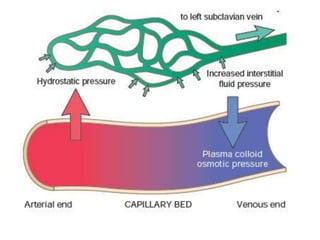
• Under normal circumstances, the tendency of
vascular hydrostatic pressure to push water and
salts out of capillaries into the interstitial space is
nearly balanced by the tendency of plasma
colloid oncotic pressure to pull water and salts
back into vessels.
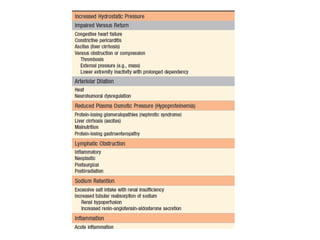
• Elevated hydrostatic pressure or diminished
colloid oncotic pressure disrupts this balance and
results in increased movement of fluid out of
vessels.
• If the net rate of fluid movement exceeds the rate
of lymphatic drainage, fluid accumulates.
• Within tissues the result is edema, and if a
serosal surface is involved, fluid may accumulate
within the adjacent body cavity as an effusion.
• Edema fluids and effusions may be inflammatory or non
inflammatory .
• The protein-rich exudates accumulate due to increases in vascular
permeability caused by inflammatory mediators.
• Usually, inflammation-associated edema is localized to one or a few
tissues, but in systemic inflammatory states, such as sepsis, that
produce widespread endothelial injury and dysfunction, generalized
edema may appear, often with severe consequences.
• In contrast, noninflammatory edema and effusions are protein-poor
fluids called transudates.
• Noninflammatory edema and effusions are
common in many diseases, including heart
failure, liver failure, renal disease, and severe
nutritional disorders
Increased Hydrostatic Pressure
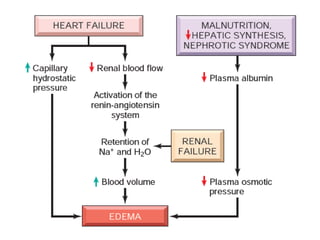
• Increases in hydrostatic pressure are mainly
caused by disorders that impair venous return.
• If the impairment is localized (e.g., a deep venous
thrombosis [DVT] in a lower extremity), then the
resulting edema is confined to the affected part.
• Conditions leading to systemic increases in
venous pressure e.g., congestive heart failure, are
understandably associated with more widespread
edema.
Reduced Plasma Oncotic Pressure
• Under normal circumstances albumin accounts for almost
half of the total plasma protein; it follows that conditions
leading to inadequate synthesis or increased loss of
albumin from the circulation are common causes of
reduced plasma oncotic pressure.
• Reduced albumin synthesis occurs mainly in severe liver
diseases e.g., end-stage Cirrhosis and protein malnutrition
• An important cause of albumin loss is the nephrotic
syndrome in which albumin leaks into the urine through
abnormally permeable glomerular capillaries.
• Regardless of cause, reduced plasma oncotic
pressure leads in a stepwise fashion to edema,
reduced intravascular volume, renal
hypoperfusion, and secondary
hyperaldosteronism.
Sodium and Water Retention
• Increased salt retention—with obligate retention
of associated water—causes both increased
hydrostatic pressure (due to intravascular fluid
volume expansion) and diminished vascular
colloid oncotic pressure (due to dilution).
• Salt retention occurs whenever renal function is
compromised, such as in primary kidney
disorders and in cardiovascular disorders that
decrease renal perfusion.
• One of the most important causes of renal
hypoperfusion is congestive heart failure, which (like
hypoproteinemia) results in the activation of the renin-
angiotensin-aldosterone axis.
• In early heart failure, this response is beneficial, as the
retention of sodium and water and other adaptations,
including increased vascular tone and elevated levels of
antidiuretic hormone, improve cardiac output and
restore normal renal perfusion.
• However, as heart failure worsens and cardiac
output diminishes, the retained fluid merely
increases the hydrostatic pressure, leading to
edema and effusions.
Lymphatic Obstruction
• Trauma, fibrosis, invasive tumors, and infectious
agents can all disrupt lymphatic vessels and
impair the clearance of interstitial fluid, resulting
in lymphedema in the affected part of the body.
• A dramatic example is seen in parasitic filariasis,
in which the organism induces obstructive
fibrosis of lymphatic channels and lymph nodes.
• This may result in edema of the external genitalia
and lower limbs ……………..elephantiasis.
• Severe edema of the upper extremity may
also complicate surgical removal and/or
irradiation of the breast and associated
axillary lymph nodes in patients with breast
cancer.
MORPHOLOGY
• Edema is easily recognized grossly; microscopically, it is appreciated
as clearing and separation of the extracellular matrix and subtle cell
swelling.
• Any organ or tissue can be involved, but edema is most commonly
seen in subcutaneous tissues, the lungs, and the brain.
• Subcutaneous edema can be diffuse or more conspicuous in
regions with high hydrostatic pressures.
• Its distribution is often influenced by gravity (e.g., it appears in the
legs when standing and the sacrum when recumbent), a feature
termed dependent edema..
• Finger pressure over markedly edematous
subcutaneous tissue displaces the interstitial
fluid and leaves a depression, a sign called
pitting edema
• Edema resulting from renal dysfunction often appears initially in parts of
the body containing loose connective tissue, such as the eyelids
• Periorbital edema is thus a characteristic finding in severe renal disease.
• With pulmonary edema, the lungs are often two to three times their
normal weight, and sectioning yields frothy, blood-tinged fluid—a mixture
of air, edema, and extravasated red cells.
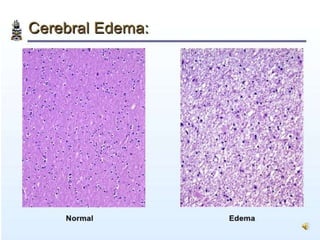
• Brain edema can be localized or generalized depending on the nature and
extent of the pathologic process or injury.
• The swollen brain exhibits narrowed sulci and distended gyri
• Effusions involving the pleural cavity (hydrothorax), the
pericardial cavity (hydropericardium), or the
peritoneal cavity (hydroperitoneum or ascites)
• Transudative effusions are typically protein poor,
translucent and straw colored. An exception are
peritoneal effusions caused by lymphatic blockage
(chylous effusion), which may be milky due to the
presence of lipids absorbed from the gut.
• In contrast, exudative effusions are protein-rich and
often cloudy due to the presence of white cells.
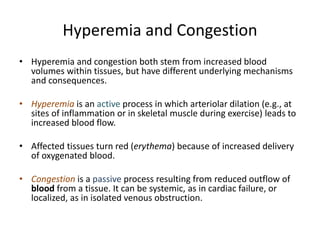
Hyperemia and Congestion
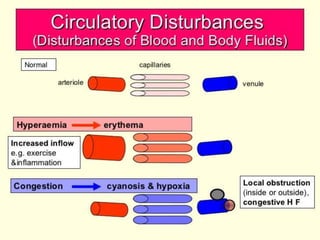
• Hyperemia and congestion both stem from increased blood
volumes within tissues, but have different underlying mechanisms
and consequences.
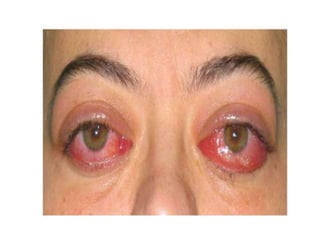
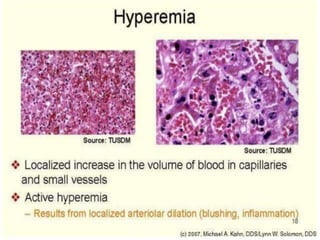
• Hyperemia is an active process in which arteriolar dilation (e.g., at
sites of inflammation or in skeletal muscle during exercise) leads to
increased blood flow.
• Affected tissues turn red (erythema) because of increased delivery
of oxygenated blood.
• Congestion is a passive process resulting from reduced outflow of
blood from a tissue. It can be systemic, as in cardiac failure, or
localized, as in isolated venous obstruction.
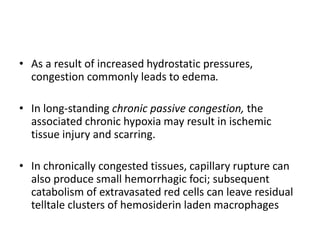
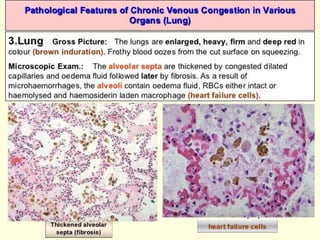
• As a result of increased hydrostatic pressures,
congestion commonly leads to edema.
• In long-standing chronic passive congestion, the
associated chronic hypoxia may result in ischemic
tissue injury and scarring.
• In chronically congested tissues, capillary rupture can
also produce small hemorrhagic foci; subsequent
catabolism of extravasated red cells can leave residual
telltale clusters of hemosiderin laden macrophages
Hemostasis, Hemorrhagic Disorders,
and Thrombosis
• Hemostasis can be defined simply as the process
by which
“blood clots form at sites of vascular
injury”
Hemostasis is essential for life and is deranged to
varying degrees in a broad range of disorders,
which can be divided into two groups.
• In hemorrhagic disorders, characterized by
excessive bleeding, hemostatic mechanisms
are either blunted or insufficient to prevent
abnormal blood loss.
• By contrast, in thrombotic disorders blood
clots (often referred to as thrombi) form
within intact blood vessels or within the
chambers of the heart.
• This division between bleeding and
thrombotic disorders sometimes breaks down,
in that generalized activation of clotting
sometimes paradoxically produces bleeding
due to the consumption of coagulation
factors, as in disseminated intravascular
coagulation (DIC).
Endothelium
• The balance between the anticoagulant and
procoagulant activities of endothelium often
determines whether clot formation, propagation, or
dissolution occurs.
• Normal endothelial cells express a multitude of factors
that inhibit the procoagulant activities of platelets and
coagulation factors and that augment fibrinolysis
• These factors act in concert to prevent thrombosis and
to limit clotting to sites of vascular damage.
Anti-platelet effect
• An obvious effect of intact endothelium is to serve as a
barrier that shields platelets from subendothelial VWF
and collagen
• However, normal endothelium also releases a number
of factors that inhibit platelet activation and
aggregation.
• Among the most important are prostacyclin (PGI2),
nitric oxide (NO), and adenosine diphosphatase
Anticoagulant effects
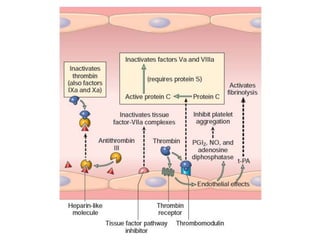
• Normal endothelium shields coagulation factors from tissue factor in
vessel walls and expresses multiple factors that actively oppose
coagulation, most notably thrombomodulin, endothelial protein C
receptor, heparin-like molecules, and tissue factor pathway inhibitor
(TFPI).
• Thrombomodulin and endothelial protein C receptor bind thrombin and
protein C, respectively, in a complex on the endothelial cell surface.
• When bound in this complex, thrombin loses its ability to activate
coagulation factors and platelets, and instead activates protein C, a
vitamin K–dependent protease that requires a cofactor, protein S
• Activated protein C/protein S complex is a potent inhibitor of coagulation
factors Va and VIIIa.
• Heparin-like molecules on the surface of
endothelium bind and activate antithrombin
III, which then inhibits thrombin and factors
IXa, Xa, XIa, and XIIa.
• The clinical utility of heparin and related drugs
is based on their ability to stimulate
antithrombin III activity.
• Tissue factor pathway inhibitor (TFPI), like
protein C, requires protein S as a cofactor and,
as the name implies, binds and inhibits tissue
factor/factor VIIa complexes.
Fibrinolytic effects
• Normal endothelial cells synthesize t-PA, as a
key component of the fibrinolytic pathway
Hemostasis
• Hemostasis is a precise process involving platelets, clotting
factors, and endothelium that occurs at the site of vascular
injury and culminates in the formation of a blood clot, which
serves to prevent or limit the extent of bleeding.
• The general sequence of events leading to hemostasis at a site
of vascular injury are
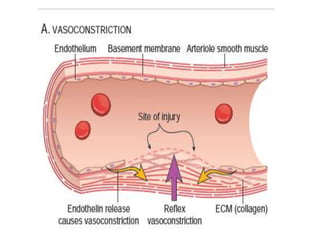
Arteriolar vasoconstriction
• occurs immediately and markedly reduces blood
flow to the injured area
• It is mediated by reflex neurogenic mechanisms
and augmented by the local secretion of factors
such as endothelin, a potent endothelium-derived
vasoconstrictor.
• This effect is transient.
Primary hemostasis
(the formation of the platelet plug)
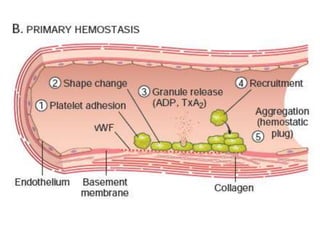
• Disruption of the endothelium exposes subendothelial
von Willebrand factor (vWF) and collagen, which
promote platelet adherence and activation.
• Activation of platelets results in a dramatic shape
change (from small rounded discs to flat plates with
spiky protrusions that markedly increased surface
area), as well as the release of secretory granules
• Within minutes the secreted products recruit
additional platelets, which undergo aggregation to
form a primary hemostatic plug
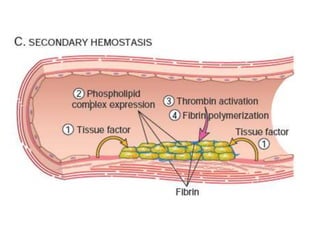
Secondary hemostasis
(deposition of fibrin)
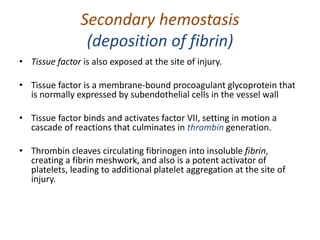
• Tissue factor is also exposed at the site of injury.
• Tissue factor is a membrane-bound procoagulant glycoprotein that
is normally expressed by subendothelial cells in the vessel wall
• Tissue factor binds and activates factor VII, setting in motion a
cascade of reactions that culminates in thrombin generation.
• Thrombin cleaves circulating fibrinogen into insoluble fibrin,
creating a fibrin meshwork, and also is a potent activator of
platelets, leading to additional platelet aggregation at the site of
injury.
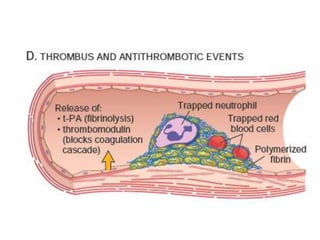
• Thrombin also converts fibrinogen into
insoluble fibrin, cementing the platelets in
place and creating the definitive secondary
hemostatic plug.
• Entrapped red cells and leukocytes are also
found in hemostatic plugs, in part due to
adherence of leukocytes to P-selectin
expressed on activated platelets.
Clot stabilization and resorption
• Polymerized fibrin and platelet aggregates
undergo contraction to form a solid, permanent
plug that prevents further hemorrhage.
• At this stage, counter regulatory mechanisms
(e.g., tissue plasminogen activator, t-PA) are set
into motion that limit clotting to the site of injury
and eventually lead to clot resorption and tissue
repair.
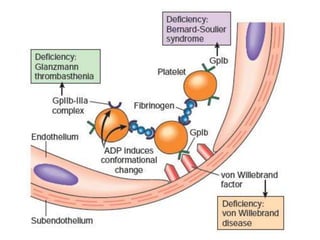
• Platelet adhesion is mediated largely via
interactions with vWF, which acts as a bridge
between the platelet surface receptor
glycoprotein Ib (GpIb) and exposed collagen.
• genetic deficiencies of Vwf (von Willebrand
disease, or GpIb (Bernard- Soulier syndrome)
result in bleeding disorders
• Platelet aggregation follows their activation.
• The conformational change in glycoprotein IIb/IIIa
that occurs with platelet activation allows binding
of fibrinogen, that forms bridges between
adjacent platelets, leading to their aggregation.
• Predictably, inherited deficiency of GpIIb-IIIa
results in a bleeding disorder called Glanzmann
thrombasthenia).
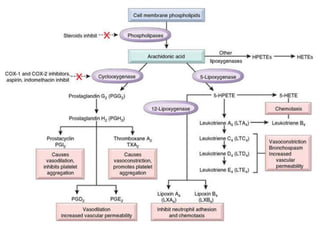
• Activated platelets also produce the
prostaglandin thromboxane A2 (TxA2), a
potent inducer of platelet aggregation.
• Aspirin inhibits platelet aggregation and
produces a mild bleeding defect by inhibiting
cyclooxygenase, a platelet enzyme that is
required for TxA2 synthesis.
Coagulation Cascade
• The coagulation cascade is series of amplifying
enzymatic reactions that leads to the
deposition of an insoluble fibrin clot.
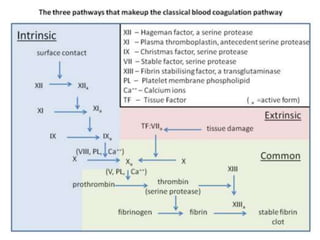
Coagulation cascade
• The coagulation cascade can follow the alternative routes
depending on an initiating factor
• The extrinsic pathway is initiated by tissue thromboplastin
(factor III) and involves calcium ions and factor VII.
• In the intrinsic pathway factor XII, XI, IX and VIII are activated
by exposure to sub endothelial collagen or foreign surfaces.
• Both pathways lead to the activation of factor X and proceed
along the common pathway and involves factors I, II, V, and X.
Extrinsic Pathway
• This pathway is quicker than the intrinsic
pathway.
• It involves factor VII.
Intrinsic Pathway
• The intrinsic pathway is activated by trauma inside the
vascular system, and is activated by platelets, exposed
endothelium, chemicals, or collagen.
• The contact activation pathway begins with formation of
the primary complex on collagen by high-molecular-weight
kininogen (HMWK), prekallikrein, and FXII (Hageman factor)
• This pathway is slower than the extrinsic pathway, but
more important.
• It involves factors XII, XI, IX, VIII.
Cell Proliferation: Signals and Control
Mechanisms
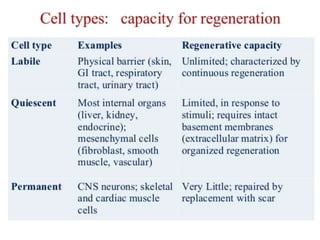
• The ability of tissues to repair themselves is
determined, in part, by their intrinsic
proliferative capacity. The tissues of the body
are divided into three groups.
• Labile (continuously dividing) tissues.
• Stable tissues.
• Permanent tissues.
• Labile (continuously dividing) tissues.
• Cells of these tissues are continuously being
lost and replaced by maturation from tissue
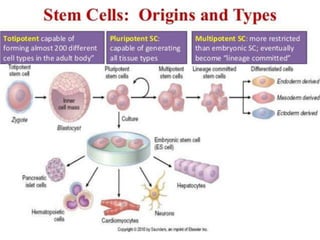
stem cells and by proliferation of mature cells.
• Labile cells include hematopoietic cells in the
bone marrow and the majority of surface
epithelia, such as the stratified squamous
epithelia of the skin, oral cavity, vagina, and
cervix etc.
• Stable tissues.
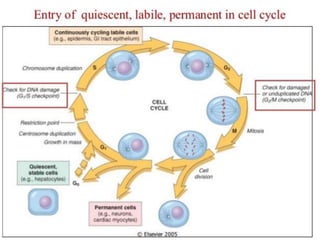
• Cells of these tissues are quiescent (in the G0
stage of the cell cycle) and have only minimal
proliferative activity in their normal state.
• However, these cells are capable of dividing in
response to injury or loss of tissue mass.
• Stable cells constitute the parenchyma of
most solid tissues, such as liver, kidney, and
pancreas.
Healing of Skin Wounds
• This is a process that involves both epithelial
regeneration and the formation of connective
tissue scar.
• Healing by First Intention
• When the injury involves only the epithelial layer,
the principal mechanism of repair is epithelial
regeneration, also called primary union or healing
by first intention.
• One of the simplest examples of this type of
wound repair is the healing of a clean, uninfected
surgical incision approximated by surgical sutures
• Healing by Second Intention
• When cell or tissue loss is more extensive,
such as in large wounds, abscesses, ulceration,
and ischemic necrosis (infarction) in
parenchymal organs, the repair process
involves a combination of regeneration and
scarring.
• In healing of skin wounds by second intention,
also known as healing by secondary union
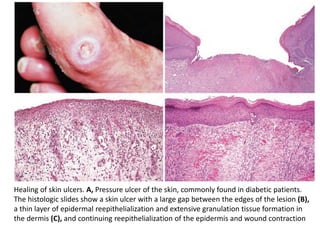
Healing of skin ulcers. A, Pressure ulcer of the skin, commonly found in diabetic patients.
The histologic slides show a skin ulcer with a large gap between the edges of the lesion (B),
a thin layer of epidermal reepithelialization and extensive granulation tissue formation in
the dermis (C), and continuing reepithelialization of the epidermis and wound contraction
Factors That Influence Tissue Repair
• Infection
• Diabetes
• Nutritional status
• Glucocorticoids (steroids)
• Mechanical factors
• Poor perfusion
• Foreign bodies
• The type and extent of tissue injury
Abnormalities in Tissue Repair
• Inadequate formation of granulation tissue or
formation of a scar can lead to two types of
complications:
• wound dehiscence and ulceration.
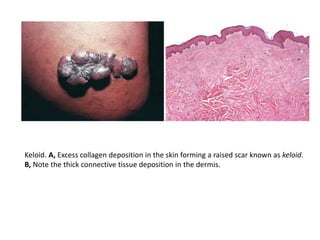
• Excessive formation of the components of the
repair process can give rise to hypertrophic
scars and keloids.
• Exuberant granulation
Keloid. A, Excess collagen deposition in the skin forming a raised scar known as keloid.
B, Note the thick connective tissue deposition in the dermis.

Haemodynamics

  • 1.
  • 2.
    Edema and Effusions •Disorders that perturb cardiovascular, renal, or hepatic function are often marked by the accumulation of fluid in tissues (edema) or body cavities (effusions). • Under normal circumstances, the tendency of vascular hydrostatic pressure to push water and salts out of capillaries into the interstitial space is nearly balanced by the tendency of plasma colloid oncotic pressure to pull water and salts back into vessels.
  • 3.
    • Elevated hydrostaticpressure or diminished colloid oncotic pressure disrupts this balance and results in increased movement of fluid out of vessels. • If the net rate of fluid movement exceeds the rate of lymphatic drainage, fluid accumulates. • Within tissues the result is edema, and if a serosal surface is involved, fluid may accumulate within the adjacent body cavity as an effusion.
  • 4.
    • Edema fluidsand effusions may be inflammatory or non inflammatory . • The protein-rich exudates accumulate due to increases in vascular permeability caused by inflammatory mediators. • Usually, inflammation-associated edema is localized to one or a few tissues, but in systemic inflammatory states, such as sepsis, that produce widespread endothelial injury and dysfunction, generalized edema may appear, often with severe consequences. • In contrast, noninflammatory edema and effusions are protein-poor fluids called transudates.
  • 5.
    • Noninflammatory edemaand effusions are common in many diseases, including heart failure, liver failure, renal disease, and severe nutritional disorders
  • 7.
    Increased Hydrostatic Pressure •Increases in hydrostatic pressure are mainly caused by disorders that impair venous return. • If the impairment is localized (e.g., a deep venous thrombosis [DVT] in a lower extremity), then the resulting edema is confined to the affected part. • Conditions leading to systemic increases in venous pressure e.g., congestive heart failure, are understandably associated with more widespread edema.
  • 8.
    Reduced Plasma OncoticPressure • Under normal circumstances albumin accounts for almost half of the total plasma protein; it follows that conditions leading to inadequate synthesis or increased loss of albumin from the circulation are common causes of reduced plasma oncotic pressure. • Reduced albumin synthesis occurs mainly in severe liver diseases e.g., end-stage Cirrhosis and protein malnutrition • An important cause of albumin loss is the nephrotic syndrome in which albumin leaks into the urine through abnormally permeable glomerular capillaries.
  • 9.
    • Regardless ofcause, reduced plasma oncotic pressure leads in a stepwise fashion to edema, reduced intravascular volume, renal hypoperfusion, and secondary hyperaldosteronism.
  • 10.
    Sodium and WaterRetention • Increased salt retention—with obligate retention of associated water—causes both increased hydrostatic pressure (due to intravascular fluid volume expansion) and diminished vascular colloid oncotic pressure (due to dilution). • Salt retention occurs whenever renal function is compromised, such as in primary kidney disorders and in cardiovascular disorders that decrease renal perfusion.
  • 11.
    • One ofthe most important causes of renal hypoperfusion is congestive heart failure, which (like hypoproteinemia) results in the activation of the renin- angiotensin-aldosterone axis. • In early heart failure, this response is beneficial, as the retention of sodium and water and other adaptations, including increased vascular tone and elevated levels of antidiuretic hormone, improve cardiac output and restore normal renal perfusion.
  • 12.
    • However, asheart failure worsens and cardiac output diminishes, the retained fluid merely increases the hydrostatic pressure, leading to edema and effusions.
  • 13.
    Lymphatic Obstruction • Trauma,fibrosis, invasive tumors, and infectious agents can all disrupt lymphatic vessels and impair the clearance of interstitial fluid, resulting in lymphedema in the affected part of the body. • A dramatic example is seen in parasitic filariasis, in which the organism induces obstructive fibrosis of lymphatic channels and lymph nodes. • This may result in edema of the external genitalia and lower limbs ……………..elephantiasis.
  • 14.
    • Severe edemaof the upper extremity may also complicate surgical removal and/or irradiation of the breast and associated axillary lymph nodes in patients with breast cancer.
  • 17.
    MORPHOLOGY • Edema iseasily recognized grossly; microscopically, it is appreciated as clearing and separation of the extracellular matrix and subtle cell swelling. • Any organ or tissue can be involved, but edema is most commonly seen in subcutaneous tissues, the lungs, and the brain. • Subcutaneous edema can be diffuse or more conspicuous in regions with high hydrostatic pressures. • Its distribution is often influenced by gravity (e.g., it appears in the legs when standing and the sacrum when recumbent), a feature termed dependent edema..
  • 18.
    • Finger pressureover markedly edematous subcutaneous tissue displaces the interstitial fluid and leaves a depression, a sign called pitting edema
  • 19.
    • Edema resultingfrom renal dysfunction often appears initially in parts of the body containing loose connective tissue, such as the eyelids • Periorbital edema is thus a characteristic finding in severe renal disease. • With pulmonary edema, the lungs are often two to three times their normal weight, and sectioning yields frothy, blood-tinged fluid—a mixture of air, edema, and extravasated red cells. • Brain edema can be localized or generalized depending on the nature and extent of the pathologic process or injury. • The swollen brain exhibits narrowed sulci and distended gyri
  • 20.
    • Effusions involvingthe pleural cavity (hydrothorax), the pericardial cavity (hydropericardium), or the peritoneal cavity (hydroperitoneum or ascites) • Transudative effusions are typically protein poor, translucent and straw colored. An exception are peritoneal effusions caused by lymphatic blockage (chylous effusion), which may be milky due to the presence of lipids absorbed from the gut. • In contrast, exudative effusions are protein-rich and often cloudy due to the presence of white cells.
  • 22.
    Hyperemia and Congestion •Hyperemia and congestion both stem from increased blood volumes within tissues, but have different underlying mechanisms and consequences. • Hyperemia is an active process in which arteriolar dilation (e.g., at sites of inflammation or in skeletal muscle during exercise) leads to increased blood flow. • Affected tissues turn red (erythema) because of increased delivery of oxygenated blood. • Congestion is a passive process resulting from reduced outflow of blood from a tissue. It can be systemic, as in cardiac failure, or localized, as in isolated venous obstruction.
  • 24.
    • As aresult of increased hydrostatic pressures, congestion commonly leads to edema. • In long-standing chronic passive congestion, the associated chronic hypoxia may result in ischemic tissue injury and scarring. • In chronically congested tissues, capillary rupture can also produce small hemorrhagic foci; subsequent catabolism of extravasated red cells can leave residual telltale clusters of hemosiderin laden macrophages
  • 31.
    Hemostasis, Hemorrhagic Disorders, andThrombosis • Hemostasis can be defined simply as the process by which “blood clots form at sites of vascular injury” Hemostasis is essential for life and is deranged to varying degrees in a broad range of disorders, which can be divided into two groups.
  • 32.
    • In hemorrhagicdisorders, characterized by excessive bleeding, hemostatic mechanisms are either blunted or insufficient to prevent abnormal blood loss. • By contrast, in thrombotic disorders blood clots (often referred to as thrombi) form within intact blood vessels or within the chambers of the heart.
  • 33.
    • This divisionbetween bleeding and thrombotic disorders sometimes breaks down, in that generalized activation of clotting sometimes paradoxically produces bleeding due to the consumption of coagulation factors, as in disseminated intravascular coagulation (DIC).
  • 34.
    Endothelium • The balancebetween the anticoagulant and procoagulant activities of endothelium often determines whether clot formation, propagation, or dissolution occurs. • Normal endothelial cells express a multitude of factors that inhibit the procoagulant activities of platelets and coagulation factors and that augment fibrinolysis • These factors act in concert to prevent thrombosis and to limit clotting to sites of vascular damage.
  • 35.
    Anti-platelet effect • Anobvious effect of intact endothelium is to serve as a barrier that shields platelets from subendothelial VWF and collagen • However, normal endothelium also releases a number of factors that inhibit platelet activation and aggregation. • Among the most important are prostacyclin (PGI2), nitric oxide (NO), and adenosine diphosphatase
  • 36.
    Anticoagulant effects • Normalendothelium shields coagulation factors from tissue factor in vessel walls and expresses multiple factors that actively oppose coagulation, most notably thrombomodulin, endothelial protein C receptor, heparin-like molecules, and tissue factor pathway inhibitor (TFPI). • Thrombomodulin and endothelial protein C receptor bind thrombin and protein C, respectively, in a complex on the endothelial cell surface. • When bound in this complex, thrombin loses its ability to activate coagulation factors and platelets, and instead activates protein C, a vitamin K–dependent protease that requires a cofactor, protein S • Activated protein C/protein S complex is a potent inhibitor of coagulation factors Va and VIIIa.
  • 37.
    • Heparin-like moleculeson the surface of endothelium bind and activate antithrombin III, which then inhibits thrombin and factors IXa, Xa, XIa, and XIIa. • The clinical utility of heparin and related drugs is based on their ability to stimulate antithrombin III activity.
  • 38.
    • Tissue factorpathway inhibitor (TFPI), like protein C, requires protein S as a cofactor and, as the name implies, binds and inhibits tissue factor/factor VIIa complexes.
  • 39.
    Fibrinolytic effects • Normalendothelial cells synthesize t-PA, as a key component of the fibrinolytic pathway
  • 41.
    Hemostasis • Hemostasis isa precise process involving platelets, clotting factors, and endothelium that occurs at the site of vascular injury and culminates in the formation of a blood clot, which serves to prevent or limit the extent of bleeding. • The general sequence of events leading to hemostasis at a site of vascular injury are
  • 42.
    Arteriolar vasoconstriction • occursimmediately and markedly reduces blood flow to the injured area • It is mediated by reflex neurogenic mechanisms and augmented by the local secretion of factors such as endothelin, a potent endothelium-derived vasoconstrictor. • This effect is transient.
  • 44.
    Primary hemostasis (the formationof the platelet plug) • Disruption of the endothelium exposes subendothelial von Willebrand factor (vWF) and collagen, which promote platelet adherence and activation. • Activation of platelets results in a dramatic shape change (from small rounded discs to flat plates with spiky protrusions that markedly increased surface area), as well as the release of secretory granules • Within minutes the secreted products recruit additional platelets, which undergo aggregation to form a primary hemostatic plug
  • 46.
    Secondary hemostasis (deposition offibrin) • Tissue factor is also exposed at the site of injury. • Tissue factor is a membrane-bound procoagulant glycoprotein that is normally expressed by subendothelial cells in the vessel wall • Tissue factor binds and activates factor VII, setting in motion a cascade of reactions that culminates in thrombin generation. • Thrombin cleaves circulating fibrinogen into insoluble fibrin, creating a fibrin meshwork, and also is a potent activator of platelets, leading to additional platelet aggregation at the site of injury.
  • 48.
    • Thrombin alsoconverts fibrinogen into insoluble fibrin, cementing the platelets in place and creating the definitive secondary hemostatic plug. • Entrapped red cells and leukocytes are also found in hemostatic plugs, in part due to adherence of leukocytes to P-selectin expressed on activated platelets.
  • 49.
    Clot stabilization andresorption • Polymerized fibrin and platelet aggregates undergo contraction to form a solid, permanent plug that prevents further hemorrhage. • At this stage, counter regulatory mechanisms (e.g., tissue plasminogen activator, t-PA) are set into motion that limit clotting to the site of injury and eventually lead to clot resorption and tissue repair.
  • 51.
    • Platelet adhesionis mediated largely via interactions with vWF, which acts as a bridge between the platelet surface receptor glycoprotein Ib (GpIb) and exposed collagen. • genetic deficiencies of Vwf (von Willebrand disease, or GpIb (Bernard- Soulier syndrome) result in bleeding disorders
  • 53.
    • Platelet aggregationfollows their activation. • The conformational change in glycoprotein IIb/IIIa that occurs with platelet activation allows binding of fibrinogen, that forms bridges between adjacent platelets, leading to their aggregation. • Predictably, inherited deficiency of GpIIb-IIIa results in a bleeding disorder called Glanzmann thrombasthenia).
  • 54.
    • Activated plateletsalso produce the prostaglandin thromboxane A2 (TxA2), a potent inducer of platelet aggregation. • Aspirin inhibits platelet aggregation and produces a mild bleeding defect by inhibiting cyclooxygenase, a platelet enzyme that is required for TxA2 synthesis.
  • 56.
    Coagulation Cascade • Thecoagulation cascade is series of amplifying enzymatic reactions that leads to the deposition of an insoluble fibrin clot.
  • 57.
    Coagulation cascade • Thecoagulation cascade can follow the alternative routes depending on an initiating factor • The extrinsic pathway is initiated by tissue thromboplastin (factor III) and involves calcium ions and factor VII. • In the intrinsic pathway factor XII, XI, IX and VIII are activated by exposure to sub endothelial collagen or foreign surfaces. • Both pathways lead to the activation of factor X and proceed along the common pathway and involves factors I, II, V, and X.
  • 58.
    Extrinsic Pathway • Thispathway is quicker than the intrinsic pathway. • It involves factor VII.
  • 59.
    Intrinsic Pathway • Theintrinsic pathway is activated by trauma inside the vascular system, and is activated by platelets, exposed endothelium, chemicals, or collagen. • The contact activation pathway begins with formation of the primary complex on collagen by high-molecular-weight kininogen (HMWK), prekallikrein, and FXII (Hageman factor) • This pathway is slower than the extrinsic pathway, but more important. • It involves factors XII, XI, IX, VIII.
  • 64.
    Cell Proliferation: Signalsand Control Mechanisms • The ability of tissues to repair themselves is determined, in part, by their intrinsic proliferative capacity. The tissues of the body are divided into three groups. • Labile (continuously dividing) tissues. • Stable tissues. • Permanent tissues.
  • 65.
    • Labile (continuouslydividing) tissues. • Cells of these tissues are continuously being lost and replaced by maturation from tissue stem cells and by proliferation of mature cells. • Labile cells include hematopoietic cells in the bone marrow and the majority of surface epithelia, such as the stratified squamous epithelia of the skin, oral cavity, vagina, and cervix etc.
  • 66.
    • Stable tissues. •Cells of these tissues are quiescent (in the G0 stage of the cell cycle) and have only minimal proliferative activity in their normal state. • However, these cells are capable of dividing in response to injury or loss of tissue mass. • Stable cells constitute the parenchyma of most solid tissues, such as liver, kidney, and pancreas.
  • 67.
    Healing of SkinWounds • This is a process that involves both epithelial regeneration and the formation of connective tissue scar. • Healing by First Intention • When the injury involves only the epithelial layer, the principal mechanism of repair is epithelial regeneration, also called primary union or healing by first intention. • One of the simplest examples of this type of wound repair is the healing of a clean, uninfected surgical incision approximated by surgical sutures
  • 68.
    • Healing bySecond Intention • When cell or tissue loss is more extensive, such as in large wounds, abscesses, ulceration, and ischemic necrosis (infarction) in parenchymal organs, the repair process involves a combination of regeneration and scarring. • In healing of skin wounds by second intention, also known as healing by secondary union
  • 69.
    Healing of skinulcers. A, Pressure ulcer of the skin, commonly found in diabetic patients. The histologic slides show a skin ulcer with a large gap between the edges of the lesion (B), a thin layer of epidermal reepithelialization and extensive granulation tissue formation in the dermis (C), and continuing reepithelialization of the epidermis and wound contraction
  • 70.
    Factors That InfluenceTissue Repair • Infection • Diabetes • Nutritional status • Glucocorticoids (steroids) • Mechanical factors • Poor perfusion • Foreign bodies • The type and extent of tissue injury
  • 71.
    Abnormalities in TissueRepair • Inadequate formation of granulation tissue or formation of a scar can lead to two types of complications: • wound dehiscence and ulceration. • Excessive formation of the components of the repair process can give rise to hypertrophic scars and keloids. • Exuberant granulation
  • 72.
    Keloid. A, Excesscollagen deposition in the skin forming a raised scar known as keloid. B, Note the thick connective tissue deposition in the dermis.