Amputations
Dr .Waqas Arshad Bajwa
Indications
• Gangrene due to atherosclerosis, embolism, TAO, diabetes.
• Trauma: To save life in crush injuries.
• Neoplasms: Osteosarcomas, Marjolin’s ulcer, melanomas.
• Gas gangrene.
• Severe sepsis.
• Occasionally severe elephantiasis, madura foot, when all other
methods have failed to help.
• Dead, dying, devitalised tissues.
• Severe deformity congenital or acquired
Types
• Non-end bearing/side bearing—Weight is taken up by the joint.
• End bearing/cone bearing—Weight is taken up by the body.
• Weight bearing.
• Non-weight bearing
• Provisional amputation with flap—later final formal amputation my
be required.
• Guillotine amputation which always requires revision formal
amputation.
• Formal amputation—is definitive one.
Types of flaps
• Long posterior flap in below-knee amputation.
• Equal flaps in above-knee amputation.
Ideal Stump
• Should heal adequately by 1st intention.
• Should have rounded, gentle contour, with adequate muscle padding.
• Should have sufficient length to bear prosthesis.
• For B-K 7.5 (minimum) to 12.5 cm from tibial tuberosity
• For above and below elbow 20 cm stump.
• For A-K 23 cm from greater trochanter.
• Should have thin scar which does not interfere with prosthetic
function.
• Should have adequate adjacent joint movement.
• Should have adequate blood supply.
• Scar should be in a place where it is not exposed to pressure
• Scar should be freely mobile over underlying tissues
• Stump should be free from tenderness and conical.
• Skin should not be infolded.
Evaluation of the Patients who need Amputation
• Haematocrit, control of anaemia by transfusing blood/packed cells.
• Control of infection using antibiotics.
• Decision of level of amputation by skin temperature, arte_x0002_rial
Doppler.
• Informed consent should be taken.
• Plan for prosthesis and rehabilitation by physiotherapist and
rehabilitation team.
Principles in Amputation
• Adequate blood supply of the flap should be maintained.
• Proper marking of the skin incision is essential.
• Tourniquet should not be used if amputation is done for vascular diseases.
• Proximal part of the flap contains muscle component but distal part should
contain only skin and deep fascia.
• Flap length should be adequate; not short. It should be ideally semicircular
not rectangular to get a conical stump.
• Nerve should be pulled down and cut using a sharp knife and allowed to
retract into the soft tissue otherwise neuromas may develop
• Bone should be cut with beveling and all sharp margins should be
rounded
• Stumps can be side bearing (sutures are on the side) end
bearing/conical (sutures are on the end) or cylindrical.
• Postoperatively active exercise should be given to the proximal joint
so that prosthesis can be fit to it properly.
• Proper anatomy of muscles and neurovascular bundle around should
be known in all amputations.
Different incisions for amputation
• Circular incision amputation—skin and muscles are divided circularly
at a lower level than that of bone
• Elliptical/oval incision amputation
• Racquet incision amputation—for digital disarticulation
• Amputation using flaps—it may be of equal flap (above-knee
amputation) or with long posterior single flap (below-knee
amputation).
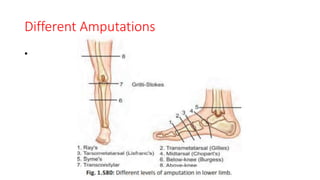
Different Amputations
•
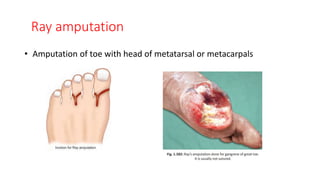
Ray amputation
• Amputation of toe with head of metatarsal or metacarpals
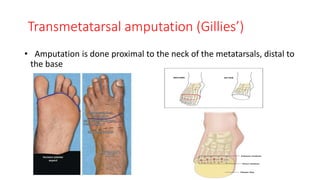
Transmetatarsal amputation (Gillies’)
• Amputation is done proximal to the neck of the metatarsals, distal to
the base
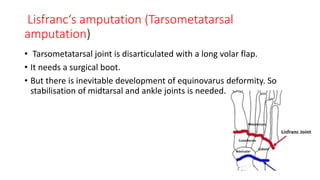
Lisfranc‘s amputation (Tarsometatarsal
amputation)
• Tarsometatarsal joint is disarticulated with a long volar flap.
• It needs a surgical boot.
• But there is inevitable development of equinovarus deformity. So
stabilisation of midtarsal and ankle joints is needed.
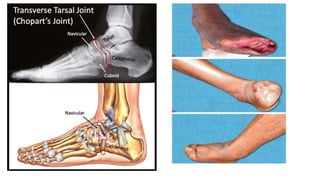
Chopart‘s amputation (Midtarsal amputation)
• Talonvicular joint and calcaneo-cuboid joints are disarticulated.
• Tibialis anterior muscle is sutured to drilled talus bone.
• A long volar flap is used and immobilised for 6 weeks after surgery.
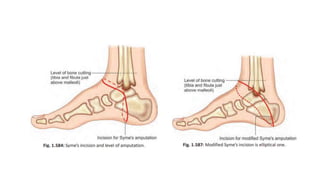
Syme’s amputation
• It is removal of the foot with calcaneum and cutting of tibia and
fibula just above the ankle joint with retaining heel flap (dividing both
malleoli).
• Heel flap is supplied by medial and lateral calcaneal vessels (branches
of posterior tibial artery).
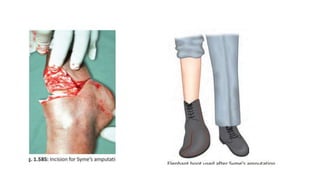
• Elephant boot is used for the limb after Syme’s which is inexpensive.
Many patients walk well with Syme’s stump without difficulty.
• It is presently mainly used in trauma (crush injury) and malignancies
in distal part of the foot.
• In vascular diseases, calcaneal vessels may not be adequate to
maintain the viability of the flap.
• While raising the flap, knife should be very close to the calcaneum so
as to avoid injury to calcaneal vessels and to maintain the viability of
the flap.
• Advantages —it is an end-bearing stump having good
proprioception.
• Patient can walk without prosthesis.
• Low energy consumption ambulation is possible.
• Disadvantages
• posterior displacement of heel pad
• poor cosmesis
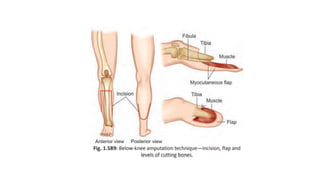
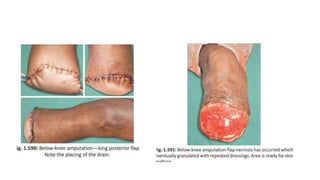
Below-knee amputation ( Burgess amputation)
• we use a long-posterior flap with scar placed over anterior aspect is
used.
• Prosthesis placement is better here with greater range of movements
without limp and without support.
•
Principles
• Tibial stump should be beveled anteriorly.
• Posterior muscles are sutured across the bone end, to the
periosteum in front.
• More proximal type of below-knee amputation, fibula often is
removed to allow the proper use of flap.
• Length of the flap should be 11/2 times the circumference of the site
(around 12 cm).
• Stump length is 14–17 cm from knee joint.
• Minimum length required for prosthesis is 8 cm.
• Modern artificial limbs like suction socket prosthesis
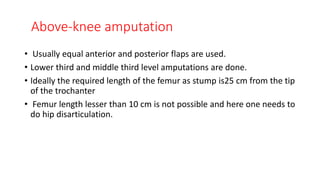
Above-knee amputation
• Usually equal anterior and posterior flaps are used.
• Lower third and middle third level amputations are done.
• Ideally the required length of the femur as stump is25 cm from the tip
of the trochanter
• Femur length lesser than 10 cm is not possible and here one needs to
do hip disarticulation.
• In children as growing epiphysis of femur is in lower end, it is
essential to preserve as much length of femur as possible.
• It is done in ischaemia, trauma, sepsis, gangrene
• It is usually contraindicated in children (done only in undue definitive
indication) or if stump is less than 7.5 cm.
Postoperative Period
• Physiotherapy is advised.
• Regular dressings are done.
• Crutch is used initially, after 3 months prosthesis is placed.
• Rehabilitation is important
COMPLICATIONS OF AMPUTATIONS
Early
Haemorrhage
haematoma
infection
Late
Pain
Ulceration of stump
Ring sequestrum formation
Flap necrosis
Painful scar
Phantom limb—feeling of amputated part or partially with pain over
it.

Amputations.pptx

  • 1.
  • 2.
    Indications • Gangrene dueto atherosclerosis, embolism, TAO, diabetes. • Trauma: To save life in crush injuries. • Neoplasms: Osteosarcomas, Marjolin’s ulcer, melanomas. • Gas gangrene. • Severe sepsis. • Occasionally severe elephantiasis, madura foot, when all other methods have failed to help. • Dead, dying, devitalised tissues. • Severe deformity congenital or acquired
  • 3.
    Types • Non-end bearing/sidebearing—Weight is taken up by the joint. • End bearing/cone bearing—Weight is taken up by the body. • Weight bearing. • Non-weight bearing • Provisional amputation with flap—later final formal amputation my be required. • Guillotine amputation which always requires revision formal amputation. • Formal amputation—is definitive one.
  • 4.
    Types of flaps •Long posterior flap in below-knee amputation. • Equal flaps in above-knee amputation.
  • 5.
    Ideal Stump • Shouldheal adequately by 1st intention. • Should have rounded, gentle contour, with adequate muscle padding. • Should have sufficient length to bear prosthesis. • For B-K 7.5 (minimum) to 12.5 cm from tibial tuberosity • For above and below elbow 20 cm stump. • For A-K 23 cm from greater trochanter.
  • 6.
    • Should havethin scar which does not interfere with prosthetic function. • Should have adequate adjacent joint movement. • Should have adequate blood supply. • Scar should be in a place where it is not exposed to pressure • Scar should be freely mobile over underlying tissues • Stump should be free from tenderness and conical. • Skin should not be infolded.
  • 7.
    Evaluation of thePatients who need Amputation • Haematocrit, control of anaemia by transfusing blood/packed cells. • Control of infection using antibiotics. • Decision of level of amputation by skin temperature, arte_x0002_rial Doppler. • Informed consent should be taken. • Plan for prosthesis and rehabilitation by physiotherapist and rehabilitation team.
  • 8.
    Principles in Amputation •Adequate blood supply of the flap should be maintained. • Proper marking of the skin incision is essential. • Tourniquet should not be used if amputation is done for vascular diseases. • Proximal part of the flap contains muscle component but distal part should contain only skin and deep fascia. • Flap length should be adequate; not short. It should be ideally semicircular not rectangular to get a conical stump. • Nerve should be pulled down and cut using a sharp knife and allowed to retract into the soft tissue otherwise neuromas may develop
  • 9.
    • Bone shouldbe cut with beveling and all sharp margins should be rounded • Stumps can be side bearing (sutures are on the side) end bearing/conical (sutures are on the end) or cylindrical. • Postoperatively active exercise should be given to the proximal joint so that prosthesis can be fit to it properly. • Proper anatomy of muscles and neurovascular bundle around should be known in all amputations.
  • 10.
    Different incisions foramputation • Circular incision amputation—skin and muscles are divided circularly at a lower level than that of bone • Elliptical/oval incision amputation • Racquet incision amputation—for digital disarticulation • Amputation using flaps—it may be of equal flap (above-knee amputation) or with long posterior single flap (below-knee amputation).
  • 11.
  • 12.
    Ray amputation • Amputationof toe with head of metatarsal or metacarpals
  • 13.
    Transmetatarsal amputation (Gillies’) •Amputation is done proximal to the neck of the metatarsals, distal to the base
  • 14.
    Lisfranc‘s amputation (Tarsometatarsal amputation) •Tarsometatarsal joint is disarticulated with a long volar flap. • It needs a surgical boot. • But there is inevitable development of equinovarus deformity. So stabilisation of midtarsal and ankle joints is needed.
  • 15.
    Chopart‘s amputation (Midtarsalamputation) • Talonvicular joint and calcaneo-cuboid joints are disarticulated. • Tibialis anterior muscle is sutured to drilled talus bone. • A long volar flap is used and immobilised for 6 weeks after surgery.
  • 17.
    Syme’s amputation • Itis removal of the foot with calcaneum and cutting of tibia and fibula just above the ankle joint with retaining heel flap (dividing both malleoli). • Heel flap is supplied by medial and lateral calcaneal vessels (branches of posterior tibial artery). • Elephant boot is used for the limb after Syme’s which is inexpensive. Many patients walk well with Syme’s stump without difficulty.
  • 18.
    • It ispresently mainly used in trauma (crush injury) and malignancies in distal part of the foot. • In vascular diseases, calcaneal vessels may not be adequate to maintain the viability of the flap. • While raising the flap, knife should be very close to the calcaneum so as to avoid injury to calcaneal vessels and to maintain the viability of the flap.
  • 19.
    • Advantages —itis an end-bearing stump having good proprioception. • Patient can walk without prosthesis. • Low energy consumption ambulation is possible. • Disadvantages • posterior displacement of heel pad • poor cosmesis
  • 22.
    Below-knee amputation (Burgess amputation) • we use a long-posterior flap with scar placed over anterior aspect is used. • Prosthesis placement is better here with greater range of movements without limp and without support. •
  • 23.
    Principles • Tibial stumpshould be beveled anteriorly. • Posterior muscles are sutured across the bone end, to the periosteum in front. • More proximal type of below-knee amputation, fibula often is removed to allow the proper use of flap.
  • 24.
    • Length ofthe flap should be 11/2 times the circumference of the site (around 12 cm). • Stump length is 14–17 cm from knee joint. • Minimum length required for prosthesis is 8 cm. • Modern artificial limbs like suction socket prosthesis
  • 27.
    Above-knee amputation • Usuallyequal anterior and posterior flaps are used. • Lower third and middle third level amputations are done. • Ideally the required length of the femur as stump is25 cm from the tip of the trochanter • Femur length lesser than 10 cm is not possible and here one needs to do hip disarticulation.
  • 28.
    • In childrenas growing epiphysis of femur is in lower end, it is essential to preserve as much length of femur as possible. • It is done in ischaemia, trauma, sepsis, gangrene • It is usually contraindicated in children (done only in undue definitive indication) or if stump is less than 7.5 cm.
  • 29.
    Postoperative Period • Physiotherapyis advised. • Regular dressings are done. • Crutch is used initially, after 3 months prosthesis is placed. • Rehabilitation is important
  • 30.
  • 31.
    Late Pain Ulceration of stump Ringsequestrum formation Flap necrosis Painful scar Phantom limb—feeling of amputated part or partially with pain over it.