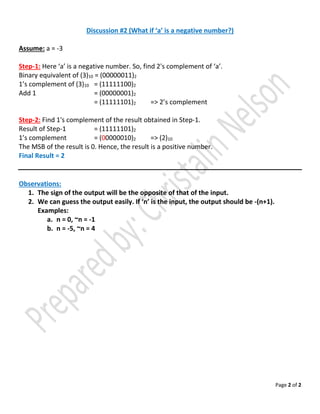
The document discusses the bitwise complement operator (~) in Java. It provides an example where a is declared as a byte with a value of 1. The output of ~a is -2. This is explained through a step-by-step process showing the 1's and 2's complement calculations to get from the binary representation of 1 to -2. The document also discusses what would happen if a was a negative number, walking through an example where a is -3 and the output of ~a is 2.
![Page 1 of 2
Bitwise complement operator (tilde ~) in Java language
Problem: Let integer a=1. Find ~a using a Java program.
Program:
class tilde
{
public static void main(String args[])
{
byte a =1; //Here 1B memory is sufficient. Hence use ‘byte’ data type.
System.out.println("Complement of ” + a + “ is “ + ~a);
}
}
Output:
Complement of 1 is -2
Discussion #1 (How the output is -2?)
Step-1: Here ‘a’ = 1, a positive number. So, find 1's complement of ‘a’.
Binary equivalent of ‘a’ = (00000001)2
1’s complement of ‘a’ = (11111110)2 => (254)10
The Leftmost bit (Most Significant Bit, MSB) of the result is 1 (i.e. negative). Hence, remember
the sign of the result and proceed to Step-2.
Step-2: Find 2's complement of the result obtained in Step-1.
2's complement of a number can be obtained by adding 1 to the 1's complement of that number.
Result of Step-1 = (254)10
Binary equivalent of (254)10 = (11111110)2
1’s complement (254)10 = (00000001)2
Add 1 = (00000001)2
2's complement of (254)10 = (00000010)2 => (2)10
Step-3: Compute the Final result.
Remembering the sign from Step-1 & value from Step-2
Final Result = -2](https://image.slidesharecdn.com/bitwisecomplementoperator-220831095558-faa894f4/85/Bitwise-complement-operator-1-320.jpg)
![Page 1 of 2
Bitwise complement operator (tilde ~) in Java language
Problem: Let integer a=1. Find ~a using a Java program.
Program:
class tilde
{
public static void main(String args[])
{
byte a =1; //Here 1B memory is sufficient. Hence use ‘byte’ data type.
System.out.println("Complement of ” + a + “ is “ + ~a);
}
}
Output:
Complement of 1 is -2
Discussion #1 (How the output is -2?)
Step-1: Here ‘a’ = 1, a positive number. So, find 1's complement of ‘a’.
Binary equivalent of ‘a’ = (00000001)2
1’s complement of ‘a’ = (11111110)2 => (254)10
The Leftmost bit (Most Significant Bit, MSB) of the result is 1 (i.e. negative). Hence, remember
the sign of the result and proceed to Step-2.
Step-2: Find 2's complement of the result obtained in Step-1.
2's complement of a number can be obtained by adding 1 to the 1's complement of that number.
Result of Step-1 = (254)10
Binary equivalent of (254)10 = (11111110)2
1’s complement (254)10 = (00000001)2
Add 1 = (00000001)2
2's complement of (254)10 = (00000010)2 => (2)10
Step-3: Compute the Final result.
Remembering the sign from Step-1 & value from Step-2
Final Result = -2](https://image.slidesharecdn.com/bitwisecomplementoperator-220831095558-faa894f4/75/Bitwise-complement-operator-1-2048.jpg)