Application of Stacks
By
S. Christalin Nelson
Formula Translation
 The Problem: Writing formula or arithmetic
expressions in something close to their usual
mathematical/scientific form
 One of the most important accomplishments of early
design computer languages in designing a compiler that
understood expressions & to produce a machine-
language output.
 In fact, the name FORTRAN stands for FORMULA
TRANSLATOR.
2 of 27
3/17/2022
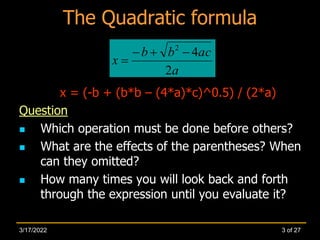
The Quadratic formula
x = (-b + (b*b – (4*a)*c)^0.5) / (2*a)
Question
 Which operation must be done before others?
 What are the effects of the parentheses? When
can they omitted?
 How many times you will look back and forth
through the expression until you evaluate it?
a
ac
b
b
x
2
4
2




3 of 27
3/17/2022
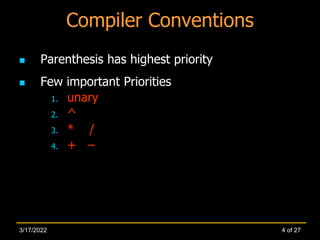
Compiler Conventions
 Parenthesis has highest priority
 Few important Priorities
1. unary
2. ^
3. * /
4. + –
4 of 27
3/17/2022
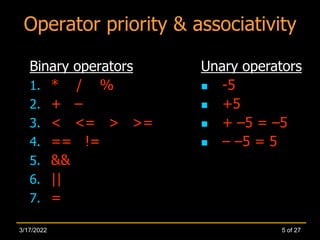
Operator priority & associativity
Binary operators
1. * / %
2. + –
3. < <= > >=
4. == !=
5. &&
6. ||
7. =
Unary operators
 -5
 +5
 + –5 = –5
 – –5 = 5
5 of 27
3/17/2022
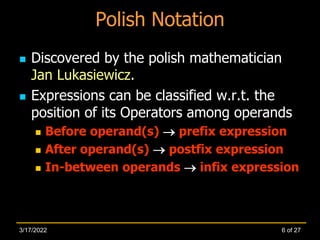
Polish Notation
 Discovered by the polish mathematician
Jan Lukasiewicz.
 Expressions can be classified w.r.t. the
position of its Operators among operands
 Before operand(s)  prefix expression
 After operand(s)  postfix expression
 In-between operands  infix expression
6 of 27
3/17/2022
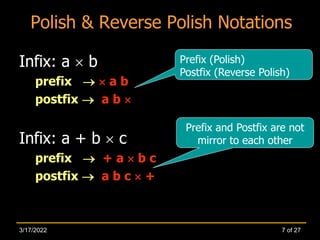
Polish & Reverse Polish Notations
Infix: a  b
prefix   a b
postfix  a b 
Infix: a + b  c
prefix  + a  b c
postfix  a b c  +
Prefix and Postfix are not
mirror to each other
Prefix (Polish)
Postfix (Reverse Polish)
7 of 27
3/17/2022
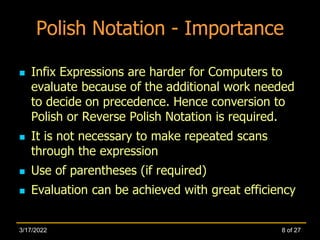
Polish Notation - Importance
 Infix Expressions are harder for Computers to
evaluate because of the additional work needed
to decide on precedence. Hence conversion to
Polish or Reverse Polish Notation is required.
 It is not necessary to make repeated scans
through the expression
 Use of parentheses (if required)
 Evaluation can be achieved with great efficiency
8 of 27
3/17/2022
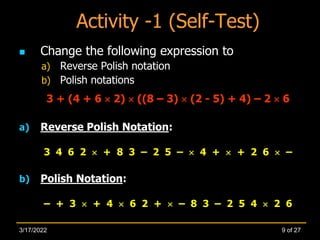
Activity -1 (Self-Test)
 Change the following expression to
a) Reverse Polish notation
b) Polish notations
3 + (4 + 6  2)  ((8 – 3)  (2 - 5) + 4) – 2  6
a) Reverse Polish Notation:
3 4 6 2  + 8 3 – 2 5 –  4 +  + 2 6  –
b) Polish Notation:
– + 3  + 4  6 2 +  – 8 3 – 2 5 4  2 6
9 of 27
3/17/2022
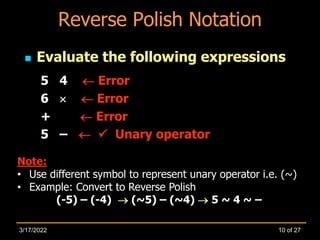
 Evaluate the following expressions
5 4  Error
6   Error
+  Error
5 –   Unary operator
Reverse Polish Notation
Note:
• Use different symbol to represent unary operator i.e. (~)
• Example: Convert to Reverse Polish
(-5) – (-4)  (~5) – (~4)  5 ~ 4 ~ –
10 of 27
3/17/2022
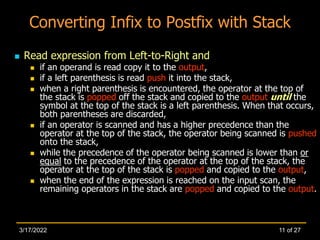
Converting Infix to Postfix with Stack
 Read expression from Left-to-Right and
 if an operand is read copy it to the output,
 if a left parenthesis is read push it into the stack,
 when a right parenthesis is encountered, the operator at the top of
the stack is popped off the stack and copied to the output until the
symbol at the top of the stack is a left parenthesis. When that occurs,
both parentheses are discarded,
 if an operator is scanned and has a higher precedence than the
operator at the top of the stack, the operator being scanned is pushed
onto the stack,
 while the precedence of the operator being scanned is lower than or
equal to the precedence of the operator at the top of the stack, the
operator at the top of the stack is popped and copied to the output,
 when the end of the expression is reached on the input scan, the
remaining operators in the stack are popped and copied to the output.
11 of 27
3/17/2022
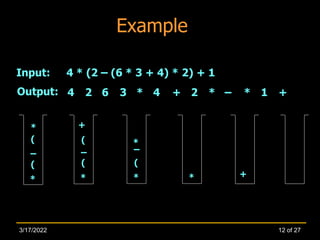
Example
*
(
–
(
*
Input: 4 * (2 – (6 * 3 + 4) * 2) + 1
Output:
*
(
–
(
+
*
(
–
*
*
4 2 6 3 * 4 + 2 * – *
+
1 +
12 of 27
3/17/2022
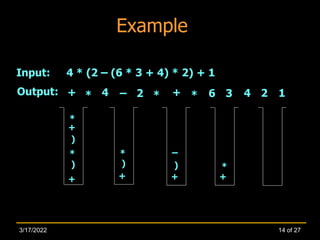
Converting Infix to Prefix with Stack
1st method
 Read expression from Right-to-Left and
 if an operand is read copy it to the RIGHT of the output,
 if a right parenthesis is read push it into the stack,
 when a left parenthesis is encountered, the operator at the top of the
stack is popped off the stack and copied to the output until the
symbol at the top of the stack is a right parenthesis. When that
occurs, both parentheses are discarded,
 if an operator is scanned and has a higher or equal precedence than
the operator at the top of the stack, the operator being scanned is
pushed onto the stack,
 while the precedence of the operator being scanned is lower than to
the precedence of the operator at the top of the stack, the operator at
the top of the stack is popped and copied to the output,
 when the end of the expression is reached on the input scan, the
remaining operators in the stack are popped and copied to the LEFT
of the output.
13 of 27
3/17/2022
Example
+
)
*
)
+
Input: 4 * (2 – (6 * 3 + 4) * 2) + 1
Output:
–
*
+ * 4 – 2 * + * 6 4 2 1
3
+
)
*
+
)
+
*
14 of 27
3/17/2022
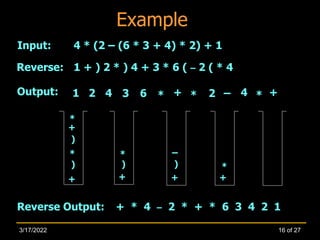
Converting Infix to Prefix with Stack
2nd method
 Reverse the expression & Read expression from Left-to-Right
 if an operand is read copy it to the output (left-to-right)
 if a right parenthesis is read push it into the stack
 when a left parenthesis is encountered, the operator at the top of the
stack is popped off the stack and copied to the output until the
symbol at the top of the stack is a right parenthesis. When that
occurs, both parentheses are discarded.
 if an operator is scanned and has a higher or equal precedence than
the operator at the top of the stack, the operator being scanned is
pushed onto the stack
 while the precedence of the operator being scanned is lower than to
the precedence of the operator at the top of the stack, the operator at
the top of the stack is popped and copied to the output
 when the end of the expression is reached on the input scan, the
remaining operators in the stack are popped and copied to the output.
 Reverse the output
15 of 27
3/17/2022
Example
+
)
*
)
+
Input: 4 * (2 – (6 * 3 + 4) * 2) + 1
Output:
–
*
+
*
4
–
2
*
+
*
6
4
2
1 3
+
)
*
+
)
+
*
1 + ) 2 * ) 4 + 3 * 6 ( – 2 ( * 4
Reverse:
+ * 4 – 2 * + * 6 3 4 2 1
Reverse Output:
16 of 27
3/17/2022
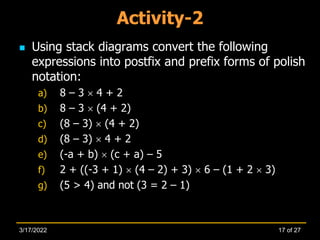
Activity-2
 Using stack diagrams convert the following
expressions into postfix and prefix forms of polish
notation:
a) 8 – 3  4 + 2
b) 8 – 3  (4 + 2)
c) (8 – 3)  (4 + 2)
d) (8 – 3)  4 + 2
e) (-a + b)  (c + a) – 5
f) 2 + ((-3 + 1)  (4 – 2) + 3)  6 – (1 + 2  3)
g) (5 > 4) and not (3 = 2 – 1)
17 of 27
3/17/2022
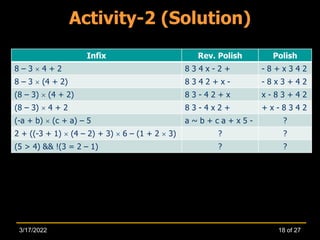
Activity-2 (Solution)
Infix Rev. Polish Polish
8 – 3  4 + 2 8 3 4 x - 2 + - 8 + x 3 4 2
8 – 3  (4 + 2) 8 3 4 2 + x - - 8 x 3 + 4 2
(8 – 3)  (4 + 2) 8 3 - 4 2 + x x - 8 3 + 4 2
(8 – 3)  4 + 2 8 3 - 4 x 2 + + x - 8 3 4 2
(-a + b)  (c + a) – 5 a ~ b + c a + x 5 - ?
2 + ((-3 + 1)  (4 – 2) + 3)  6 – (1 + 2  3) ? ?
(5 > 4) && !(3 = 2 – 1) ? ?
18 of 27
3/17/2022
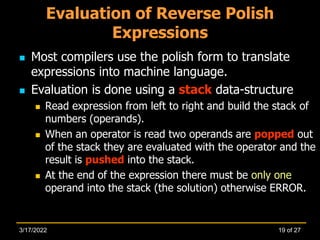
Evaluation of Reverse Polish
Expressions
 Most compilers use the polish form to translate
expressions into machine language.
 Evaluation is done using a stack data-structure
 Read expression from left to right and build the stack of
numbers (operands).
 When an operator is read two operands are popped out
of the stack they are evaluated with the operator and the
result is pushed into the stack.
 At the end of the expression there must be only one
operand into the stack (the solution) otherwise ERROR.
19 of 27
3/17/2022
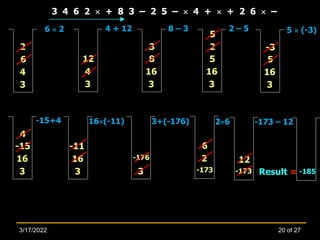
5
3
3 4 6 2  + 8 3 – 2 5 –  4 +  + 2 6  –
3
4
6
2
6  2
3
4
12
4 + 12
3
16
8
8 – 3
2
3
16
5
2 – 5
-3
3
16
5
5  (-3)
4
3
16
-15
-15+4
3
16
-11
16(-11)
3
-176
3+(-176)
-173
2
6
26
-173
12
-173 – 12
-185
Result =
20 of 27
3/17/2022
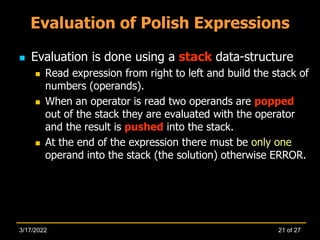
Evaluation of Polish Expressions
 Evaluation is done using a stack data-structure
 Read expression from right to left and build the stack of
numbers (operands).
 When an operator is read two operands are popped
out of the stack they are evaluated with the operator
and the result is pushed into the stack.
 At the end of the expression there must be only one
operand into the stack (the solution) otherwise ERROR.
21 of 27
3/17/2022
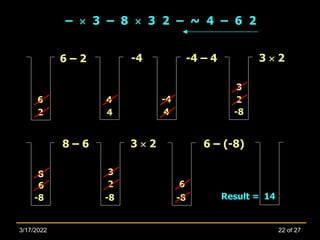
3
–  3 – 8  3 2 – ~ 4 – 6 2
2
6
6 – 2
4
4
-4
4
-4
-4 – 4
2
-8
3  2
6
-8
8
8 – 6
3
-8
2
3  2
-8
6
6 – (-8)
14
Result =
22 of 27
3/17/2022
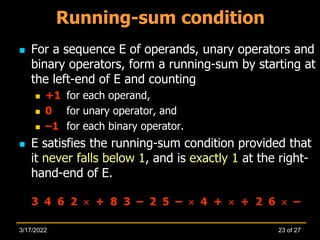
Running-sum condition
 For a sequence E of operands, unary operators and
binary operators, form a running-sum by starting at
the left-end of E and counting
 +1 for each operand,
 0 for unary operator, and
 –1 for each binary operator.
 E satisfies the running-sum condition provided that
it never falls below 1, and is exactly 1 at the right-
hand-end of E.
3 4 6 2  + 8 3 – 2 5 –  4 +  + 2 6  –
23 of 27
3/17/2022
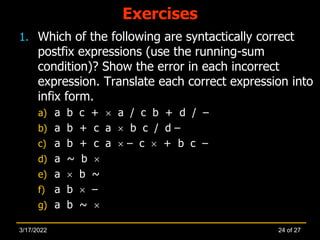
Exercises
1. Which of the following are syntactically correct
postfix expressions (use the running-sum
condition)? Show the error in each incorrect
expression. Translate each correct expression into
infix form.
a) a b c +  a / c b + d / –
b) a b + c a  b c / d –
c) a b + c a  – c  + b c –
d) a ~ b 
e) a  b ~
f) a b  –
g) a b ~ 
24 of 27
3/17/2022
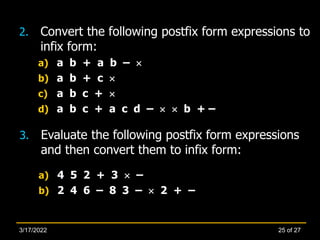
2. Convert the following postfix form expressions to
infix form:
a) a b + a b – 
b) a b + c 
c) a b c + 
d) a b c + a c d –   b + –
3. Evaluate the following postfix form expressions
and then convert them to infix form:
a) 4 5 2 + 3  –
b) 2 4 6 – 8 3 –  2 + –
25 of 27
3/17/2022
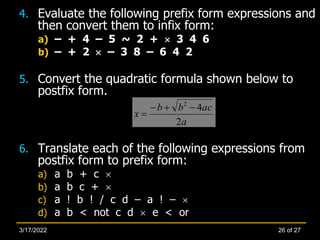
4. Evaluate the following prefix form expressions and
then convert them to infix form:
a) – + 4 – 5 ~ 2 +  3 4 6
b) – + 2  – 3 8 – 6 4 2
5. Convert the quadratic formula shown below to
postfix form.
6. Translate each of the following expressions from
postfix form to prefix form:
a) a b + c 
b) a b c + 
c) a ! b ! / c d – a ! – 
d) a b < not c d  e < or
a
ac
b
b
x
2
4
2




26 of 27
3/17/2022
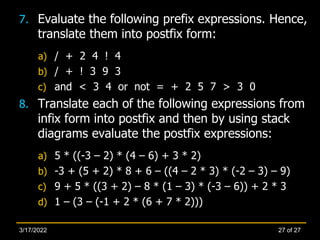
7. Evaluate the following prefix expressions. Hence,
translate them into postfix form:
a) / + 2 4 ! 4
b) / + ! 3 9 3
c) and < 3 4 or not = + 2 5 7 > 3 0
8. Translate each of the following expressions from
infix form into postfix and then by using stack
diagrams evaluate the postfix expressions:
a) 5 * ((-3 – 2) * (4 – 6) + 3 * 2)
b) -3 + (5 + 2) * 8 + 6 – ((4 – 2 * 3) * (-2 – 3) – 9)
c) 9 + 5 * ((3 + 2) – 8 * (1 – 3) * (-3 – 6)) + 2 * 3
d) 1 – (3 – (-1 + 2 * (6 + 7 * 2)))
27 of 27
3/17/2022

Applications of Stack

  • 1.
    Application of Stacks By S.Christalin Nelson
  • 2.
    Formula Translation  TheProblem: Writing formula or arithmetic expressions in something close to their usual mathematical/scientific form  One of the most important accomplishments of early design computer languages in designing a compiler that understood expressions & to produce a machine- language output.  In fact, the name FORTRAN stands for FORMULA TRANSLATOR. 2 of 27 3/17/2022
  • 3.
    The Quadratic formula x= (-b + (b*b – (4*a)*c)^0.5) / (2*a) Question  Which operation must be done before others?  What are the effects of the parentheses? When can they omitted?  How many times you will look back and forth through the expression until you evaluate it? a ac b b x 2 4 2     3 of 27 3/17/2022
  • 4.
    Compiler Conventions  Parenthesishas highest priority  Few important Priorities 1. unary 2. ^ 3. * / 4. + – 4 of 27 3/17/2022
  • 5.
    Operator priority &associativity Binary operators 1. * / % 2. + – 3. < <= > >= 4. == != 5. && 6. || 7. = Unary operators  -5  +5  + –5 = –5  – –5 = 5 5 of 27 3/17/2022
  • 6.
    Polish Notation  Discoveredby the polish mathematician Jan Lukasiewicz.  Expressions can be classified w.r.t. the position of its Operators among operands  Before operand(s)  prefix expression  After operand(s)  postfix expression  In-between operands  infix expression 6 of 27 3/17/2022
  • 7.
    Polish & ReversePolish Notations Infix: a  b prefix   a b postfix  a b  Infix: a + b  c prefix  + a  b c postfix  a b c  + Prefix and Postfix are not mirror to each other Prefix (Polish) Postfix (Reverse Polish) 7 of 27 3/17/2022
  • 8.
    Polish Notation -Importance  Infix Expressions are harder for Computers to evaluate because of the additional work needed to decide on precedence. Hence conversion to Polish or Reverse Polish Notation is required.  It is not necessary to make repeated scans through the expression  Use of parentheses (if required)  Evaluation can be achieved with great efficiency 8 of 27 3/17/2022
  • 9.
    Activity -1 (Self-Test) Change the following expression to a) Reverse Polish notation b) Polish notations 3 + (4 + 6  2)  ((8 – 3)  (2 - 5) + 4) – 2  6 a) Reverse Polish Notation: 3 4 6 2  + 8 3 – 2 5 –  4 +  + 2 6  – b) Polish Notation: – + 3  + 4  6 2 +  – 8 3 – 2 5 4  2 6 9 of 27 3/17/2022
  • 10.
     Evaluate thefollowing expressions 5 4  Error 6   Error +  Error 5 –   Unary operator Reverse Polish Notation Note: • Use different symbol to represent unary operator i.e. (~) • Example: Convert to Reverse Polish (-5) – (-4)  (~5) – (~4)  5 ~ 4 ~ – 10 of 27 3/17/2022
  • 11.
    Converting Infix toPostfix with Stack  Read expression from Left-to-Right and  if an operand is read copy it to the output,  if a left parenthesis is read push it into the stack,  when a right parenthesis is encountered, the operator at the top of the stack is popped off the stack and copied to the output until the symbol at the top of the stack is a left parenthesis. When that occurs, both parentheses are discarded,  if an operator is scanned and has a higher precedence than the operator at the top of the stack, the operator being scanned is pushed onto the stack,  while the precedence of the operator being scanned is lower than or equal to the precedence of the operator at the top of the stack, the operator at the top of the stack is popped and copied to the output,  when the end of the expression is reached on the input scan, the remaining operators in the stack are popped and copied to the output. 11 of 27 3/17/2022
  • 12.
    Example * ( – ( * Input: 4 *(2 – (6 * 3 + 4) * 2) + 1 Output: * ( – ( + * ( – * * 4 2 6 3 * 4 + 2 * – * + 1 + 12 of 27 3/17/2022
  • 13.
    Converting Infix toPrefix with Stack 1st method  Read expression from Right-to-Left and  if an operand is read copy it to the RIGHT of the output,  if a right parenthesis is read push it into the stack,  when a left parenthesis is encountered, the operator at the top of the stack is popped off the stack and copied to the output until the symbol at the top of the stack is a right parenthesis. When that occurs, both parentheses are discarded,  if an operator is scanned and has a higher or equal precedence than the operator at the top of the stack, the operator being scanned is pushed onto the stack,  while the precedence of the operator being scanned is lower than to the precedence of the operator at the top of the stack, the operator at the top of the stack is popped and copied to the output,  when the end of the expression is reached on the input scan, the remaining operators in the stack are popped and copied to the LEFT of the output. 13 of 27 3/17/2022
  • 14.
    Example + ) * ) + Input: 4 *(2 – (6 * 3 + 4) * 2) + 1 Output: – * + * 4 – 2 * + * 6 4 2 1 3 + ) * + ) + * 14 of 27 3/17/2022
  • 15.
    Converting Infix toPrefix with Stack 2nd method  Reverse the expression & Read expression from Left-to-Right  if an operand is read copy it to the output (left-to-right)  if a right parenthesis is read push it into the stack  when a left parenthesis is encountered, the operator at the top of the stack is popped off the stack and copied to the output until the symbol at the top of the stack is a right parenthesis. When that occurs, both parentheses are discarded.  if an operator is scanned and has a higher or equal precedence than the operator at the top of the stack, the operator being scanned is pushed onto the stack  while the precedence of the operator being scanned is lower than to the precedence of the operator at the top of the stack, the operator at the top of the stack is popped and copied to the output  when the end of the expression is reached on the input scan, the remaining operators in the stack are popped and copied to the output.  Reverse the output 15 of 27 3/17/2022
  • 16.
    Example + ) * ) + Input: 4 *(2 – (6 * 3 + 4) * 2) + 1 Output: – * + * 4 – 2 * + * 6 4 2 1 3 + ) * + ) + * 1 + ) 2 * ) 4 + 3 * 6 ( – 2 ( * 4 Reverse: + * 4 – 2 * + * 6 3 4 2 1 Reverse Output: 16 of 27 3/17/2022
  • 17.
    Activity-2  Using stackdiagrams convert the following expressions into postfix and prefix forms of polish notation: a) 8 – 3  4 + 2 b) 8 – 3  (4 + 2) c) (8 – 3)  (4 + 2) d) (8 – 3)  4 + 2 e) (-a + b)  (c + a) – 5 f) 2 + ((-3 + 1)  (4 – 2) + 3)  6 – (1 + 2  3) g) (5 > 4) and not (3 = 2 – 1) 17 of 27 3/17/2022
  • 18.
    Activity-2 (Solution) Infix Rev.Polish Polish 8 – 3  4 + 2 8 3 4 x - 2 + - 8 + x 3 4 2 8 – 3  (4 + 2) 8 3 4 2 + x - - 8 x 3 + 4 2 (8 – 3)  (4 + 2) 8 3 - 4 2 + x x - 8 3 + 4 2 (8 – 3)  4 + 2 8 3 - 4 x 2 + + x - 8 3 4 2 (-a + b)  (c + a) – 5 a ~ b + c a + x 5 - ? 2 + ((-3 + 1)  (4 – 2) + 3)  6 – (1 + 2  3) ? ? (5 > 4) && !(3 = 2 – 1) ? ? 18 of 27 3/17/2022
  • 19.
    Evaluation of ReversePolish Expressions  Most compilers use the polish form to translate expressions into machine language.  Evaluation is done using a stack data-structure  Read expression from left to right and build the stack of numbers (operands).  When an operator is read two operands are popped out of the stack they are evaluated with the operator and the result is pushed into the stack.  At the end of the expression there must be only one operand into the stack (the solution) otherwise ERROR. 19 of 27 3/17/2022
  • 20.
    5 3 3 4 62  + 8 3 – 2 5 –  4 +  + 2 6  – 3 4 6 2 6  2 3 4 12 4 + 12 3 16 8 8 – 3 2 3 16 5 2 – 5 -3 3 16 5 5  (-3) 4 3 16 -15 -15+4 3 16 -11 16(-11) 3 -176 3+(-176) -173 2 6 26 -173 12 -173 – 12 -185 Result = 20 of 27 3/17/2022
  • 21.
    Evaluation of PolishExpressions  Evaluation is done using a stack data-structure  Read expression from right to left and build the stack of numbers (operands).  When an operator is read two operands are popped out of the stack they are evaluated with the operator and the result is pushed into the stack.  At the end of the expression there must be only one operand into the stack (the solution) otherwise ERROR. 21 of 27 3/17/2022
  • 22.
    3 –  3– 8  3 2 – ~ 4 – 6 2 2 6 6 – 2 4 4 -4 4 -4 -4 – 4 2 -8 3  2 6 -8 8 8 – 6 3 -8 2 3  2 -8 6 6 – (-8) 14 Result = 22 of 27 3/17/2022
  • 23.
    Running-sum condition  Fora sequence E of operands, unary operators and binary operators, form a running-sum by starting at the left-end of E and counting  +1 for each operand,  0 for unary operator, and  –1 for each binary operator.  E satisfies the running-sum condition provided that it never falls below 1, and is exactly 1 at the right- hand-end of E. 3 4 6 2  + 8 3 – 2 5 –  4 +  + 2 6  – 23 of 27 3/17/2022
  • 24.
    Exercises 1. Which ofthe following are syntactically correct postfix expressions (use the running-sum condition)? Show the error in each incorrect expression. Translate each correct expression into infix form. a) a b c +  a / c b + d / – b) a b + c a  b c / d – c) a b + c a  – c  + b c – d) a ~ b  e) a  b ~ f) a b  – g) a b ~  24 of 27 3/17/2022
  • 25.
    2. Convert thefollowing postfix form expressions to infix form: a) a b + a b –  b) a b + c  c) a b c +  d) a b c + a c d –   b + – 3. Evaluate the following postfix form expressions and then convert them to infix form: a) 4 5 2 + 3  – b) 2 4 6 – 8 3 –  2 + – 25 of 27 3/17/2022
  • 26.
    4. Evaluate thefollowing prefix form expressions and then convert them to infix form: a) – + 4 – 5 ~ 2 +  3 4 6 b) – + 2  – 3 8 – 6 4 2 5. Convert the quadratic formula shown below to postfix form. 6. Translate each of the following expressions from postfix form to prefix form: a) a b + c  b) a b c +  c) a ! b ! / c d – a ! –  d) a b < not c d  e < or a ac b b x 2 4 2     26 of 27 3/17/2022
  • 27.
    7. Evaluate thefollowing prefix expressions. Hence, translate them into postfix form: a) / + 2 4 ! 4 b) / + ! 3 9 3 c) and < 3 4 or not = + 2 5 7 > 3 0 8. Translate each of the following expressions from infix form into postfix and then by using stack diagrams evaluate the postfix expressions: a) 5 * ((-3 – 2) * (4 – 6) + 3 * 2) b) -3 + (5 + 2) * 8 + 6 – ((4 – 2 * 3) * (-2 – 3) – 9) c) 9 + 5 * ((3 + 2) – 8 * (1 – 3) * (-3 – 6)) + 2 * 3 d) 1 – (3 – (-1 + 2 * (6 + 7 * 2))) 27 of 27 3/17/2022