The document discusses Godel's incompleteness theorems and Hilbert's program. It provides background on key figures like Hilbert, Godel, Russell and Cantor. It then explains Hilbert's program to formalize all of mathematics and prove its consistency. Godel showed that any theory capable of elementary arithmetic cannot be both consistent and complete. Specifically, for any formal theory T including basic arithmetic truths, T includes a statement of its own consistency if and only if T is inconsistent.
In this document
Powered by AI
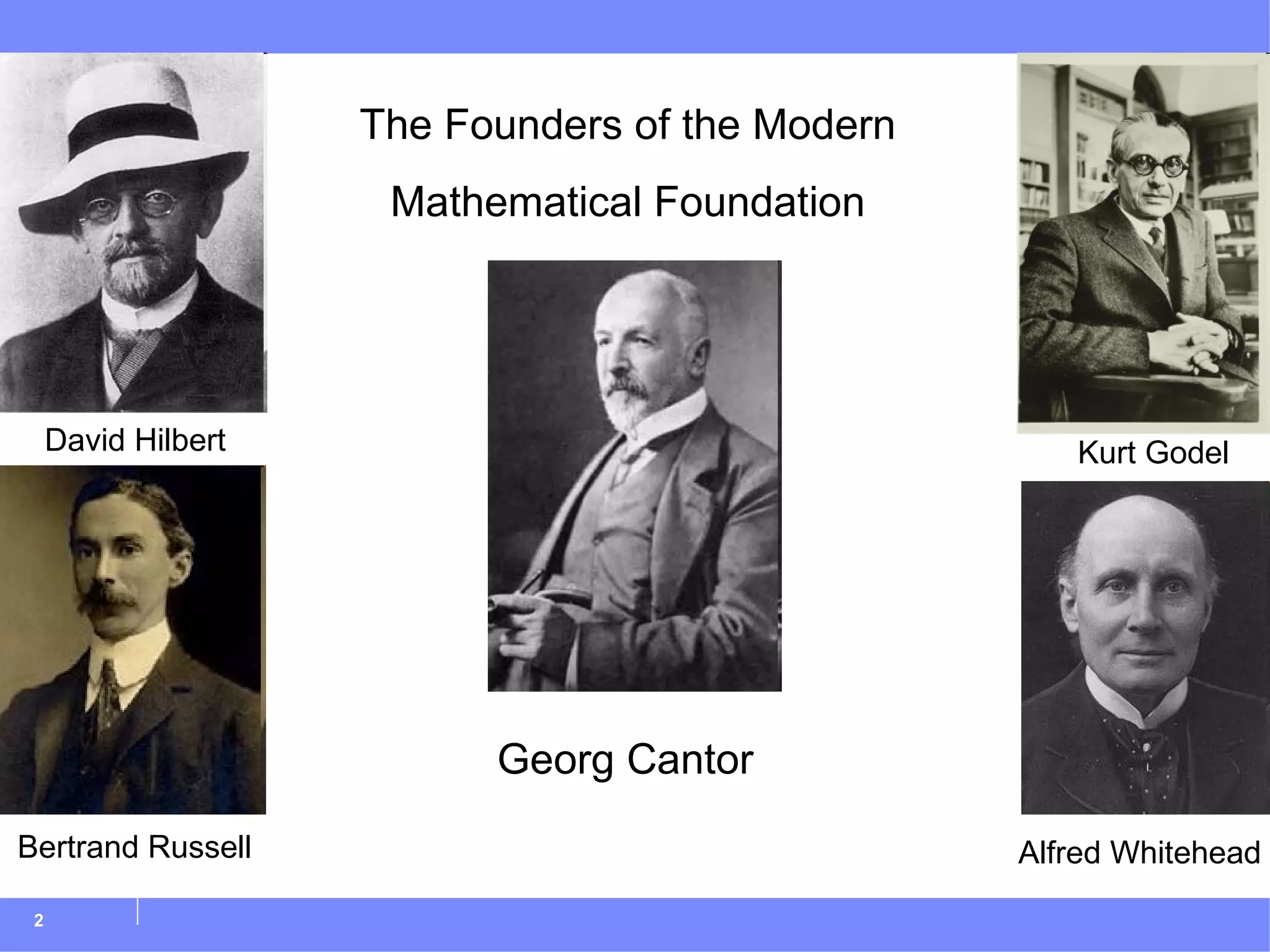
Introduces key figures like Godel, Hilbert, Russell, and Cantor in the development of mathematical logic.
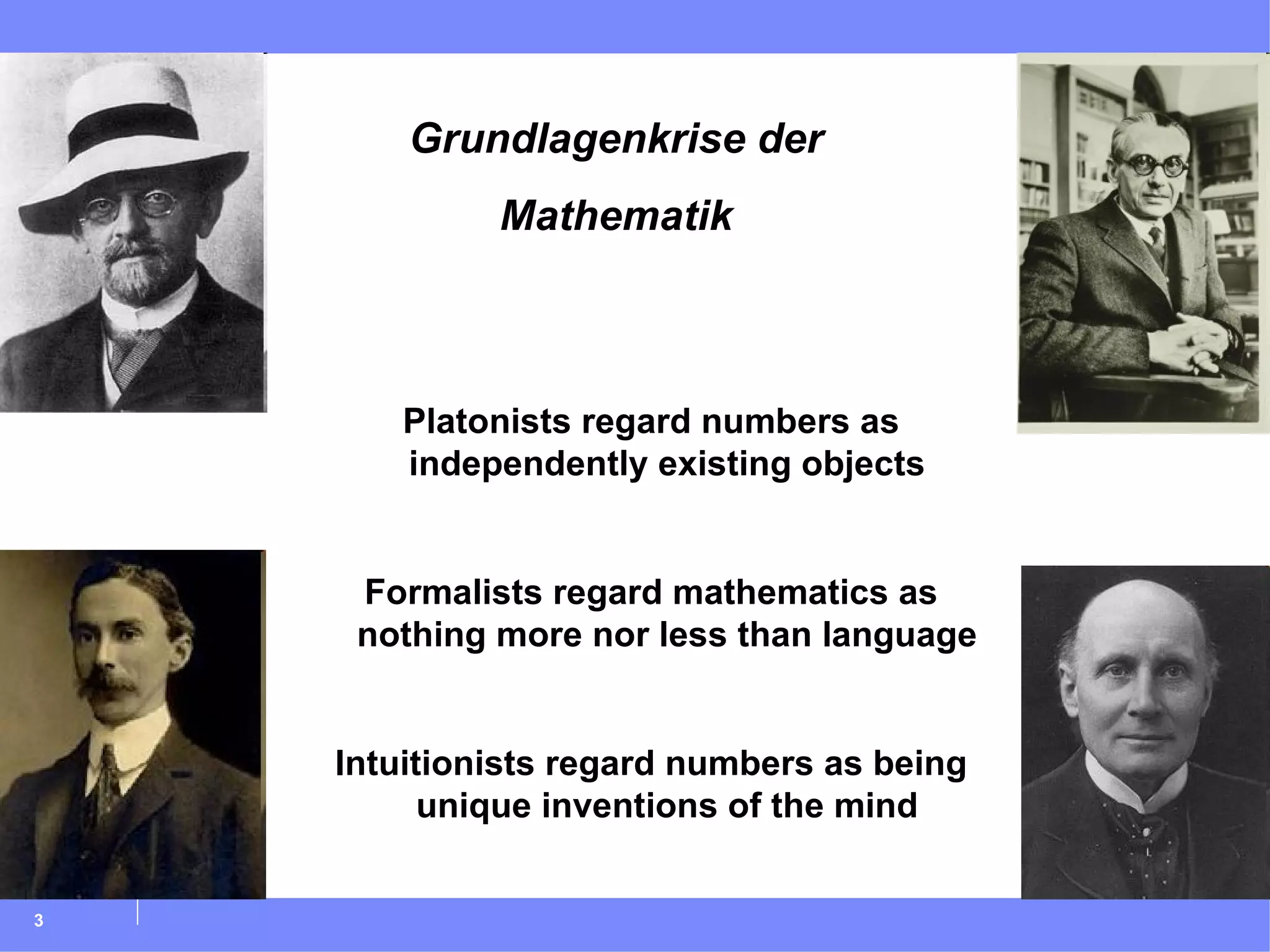
Discusses different philosophical perspectives on mathematics: Platonism, Formalism, and Intuitionism.
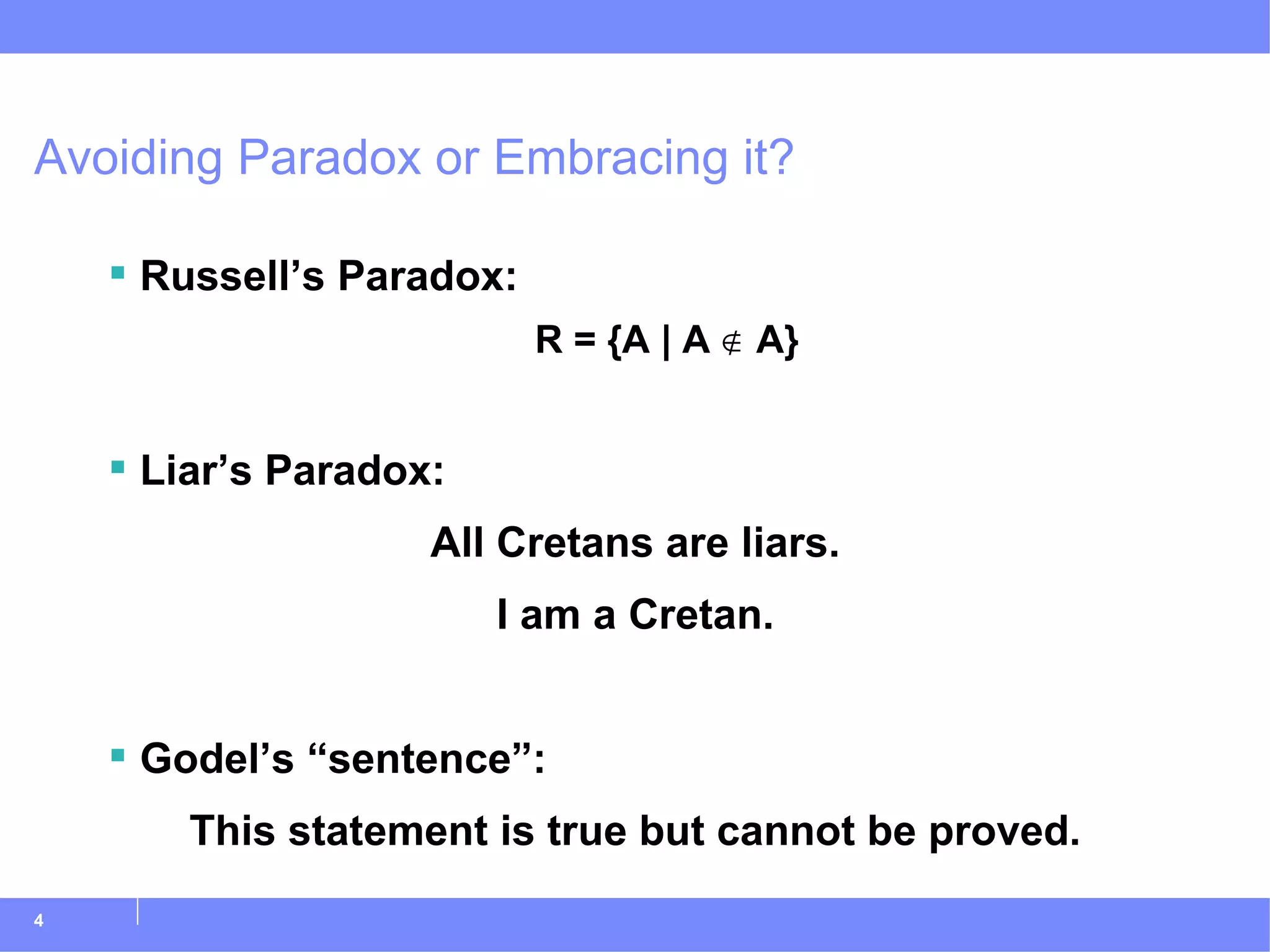
Examines paradoxes such as Russell’s Paradox and Liar’s Paradox, highlighting their implications in mathematical logic.
Outlines the second problem posed by Hilbert regarding the proof of non-contradictory axioms.
Details Hilbert’s program aimed at formalizing mathematics, ensuring consistency, completeness, and decidability.
States Godel's key theorem that any sufficiently strong mathematical theory cannot be both consistent and complete.
Introduces a machine that prints sentences, exploring whether it can print all true sentences, leading to undecidability.
Describes Godel numbering and correctness conditions for logical systems, formalizing sentences and their truths.
Explains diagonalization as a method for proving the existence of unprovable sentences in formal systems.
Discusses concepts of decidability and consistency, leading to Godel's Second Incompleteness Theorem and implications for Hilbert’s program.
Concludes that Hilbert's aim to formalize mathematics completely is unattainable due to inherent incompleteness.
David Hilbert KurtGodel Bertrand Russell Alfred Whitehead Georg Cantor The Founders of the Modern Mathematical Foundation
3.
Platonists regard numbersas independently existing objects Formalists regard mathematics as nothing more nor less than language Intuitionists regard numbers as being unique inventions of the mind Grundlagenkrise der Mathematik
4.
Avoiding Paradox orEmbracing it? Russell’s Paradox: R = {A | A ∉ A} Liar’s Paradox: All Cretans are liars. I am a Cretan. Godel’s “sentence”: This statement is true but cannot be proved.
5.
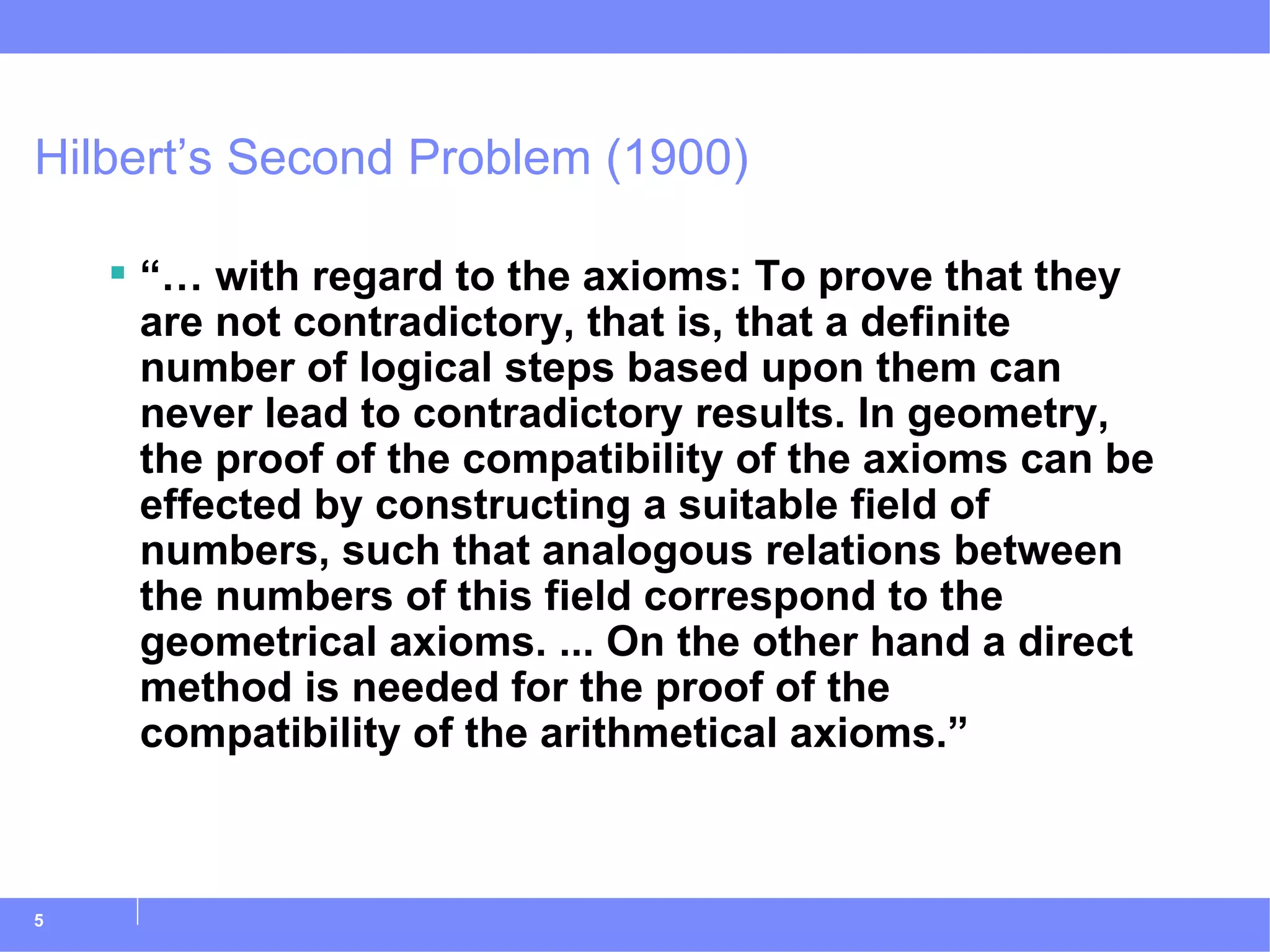
Hilbert’s Second Problem(1900) “… with regard to the axioms: To prove that they are not contradictory, that is, that a definite number of logical steps based upon them can never lead to contradictory results. In geometry, the proof of the compatibility of the axioms can be effected by constructing a suitable field of numbers, such that analogous relations between the numbers of this field correspond to the geometrical axioms. ... On the other hand a direct method is needed for the proof of the compatibility of the arithmetical axioms.”
6.
Hilbert’s Program (circa1921) A formalization of all mathematics; in other words all mathematical statements should be written in a precise formal language, and manipulated according to well defined rules
7.
Hilbert’s Program Formalization: the principle that all mathematical statements should be written in a precise formal language, and manipulated according to well defined rules. Consistency: a proof that no contradiction can be obtained in the formalism of mathematics. This consistency proof should preferably use only "finitistic" reasoning about finite mathematical objects.
8.
Hilbert’s Program Completeness: a proof that all true mathematical statements can be proved in the formalism. Decidability: there should be an algorithm for deciding the truth or falsity of any mathematical statement.
9.
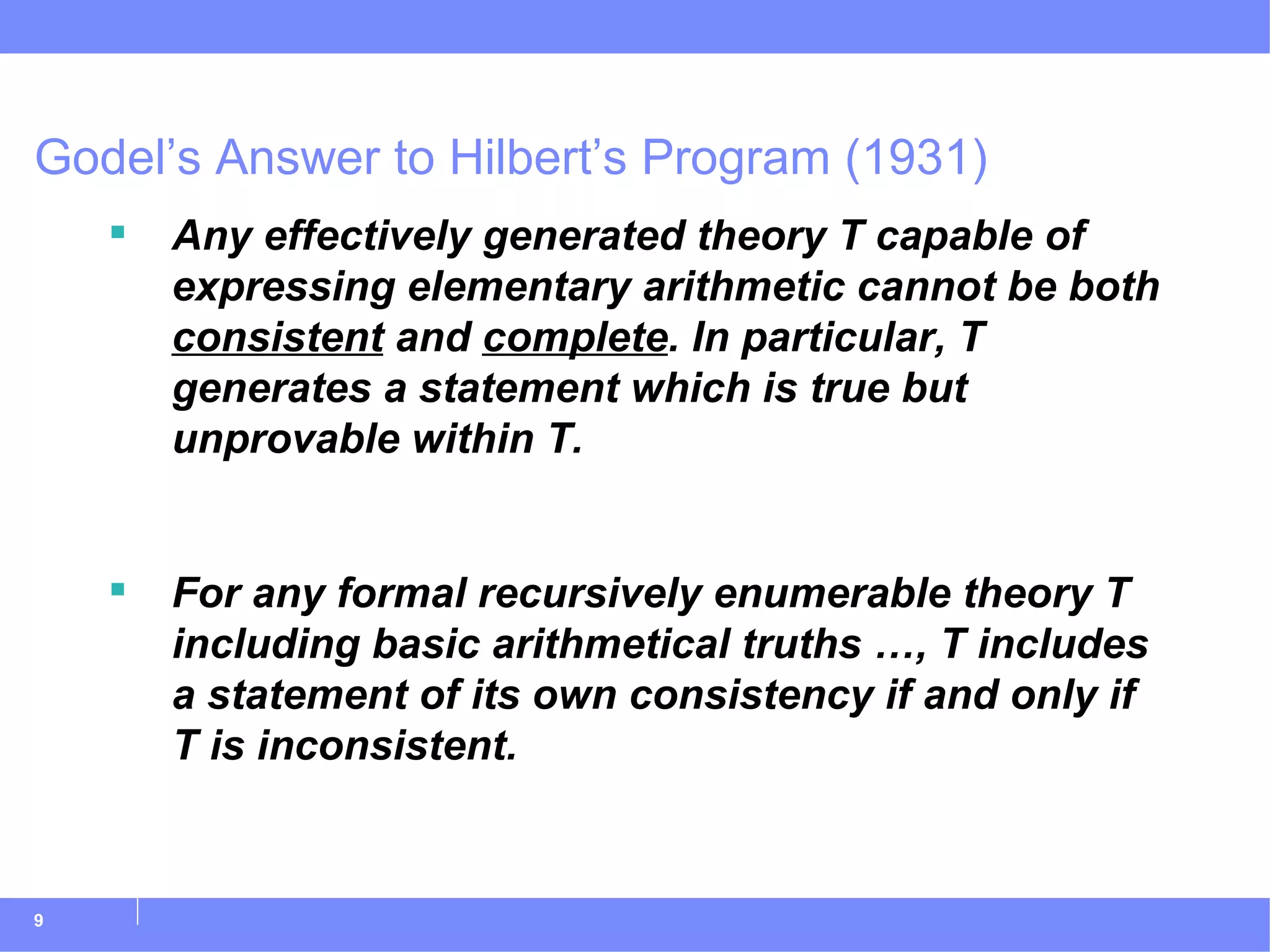
Godel’s Answer toHilbert’s Program (1931) Any effectively generated theory T capable of expressing elementary arithmetic cannot be both consistent and complete . In particular, T generates a statement which is true but unprovable within T. For any formal recursively enumerable theory T including basic arithmetical truths …, T includes a statement of its own consistency if and only if T is inconsistent.
10.
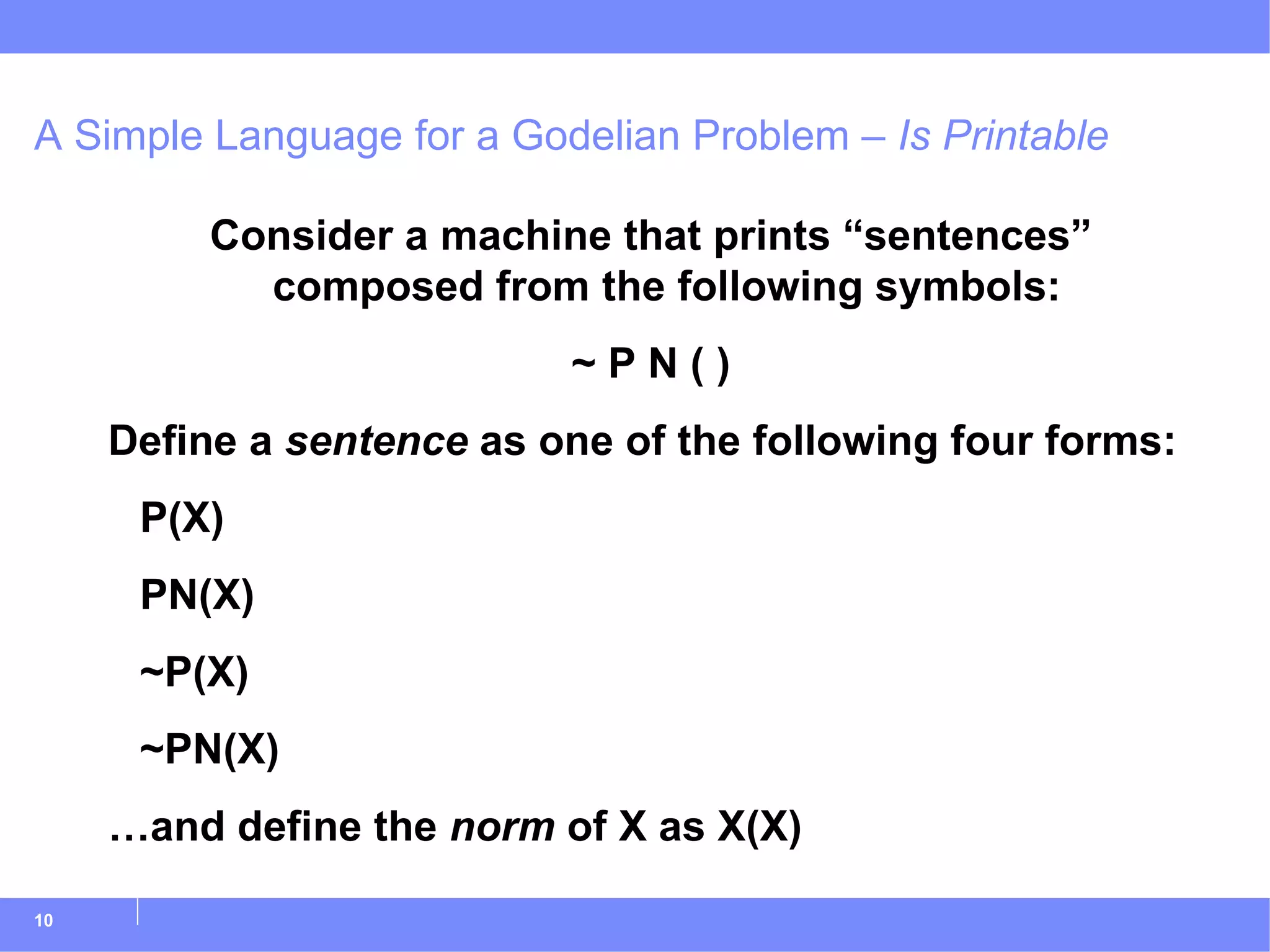
A Simple Languagefor a Godelian Problem – Is Printable Consider a machine that prints “sentences” composed from the following symbols: ~ P N ( ) Define a sentence as one of the following four forms: P(X) PN(X) ~P(X) ~PN(X) … and define the norm of X as X(X)
11.
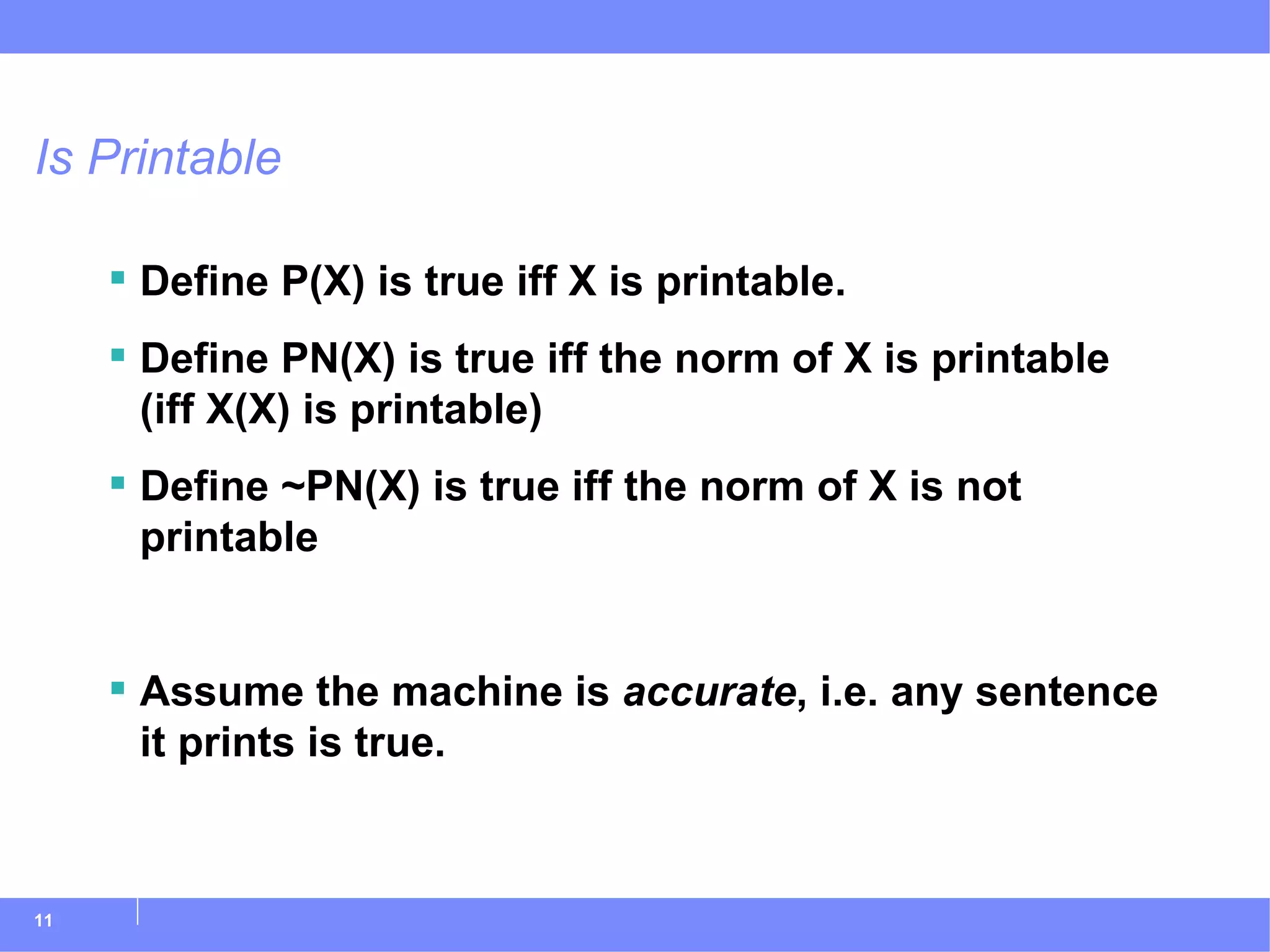
Is Printable DefineP(X) is true iff X is printable. Define PN(X) is true iff the norm of X is printable (iff X(X) is printable) Define ~PN(X) is true iff the norm of X is not printable Assume the machine is accurate , i.e. any sentence it prints is true.
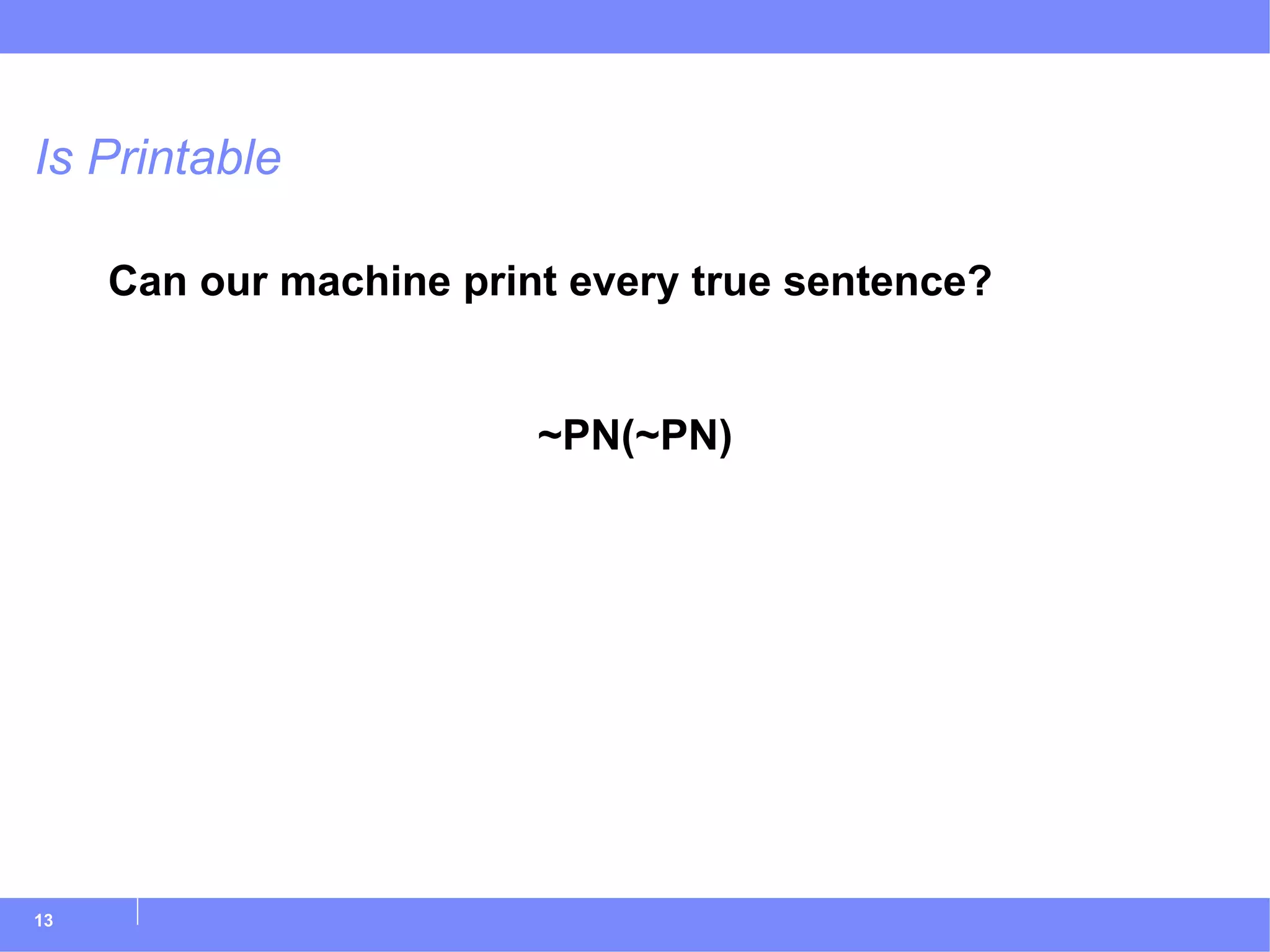
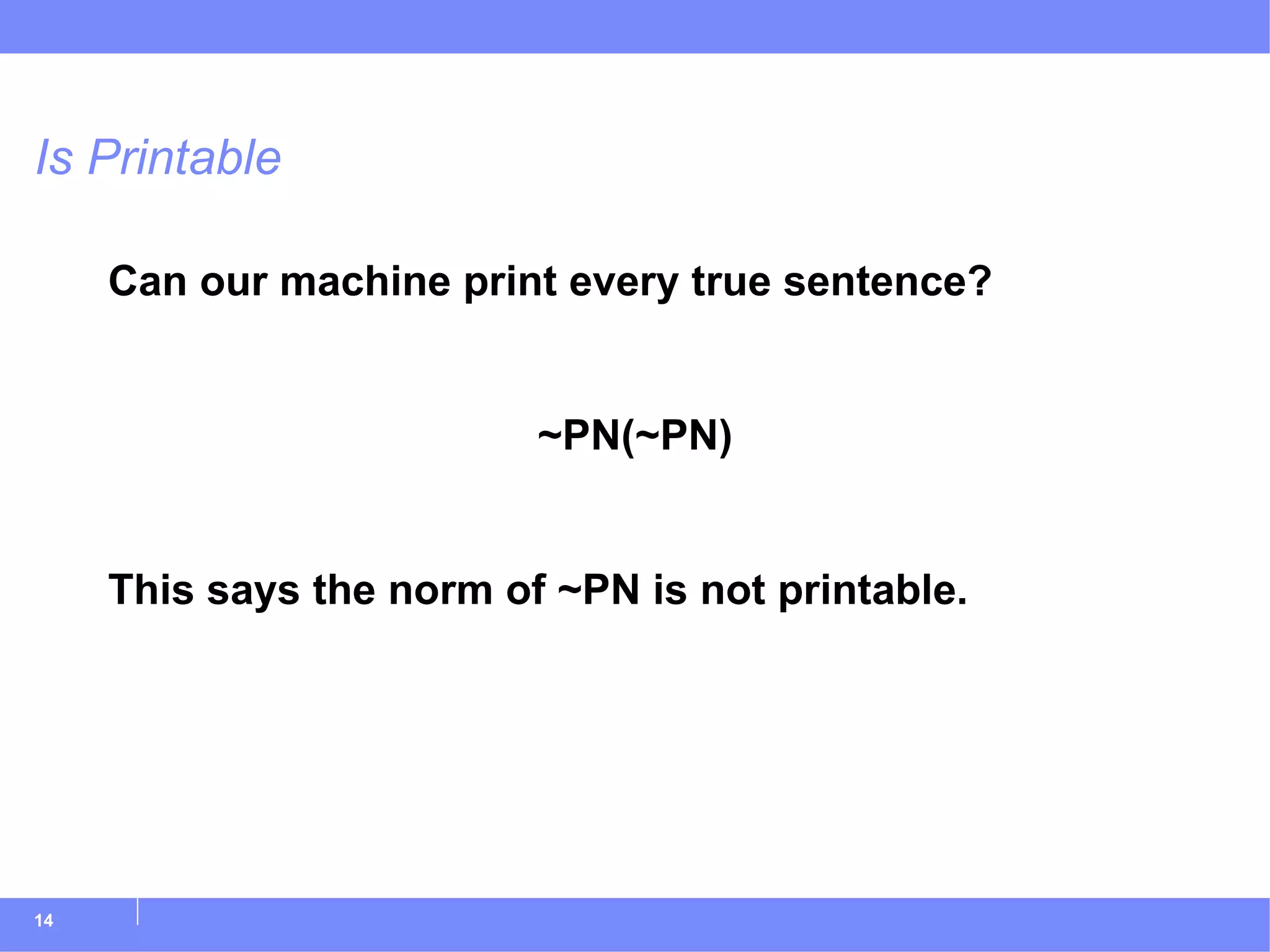
Is Printable Canour machine print every true sentence? ~PN(~PN) This says the norm of ~PN is not printable.
15.
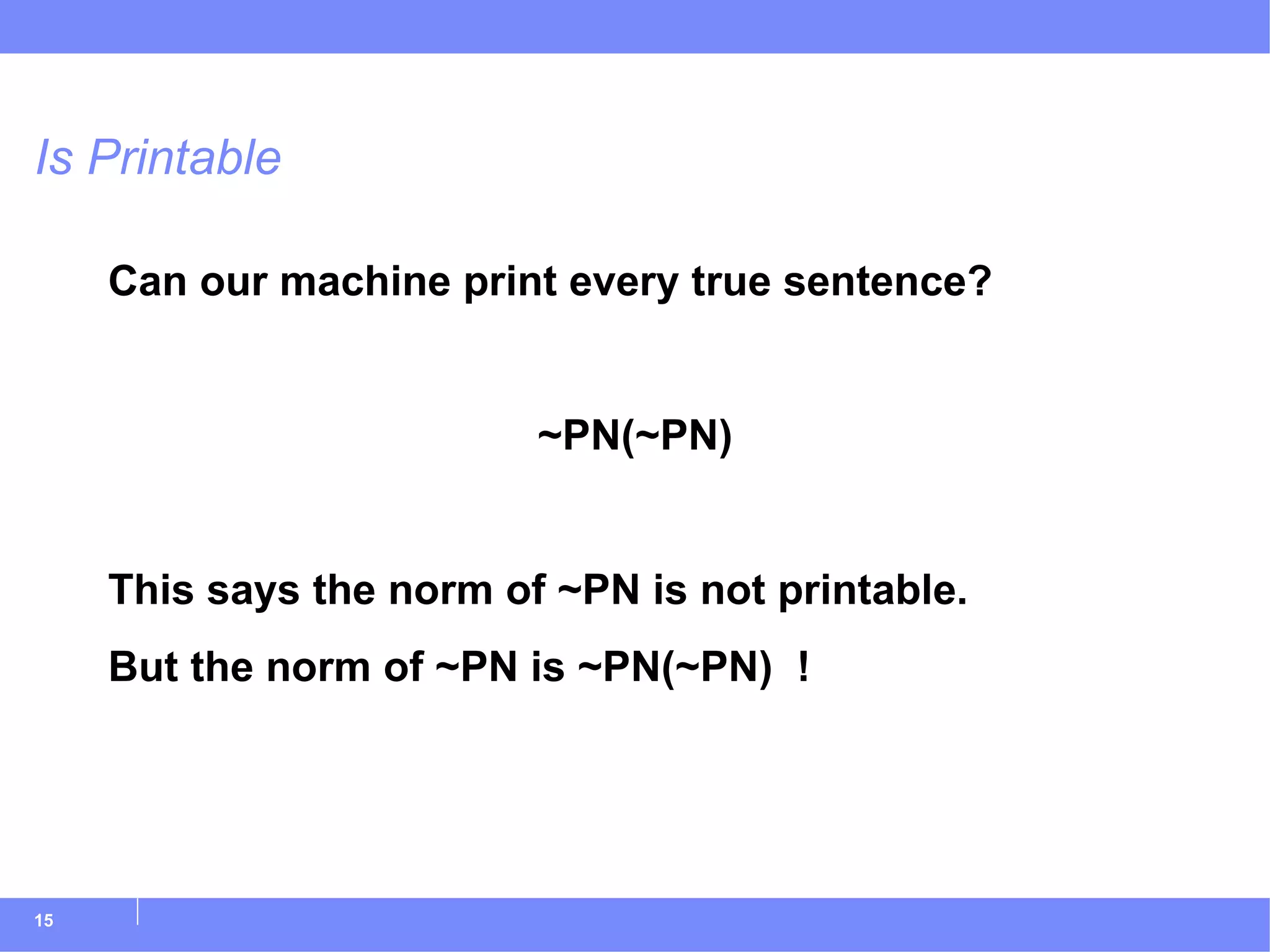
Is Printable Canour machine print every true sentence? ~PN(~PN) This says the norm of ~PN is not printable. But the norm of ~PN is ~PN(~PN) !
16.
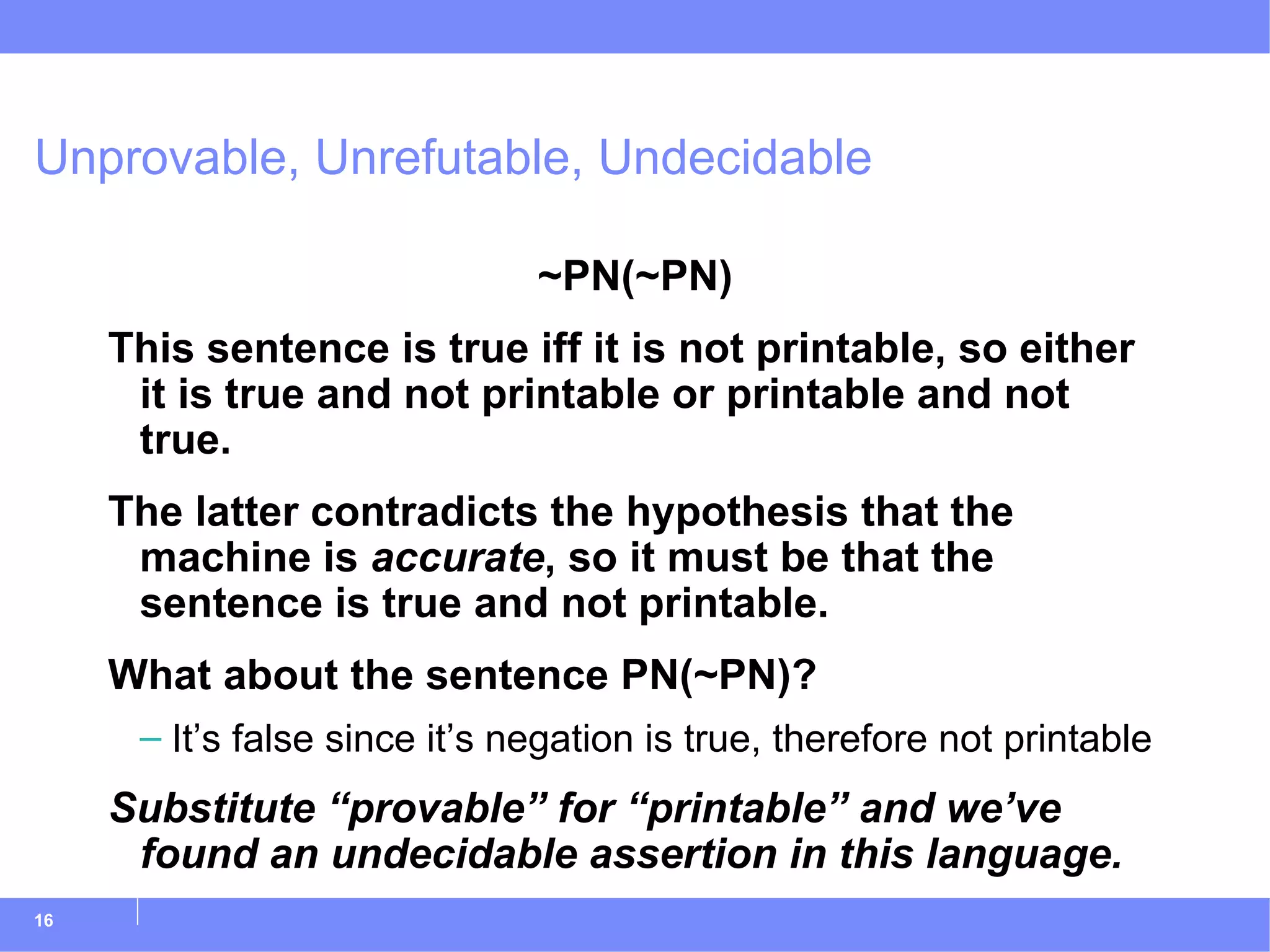
Unprovable, Unrefutable, Undecidable~PN(~PN) This sentence is true iff it is not printable, so either it is true and not printable or printable and not true. The latter contradicts the hypothesis that the machine is accurate , so it must be that the sentence is true and not printable. What about the sentence PN(~PN)? It’s false since it’s negation is true, therefore not printable Substitute “provable” for “printable” and we’ve found an undecidable assertion in this language.
17.
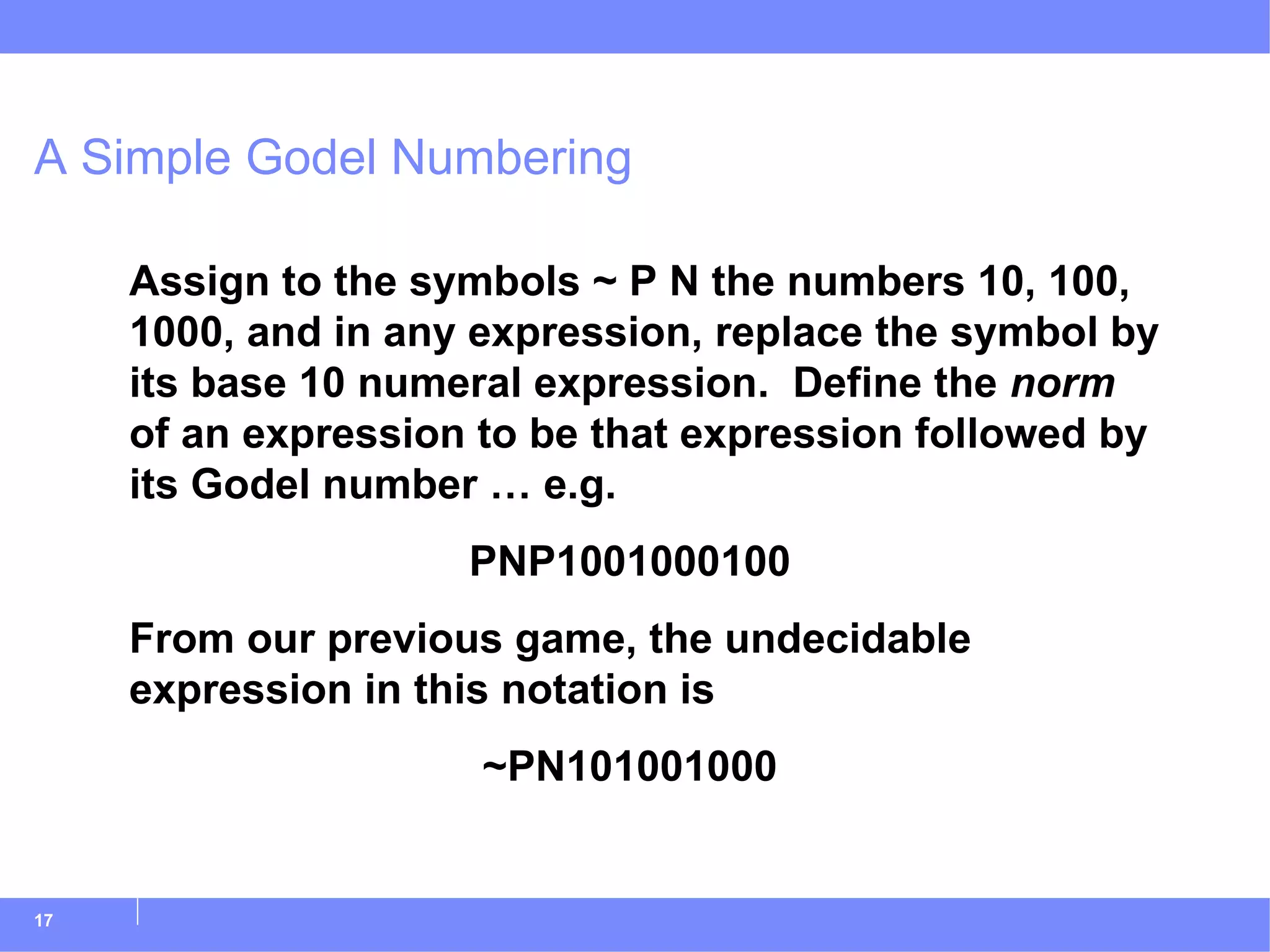
A Simple GodelNumbering Assign to the symbols ~ P N the numbers 10, 100, 1000, and in any expression, replace the symbol by its base 10 numeral expression. Define the norm of an expression to be that expression followed by its Godel number … e.g. PNP1001000100 From our previous game, the undecidable expression in this notation is ~PN101001000
18.
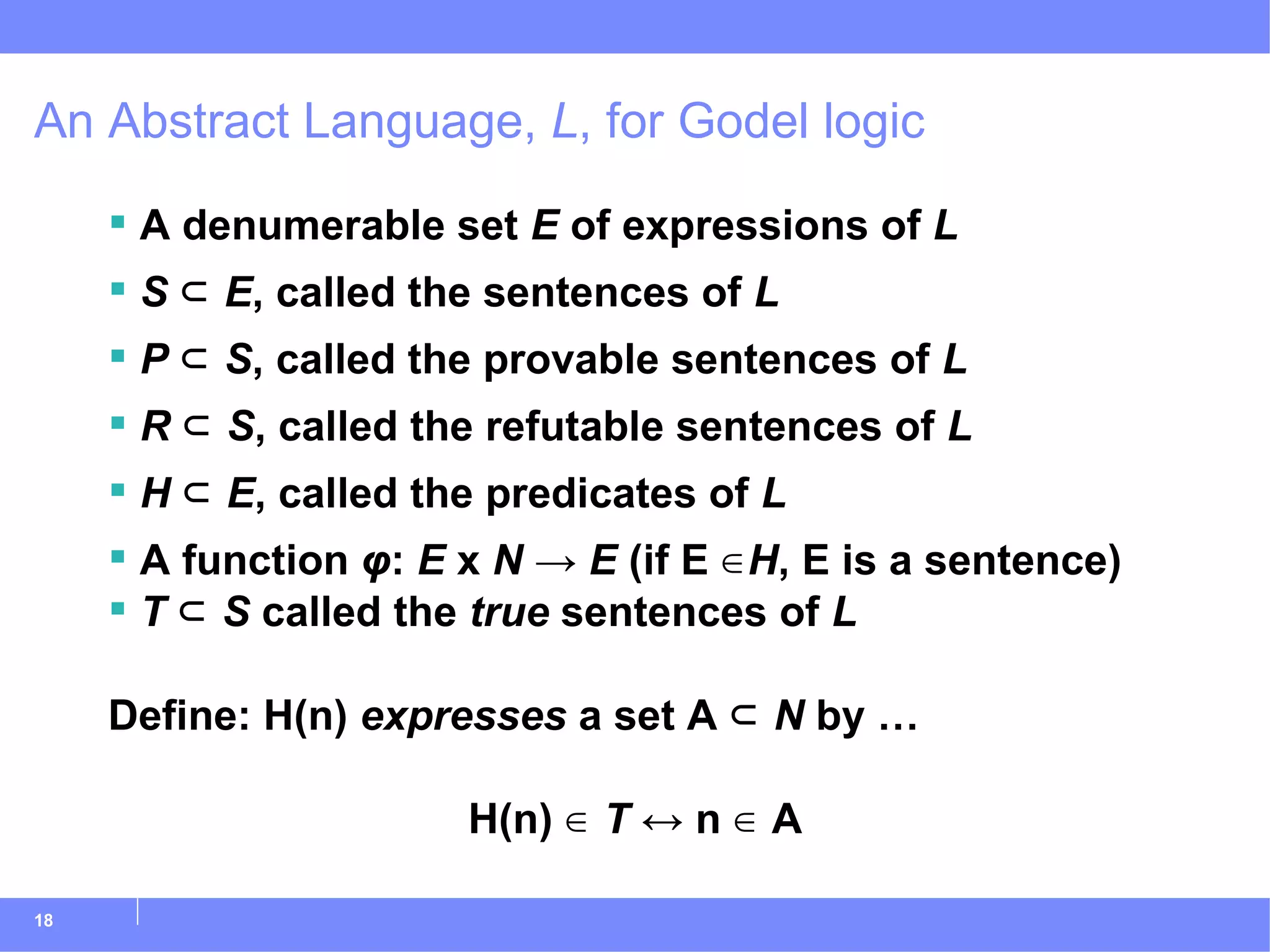
An Abstract Language, L , for Godel logic A denumerable set E of expressions of L S ⊂ E , called the sentences of L P ⊂ S , called the provable sentences of L R ⊂ S , called the refutable sentences of L H ⊂ E , called the predicates of L A function φ : E x N -> E (if E ∈ H , E is a sentence) T ⊂ S called the true sentences of L Define: H(n) expresses a set A ⊂ N by … H(n) ∈ T ↔ n ∈ A
19.
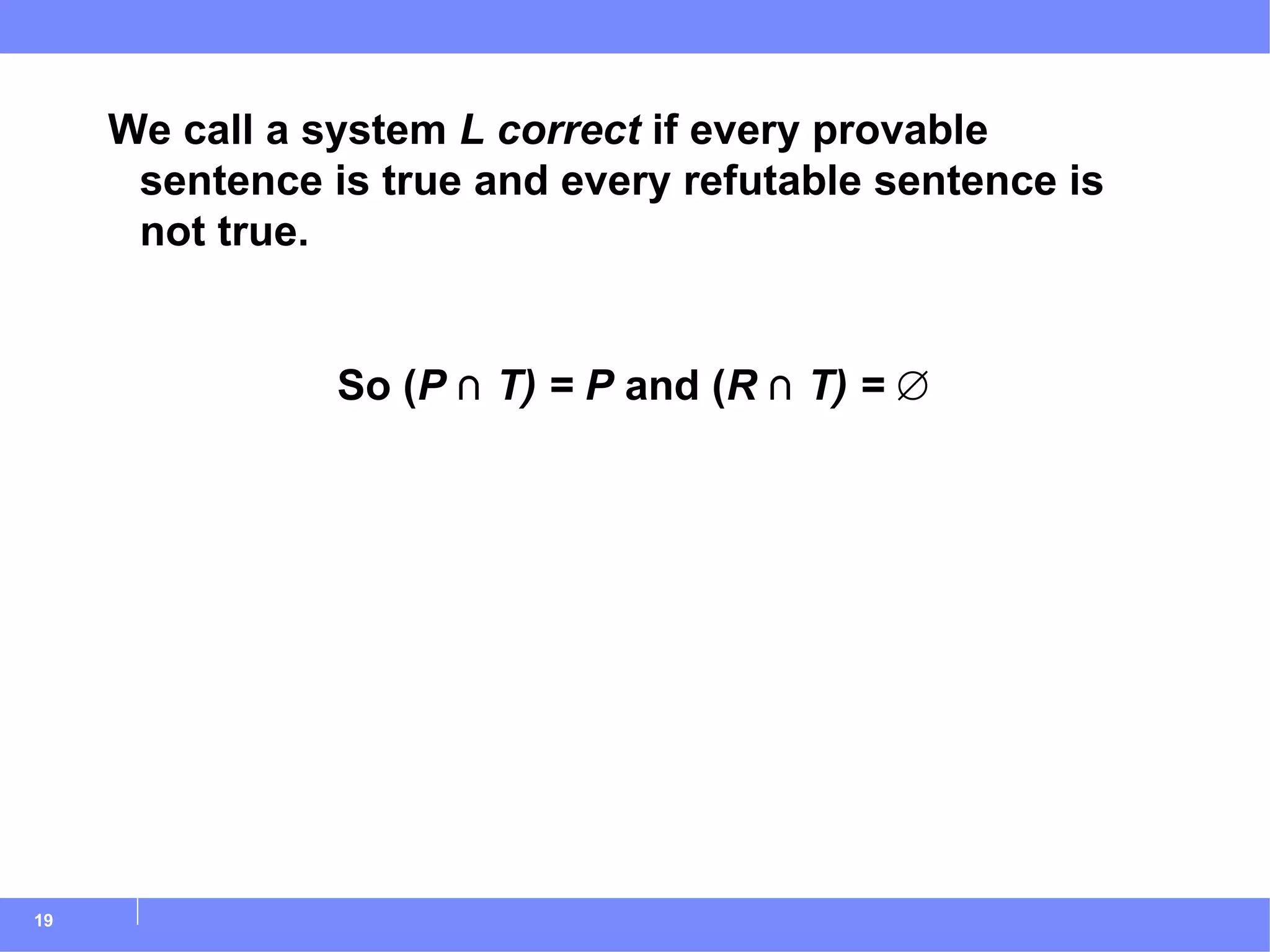
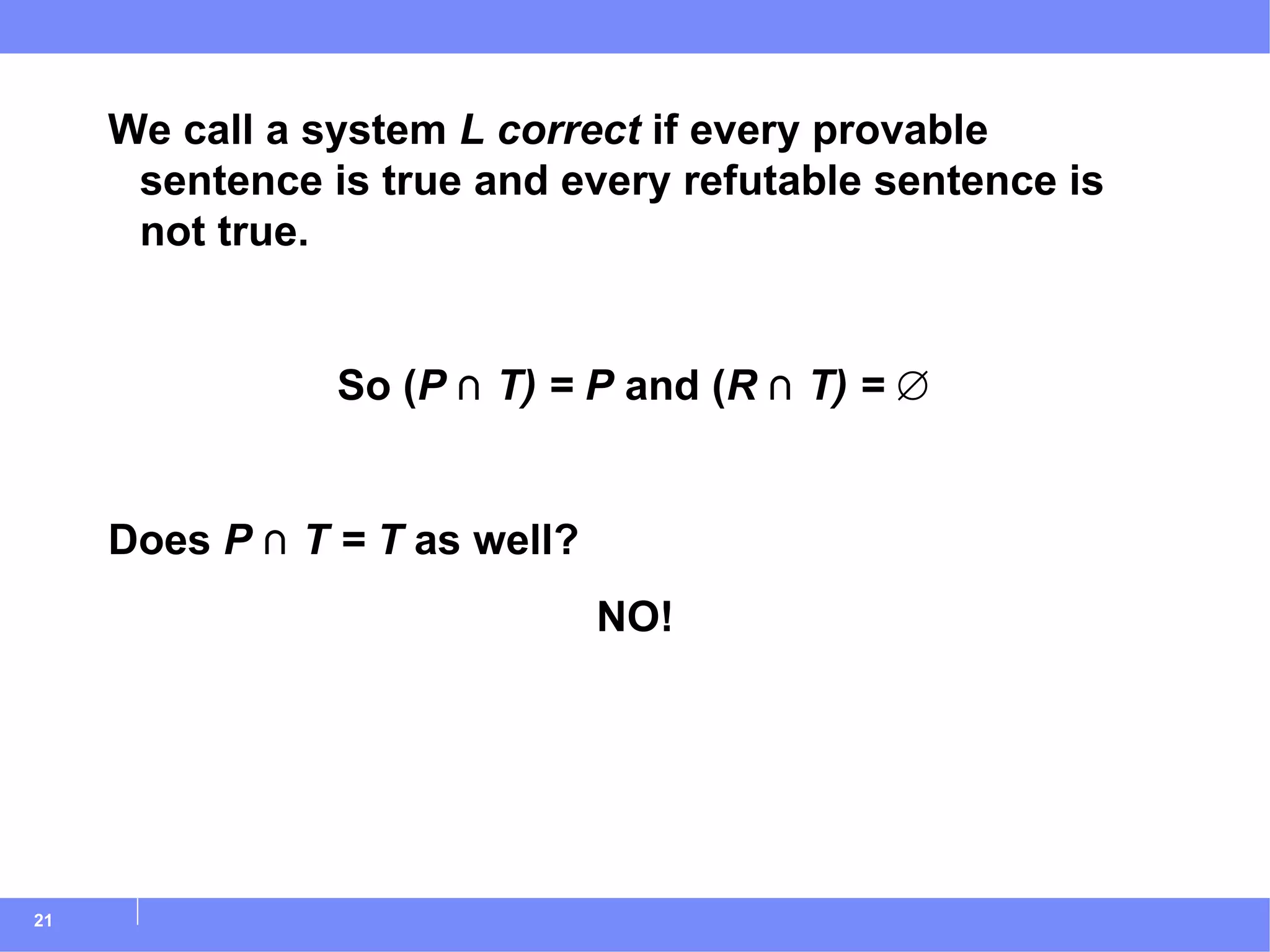
We call asystem L correct if every provable sentence is true and every refutable sentence is not true. So ( P ⋂ T) = P and ( R ⋂ T) = ∅
20.
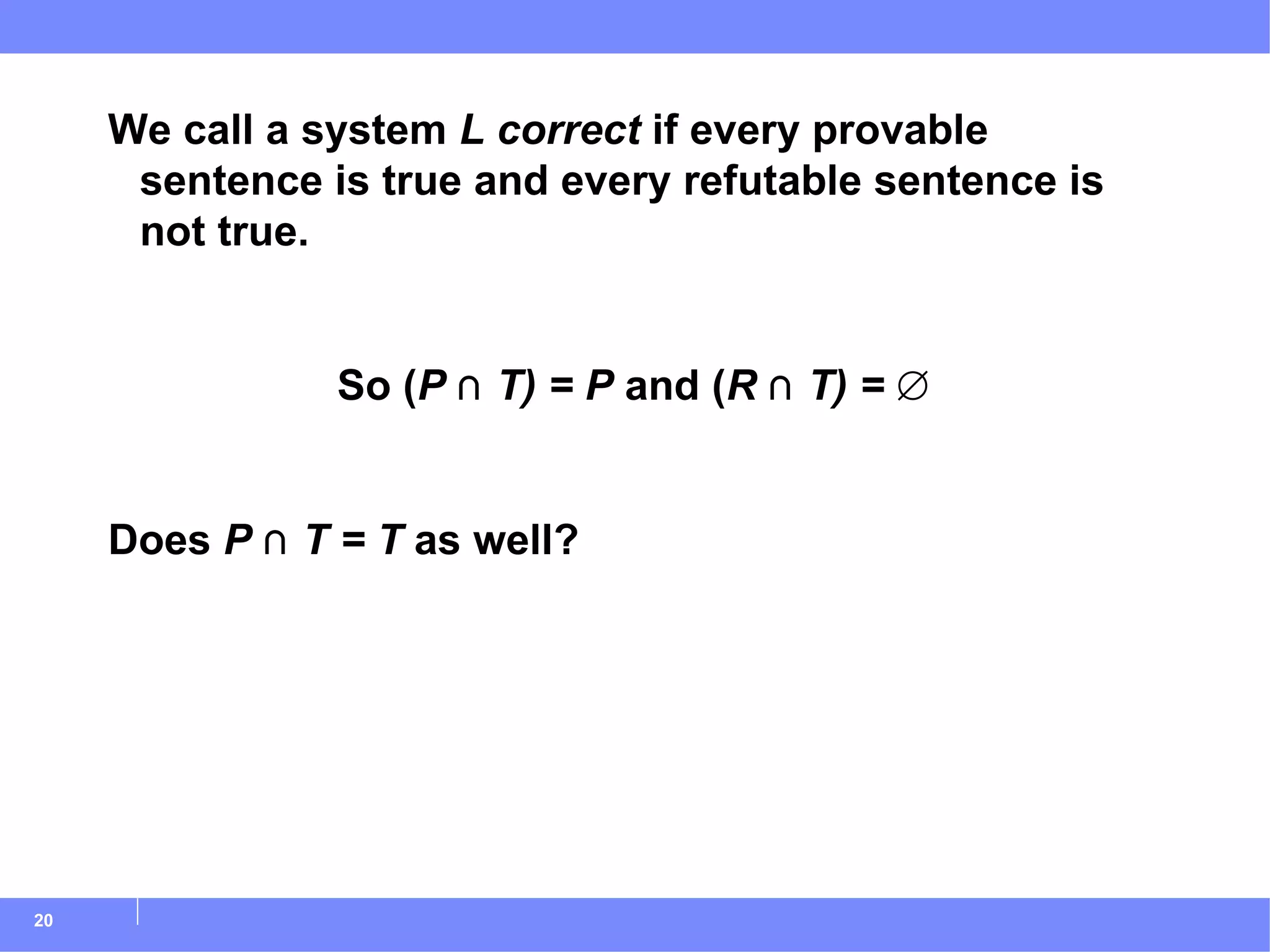
We call asystem L correct if every provable sentence is true and every refutable sentence is not true. So ( P ⋂ T) = P and ( R ⋂ T) = ∅ Does P ⋂ T = T as well?
21.
We call asystem L correct if every provable sentence is true and every refutable sentence is not true. So ( P ⋂ T) = P and ( R ⋂ T) = ∅ Does P ⋂ T = T as well? NO!
22.
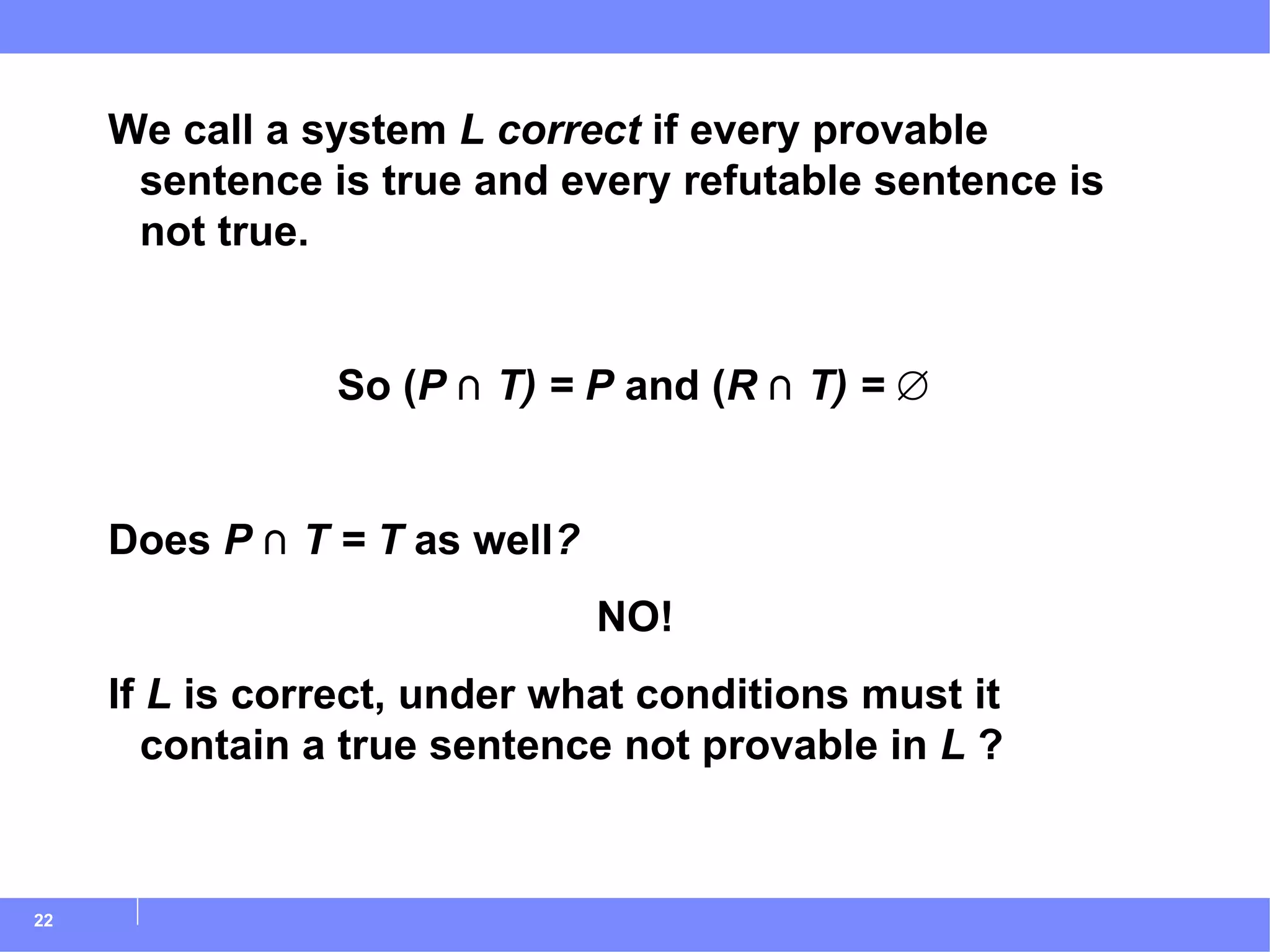
We call asystem L correct if every provable sentence is true and every refutable sentence is not true. So ( P ⋂ T) = P and ( R ⋂ T) = ∅ Does P ⋂ T = T as well ? NO! If L is correct, under what conditions must it contain a true sentence not provable in L ?
23.
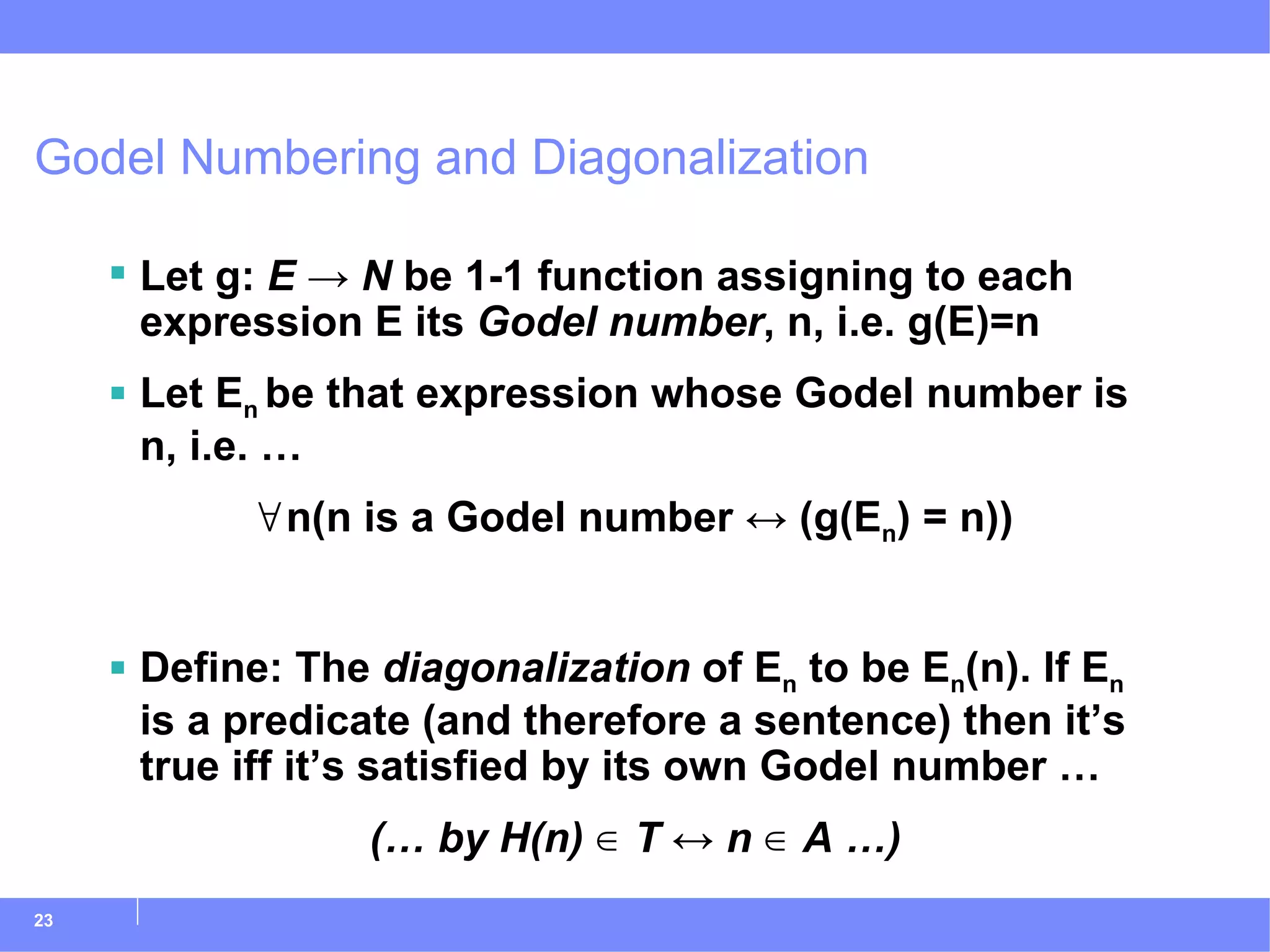
Godel Numbering andDiagonalization Let g: E -> N be 1-1 function assigning to each expression E its Godel number , n, i.e. g(E)=n Let E n be that expression whose Godel number is n, i.e. … ∀ n(n is a Godel number ↔ (g(E n ) = n)) Define: The diagonalization of E n to be E n (n). If E n is a predicate (and therefore a sentence) then it’s true iff it’s satisfied by its own Godel number … (… by H(n) ∈ T ↔ n ∈ A …)
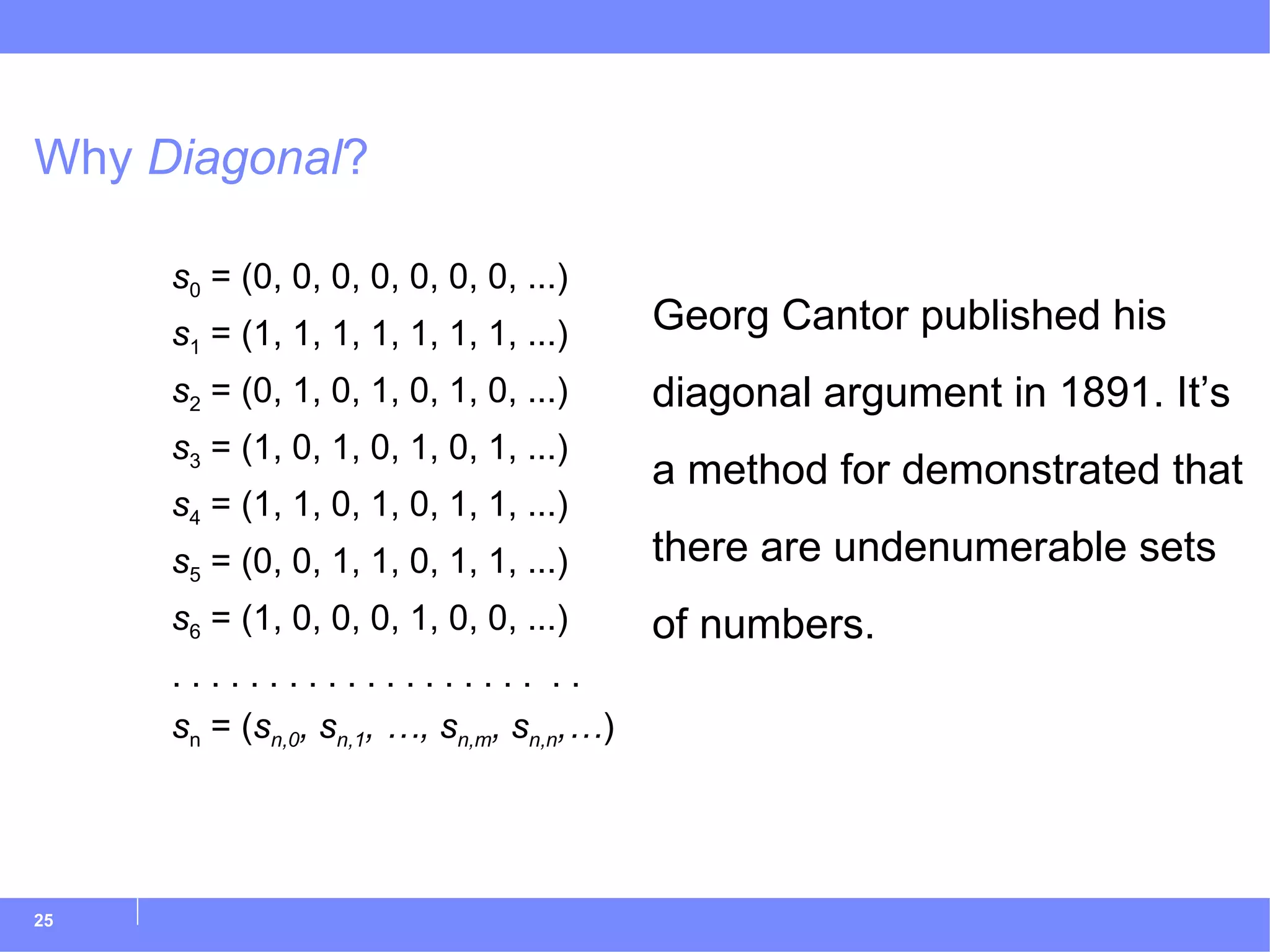
Why Diagonal? s 0 = (0, 0, 0, 0, 0, 0, 0, ...) s 1 = (1, 1, 1, 1, 1, 1, 1, ...) s 2 = (0, 1, 0, 1, 0, 1, 0, ...) s 3 = (1, 0, 1, 0, 1, 0, 1, ...) s 4 = (1, 1, 0, 1, 0, 1, 1, ...) s 5 = (0, 0, 1, 1, 0, 1, 1, ...) s 6 = (1, 0, 0, 0, 1, 0, 0, ...) . . . . . . . . . . . . . . . . . . . . . s n = ( s n,0 , s n,1 , …, s n,m , s n,n ,… ) Georg Cantor published his diagonal argument in 1891. It’s a method for demonstrated that there are undenumerable sets of numbers.
26.
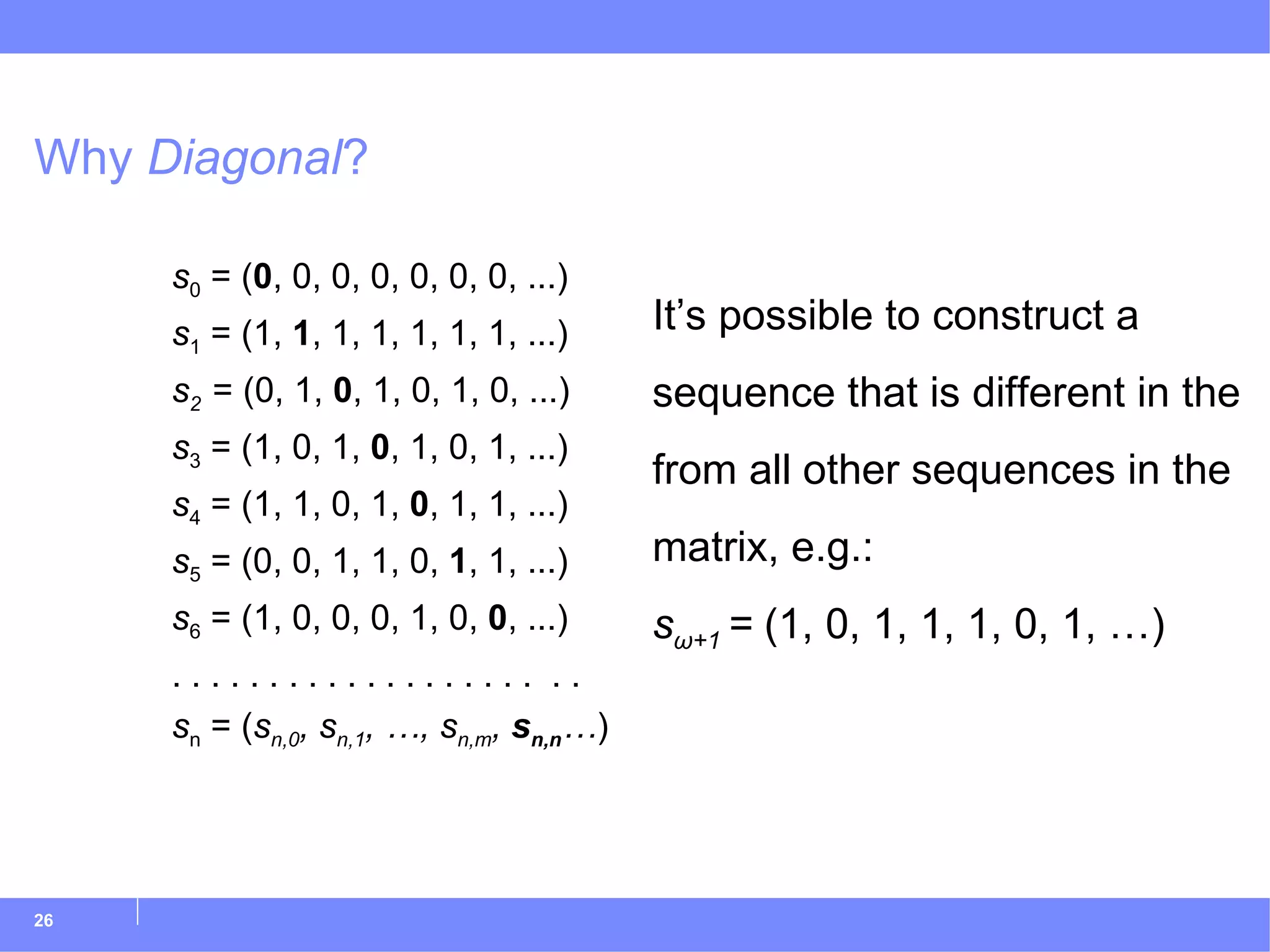
Why Diagonal? s 0 = ( 0 , 0, 0, 0, 0, 0, 0, ...) s 1 = (1, 1 , 1, 1, 1, 1, 1, ...) s 2 = (0, 1, 0 , 1, 0, 1, 0, ...) s 3 = (1, 0, 1, 0 , 1, 0, 1, ...) s 4 = (1, 1, 0, 1, 0 , 1, 1, ...) s 5 = (0, 0, 1, 1, 0, 1 , 1, ...) s 6 = (1, 0, 0, 0, 1, 0, 0 , ...) . . . . . . . . . . . . . . . . . . . . . s n = ( s n,0 , s n,1 , …, s n,m , s n,n … ) It’s possible to construct a sequence that is different in the from all other sequences in the matrix, e.g.: s ω+1 = (1, 0, 1, 1, 1, 0, 1, …)
27.
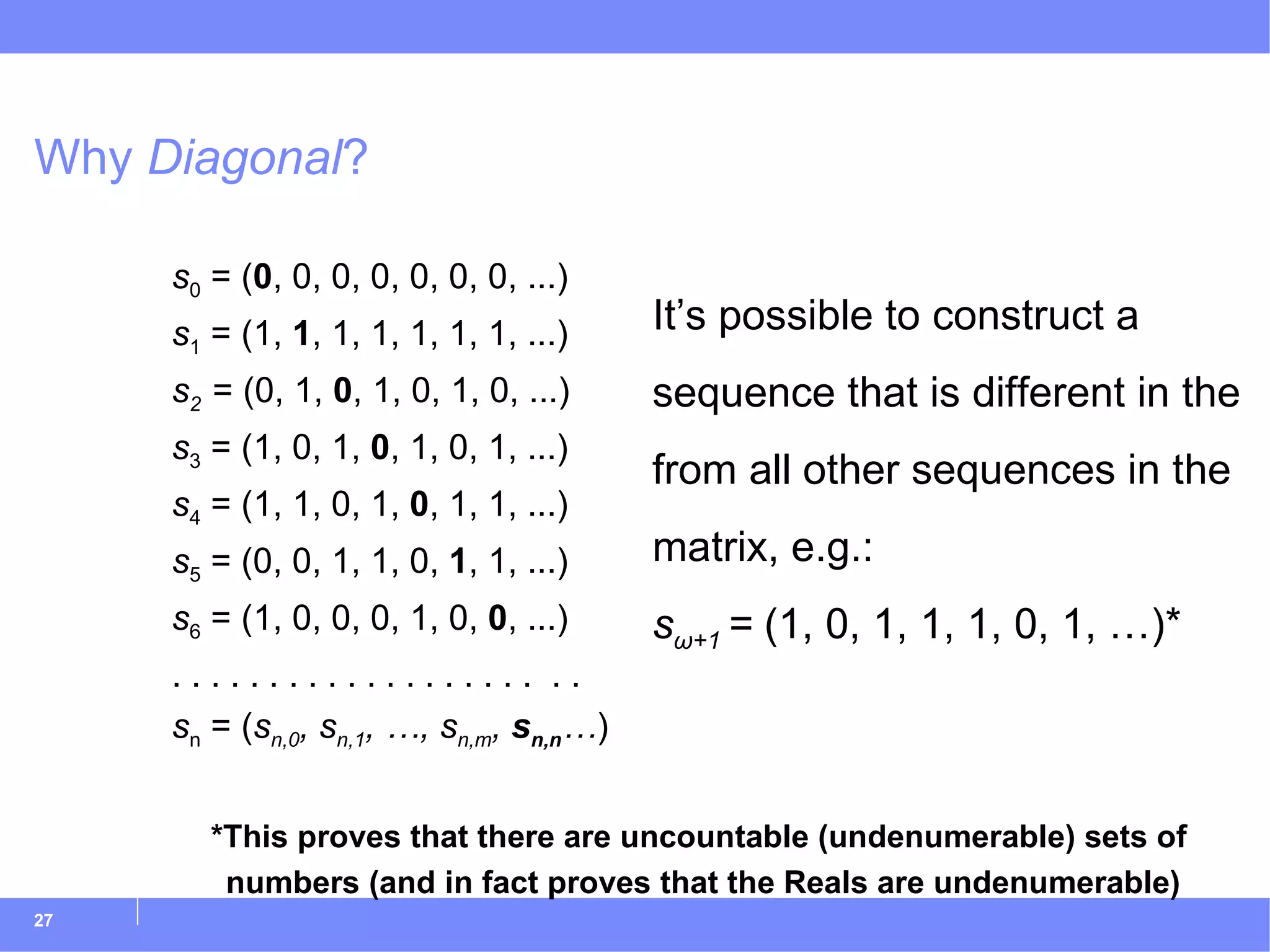
Why Diagonal? s 0 = ( 0 , 0, 0, 0, 0, 0, 0, ...) s 1 = (1, 1 , 1, 1, 1, 1, 1, ...) s 2 = (0, 1, 0 , 1, 0, 1, 0, ...) s 3 = (1, 0, 1, 0 , 1, 0, 1, ...) s 4 = (1, 1, 0, 1, 0 , 1, 1, ...) s 5 = (0, 0, 1, 1, 0, 1 , 1, ...) s 6 = (1, 0, 0, 0, 1, 0, 0 , ...) . . . . . . . . . . . . . . . . . . . . . s n = ( s n,0 , s n,1 , …, s n,m , s n,n … ) *This proves that there are uncountable (undenumerable) sets of numbers (and in fact proves that the Reals are undenumerable) It’s possible to construct a sequence that is different in the from all other sequences in the matrix, e.g.: s ω+1 = (1, 0, 1, 1, 1, 0, 1, …)*
28.
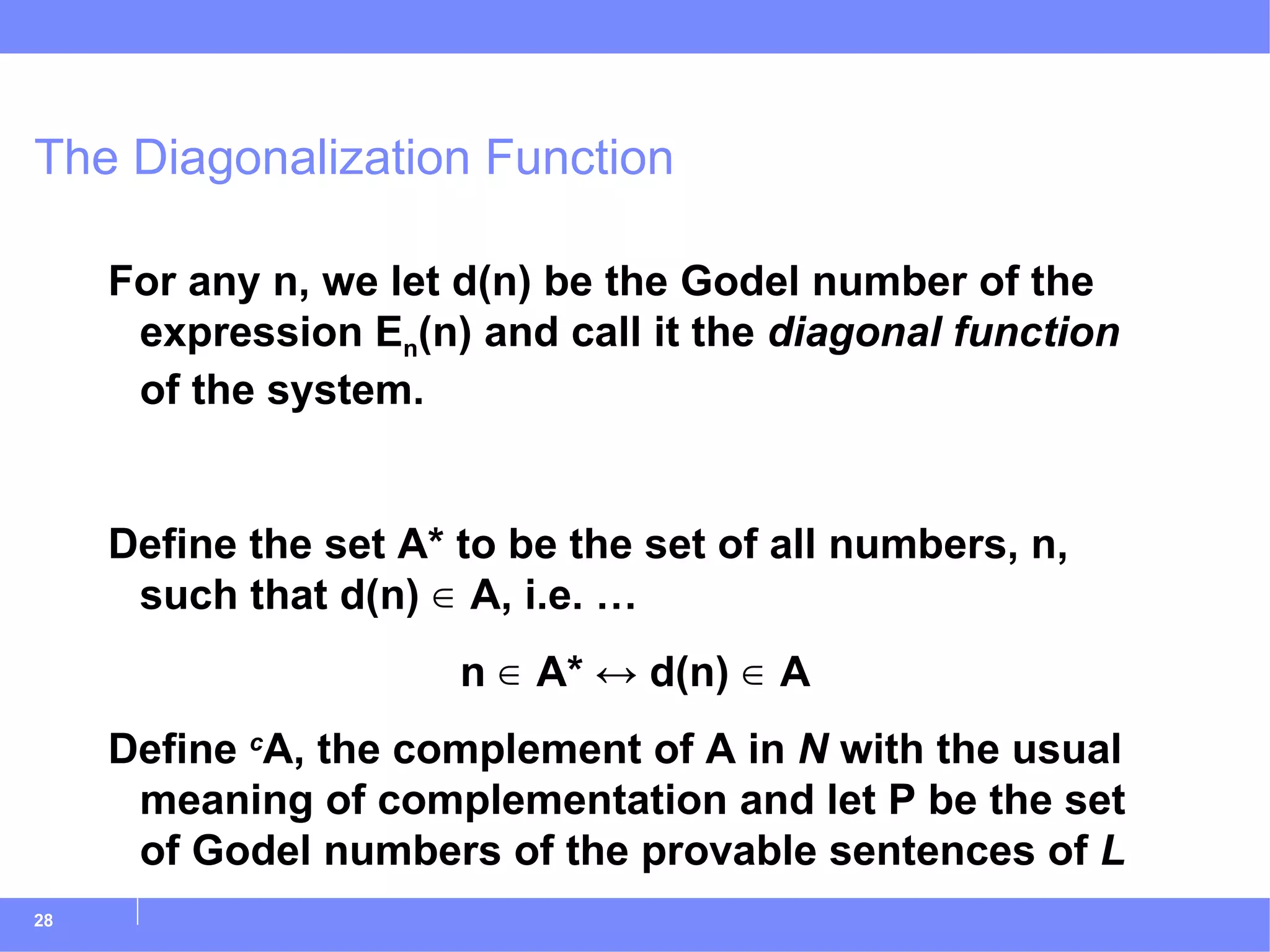
The Diagonalization FunctionFor any n, we let d(n) be the Godel number of the expression E n (n) and call it the diagonal function of the system. Define the set A* to be the set of all numbers, n, such that d(n) ∈ A, i.e. … n ∈ A* ↔ d(n) ∈ A Define c A, the complement of A in N with the usual meaning of complementation and let P be the set of Godel numbers of the provable sentences of L
29.
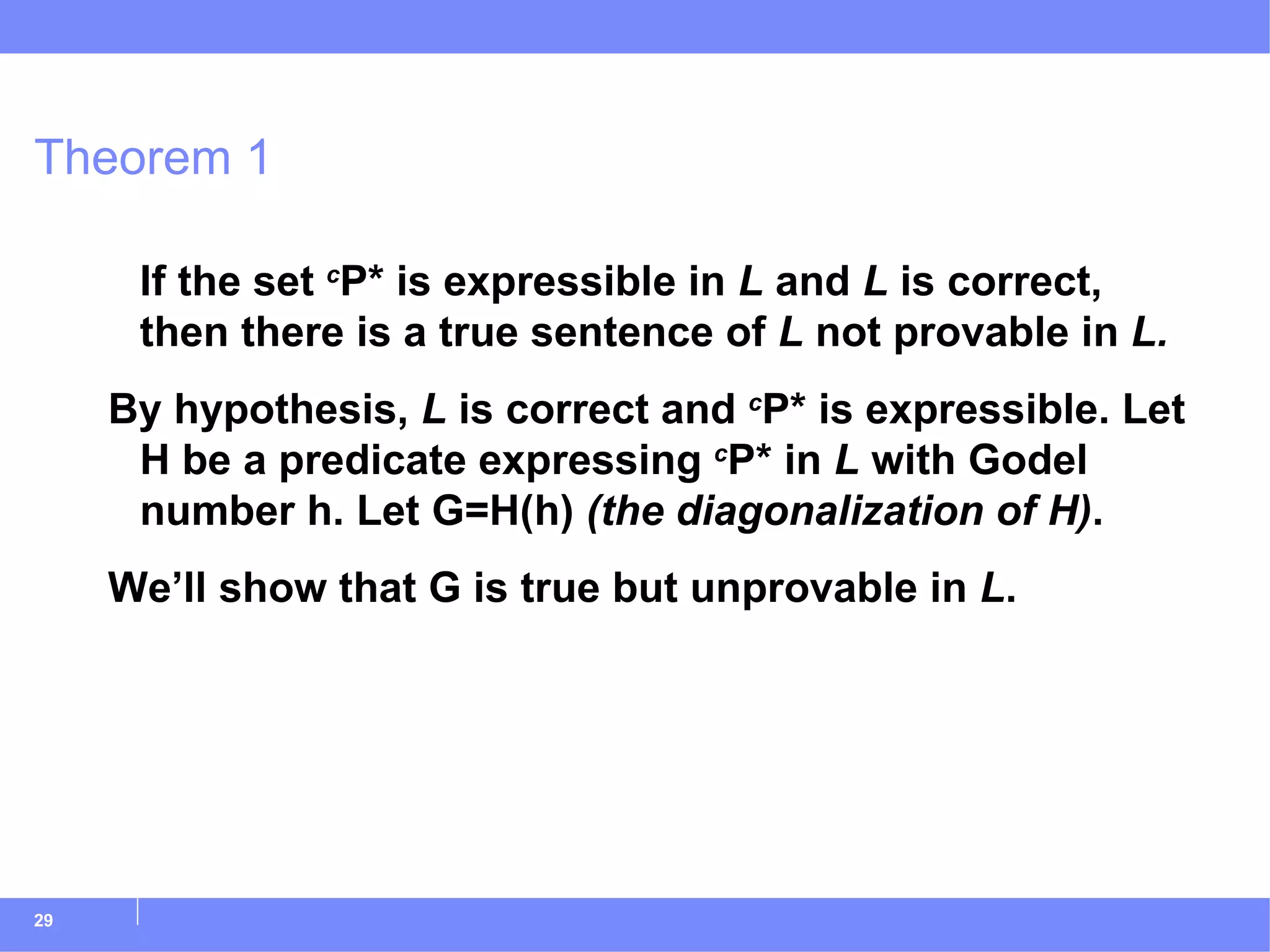
Theorem 1 Ifthe set c P* is expressible in L and L is correct, then there is a true sentence of L not provable in L. By hypothesis, L is correct and c P* is expressible. Let H be a predicate expressing c P* in L with Godel number h. Let G=H(h) (the diagonalization of H) . We’ll show that G is true but unprovable in L .
30.
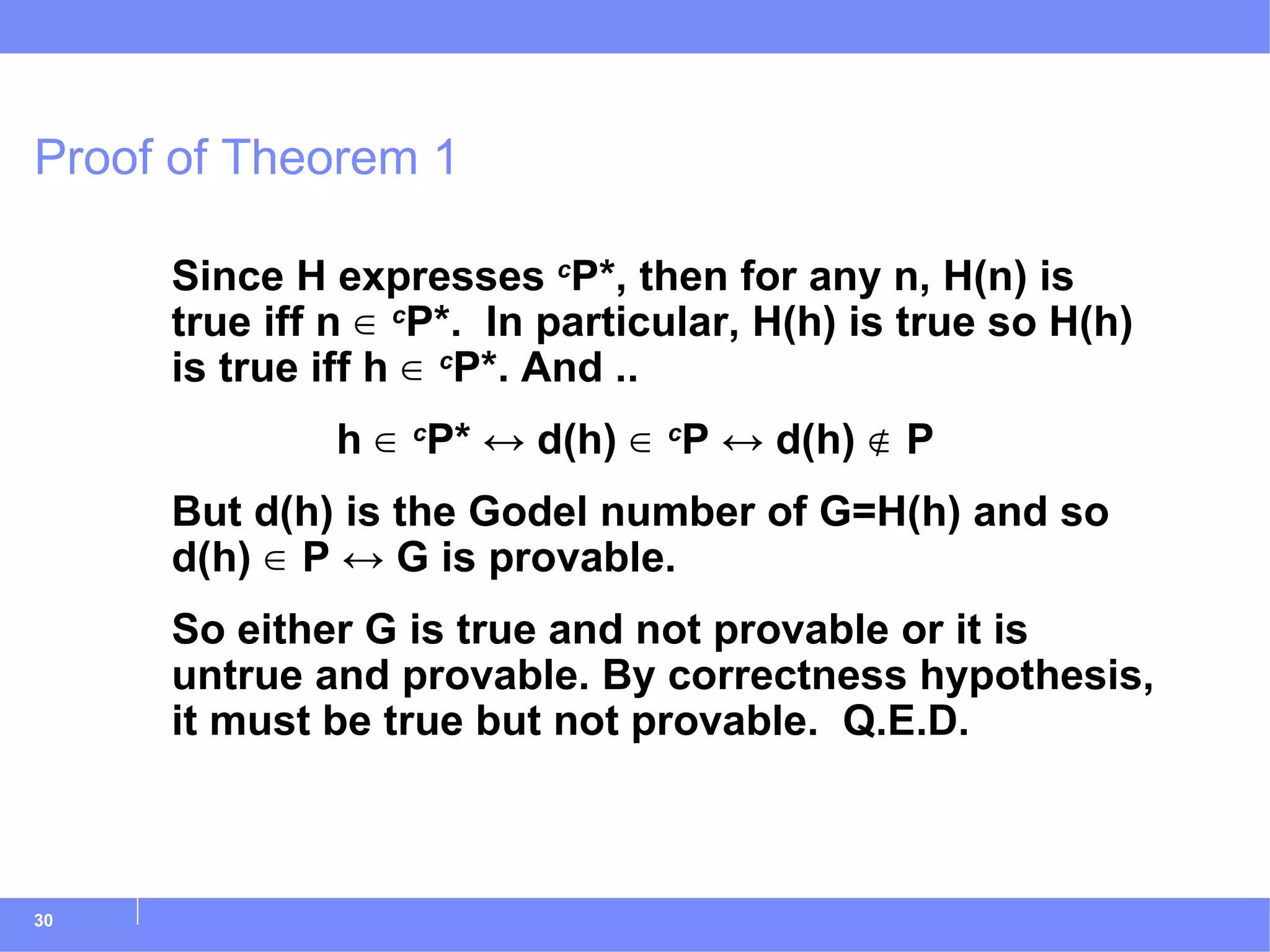
Proof of Theorem1 Since H expresses c P*, then for any n, H(n) is true iff n ∈ c P*. In particular, H(h) is true so H(h) is true iff h ∈ c P*. And .. h ∈ c P* ↔ d(h) ∈ c P ↔ d(h) ∉ P But d(h) is the Godel number of G=H(h) and so d(h) ∈ P ↔ G is provable. So either G is true and not provable or it is untrue and provable. By correctness hypothesis, it must be true but not provable. Q.E.D.
31.
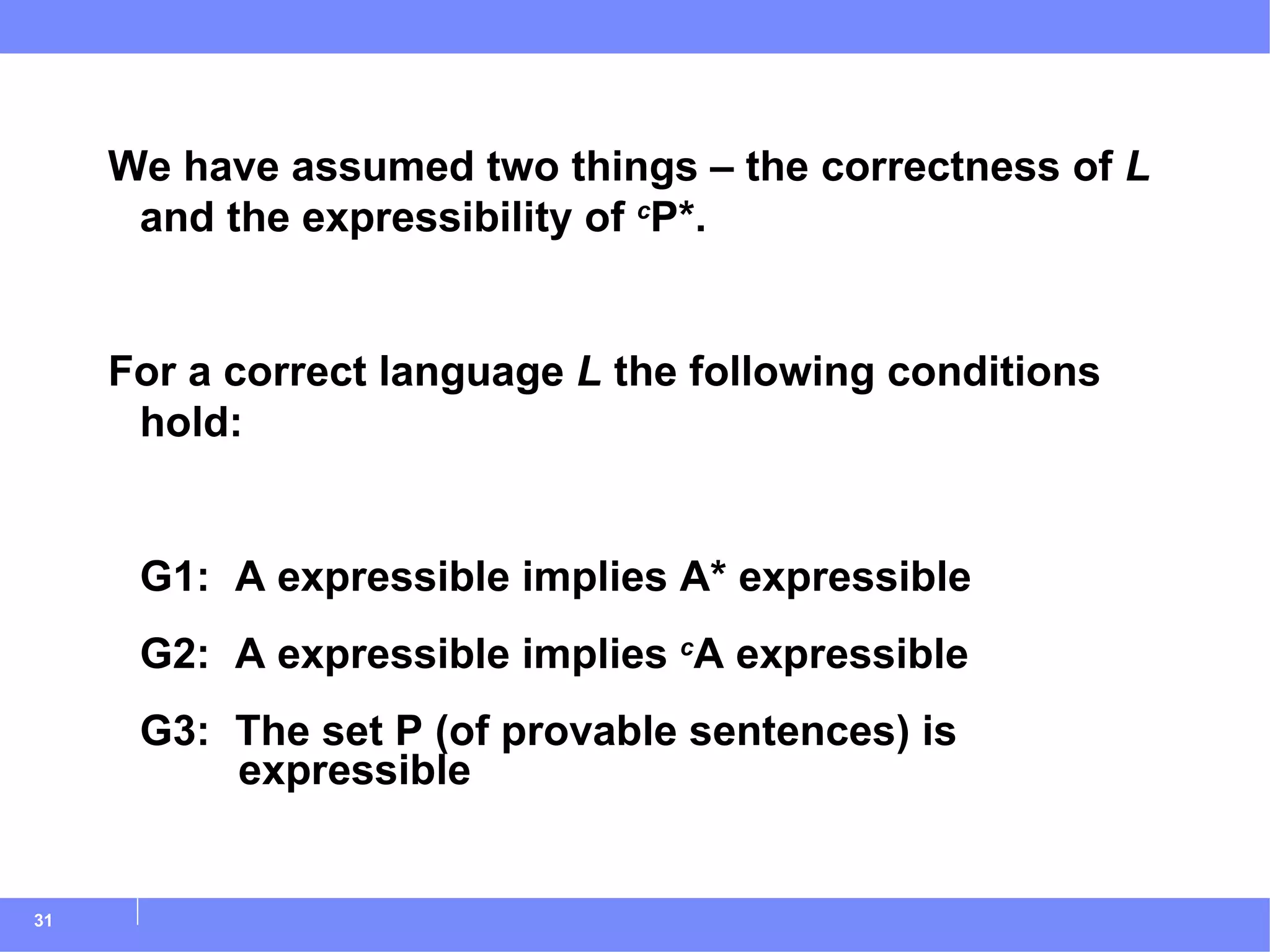
We have assumedtwo things – the correctness of L and the expressibility of c P*. For a correct language L the following conditions hold: G1: A expressible implies A* expressible G2: A expressible implies c A expressible G3: The set P (of provable sentences) is expressible
32.
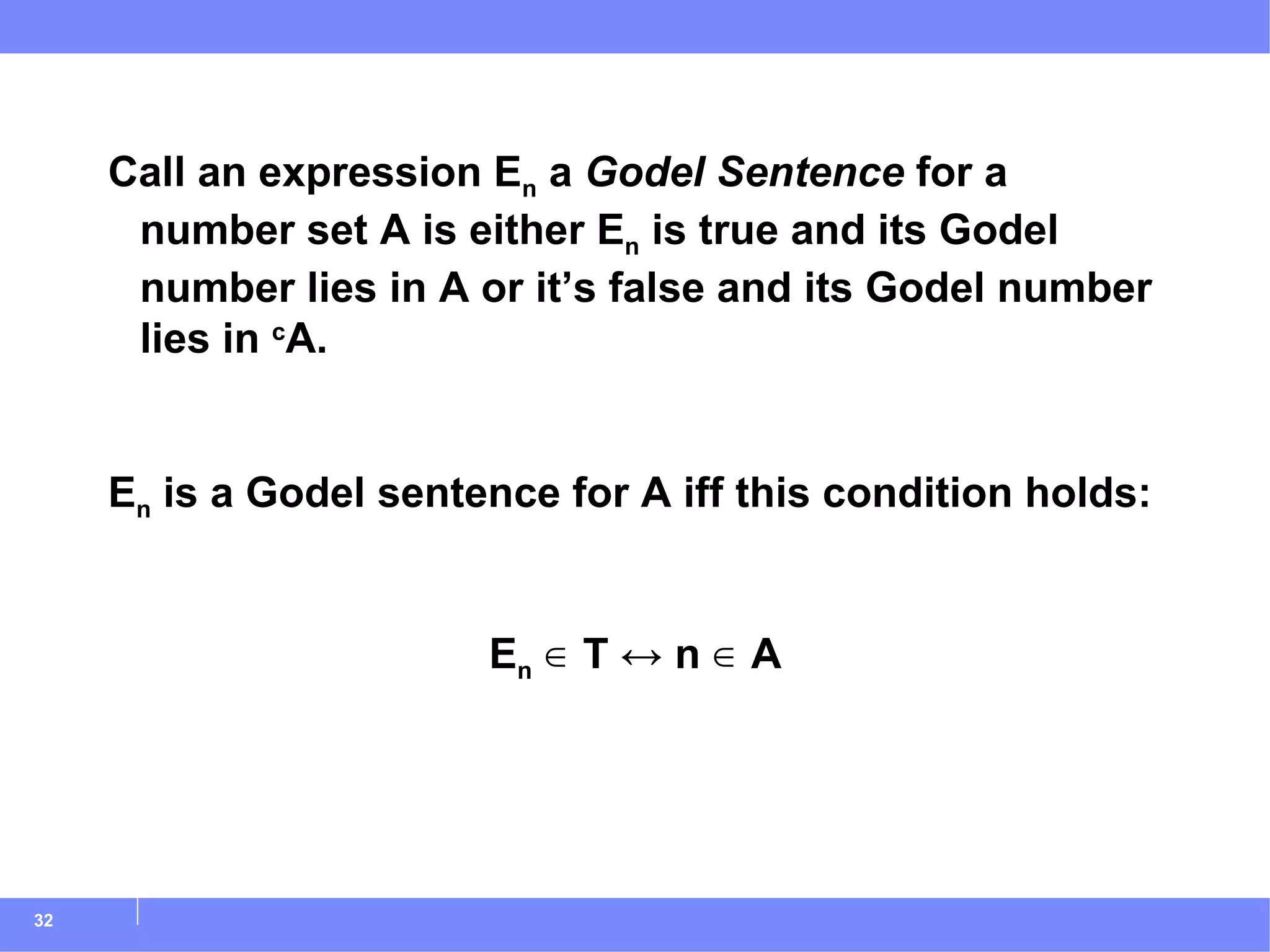
Call an expressionE n a Godel Sentence for a number set A is either E n is true and its Godel number lies in A or it’s false and its Godel number lies in c A. E n is a Godel sentence for A iff this condition holds: E n ∈ T ↔ n ∈ A
33.
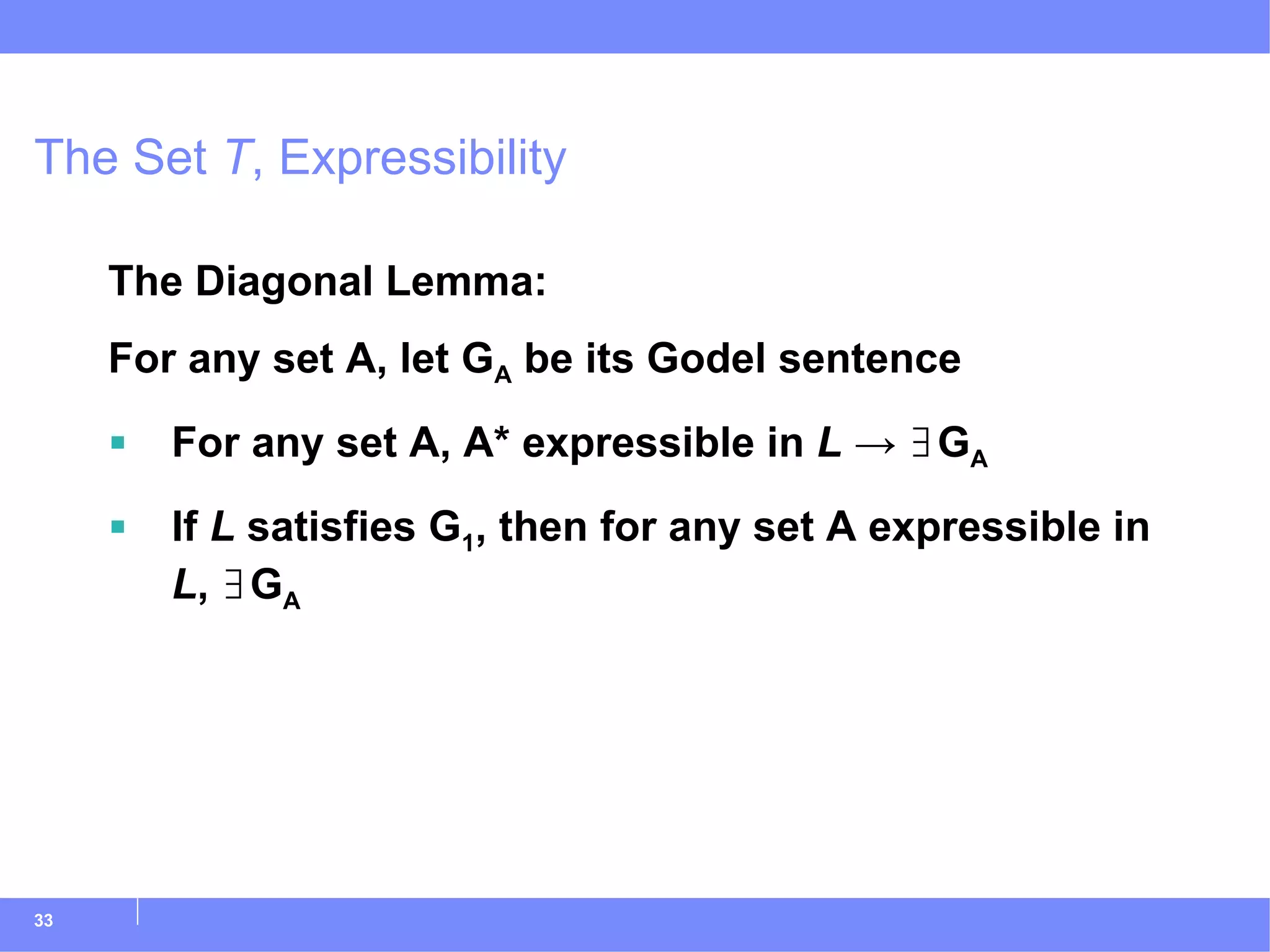
The Set T , Expressibility The Diagonal Lemma: For any set A, let G A be its Godel sentence For any set A, A* expressible in L -> ∃G A If L satisfies G 1 , then for any set A expressible in L , ∃G A
34.
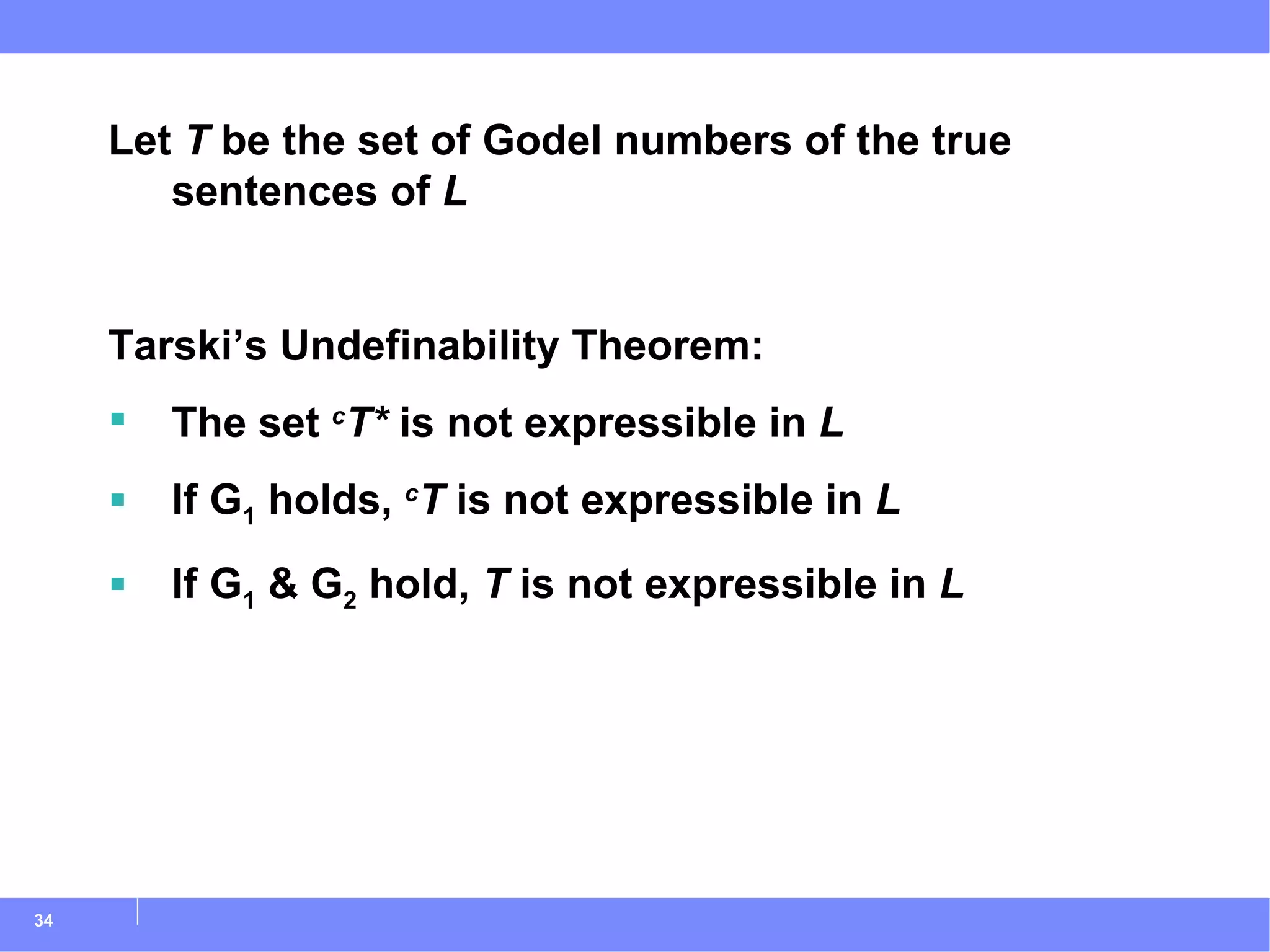
Let T be the set of Godel numbers of the true sentences of L Tarski’s Undefinability Theorem: The set c T* is not expressible in L If G 1 holds, c T is not expressible in L If G 1 & G 2 hold, T is not expressible in L
35.
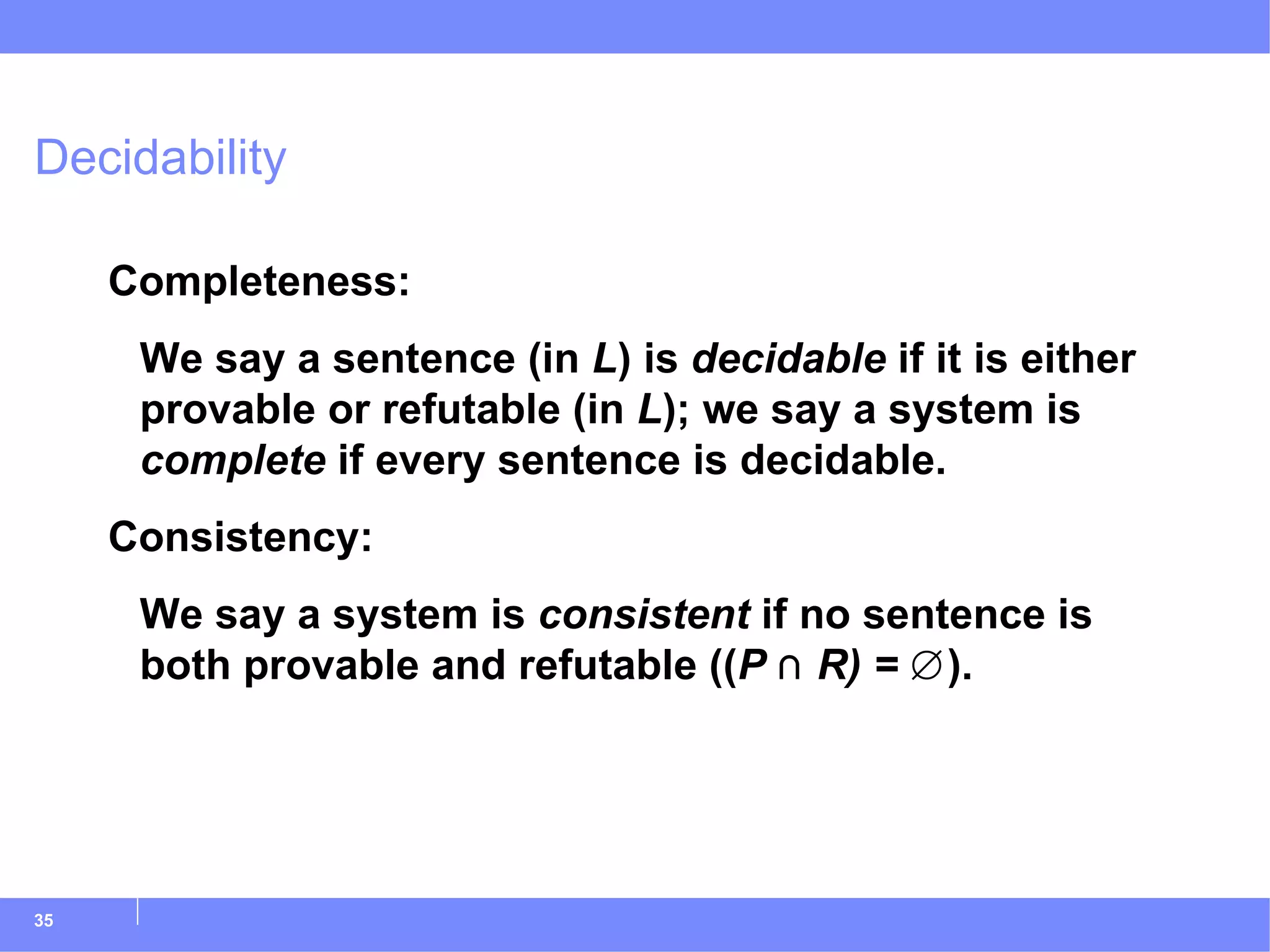
Decidability Completeness: Wesay a sentence (in L ) is decidable if it is either provable or refutable (in L ); we say a system is complete if every sentence is decidable. Consistency: We say a system is consistent if no sentence is both provable and refutable (( P ⋂ R) = ∅).
36.
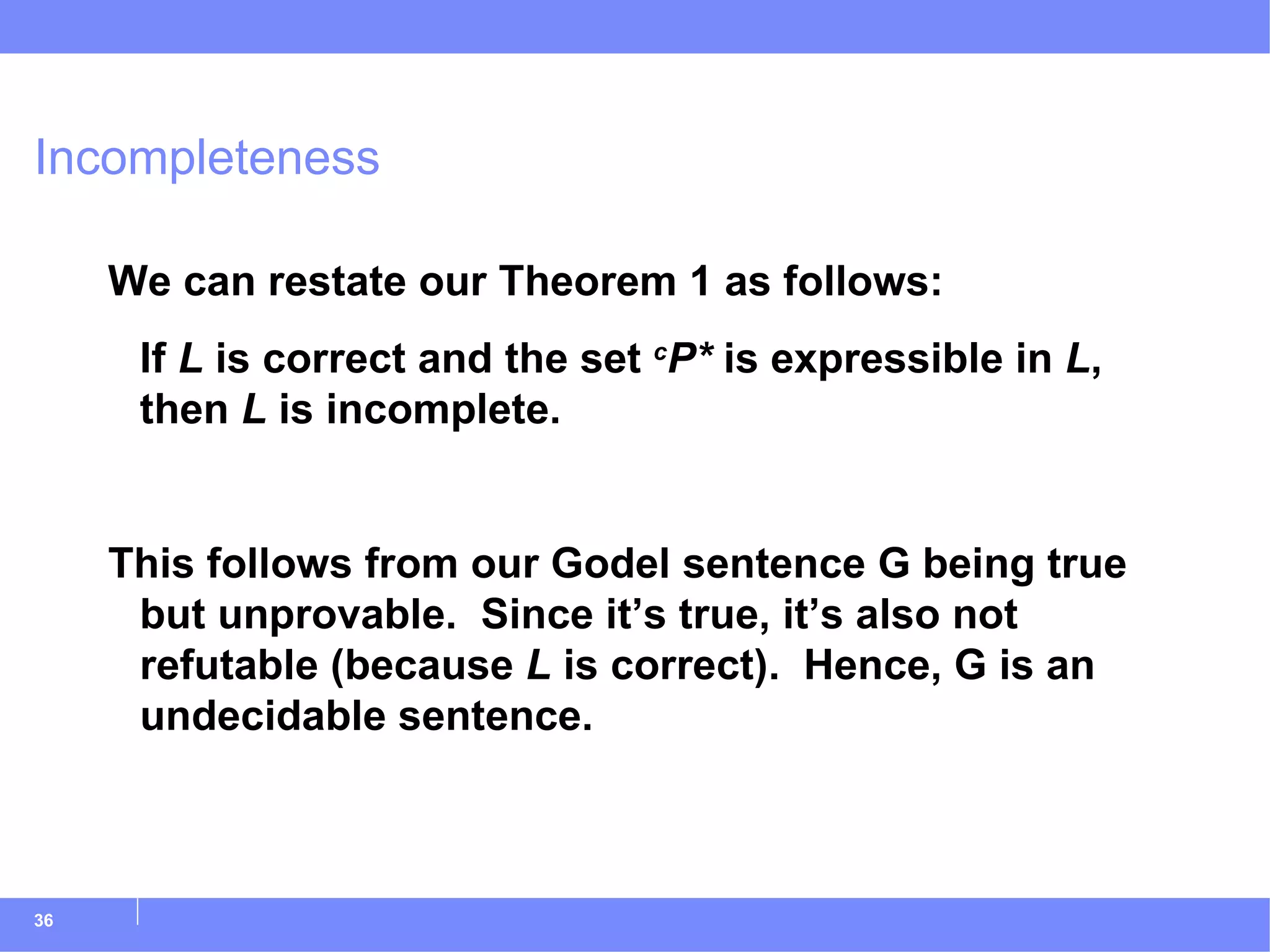
Incompleteness We canrestate our Theorem 1 as follows: If L is correct and the set c P* is expressible in L , then L is incomplete. This follows from our Godel sentence G being true but unprovable. Since it’s true, it’s also not refutable (because L is correct). Hence, G is an undecidable sentence.
37.
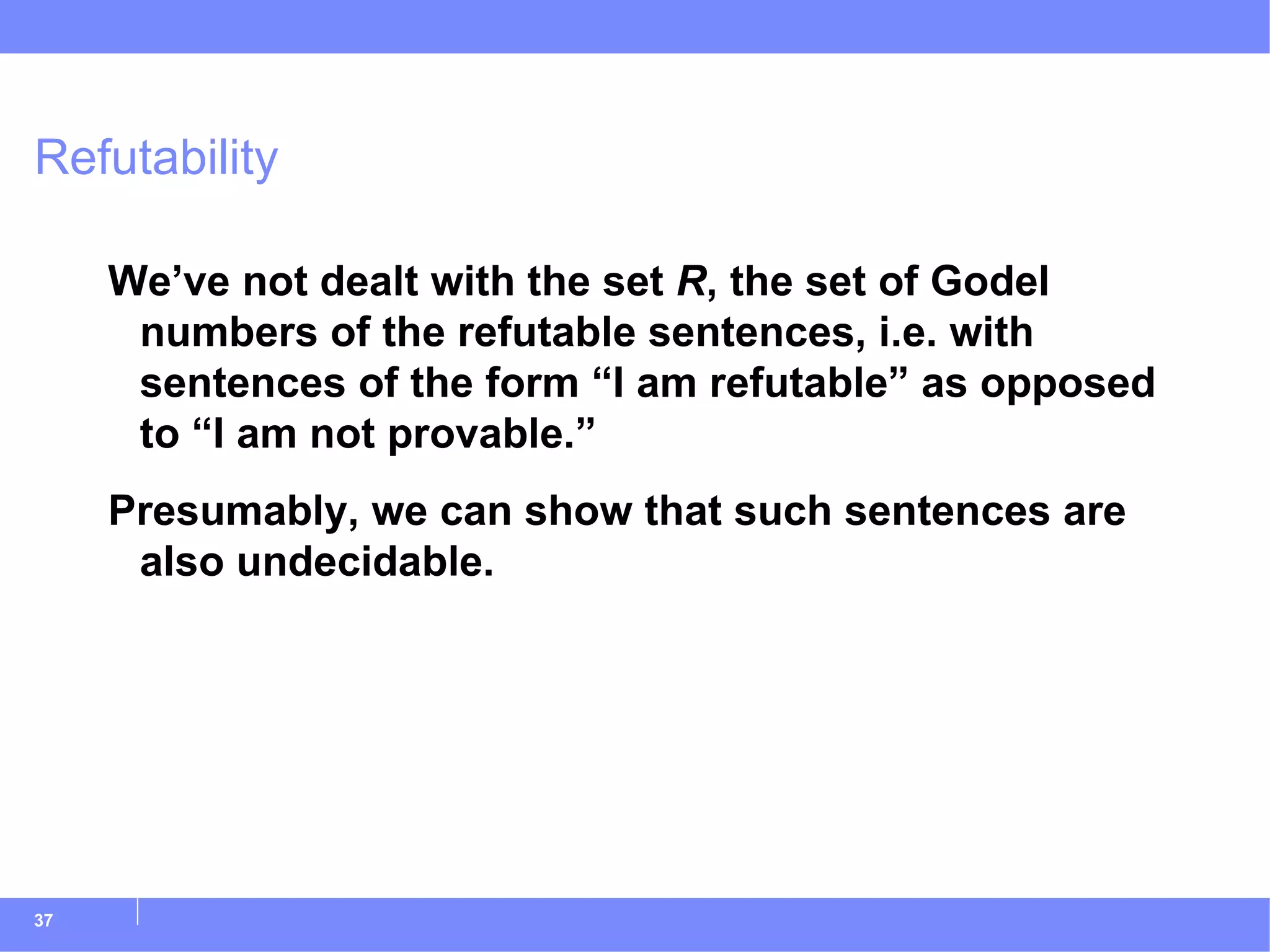
Refutability We’ve notdealt with the set R , the set of Godel numbers of the refutable sentences, i.e. with sentences of the form “I am refutable” as opposed to “I am not provable.” Presumably, we can show that such sentences are also undecidable.
38.
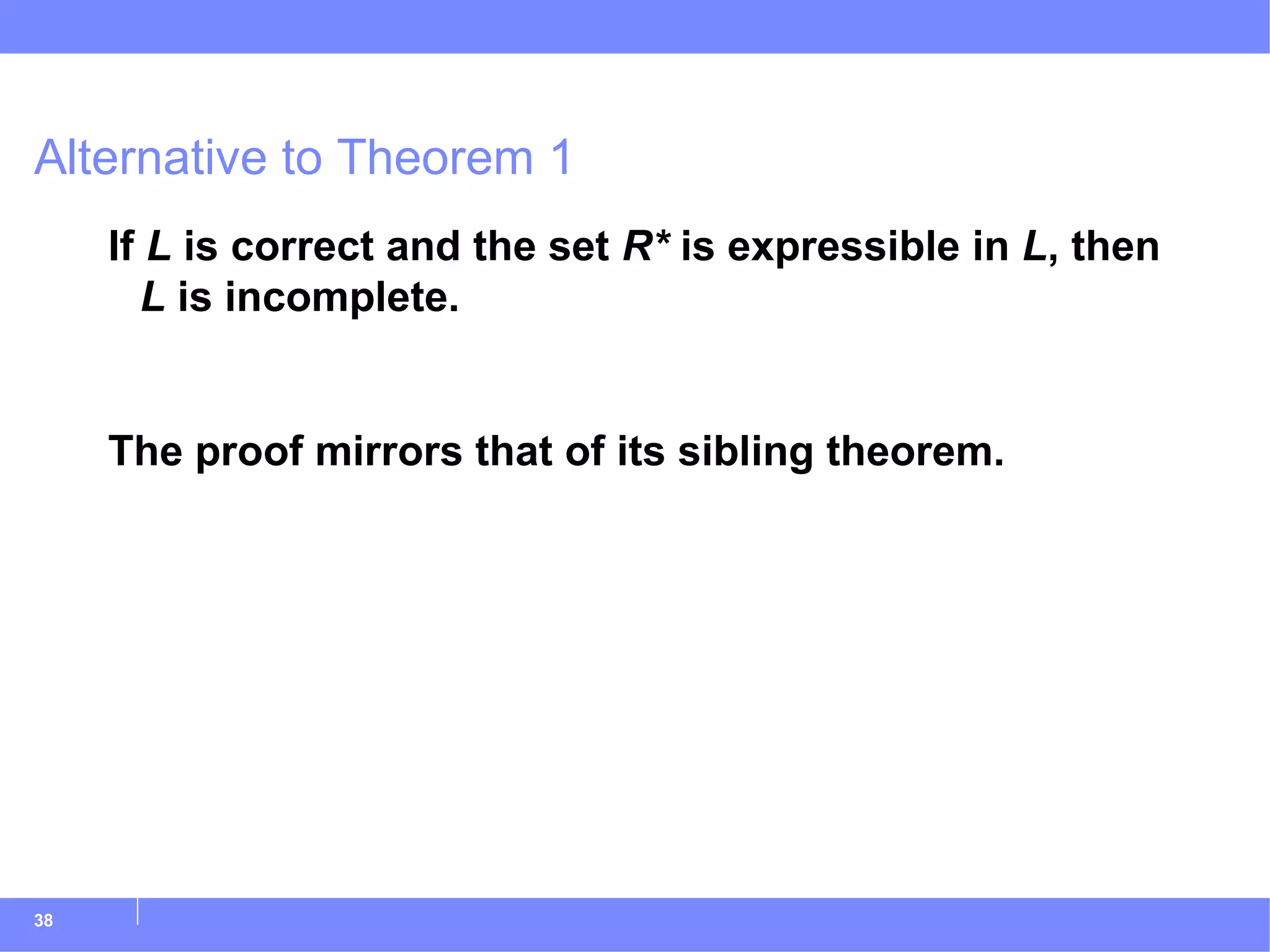
Alternative to Theorem1 If L is correct and the set R* is expressible in L , then L is incomplete. The proof mirrors that of its sibling theorem.
39.
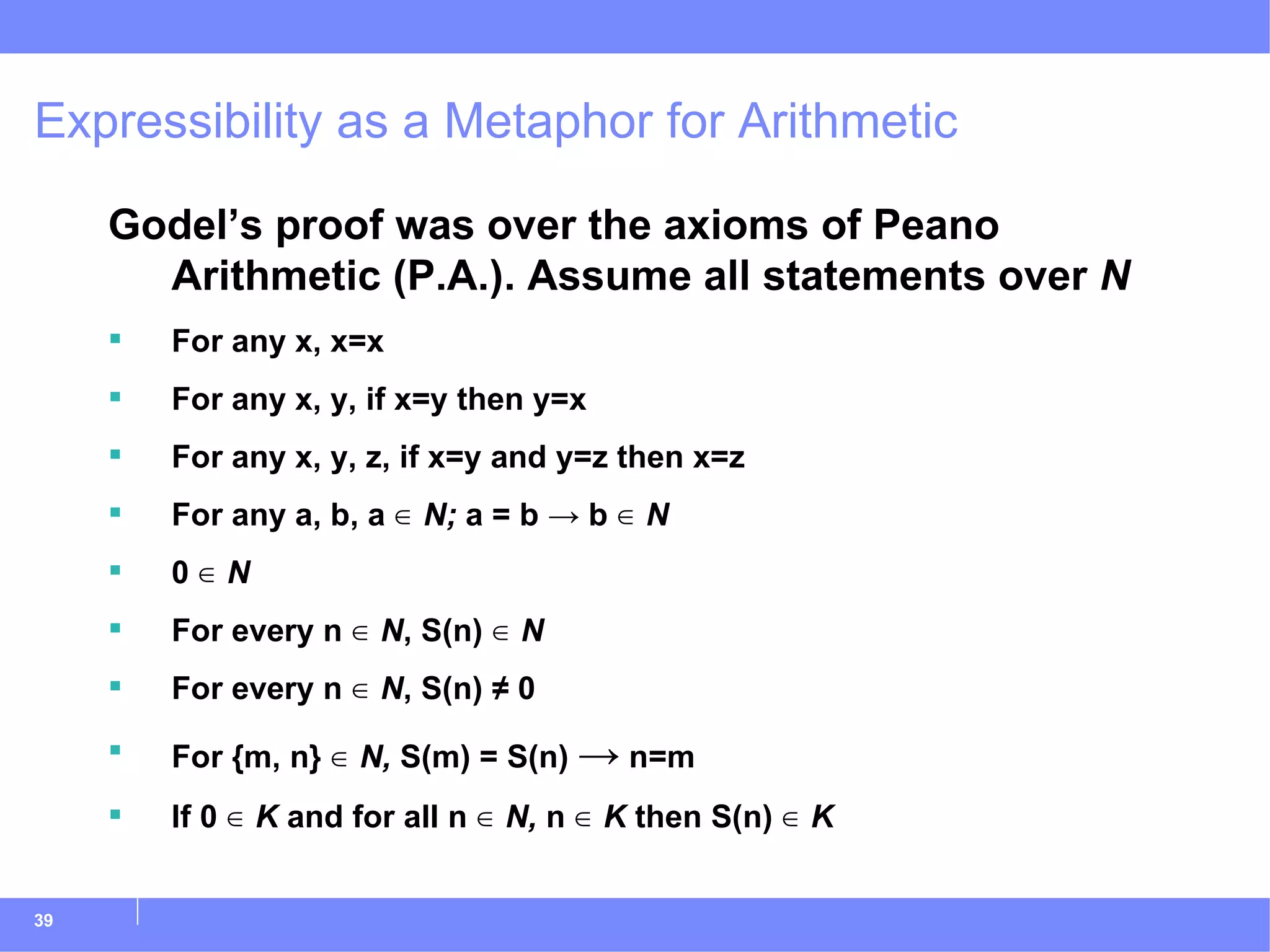
Expressibility as aMetaphor for Arithmetic Godel’s proof was over the axioms of Peano Arithmetic (P.A.). Assume all statements over N For any x, x=x For any x, y, if x=y then y=x For any x, y, z, if x=y and y=z then x=z For any a, b, a ∈ N; a = b -> b ∈ N 0 ∈ N For every n ∈ N , S(n) ∈ N For every n ∈ N , S(n) ≠ 0 For {m, n} ∈ N, S(m) = S(n) -> n=m If 0 ∈ K and for all n ∈ N, n ∈ K then S(n) ∈ K
40.
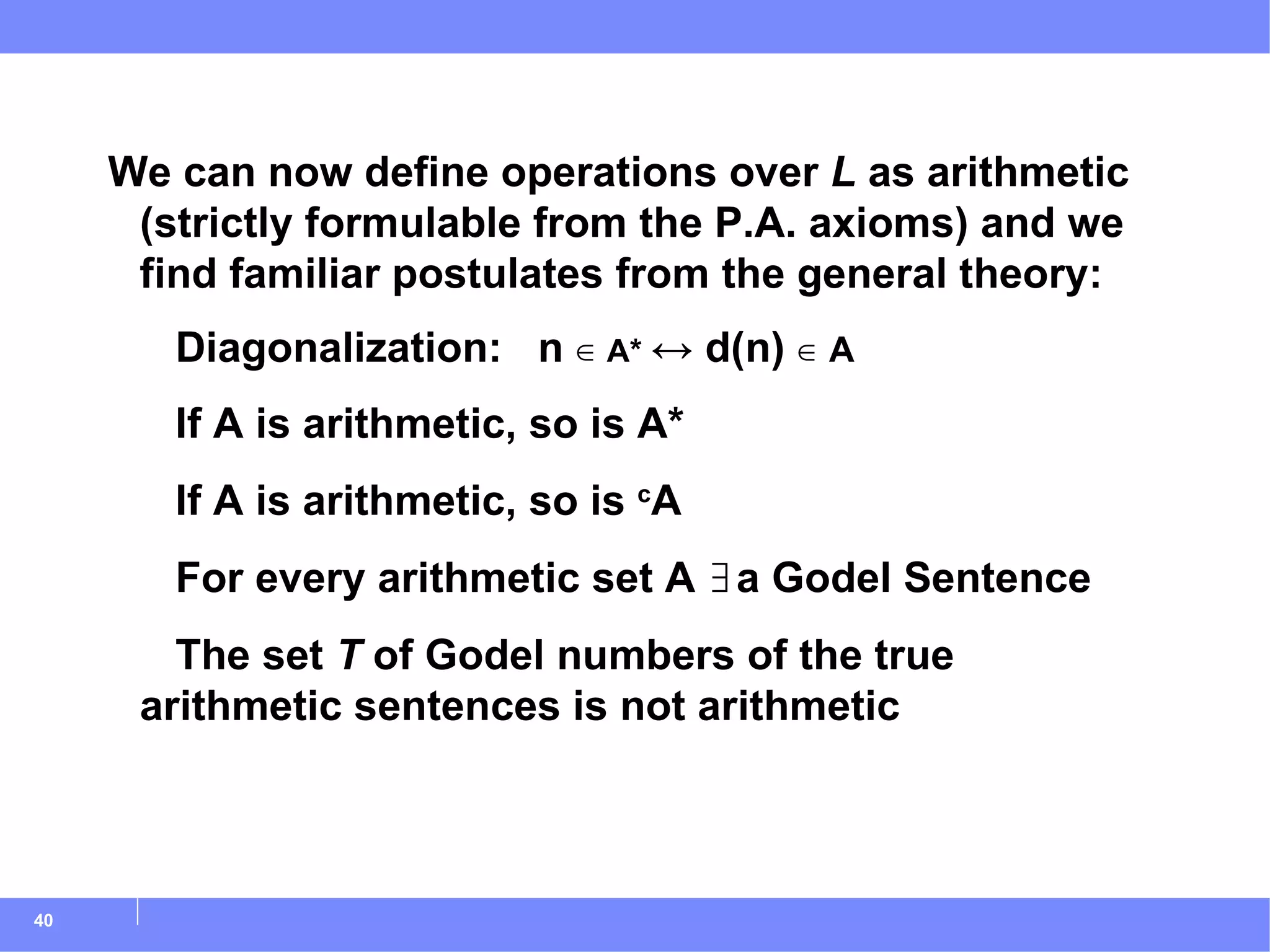
We can nowdefine operations over L as arithmetic (strictly formulable from the P.A. axioms) and we find familiar postulates from the general theory: Diagonalization: n ∈ A* ↔ d(n) ∈ A If A is arithmetic, so is A* If A is arithmetic, so is c A For every arithmetic set A ∃a Godel Sentence The set T of Godel numbers of the true arithmetic sentences is not arithmetic
41.
Correctness versus ConsistencyDefine ω-inconsistency : An axiom system S is said to ω-inconsistent if there is a formula, F(w) such that ∃ w F( w) is provable yet all the sentences F(0), F(1), F(2), ... are refutable. A system that is not ω-inconsistent is ω-consistent.
42.
Godel’s 2 nd Incompleteness Theorem For any formal recursively enumerable theory T including basic arithmetical truths …, T includes a statement of its own consistency if and only if T is inconsistent. More forcefully, this theorem says that any such system that can prove it’s own consistency is inconsistent!
43.
How’d it Workout for Hilbert’s Program? It is not possible to formalize all of mathematics There is no complete, consistent extension even of P.A. – most “interesting” systems are incomplete A theory as complex as P.A. cannot demonstrate its own consistency There is no algorithm to decide truth or provability of systems considered here (Hilbert’s Entscheidungsproblem)