
BIREFRINGENCE
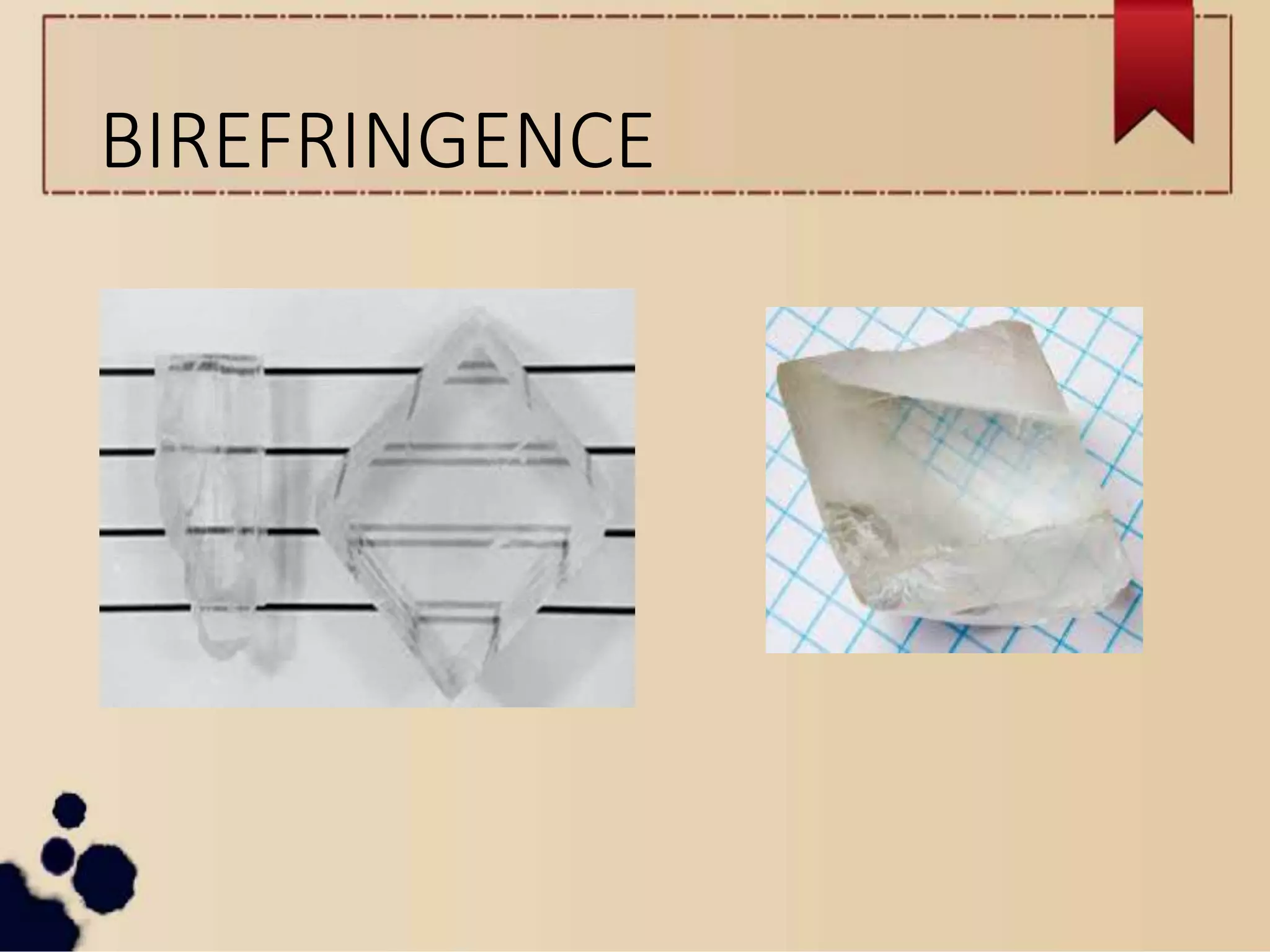
Birefringence is formally defined as the double
refraction of light in a transparent, molecularly
ordered material, which is manifested by the
existence of orientation-dependent differences in
refractive index.
POLARIZATION
•Polarization of light waves is the phenomenon of
restricting the plane of vibration of Electric field vector of
light in a definite plane.
There are three type of polarized
light
1) Plane Polarized Light 2)
Circularly Polarized Light
3) Elliptically Polarized Light
TYPES OF CRYSTALS
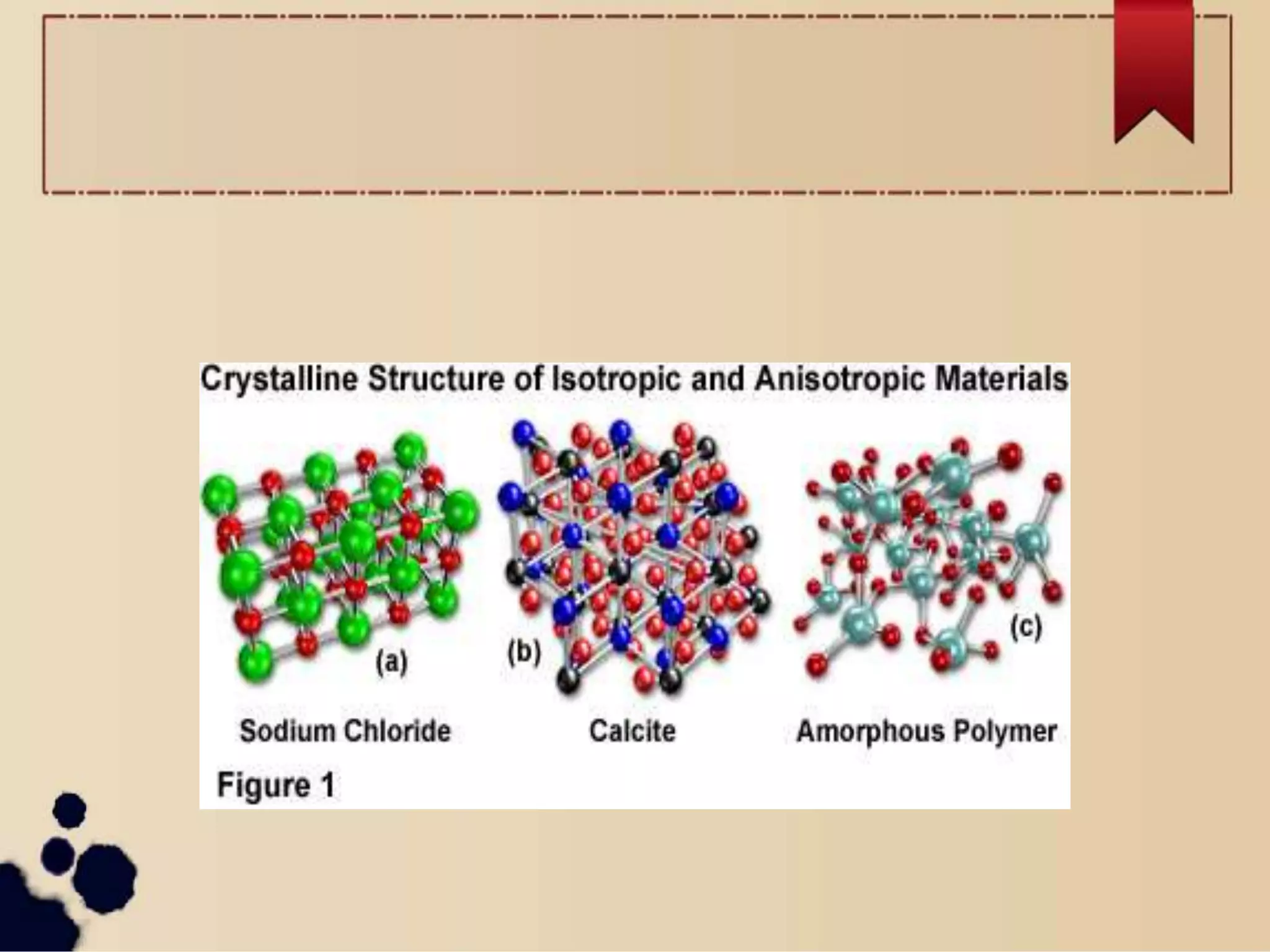
Crystals are classified as being either
isotropic or anisotropic depending upon
their optical behavior and whether or not
their crystallographic axes are equivalent.
ISOTROPIC CRYSTAL
All isotropic crystals have equivalent axes that interact with
light in a similar manner, regardless of the crystal orientation
with respect to incident light waves. Light entering an isotropic
crystal is refracted at a constant angle and passes through the
crystal at a single velocity without being polarized by
interaction with the electronic components of the crystalline
lattice.
Eg: glass, table salt (sodium chloride)
ANISOTROPHIC CRYSTAL
The term anisotropy refers to a non-uniform spatial
distribution of properties, which results in different values
being obtained when specimens are probed from several
directions within the same material. Observed properties are
often dependent on the particular probe being employed and
often vary depending upon the whether the observed
phenomena are based on optical, acoustical, thermal, magnetic,
or electrical events.
Eg: quartz, calcite, and tourmaline
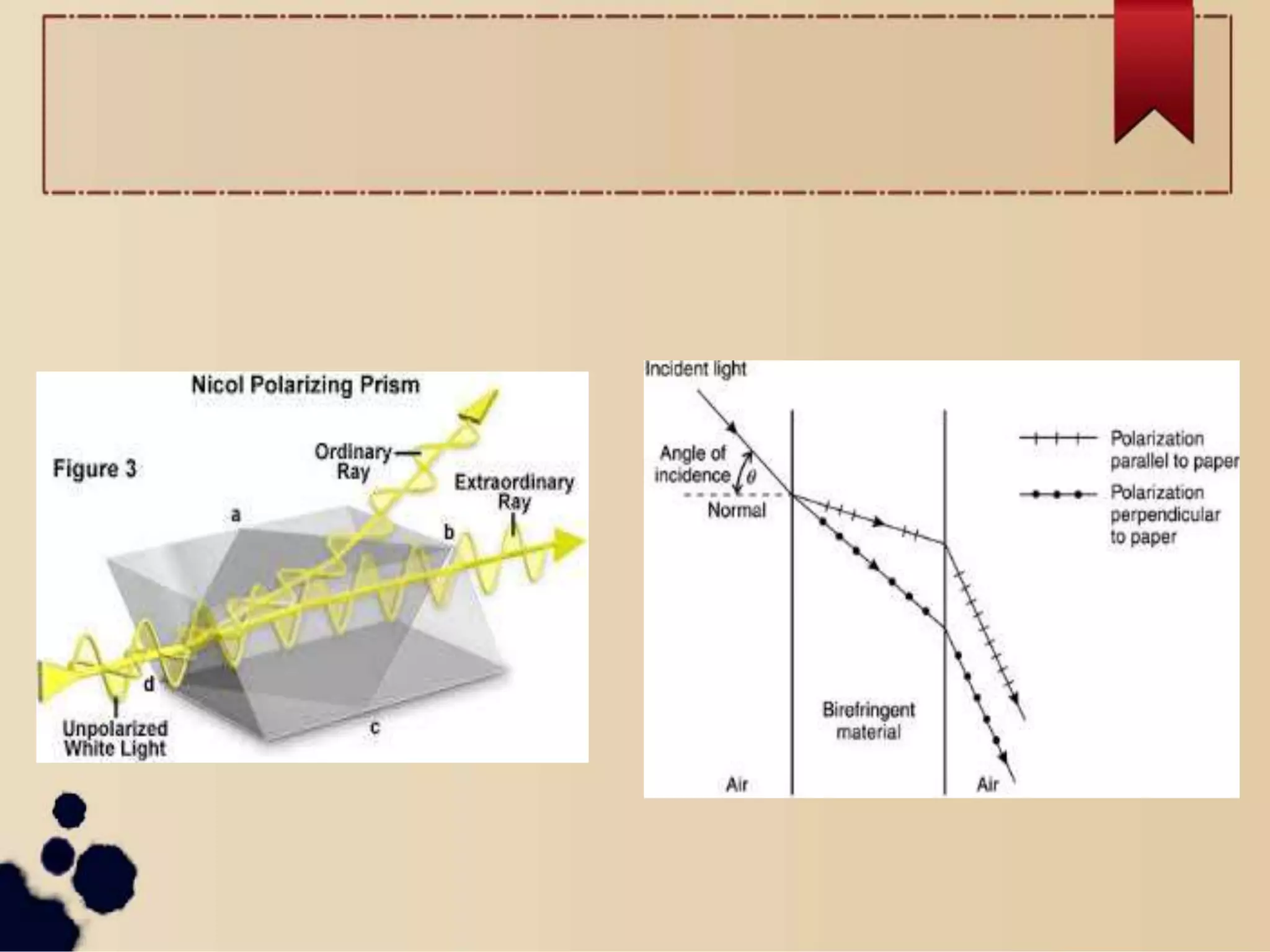
Double refraction
When light enters the optical axis of anisotropic crystals, it
behaves in a manner similar to the interaction with isotropic
crystals, and passes through at a single velocity. However,
when light enters a non-equivalent axis, it is refracted into two
rays, each polarized with the vibration directions oriented at
right angles (mutually perpendicular) to one another and
traveling at different velocities. This phenomenon is termed
double refraction or birefringence and is exhibited to a greater
or lesser degree in all anisotropic crystals.
BIREFRINGENCE
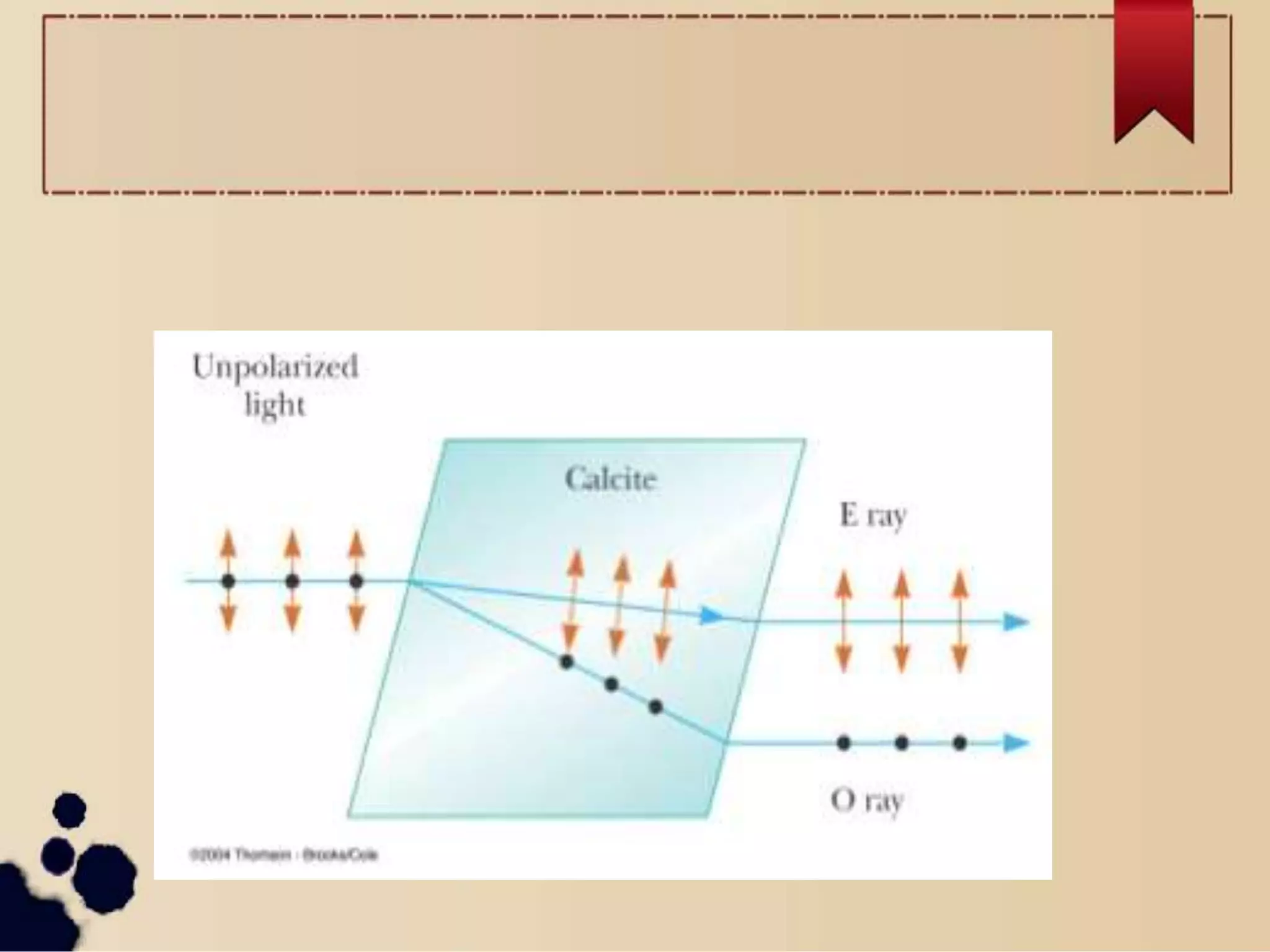
“O” AND “E” RAYS
The stationary image is known as the ordinary image(O),
produced by the refracted rays which obey the laws of
refraction. These rays are known ordinary rays.
The other image is extraordinary image(E), produced by
the refracted rays which do not obey the laws of
refraction.These rays are known as extraordinary rays
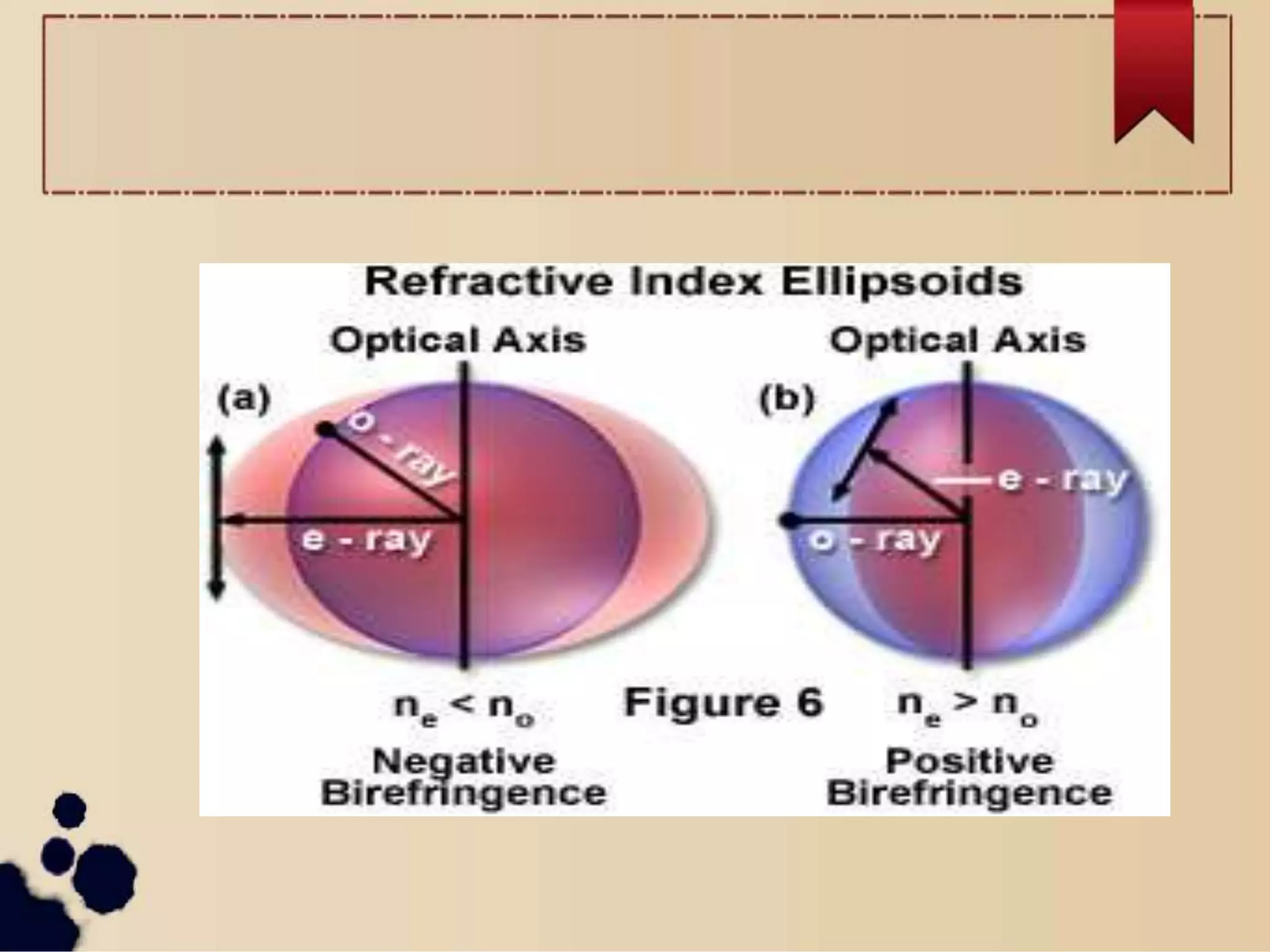
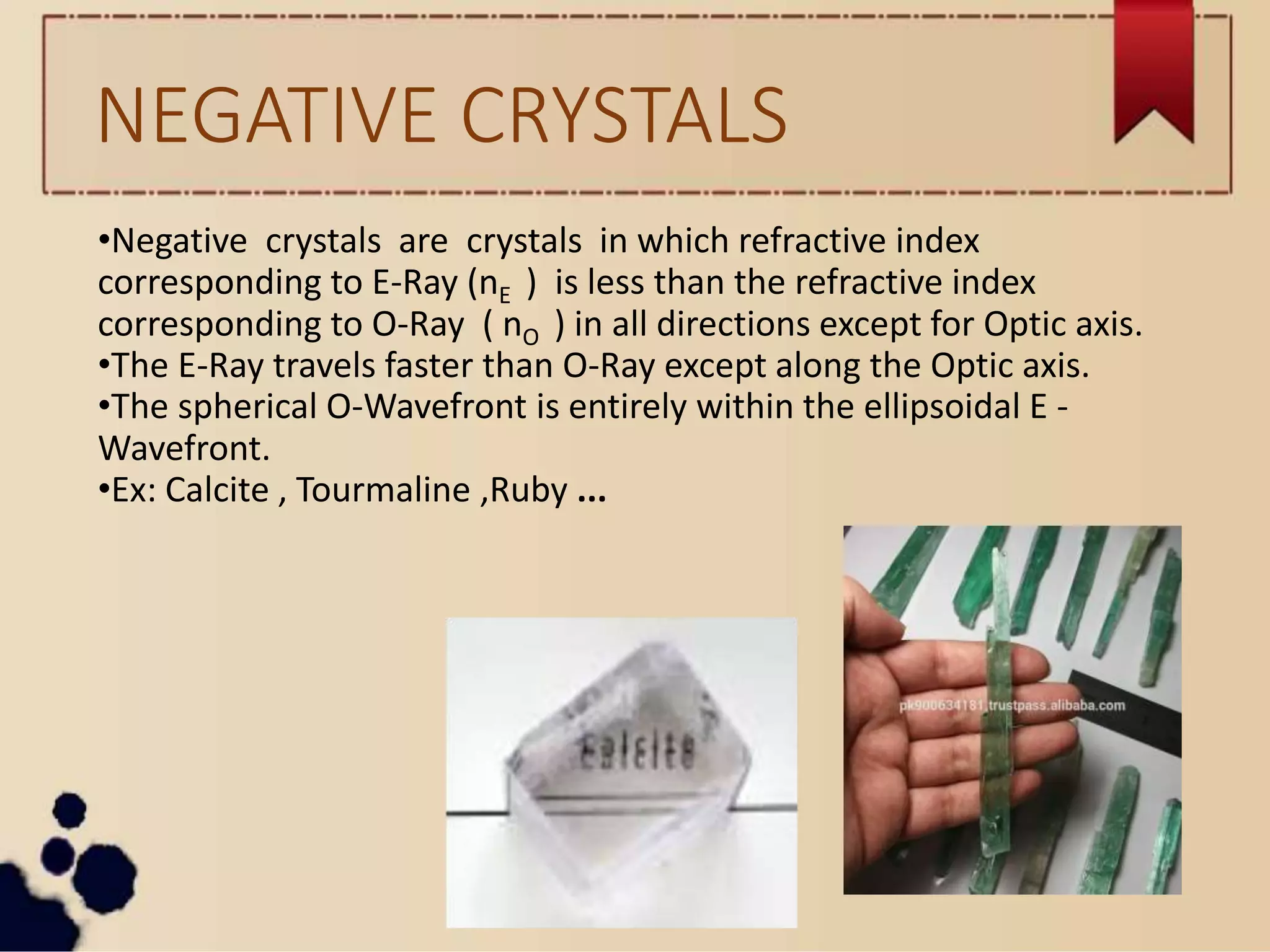
NEGATIVE CRYSTALS
•Negative crystals are crystals in which refractive index
corresponding to E-Ray (nE ) is less than the refractive index
corresponding to O-Ray ( nO ) in all directions except for Optic axis.
•The E-Ray travels faster than O-Ray except along the Optic axis.
•The spherical O-Wavefront is entirely within the ellipsoidal E -
Wavefront.
•Ex: Calcite , Tourmaline ,Ruby ...
POSITIVE CRYSTALS
•Positive crystals are crystals in which refractive for O-Ray is less than
that for E-Ray(nO<nE).
•The velocity of O-Ray is greater than or equal to the velocity of E-Ray.
•The ellipsoidal E-wavefront is entirely within the spherical O-wavefront.
•Example : Quartz (SiO2), Sellaite (MgF2),Rutile (TiO2),…
Optic axis
Inside the crystal there is a particular direction in
which both the rays travel with the same velocity.
This direction is called optic axis.
The refractive index is same for both rays and
there is no double refraction in this direction.
Types of crystals
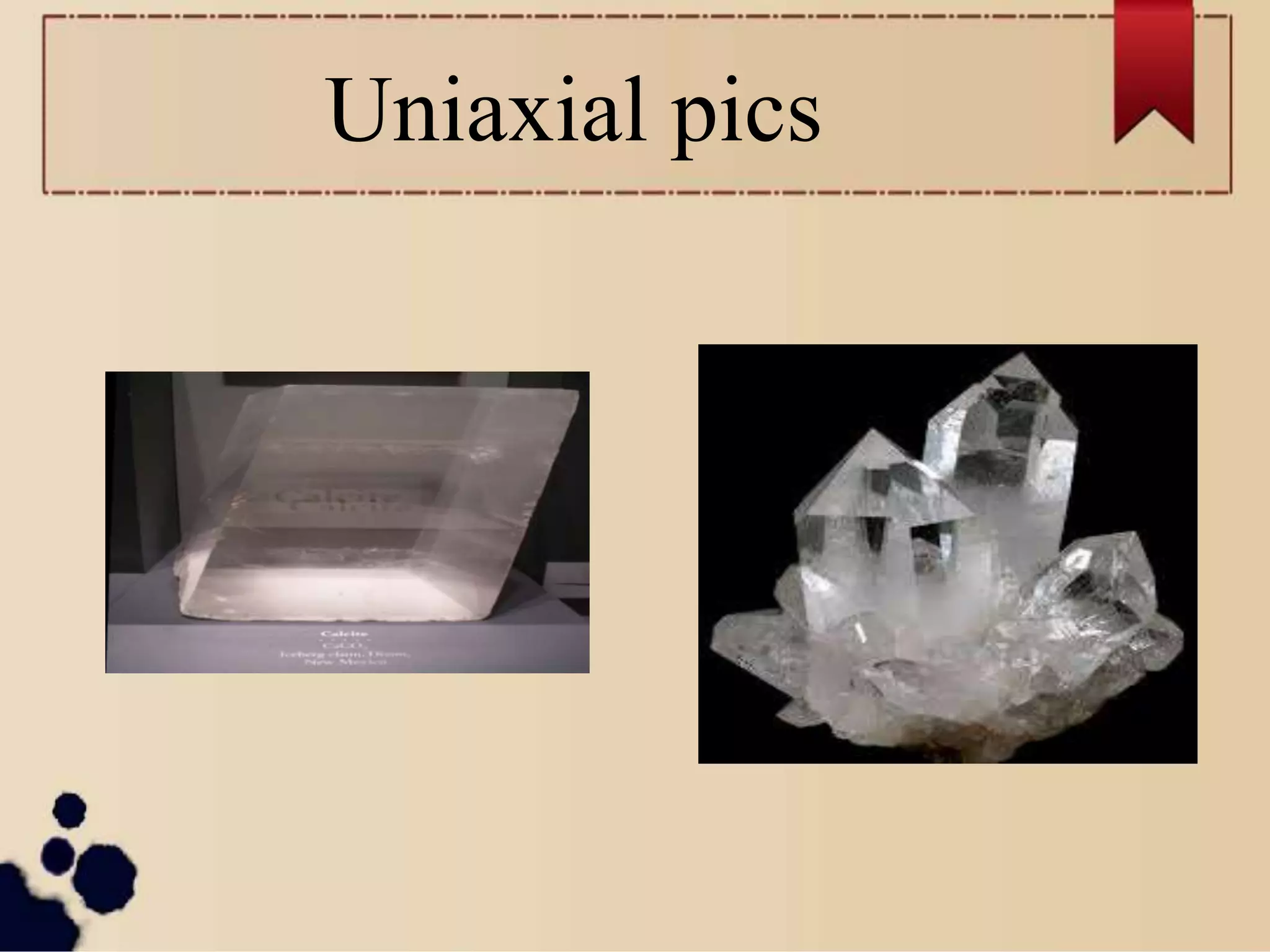
Uniaxial crystal:
Crystals like calcite,quartz,ice, and tourmaline
having only one optic axis are called as uniaxial
crystals
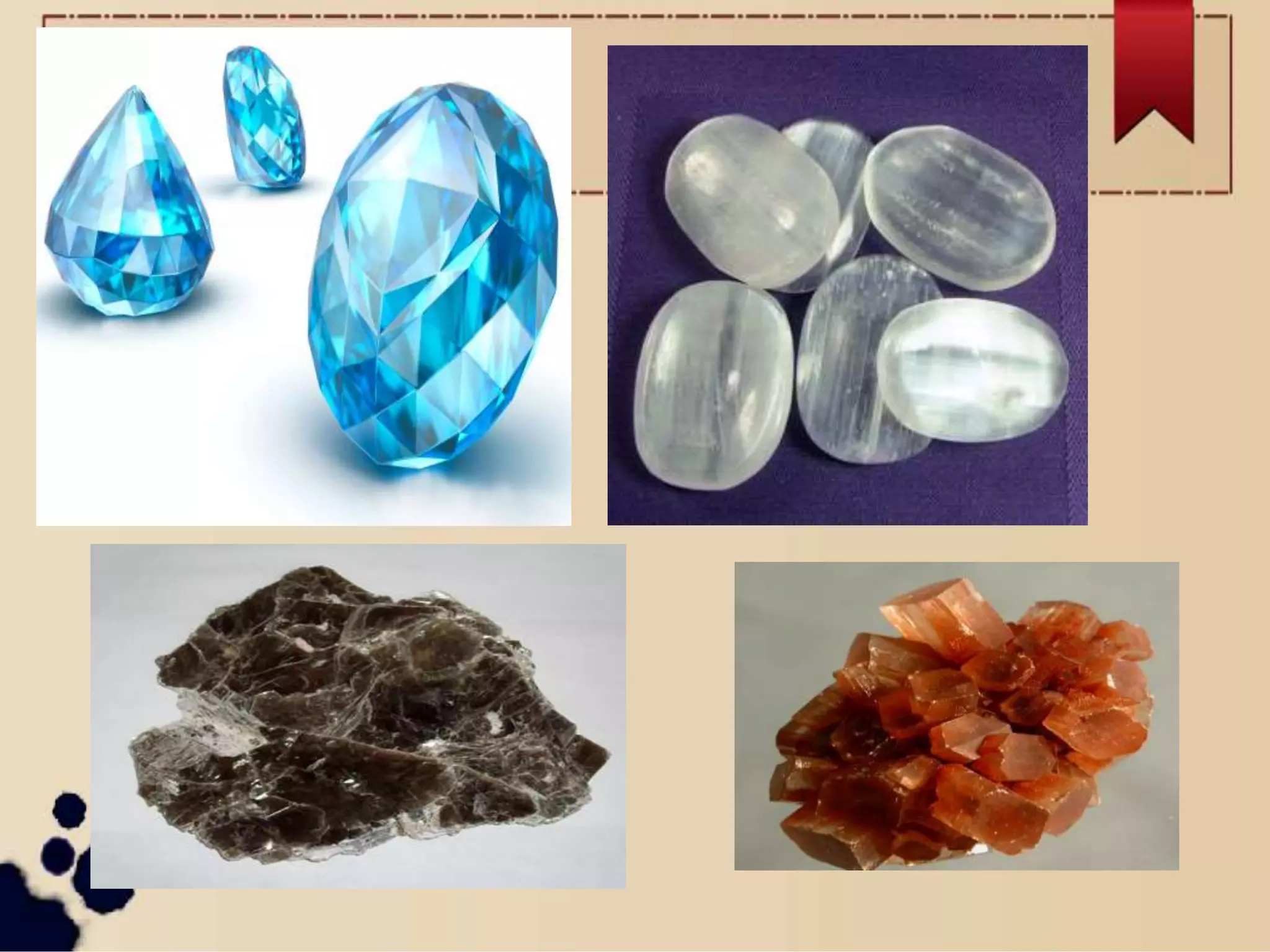
Biaxial crystal:
Crystals like mica, topaz,selenite, and aragonite
having two optic axis are called as biaxial crystals.
Uniaxial pics
 HALF WAVE PLATE
 QUARTER WAVE PLATE
WAVE PLATE
REFERENCES
TEXTBOOK OF OPTICS BY BRIJLAL
CLINICAL REFRACTION BY BORISCH
Birefringence

Birefringence

  • 1.
    BIREFRINGENCE Birefringence is formallydefined as the double refraction of light in a transparent, molecularly ordered material, which is manifested by the existence of orientation-dependent differences in refractive index.
  • 2.
    POLARIZATION •Polarization of lightwaves is the phenomenon of restricting the plane of vibration of Electric field vector of light in a definite plane.
  • 3.
    There are threetype of polarized light 1) Plane Polarized Light 2) Circularly Polarized Light 3) Elliptically Polarized Light
  • 4.
    TYPES OF CRYSTALS Crystalsare classified as being either isotropic or anisotropic depending upon their optical behavior and whether or not their crystallographic axes are equivalent.
  • 5.
    ISOTROPIC CRYSTAL All isotropiccrystals have equivalent axes that interact with light in a similar manner, regardless of the crystal orientation with respect to incident light waves. Light entering an isotropic crystal is refracted at a constant angle and passes through the crystal at a single velocity without being polarized by interaction with the electronic components of the crystalline lattice. Eg: glass, table salt (sodium chloride)
  • 7.
    ANISOTROPHIC CRYSTAL The termanisotropy refers to a non-uniform spatial distribution of properties, which results in different values being obtained when specimens are probed from several directions within the same material. Observed properties are often dependent on the particular probe being employed and often vary depending upon the whether the observed phenomena are based on optical, acoustical, thermal, magnetic, or electrical events. Eg: quartz, calcite, and tourmaline
  • 8.
    Double refraction When lightenters the optical axis of anisotropic crystals, it behaves in a manner similar to the interaction with isotropic crystals, and passes through at a single velocity. However, when light enters a non-equivalent axis, it is refracted into two rays, each polarized with the vibration directions oriented at right angles (mutually perpendicular) to one another and traveling at different velocities. This phenomenon is termed double refraction or birefringence and is exhibited to a greater or lesser degree in all anisotropic crystals.
  • 10.
  • 11.
    “O” AND “E”RAYS The stationary image is known as the ordinary image(O), produced by the refracted rays which obey the laws of refraction. These rays are known ordinary rays. The other image is extraordinary image(E), produced by the refracted rays which do not obey the laws of refraction.These rays are known as extraordinary rays
  • 14.
    NEGATIVE CRYSTALS •Negative crystalsare crystals in which refractive index corresponding to E-Ray (nE ) is less than the refractive index corresponding to O-Ray ( nO ) in all directions except for Optic axis. •The E-Ray travels faster than O-Ray except along the Optic axis. •The spherical O-Wavefront is entirely within the ellipsoidal E - Wavefront. •Ex: Calcite , Tourmaline ,Ruby ...
  • 15.
    POSITIVE CRYSTALS •Positive crystalsare crystals in which refractive for O-Ray is less than that for E-Ray(nO<nE). •The velocity of O-Ray is greater than or equal to the velocity of E-Ray. •The ellipsoidal E-wavefront is entirely within the spherical O-wavefront. •Example : Quartz (SiO2), Sellaite (MgF2),Rutile (TiO2),…
  • 16.
    Optic axis Inside thecrystal there is a particular direction in which both the rays travel with the same velocity. This direction is called optic axis. The refractive index is same for both rays and there is no double refraction in this direction.
  • 17.
    Types of crystals Uniaxialcrystal: Crystals like calcite,quartz,ice, and tourmaline having only one optic axis are called as uniaxial crystals Biaxial crystal: Crystals like mica, topaz,selenite, and aragonite having two optic axis are called as biaxial crystals.
  • 18.
  • 20.
     HALF WAVEPLATE  QUARTER WAVE PLATE WAVE PLATE
  • 21.
    REFERENCES TEXTBOOK OF OPTICSBY BRIJLAL CLINICAL REFRACTION BY BORISCH