Polarization
Reference:
1. Optics (4th Edition)[Ajoy Ghatak]
2. Optics (4th Edition) [Eugene Hecht]
3. A Textbook of Optics [Brijlal & Subrahmanyam]
If we have a one end of a string up & down then a
transverse wave is generated. Each point of the string
executes sinusoidal oscillation in straight light (along x-
axis) and the wave, therefore, known as a linearly
polarized wave.
Light as an electromagnetic wave
Light is a transverse electromagnetic wave
The vibrating electric
vector E and the
direction of wave
propagation form a
plane. Plane of
vibration/Polarization
Unpolarized light.
Light in which the planes of vibration are
symmetrically distributed about the
propagation direction of the wave
Linearly polarized light.
Electric field vector oscillated in a given
constant orientation.
Effect of polarizer on natural light
P A
Io
I
A
Io
P
P A
?
θ
Eo
E=Ey=EoCosθ
I=IoCos2θ
Io
Malus’s Law
Polarization by Reflection [Brewster’s Law]
µ = tanip
µ = sinip / cosip
Snell’s law
µ = sinip / sin r
r = 90- ip
OR
r+ ip =90
Sin r = cosip
Refraction
Polarization by Double refraction
Arrangement of atoms in a crystal can lead to both a
structural asymmetry and an anisotropy in the optical
properties.
The speed of the E-M wave depends on the refractive
index n.
Therefore phenomenon of double refraction
(birefringence) occurs
Ordinary ray—follows snell’s law (n constant)
Extraorinary ray – does not follow snells law (n not fixed)
The difference n = ne – no is a measure of the birefringence.
Optic Axis – A direction along which incident light does not suffer double refraction.
All crystals having symmetries that are hexagonal, tetragonal, and trigonal are
optically anisotropic and will lead to birefringence.
In such crystals, an optic axis exists and about which the atoms are arranged
symmetrically.
Crystals possessing only one such optic axis are known as uniaxial. [Calcite,
tourmaline, and quartz]
For calcite n = 1.486 – 1.658 = -0.172, negative uniaxial, while quartz is Positive.
The crystal having two optic axis and both the refracted rays are extraordinary are
biaxial. [mica, topaz, aragonite]
The Calcite Crystal
The Calcite is chemically calcium carbonate CaCO3. (rhombohedron)
Each of six faces of the crystal is a parallelogram of 78.08 and 101.92.
Two opposite corners A and B are obtuse and called as blunt corners.
ne = 1.486
no = 1.658
Nicol Prism
A calcite crystal that is cut, polished, and painted, separates the o-
ray and e-ray via TIR (total internal reflection).
A thin layer of balsam glues two halves of the crystal.
Balsam has an index of refraction, nb, which is between that of the
o- and e-rays, i.e., ne (1..486) < nb (1.55) < no (1.66).
Thus, the o-ray experiences TIR at the balsam interface and is
absorbed by the layer of black paint on the side.
The e-ray refracts normally at the balsam interface an leaves the
crystal at the bottom. Therefore, the emitted ray can be used as a
fully linearly polarized beam.
Double refraction
Huygen’s Explanation
When the light wave strikes of a doubly refracting
crystal, every point of the crystal becomes source of
two secondary wavelets; (O)rdinary and
(E)xtraordinary.
For O – ray velocity is same in all the directions, the
wave front is spherical.
For E – ray velocity, the wave front is ellipoisdal.
For Negative uniaxial crystal the sphere lies inside
the ellipsoid, while in Positive crystal ellipsoid lies
inside the sphere.
Optic Axis
Optic Axis
Calcite (-ve) Quartz (+ve)
E-ray
O-ray
E-ray
O-ray
Semi major axis = vet
Semi Minor axis = vot
E-ray O-ray
Radius = vot
Optic Axis inclined to the refracting face & in the plane of incidence
CASE 1
1.1 Oblique incidence
During time t = BC/v, in
which disturbance from B to
C reaches C, the spherical
wave (o) front travelled
AG = vot = voBC/v = BC/µo
Similarly the distance travelled by
extra ordinary (e) wave
AH = vet= veBC/v = BC/µe
1. The ordinary spherical wave surface acquires a radius BC/µo
2. The extra ordinary ellipsoidal wave surface has semi minor axis
along the optic axis and semi major axis perpendicular to optic
axis
BC/µo = semi minor axis or radius of spherical wave
BC/µE = semi major axis ; Where µE = minimum refractive index for
E-ray at Perpendicular to optic axis.
• CG (Tangent) represents the position of Ordinary wave front and
CH represents the position of Extra ordinary wave front.
• AG represents the direction of O rays while AH gives the
direction of E-ray.
Both E and O ray travel in different directions and with
different velocities.
1.2 Normal Incidence
Dotted line is the optic axis
The tangent planes CD
and GH are parallel and
represent the positions of
Ordinary spherical and
Extraordinary ellipsoidal
wave surfaces.
The AO and AE are the
O and E ray which
travel along different
path with different
velocities.
CASE 2
Optic Axis parallel to the refracting face & in the plane of incidence
2.1 Oblique
incidence
The AO and AE are the O
and E ray which travel
along different path with
different velocities.
2.2 Normal incidence
Although the O and E ray
are not separated and
they travel along the
same direction , yet there
is double diffraction. As
they travel with different
velocities a phase
difference is introduced
between them
This property is utilized in quarter and half
wave plate [Important]
CASE 3
Optic Axis perpendicular to the refracting surface & in the plane of
incidence
3.1 Oblique incidence
The AO and AE are the
O and E ray which travel
along different path
with different velocities.
3.2 Normal incidence
Both O and E travel with the same
velocity
CASE 4
Optic Axis parallel to the refracting surface & perpendicular to the plane
of incidence
4.1 Oblique incidence
The AO and AE are the
O and E ray which travel
along different path
with different velocities.
4.2 Normal incidence
Although the O and E ray
are not separated and
they travel along the
same direction , yet there
is double diffraction. As
they travel with different
velocities a phase
difference is introduced
between them
Quarter wave plates
A thin plate of birefringent crystal having the optic
axis parallel to its refracting faces and its thickness
is adjusted such that it introduces a quarter wave
(/4) path difference (OR a phase difference of 90
between the e- and o-rays, propagating through it.
Path difference () = (µo-µe)t = /4
for –ve calcite
Path difference () = (µe-µo)t = /4
for +ve Quartz
Half wave plates
• A thin plate of birefringent crystal having the optic
axis parallel to its refracting faces and its thickness is
adjusted such that it introduces a half wave (/2)
path difference (OR a phase difference of 180
between the e- and o-rays, propagating through it.
Path difference () = (µo-µe)t = /2
for –ve calcite
Path difference () = (µe-µo)t = /2
for +ve Quartz
Superposition of waves linearly polarized at right angles
Production of circularly and elliptically polarized light
OR
For calcite crystal e-ray travels faster than o - ray
Along X-axis (e-ray)
x = aSin (ωt+φ)----(1)
Along Y-axis (o-ray)
y = bSinωt-------(2)
y/b = Sinωt-------(3)
e-ray
Amplitude-a
O-ray
A
θ
Amplitude-b
Using eq (1)
x/a = sinωtcosφ+cosωtsinφ
x/a = sinωtcosφ+(1-sin2ωt)1/2sinφ
Using eq (2)
(x/a) = (y/b)cosφ+{1-(y/b)2}1/2sinφ
(x/a) –(y/b)cosφ = {1-(y/b)2}1/2sinφ
[(x/a) –(y/b)cosφ]2 = {1-(y/b)2}sin2φ
(x/a)2 +(y/b)2cos2φ-(2xy/ab)cosφ = sin2φ-(y/b)2sin2φ
(x/a)2 +(y/b)2(sin2φ+cos2φ)-(2xy/ab)cosφ = sin2φ
(x/a)2 +(y/b)2-(2xy/ab)cosφ = sin2φ
This is the general equation of ellipse
Case (1) if
Φ = 0, 2π, 4π, 6π
sinΦ = 0 ; cosΦ = 1
(x/a)2 +(y/b)2-(2xy/ab)= 0
(x/a – y/b)2 = o
OR y=(b/a)x [ Straight line]
Plane polarized light
General equation becomes
b
a
Case (2) if
Φ = π, 3π, 5π,….
sinΦ = 0 ; cosΦ = -1
y= - (b/a)x [ Straight line]
Plane polarized light
General equation becomes
b
a
(x/a)2 +(y/b)2-(2xy/ab)cosφ = sin2φ
Case (3) if Φ = π/2,3π/2,5π/2,7π/2,9π/2
sinΦ = 1 ; cosΦ = 0 and a≠b
(x/a)2 +(y/b)2= 1
Elliptically polarized light
General equation becomes
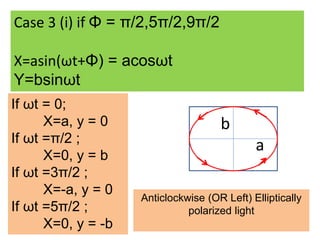
Case 3 (i) if Φ = π/2,5π/2,9π/2
X=asin(ωt+Φ) = acosωt
Y=bsinωt
If ωt = 0;
X=a, y = 0
If ωt =π/2 ;
X=0, y = b
If ωt =3π/2 ;
X=-a, y = 0
If ωt =5π/2 ;
X=0, y = -b
b
a
Anticlockwise (OR Left) Elliptically
polarized light
Case 3 (ii) if Φ = 3π/2,7π/2,11π/2..etc
X=asin(ωt+Φ) = -acosωt
Y=bsinωt
If ωt = 0;
X=0, y =-b
If ωt =π/2 ;
X=-a, y = 0
b
a
Clockwise (OR Right) Elliptically
polarized light
(x/a)2 +(y/b)2-(2xy/ab)cosφ = sin2φ
Case (4) if Φ = π/2,3π/2,5π/2,7π/2,9π/2
sinΦ = 1 ; cosΦ = 0 AND a=b
x2 +y2= a2
Circularly polarized light
General equation becomes
Case 4 (i) if Φ = π/2,5π/2,9π/2
X=asin(ωt+Φ) = acosωt
Y=asinωt
Anticlockwise (OR Left) Circularly polarized light
a
a
Case 4 (ii) if Φ = 3π/2,7π/2,11π/2..etc
X=asin(ωt+Φ) = -acosωt
Y=asinωt
a
a
Clockwise (OR Right) Circularly polarized light
e-ray
Amplitude-a
O-ray
A
θ
Amplitude-b
Production of elliptically OR Circularly polarized light
Optic Axis
θ
If θ ≠ 45  Elliptically
If θ = 45  Circularly
b
a
QWP
Analysis of polarized light
Operation
Unknown
light
Analyzer
Plane
polarized
Conclusion
Imax
0
0
Imax
Unknown
light
Analyzer
Operation
Elliptically
OR
Partially
polarized light ?
Imax
Imin
Imin
Imax
QWP Analyzer
Operation
Imax
0
Imax
0
Elliptically
OR
Partially
polarized light ?
Elliptically
polarized
Conclusion
Unknown
light
QWP
Analyzer
Rotation of
analyzer about
its own axis
Imax
0
Imax
Imin
Analyzer
Rotation of
analyzer
about its own
axis
0
Imax
Imax
Imin
Unknown
light
QWP
Analyzer
Rotation of
analyzer about
its own axis
Imax
0
Imax
I
Analyzer
Rotation of
analyzer
about its own
axis
0
I
I
I
Imax
Imin
Imax
Imin
Partially
polarized
Conclusion
Unknown
light
Analyzer
Operation
Circularly
OR
unpolarized light
?
I
I
I
I
QWP Analyzer
Operation
I
0
I
0
Circularly
OR
unpolarized light
?
Circularly
polarized
Conclusion
I
I
I
I
unpolarized
Conclusion
50
• With achiral compounds, the light that exits the sample tube remains
unchanged. The compound is said to be optically inactive.
Optical Activity
• With chiral compounds, the plane of the polarized light is rotated through
an angle .
• A compound that rotates polarized light is said to be optically active.
The ability to rotate the plane of polarization of plane
polarized light certain substances is called optical activity.
Substances are known as optically active substance
i) Dextro rotatory (D-type)
ii) Laevo rotatory (L-type)
Specific rotation
θ α l; θ α c; θ α lc
OR
θ = Slc OR S= θ/lc [specific rotation]
Facts: Optically Active Biological Substance
Natural sugar (sucrose C12H22O11, glucose
C6H12O6) is always d-rotatory, while laboratory-
synthesized organic molecules are equal in the
number of l- and d-rotatory molecules.
Most proteins are l-rotatory.
Proteins found in meteorite are equal in the
number of l- and drotatory form.
Fresnel’s Theory of Optical activity
The plane polarized light consists of resultant of circularly polarized
vibrations rotating in opposite directions with the same angular velocity.
x = 0
y=2asinωt
Consider a plane polarized light is incident normally on a
doubly refracting crystal. The vibration in the incident beam
are represented by
x = acosωt-acosωt
y=asinωt+asinωt
x1 = acosωt; y1=asinωt
x2 = -acosωt; y2=asinωt
These circular components travel through the crystal
with different velocities. When they emerge from the
crystal, there is a phase difference δ between them. In
case of quartz (Right handed crystal), the clock wise
component will travel faster.
X=x1 +x2
Y=y1 +y2
x1 = acos(ωt+δ); y1=asin(ωt+δ);
x2 = -acos(ωt); y2=asin(ωt)
X = 2asin(δ/2) sin(ωt+δ/2)…..(1)
Y = 2acos(δ/2)sin(ωt+δ/2)…(2)
Resultant vibrations along X and Y axis have the same
phase. Therefore, the resultant vibration is plane
polarized and it makes an angle δ/2 with the original
direction. Therefore plane of polarization is rotated
through an angle δ/2 on passing through the crystal
From (1) & (2)
Y/X = tan(δ/2)
Represents, plane polarized light with vibrations
inclined at an angle δ/2 with y-axis
=t(µL-µR); δ=(2π/)t(µL-µR)
OR
Θ=δ/2 =(π/)(µL-µR)t
Lorent’s half shade Polarimeter
The Lorent’s half shade device consists of a semi circular half wave plate ABC of
quartz and a semi circular glass plate ADC. These two plates are cemented along
AC
The HWP introduces a phase difference of  between O and E-ray.
The thickness of glass plate is such that it absorbs same amount of light as the
quartz plate.
Plane of vibration of plane polarized light incident normally on the half
shade and is along PQ.
The vibrations emerge from glass plate along PQ, while from Quartz plate
a phase difference of  is introduces between them. Due to this phase
difference the direction of O components reversed.
Application: Specific rotation of sugar solution
S= θ/lc OR θ = Slc
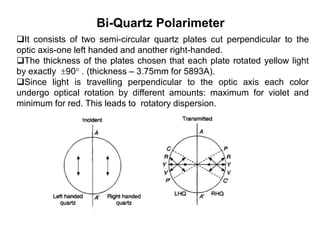
Bi-Quartz Polarimeter
It consists of two semi-circular quartz plates cut perpendicular to the
optic axis-one left handed and another right-handed.
The thickness of the plates chosen that each plate rotated yellow light
by exactly 90 . (thickness – 3.75mm for 5893A).
Since light is travelling perpendicular to the optic axis each color
undergo optical rotation by different amounts: maximum for violet and
minimum for red. This leads to rotatory dispersion.
Two semicircular quartz plates rotates yellow light
exactly by 90  in opposite direction.
The red light is rotated by smallest amount say θ
and shortest wave length violet is rotated by
maximum angle . All other wavelenghts are rotated
between θ and  but yellow by 90 .
When transmitting direction of N2 happens to be
parallel to AA’, yellow light being at the right angles,
it is not transmitted through analyser N2.
Red and violet make almost equal angles with the
transmitted axis of N2 so these are transmitted
equally from both semicircular plates.
Thus both appear grey-violet (GV) colored. This
color is called Tint of Passage or Sensitive Tint.
If the analyser N2 is rotated clockwise
through a small angle so that its
transmission direction become say PP’.
Then red is almost parallel in right half
and violet is parallel in left-half the two
circular plates .
As a result, these colors transmit
maximum and so right half become red or
pink whereas left half becomes violet or
blue.
If the analyser N2 is rotated
anticlockwise through a small angle so that
its transmission direction become say CC’.
Then red is parallel to direction of
transmission in left half and violet is
parallel to direction in right half.
The result is opposite to one seen when
rotated clockwise.
The left-half becomes pink-red and right
becomes blue-violet.
Thus a small rotation changes the colors contrast in the filed of view.
This device is far more sensitive than a half-shade device.
Twin Paradox.
About Relativity
• As an object approaches the speed of light,
time slows down.
• (Moving clocks are slow)
• (Moving rulers are short)
Earth
Mr.
A
Mr.
B
Planet X
Mr. A stays on Earth and Mr. B travels 10 light-years at 80% of
the speed of light.
As Viewed From Earth
• Without Relativity…..
• x = vt or t = x/v
• x is light years traveled
• v is velocity.
• t is time.
• t = 10 LY/0.8c = 12.5 years each way.
• There and back makes the trip
12.5 x 2 or 25 years!!
(This is time as appeared by A i.e. T)
As Viewed From Earth
• With Relativity
• Mr. A sees Mr. B’s clock is
running slow by…
• γ = 5/3 !! [γ= ]
• Therefore the time as read by
B’s clock (Actual time i.e. To) =
25 years ÷ γ
• 25 ÷ 5/3 = 15 years!!
1
1 - β²
Physical Results of Trip
• Mr. A on Earth ages 25
years!!
• Mr. B, traveling at 80%
the speed of light ages
15 years!!

Polarization Physics Optics.pptx

  • 1.
    Polarization Reference: 1. Optics (4thEdition)[Ajoy Ghatak] 2. Optics (4th Edition) [Eugene Hecht] 3. A Textbook of Optics [Brijlal & Subrahmanyam]
  • 2.
    If we havea one end of a string up & down then a transverse wave is generated. Each point of the string executes sinusoidal oscillation in straight light (along x- axis) and the wave, therefore, known as a linearly polarized wave.
  • 3.
    Light as anelectromagnetic wave Light is a transverse electromagnetic wave The vibrating electric vector E and the direction of wave propagation form a plane. Plane of vibration/Polarization
  • 4.
    Unpolarized light. Light inwhich the planes of vibration are symmetrically distributed about the propagation direction of the wave Linearly polarized light. Electric field vector oscillated in a given constant orientation.
  • 5.
    Effect of polarizeron natural light P A Io I A Io P
  • 6.
  • 7.
    Polarization by Reflection[Brewster’s Law] µ = tanip µ = sinip / cosip Snell’s law µ = sinip / sin r r = 90- ip OR r+ ip =90 Sin r = cosip
  • 8.
  • 9.
  • 10.
    Arrangement of atomsin a crystal can lead to both a structural asymmetry and an anisotropy in the optical properties. The speed of the E-M wave depends on the refractive index n. Therefore phenomenon of double refraction (birefringence) occurs Ordinary ray—follows snell’s law (n constant) Extraorinary ray – does not follow snells law (n not fixed)
  • 12.
    The difference n= ne – no is a measure of the birefringence. Optic Axis – A direction along which incident light does not suffer double refraction. All crystals having symmetries that are hexagonal, tetragonal, and trigonal are optically anisotropic and will lead to birefringence. In such crystals, an optic axis exists and about which the atoms are arranged symmetrically. Crystals possessing only one such optic axis are known as uniaxial. [Calcite, tourmaline, and quartz] For calcite n = 1.486 – 1.658 = -0.172, negative uniaxial, while quartz is Positive. The crystal having two optic axis and both the refracted rays are extraordinary are biaxial. [mica, topaz, aragonite]
  • 13.
    The Calcite Crystal TheCalcite is chemically calcium carbonate CaCO3. (rhombohedron) Each of six faces of the crystal is a parallelogram of 78.08 and 101.92. Two opposite corners A and B are obtuse and called as blunt corners. ne = 1.486 no = 1.658
  • 14.
    Nicol Prism A calcitecrystal that is cut, polished, and painted, separates the o- ray and e-ray via TIR (total internal reflection). A thin layer of balsam glues two halves of the crystal. Balsam has an index of refraction, nb, which is between that of the o- and e-rays, i.e., ne (1..486) < nb (1.55) < no (1.66). Thus, the o-ray experiences TIR at the balsam interface and is absorbed by the layer of black paint on the side. The e-ray refracts normally at the balsam interface an leaves the crystal at the bottom. Therefore, the emitted ray can be used as a fully linearly polarized beam.
  • 17.
  • 18.
    When the lightwave strikes of a doubly refracting crystal, every point of the crystal becomes source of two secondary wavelets; (O)rdinary and (E)xtraordinary. For O – ray velocity is same in all the directions, the wave front is spherical. For E – ray velocity, the wave front is ellipoisdal. For Negative uniaxial crystal the sphere lies inside the ellipsoid, while in Positive crystal ellipsoid lies inside the sphere.
  • 19.
    Optic Axis Optic Axis Calcite(-ve) Quartz (+ve) E-ray O-ray E-ray O-ray Semi major axis = vet Semi Minor axis = vot E-ray O-ray Radius = vot
  • 20.
    Optic Axis inclinedto the refracting face & in the plane of incidence CASE 1 1.1 Oblique incidence During time t = BC/v, in which disturbance from B to C reaches C, the spherical wave (o) front travelled AG = vot = voBC/v = BC/µo Similarly the distance travelled by extra ordinary (e) wave AH = vet= veBC/v = BC/µe
  • 21.
    1. The ordinaryspherical wave surface acquires a radius BC/µo 2. The extra ordinary ellipsoidal wave surface has semi minor axis along the optic axis and semi major axis perpendicular to optic axis BC/µo = semi minor axis or radius of spherical wave BC/µE = semi major axis ; Where µE = minimum refractive index for E-ray at Perpendicular to optic axis. • CG (Tangent) represents the position of Ordinary wave front and CH represents the position of Extra ordinary wave front. • AG represents the direction of O rays while AH gives the direction of E-ray. Both E and O ray travel in different directions and with different velocities.
  • 22.
    1.2 Normal Incidence Dottedline is the optic axis The tangent planes CD and GH are parallel and represent the positions of Ordinary spherical and Extraordinary ellipsoidal wave surfaces. The AO and AE are the O and E ray which travel along different path with different velocities.
  • 23.
    CASE 2 Optic Axisparallel to the refracting face & in the plane of incidence 2.1 Oblique incidence The AO and AE are the O and E ray which travel along different path with different velocities.
  • 24.
    2.2 Normal incidence Althoughthe O and E ray are not separated and they travel along the same direction , yet there is double diffraction. As they travel with different velocities a phase difference is introduced between them This property is utilized in quarter and half wave plate [Important]
  • 25.
    CASE 3 Optic Axisperpendicular to the refracting surface & in the plane of incidence 3.1 Oblique incidence The AO and AE are the O and E ray which travel along different path with different velocities.
  • 26.
    3.2 Normal incidence BothO and E travel with the same velocity
  • 27.
    CASE 4 Optic Axisparallel to the refracting surface & perpendicular to the plane of incidence 4.1 Oblique incidence The AO and AE are the O and E ray which travel along different path with different velocities.
  • 28.
    4.2 Normal incidence Althoughthe O and E ray are not separated and they travel along the same direction , yet there is double diffraction. As they travel with different velocities a phase difference is introduced between them
  • 29.
    Quarter wave plates Athin plate of birefringent crystal having the optic axis parallel to its refracting faces and its thickness is adjusted such that it introduces a quarter wave (/4) path difference (OR a phase difference of 90 between the e- and o-rays, propagating through it. Path difference () = (µo-µe)t = /4 for –ve calcite Path difference () = (µe-µo)t = /4 for +ve Quartz
  • 30.
    Half wave plates •A thin plate of birefringent crystal having the optic axis parallel to its refracting faces and its thickness is adjusted such that it introduces a half wave (/2) path difference (OR a phase difference of 180 between the e- and o-rays, propagating through it. Path difference () = (µo-µe)t = /2 for –ve calcite Path difference () = (µe-µo)t = /2 for +ve Quartz
  • 31.
    Superposition of waveslinearly polarized at right angles Production of circularly and elliptically polarized light OR For calcite crystal e-ray travels faster than o - ray Along X-axis (e-ray) x = aSin (ωt+φ)----(1) Along Y-axis (o-ray) y = bSinωt-------(2) y/b = Sinωt-------(3) e-ray Amplitude-a O-ray A θ Amplitude-b
  • 32.
    Using eq (1) x/a= sinωtcosφ+cosωtsinφ x/a = sinωtcosφ+(1-sin2ωt)1/2sinφ Using eq (2) (x/a) = (y/b)cosφ+{1-(y/b)2}1/2sinφ (x/a) –(y/b)cosφ = {1-(y/b)2}1/2sinφ [(x/a) –(y/b)cosφ]2 = {1-(y/b)2}sin2φ (x/a)2 +(y/b)2cos2φ-(2xy/ab)cosφ = sin2φ-(y/b)2sin2φ (x/a)2 +(y/b)2(sin2φ+cos2φ)-(2xy/ab)cosφ = sin2φ
  • 33.
    (x/a)2 +(y/b)2-(2xy/ab)cosφ =sin2φ This is the general equation of ellipse Case (1) if Φ = 0, 2π, 4π, 6π sinΦ = 0 ; cosΦ = 1
  • 34.
    (x/a)2 +(y/b)2-(2xy/ab)= 0 (x/a– y/b)2 = o OR y=(b/a)x [ Straight line] Plane polarized light General equation becomes b a
  • 35.
    Case (2) if Φ= π, 3π, 5π,…. sinΦ = 0 ; cosΦ = -1 y= - (b/a)x [ Straight line] Plane polarized light General equation becomes b a
  • 36.
    (x/a)2 +(y/b)2-(2xy/ab)cosφ =sin2φ Case (3) if Φ = π/2,3π/2,5π/2,7π/2,9π/2 sinΦ = 1 ; cosΦ = 0 and a≠b (x/a)2 +(y/b)2= 1 Elliptically polarized light General equation becomes
  • 37.
    Case 3 (i)if Φ = π/2,5π/2,9π/2 X=asin(ωt+Φ) = acosωt Y=bsinωt If ωt = 0; X=a, y = 0 If ωt =π/2 ; X=0, y = b If ωt =3π/2 ; X=-a, y = 0 If ωt =5π/2 ; X=0, y = -b b a Anticlockwise (OR Left) Elliptically polarized light
  • 38.
    Case 3 (ii)if Φ = 3π/2,7π/2,11π/2..etc X=asin(ωt+Φ) = -acosωt Y=bsinωt If ωt = 0; X=0, y =-b If ωt =π/2 ; X=-a, y = 0 b a Clockwise (OR Right) Elliptically polarized light
  • 39.
    (x/a)2 +(y/b)2-(2xy/ab)cosφ =sin2φ Case (4) if Φ = π/2,3π/2,5π/2,7π/2,9π/2 sinΦ = 1 ; cosΦ = 0 AND a=b x2 +y2= a2 Circularly polarized light General equation becomes
  • 40.
    Case 4 (i)if Φ = π/2,5π/2,9π/2 X=asin(ωt+Φ) = acosωt Y=asinωt Anticlockwise (OR Left) Circularly polarized light a a
  • 41.
    Case 4 (ii)if Φ = 3π/2,7π/2,11π/2..etc X=asin(ωt+Φ) = -acosωt Y=asinωt a a Clockwise (OR Right) Circularly polarized light
  • 42.
  • 43.
    Production of ellipticallyOR Circularly polarized light Optic Axis θ If θ ≠ 45  Elliptically If θ = 45  Circularly b a QWP
  • 44.
    Analysis of polarizedlight Operation Unknown light Analyzer Plane polarized Conclusion Imax 0 0 Imax
  • 45.
    Unknown light Analyzer Operation Elliptically OR Partially polarized light ? Imax Imin Imin Imax QWPAnalyzer Operation Imax 0 Imax 0 Elliptically OR Partially polarized light ? Elliptically polarized Conclusion
  • 46.
    Unknown light QWP Analyzer Rotation of analyzer about itsown axis Imax 0 Imax Imin Analyzer Rotation of analyzer about its own axis 0 Imax Imax Imin Unknown light QWP Analyzer Rotation of analyzer about its own axis Imax 0 Imax I Analyzer Rotation of analyzer about its own axis 0 I I I
  • 47.
  • 48.
  • 49.
  • 50.
    50 • With achiralcompounds, the light that exits the sample tube remains unchanged. The compound is said to be optically inactive. Optical Activity
  • 51.
    • With chiralcompounds, the plane of the polarized light is rotated through an angle . • A compound that rotates polarized light is said to be optically active.
  • 53.
    The ability torotate the plane of polarization of plane polarized light certain substances is called optical activity. Substances are known as optically active substance i) Dextro rotatory (D-type) ii) Laevo rotatory (L-type) Specific rotation θ α l; θ α c; θ α lc OR θ = Slc OR S= θ/lc [specific rotation]
  • 54.
    Facts: Optically ActiveBiological Substance Natural sugar (sucrose C12H22O11, glucose C6H12O6) is always d-rotatory, while laboratory- synthesized organic molecules are equal in the number of l- and d-rotatory molecules. Most proteins are l-rotatory. Proteins found in meteorite are equal in the number of l- and drotatory form.
  • 55.
    Fresnel’s Theory ofOptical activity The plane polarized light consists of resultant of circularly polarized vibrations rotating in opposite directions with the same angular velocity.
  • 56.
    x = 0 y=2asinωt Considera plane polarized light is incident normally on a doubly refracting crystal. The vibration in the incident beam are represented by x = acosωt-acosωt y=asinωt+asinωt
  • 57.
    x1 = acosωt;y1=asinωt x2 = -acosωt; y2=asinωt These circular components travel through the crystal with different velocities. When they emerge from the crystal, there is a phase difference δ between them. In case of quartz (Right handed crystal), the clock wise component will travel faster.
  • 58.
    X=x1 +x2 Y=y1 +y2 x1= acos(ωt+δ); y1=asin(ωt+δ); x2 = -acos(ωt); y2=asin(ωt)
  • 59.
    X = 2asin(δ/2)sin(ωt+δ/2)…..(1) Y = 2acos(δ/2)sin(ωt+δ/2)…(2) Resultant vibrations along X and Y axis have the same phase. Therefore, the resultant vibration is plane polarized and it makes an angle δ/2 with the original direction. Therefore plane of polarization is rotated through an angle δ/2 on passing through the crystal From (1) & (2) Y/X = tan(δ/2) Represents, plane polarized light with vibrations inclined at an angle δ/2 with y-axis
  • 60.
  • 61.
    Lorent’s half shadePolarimeter The Lorent’s half shade device consists of a semi circular half wave plate ABC of quartz and a semi circular glass plate ADC. These two plates are cemented along AC The HWP introduces a phase difference of  between O and E-ray. The thickness of glass plate is such that it absorbs same amount of light as the quartz plate.
  • 62.
    Plane of vibrationof plane polarized light incident normally on the half shade and is along PQ. The vibrations emerge from glass plate along PQ, while from Quartz plate a phase difference of  is introduces between them. Due to this phase difference the direction of O components reversed.
  • 63.
    Application: Specific rotationof sugar solution S= θ/lc OR θ = Slc
  • 64.
    Bi-Quartz Polarimeter It consistsof two semi-circular quartz plates cut perpendicular to the optic axis-one left handed and another right-handed. The thickness of the plates chosen that each plate rotated yellow light by exactly 90 . (thickness – 3.75mm for 5893A). Since light is travelling perpendicular to the optic axis each color undergo optical rotation by different amounts: maximum for violet and minimum for red. This leads to rotatory dispersion.
  • 65.
    Two semicircular quartzplates rotates yellow light exactly by 90  in opposite direction. The red light is rotated by smallest amount say θ and shortest wave length violet is rotated by maximum angle . All other wavelenghts are rotated between θ and  but yellow by 90 . When transmitting direction of N2 happens to be parallel to AA’, yellow light being at the right angles, it is not transmitted through analyser N2. Red and violet make almost equal angles with the transmitted axis of N2 so these are transmitted equally from both semicircular plates. Thus both appear grey-violet (GV) colored. This color is called Tint of Passage or Sensitive Tint.
  • 66.
    If the analyserN2 is rotated clockwise through a small angle so that its transmission direction become say PP’. Then red is almost parallel in right half and violet is parallel in left-half the two circular plates . As a result, these colors transmit maximum and so right half become red or pink whereas left half becomes violet or blue.
  • 67.
    If the analyserN2 is rotated anticlockwise through a small angle so that its transmission direction become say CC’. Then red is parallel to direction of transmission in left half and violet is parallel to direction in right half. The result is opposite to one seen when rotated clockwise. The left-half becomes pink-red and right becomes blue-violet. Thus a small rotation changes the colors contrast in the filed of view. This device is far more sensitive than a half-shade device.
  • 68.
    Twin Paradox. About Relativity •As an object approaches the speed of light, time slows down. • (Moving clocks are slow) • (Moving rulers are short)
  • 69.
    Earth Mr. A Mr. B Planet X Mr. Astays on Earth and Mr. B travels 10 light-years at 80% of the speed of light.
  • 70.
    As Viewed FromEarth • Without Relativity….. • x = vt or t = x/v • x is light years traveled • v is velocity. • t is time. • t = 10 LY/0.8c = 12.5 years each way. • There and back makes the trip 12.5 x 2 or 25 years!! (This is time as appeared by A i.e. T)
  • 71.
    As Viewed FromEarth • With Relativity • Mr. A sees Mr. B’s clock is running slow by… • γ = 5/3 !! [γ= ] • Therefore the time as read by B’s clock (Actual time i.e. To) = 25 years ÷ γ • 25 ÷ 5/3 = 15 years!! 1 1 - β²
  • 72.
    Physical Results ofTrip • Mr. A on Earth ages 25 years!! • Mr. B, traveling at 80% the speed of light ages 15 years!!