Birds Iva Dikova Simona Zahova Veselin Karadzhov 10/3
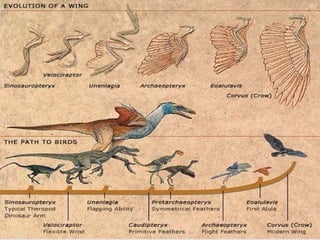
In 1859 Charles Darwin writes  On the Origin of Species ;  3 Archaeopteryx  is admitted to be  the earliest known ( the fundamental ) member of the  genealogy  of modern birds ;  3 Theropods had all characteristics of birds;  3 Evolution of feathers enhanced flight capabilities of birds. Larger feathers increased lift;  3 Evolution of alula- a tuft of specialized feathers that improve takeoffs, landings and maneuvering at slow speed of flying.  3 Evolution of birds
 
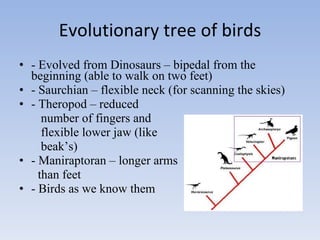
Evolutionary tree of birds - Evolved from Dinosaurs – bipedal from the beginning (able to walk on two feet)  - Saurchian – flexible neck (for scanning the skies) - Theropod – reduced  number of fingers and  flexible lower jaw (like beak’s) - Maniraptoran – longer arms  than feet  - Birds as we know them
Birds have bilateral symmetry.  4 This means that a bird  can be cut from the center of its beak down to the center of its tail in mirror images . Symmetry of birds
Feathers – made of keratin –> flexible; hollow spine – light Beaks with various shapes depending on the type of food eaten by the bird; lack of teeth Air sacs in the lungs for lightness Fused finger bones Songbirds have syrinx – vocal organ that helps singing two tones at the same time Characteristics unique to birds
How does flying happen? Birds have many adaptations in order to fly; The wings are the most obvious adaptations; The wings are airfoil shaped, which produces an upward force; Bernoulli’s equation:  9
The wings are covered with feathers;  8 Made of beta-keratin;  8 Flapping of the wings is required in order to stay in flight, some birds need to flap continuously;  8 The power for flapping comes from the pectoral muscles;  8 The Peregrine Falcon- the fastest bird, can reach about 440km/h;  10 Flying has many benefits, including: enhanced hunting, easier ways to escape from predators, ability to migrate;  8 Flying requires a lot of energy;  8 How does flying happen?
High metabolism rate, but short lifespan;  10 At night the metabolism slows down  10 High-energy food- seeds, nuts, fruits, fish  10 Maintain high body temperature;  8 Feathers and layers of fat provide insulation;  8 The lungs have improved structure;  8 Very efficient respiratory and circulatory system;  8 4-chambered heart;  8  Tissues are well-supplied with nutrients and oxygen;  8 Adaptations for flight
Excellent vision and improved hunting;  10 3 eyelids, very thick retina (provides very clear image);  10 Fine muscle control;  10 Visual and motor parts of the brain are very well developed;  8 Weight is minimized: lack of urinary bladder and teeth;  8 Females have only one ovary;  8 Less and lighter bones;  8 Excellent hearing- critical for maintaining balance during flight  10 Adaptations for flight
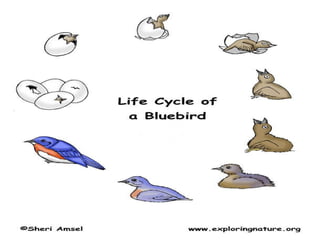
Birds are born inside eggs  with hard shells . 1 For many days  their parents  protect and  keep the eggs warm – a process called  incubation . 1 After the  baby birds  hatch, they  are  fed by their parent s. 1 It takes a few weeks for their feathers to develop . During this time, they also become big  enough to fly  even though  they can swim  just  a few hours  after they are hatched . 1 When they become mature enough to find their own food and fly their parents drive them away. 1 After a year  they will mate and have young of their own.  1 The cycle begins again. 1 Life cycle of birds
 
In order to avoid predation,  birds associat e with each other.  2 Some birds like penguins swim very fast in the water and can avoid bigger slower predators.  2 Some birds like penguins go to the most inhospitable places on the poles in order to hatch their eggs without threat of sudden attack.  2 When sleeping at night: Some birds  sleep sitting or   standing  in the water or on predator-free islands. (2) Many other s  sleep on the ground in  dense vegetation   .  2 Others  prefer to sleep in trees , chimneys,  nest boxes  or dense shrubs.  2 How do birds avoid predation?
18 main groups Most famous ones: Ducks, geese, swans Pigeons and doves Pelicans and allies Cuckoos Owls Swifts and hummingbirds Woodpeckers Main representatives of birds
Light colored with white heart-shaped face Height – 30- 40 centimeters Hunts at night time (mammals pertaining to the rodent family) One of the most widely distributed birds American Robin ( Turdus migratorius ) from  the perching birds group:  grayish – brown with rusty front 20-28 centimeters high Eats insects Found in North America Barn Owl and American Robin
Saurischian- lizard hipped dinosaurs, one of the 2 basic divisions of dinosaurs. Filamentous- composed of filaments Ratites- having a flat sternum Insulation- isolation Pectoral- pertaining to the breast shaft- a long narrow stem Vane- a flattened weblike part of a feather consisting of a series of fibrils on the sides of the shaft Beta-keratin- a protein that forms the feathers Sternum- breast bone Theropods- a group of saurischian dinosaurs. Vocabulary
Works Cited: Amsel, Sheri. “Life Cycles of Plants and Animals.” Bird Life Cycle. Exploring Nature Educational Resource. © 2005 - 2010. March 29, 2010.  http://exploringnature.org/db/detail.php?dbID=32&detID=1210 McClain, Russ. &quot;Where do birds go at night?.&quot;  Where Do Birds Sleep At Night...and Other Avian Questions . The Birdwatcher’s Companion., n.d. Web. 29 Mar 2010.  http://www.wvdnr.gov/wildlife/magazine/Archive/06winter/AvianQuestions .pdf . &quot;Bird Evolution.&quot;  Evolution . WGBH Educational Foundation and Clear Blue Sky Productions, Inc., n.d. Web. 29 Mar 2010.  http://www.pbs.org/wgbh/evolution/library/03/4/l_034_01.html . Frondorf, Anne. &quot;Birds.&quot;  Birds . WGBH Educational Foundation, n.d. Web. 30 Mar 2010.  http://www.mcwdn.org/Animals/Bird.html . http://images.paraorkut.com/img/pics/images/e/emperor_penguins-12141.jpg http://www.exploringnature.org/graphics/bird_cycle_color72.jpg http://www.pbs.org/wgbh/evolution/library/03/4/image_pop/l_034_01.html Campbell, Neil.  Biology . San Francisco: Pearson, 2009. Serway, Raymond.  College Physics . Orlando, Florida: Harcourt Brace & Company, 1995.\ &quot;Aerodynamics of Animals- Birds&quot;. Cislunar Aerospace, Inc.. 3/30/2010 <http://wings.avkids.com/Book/Animals/intermediate/birds-01.html>. Wildermuth, Michael. &quot;Evolution of Birds.&quot; Geology.Fulletron. N.p., 2005. Web. 30 Mar. 2010. <http://geology.fullerton.edu/whenderson/Fal201L2005/Evolution%20of%20Birds/new_page_1.htm>. &quot;American Robin.&quot; All About Birds. Cornell lab of Ornithology, 2009. Web. 30  Mar. 2010. <http://www.allaboutbirds.org/guide/American_Robin/lifehistory>.

Birds 10-3

  • 1.
    Birds Iva DikovaSimona Zahova Veselin Karadzhov 10/3
  • 2.
    In 1859 CharlesDarwin writes On the Origin of Species ; 3 Archaeopteryx is admitted to be the earliest known ( the fundamental ) member of the genealogy of modern birds ; 3 Theropods had all characteristics of birds; 3 Evolution of feathers enhanced flight capabilities of birds. Larger feathers increased lift; 3 Evolution of alula- a tuft of specialized feathers that improve takeoffs, landings and maneuvering at slow speed of flying. 3 Evolution of birds
  • 3.
  • 4.
    Evolutionary tree ofbirds - Evolved from Dinosaurs – bipedal from the beginning (able to walk on two feet) - Saurchian – flexible neck (for scanning the skies) - Theropod – reduced number of fingers and flexible lower jaw (like beak’s) - Maniraptoran – longer arms than feet - Birds as we know them
  • 5.
    Birds have bilateralsymmetry. 4 This means that a bird can be cut from the center of its beak down to the center of its tail in mirror images . Symmetry of birds
  • 6.
    Feathers – madeof keratin –> flexible; hollow spine – light Beaks with various shapes depending on the type of food eaten by the bird; lack of teeth Air sacs in the lungs for lightness Fused finger bones Songbirds have syrinx – vocal organ that helps singing two tones at the same time Characteristics unique to birds
  • 7.
    How does flyinghappen? Birds have many adaptations in order to fly; The wings are the most obvious adaptations; The wings are airfoil shaped, which produces an upward force; Bernoulli’s equation: 9
  • 8.
    The wings arecovered with feathers; 8 Made of beta-keratin; 8 Flapping of the wings is required in order to stay in flight, some birds need to flap continuously; 8 The power for flapping comes from the pectoral muscles; 8 The Peregrine Falcon- the fastest bird, can reach about 440km/h; 10 Flying has many benefits, including: enhanced hunting, easier ways to escape from predators, ability to migrate; 8 Flying requires a lot of energy; 8 How does flying happen?
  • 9.
    High metabolism rate,but short lifespan; 10 At night the metabolism slows down 10 High-energy food- seeds, nuts, fruits, fish 10 Maintain high body temperature; 8 Feathers and layers of fat provide insulation; 8 The lungs have improved structure; 8 Very efficient respiratory and circulatory system; 8 4-chambered heart; 8 Tissues are well-supplied with nutrients and oxygen; 8 Adaptations for flight
  • 10.
    Excellent vision andimproved hunting; 10 3 eyelids, very thick retina (provides very clear image); 10 Fine muscle control; 10 Visual and motor parts of the brain are very well developed; 8 Weight is minimized: lack of urinary bladder and teeth; 8 Females have only one ovary; 8 Less and lighter bones; 8 Excellent hearing- critical for maintaining balance during flight 10 Adaptations for flight
  • 11.
    Birds are borninside eggs with hard shells . 1 For many days their parents protect and keep the eggs warm – a process called incubation . 1 After the baby birds hatch, they are fed by their parent s. 1 It takes a few weeks for their feathers to develop . During this time, they also become big enough to fly even though they can swim just a few hours after they are hatched . 1 When they become mature enough to find their own food and fly their parents drive them away. 1 After a year they will mate and have young of their own. 1 The cycle begins again. 1 Life cycle of birds
  • 12.
  • 13.
    In order toavoid predation, birds associat e with each other. 2 Some birds like penguins swim very fast in the water and can avoid bigger slower predators. 2 Some birds like penguins go to the most inhospitable places on the poles in order to hatch their eggs without threat of sudden attack. 2 When sleeping at night: Some birds sleep sitting or standing in the water or on predator-free islands. (2) Many other s sleep on the ground in dense vegetation . 2 Others prefer to sleep in trees , chimneys, nest boxes or dense shrubs. 2 How do birds avoid predation?
  • 14.
    18 main groupsMost famous ones: Ducks, geese, swans Pigeons and doves Pelicans and allies Cuckoos Owls Swifts and hummingbirds Woodpeckers Main representatives of birds
  • 15.
    Light colored withwhite heart-shaped face Height – 30- 40 centimeters Hunts at night time (mammals pertaining to the rodent family) One of the most widely distributed birds American Robin ( Turdus migratorius ) from the perching birds group: grayish – brown with rusty front 20-28 centimeters high Eats insects Found in North America Barn Owl and American Robin
  • 16.
    Saurischian- lizard hippeddinosaurs, one of the 2 basic divisions of dinosaurs. Filamentous- composed of filaments Ratites- having a flat sternum Insulation- isolation Pectoral- pertaining to the breast shaft- a long narrow stem Vane- a flattened weblike part of a feather consisting of a series of fibrils on the sides of the shaft Beta-keratin- a protein that forms the feathers Sternum- breast bone Theropods- a group of saurischian dinosaurs. Vocabulary
  • 17.
    Works Cited: Amsel,Sheri. “Life Cycles of Plants and Animals.” Bird Life Cycle. Exploring Nature Educational Resource. © 2005 - 2010. March 29, 2010. http://exploringnature.org/db/detail.php?dbID=32&detID=1210 McClain, Russ. &quot;Where do birds go at night?.&quot; Where Do Birds Sleep At Night...and Other Avian Questions . The Birdwatcher’s Companion., n.d. Web. 29 Mar 2010. http://www.wvdnr.gov/wildlife/magazine/Archive/06winter/AvianQuestions .pdf . &quot;Bird Evolution.&quot; Evolution . WGBH Educational Foundation and Clear Blue Sky Productions, Inc., n.d. Web. 29 Mar 2010. http://www.pbs.org/wgbh/evolution/library/03/4/l_034_01.html . Frondorf, Anne. &quot;Birds.&quot; Birds . WGBH Educational Foundation, n.d. Web. 30 Mar 2010. http://www.mcwdn.org/Animals/Bird.html . http://images.paraorkut.com/img/pics/images/e/emperor_penguins-12141.jpg http://www.exploringnature.org/graphics/bird_cycle_color72.jpg http://www.pbs.org/wgbh/evolution/library/03/4/image_pop/l_034_01.html Campbell, Neil. Biology . San Francisco: Pearson, 2009. Serway, Raymond. College Physics . Orlando, Florida: Harcourt Brace & Company, 1995.\ &quot;Aerodynamics of Animals- Birds&quot;. Cislunar Aerospace, Inc.. 3/30/2010 <http://wings.avkids.com/Book/Animals/intermediate/birds-01.html>. Wildermuth, Michael. &quot;Evolution of Birds.&quot; Geology.Fulletron. N.p., 2005. Web. 30 Mar. 2010. <http://geology.fullerton.edu/whenderson/Fal201L2005/Evolution%20of%20Birds/new_page_1.htm>. &quot;American Robin.&quot; All About Birds. Cornell lab of Ornithology, 2009. Web. 30 Mar. 2010. <http://www.allaboutbirds.org/guide/American_Robin/lifehistory>.

Editor's Notes

  • #3 In 1859 Charles Darwin writes On the Origin of Species . In 1861 was discovered t he oldest-known bird fossil - the famous Archaeopteryx Lithographica which lived about 150 million years ago . This Archaeopteryx Lithographica had characteristics of reptiles, dinosaurs, and birds at the same time. It had long legs, three toes with claws at their ends, jawbone, and teeth that were just like the features of a small dinosaur. It also had a tail formed from its extended spine – found in reptiles and dinosaurs. But it also had wings and feathers which are birds traits. Archaeopteryx is admitted to be the earliest known ( the fundamental ) member of the genealogy of modern birds, but it still had many features of small dinosaurs. These small dinosaurs were called theropods – small bipedal predators. Theropods had hollow bones, a backward-pointing pelvis, feathers, a wishbone, and a three-toed foot – all characteristics of birds. Throughout the evolution of theropods their forelimbs and hands became longer and in some theropods the wrist bones took on a shape allowing the joint to bend sideways . Also, the grabbing movement of the theropods is almost the same as the flight stroke of modern birds . E volution of birds’ feathers with an asymmetrical shape enhanced the flight capabilities of early birds. Larger feathers increased lift . Evolution of alula - a tuft of specialized feathers attached to the thumb that change airflow and allow control over takeoffs and landings, and maneuvering at slow speed of flying.
  • #9 Some birds take advantage of air flows, called thermals, in order to stay in flight.