DISCOVERY AND BIOSYNTHESIS
OF AUXINS- IAA
Contents
• Introduction
• Discovery of Auxin
• Natural and synthetic Auxin
• Biosynthesis of Auxin
1. Trp dependent pathway
2. Trp independent pathway
• Conclusion
• References
What is hormone?
Hormones are chemical Messengers that are produced
in one cell and modulate cellular processes in another
cell by interacting with specific proteins that function
as receptor linked to cellular transduction pathway
Types of Plant hormones
Introduction
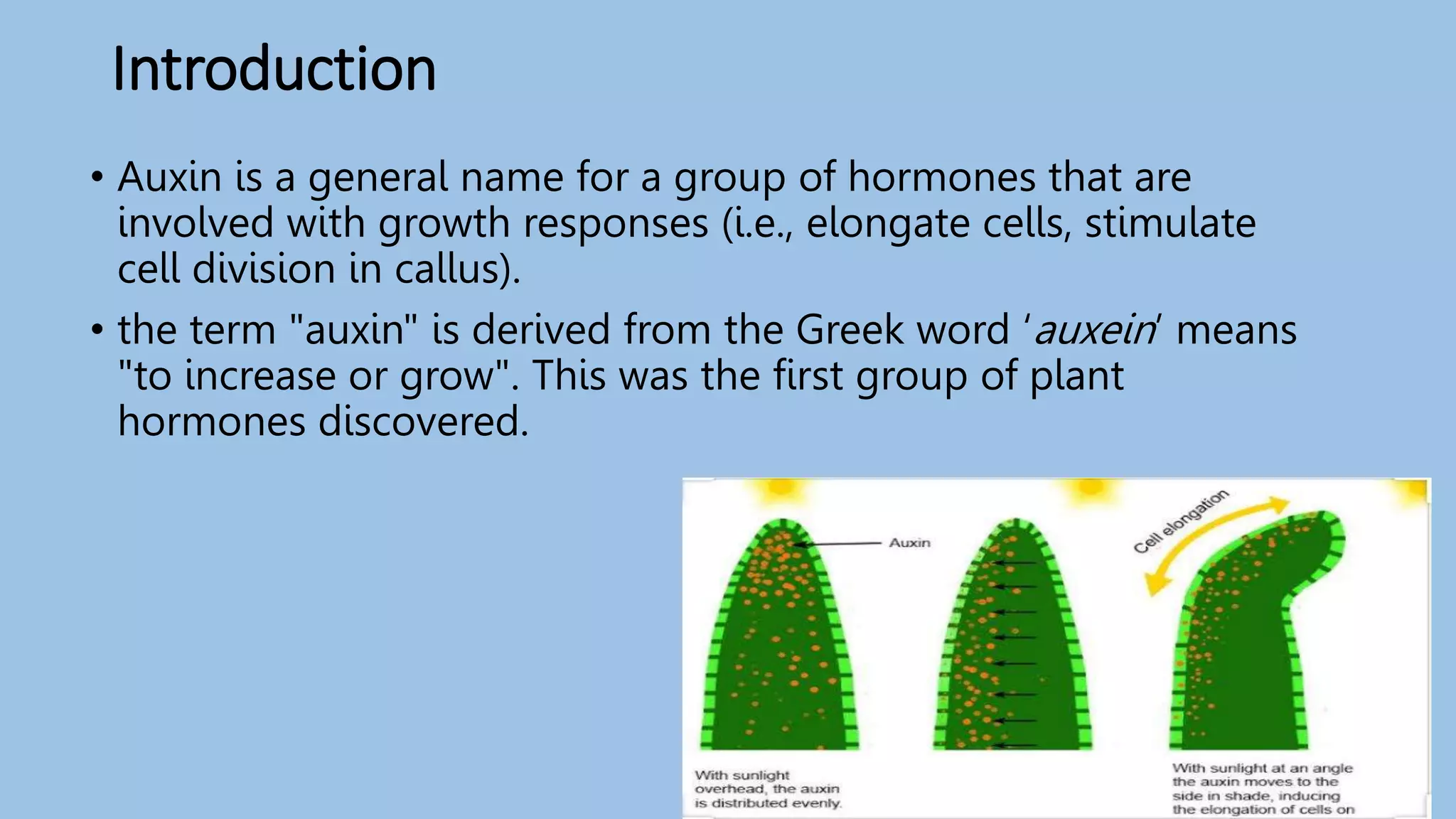
• Auxin is a general name for a group of hormones that are
involved with growth responses (i.e., elongate cells, stimulate
cell division in callus).
• the term "auxin" is derived from the Greek word ‘auxein’ means
"to increase or grow". This was the first group of plant
hormones discovered.
Cont.
• At cellular level, Auxins control basic processes such as cell division
and cell elongation.
• The plant hormone auxin, which is predominantly represented
by indole-3-acetic acid (IAA), is involved in the regulation of
plant growth and development. Although IAA was the first plant
hormone identified
Discovery of Auxin.
• Auxins were the first plant hormones discovered.
• Darwin was among the first scientists to dable in plant hormones
research. In his book ”The Power of Movement in Plants” presented
in 1880.
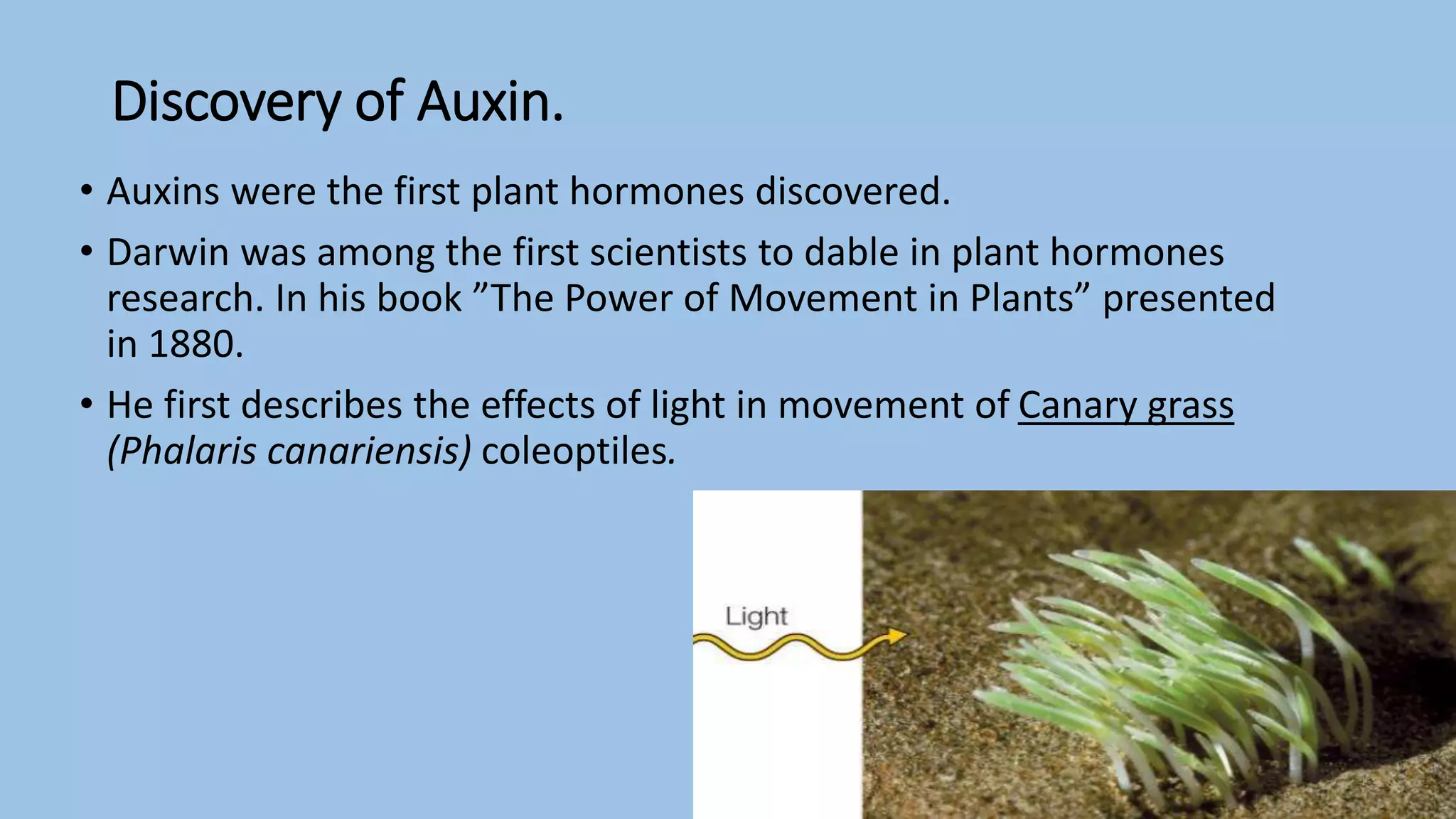
• He first describes the effects of light in movement of Canary grass
(Phalaris canariensis) coleoptiles.
Discovery of Auxin
Cont.
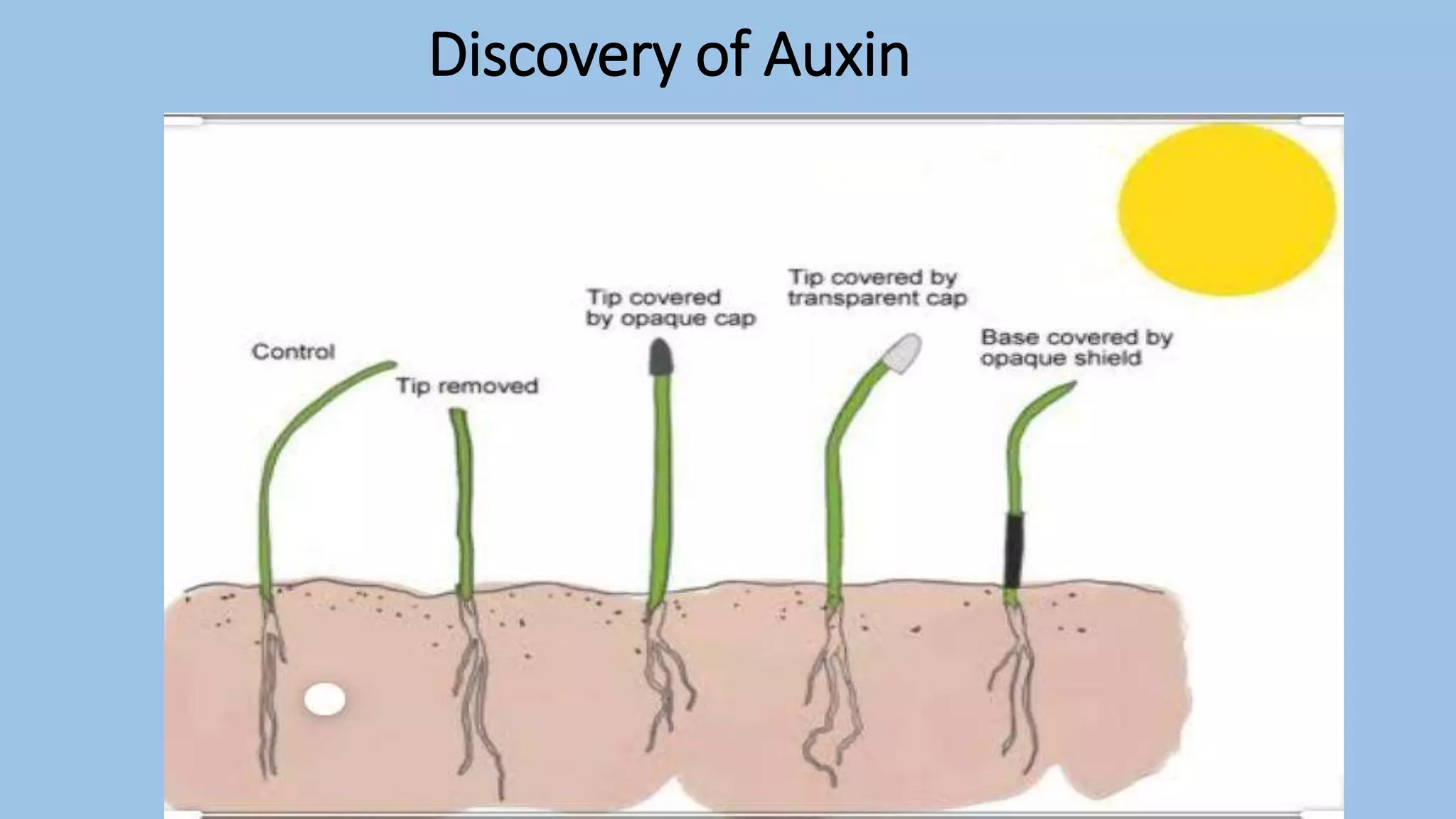
• When the unidirectional light shines on the coleoptile, it bends in the
direction of the light.
• If the tip of the coleoptile was covered with the aluminium foil, no
bending would occur towards the unidirectional light.
• If the tip of the coleoptile was left uncovered but the portion just
below the tip was covered, exposure to unidirectional light resulted in
curvature towards the light.
Cont.
• Darwin’s experiment suggested that the tip of the coleoptile was the
tissue responsible for perceiving the light and producing some signal
which was transported to the lower part of the coleoptile where the
physiological response of bending occurred.
• He then cut off the tip of the coleoptile and exposed the rest of the
coleoptile to unidirectional light to see if curving occurred, but
curvature did not occure confirming the results of his first
experiment.
Cont.
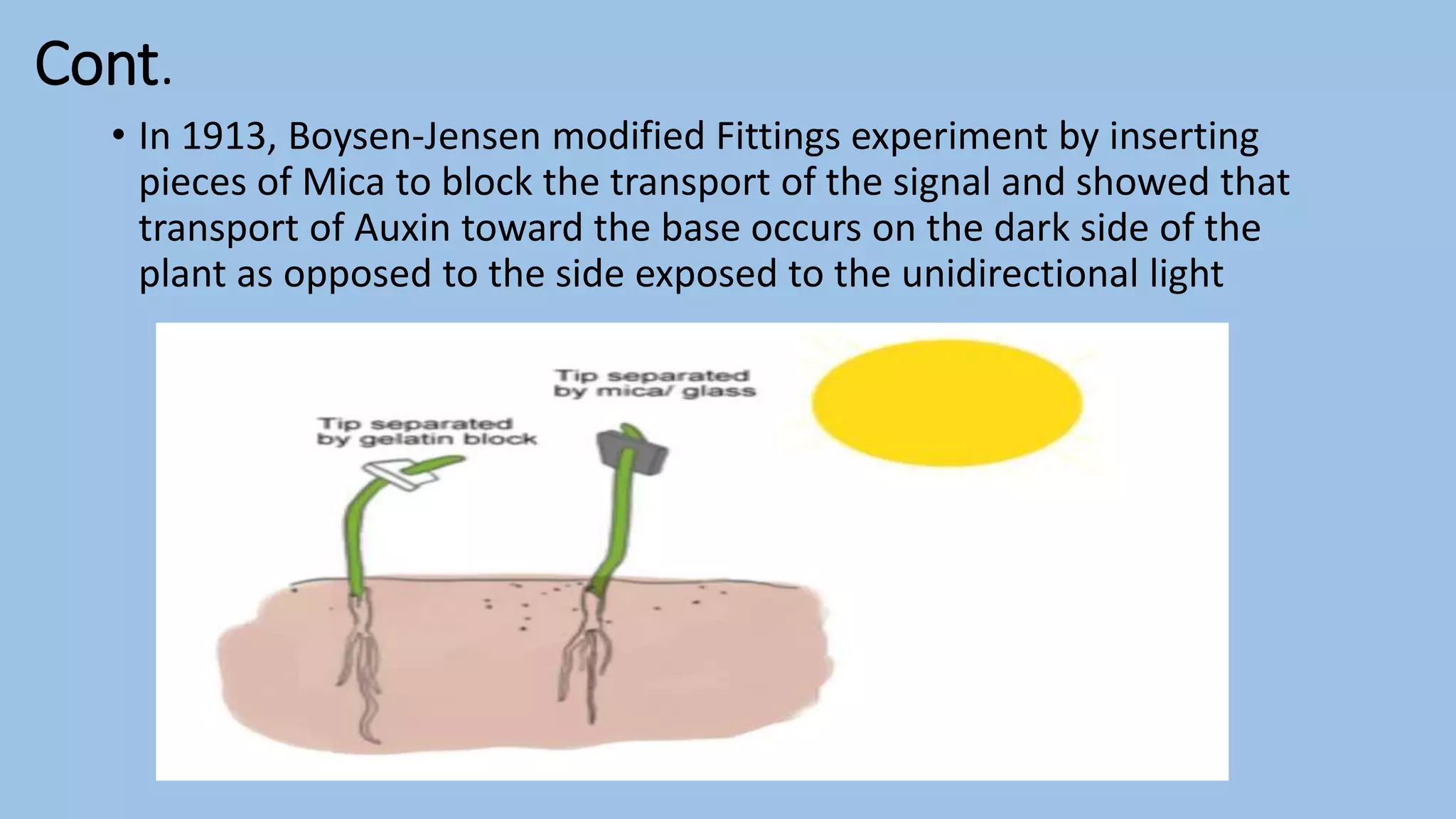
• In 1913, Boysen-Jensen modified Fittings experiment by inserting
pieces of Mica to block the transport of the signal and showed that
transport of Auxin toward the base occurs on the dark side of the
plant as opposed to the side exposed to the unidirectional light
Cont.
• In 1926, a graduate student from Holland by the name Fritz went
published a report describing how he isolated a plant growth
substance by placing agar blocks under the coleoptile tips for a period
of time then removing them and placing them on decapitated Avena
sativa stems.
• After placement of the agar, the stems resumed growth.
• In 1928, Went developed a method of quantifying this plant growth
substance in the agar, this test was called The Avena curvature test
Cont.
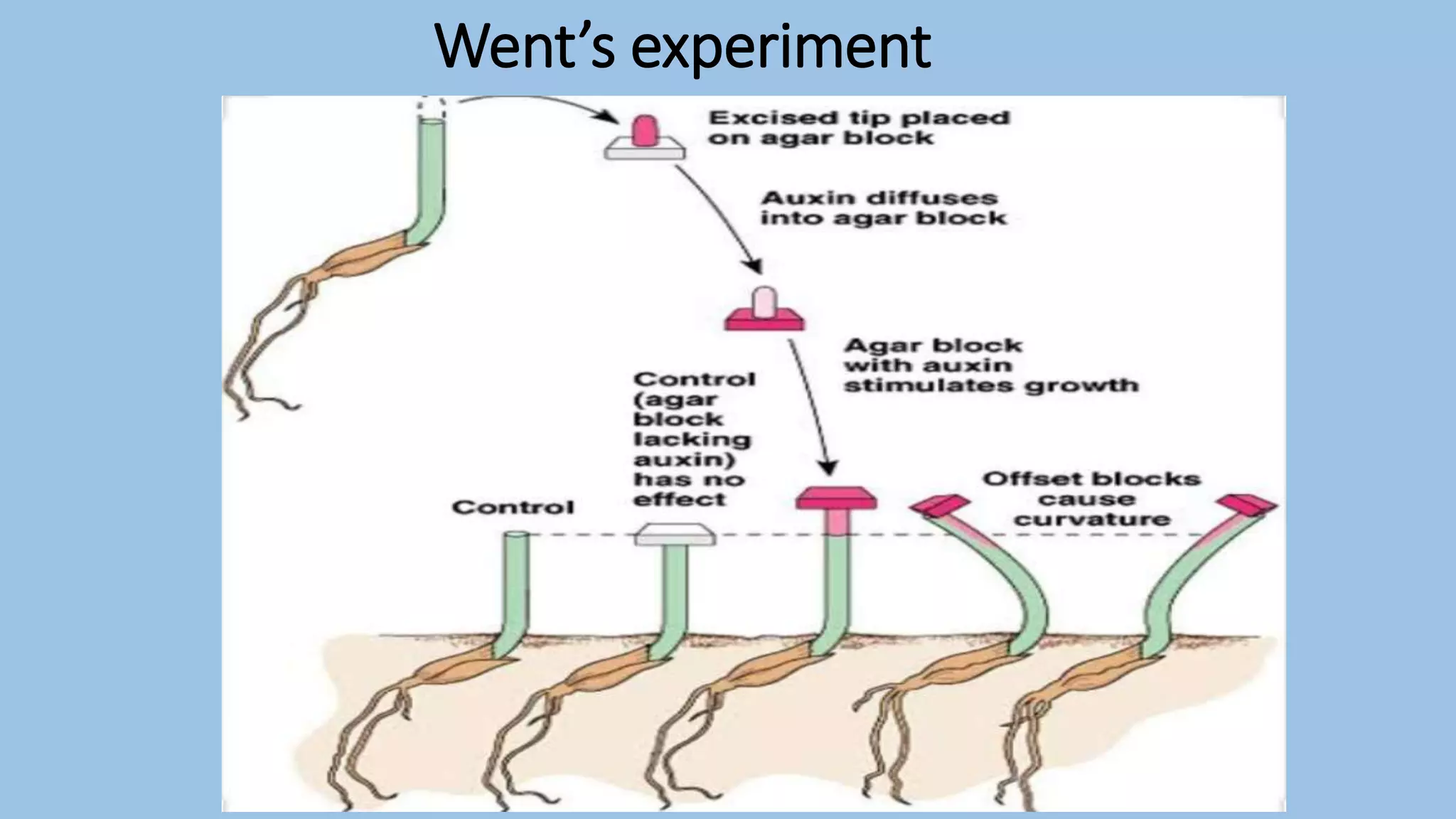
• Went's different experiments and results:
• (i) Cut off coleoptiles & without agar blocks, did not grow. This
confirmed that the tips produced something essential for growth.
• (ii) Agar blocks that contacted cut tips were placed on the center of the
cut off coleoptiles and they grew straight up. Therefore, the chemical
diffused into the agar from the coleoptile tips, and stimulated their
growth.
• (iii) Agar blocks that did not contact the cut tips of coleoptiles did not
show any response. Therefore, nothing in the agar caused growth of
the coleoptile.
• (iv) Agar blocks that had contacted the cut tips when placed on one
side of the cut off coleoptiles, curved away from the agar blocks. This
confirmed that the agar blocks had a chemical that stimulated growth
of coleoptiles.
Went’s experiment
Cont.
• Kogl – and Haagen-smit who purified the compound auxentriolic acid
(auxin-A) from human urine in 1931.
• Later kogl isolated other components which were similar in structure
and function to auxin-A, one of which was indole-3 acetic acid (IAA),
initially discovered by Salkowski in 1985.
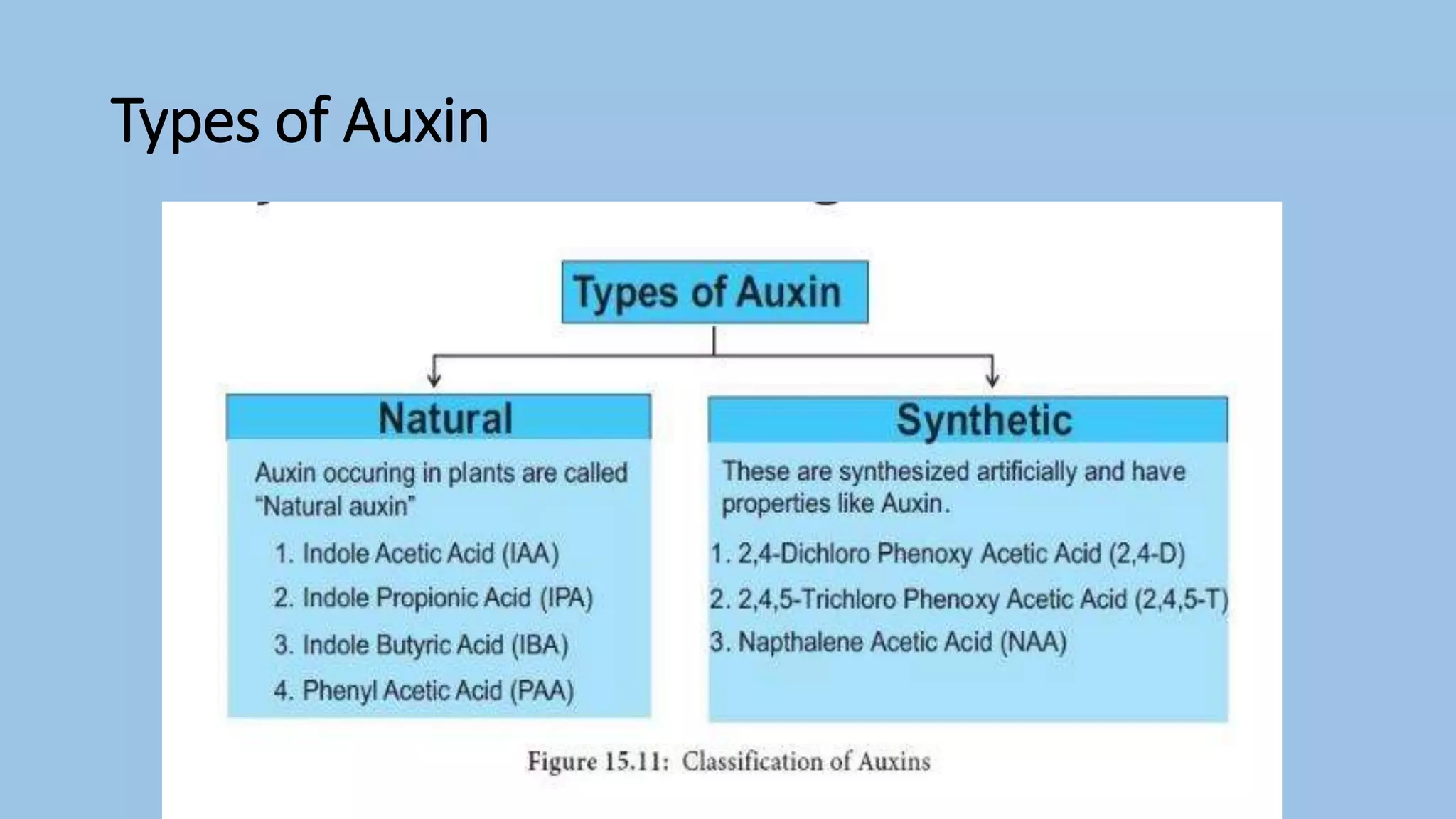
Types of Auxin
Biosynthesis of Auxin
• Naturally occurring Auxin is in the form of indole-3-acetic acid (IAA).
• The similarity in structures of Tryptophan amino acid and IAA
indicated that tryptophan is the probable precursor.
• Major sources of auxin are apical shoot, pollen, embryo and
developing buds. Indole acetic acid is generated by tryptophan amino
acid by several pathways.
Two major pathways Of IAA synthesis has been proposed in the pants
• Trp dependent pathway.
• Trp independent pathway.
Tryptophan dependent biosynthesis
IAA is structurally related to the amino acid tryptophan, and early
studies on social biosynthesis suggest that tryptophan is the probable
precursor.
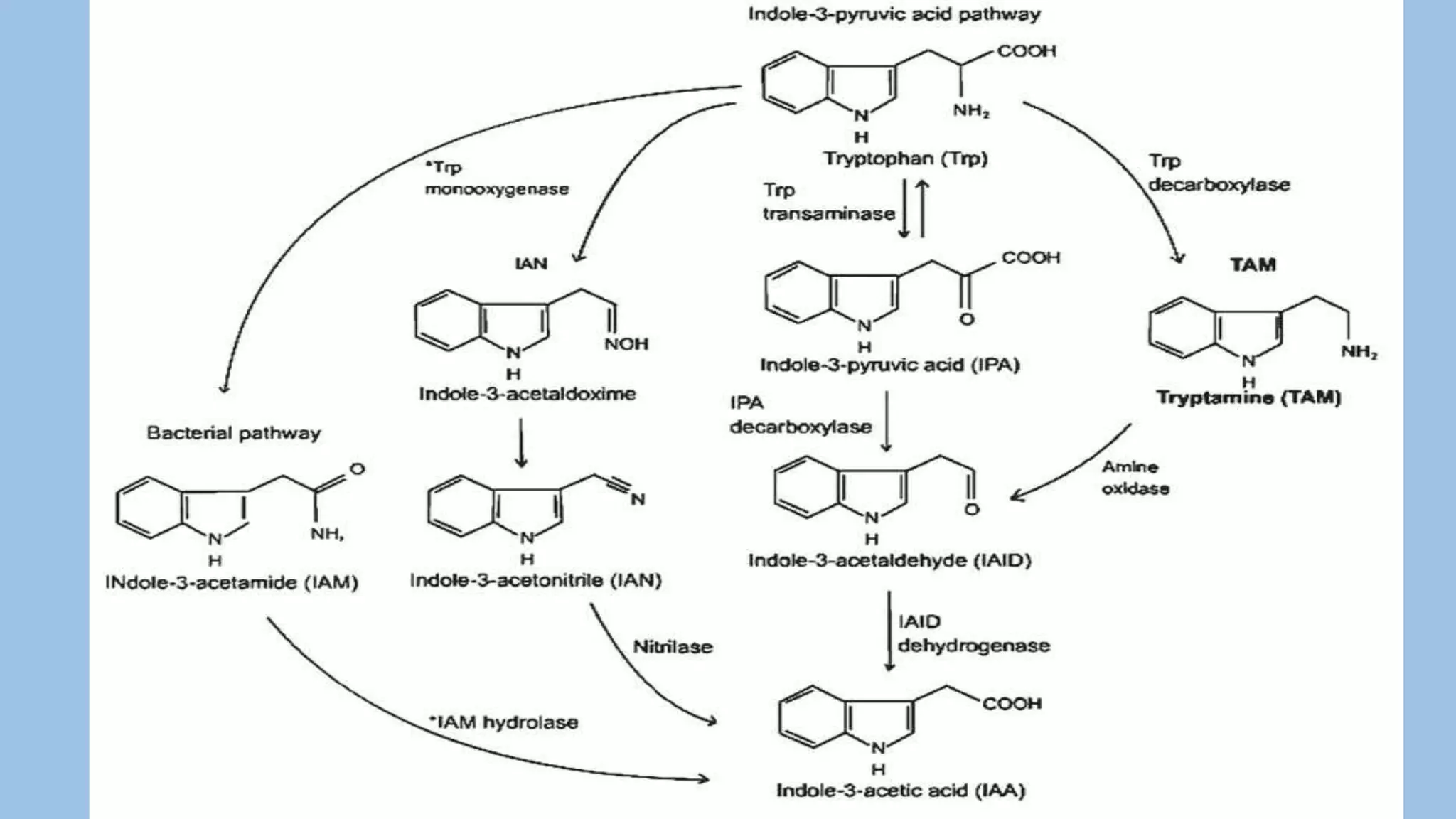
Tryptophan converts to IAA by several pathways:
1. The indole-3-acetamide (IAM) pathway.
2. The indole-3-pyruvic acid (IPA) pathway.
3. The indole-3-acetonitrile (IAN) pathway.
4. The tryptamine ( TAM) pathway.
Cont.
The indole-3-acetamide pathway (IAM).
• This pathway uses indole-3-acetamide as an intermediate, this
pathway is used by various pathogenic bacteria such as Pseudomonas
savastanoi & Agrobacterium tumefaciens.
• This pathway involves the to enzymes, Tryptophan monooxygenase
and indole-3-acetamide hydrolase.
The indole-3-pyruvic acid (IPA) pathway.
• It involves deamination if tryptophan, followed by decarboxylation
reaction to form indole-3-acetaldehyde.
• Indol-3-acetaldehyde is then oxidized to IAA by IAA dehydrogenase
enzyme.
Cont.
The indole-3-acetonitrile (IAN) pathway
• In the indole-3-acetonitrile pathway, tryptophan if first converted to indole-
3-acetaldoxime and then to indole-3-acetonitrile.
• The enzymes that converts IAN to IAA is nitrilase.
• This pathway is important in 3 families: Brassicaceae,Poaceae & Musaceae.
The TAM pathway.
• The tryptamine pathway is similar to the IPA pathway, except that the order
of deamination and decarboxylation reaction is reversed and different
enzymes are involved.
• In Lycopersicon (tomato) evidence of both IPA and TAM pathway have been
found.
Tryptophan independent pathway
• Trp-independent synthesis of indole-3-acetic acid (IAA) was
proposed back in the early 1990s based on observations from
Trp auxotrophs in maize (Zea mays) and Arabidopsis
(Arabidopsis thaliana).
• the major Trp-dependent route for IAA production. whereby Trp,
produced by the concerted action of Trp synthase α- and β-
subunits, is converted to IAA.
Conclusion
• Auxins are natural hormones, mobile biochemicals which are
transported from cell and organ to organ to signal and coordinate
growth and development.
• It also mediates control over many other key events during plant
development. such as, apical dominance, fruit set and development,
abscission, both lateral and adventitious root initiation, phyllotaxy,
and vascular patterning.
Reference
• Plant growth regulators: introduction; Auxin, their analoges and
inhibitors. www.researchgate.net.com
• Yoshihiro Mano. keiichirou Nemoto. The pathway of Auxin
biosynthesis in plants. Journal of experimental botany. Volume
63,issue8, May 2012, pages 2853-2872.
• Auxin biosynthesis. www.ncbi.nim.nih.gov
• Nathan Tivendale. Analytical history of Auxin. Journal of plant growth
and regulation. Dec.2015.
Biosynthesis of Auxin

Biosynthesis of Auxin

  • 1.
  • 2.
    Contents • Introduction • Discoveryof Auxin • Natural and synthetic Auxin • Biosynthesis of Auxin 1. Trp dependent pathway 2. Trp independent pathway • Conclusion • References
  • 3.
    What is hormone? Hormonesare chemical Messengers that are produced in one cell and modulate cellular processes in another cell by interacting with specific proteins that function as receptor linked to cellular transduction pathway
  • 4.
  • 5.
    Introduction • Auxin isa general name for a group of hormones that are involved with growth responses (i.e., elongate cells, stimulate cell division in callus). • the term "auxin" is derived from the Greek word ‘auxein’ means "to increase or grow". This was the first group of plant hormones discovered.
  • 6.
    Cont. • At cellularlevel, Auxins control basic processes such as cell division and cell elongation. • The plant hormone auxin, which is predominantly represented by indole-3-acetic acid (IAA), is involved in the regulation of plant growth and development. Although IAA was the first plant hormone identified
  • 7.
    Discovery of Auxin. •Auxins were the first plant hormones discovered. • Darwin was among the first scientists to dable in plant hormones research. In his book ”The Power of Movement in Plants” presented in 1880. • He first describes the effects of light in movement of Canary grass (Phalaris canariensis) coleoptiles.
  • 8.
  • 9.
    Cont. • When theunidirectional light shines on the coleoptile, it bends in the direction of the light. • If the tip of the coleoptile was covered with the aluminium foil, no bending would occur towards the unidirectional light. • If the tip of the coleoptile was left uncovered but the portion just below the tip was covered, exposure to unidirectional light resulted in curvature towards the light.
  • 10.
    Cont. • Darwin’s experimentsuggested that the tip of the coleoptile was the tissue responsible for perceiving the light and producing some signal which was transported to the lower part of the coleoptile where the physiological response of bending occurred. • He then cut off the tip of the coleoptile and exposed the rest of the coleoptile to unidirectional light to see if curving occurred, but curvature did not occure confirming the results of his first experiment.
  • 11.
    Cont. • In 1913,Boysen-Jensen modified Fittings experiment by inserting pieces of Mica to block the transport of the signal and showed that transport of Auxin toward the base occurs on the dark side of the plant as opposed to the side exposed to the unidirectional light
  • 13.
    Cont. • In 1926,a graduate student from Holland by the name Fritz went published a report describing how he isolated a plant growth substance by placing agar blocks under the coleoptile tips for a period of time then removing them and placing them on decapitated Avena sativa stems. • After placement of the agar, the stems resumed growth. • In 1928, Went developed a method of quantifying this plant growth substance in the agar, this test was called The Avena curvature test
  • 14.
    Cont. • Went's differentexperiments and results: • (i) Cut off coleoptiles & without agar blocks, did not grow. This confirmed that the tips produced something essential for growth. • (ii) Agar blocks that contacted cut tips were placed on the center of the cut off coleoptiles and they grew straight up. Therefore, the chemical diffused into the agar from the coleoptile tips, and stimulated their growth. • (iii) Agar blocks that did not contact the cut tips of coleoptiles did not show any response. Therefore, nothing in the agar caused growth of the coleoptile. • (iv) Agar blocks that had contacted the cut tips when placed on one side of the cut off coleoptiles, curved away from the agar blocks. This confirmed that the agar blocks had a chemical that stimulated growth of coleoptiles.
  • 15.
  • 16.
    Cont. • Kogl –and Haagen-smit who purified the compound auxentriolic acid (auxin-A) from human urine in 1931. • Later kogl isolated other components which were similar in structure and function to auxin-A, one of which was indole-3 acetic acid (IAA), initially discovered by Salkowski in 1985.
  • 17.
  • 19.
    Biosynthesis of Auxin •Naturally occurring Auxin is in the form of indole-3-acetic acid (IAA). • The similarity in structures of Tryptophan amino acid and IAA indicated that tryptophan is the probable precursor. • Major sources of auxin are apical shoot, pollen, embryo and developing buds. Indole acetic acid is generated by tryptophan amino acid by several pathways. Two major pathways Of IAA synthesis has been proposed in the pants • Trp dependent pathway. • Trp independent pathway.
  • 20.
    Tryptophan dependent biosynthesis IAAis structurally related to the amino acid tryptophan, and early studies on social biosynthesis suggest that tryptophan is the probable precursor. Tryptophan converts to IAA by several pathways: 1. The indole-3-acetamide (IAM) pathway. 2. The indole-3-pyruvic acid (IPA) pathway. 3. The indole-3-acetonitrile (IAN) pathway. 4. The tryptamine ( TAM) pathway.
  • 22.
    Cont. The indole-3-acetamide pathway(IAM). • This pathway uses indole-3-acetamide as an intermediate, this pathway is used by various pathogenic bacteria such as Pseudomonas savastanoi & Agrobacterium tumefaciens. • This pathway involves the to enzymes, Tryptophan monooxygenase and indole-3-acetamide hydrolase. The indole-3-pyruvic acid (IPA) pathway. • It involves deamination if tryptophan, followed by decarboxylation reaction to form indole-3-acetaldehyde. • Indol-3-acetaldehyde is then oxidized to IAA by IAA dehydrogenase enzyme.
  • 23.
    Cont. The indole-3-acetonitrile (IAN)pathway • In the indole-3-acetonitrile pathway, tryptophan if first converted to indole- 3-acetaldoxime and then to indole-3-acetonitrile. • The enzymes that converts IAN to IAA is nitrilase. • This pathway is important in 3 families: Brassicaceae,Poaceae & Musaceae. The TAM pathway. • The tryptamine pathway is similar to the IPA pathway, except that the order of deamination and decarboxylation reaction is reversed and different enzymes are involved. • In Lycopersicon (tomato) evidence of both IPA and TAM pathway have been found.
  • 24.
    Tryptophan independent pathway •Trp-independent synthesis of indole-3-acetic acid (IAA) was proposed back in the early 1990s based on observations from Trp auxotrophs in maize (Zea mays) and Arabidopsis (Arabidopsis thaliana). • the major Trp-dependent route for IAA production. whereby Trp, produced by the concerted action of Trp synthase α- and β- subunits, is converted to IAA.
  • 26.
    Conclusion • Auxins arenatural hormones, mobile biochemicals which are transported from cell and organ to organ to signal and coordinate growth and development. • It also mediates control over many other key events during plant development. such as, apical dominance, fruit set and development, abscission, both lateral and adventitious root initiation, phyllotaxy, and vascular patterning.
  • 27.
    Reference • Plant growthregulators: introduction; Auxin, their analoges and inhibitors. www.researchgate.net.com • Yoshihiro Mano. keiichirou Nemoto. The pathway of Auxin biosynthesis in plants. Journal of experimental botany. Volume 63,issue8, May 2012, pages 2853-2872. • Auxin biosynthesis. www.ncbi.nim.nih.gov • Nathan Tivendale. Analytical history of Auxin. Journal of plant growth and regulation. Dec.2015.