METABOLISM AND PHYSIOLOGICAL
EFFECTS OF ABA AND THEIR
APPLICATIONS
CONTENT
• INTRODUCTION
• METABOLISM
• PHYSIOLOGICAL EFFECT
• APPLICATION
• CONCLUSION
• REFERENCE
INTRODUCTION
Abscisic acid (ABA) is a 15-C weak acid that was first
identified in the early 1960s as a growth inhibitor accumulating in
abscising cotton fruit (“abscisin II”). ABA has since been shown to
regulate many aspects of plant growth and development including
embryo maturation, seed dormancy, germination, cell division and
elongation, floral induction, and responses to environmental
stresses such as drought, salinity, cold, pathogen attack and UV
radiation.
METABOLISM
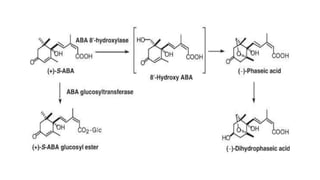
Metabolism of ABA takes places by two pathway , namely
(i) Hydroxylation of ABA at the 8′ position by P-450 type
monoxygenases to give an unstable intermediate (8′-
OH-ABA) that is isomerized to phaseic acid (PA), and
(ii) Esterification of ABA to ABA-glucose ester (ABA-GE).
The first method involves hydroxylation of 8- carbon,
ABA is hydroxylised to 8-hydroxy-ABA with the help of an
enzyme P-450 monoxygenases. Since 8-hydroxy ABA is not
stable it is converted into phaseic acid. Then phaseic acid is
reduced to dihydrophaseic acid.
The alternative route in ABA metabolism involve conversion
to to 7- hydroxy ABA and later conjugation takes place to
form ABA-glucosyl ester with the help of an enzyme 8
glucosyltransferases. Recent studies indicate that ABA-GE is
a storage or transport form of ABA. ABA-GE accumulates in
vacuoles and the apoplast, but is relocalized to the
endoplasmic reticulum in response to dehydration.
PHYSIOLOGICAL EFFECT
 STOMATAL REGULATION: The most significant and best
known effect of abscisic acid is its control of stomatal closing
in water stress or drought plants. It inhibits K+ uptake by
guard cells and promotes the leakage of malic acid. It results
reduction of osmotically active solutes so that the guard cells
become flaccid and stomata get closed.
SEED AND BUD DORMANCY: ABA acts as growth
inhibitor and induces bud dormancy in a variety of plants. It
inhibits lateral growth of buds, as reported in Tomato. Without
ABA, buds and seeds would start to grow during warm periods
in winter and be killed when it froze again.
SEED DEVELOPMENT AND GERMINATION: It has
been observed that ABA accumulates in embryos of
developing seeds, either it is synthesized de-novo or
translocated from leaves. It inhibits formation of enzymes
involved in germination process in the embryo and inhibits
vivipary. Exogenous supply of ABA inhibits germination of
most non-dormant seeds. As soon as it is removed by washing
the seeds, the germination can take place which may be due
to- inhibition of enzymes involved in germination process,
inhibition of water uptake by germinating seeds, etc.
 SENESCENCE AND ABSCISSION: Many workers
suggested ABA is an endogenous factor and involved in the
senescence and abscission of leaves and other plant organs.
Exogenous application of ABA induces primary yellowing in
leaf tissues in a variety of species ranging from deciduous
trees to herbaceous plants. ABA production increases in
senescing leaves once the photosynthetic activity of the
leaves decreases below the compensation point.
FLOWERING: ABA acts as inhibitor of flowering in long
day plants by counteracting the effect of gibberellins on
flowering in these plants. On the other hand ABA induces
flowering in short day plants.
CAMBIUM ACTIVITY: Abscisic acid stops mitosis in
vascular cambium towards the approach of winter.
 ROLE IN WATER STRESS: Abscisic acid plays an
important role in plants during water stress and drought
conditions. It increases the tolerance of plants to different
kinds of stress and is, therefore, called ‘stress hormone’. It
has been observed that the concentration of ABA increases
in the leaves of plants facing such stresses. In plants under
water stress, ABA plays a role in closing the stomata.
 COUNTERACTS THE EFFECTS OF OTHER
HORMONES: Abscisic acid counteracts the stimulatory
/inhibitory effects of other hormones: i) ABA inhibits cell
growth promoted by IAA, ii) ABA inhibits amylase produced
by seeds treated with gibberellins, iii) ABA promotes
chlorosis, which is inhibited by cytokinin. This may be due
to the fact that ABA is a Ca++ antagonist and its inhibition
of the stimulatory effects of IAA and cytokinin may be due
to its interference with Ca++ metabolism
APPLICATION IN AGRICULTURE
AND RESEARCH
Drought stress is a major cause of postproduction decline in plants.
The plant hormone abscisic acid (ABA) regulates drought stress
responses by mediating stomatal closure, thereby reducing
transpirational water loss. Exogenous ABA applications delay wilting
and allow plants to survive short periods of severe drought. The
effectiveness of the ABA biochemical, s-ABA at delaying wilting and
extending shelf life during drought stress.
They are used to induce seed dormancy to withstand desiccation
and unfavorable conditions for growth.
It stimulates the closure of stomata so delays wilting by
reducing water loss by transpiration. A plant can withstand
a short period of drought.
The combination of ABA and ethanol is more effective in
improving the colour of red globe grapes and increases
production of grapes.(Orman.A.M.,)
Abscisic acid is applied to greenhouse crops before
transition to field to reduce shock from change in
environmental stress.
CONCLUSION
Abscisic acid (ABA) is an important phytohormone
regulating plant growth, development, and stress responses.
It has an essential role in multiple physiological processes
of plants, such as stomatal closure, leaf senescence, bud
dormancy, seed germination, osmotic regulation, and
growth inhibition among many others.
REFERENCE
• Buchanan,B.,Gruissem,W.,Jones,R.L.,(2004)Biochemistry and
Molecular Biology of Plants,I.K.International pvt.ltd,New Delhi,pp-
865-873
• https://academic.oup.com/plphys/article/134/1/361/6112307?g
clid=EAIaIQobChMIwaLf2YjQ9QIVAJhmAh00Hw-
BEAAYAyAAEgIhHvD_BwE&login=false
• https://www.ncbi.nlm.nih.gov/pmc/articles/PMC4855980/
• https://gcwgandhinagar.com/econtent/document/1587179167Un
it%205.1%20Abscisic%20Acid.pdf
THANK YOU

ABA -Abscisic acid

  • 1.
    METABOLISM AND PHYSIOLOGICAL EFFECTSOF ABA AND THEIR APPLICATIONS
  • 2.
    CONTENT • INTRODUCTION • METABOLISM •PHYSIOLOGICAL EFFECT • APPLICATION • CONCLUSION • REFERENCE
  • 3.
    INTRODUCTION Abscisic acid (ABA)is a 15-C weak acid that was first identified in the early 1960s as a growth inhibitor accumulating in abscising cotton fruit (“abscisin II”). ABA has since been shown to regulate many aspects of plant growth and development including embryo maturation, seed dormancy, germination, cell division and elongation, floral induction, and responses to environmental stresses such as drought, salinity, cold, pathogen attack and UV radiation.
  • 5.
    METABOLISM Metabolism of ABAtakes places by two pathway , namely (i) Hydroxylation of ABA at the 8′ position by P-450 type monoxygenases to give an unstable intermediate (8′- OH-ABA) that is isomerized to phaseic acid (PA), and (ii) Esterification of ABA to ABA-glucose ester (ABA-GE).
  • 6.
    The first methodinvolves hydroxylation of 8- carbon, ABA is hydroxylised to 8-hydroxy-ABA with the help of an enzyme P-450 monoxygenases. Since 8-hydroxy ABA is not stable it is converted into phaseic acid. Then phaseic acid is reduced to dihydrophaseic acid.
  • 7.
    The alternative routein ABA metabolism involve conversion to to 7- hydroxy ABA and later conjugation takes place to form ABA-glucosyl ester with the help of an enzyme 8 glucosyltransferases. Recent studies indicate that ABA-GE is a storage or transport form of ABA. ABA-GE accumulates in vacuoles and the apoplast, but is relocalized to the endoplasmic reticulum in response to dehydration.
  • 9.
    PHYSIOLOGICAL EFFECT  STOMATALREGULATION: The most significant and best known effect of abscisic acid is its control of stomatal closing in water stress or drought plants. It inhibits K+ uptake by guard cells and promotes the leakage of malic acid. It results reduction of osmotically active solutes so that the guard cells become flaccid and stomata get closed.
  • 10.
    SEED AND BUDDORMANCY: ABA acts as growth inhibitor and induces bud dormancy in a variety of plants. It inhibits lateral growth of buds, as reported in Tomato. Without ABA, buds and seeds would start to grow during warm periods in winter and be killed when it froze again.
  • 11.
    SEED DEVELOPMENT ANDGERMINATION: It has been observed that ABA accumulates in embryos of developing seeds, either it is synthesized de-novo or translocated from leaves. It inhibits formation of enzymes involved in germination process in the embryo and inhibits vivipary. Exogenous supply of ABA inhibits germination of most non-dormant seeds. As soon as it is removed by washing the seeds, the germination can take place which may be due to- inhibition of enzymes involved in germination process, inhibition of water uptake by germinating seeds, etc.
  • 12.
     SENESCENCE ANDABSCISSION: Many workers suggested ABA is an endogenous factor and involved in the senescence and abscission of leaves and other plant organs. Exogenous application of ABA induces primary yellowing in leaf tissues in a variety of species ranging from deciduous trees to herbaceous plants. ABA production increases in senescing leaves once the photosynthetic activity of the leaves decreases below the compensation point.
  • 13.
    FLOWERING: ABA actsas inhibitor of flowering in long day plants by counteracting the effect of gibberellins on flowering in these plants. On the other hand ABA induces flowering in short day plants. CAMBIUM ACTIVITY: Abscisic acid stops mitosis in vascular cambium towards the approach of winter.
  • 14.
     ROLE INWATER STRESS: Abscisic acid plays an important role in plants during water stress and drought conditions. It increases the tolerance of plants to different kinds of stress and is, therefore, called ‘stress hormone’. It has been observed that the concentration of ABA increases in the leaves of plants facing such stresses. In plants under water stress, ABA plays a role in closing the stomata.
  • 15.
     COUNTERACTS THEEFFECTS OF OTHER HORMONES: Abscisic acid counteracts the stimulatory /inhibitory effects of other hormones: i) ABA inhibits cell growth promoted by IAA, ii) ABA inhibits amylase produced by seeds treated with gibberellins, iii) ABA promotes chlorosis, which is inhibited by cytokinin. This may be due to the fact that ABA is a Ca++ antagonist and its inhibition of the stimulatory effects of IAA and cytokinin may be due to its interference with Ca++ metabolism
  • 18.
    APPLICATION IN AGRICULTURE ANDRESEARCH Drought stress is a major cause of postproduction decline in plants. The plant hormone abscisic acid (ABA) regulates drought stress responses by mediating stomatal closure, thereby reducing transpirational water loss. Exogenous ABA applications delay wilting and allow plants to survive short periods of severe drought. The effectiveness of the ABA biochemical, s-ABA at delaying wilting and extending shelf life during drought stress. They are used to induce seed dormancy to withstand desiccation and unfavorable conditions for growth.
  • 19.
    It stimulates theclosure of stomata so delays wilting by reducing water loss by transpiration. A plant can withstand a short period of drought. The combination of ABA and ethanol is more effective in improving the colour of red globe grapes and increases production of grapes.(Orman.A.M.,) Abscisic acid is applied to greenhouse crops before transition to field to reduce shock from change in environmental stress.
  • 20.
    CONCLUSION Abscisic acid (ABA)is an important phytohormone regulating plant growth, development, and stress responses. It has an essential role in multiple physiological processes of plants, such as stomatal closure, leaf senescence, bud dormancy, seed germination, osmotic regulation, and growth inhibition among many others.
  • 21.
    REFERENCE • Buchanan,B.,Gruissem,W.,Jones,R.L.,(2004)Biochemistry and MolecularBiology of Plants,I.K.International pvt.ltd,New Delhi,pp- 865-873 • https://academic.oup.com/plphys/article/134/1/361/6112307?g clid=EAIaIQobChMIwaLf2YjQ9QIVAJhmAh00Hw- BEAAYAyAAEgIhHvD_BwE&login=false • https://www.ncbi.nlm.nih.gov/pmc/articles/PMC4855980/ • https://gcwgandhinagar.com/econtent/document/1587179167Un it%205.1%20Abscisic%20Acid.pdf
  • 22.