BIOSENSORS
Suman Shaw
DEFINITION
 Self-contained integrated device that is
capable of providing specific qualitative or
semi-quantitative analytical information
using a biological recognition element
which is in direct-spatial contact with a
transduction element. (IUPAC,1998)
FATHER OF BIOSENSOR.
Professor Leland C Clark
Jr. (1918–2005)
COMPONENTS
Detector
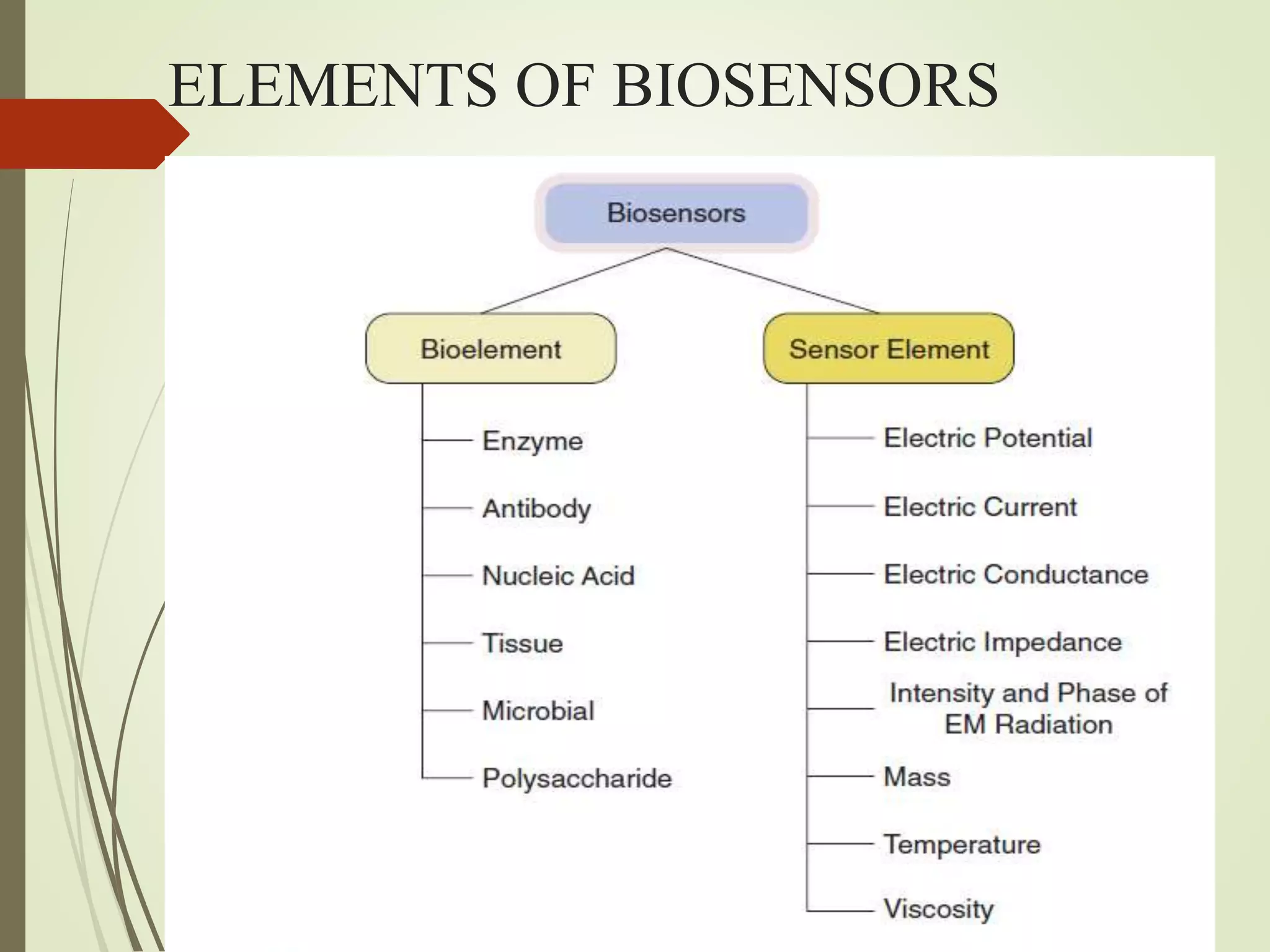
ELEMENTS OF BIOSENSORS
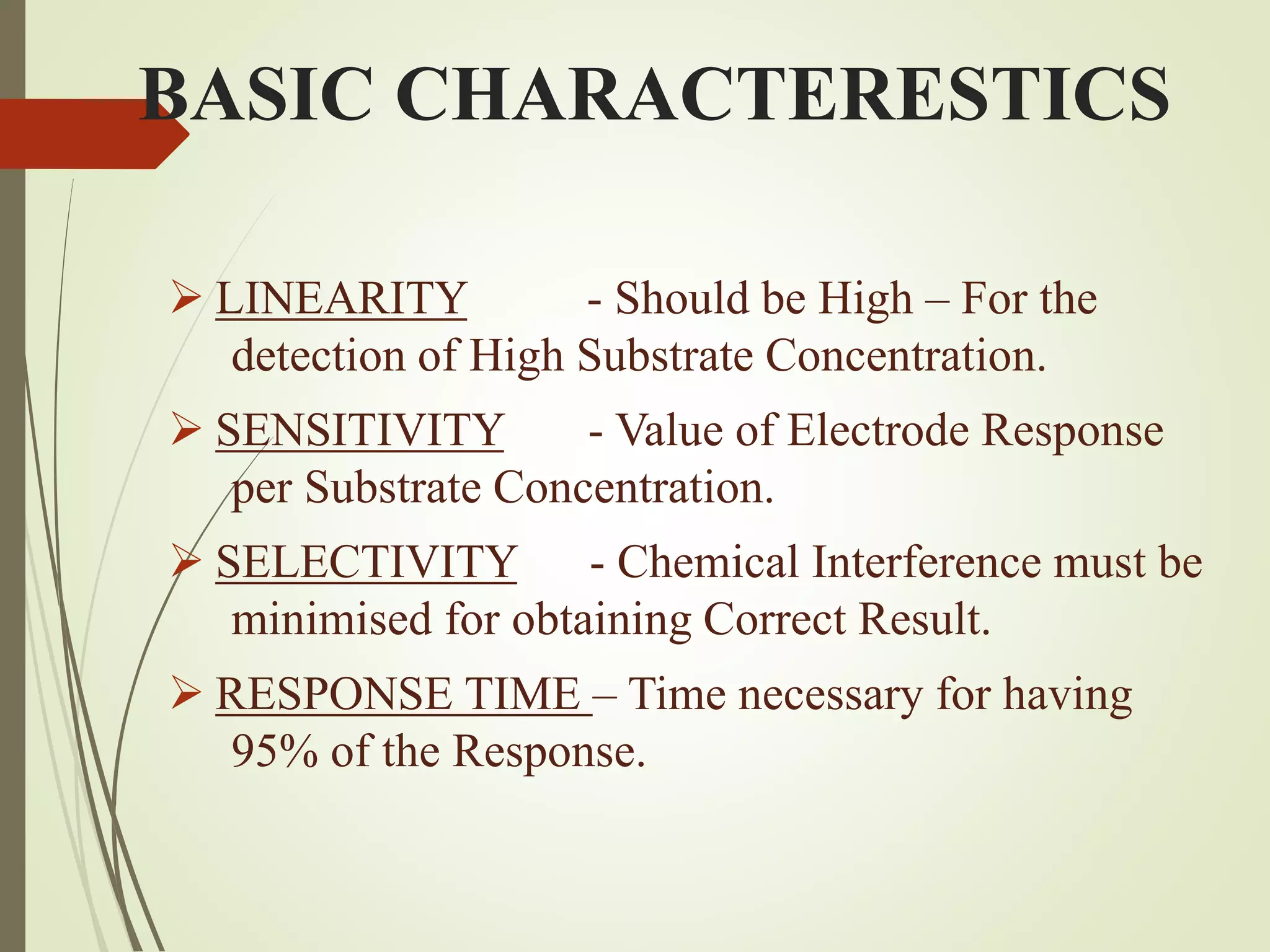
BASIC CHARACTERESTICS
 LINEARITY - Should be High – For the
detection of High Substrate Concentration.
 SENSITIVITY - Value of Electrode Response
per Substrate Concentration.
 SELECTIVITY - Chemical Interference must be
minimised for obtaining Correct Result.
 RESPONSE TIME – Time necessary for having
95% of the Response.
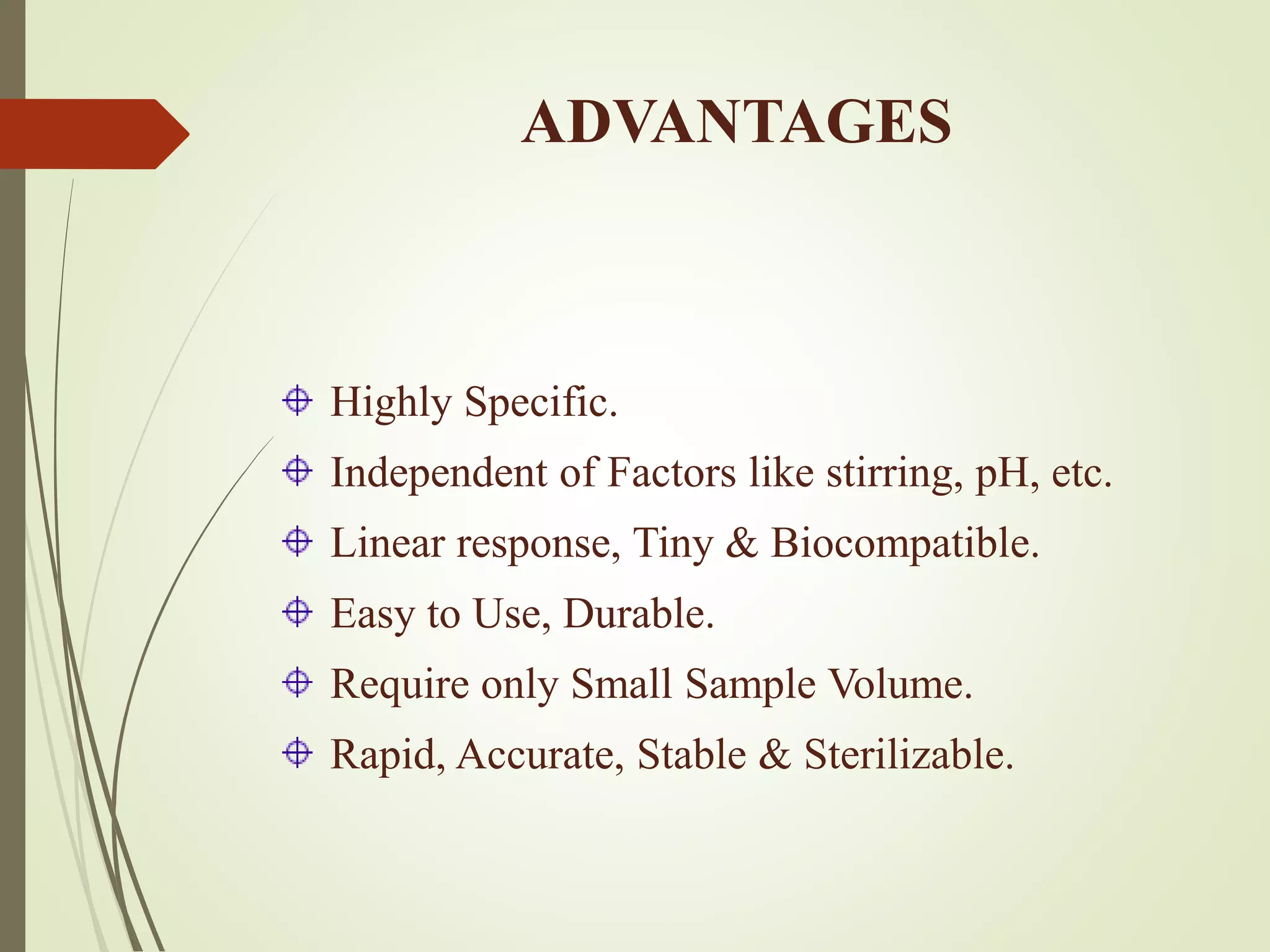
ADVANTAGES
Highly Specific.
Independent of Factors like stirring, pH, etc.
Linear response, Tiny & Biocompatible.
Easy to Use, Durable.
Require only Small Sample Volume.
Rapid, Accurate, Stable & Sterilizable.
TYPICAL SENSING TECHNIQUES
Fluorescence.
DNA Microarray.
SPR (Surface Plasma Resistance).
Impedance Spectroscopy.
SPM (Scanning Probe Microscopy, AFM, STM).
QCM (Quartz Crystal Microbalance).
SERS (Surface Enhanced Raman Spectroscopy).
Electrochemical.
TYPES
 Calorimetric/Thermal Detection Biosensors.
 Optical Biosensors.
 Resonant Biosensors.
 Piezoelectric Biosensors.
 Ion Sensitive Biosensors.
 Electrochemical Biosensors.
 Conductimetric Sensors.
 Amperometric Sensors.
 Potentiometric Sensors.
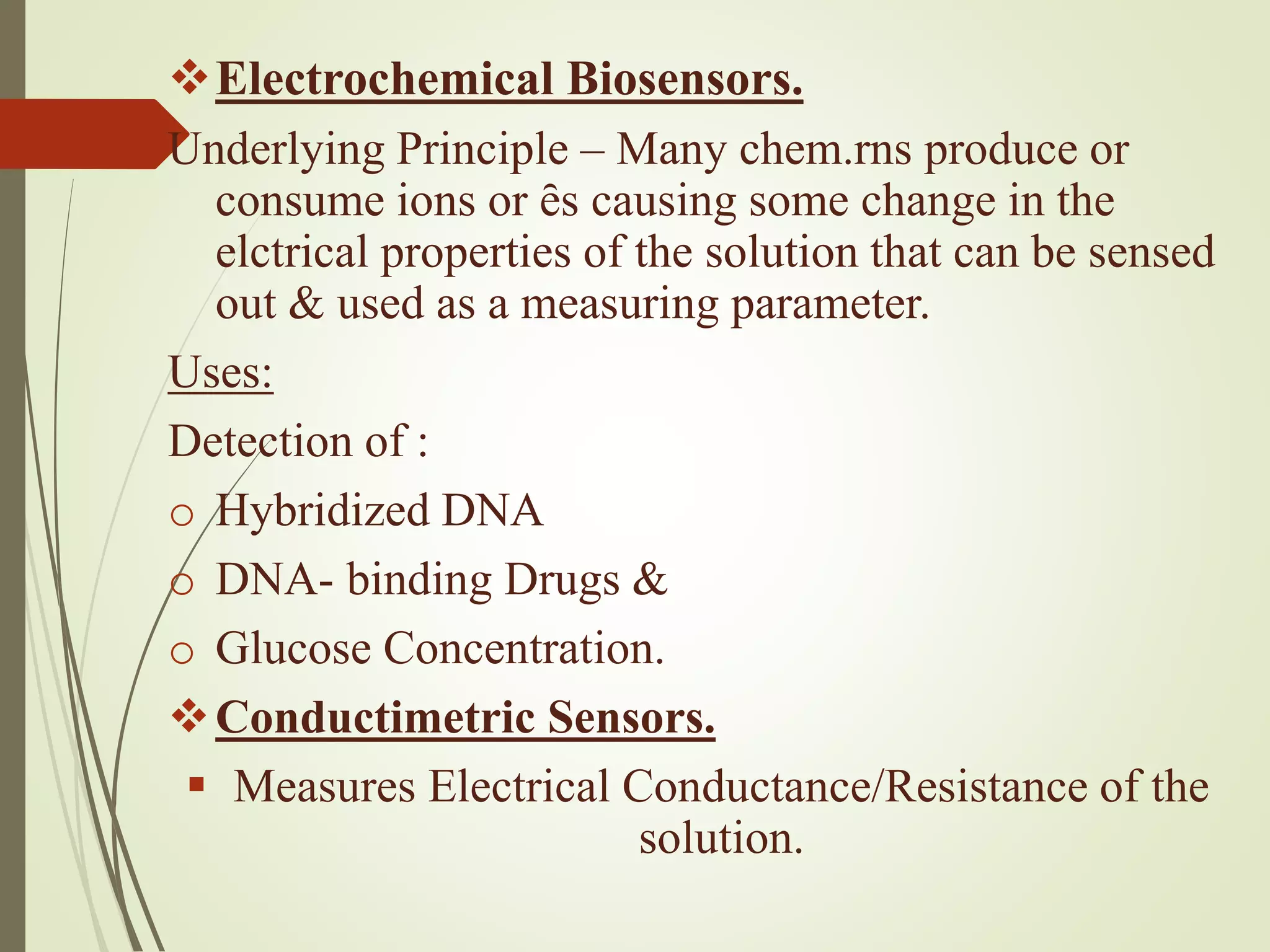
Electrochemical Biosensors.
Underlying Principle – Many chem.rns produce or
consume ions or ȇs causing some change in the
elctrical properties of the solution that can be sensed
out & used as a measuring parameter.
Uses:
Detection of :
o Hybridized DNA
o DNA- binding Drugs &
o Glucose Concentration.
Conductimetric Sensors.
 Measures Electrical Conductance/Resistance of the
solution.
Food Analysis.
Study of Biomolecules & their Interaction.
Drug Development.
Crime Detection.
Medical Diagnosis (Clin&Lab).
Environmental Field Monitoring.
Quality Control.
Industrial Process Control.
Detection Systems for Biological Warfare Agents.
Manf. Of Pharmaceuticals & Replacement organs.
BIOSENSOR FOR
AGRICULTURAL & FOOD
INDUSTRY.
o Detection of viral, fungal, bacterial diseases
of plants.
o In food industry, detection of total microbes
& food quantification in soft drinks.
o To determine the freshness of other fish,
beef & other food items.
o Makes Bacteria GLOW by OPTICAL
Biosensor
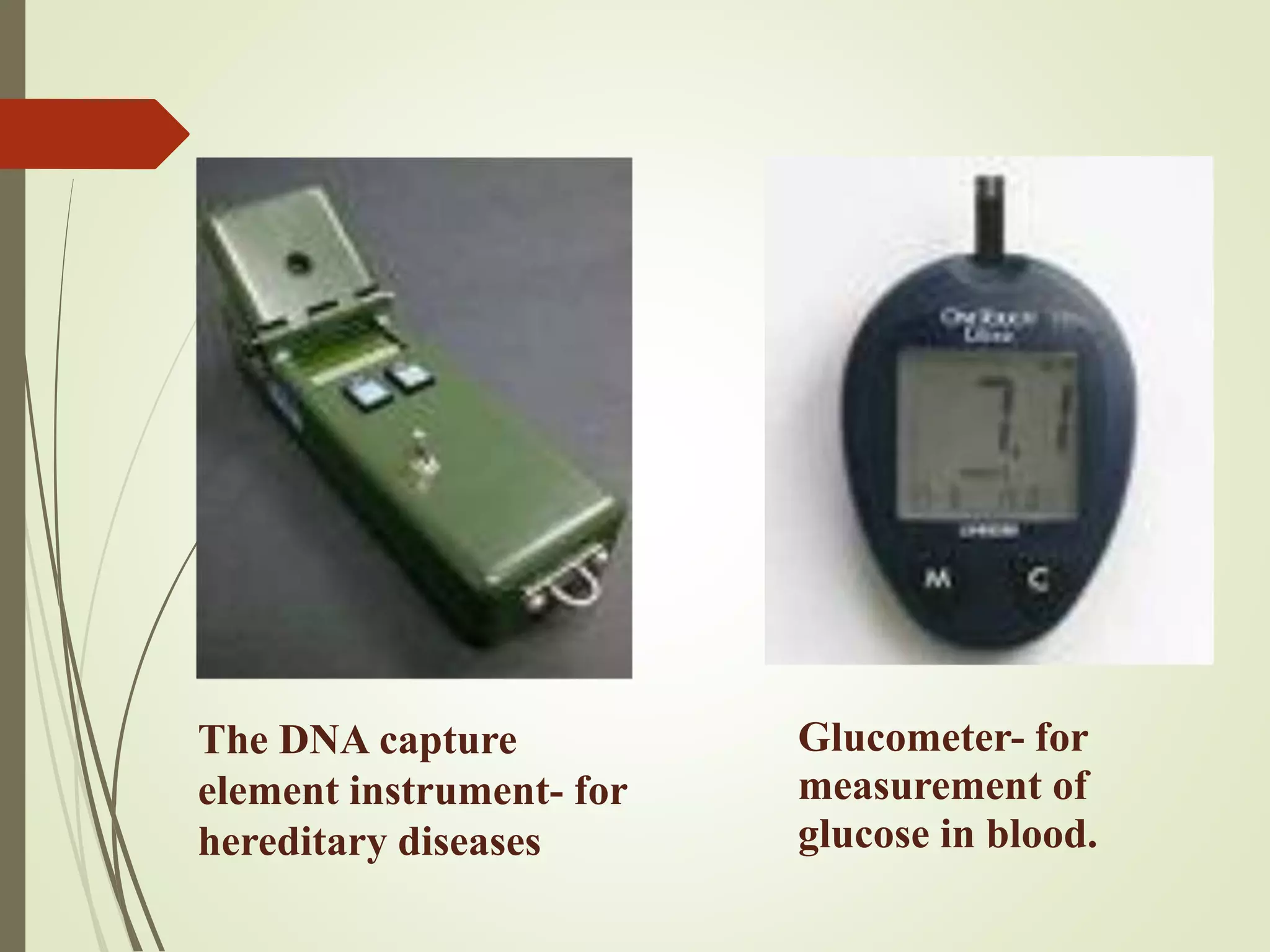
The DNA capture
element instrument- for
hereditary diseases
Glucometer- for
measurement of
glucose in blood.
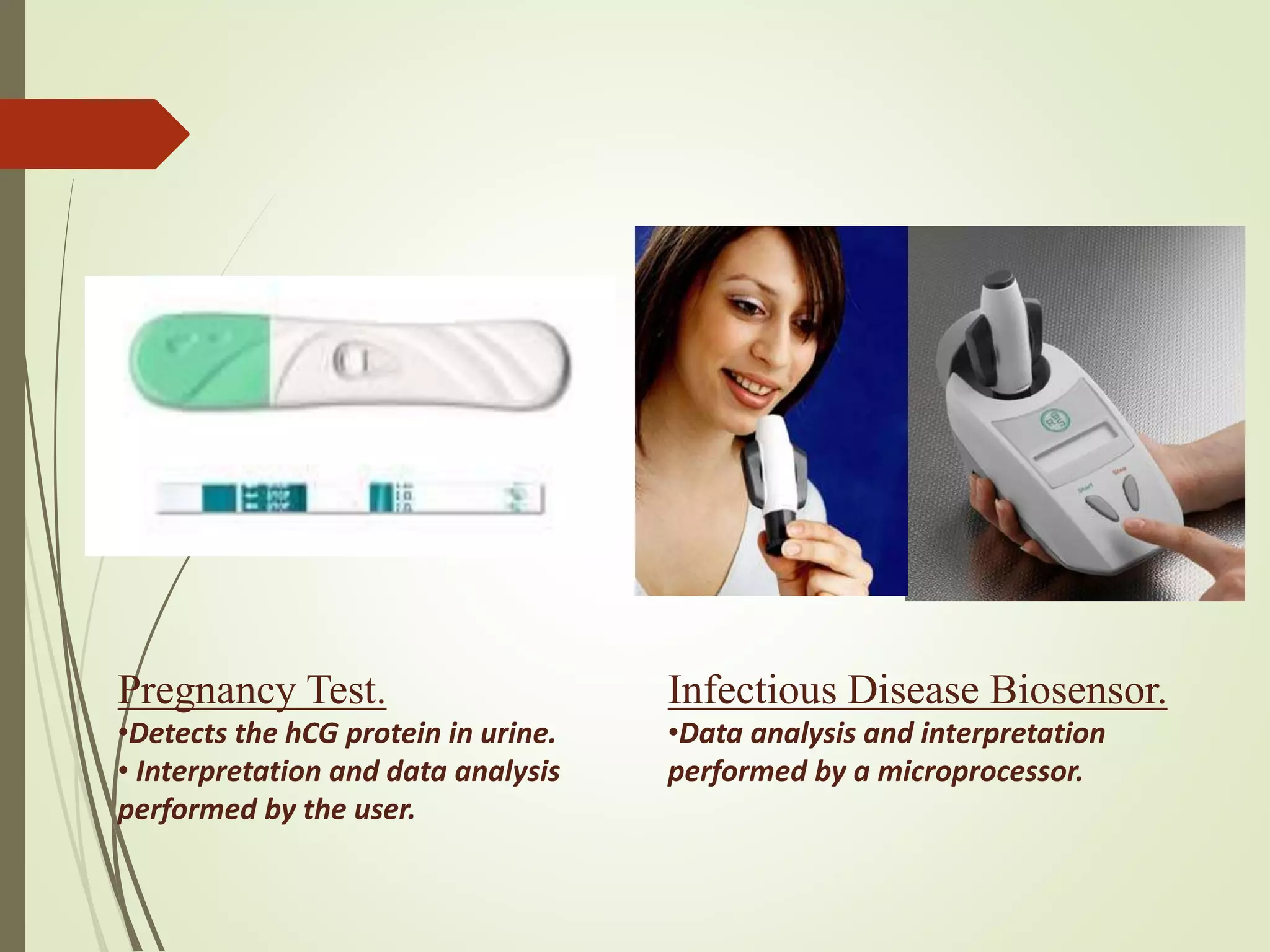
Pregnancy Test.
•Detects the hCG protein in urine.
• Interpretation and data analysis
performed by the user.
Infectious Disease Biosensor.
•Data analysis and interpretation
performed by a microprocessor.
Old time coal miners’
Biosensor.
Data analysis and interpretation
performed by the coal miner.
Biacore Biosensor platform.
General and flexible, good tool for
development of specific biosensors.
BIOSENSOR FOR DETECTION OF POLLUTION &
OF THE CHEMICALS PRESENT IN THE
ENVIRONMENT.
Biosensor_ Suman Shaw

Biosensor_ Suman Shaw

  • 1.
  • 2.
    DEFINITION  Self-contained integrateddevice that is capable of providing specific qualitative or semi-quantitative analytical information using a biological recognition element which is in direct-spatial contact with a transduction element. (IUPAC,1998)
  • 3.
    FATHER OF BIOSENSOR. ProfessorLeland C Clark Jr. (1918–2005)
  • 4.
  • 6.
  • 7.
    BASIC CHARACTERESTICS  LINEARITY- Should be High – For the detection of High Substrate Concentration.  SENSITIVITY - Value of Electrode Response per Substrate Concentration.  SELECTIVITY - Chemical Interference must be minimised for obtaining Correct Result.  RESPONSE TIME – Time necessary for having 95% of the Response.
  • 8.
    ADVANTAGES Highly Specific. Independent ofFactors like stirring, pH, etc. Linear response, Tiny & Biocompatible. Easy to Use, Durable. Require only Small Sample Volume. Rapid, Accurate, Stable & Sterilizable.
  • 9.
    TYPICAL SENSING TECHNIQUES Fluorescence. DNAMicroarray. SPR (Surface Plasma Resistance). Impedance Spectroscopy. SPM (Scanning Probe Microscopy, AFM, STM). QCM (Quartz Crystal Microbalance). SERS (Surface Enhanced Raman Spectroscopy). Electrochemical.
  • 10.
    TYPES  Calorimetric/Thermal DetectionBiosensors.  Optical Biosensors.  Resonant Biosensors.  Piezoelectric Biosensors.  Ion Sensitive Biosensors.  Electrochemical Biosensors.  Conductimetric Sensors.  Amperometric Sensors.  Potentiometric Sensors.
  • 11.
    Electrochemical Biosensors. Underlying Principle– Many chem.rns produce or consume ions or ȇs causing some change in the elctrical properties of the solution that can be sensed out & used as a measuring parameter. Uses: Detection of : o Hybridized DNA o DNA- binding Drugs & o Glucose Concentration. Conductimetric Sensors.  Measures Electrical Conductance/Resistance of the solution.
  • 13.
    Food Analysis. Study ofBiomolecules & their Interaction. Drug Development. Crime Detection. Medical Diagnosis (Clin&Lab). Environmental Field Monitoring. Quality Control. Industrial Process Control. Detection Systems for Biological Warfare Agents. Manf. Of Pharmaceuticals & Replacement organs.
  • 14.
    BIOSENSOR FOR AGRICULTURAL &FOOD INDUSTRY. o Detection of viral, fungal, bacterial diseases of plants. o In food industry, detection of total microbes & food quantification in soft drinks. o To determine the freshness of other fish, beef & other food items. o Makes Bacteria GLOW by OPTICAL Biosensor
  • 16.
    The DNA capture elementinstrument- for hereditary diseases Glucometer- for measurement of glucose in blood.
  • 17.
    Pregnancy Test. •Detects thehCG protein in urine. • Interpretation and data analysis performed by the user. Infectious Disease Biosensor. •Data analysis and interpretation performed by a microprocessor.
  • 18.
    Old time coalminers’ Biosensor. Data analysis and interpretation performed by the coal miner. Biacore Biosensor platform. General and flexible, good tool for development of specific biosensors.
  • 19.
    BIOSENSOR FOR DETECTIONOF POLLUTION & OF THE CHEMICALS PRESENT IN THE ENVIRONMENT.

Editor's Notes

  • #4 University of Rochester