BIOPLASTICS
Plastic...
“Any of various complex organic compounds
produced by polymerization, capable of being
modelled, extruded, cast into various shapes
and films, or drawn into filaments and then
used as textile fibres.“
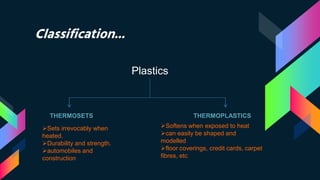
Classification...
Plastics
THERMOSETS THERMOPLASTICS
Sets irrevocably when
heated.
Durability and strength.
automobiles and
construction
Softens when exposed to heat
can easily be shaped and
modelled
floor coverings, credit cards, carpet
fibres, etc
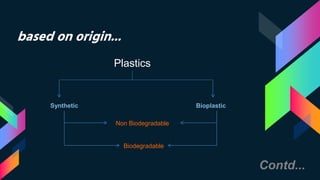
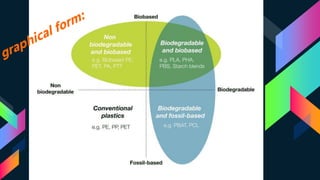
based on origin...
Plastics
Synthetic Bioplastic
Non Biodegradable
Biodegradable
Contd...
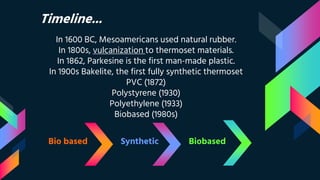
Timeline...
In 1600 BC, Mesoamericans used natural rubber.
In 1800s, vulcanization to thermoset materials.
In 1862, Parkesine is the first man-made plastic.
In 1900s Bakelite, the first fully synthetic thermoset
PVC (1872)
Polystyrene (1930)
Polyethylene (1933)
Biobased (1980s)
Bio based Synthetic Biobased
Biobased polymer...
“Bioplastics are plastics derived from
renewable biomass sources, such
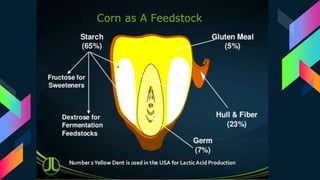
as vegetable fats and oils, corn starch,
or microbiota.”
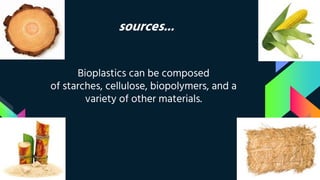
sources...
Bioplastics can be composed
of starches, cellulose, biopolymers, and a
variety of other materials.
Polymers...
Polymers are substances whose molecules
have high molar masses and are composed
of a large number of repeating units. There
are both naturally occurring and
synthetic polymers. Among naturally
occurring polymers are proteins, starches,
cellulose, and latex.
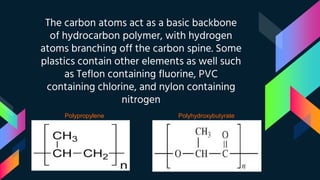
The carbon atoms act as a basic backbone
of hydrocarbon polymer, with hydrogen
atoms branching off the carbon spine. Some
plastics contain other elements as well such
as Teflon containing fluorine, PVC
containing chlorine, and nylon containing
nitrogen
Polypropylene Polyhydroxybutyrate
Types...
 Starch based
Sugar based
Cellulose based
Synthetic materials
Starch based...
Application:
 Thermoplastic starch is unsuitable for
packaging liquids.
It has good oxygen barrier properties.
can be melted and deformed
thermoplastically.
Sources:
potatoes, maize, wheat and tapioca
Sugar based...
Application:
Polyalctides decompose harmlessly in the
human body.
surgical implants which do not require
operative removal
Polylactides are water resistant
Sources:
sucrose or starch by bacterial fermentation
 sugar beet, potatoes, wheat, maize etc
Cellulose based...
Application:
Familiar applications of cellophane include
packaging for CDS, confectionary and
cigarettes.
 transparent and has good folding
properties
Source:
Any cellulose source
Synthetic based...
Application:
 resembling those of polyethylene (LDPE)
fully biodegradable and compostable.
Source:
Petrochemical polymers
Microbiology of
Bioplastics
Microorganisms...
Bacillus cereus
Alcaligenes
Pseudomonas
Azotobacter
Ralstonia eutropha
Vibrio
Enterobacter
Cuprividus necator
Methylobacterium
B.cereus...
›Poly-β- hydroxybutyrate (PHB) is the most
known degradable biopolymers, produced
by genera of bacteria under unfavourable
conditions.
›The most active bacterium that
accumulated high amount of PHB was
selected and identified as Bacillus cereus
MM7
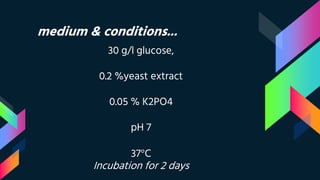
medium & conditions...
30 g/l glucose,
0.2 %yeast extract
0.05 % K2PO4
pH 7
37°C
Incubation for 2 days
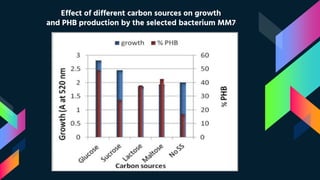
Effect of different carbon sources on growth
and PHB production by the selected bacterium MM7
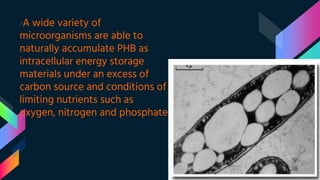
›A wide variety of
microorganisms are able to
naturally accumulate PHB as
intracellular energy storage
materials under an excess of
carbon source and conditions of
limiting nutrients such as
oxygen, nitrogen and phosphate
Drivers for bioplastics...
›Renewable vs Oil based resources
›Reduced environmental impact
›Human health concerns
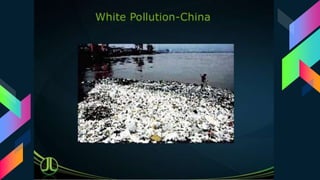
›Landfills
›Legislative initiatives
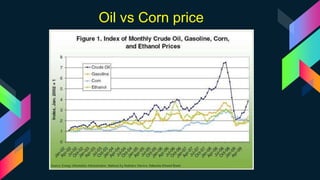
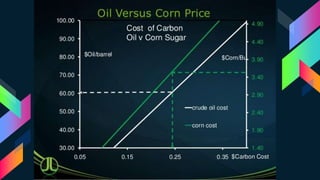
Oil vs Corn price
Definition of Sustainability
"Meeting the needs of present without
compromising the ability of the future
generations to meet their own needs”
“ATHI SRAVATRA VARJAYETH”
›BIOPLASTICS ARE STILL AT A
LONGWAY....
›BE CAUTIOUS
›DISCARD THE WASTES
PROPERLY
›LIMIT THE USE OF PLASTIC
›LIMIT THE USE OF FOSSIL FUEL
References...
›[1] E. S. Stevens, Green Plastics: An introduction to the
new science of biodegradable plastics, Princeton
University Press, New Jersey, 2002.
›[2] M. Vert, Biomacromolecules 6 (2005) 538-546.
›[3] Q. Yang, M. Hirata, Y. Hsu, D. Lu, Y. Kimura, J. Appl.
Polym. Sci. 131 (2014) 39952.
›[4] B. Saulnier, S. Ponsart, J. Coudane, H. Garreau, M. Vert,
Macromol. Biosci. 4 (2004) 232-237.
›[5]
http://worldaccount.basf.com/wa/plasticsAP~ja_JP/portal/
show/content/products/biodegradable_plastics/ecoflex
›[6] V. Nagarajan, M. Singh, H. Kane, M. Khalili, M. J.
Bramucci, Polym. Environ. 14 (2006) 281-287.
THANKS!
Any Questions?

Bioplastics