lant extracts were
likely the earliest agricultural biopesticides.
Experiments with mineral oils
as plant protectants were also reported.
a growing number of studies
and proposal for biopesticides were developed.
 The first, and still most, widely used biopesticides
included spores of the bacteria
( ).
, research and
development continued at a low level because of
the widespread adoption of chemical insecticides.
, there were approximately 245
registered biopesticide active ingredients used in
products
 Biopesticides are usually inherently less
toxic.
 Biopesticides generally affect only the
target pest and closely related organisms.
 Biopesticides often are effective in very
small quantities and often decompose
quickly.
 To use biopesticides effectively,
however, users need to know a great
deal about managing pests.
 Difficult for insects to develop
resistance to these pesticides.
 When used as a component of
Integrated Pest Management (IPM)
programs, biopesticides can greatly
decrease the use of conventional
pesticides.
Renewable can be handled safely.
 Have slow action.
 They are high specific in mode of action.
 Seasonal availability of plants products
indicates the needs for storage.
 They are not available easily.
 All products applied followed by growers
have not been scientifically verified.
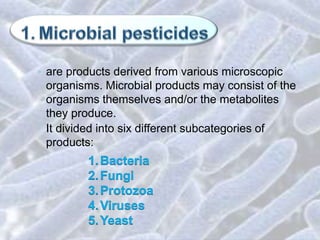
• are products derived from various microscopic
organisms. Microbial products may consist of the
organisms themselves and/or the metabolites
they produce.
• It divided into six different subcategories of
products:
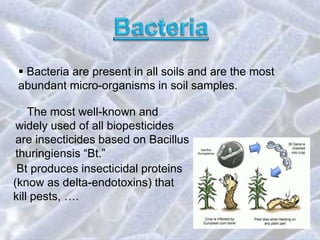
 The most well-known and
widely used of all biopesticides
are insecticides based on Bacillus
thuringiensis “Bt.”
Bt produces insecticidal proteins
(know as delta-endotoxins) that
kill pests, ….
 Bacteria are present in all soils and are the most
abundant micro-organisms in soil samples.
• Fungi are a diverse group of organisms and can be
found in almost every environment on Earth. Some
species have proven useful as microbial
biopesticides.
• they have the ability to attack and parasitize plant
pathogens under certain environmental conditions.
• Two of the most common commercial fungal
biopesticides are Trichoderma spp. and Beauveria
bassiana
• Trichoderma have the ability to readily colonize plant
roots, without harming the plant.
• Beauveria bassiana is a fungus that acts as a
parasite on many insect species.
• Protozoa are single-celled eukaryotic organisms that
exist in both water and soil.
• the protozan Nosema locustae is known to be a
natural biocontrol agent of many grasshopper
species.
• Nosema infects at least 90 species of grasshoppers.
It is non-toxic to humans and other mammals
• it infects and weakens young grasshoppers and
adversely affects female grasshoppers’ ability to
reproduce.
• Baculoviruses : is a microbial pesticides are a family
of naturally-occurring viruses known to infect only
insects.
• They are so specific in their action that they infect
and kill only one or a few species of caterpillars.
• The viral DNA replicates in the nuclei of the host
cells and then spreads throughout the body of the
larvae, turning it into a “virus factory.”
• The infected insect stops feeding within a few days,
dies and disintegrate.
• A variety of yeasts have been investigated for their
usefulness in controlling plant diseases
• Non-pathogenic Cryptococcus and Candida species
naturally occur on plant tissues and in water.
• The yeast serves as an antagonist to fungal
pathogens such as gray mold (Botrytis cinerea) and
blue mold (Penicillium expansum), which cause
post-harvest decay.
• there is evidence that it produces enzymes that can
degrade fungal cell walls and stimulate plant host
defense pathways in freshly harvested fruit.
Pesticides derived from plants
Generally act in one of two ways
• Contact poison
• Stomach poison
About 250000 plant species evaluated
2121 useful in pest management
• 1005 exhibited insecticidal activity
• 384antifeedants
• 297 repellents
• 27 attractants
• 31 growth inhibiting properties
The plant should be a perennial
It should have a wide distribution and be present in
large numbers in nature otherwise it should be
possible to grow it by agricultural practices
Harvesting should not mean destruction of the plant
Plants should require small space , reduced
management and little water and fertilization
Plant should not otherwise have a high economic
value
Ovipostitional deterrent …. Affects the egg
laying and egg hatching
e.g.
Ovicidal …. Kill eggs and disrupts
embryonic development so prevents
hatching of egg
e.g.
Feeding deterrents / Antifeedants ….
Gustatory substances which causes the pest
to stop feeding and starve to death
e.g.
Antigonadal agents …. Inhibit the
development of ovaries of a no. of stored
grain pests and in male insect it showed
sperm malformation and agglutination
e.g.
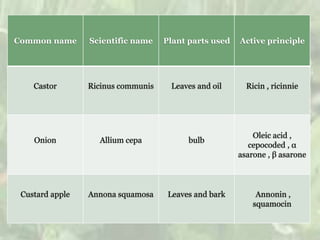
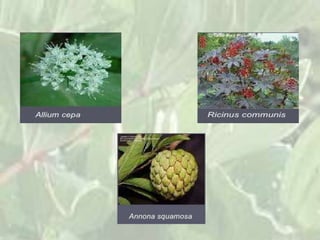
Common name Scientific name Plant parts used Active principle
Castor Ricinus communis Leaves and oil Ricin , ricinnie
Onion Allium cepa bulb
Oleic acid ,
cepocoded , α
asarone , β asarone
Custard apple Annona squamosa Leaves and bark Annonin ,
squamocin
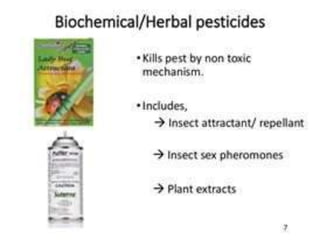
• Are naturally occurring substances that control pests by
non-toxic mechanisms. Conventional pesticides, by
contrast, are generally synthetic materials that directly
kill or inactivate the pest. Biochemical pesticides include
substances, such as insect sex pheromones, that
interfere with mating, as well as various scented plant
extracts that attract insect pests to traps. Because it is
sometimes difficult to determine whether a substance
meets the criteria for classification as a biochemical
pesticide, EPA has established a special committee to
make such decisions.
http://www.biopesticideindustryalliance.org/history-
of-biopesticides/
http://www.epa.gov/pesticides/biopesticides/what
arebiopesticides.htm
http://www.biotecharticles.com/Agriculture-
Article/Agricultural-Applications-of-
Biopesticides-1486.html
Biopesticides

Biopesticides

  • 4.
    lant extracts were likelythe earliest agricultural biopesticides. Experiments with mineral oils as plant protectants were also reported. a growing number of studies and proposal for biopesticides were developed.
  • 5.
     The first,and still most, widely used biopesticides included spores of the bacteria ( ). , research and development continued at a low level because of the widespread adoption of chemical insecticides. , there were approximately 245 registered biopesticide active ingredients used in products
  • 6.
     Biopesticides areusually inherently less toxic.  Biopesticides generally affect only the target pest and closely related organisms.  Biopesticides often are effective in very small quantities and often decompose quickly.  To use biopesticides effectively, however, users need to know a great deal about managing pests.
  • 7.
     Difficult forinsects to develop resistance to these pesticides.  When used as a component of Integrated Pest Management (IPM) programs, biopesticides can greatly decrease the use of conventional pesticides. Renewable can be handled safely.
  • 8.
     Have slowaction.  They are high specific in mode of action.  Seasonal availability of plants products indicates the needs for storage.  They are not available easily.  All products applied followed by growers have not been scientifically verified.
  • 10.
    • are productsderived from various microscopic organisms. Microbial products may consist of the organisms themselves and/or the metabolites they produce. • It divided into six different subcategories of products:
  • 11.
     The mostwell-known and widely used of all biopesticides are insecticides based on Bacillus thuringiensis “Bt.” Bt produces insecticidal proteins (know as delta-endotoxins) that kill pests, ….  Bacteria are present in all soils and are the most abundant micro-organisms in soil samples.
  • 12.
    • Fungi area diverse group of organisms and can be found in almost every environment on Earth. Some species have proven useful as microbial biopesticides. • they have the ability to attack and parasitize plant pathogens under certain environmental conditions. • Two of the most common commercial fungal biopesticides are Trichoderma spp. and Beauveria bassiana • Trichoderma have the ability to readily colonize plant roots, without harming the plant. • Beauveria bassiana is a fungus that acts as a parasite on many insect species.
  • 13.
    • Protozoa aresingle-celled eukaryotic organisms that exist in both water and soil. • the protozan Nosema locustae is known to be a natural biocontrol agent of many grasshopper species. • Nosema infects at least 90 species of grasshoppers. It is non-toxic to humans and other mammals • it infects and weakens young grasshoppers and adversely affects female grasshoppers’ ability to reproduce.
  • 14.
    • Baculoviruses :is a microbial pesticides are a family of naturally-occurring viruses known to infect only insects. • They are so specific in their action that they infect and kill only one or a few species of caterpillars. • The viral DNA replicates in the nuclei of the host cells and then spreads throughout the body of the larvae, turning it into a “virus factory.” • The infected insect stops feeding within a few days, dies and disintegrate.
  • 15.
    • A varietyof yeasts have been investigated for their usefulness in controlling plant diseases • Non-pathogenic Cryptococcus and Candida species naturally occur on plant tissues and in water. • The yeast serves as an antagonist to fungal pathogens such as gray mold (Botrytis cinerea) and blue mold (Penicillium expansum), which cause post-harvest decay. • there is evidence that it produces enzymes that can degrade fungal cell walls and stimulate plant host defense pathways in freshly harvested fruit.
  • 16.
    Pesticides derived fromplants Generally act in one of two ways • Contact poison • Stomach poison About 250000 plant species evaluated 2121 useful in pest management • 1005 exhibited insecticidal activity • 384antifeedants • 297 repellents • 27 attractants • 31 growth inhibiting properties
  • 17.
    The plant shouldbe a perennial It should have a wide distribution and be present in large numbers in nature otherwise it should be possible to grow it by agricultural practices Harvesting should not mean destruction of the plant Plants should require small space , reduced management and little water and fertilization Plant should not otherwise have a high economic value
  • 18.
    Ovipostitional deterrent ….Affects the egg laying and egg hatching e.g. Ovicidal …. Kill eggs and disrupts embryonic development so prevents hatching of egg e.g. Feeding deterrents / Antifeedants …. Gustatory substances which causes the pest to stop feeding and starve to death e.g.
  • 19.
    Antigonadal agents ….Inhibit the development of ovaries of a no. of stored grain pests and in male insect it showed sperm malformation and agglutination e.g.
  • 20.
    Common name Scientificname Plant parts used Active principle Castor Ricinus communis Leaves and oil Ricin , ricinnie Onion Allium cepa bulb Oleic acid , cepocoded , α asarone , β asarone Custard apple Annona squamosa Leaves and bark Annonin , squamocin
  • 22.
    • Are naturallyoccurring substances that control pests by non-toxic mechanisms. Conventional pesticides, by contrast, are generally synthetic materials that directly kill or inactivate the pest. Biochemical pesticides include substances, such as insect sex pheromones, that interfere with mating, as well as various scented plant extracts that attract insect pests to traps. Because it is sometimes difficult to determine whether a substance meets the criteria for classification as a biochemical pesticide, EPA has established a special committee to make such decisions.
  • 24.