BIOPESTICIDES
AND THEIR USES
Biopesticide is a formulation made from naturally occurring
substances that controls pests by non toxic mechanisms and in
ecofriendly manner.
Biopesticides may be derived from animals (e.g. nematodes),
plants (Chrysanthemum, Azadirachta) and micro-organisms
(e.g. Bacillus thuringiensis, Trichoderma, nucleopolyhedrosis
virus), and include living organisms (natural enemies) etc.
However, biopesticides are generally less toxic to the user and
are non-target organisms, making them desirable and
INTRODUCTION
Inherently less harmful and less environmental load,
Designed to affect only one specific pest or, in some
cases, a few target organisms,
Often effective in very small quantities and often
decompose quickly, thereby resulting in lower exposures
and largely avoiding the pollution problems .
When used as a component of Integrated Pest
Management (IPM) programs, biopesticides can
contribute greatly.
Advantages of biopesticides
Types of biopesticides
 Microbial pesticides
 Plant-incorporated-protectants (PIPs)
 Biochemical pesticides
 Botanical pesticides
 Biotic agents (parasitoids and predators)
Microbial Pesticides
• Microbial pesticides are composed of microscopic
living organisms (viruses, bacteria, fungi, protozoa, or
nematodes) or toxin produced by these organisms
• Applied as conventional insecticidal sprays, dusts, or
granules.
• Their greatest strength is their specificity as most are
essentially nontoxic and non pathogenic to animals
and humans.
• Microbial pesticides includes insecticides, fungicides,
a. Bacillus thuringiensis
• Discovered in Japan in early 20th
century and first
become a commercial product in France in 1938.
• Control lepidopterous pests like
American bollworm in cotton
and stem borers in rice.
Fig:
Bacillus thuringiensis
• When ingested by pest larvae, Bt releases toxins which
damage the mid gut of the pest, eventually killing it.
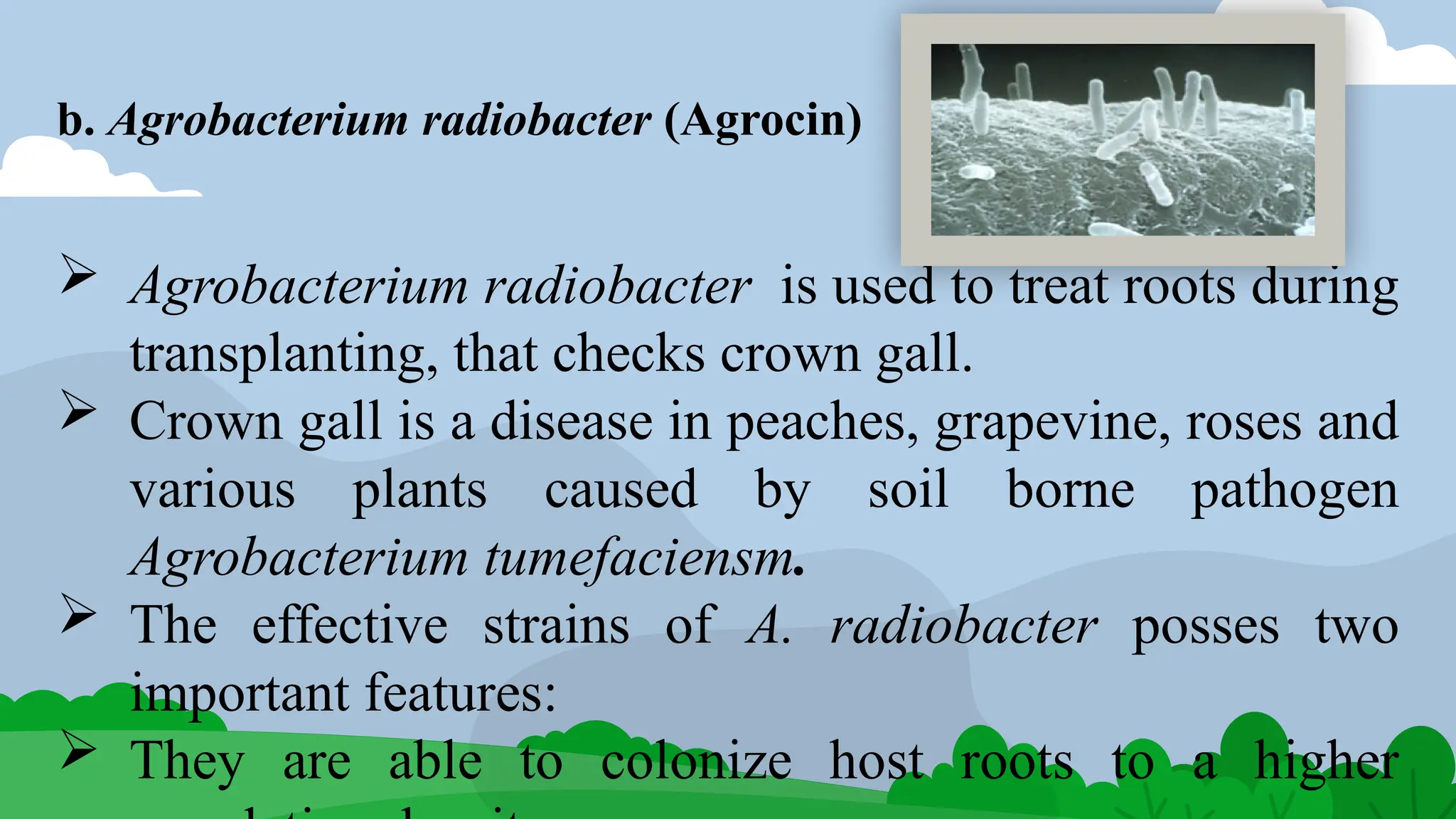
b. Agrobacterium radiobacter (Agrocin)
 Agrobacterium radiobacter is used to treat roots during
transplanting, that checks crown gall.
 Crown gall is a disease in peaches, grapevine, roses and
various plants caused by soil borne pathogen
Agrobacterium tumefaciensm.
 The effective strains of A. radiobacter posses two
important features:
 They are able to colonize host roots to a higher
c. Pseudomonas fluorescens (Phenazine)
This bacteria is used to control damping off caused by Pythium sp., Rhizoctonia solani,
Gaeumannomyces graminis.
It has ability to grow quickly in the rhizosphere
d. Trichoderma Fig: Pseudomonas
Trichoderma is a fungicide effective against soil born diseases such as root rot.
This is also used against Necteia
galligena, that causes silver leaf
disease of fruit trees by entering
through pruning wounds.
Fig. spores of Trichoderma
zium anisopliae
spittlegbugs, rhinoceros beetles.
ria bassiana
s Colorado potato beetle.
llum lecanii:
aphids and whiteflies.
raea riley:
s soybean caterpillars.
oviruses(Bvs)
Fig: Metarhizium anisopliae
Plant-incorporated-protectants (PIPs)
• Pesticidal substances that plant produce from the genetic material
that has been added to the plant.
• As the pest feed on such plants they will eventually die.
Botanical pesticides
• These are naturally occurring plant material that may be
crude preparation of the plant parts ground to produce a dust
or powder that can be used in full strength or dilute form in a
carrier such as clay, talc or diatomaceous earth.
• “Azadirachtin” effects the reproductive and digestive procees
of pest.
• Several plant based insecticides as nicotinoids, natural
pyrethrins, rotenoids, neem products etc are used.
CHEMICALLY RELATED PESTICIDES
4.Biochemical pesticides
• They are naturally occurring substance to control pest by
non-toxic mechanisms.
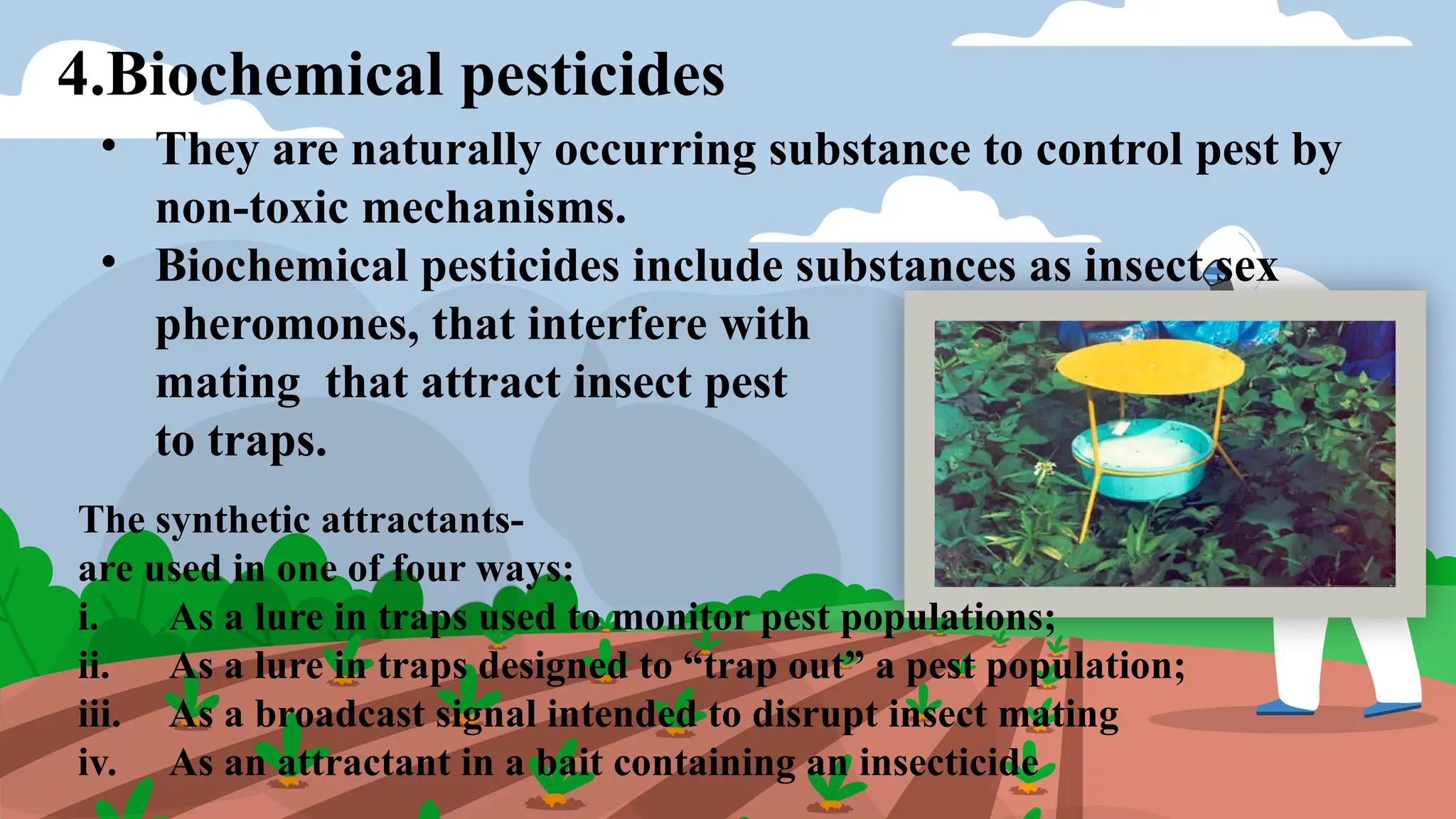
• Biochemical pesticides include substances as insect sex
pheromones, that interfere with
mating that attract insect pest
to traps.
The synthetic attractants-
are used in one of four ways:
i. As a lure in traps used to monitor pest populations;
ii. As a lure in traps designed to “trap out” a pest population;
iii. As a broadcast signal intended to disrupt insect mating
iv. As an attractant in a bait containing an insecticide
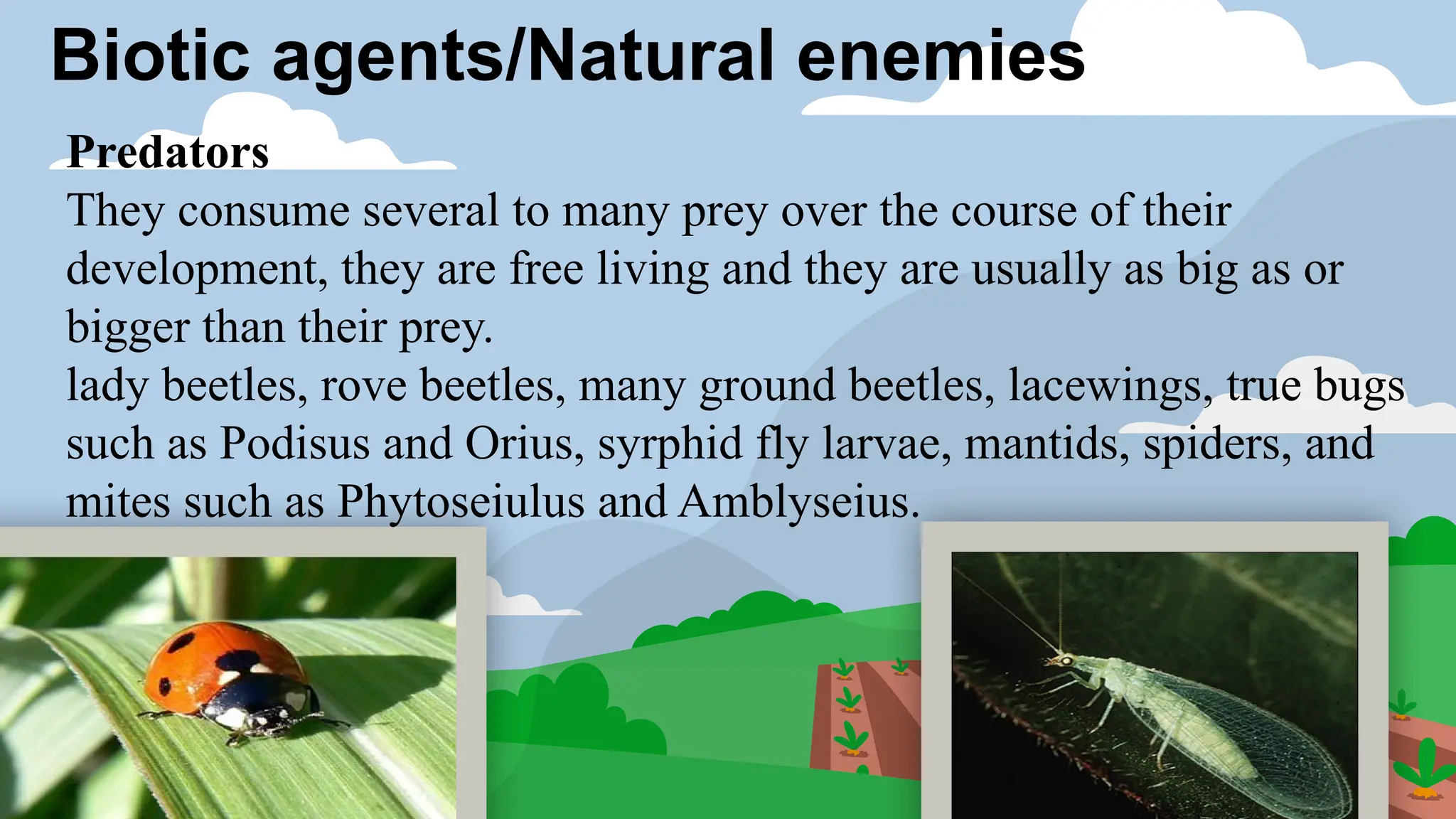
Predators
They consume several to many prey over the course of their
development, they are free living and they are usually as big as or
bigger than their prey.
lady beetles, rove beetles, many ground beetles, lacewings, true bugs
such as Podisus and Orius, syrphid fly larvae, mantids, spiders, and
mites such as Phytoseiulus and Amblyseius.
Biotic agents/Natural enemies
Parasitoids
Parasitoids are almost the same size as their hosts, and their
development always kills the host insect.
An adult parasitoid deposits one or more eggs into or onto the body
of a host insect or somewhere in the host’s habitat.
The larva that hatches from each egg feeds internally or externally
on the host’s tissues and body fluids, consuming it slowly.
Later in development, the host dies and the parasitoid pupates inside
or outside of the host’s body.
Bathyplectes, trichogramma, encarsia, muscidifurax etc.
Conclusion
• Biopesticides are typically microbial biological pest control
that are applied in a manner similar to chemical pesticides.
• Available in different formulations
• Also used to control soil borne and seed borne fungal
pathogens
• Disadvantages of them are, high specificity, slow speed of
action and their requirement of suitable condition for their
survival.
• Eventhough, biopesticides are best for controlling the pests
of agriculture then the chemicals
• Therefore there should be more works on production on
biopesticides and encourage people to use biopesticides to

biopesticides report for college studentspptx

  • 1.
  • 2.
    Biopesticide is aformulation made from naturally occurring substances that controls pests by non toxic mechanisms and in ecofriendly manner. Biopesticides may be derived from animals (e.g. nematodes), plants (Chrysanthemum, Azadirachta) and micro-organisms (e.g. Bacillus thuringiensis, Trichoderma, nucleopolyhedrosis virus), and include living organisms (natural enemies) etc. However, biopesticides are generally less toxic to the user and are non-target organisms, making them desirable and INTRODUCTION
  • 3.
    Inherently less harmfuland less environmental load, Designed to affect only one specific pest or, in some cases, a few target organisms, Often effective in very small quantities and often decompose quickly, thereby resulting in lower exposures and largely avoiding the pollution problems . When used as a component of Integrated Pest Management (IPM) programs, biopesticides can contribute greatly. Advantages of biopesticides
  • 4.
    Types of biopesticides Microbial pesticides  Plant-incorporated-protectants (PIPs)  Biochemical pesticides  Botanical pesticides  Biotic agents (parasitoids and predators)
  • 5.
    Microbial Pesticides • Microbialpesticides are composed of microscopic living organisms (viruses, bacteria, fungi, protozoa, or nematodes) or toxin produced by these organisms • Applied as conventional insecticidal sprays, dusts, or granules. • Their greatest strength is their specificity as most are essentially nontoxic and non pathogenic to animals and humans. • Microbial pesticides includes insecticides, fungicides,
  • 6.
    a. Bacillus thuringiensis •Discovered in Japan in early 20th century and first become a commercial product in France in 1938. • Control lepidopterous pests like American bollworm in cotton and stem borers in rice. Fig: Bacillus thuringiensis • When ingested by pest larvae, Bt releases toxins which damage the mid gut of the pest, eventually killing it.
  • 7.
    b. Agrobacterium radiobacter(Agrocin)  Agrobacterium radiobacter is used to treat roots during transplanting, that checks crown gall.  Crown gall is a disease in peaches, grapevine, roses and various plants caused by soil borne pathogen Agrobacterium tumefaciensm.  The effective strains of A. radiobacter posses two important features:  They are able to colonize host roots to a higher
  • 8.
    c. Pseudomonas fluorescens(Phenazine) This bacteria is used to control damping off caused by Pythium sp., Rhizoctonia solani, Gaeumannomyces graminis. It has ability to grow quickly in the rhizosphere d. Trichoderma Fig: Pseudomonas Trichoderma is a fungicide effective against soil born diseases such as root rot. This is also used against Necteia galligena, that causes silver leaf disease of fruit trees by entering through pruning wounds. Fig. spores of Trichoderma
  • 9.
    zium anisopliae spittlegbugs, rhinocerosbeetles. ria bassiana s Colorado potato beetle. llum lecanii: aphids and whiteflies. raea riley: s soybean caterpillars. oviruses(Bvs) Fig: Metarhizium anisopliae
  • 10.
    Plant-incorporated-protectants (PIPs) • Pesticidalsubstances that plant produce from the genetic material that has been added to the plant. • As the pest feed on such plants they will eventually die.
  • 11.
    Botanical pesticides • Theseare naturally occurring plant material that may be crude preparation of the plant parts ground to produce a dust or powder that can be used in full strength or dilute form in a carrier such as clay, talc or diatomaceous earth. • “Azadirachtin” effects the reproductive and digestive procees of pest. • Several plant based insecticides as nicotinoids, natural pyrethrins, rotenoids, neem products etc are used.
  • 12.
  • 13.
    4.Biochemical pesticides • Theyare naturally occurring substance to control pest by non-toxic mechanisms. • Biochemical pesticides include substances as insect sex pheromones, that interfere with mating that attract insect pest to traps. The synthetic attractants- are used in one of four ways: i. As a lure in traps used to monitor pest populations; ii. As a lure in traps designed to “trap out” a pest population; iii. As a broadcast signal intended to disrupt insect mating iv. As an attractant in a bait containing an insecticide
  • 14.
    Predators They consume severalto many prey over the course of their development, they are free living and they are usually as big as or bigger than their prey. lady beetles, rove beetles, many ground beetles, lacewings, true bugs such as Podisus and Orius, syrphid fly larvae, mantids, spiders, and mites such as Phytoseiulus and Amblyseius. Biotic agents/Natural enemies
  • 15.
    Parasitoids Parasitoids are almostthe same size as their hosts, and their development always kills the host insect. An adult parasitoid deposits one or more eggs into or onto the body of a host insect or somewhere in the host’s habitat. The larva that hatches from each egg feeds internally or externally on the host’s tissues and body fluids, consuming it slowly. Later in development, the host dies and the parasitoid pupates inside or outside of the host’s body. Bathyplectes, trichogramma, encarsia, muscidifurax etc.
  • 16.
    Conclusion • Biopesticides aretypically microbial biological pest control that are applied in a manner similar to chemical pesticides. • Available in different formulations • Also used to control soil borne and seed borne fungal pathogens • Disadvantages of them are, high specificity, slow speed of action and their requirement of suitable condition for their survival. • Eventhough, biopesticides are best for controlling the pests of agriculture then the chemicals • Therefore there should be more works on production on biopesticides and encourage people to use biopesticides to