BIOMETRICS TECHNIQUES 
Presented To:Dr.Ayman Taha 
Presented By:Noha Hesham & Moataz Mahmoud
2 
OUTLINE 
 Introduction 
 User Authentication Approaches 
 What is Biometrics 
 Biometrics techniques 
 Requirements for an ideal biometric 
 Different Types of biometrics techniques 
 Different biometrics techniques concept 
 Biometric techniques factors of evaluation 
 Comparison of biometric techniques 
 Biometrics Identification & Verification 
 Biometrics System Stages 
 Fingerprint Technology 
 Fingerprint Threats
3 
INTRODUCTION 
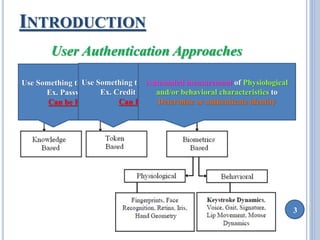
User Authentication Approaches 
Use Something that you have 
Use Something that you Know 
Automated measurement of Physiological 
Ex. Credit Card, Keys 
Ex. Password, PIN 
Can be Forgotten 
and/or behavioral characteristics to 
Determine or authenticate identity 
Can Be lost
4 
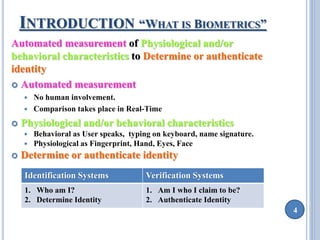
INTRODUCTION “WHAT IS BIOMETRICS” 
Automated measurement of Physiological and/or 
behavioral characteristics to Determine or authenticate 
identity 
 Automated measurement 
 No human involvement. 
 Comparison takes place in Real-Time 
 Physiological and/or behavioral characteristics 
 Behavioral as User speaks, typing on keyboard, name signature. 
 Physiological as Fingerprint, Hand, Eyes, Face 
 Determine or authenticate identity 
Identification Systems Verification Systems 
1. Who am I? 
2. Determine Identity 
1. Am I who I claim to be? 
2. Authenticate Identity
5 
BIOMETRICS TECHNIQUES 
Requirements for an ideal biometric 
 Universality 
Each person should have the characteristic 
 Uniqueness 
No two persons should have same characteristic 
 Permanence 
 The characteristic should not change 
 Performance 
Accuracy, speed, robustness, resource requirements 
 Acceptability 
Extend to people willing to accept a characteristic 
 Faked protection 
 How easy is to fool the system by fraudulent methods
6 
BIOMETRICS TECHNIQUES 
Different Type of biometrics techniques 
 Identification and verification: 
 Fingerprint scan 
 Face recognition ( Facial scan ) 
 Retina scan 
 Iris scan 
 Verification only: 
 Hand Geometry 
 Keystroke Dynamics 
 Mouse Dynamics 
 Gait Dynamics ( how people walk ) 
 Voice Print 
 Signature
7 
BIOMETRICS TECHNIQUES 
Different biometrics techniques concept 
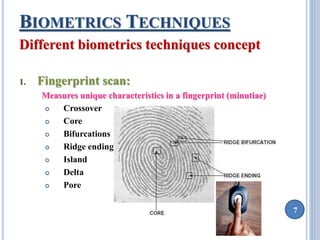
1. Fingerprint scan: 
Measures unique characteristics in a fingerprint (minutiae) 
 Crossover 
 Core 
 Bifurcations 
 Ridge ending 
 Island 
 Delta 
 Pore
8 
BIOMETRICS TECHNIQUES 
Different biometrics techniques concept 
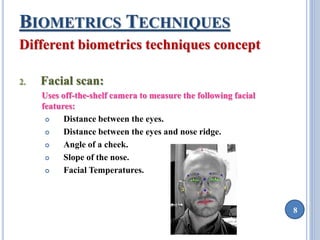
2. Facial scan: 
Uses off-the-shelf camera to measure the following facial 
features: 
 Distance between the eyes. 
 Distance between the eyes and nose ridge. 
 Angle of a cheek. 
 Slope of the nose. 
 Facial Temperatures.
9 
BIOMETRICS TECHNIQUES 
Different biometrics techniques concept 
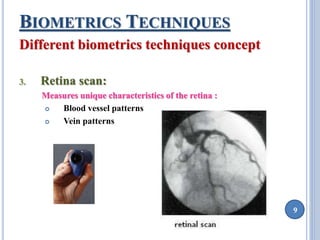
3. Retina scan: 
Measures unique characteristics of the retina : 
 Blood vessel patterns 
 Vein patterns
10 
BIOMETRICS TECHNIQUES 
Different biometrics techniques concept 
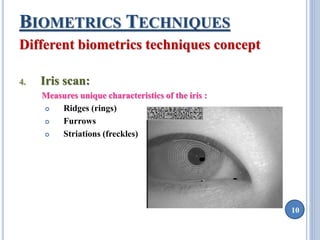
4. Iris scan: 
Measures unique characteristics of the iris : 
 Ridges (rings) 
 Furrows 
 Striations (freckles)
11 
BIOMETRICS TECHNIQUES 
Different biometrics techniques concept 
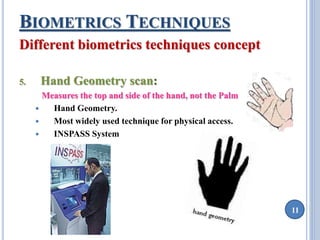
5. Hand Geometry scan: 
Measures the top and side of the hand, not the Palm 
 Hand Geometry. 
 Most widely used technique for physical access. 
 INSPASS System
12 
BIOMETRICS TECHNIQUES 
Different biometrics techniques concept 
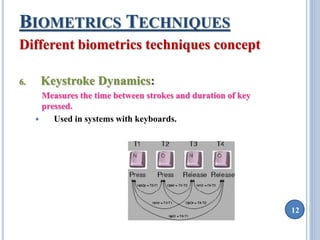
6. Keystroke Dynamics: 
Measures the time between strokes and duration of key 
pressed. 
 Used in systems with keyboards.
13 
BIOMETRICS TECHNIQUES 
Different biometrics techniques concept 
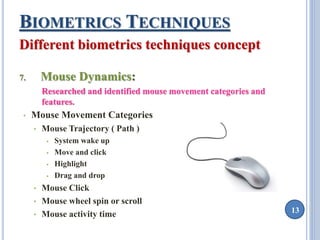
7. Mouse Dynamics: 
Researched and identified mouse movement categories and 
features. 
• Mouse Movement Categories 
• Mouse Trajectory ( Path ) 
 System wake up 
 Move and click 
 Highlight 
 Drag and drop 
• Mouse Click 
• Mouse wheel spin or scroll 
• Mouse activity time
14 
BIOMETRICS TECHNIQUES 
Different biometrics techniques concept 
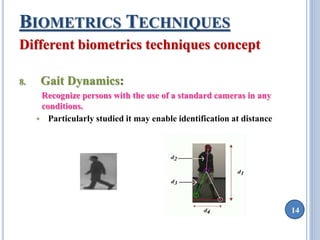
8. Gait Dynamics: 
Recognize persons with the use of a standard cameras in any 
conditions. 
 Particularly studied it may enable identification at distance
15 
BIOMETRICS TECHNIQUES 
Different biometrics techniques concept 
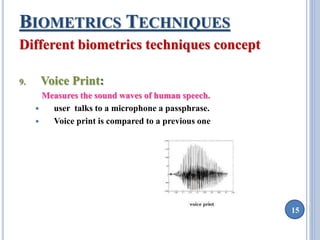
9. Voice Print: 
Measures the sound waves of human speech. 
 user talks to a microphone a passphrase. 
 Voice print is compared to a previous one
16 
BIOMETRICS TECHNIQUES 
Different biometrics techniques concept 
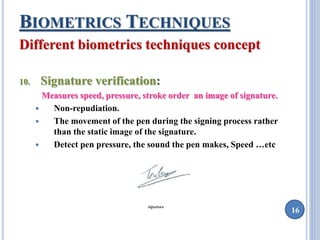
10. Signature verification: 
Measures speed, pressure, stroke order an image of signature. 
 Non-repudiation. 
 The movement of the pen during the signing process rather 
than the static image of the signature. 
 Detect pen pressure, the sound the pen makes, Speed …etc
17 
BIOMETRICS TECHNIQUES 
Different biometrics techniques concept 
11. Palm vain recognition: 
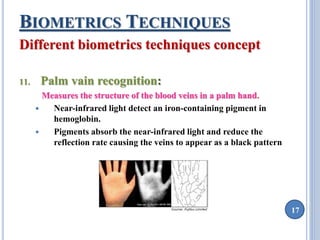
Measures the structure of the blood veins in a palm hand. 
 Near-infrared light detect an iron-containing pigment in 
hemoglobin. 
 Pigments absorb the near-infrared light and reduce the 
reflection rate causing the veins to appear as a black pattern
18 
BIOMETRICS TECHNIQUES 
Biometric techniques factors of evaluation 
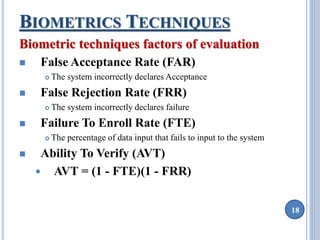
 False Acceptance Rate (FAR) 
 The system incorrectly declares Acceptance 
 False Rejection Rate (FRR) 
 The system incorrectly declares failure 
 Failure To Enroll Rate (FTE) 
 The percentage of data input that fails to input to the system 
 Ability To Verify (AVT) 
 AVT = (1 - FTE)(1 - FRR)
19 
BIOMETRICS TECHNIQUES 
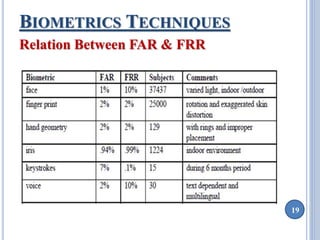
Relation Between FAR & FRR
20 
BIOMETRICS TECHNIQUES 
Comparison of biometric techniques 
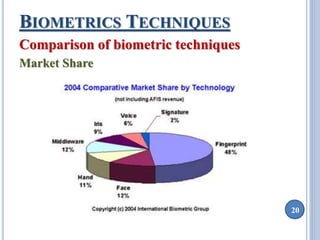
Market Share
21 
BIOMETRICS TECHNIQUES 
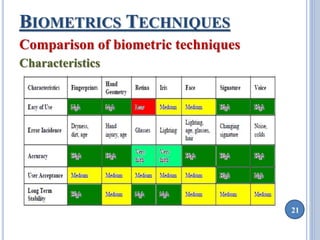
Comparison of biometric techniques 
Characteristics
22 
BIOMETRICS TECHNIQUES 
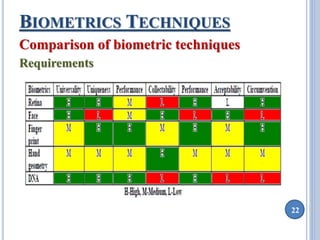
Comparison of biometric techniques 
Requirements
23 
BIOMETRICS TECHNIQUES 
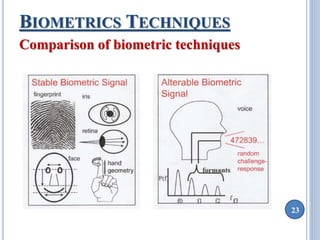
Comparison of biometric techniques
24 
BIOMETRICS TECHNIQUES 
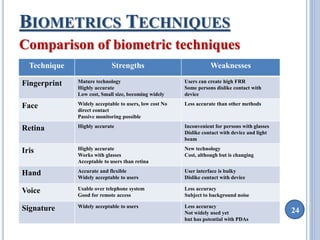
Comparison of biometric techniques 
Technique Strengths Weaknesses 
Fingerprint Mature technology 
Highly accurate 
Low cost, Small size, becoming widely 
Users can create high FRR 
Some persons dislike contact with 
device 
Face Widely acceptable to users, low cost No 
direct contact 
Passive monitoring possible 
Less accurate than other methods 
Retina Highly accurate Inconvenient for persons with glasses 
Dislike contact with device and light 
beam 
Iris Highly accurate 
Works with glasses 
Acceptable to users than retina 
New technology 
Cost, although but is changing 
Hand Accurate and flexible 
Widely acceptable to users 
User interface is bulky 
Dislike contact with device 
Voice Usable over telephone system 
Good for remote access 
Less accuracy 
Subject to background noise 
Signature Widely acceptable to users Less accuracy 
Not widely used yet 
but has potential with PDAs
25 
BIOMETRICS TECHNIQUES 
Biometrics Identification & Verification
26 
BIOMETRICS TECHNIQUES 
Biometrics Identification & Verification 
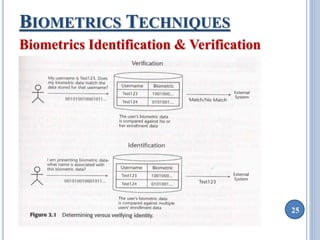
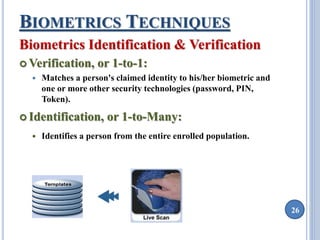
Verification, or 1-to-1: 
 Matches a person's claimed identity to his/her biometric and 
one or more other security technologies (password, PIN, 
Token). 
 Identification, or 1-to-Many: 
 Identifies a person from the entire enrolled population.
27 
BIOMETRICS TECHNIQUES 
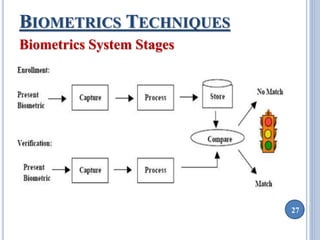
Biometrics System Stages
28 
BIOMETRICS TECHNIQUES 
Fingerprint Technology 
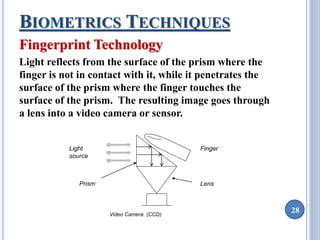
Light reflects from the surface of the prism where the 
finger is not in contact with it, while it penetrates the 
surface of the prism where the finger touches the 
surface of the prism. The resulting image goes through 
a lens into a video camera or sensor. 
Light 
source 
Finger 
Prism Lens 
Video Camera (CCD)
29 
BIOMETRICS TECHNIQUES 
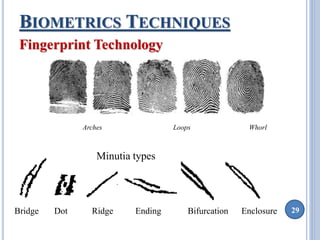
Fingerprint Technology 
Arches Loops Whorl 
Minutia types 
Bridge Dot Ridge Ending Bifurcation Enclosure
30 
BIOMETRICS TECHNIQUES 
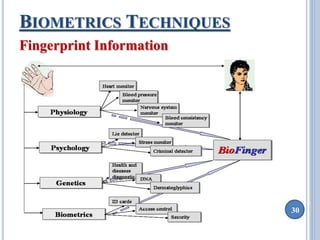
Fingerprint Information
31 
BIOMETRICS TECHNIQUES 
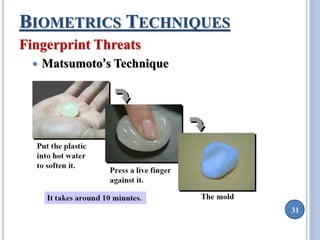
Fingerprint Threats 
 Matsumoto’s Technique
32 
BIOMETRICS TECHNIQUES 
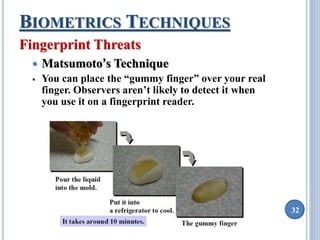
Fingerprint Threats 
 Matsumoto’s Technique 
 You can place the “gummy finger” over your real 
finger. Observers aren’t likely to detect it when 
you use it on a fingerprint reader.

Biometrics techniques

  • 1.
    BIOMETRICS TECHNIQUES PresentedTo:Dr.Ayman Taha Presented By:Noha Hesham & Moataz Mahmoud
  • 2.
    2 OUTLINE Introduction  User Authentication Approaches  What is Biometrics  Biometrics techniques  Requirements for an ideal biometric  Different Types of biometrics techniques  Different biometrics techniques concept  Biometric techniques factors of evaluation  Comparison of biometric techniques  Biometrics Identification & Verification  Biometrics System Stages  Fingerprint Technology  Fingerprint Threats
  • 3.
    3 INTRODUCTION UserAuthentication Approaches Use Something that you have Use Something that you Know Automated measurement of Physiological Ex. Credit Card, Keys Ex. Password, PIN Can be Forgotten and/or behavioral characteristics to Determine or authenticate identity Can Be lost
  • 4.
    4 INTRODUCTION “WHATIS BIOMETRICS” Automated measurement of Physiological and/or behavioral characteristics to Determine or authenticate identity  Automated measurement  No human involvement.  Comparison takes place in Real-Time  Physiological and/or behavioral characteristics  Behavioral as User speaks, typing on keyboard, name signature.  Physiological as Fingerprint, Hand, Eyes, Face  Determine or authenticate identity Identification Systems Verification Systems 1. Who am I? 2. Determine Identity 1. Am I who I claim to be? 2. Authenticate Identity
  • 5.
    5 BIOMETRICS TECHNIQUES Requirements for an ideal biometric  Universality Each person should have the characteristic  Uniqueness No two persons should have same characteristic  Permanence  The characteristic should not change  Performance Accuracy, speed, robustness, resource requirements  Acceptability Extend to people willing to accept a characteristic  Faked protection  How easy is to fool the system by fraudulent methods
  • 6.
    6 BIOMETRICS TECHNIQUES Different Type of biometrics techniques  Identification and verification:  Fingerprint scan  Face recognition ( Facial scan )  Retina scan  Iris scan  Verification only:  Hand Geometry  Keystroke Dynamics  Mouse Dynamics  Gait Dynamics ( how people walk )  Voice Print  Signature
  • 7.
    7 BIOMETRICS TECHNIQUES Different biometrics techniques concept 1. Fingerprint scan: Measures unique characteristics in a fingerprint (minutiae)  Crossover  Core  Bifurcations  Ridge ending  Island  Delta  Pore
  • 8.
    8 BIOMETRICS TECHNIQUES Different biometrics techniques concept 2. Facial scan: Uses off-the-shelf camera to measure the following facial features:  Distance between the eyes.  Distance between the eyes and nose ridge.  Angle of a cheek.  Slope of the nose.  Facial Temperatures.
  • 9.
    9 BIOMETRICS TECHNIQUES Different biometrics techniques concept 3. Retina scan: Measures unique characteristics of the retina :  Blood vessel patterns  Vein patterns
  • 10.
    10 BIOMETRICS TECHNIQUES Different biometrics techniques concept 4. Iris scan: Measures unique characteristics of the iris :  Ridges (rings)  Furrows  Striations (freckles)
  • 11.
    11 BIOMETRICS TECHNIQUES Different biometrics techniques concept 5. Hand Geometry scan: Measures the top and side of the hand, not the Palm  Hand Geometry.  Most widely used technique for physical access.  INSPASS System
  • 12.
    12 BIOMETRICS TECHNIQUES Different biometrics techniques concept 6. Keystroke Dynamics: Measures the time between strokes and duration of key pressed.  Used in systems with keyboards.
  • 13.
    13 BIOMETRICS TECHNIQUES Different biometrics techniques concept 7. Mouse Dynamics: Researched and identified mouse movement categories and features. • Mouse Movement Categories • Mouse Trajectory ( Path )  System wake up  Move and click  Highlight  Drag and drop • Mouse Click • Mouse wheel spin or scroll • Mouse activity time
  • 14.
    14 BIOMETRICS TECHNIQUES Different biometrics techniques concept 8. Gait Dynamics: Recognize persons with the use of a standard cameras in any conditions.  Particularly studied it may enable identification at distance
  • 15.
    15 BIOMETRICS TECHNIQUES Different biometrics techniques concept 9. Voice Print: Measures the sound waves of human speech.  user talks to a microphone a passphrase.  Voice print is compared to a previous one
  • 16.
    16 BIOMETRICS TECHNIQUES Different biometrics techniques concept 10. Signature verification: Measures speed, pressure, stroke order an image of signature.  Non-repudiation.  The movement of the pen during the signing process rather than the static image of the signature.  Detect pen pressure, the sound the pen makes, Speed …etc
  • 17.
    17 BIOMETRICS TECHNIQUES Different biometrics techniques concept 11. Palm vain recognition: Measures the structure of the blood veins in a palm hand.  Near-infrared light detect an iron-containing pigment in hemoglobin.  Pigments absorb the near-infrared light and reduce the reflection rate causing the veins to appear as a black pattern
  • 18.
    18 BIOMETRICS TECHNIQUES Biometric techniques factors of evaluation  False Acceptance Rate (FAR)  The system incorrectly declares Acceptance  False Rejection Rate (FRR)  The system incorrectly declares failure  Failure To Enroll Rate (FTE)  The percentage of data input that fails to input to the system  Ability To Verify (AVT)  AVT = (1 - FTE)(1 - FRR)
  • 19.
    19 BIOMETRICS TECHNIQUES Relation Between FAR & FRR
  • 20.
    20 BIOMETRICS TECHNIQUES Comparison of biometric techniques Market Share
  • 21.
    21 BIOMETRICS TECHNIQUES Comparison of biometric techniques Characteristics
  • 22.
    22 BIOMETRICS TECHNIQUES Comparison of biometric techniques Requirements
  • 23.
    23 BIOMETRICS TECHNIQUES Comparison of biometric techniques
  • 24.
    24 BIOMETRICS TECHNIQUES Comparison of biometric techniques Technique Strengths Weaknesses Fingerprint Mature technology Highly accurate Low cost, Small size, becoming widely Users can create high FRR Some persons dislike contact with device Face Widely acceptable to users, low cost No direct contact Passive monitoring possible Less accurate than other methods Retina Highly accurate Inconvenient for persons with glasses Dislike contact with device and light beam Iris Highly accurate Works with glasses Acceptable to users than retina New technology Cost, although but is changing Hand Accurate and flexible Widely acceptable to users User interface is bulky Dislike contact with device Voice Usable over telephone system Good for remote access Less accuracy Subject to background noise Signature Widely acceptable to users Less accuracy Not widely used yet but has potential with PDAs
  • 25.
    25 BIOMETRICS TECHNIQUES Biometrics Identification & Verification
  • 26.
    26 BIOMETRICS TECHNIQUES Biometrics Identification & Verification Verification, or 1-to-1:  Matches a person's claimed identity to his/her biometric and one or more other security technologies (password, PIN, Token).  Identification, or 1-to-Many:  Identifies a person from the entire enrolled population.
  • 27.
    27 BIOMETRICS TECHNIQUES Biometrics System Stages
  • 28.
    28 BIOMETRICS TECHNIQUES Fingerprint Technology Light reflects from the surface of the prism where the finger is not in contact with it, while it penetrates the surface of the prism where the finger touches the surface of the prism. The resulting image goes through a lens into a video camera or sensor. Light source Finger Prism Lens Video Camera (CCD)
  • 29.
    29 BIOMETRICS TECHNIQUES Fingerprint Technology Arches Loops Whorl Minutia types Bridge Dot Ridge Ending Bifurcation Enclosure
  • 30.
    30 BIOMETRICS TECHNIQUES Fingerprint Information
  • 31.
    31 BIOMETRICS TECHNIQUES Fingerprint Threats  Matsumoto’s Technique
  • 32.
    32 BIOMETRICS TECHNIQUES Fingerprint Threats  Matsumoto’s Technique  You can place the “gummy finger” over your real finger. Observers aren’t likely to detect it when you use it on a fingerprint reader.