By
Imran Hossain Faruk
   Ear features have been used for many years
    in the forensic science of recognition
   Ear is a stable biometric and does not very
    with age.
   Ear has all the properties that a biometric
    trait should have, i.e. uniqueness,
    universality, permanence and collectability


                 Imran Hossain Faruk   01/28/13   2
   Ear does not have a completely random
    structure. It has standard parts as other
    biometric traits like face
   Unlike human face, ear has no expression
    changes, make-up effects and more over the
    color is constant through out the ear.


                 Imran Hossain Faruk   01/28/13   3
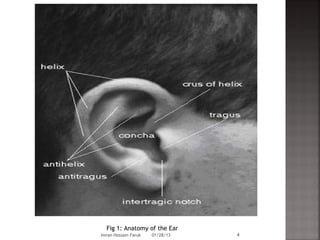
Fig 1: Anatomy of the Ear
Imran Hossain Faruk   01/28/13   4
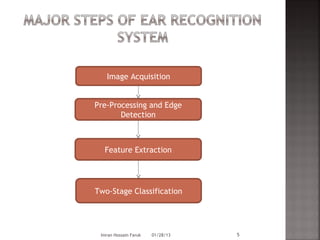
Image Acquisition


Pre-Processing and Edge
       Detection


  Feature Extraction


Two-Stage Classification


 Imran Hossain Faruk   01/28/13   5
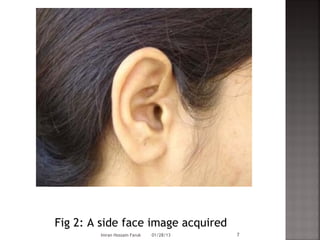
   The side face images have been acquired in
    the same lightening conditions.
   All Images taken from with a distance of 15-
    20 cms between the ear and camera
   The image should be carefully taken such
    that outer ear shape is preserved.
   The less erroneous the outer shape is the
    more accurate the results are.


                 Imran Hossain Faruk   01/28/13   6
Fig 2: A side face image acquired
        Imran Hossain Faruk   01/28/13   7
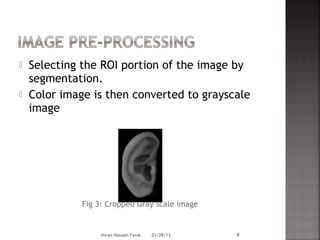
   Selecting the ROI portion of the image by
    segmentation.
   Color image is then converted to grayscale
    image


              Fig 3: Cropped Gray scale image


                   Imran Hossain Faruk   01/28/13   8
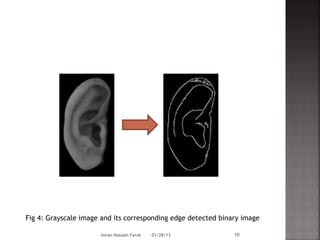
   Edge detection and binarization is done using
    the well known canny edge detector.
   If w is the width of the image in pixel and h
    is the height of the image in pixel, the canny
    edge detector takes as input an array w Ă— h
    of gray values and sigma (standard deviation)
   Output a binary image with a value 1 for
    edge pixels, i.e., the pixel which constitute
    an edge and a value 0 for all other pixels.


                  Imran Hossain Faruk   01/28/13   9
Fig 4: Grayscale image and its corresponding edge detected binary image

                      Imran Hossain Faruk   01/28/13           10
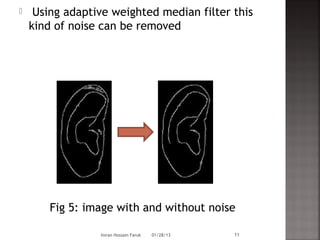
    Using adaptive weighted median filter this
    kind of noise can be removed


        Fig 5: image with and without noise

                 Imran Hossain Faruk   01/28/13   11
   Here features extracted all are angles
   Features are divided into two vectors
   First features is found using the outer shape
    of the ear.
   Second feature vector is found using all other
    edges
   To find the angels, the terms max-line and
    normal line are used


                  Imran Hossain Faruk   01/28/13   12
   Max-line: it is the longest line that can be
    drawn with both its endpoints on the edges
    of the ear.
   The length of a line is measured in terms of
    Euclidean distance
   If there are more than one line, features
    corresponding to each max-line are to be
    extracted


                 Imran Hossain Faruk   01/28/13   13
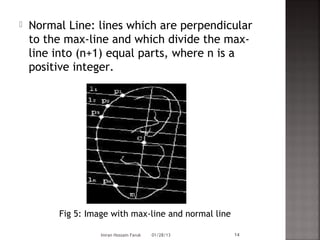
   Normal Line: lines which are perpendicular
    to the max-line and which divide the max-
    line into (n+1) equal parts, where n is a
    positive integer.


         Fig 5: Image with max-line and normal line

                   Imran Hossain Faruk   01/28/13     14
   The max-line m, normal line l1,l2,l3,…..,ln
    named from top to bottom.
   Center of the max-line is c.
   P1,P2,P3,……,Pn are the points where the
    outer edge and the normal lines intersect.


                  Imran Hossain Faruk   01/28/13   15
   First feature vector(FV1): it can be defined
    by.
          FV1 = [θ1, θ2, θ3,…., θn]


               Fig 6: image showing the angel θ1

                  Imran Hossain Faruk   01/28/13   16
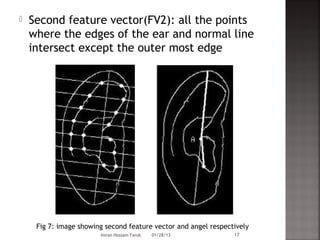
   Second feature vector(FV2): all the points
    where the edges of the ear and normal line
    intersect except the outer most edge


     Fig 7: image showing second feature vector and angel respectively
                        Imran Hossain Faruk   01/28/13           17
   Classification is the task of finding a match
    for a given query image.
   Here classification is performed in two
    stages.
   In first stage the first feature vector is used
    while in second stage second feature vector
    is used.


                  Imran Hossain Faruk   01/28/13   18
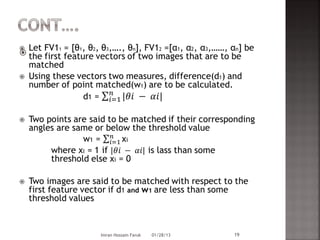
Imran Hossain Faruk   01/28/13   19
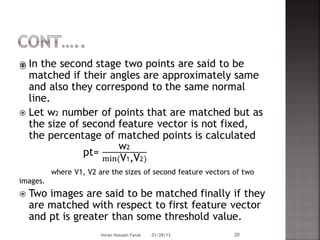
Imran Hossain Faruk   01/28/13   20
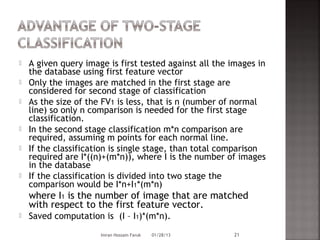
   A given query image is first tested against all the images in
    the database using first feature vector
   Only the images are matched in the first stage are
    considered for second stage of classification
   As the size of the FV1 is less, that is n (number of normal
    line) so only n comparison is needed for the first stage
    classification.
   In the second stage classification m*n comparison are
    required, assuming m points for each normal line.
   If the classification is single stage, than total comparison
    required are I*((n)+(m*n)), where I is the number of images
    in the database
   If the classification is divided into two stage the
    comparison would be I*n+I1*(m*n)
    where I1 is the number of image that are matched
    with respect to the first feature vector.
   Saved computation is (I – I1)*(m*n).
                      Imran Hossain Faruk   01/28/13    21
   Ear recognition can used for both
    identification and verification purpose.
   Since some portion of ear is kept covert by
    hair so it is very difficult to get the complete
    image of ear.
   Since its uniqueness is moderate we can not
    rely on it completely.


                  Imran Hossain Faruk   01/28/13   22
   Ping Yan, Kevin W. Bowyer, “Empirical
    Evaluation of Advanced Ear Biometrics”, IEEE
    Computer Society Conference on Computer
    Vision and Pattern Recognition , 2005
   Michal choaras, “Ear biometric based on
    geometric al feature extraction”, Electronic
    letters on computer vision and image
    analysis(Journal ELCVIA), 585-95,2005.


                 Imran Hossain Faruk   01/28/13   23

Ear recognition system

  • 1.
  • 2.
     Ear features have been used for many years in the forensic science of recognition  Ear is a stable biometric and does not very with age.  Ear has all the properties that a biometric trait should have, i.e. uniqueness, universality, permanence and collectability Imran Hossain Faruk 01/28/13 2
  • 3.
     Ear does not have a completely random structure. It has standard parts as other biometric traits like face  Unlike human face, ear has no expression changes, make-up effects and more over the color is constant through out the ear. Imran Hossain Faruk 01/28/13 3
  • 4.
    Fig 1: Anatomyof the Ear Imran Hossain Faruk 01/28/13 4
  • 5.
    Image Acquisition Pre-Processing andEdge Detection Feature Extraction Two-Stage Classification Imran Hossain Faruk 01/28/13 5
  • 6.
     The side face images have been acquired in the same lightening conditions.  All Images taken from with a distance of 15- 20 cms between the ear and camera  The image should be carefully taken such that outer ear shape is preserved.  The less erroneous the outer shape is the more accurate the results are. Imran Hossain Faruk 01/28/13 6
  • 7.
    Fig 2: Aside face image acquired Imran Hossain Faruk 01/28/13 7
  • 8.
     Selecting the ROI portion of the image by segmentation.  Color image is then converted to grayscale image Fig 3: Cropped Gray scale image Imran Hossain Faruk 01/28/13 8
  • 9.
     Edge detection and binarization is done using the well known canny edge detector.  If w is the width of the image in pixel and h is the height of the image in pixel, the canny edge detector takes as input an array w × h of gray values and sigma (standard deviation)  Output a binary image with a value 1 for edge pixels, i.e., the pixel which constitute an edge and a value 0 for all other pixels. Imran Hossain Faruk 01/28/13 9
  • 10.
    Fig 4: Grayscaleimage and its corresponding edge detected binary image Imran Hossain Faruk 01/28/13 10
  • 11.
     Using adaptive weighted median filter this kind of noise can be removed Fig 5: image with and without noise Imran Hossain Faruk 01/28/13 11
  • 12.
     Here features extracted all are angles  Features are divided into two vectors  First features is found using the outer shape of the ear.  Second feature vector is found using all other edges  To find the angels, the terms max-line and normal line are used Imran Hossain Faruk 01/28/13 12
  • 13.
     Max-line: it is the longest line that can be drawn with both its endpoints on the edges of the ear.  The length of a line is measured in terms of Euclidean distance  If there are more than one line, features corresponding to each max-line are to be extracted Imran Hossain Faruk 01/28/13 13
  • 14.
     Normal Line: lines which are perpendicular to the max-line and which divide the max- line into (n+1) equal parts, where n is a positive integer. Fig 5: Image with max-line and normal line Imran Hossain Faruk 01/28/13 14
  • 15.
     The max-line m, normal line l1,l2,l3,…..,ln named from top to bottom.  Center of the max-line is c.  P1,P2,P3,……,Pn are the points where the outer edge and the normal lines intersect. Imran Hossain Faruk 01/28/13 15
  • 16.
     First feature vector(FV1): it can be defined by. FV1 = [θ1, θ2, θ3,…., θn] Fig 6: image showing the angel θ1 Imran Hossain Faruk 01/28/13 16
  • 17.
     Second feature vector(FV2): all the points where the edges of the ear and normal line intersect except the outer most edge Fig 7: image showing second feature vector and angel respectively Imran Hossain Faruk 01/28/13 17
  • 18.
     Classification is the task of finding a match for a given query image.  Here classification is performed in two stages.  In first stage the first feature vector is used while in second stage second feature vector is used. Imran Hossain Faruk 01/28/13 18
  • 19.
    Imran Hossain Faruk 01/28/13 19
  • 20.
    Imran Hossain Faruk 01/28/13 20
  • 21.
     A given query image is first tested against all the images in the database using first feature vector  Only the images are matched in the first stage are considered for second stage of classification  As the size of the FV1 is less, that is n (number of normal line) so only n comparison is needed for the first stage classification.  In the second stage classification m*n comparison are required, assuming m points for each normal line.  If the classification is single stage, than total comparison required are I*((n)+(m*n)), where I is the number of images in the database  If the classification is divided into two stage the comparison would be I*n+I1*(m*n) where I1 is the number of image that are matched with respect to the first feature vector.  Saved computation is (I – I1)*(m*n). Imran Hossain Faruk 01/28/13 21
  • 22.
     Ear recognition can used for both identification and verification purpose.  Since some portion of ear is kept covert by hair so it is very difficult to get the complete image of ear.  Since its uniqueness is moderate we can not rely on it completely. Imran Hossain Faruk 01/28/13 22
  • 23.
     Ping Yan, Kevin W. Bowyer, “Empirical Evaluation of Advanced Ear Biometrics”, IEEE Computer Society Conference on Computer Vision and Pattern Recognition , 2005  Michal choaras, “Ear biometric based on geometric al feature extraction”, Electronic letters on computer vision and image analysis(Journal ELCVIA), 585-95,2005. Imran Hossain Faruk 01/28/13 23

Editor's Notes