The ASEAN Semiconductor Ascent: From Assembly Lines to Advanced Innovation
Southeast Asia's (SEA) semiconductor industry is currently undergoing a seismic shift,
transforming from a collection of low-cost assembly sites into a strategic, high-stakes hub for
global electronics manufacturing. As of late 2025, the region is accelerating its competitive
capabilities, leveraging a "China Plus One" diversification strategy and significant foreign direct
investment (FDI) to rapidly climb the value chain.
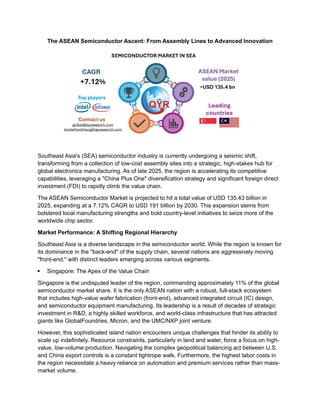
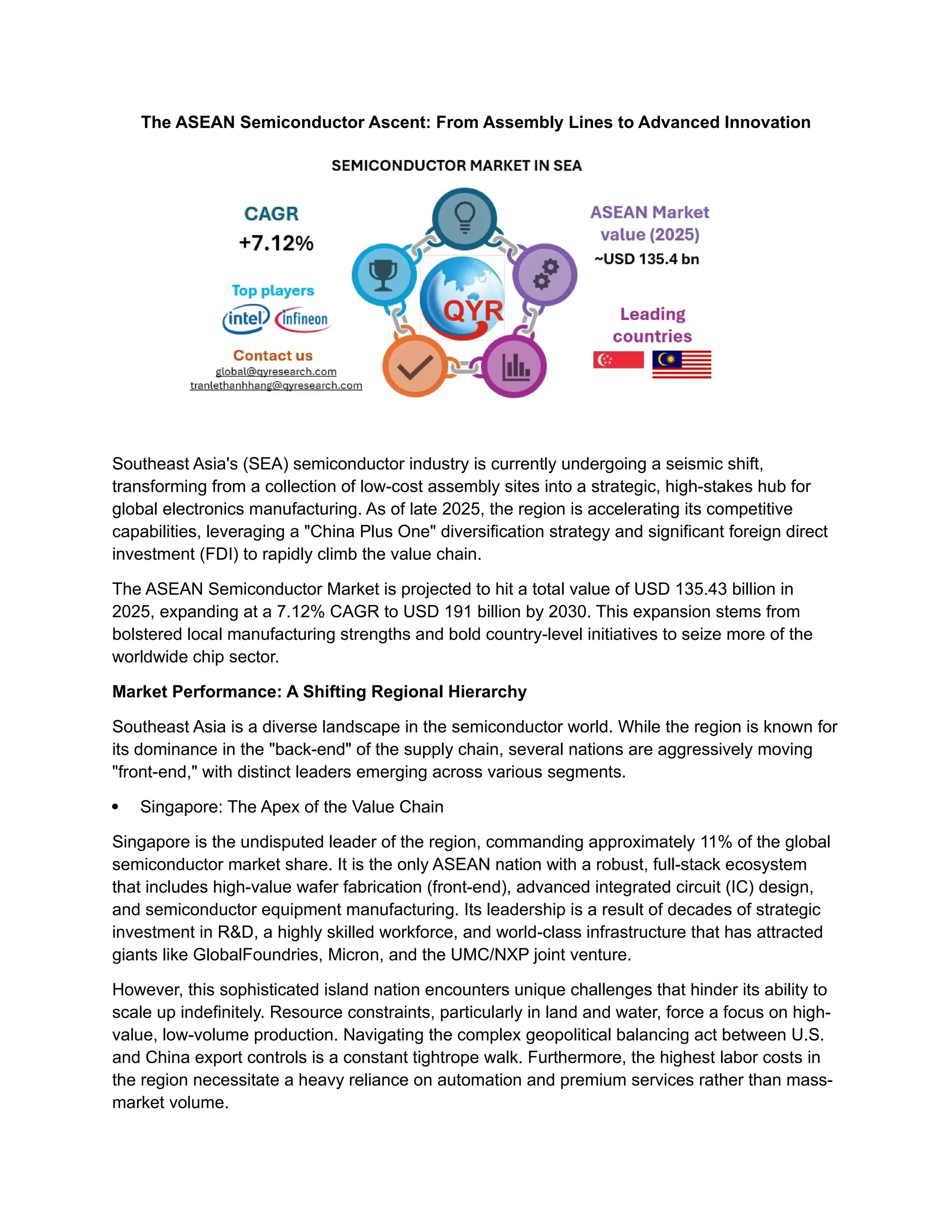
The ASEAN Semiconductor Market is projected to hit a total value of USD 135.43 billion in
2025, expanding at a 7.12% CAGR to USD 191 billion by 2030. This expansion stems from
bolstered local manufacturing strengths and bold country-level initiatives to seize more of the
worldwide chip sector.
Market Performance: A Shifting Regional Hierarchy
Southeast Asia is a diverse landscape in the semiconductor world. While the region is known for
its dominance in the "back-end" of the supply chain, several nations are aggressively moving
"front-end," with distinct leaders emerging across various segments.
 Singapore: The Apex of the Value Chain
Singapore is the undisputed leader of the region, commanding approximately 11% of the global
semiconductor market share. It is the only ASEAN nation with a robust, full-stack ecosystem
that includes high-value wafer fabrication (front-end), advanced integrated circuit (IC) design,
and semiconductor equipment manufacturing. Its leadership is a result of decades of strategic
investment in R&D, a highly skilled workforce, and world-class infrastructure that has attracted
giants like GlobalFoundries, Micron, and the UMC/NXP joint venture.
However, this sophisticated island nation encounters unique challenges that hinder its ability to
scale up indefinitely. Resource constraints, particularly in land and water, force a focus on high-
value, low-volume production. Navigating the complex geopolitical balancing act between U.S.
and China export controls is a constant tightrope walk. Furthermore, the highest labor costs in
the region necessitate a heavy reliance on automation and premium services rather than mass-
market volume.
 Malaysia: The Assembly Powerhouse
Malaysia is another significant semiconductor hub in the region, a powerhouse contributing
approximately 13% of global back-end services. With robust infrastructure and a long history of
assembly, testing, and packaging (ATP) capabilities, the country is a global leader in power
electronics (Infineon) and 3D advanced packaging (Intel).
Malaysia not only has excellent fabrication capabilities but also leverages advantages in raw
materials, specifically vast silica reserves which are a critical input for silicon wafers. The nation
is strategically transitioning its ATP expertise toward the advanced packaging required for AI and
automotive applications, moving away from legacy assembly work. The government's National
Semiconductor Strategy (NSS) is supercharging this transition with substantial financial backing.
 Vietnam: The Rising Star
Vietnam’s semiconductor industry is emerging. By the end of 2024, the value of Vietnam's
semiconductor industry is expected to exceed USD 6.16 billion, positioning the country as a key
manufacturing hub for many global semiconductor companies. Traditionally a low-cost assembly
location for electronics, Vietnam is rapidly transforming its ambition. It no longer wants to focus
solely on ATP; it is strategically moving up the value chain toward integrated circuit design and
potentially even small-scale front-end fabrication.
The nation's significant advantage in possessing the world's second-largest rare earth reserves
makes it an incredibly attractive destination for foreign investors seeking stable access to critical
minerals essential for high-tech components. This raw material advantage, combined with a
young, digitally native population, positions Vietnam as a crucial hub for global supply chains.
The Accelerators: Thailand, Philippines, and Indonesia
 Thailand is a vital hub primarily for automotive electronics and assembly, aiming to attract
USD 14.5 billion in new investment by 2029, focusing heavily on advanced packaging and
power electronics driven by its strong EV industry.
 The Philippines remains a cornerstone of global ATP, accounting for roughly 10% of the
world's ATP market. It excels in memory and sensors, leveraging strong historical ties with
U.S. tech giants and focusing heavily on talent development initiatives to move into high-
value IC design.
 Indonesia is developing its unique niche. With abundant silica sand reserves, it is focusing
heavily on downstream processing of raw materials. It has attracted significant investments
from Infineon (backend fab) and Nvidia (AI data centers), linking its semiconductor strategy
directly to its National Energy Resilience Initiative.
2. Government Strategy: Coordinated National Roadmaps
Every major ASEAN player has implemented clear, aggressive national plans to secure their
place in the global supply chain, often coordinated through national economic boards and
investment agencies:
 Singapore: Implements the National AI Strategy 2.0 and robust talent development
programs, focusing on R&D grants and infrastructure for AI-accelerator design.
 Malaysia: The government’s National Semiconductor Strategy (NSS), launched in mid-
2024, provides RM25 billion (5.3 billion USD) in funding to foster local vendors and attract
front-end fabrication capabilities.
 Vietnam employs the "C = SET + 1" formula (Chip = Specialized, Electronics, Talent +
Diversification) to drive its semiconductor ambitions. The government aims to train 50,000
engineers by 2030, a highly ambitious target supported by national programs. It also
provides substantial tax incentives and perks to draw in semiconductor companies, featuring
new regulations starting in 2025 as per the Corporate Income Tax Law. For instance, fresh
investments in this sector access top-tier benefits like a reduced 10% corporate income tax
rate over 15 years. Standard projects enjoy complete tax exemption for the first 4 profitable
years, then a 50% cut for the subsequent 9 years, while mega-projects (over 6,000 billion
VND in capital) get even better terms, such as a 5% rate for up to 37 years with extended
exemptions and reductions.
 Thailand: The National Semiconductor Strategy provides significant incentives and aims
to train 1,200 specialized personnel annually to address the skill gap.
 Philippines: Has established a Semiconductor and Electronics Advisory Council and
implemented the CREATE MORE Act tax incentives to streamline the transition to high-
value R&D and IC design.
 Indonesia: The National Semiconductor Roadmap aims to localize production facilities
and leverage U.S. CHIPS Act partnerships for workforce acceleration programs, focusing on
integrating with the EV supply chain.
3. Latest Trends and Technological Development
As of late 2025, the key technological trend across Southeast Asia is the rapid adoption
of Advanced Packaging technologies. Nations like Malaysia and Singapore are moving
beyond traditional wire bonding to sophisticated 3D stacking and chiplet integration, essential
for next-generation AI and high-performance computing chips.
 AI Integration is pervasive. Nvidia’s partnerships across Vietnam, Singapore, and
Indonesia highlight the region’s role in developing data centers and localized AI innovation
hubs.
 Power Electronics is another major focus area, with companies like Infineon leveraging
Malaysian and Indonesian fabs to produce Silicon Carbide (SiC) and Gallium Nitride (GaN)
power chips crucial for electric vehicles and industrial efficiency.
4. Outlook: Navigating Challenges and Seizing Opportunities
The trajectory for the Southeast Asian semiconductor industry is overwhelmingly positive,
positioning the region to capture significant global growth. However, the primary challenges
remain clear:
 Talent Gap: A persistent shortage of highly skilled engineers is the single biggest bottleneck
across all ASEAN nations.
 Infrastructure: While improving, concerns about power stability and logistics in emerging
hubs like Vietnam and Indonesia are deterrents for energy-intensive fabrication facilities.
 Foreign Dependency: The sector remains heavily reliant on FDI, with most high-value
assets owned by foreign entities rather than local players.
Despite these hurdles, the industry possesses bright prospects. The undeniable shift in global
supply chains offers an unprecedented influx of capital and technology transfer. The abundance
of crucial raw materials (rare earths in Vietnam, silica in Indonesia) provides a strategic
advantage in an era of resource nationalism. With coordinated government strategies and a
young, eager workforce, the Southeast Asian semiconductor industry is poised not just to
survive, but to thrive and accelerate its role in the global digital economy.
Semiconductors By Type
 Integrated Circuits (ICs): Logic, memory chips (DRAM, NAND); e.g., 28nm nodes for
consumer electronics, automotive ECUs.
 Discrete Semiconductors: Diodes, transistors, MOSFETs; e.g., power diodes for EVs, SiC
MOSFETs for renewables.
 Optoelectronics: LEDs, sensors, lasers; e.g., VCSELs for LiDAR, image sensors for
smartphones.
 Analog/Mixed-Signal: Amplifiers, converters (ADC/DAC); e.g., PMICs for mobile devices,
audio codecs.
Semiconductors by Product Category
 Wafer/Fab Products: Silicon wafers, processed dies; focus on assembly/testing.
 Packaged Chips: QFN, BGA, SiP; consumer, industrial packaging.
 Modules/Systems: Power modules, sensor modules; EV inverters, IoT boards.
 MEMS/Sensors: Accelerometers, pressure sensors; automotive, wearables.
Semiconductors by Market Segment
 Consumer Electronics: ICs for smartphones, TVs.
 Automotive/EV: chips for ADAS, battery management.
 Industrial/Infra: sensors for smart factories, 5G base stations.
 Data Centers/AI: high-bandwidth memory for servers.
Semiconductors by Features
 Advanced Nodes: 7nm/5nm FinFET for AI, high-performance computing.
 Wide Bandgap: SiC/GaN for efficient power conversion, EVs.
 Low-Power: Sub-1V IoT chips for edge devices, battery life.
 Secure/Embedded: Chips with TPM, AI accelerators for cybersecurity.
Semiconductors by Application
 Mobile/Computing: SoCs, DRAM for phones, laptops.
 Automotive/EV: MCUs, power semis for drivetrains, infotainment.
 Renewables/5G: GaN amplifiers, solar inverters.
 Industrial/IoT: Sensors, MCUs for automation, smart grids.
Top 20 Key Companies Producing and Exporting Semiconductors in Southeast Asia
 Intel (Malaysia/Vietnam)
 Infineon (Malaysia)
 NXP Semiconductors (Malaysia)
 STMicroelectronics (Singapore/Malaysia)
 ON Semiconductor (Malaysia)
 Micron (Singapore)
 GlobalFoundries (Singapore)
 UMC (Singapore ops)
 Powerchip (Malaysia)
 X-Fab (Malaysia)
 UTAC (Singapore)
 Unisem (Malaysia)
 Amkor (Vietnam)
 SPIL (Singapore)
 Hana Microelectronics (Thailand)
 PSMC (Malaysia partners)
 Tower Semiconductor (Singapore)
 JCET (Vietnam)
 Chipbond (Malaysia)
 ASE (Singapore/Thailand)
Product Models
Semiconductors are categorized by node, type, and packaging, primarily ICs, discretes, and
sensors, used in consumer electronics (50%), automotive, and industrial applications.
 Integrated Circuits (ICs): Fabbed wafers diced into chips. Notable products include:
o 28nm Logic IC – Intel: High-volume; premium segment, for PCs/smartphones.
o DRAM LPDDR5 – Micron: Mobile grade; high segment, data centers.
o MCU ARM Cortex – NXP: Automotive; mid segment, ECUs.
o PMIC buck converter – Infineon: Power management; high segment, mobiles.
o RF SoC – MediaTek partners: 5G; low-mid segment, base stations.
 Discrete Semiconductors: Individual power devices. Notable products include:
o SiC MOSFET 1200V – ON Semi Malaysia: EV grade; high segment, inverters.
o IGBT module – STMicro Malaysia: Industrial; mid segment, motors.
o Schottky diode – Vishay partners (Vietnam): Fast switching; mid segment, chargers.
o Superjunction MOSFET – Powerchip Malaysia: Efficiency; high segment, PSUs.
o TVS diode array – UTAC Singapore: Protection; low segment, IoT.
 Optoelectronics/Sensors: Light-emitting and detecting chips. Notable products include:
o CMOS Image Sensor – Sony partners (Malaysia): 48MP; high segment, cameras.
o VCSEL laser – Broadcom Singapore: LiDAR; high segment, AR/VR.
o MEMS accelerometer – Bosch Malaysia: 6-axis; mid segment, wearables.
o Ambient light sensor – Everlight Thailand: Low-power; low segment, displays.
 Analog/Mixed-Signal & Specialty: Precision and embedded chips. Notable products include:
o ADC 24-bit – Analog Devices Singapore: Audio; high segment, pro gear.
o GaN HEMT – Qorvo Malaysia: RF power; high segment, 5G.
o Secure Element – NXP Malaysia: Crypto chip; premium segment, payments.
o AI Edge TPU – Partners Vietnam: Inference; mid-high segment, IoT.
About QY Research
QY Research has established close partnerships with over 71,000 global leading players. With
more than 20,000 industry experts worldwide, we maintain a strong global network to efficiently
gather insights and raw data. Our 36-step verification system ensures the reliability and quality
of our data. With over 2 million reports, we have become the world's largest market report
vendor. Our global database spans more than 2,000 sources and covers data from most
countries, including import and export details. We have partners in over 160 countries, providing
comprehensive coverage of both sales and research networks. A 90% client return rate and
long-term cooperation with key partners demonstrate the high level of service and quality QY
Research delivery. More than 30 IPOs and over 5,000 global media outlets and major
corporations have used our data, solidifying QY Research as a global leader in data supply. We
are committed to delivering services that exceed both client and societal expectations.
Contact Information:
Tel: +1 626 2952 442 (US); +86-1082945717 (China); +84-865216594 (Vietnam)
Email: global@qyresearch.com; tranlethanhhang@qyresearch.com
Website: www.qyresearch.com
Related Report Recommendations:
Global Semiconductor Market Insights, Forecast 2024-2030
https://www.qyresearch.com/reports/3555060/semiconductor
Global EV Semiconductor Market Research Report 2025
https://www.qyresearch.com/reports/5538939/ev-semiconductor
Global EV Semiconductor Sales Market Report, Competitive Analysis and Regional
Opportunities 2025-2031
https://www.qyresearch.com/reports/5538933/ev-semiconductor
EV Semiconductor - Global Market Share and Ranking, Overall Sales and Demand
Forecast 2025-2031
https://www.qyresearch.com/reports/5538915/ev-semiconductor
Global EV Semiconductor Market Outlook, In-Depth Analysis & Forecast to 2031
https://www.qyresearch.com/reports/5538913/ev-semiconductor
Global Integrated Circuits (ICs) Market Outlook, In-Depth Analysis & Forecast to 2031
https://www.qyresearch.com/reports/5291314/integrated-circuits--ics
Integrated Circuits (ICs) - Global Market Share and Ranking, Overall Sales and Demand
Forecast 2025-2031
https://www.qyresearch.com/reports/5291313/integrated-circuits--ics
Global Integrated Circuits (ICs) Sales Market Report, Competitive Analysis and Regional
Opportunities 2025-2031
https://www.qyresearch.com/reports/4077559/integrated-circuits--ics
Global Integrated Circuits (ICs) Market Research Report 2025
https://www.qyresearch.com/reports/4070324/integrated-circuits--ics
Global Integrated Circuit Design Market Outlook, In-Depth Analysis & Forecast to 2031
https://www.qyresearch.com/reports/5222107/integrated-circuit-design
Global Discrete Semiconductors Market Outlook, In-Depth Analysis & Forecast to 2031
https://www.qyresearch.com/reports/5256073/discrete-semiconductors
Discrete Semiconductors - Global Market Share and Ranking, Overall Sales and Demand
Forecast 2025-2031
https://www.qyresearch.com/reports/4714149/discrete-semiconductors
Global Discrete Semiconductors Market Insights, Forecast to 2031
https://www.qyresearch.com/reports/4714147/discrete-semiconductors
Global Discrete Semiconductors Sales Market Report, Competitive Analysis and Regional
Opportunities 2025-2031
https://www.qyresearch.com/reports/4072567/discrete-semiconductors
Global Discrete Semiconductors Market Research Report 2025
https://www.qyresearch.com/reports/4065482/discrete-semiconductors
Discrete Semiconductors- Global Market Share and Ranking, Overall Sales and Demand
Forecast 2025-2031
https://www.qyresearch.com/reports/4080063/discrete-semiconductors
Global Power Discrete Semiconductor Market Outlook, In-Depth Analysis & Forecast to
2031
https://www.qyresearch.com/reports/5256499/power-discrete-semiconductor

Semiconductor industry in Southeast Asia.docx

  • 1.
    The ASEAN SemiconductorAscent: From Assembly Lines to Advanced Innovation Southeast Asia's (SEA) semiconductor industry is currently undergoing a seismic shift, transforming from a collection of low-cost assembly sites into a strategic, high-stakes hub for global electronics manufacturing. As of late 2025, the region is accelerating its competitive capabilities, leveraging a "China Plus One" diversification strategy and significant foreign direct investment (FDI) to rapidly climb the value chain. The ASEAN Semiconductor Market is projected to hit a total value of USD 135.43 billion in 2025, expanding at a 7.12% CAGR to USD 191 billion by 2030. This expansion stems from bolstered local manufacturing strengths and bold country-level initiatives to seize more of the worldwide chip sector. Market Performance: A Shifting Regional Hierarchy Southeast Asia is a diverse landscape in the semiconductor world. While the region is known for its dominance in the "back-end" of the supply chain, several nations are aggressively moving "front-end," with distinct leaders emerging across various segments.  Singapore: The Apex of the Value Chain Singapore is the undisputed leader of the region, commanding approximately 11% of the global semiconductor market share. It is the only ASEAN nation with a robust, full-stack ecosystem that includes high-value wafer fabrication (front-end), advanced integrated circuit (IC) design, and semiconductor equipment manufacturing. Its leadership is a result of decades of strategic investment in R&D, a highly skilled workforce, and world-class infrastructure that has attracted giants like GlobalFoundries, Micron, and the UMC/NXP joint venture. However, this sophisticated island nation encounters unique challenges that hinder its ability to scale up indefinitely. Resource constraints, particularly in land and water, force a focus on high- value, low-volume production. Navigating the complex geopolitical balancing act between U.S. and China export controls is a constant tightrope walk. Furthermore, the highest labor costs in the region necessitate a heavy reliance on automation and premium services rather than mass- market volume.
  • 2.
     Malaysia: TheAssembly Powerhouse Malaysia is another significant semiconductor hub in the region, a powerhouse contributing approximately 13% of global back-end services. With robust infrastructure and a long history of assembly, testing, and packaging (ATP) capabilities, the country is a global leader in power electronics (Infineon) and 3D advanced packaging (Intel). Malaysia not only has excellent fabrication capabilities but also leverages advantages in raw materials, specifically vast silica reserves which are a critical input for silicon wafers. The nation is strategically transitioning its ATP expertise toward the advanced packaging required for AI and automotive applications, moving away from legacy assembly work. The government's National Semiconductor Strategy (NSS) is supercharging this transition with substantial financial backing.  Vietnam: The Rising Star Vietnam’s semiconductor industry is emerging. By the end of 2024, the value of Vietnam's semiconductor industry is expected to exceed USD 6.16 billion, positioning the country as a key manufacturing hub for many global semiconductor companies. Traditionally a low-cost assembly location for electronics, Vietnam is rapidly transforming its ambition. It no longer wants to focus solely on ATP; it is strategically moving up the value chain toward integrated circuit design and potentially even small-scale front-end fabrication. The nation's significant advantage in possessing the world's second-largest rare earth reserves makes it an incredibly attractive destination for foreign investors seeking stable access to critical minerals essential for high-tech components. This raw material advantage, combined with a young, digitally native population, positions Vietnam as a crucial hub for global supply chains. The Accelerators: Thailand, Philippines, and Indonesia  Thailand is a vital hub primarily for automotive electronics and assembly, aiming to attract USD 14.5 billion in new investment by 2029, focusing heavily on advanced packaging and power electronics driven by its strong EV industry.  The Philippines remains a cornerstone of global ATP, accounting for roughly 10% of the world's ATP market. It excels in memory and sensors, leveraging strong historical ties with U.S. tech giants and focusing heavily on talent development initiatives to move into high- value IC design.  Indonesia is developing its unique niche. With abundant silica sand reserves, it is focusing heavily on downstream processing of raw materials. It has attracted significant investments from Infineon (backend fab) and Nvidia (AI data centers), linking its semiconductor strategy directly to its National Energy Resilience Initiative. 2. Government Strategy: Coordinated National Roadmaps Every major ASEAN player has implemented clear, aggressive national plans to secure their place in the global supply chain, often coordinated through national economic boards and investment agencies:
  • 3.
     Singapore: Implementsthe National AI Strategy 2.0 and robust talent development programs, focusing on R&D grants and infrastructure for AI-accelerator design.  Malaysia: The government’s National Semiconductor Strategy (NSS), launched in mid- 2024, provides RM25 billion (5.3 billion USD) in funding to foster local vendors and attract front-end fabrication capabilities.  Vietnam employs the "C = SET + 1" formula (Chip = Specialized, Electronics, Talent + Diversification) to drive its semiconductor ambitions. The government aims to train 50,000 engineers by 2030, a highly ambitious target supported by national programs. It also provides substantial tax incentives and perks to draw in semiconductor companies, featuring new regulations starting in 2025 as per the Corporate Income Tax Law. For instance, fresh investments in this sector access top-tier benefits like a reduced 10% corporate income tax rate over 15 years. Standard projects enjoy complete tax exemption for the first 4 profitable years, then a 50% cut for the subsequent 9 years, while mega-projects (over 6,000 billion VND in capital) get even better terms, such as a 5% rate for up to 37 years with extended exemptions and reductions.  Thailand: The National Semiconductor Strategy provides significant incentives and aims to train 1,200 specialized personnel annually to address the skill gap.  Philippines: Has established a Semiconductor and Electronics Advisory Council and implemented the CREATE MORE Act tax incentives to streamline the transition to high- value R&D and IC design.  Indonesia: The National Semiconductor Roadmap aims to localize production facilities and leverage U.S. CHIPS Act partnerships for workforce acceleration programs, focusing on integrating with the EV supply chain. 3. Latest Trends and Technological Development As of late 2025, the key technological trend across Southeast Asia is the rapid adoption of Advanced Packaging technologies. Nations like Malaysia and Singapore are moving beyond traditional wire bonding to sophisticated 3D stacking and chiplet integration, essential for next-generation AI and high-performance computing chips.  AI Integration is pervasive. Nvidia’s partnerships across Vietnam, Singapore, and Indonesia highlight the region’s role in developing data centers and localized AI innovation hubs.  Power Electronics is another major focus area, with companies like Infineon leveraging Malaysian and Indonesian fabs to produce Silicon Carbide (SiC) and Gallium Nitride (GaN) power chips crucial for electric vehicles and industrial efficiency. 4. Outlook: Navigating Challenges and Seizing Opportunities
  • 4.
    The trajectory forthe Southeast Asian semiconductor industry is overwhelmingly positive, positioning the region to capture significant global growth. However, the primary challenges remain clear:  Talent Gap: A persistent shortage of highly skilled engineers is the single biggest bottleneck across all ASEAN nations.  Infrastructure: While improving, concerns about power stability and logistics in emerging hubs like Vietnam and Indonesia are deterrents for energy-intensive fabrication facilities.  Foreign Dependency: The sector remains heavily reliant on FDI, with most high-value assets owned by foreign entities rather than local players. Despite these hurdles, the industry possesses bright prospects. The undeniable shift in global supply chains offers an unprecedented influx of capital and technology transfer. The abundance of crucial raw materials (rare earths in Vietnam, silica in Indonesia) provides a strategic advantage in an era of resource nationalism. With coordinated government strategies and a young, eager workforce, the Southeast Asian semiconductor industry is poised not just to survive, but to thrive and accelerate its role in the global digital economy. Semiconductors By Type  Integrated Circuits (ICs): Logic, memory chips (DRAM, NAND); e.g., 28nm nodes for consumer electronics, automotive ECUs.  Discrete Semiconductors: Diodes, transistors, MOSFETs; e.g., power diodes for EVs, SiC MOSFETs for renewables.  Optoelectronics: LEDs, sensors, lasers; e.g., VCSELs for LiDAR, image sensors for smartphones.  Analog/Mixed-Signal: Amplifiers, converters (ADC/DAC); e.g., PMICs for mobile devices, audio codecs. Semiconductors by Product Category  Wafer/Fab Products: Silicon wafers, processed dies; focus on assembly/testing.  Packaged Chips: QFN, BGA, SiP; consumer, industrial packaging.  Modules/Systems: Power modules, sensor modules; EV inverters, IoT boards.  MEMS/Sensors: Accelerometers, pressure sensors; automotive, wearables. Semiconductors by Market Segment  Consumer Electronics: ICs for smartphones, TVs.  Automotive/EV: chips for ADAS, battery management.
  • 5.
     Industrial/Infra: sensorsfor smart factories, 5G base stations.  Data Centers/AI: high-bandwidth memory for servers. Semiconductors by Features  Advanced Nodes: 7nm/5nm FinFET for AI, high-performance computing.  Wide Bandgap: SiC/GaN for efficient power conversion, EVs.  Low-Power: Sub-1V IoT chips for edge devices, battery life.  Secure/Embedded: Chips with TPM, AI accelerators for cybersecurity. Semiconductors by Application  Mobile/Computing: SoCs, DRAM for phones, laptops.  Automotive/EV: MCUs, power semis for drivetrains, infotainment.  Renewables/5G: GaN amplifiers, solar inverters.  Industrial/IoT: Sensors, MCUs for automation, smart grids. Top 20 Key Companies Producing and Exporting Semiconductors in Southeast Asia  Intel (Malaysia/Vietnam)  Infineon (Malaysia)  NXP Semiconductors (Malaysia)  STMicroelectronics (Singapore/Malaysia)  ON Semiconductor (Malaysia)  Micron (Singapore)  GlobalFoundries (Singapore)  UMC (Singapore ops)  Powerchip (Malaysia)  X-Fab (Malaysia)  UTAC (Singapore)  Unisem (Malaysia)  Amkor (Vietnam)
  • 6.
     SPIL (Singapore) Hana Microelectronics (Thailand)  PSMC (Malaysia partners)  Tower Semiconductor (Singapore)  JCET (Vietnam)  Chipbond (Malaysia)  ASE (Singapore/Thailand) Product Models Semiconductors are categorized by node, type, and packaging, primarily ICs, discretes, and sensors, used in consumer electronics (50%), automotive, and industrial applications.  Integrated Circuits (ICs): Fabbed wafers diced into chips. Notable products include: o 28nm Logic IC – Intel: High-volume; premium segment, for PCs/smartphones. o DRAM LPDDR5 – Micron: Mobile grade; high segment, data centers. o MCU ARM Cortex – NXP: Automotive; mid segment, ECUs. o PMIC buck converter – Infineon: Power management; high segment, mobiles. o RF SoC – MediaTek partners: 5G; low-mid segment, base stations.  Discrete Semiconductors: Individual power devices. Notable products include: o SiC MOSFET 1200V – ON Semi Malaysia: EV grade; high segment, inverters. o IGBT module – STMicro Malaysia: Industrial; mid segment, motors. o Schottky diode – Vishay partners (Vietnam): Fast switching; mid segment, chargers. o Superjunction MOSFET – Powerchip Malaysia: Efficiency; high segment, PSUs. o TVS diode array – UTAC Singapore: Protection; low segment, IoT.  Optoelectronics/Sensors: Light-emitting and detecting chips. Notable products include: o CMOS Image Sensor – Sony partners (Malaysia): 48MP; high segment, cameras. o VCSEL laser – Broadcom Singapore: LiDAR; high segment, AR/VR. o MEMS accelerometer – Bosch Malaysia: 6-axis; mid segment, wearables. o Ambient light sensor – Everlight Thailand: Low-power; low segment, displays.  Analog/Mixed-Signal & Specialty: Precision and embedded chips. Notable products include: o ADC 24-bit – Analog Devices Singapore: Audio; high segment, pro gear. o GaN HEMT – Qorvo Malaysia: RF power; high segment, 5G.
  • 7.
    o Secure Element– NXP Malaysia: Crypto chip; premium segment, payments. o AI Edge TPU – Partners Vietnam: Inference; mid-high segment, IoT. About QY Research QY Research has established close partnerships with over 71,000 global leading players. With more than 20,000 industry experts worldwide, we maintain a strong global network to efficiently gather insights and raw data. Our 36-step verification system ensures the reliability and quality of our data. With over 2 million reports, we have become the world's largest market report vendor. Our global database spans more than 2,000 sources and covers data from most countries, including import and export details. We have partners in over 160 countries, providing comprehensive coverage of both sales and research networks. A 90% client return rate and long-term cooperation with key partners demonstrate the high level of service and quality QY Research delivery. More than 30 IPOs and over 5,000 global media outlets and major corporations have used our data, solidifying QY Research as a global leader in data supply. We are committed to delivering services that exceed both client and societal expectations. Contact Information: Tel: +1 626 2952 442 (US); +86-1082945717 (China); +84-865216594 (Vietnam) Email: global@qyresearch.com; tranlethanhhang@qyresearch.com Website: www.qyresearch.com Related Report Recommendations: Global Semiconductor Market Insights, Forecast 2024-2030 https://www.qyresearch.com/reports/3555060/semiconductor Global EV Semiconductor Market Research Report 2025 https://www.qyresearch.com/reports/5538939/ev-semiconductor Global EV Semiconductor Sales Market Report, Competitive Analysis and Regional Opportunities 2025-2031 https://www.qyresearch.com/reports/5538933/ev-semiconductor EV Semiconductor - Global Market Share and Ranking, Overall Sales and Demand Forecast 2025-2031 https://www.qyresearch.com/reports/5538915/ev-semiconductor Global EV Semiconductor Market Outlook, In-Depth Analysis & Forecast to 2031 https://www.qyresearch.com/reports/5538913/ev-semiconductor
  • 8.
    Global Integrated Circuits(ICs) Market Outlook, In-Depth Analysis & Forecast to 2031 https://www.qyresearch.com/reports/5291314/integrated-circuits--ics Integrated Circuits (ICs) - Global Market Share and Ranking, Overall Sales and Demand Forecast 2025-2031 https://www.qyresearch.com/reports/5291313/integrated-circuits--ics Global Integrated Circuits (ICs) Sales Market Report, Competitive Analysis and Regional Opportunities 2025-2031 https://www.qyresearch.com/reports/4077559/integrated-circuits--ics Global Integrated Circuits (ICs) Market Research Report 2025 https://www.qyresearch.com/reports/4070324/integrated-circuits--ics Global Integrated Circuit Design Market Outlook, In-Depth Analysis & Forecast to 2031 https://www.qyresearch.com/reports/5222107/integrated-circuit-design Global Discrete Semiconductors Market Outlook, In-Depth Analysis & Forecast to 2031 https://www.qyresearch.com/reports/5256073/discrete-semiconductors Discrete Semiconductors - Global Market Share and Ranking, Overall Sales and Demand Forecast 2025-2031 https://www.qyresearch.com/reports/4714149/discrete-semiconductors Global Discrete Semiconductors Market Insights, Forecast to 2031 https://www.qyresearch.com/reports/4714147/discrete-semiconductors Global Discrete Semiconductors Sales Market Report, Competitive Analysis and Regional Opportunities 2025-2031 https://www.qyresearch.com/reports/4072567/discrete-semiconductors Global Discrete Semiconductors Market Research Report 2025 https://www.qyresearch.com/reports/4065482/discrete-semiconductors Discrete Semiconductors- Global Market Share and Ranking, Overall Sales and Demand Forecast 2025-2031 https://www.qyresearch.com/reports/4080063/discrete-semiconductors Global Power Discrete Semiconductor Market Outlook, In-Depth Analysis & Forecast to 2031 https://www.qyresearch.com/reports/5256499/power-discrete-semiconductor