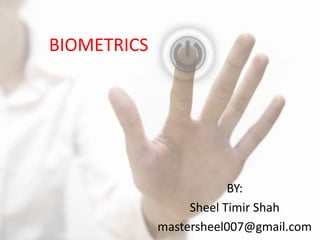
BIOMETRICS


                         BY:
                  Sheel Timir Shah
             mastersheel007@gmail.com
MY PRESENTATION
•   INTRODUCTION
•   HISTORY
•   WORKING PROCESS
•   TECHNOLOGIES
•   ADVANTAGES & DISADVANTAGES
•   CONCLUSION
•   BIBLIOGRAPHY
INTRODUCTION
• Biometrics are automated methods of
  recognizing a person based on a physiological or
  behavioral characteristic.
• As the level of security decreases and transaction
  fraud increases, the need for highly secure
  identification and personal verification
  technologies is more.
• Biometric-based solutions are able to provide for
  confidential financial transactions and personal
  data privacy.
HISTORY
• The term "biometrics" is derived from the Greek
  words bio (life) and metric (to measure).
• The first known example of biometrics in
  practice was a form of finger printing being used
  in China in the 14th century by “Joao de Barros.”
• “Bertillonage” a method of bodily measurement
  was used by police authorities.
• The police then used finger printing, which was
  developed by Richard Edward Henry of Scotland
  Yard.
WHY BIOMETRICS…?
•   Convenient
•   Passwords are not user-friendly
•   Perceived as more secured
•   Passive identification
WORKING
All biometric systems works in a four-stage process that consists of the
   following steps:

    • Capture: A biometric system collects the sample of biometric features
  like fingerprint, voice etc of the person who “LOGGS” in.

    • Extraction: The data extraction is done uniquely from the sample and a
  template is created for unique features. Templates stores in digital
  biometric code format.

   • Comparison: The template is then compared with a new sample.

  • Match/non-match: The system then decides whether the features
  extracted from the new sample are a match or a non-match with the
  template. When identity needs checking, the person interacts with the
  biometric system, a new biometric sample is taken and compared with the
  template.
TECHNOLOGIES
• Identification And Verification Systems
  Identification:Search a sample against a database
  of templates.
        Typical application: identifying fingerprints
  Verification:Compare a sample against a single
  stored template
       Typical application: voice lock
METHODS
BIOMETRIC METHODS:
1)Behavioral Biometrics
   a)Keystroke or Typing Recognition
   b)Speaker Identification or Recognition


2)Physical Biometrics
  a)Fingerprint Identification or Recognition
  b)Speaker or Voice Authentication
  c)Hand or Finger Geometry Recognition
  d) Facial Recognition
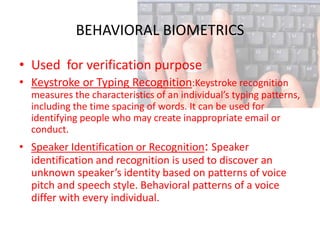
BEHAVIORAL BIOMETRICS

• Used for verification purpose
• Keystroke or Typing Recognition:Keystroke recognition
  measures the characteristics of an individual’s typing patterns,
  including the time spacing of words. It can be used for
  identifying people who may create inappropriate email or
  conduct.
• Speaker Identification or Recognition: Speaker
  identification and recognition is used to discover an
  unknown speaker’s identity based on patterns of voice
  pitch and speech style. Behavioral patterns of a voice
  differ with every individual.
PHYSICAL BIOMETRICS
• Used for Identification purpose
• Fingerprint Identification or Recognition: This type of
  biometrics compares two fingerprints to determine identification.
• Speaker or Voice Authentication: Speaker or voice
  authentication is the analysis of vocal behavior by matching it to a
  voice model template
• Hand or Finger Geometry Recognition:The method uses 3D
  analysis of the finger for tracking and identification purposes.
• Facial Recognition: Facial recognition uses algorithms to
  analyze features. These include the position/size/shape of the
  eyes, nose, cheekbones and jaw line.
ADVANTAGES
• Increase security
• Eliminate problems caused by lost IDs or
  forgotten passwords
• Reduce password administration costs.
• Make it possible, automatically, to know WHO
  did WHAT, WHERE and WHEN?
• Replace hard-to-remember passwords which
  may be shared or observed.
DISADVANTAGES
• The finger print of those people working in
  Chemical industries are often affected.
• It is found that with age, the voice of a person
  differs.
• For people affected with diabetes, the eyes
  get affected resulting in differences.
• Biometrics is an expensive security solution.
CONCLUSION
• Biometrics is a very interesting and exciting
  field that has be growing exponentially in
  recent years (especially 2001).
• The wide variety of physically unique traits
  our bodies give us will soon allow us to live in
  a very secure password-less world

Biomatrics

  • 1.
    BIOMETRICS BY: Sheel Timir Shah mastersheel007@gmail.com
  • 2.
    MY PRESENTATION • INTRODUCTION • HISTORY • WORKING PROCESS • TECHNOLOGIES • ADVANTAGES & DISADVANTAGES • CONCLUSION • BIBLIOGRAPHY
  • 3.
    INTRODUCTION • Biometrics areautomated methods of recognizing a person based on a physiological or behavioral characteristic. • As the level of security decreases and transaction fraud increases, the need for highly secure identification and personal verification technologies is more. • Biometric-based solutions are able to provide for confidential financial transactions and personal data privacy.
  • 4.
    HISTORY • The term"biometrics" is derived from the Greek words bio (life) and metric (to measure). • The first known example of biometrics in practice was a form of finger printing being used in China in the 14th century by “Joao de Barros.” • “Bertillonage” a method of bodily measurement was used by police authorities. • The police then used finger printing, which was developed by Richard Edward Henry of Scotland Yard.
  • 5.
    WHY BIOMETRICS…? • Convenient • Passwords are not user-friendly • Perceived as more secured • Passive identification
  • 6.
    WORKING All biometric systemsworks in a four-stage process that consists of the following steps: • Capture: A biometric system collects the sample of biometric features like fingerprint, voice etc of the person who “LOGGS” in. • Extraction: The data extraction is done uniquely from the sample and a template is created for unique features. Templates stores in digital biometric code format. • Comparison: The template is then compared with a new sample. • Match/non-match: The system then decides whether the features extracted from the new sample are a match or a non-match with the template. When identity needs checking, the person interacts with the biometric system, a new biometric sample is taken and compared with the template.
  • 7.
    TECHNOLOGIES • Identification AndVerification Systems Identification:Search a sample against a database of templates. Typical application: identifying fingerprints Verification:Compare a sample against a single stored template Typical application: voice lock
  • 8.
    METHODS BIOMETRIC METHODS: 1)Behavioral Biometrics a)Keystroke or Typing Recognition b)Speaker Identification or Recognition 2)Physical Biometrics a)Fingerprint Identification or Recognition b)Speaker or Voice Authentication c)Hand or Finger Geometry Recognition d) Facial Recognition
  • 9.
    BEHAVIORAL BIOMETRICS • Usedfor verification purpose • Keystroke or Typing Recognition:Keystroke recognition measures the characteristics of an individual’s typing patterns, including the time spacing of words. It can be used for identifying people who may create inappropriate email or conduct. • Speaker Identification or Recognition: Speaker identification and recognition is used to discover an unknown speaker’s identity based on patterns of voice pitch and speech style. Behavioral patterns of a voice differ with every individual.
  • 10.
    PHYSICAL BIOMETRICS • Usedfor Identification purpose • Fingerprint Identification or Recognition: This type of biometrics compares two fingerprints to determine identification. • Speaker or Voice Authentication: Speaker or voice authentication is the analysis of vocal behavior by matching it to a voice model template • Hand or Finger Geometry Recognition:The method uses 3D analysis of the finger for tracking and identification purposes. • Facial Recognition: Facial recognition uses algorithms to analyze features. These include the position/size/shape of the eyes, nose, cheekbones and jaw line.
  • 11.
    ADVANTAGES • Increase security •Eliminate problems caused by lost IDs or forgotten passwords • Reduce password administration costs. • Make it possible, automatically, to know WHO did WHAT, WHERE and WHEN? • Replace hard-to-remember passwords which may be shared or observed.
  • 12.
    DISADVANTAGES • The fingerprint of those people working in Chemical industries are often affected. • It is found that with age, the voice of a person differs. • For people affected with diabetes, the eyes get affected resulting in differences. • Biometrics is an expensive security solution.
  • 13.
    CONCLUSION • Biometrics isa very interesting and exciting field that has be growing exponentially in recent years (especially 2001). • The wide variety of physically unique traits our bodies give us will soon allow us to live in a very secure password-less world