Prepared By :
AKASH DEEP
MAURYA
1351110002
Presentation Outlines
 Authentication & Its types
 Biometric & Why use it ?
 Characteristics & Modes
 Working of Biometric System
 Different Techniques
 Comparison b/w Different techniques
 Application of Biometric Authentication
 Limitations
 Conclusion
 References
Authentication
 Act of confirming something or giving
privileges to access something.
 Process of giving someone identity-he or she
can access that particular application or data.
 For e.g. : Giving identity-card to a student of
an institute.
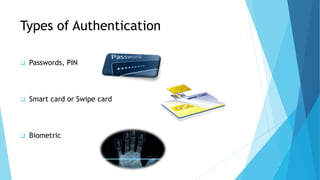
Types of Authentication
 Passwords, PIN
 Smart card or Swipe card
 Biometric
Biometric
“ something that you are ”
 Two Greek words Bio(Life) and Metric(To Measure).
 Measures and Analyzes - biological traits - human being.
 Automated recognition of an individual - behavioral or
physical characteristics.
 Provides privacy to personal data & high security to
confidential, financial transactions.
Why Biometric ?
 Identity theft is not possible
 Password remembrance problem does not exist
 Cannot be predicted or hacked
 Cannot be shared
 Perceived as more secure
 Accuracy
Characteristics of a Biometric
Recognizing an individual based on two main characteristics :
 Physical characteristics are related to physical shape of the
body. For e.g. Fingerprint, face, hand geometry, iris etc.
 Behavioral characteristics are related to the behavior of a
person. For e.g. Voice pitch, speaking style, typing rhythm,
signature etc.
Modes of Biometric System
Identification
 One-to-many comparison.
 It search for a sample against a database of templates.
 It identifies an unknown individual.
 For e.g. Who is “x” ?
Verification
 One-to-one comparison.
 It compares a sample against a single stored template.
 It verifies the individual’s identity.
 For e.g. Is this “x” ?
Working process
 Enrollment : In this stage, Information captured-sensing
device-stored in database for later comparison. When someone
uses biometric for the first time then the stage is called
enrollment.
 Authentication : Registered biometric sample during the
enrollment process are matched against newly capturing
biometric sample.
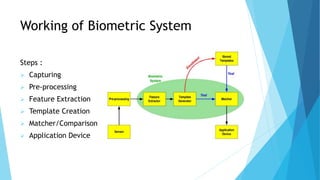
Working of Biometric System
Steps :
 Capturing
 Pre-processing
 Feature Extraction
 Template Creation
 Matcher/Comparison
 Application Device
Different biometric technique
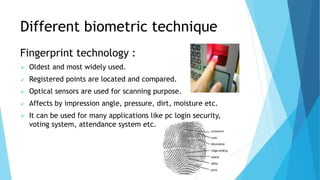
Fingerprint technology :
 Oldest and most widely used.
 Registered points are located and compared.
 Optical sensors are used for scanning purpose.
 Affects by impression angle, pressure, dirt, moisture etc.
 It can be used for many applications like pc login security,
voting system, attendance system etc.
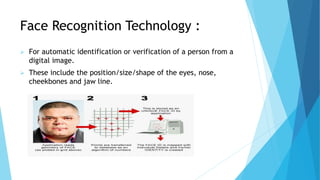
Face Recognition Technology :
 For automatic identification or verification of a person from a
digital image.
 These include the position/size/shape of the eyes, nose,
cheekbones and jaw line.
Iris Recognition Technology :
 It measures the iris pattern of the eye i.e. the colored part of
the eye that surrounds the pupil.
 The iris scanner analyzes features like rings, furrows, and
freckles existing in the colored tissue surrounding pupil.
 Iris pattern is not changed over years or by glasses, contact
lenses.
Hand Geometry Technology :
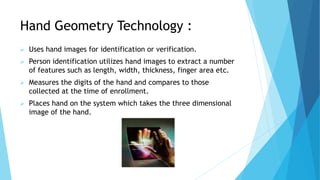
 Uses hand images for identification or verification.
 Person identification utilizes hand images to extract a number
of features such as length, width, thickness, finger area etc.
 Measures the digits of the hand and compares to those
collected at the time of enrollment.
 Places hand on the system which takes the three dimensional
image of the hand.
Voice Recognition Technology :
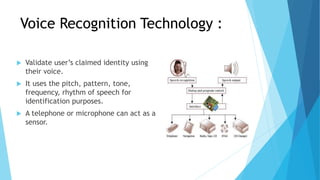
 Validate user’s claimed identity using
their voice.
 It uses the pitch, pattern, tone,
frequency, rhythm of speech for
identification purposes.
 A telephone or microphone can act as a
sensor.
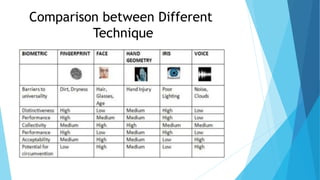
Comparison between Different
Technique
Applications Limitations
 Criminal identification
 Internet Banking
 Attendance system
 Airport, Bank security
 PC login security
 Prevents unauthorized access to
private data.
 Presence of noise in the sensed
data.
 Variations in the enrolled data
i.e. change in age, disease,
environment etc.
 Non-universality
 It is an expensive security
solution.
Conclusion
 Security of e-commerce or e-government sites -
Enhanced
 The Greatest strength of the biometric system is that
they does not change over time so it is much more
efficient than other traditional security mechanism.
 Accuracy, performance, effectiveness & suitability of
the security systems can be increased.
References
 Wikipedia :
http:en.Wikipedia.org/wiki/Biometric_authentication
 Google Search Engine
Biometrics Based Authentication AKASH

Biometrics Based Authentication AKASH

  • 1.
    Prepared By : AKASHDEEP MAURYA 1351110002
  • 2.
    Presentation Outlines  Authentication& Its types  Biometric & Why use it ?  Characteristics & Modes  Working of Biometric System  Different Techniques  Comparison b/w Different techniques  Application of Biometric Authentication  Limitations  Conclusion  References
  • 3.
    Authentication  Act ofconfirming something or giving privileges to access something.  Process of giving someone identity-he or she can access that particular application or data.  For e.g. : Giving identity-card to a student of an institute.
  • 4.
    Types of Authentication Passwords, PIN  Smart card or Swipe card  Biometric
  • 5.
    Biometric “ something thatyou are ”  Two Greek words Bio(Life) and Metric(To Measure).  Measures and Analyzes - biological traits - human being.  Automated recognition of an individual - behavioral or physical characteristics.  Provides privacy to personal data & high security to confidential, financial transactions.
  • 6.
    Why Biometric ? Identity theft is not possible  Password remembrance problem does not exist  Cannot be predicted or hacked  Cannot be shared  Perceived as more secure  Accuracy
  • 7.
    Characteristics of aBiometric Recognizing an individual based on two main characteristics :  Physical characteristics are related to physical shape of the body. For e.g. Fingerprint, face, hand geometry, iris etc.  Behavioral characteristics are related to the behavior of a person. For e.g. Voice pitch, speaking style, typing rhythm, signature etc.
  • 8.
    Modes of BiometricSystem Identification  One-to-many comparison.  It search for a sample against a database of templates.  It identifies an unknown individual.  For e.g. Who is “x” ? Verification  One-to-one comparison.  It compares a sample against a single stored template.  It verifies the individual’s identity.  For e.g. Is this “x” ?
  • 9.
    Working process  Enrollment: In this stage, Information captured-sensing device-stored in database for later comparison. When someone uses biometric for the first time then the stage is called enrollment.  Authentication : Registered biometric sample during the enrollment process are matched against newly capturing biometric sample.
  • 10.
    Working of BiometricSystem Steps :  Capturing  Pre-processing  Feature Extraction  Template Creation  Matcher/Comparison  Application Device
  • 11.
    Different biometric technique Fingerprinttechnology :  Oldest and most widely used.  Registered points are located and compared.  Optical sensors are used for scanning purpose.  Affects by impression angle, pressure, dirt, moisture etc.  It can be used for many applications like pc login security, voting system, attendance system etc.
  • 12.
    Face Recognition Technology:  For automatic identification or verification of a person from a digital image.  These include the position/size/shape of the eyes, nose, cheekbones and jaw line.
  • 13.
    Iris Recognition Technology:  It measures the iris pattern of the eye i.e. the colored part of the eye that surrounds the pupil.  The iris scanner analyzes features like rings, furrows, and freckles existing in the colored tissue surrounding pupil.  Iris pattern is not changed over years or by glasses, contact lenses.
  • 14.
    Hand Geometry Technology:  Uses hand images for identification or verification.  Person identification utilizes hand images to extract a number of features such as length, width, thickness, finger area etc.  Measures the digits of the hand and compares to those collected at the time of enrollment.  Places hand on the system which takes the three dimensional image of the hand.
  • 15.
    Voice Recognition Technology:  Validate user’s claimed identity using their voice.  It uses the pitch, pattern, tone, frequency, rhythm of speech for identification purposes.  A telephone or microphone can act as a sensor.
  • 16.
  • 17.
    Applications Limitations  Criminalidentification  Internet Banking  Attendance system  Airport, Bank security  PC login security  Prevents unauthorized access to private data.  Presence of noise in the sensed data.  Variations in the enrolled data i.e. change in age, disease, environment etc.  Non-universality  It is an expensive security solution.
  • 18.
    Conclusion  Security ofe-commerce or e-government sites - Enhanced  The Greatest strength of the biometric system is that they does not change over time so it is much more efficient than other traditional security mechanism.  Accuracy, performance, effectiveness & suitability of the security systems can be increased.
  • 19.