Combustion of Biomass
BET 1 2017
Jackson Mutegeki,
Nyabyeya Forestry College
3 of 24 © Boardworks Ltd 2006
When a substance burns,
it is said to combust.
A fuel is a substance that reacts with oxygen (combusts) to
release useful energy.
Combustion- Definition
Many fractions obtained from crude oil are used as fuels
because they contain hydrocarbons that burn easily and
release a large amount of useful energy.
Combustion is a rapid
reaction between a
substance and oxygen
that releases heat and
light energy.
4 of 24 © Boardworks Ltd 2006
What are the products of the
complete combustion of a hydrocarbon?
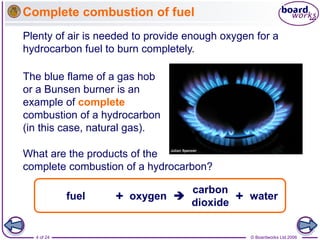
Plenty of air is needed to provide enough oxygen for a
hydrocarbon fuel to burn completely.
oxygen
carbon
dioxide
fuel + +
 water
The blue flame of a gas hob
or a Bunsen burner is an
example of complete
combustion of a hydrocarbon
(in this case, natural gas).
Complete combustion of fuel
5 of 24 © Boardworks Ltd 2006
Example - Complete combustion of
propane
Propane is a hydrocarbon used in camping gas. What is the
equation for its combustion?
oxygen
carbon
dioxide
propane + +
 water
5O2 3CO2
C3H8 + +
 4H20
How would the equations change if wood was used?
6 of 24 © Boardworks Ltd 2006
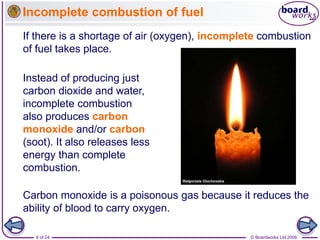
If there is a shortage of air (oxygen), incomplete combustion
of fuel takes place.
Instead of producing just
carbon dioxide and water,
incomplete combustion
also produces carbon
monoxide and/or carbon
(soot). It also releases less
energy than complete
combustion.
Carbon monoxide is a poisonous gas because it reduces the
ability of blood to carry oxygen.
Incomplete combustion of fuel
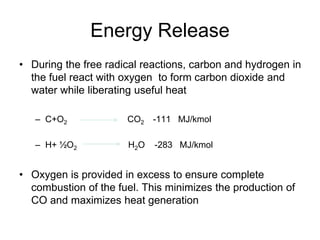
Energy Release
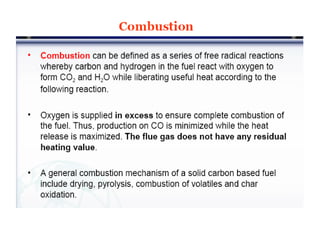
• During the free radical reactions, carbon and hydrogen in
the fuel react with oxygen to form carbon dioxide and
water while liberating useful heat
– C+O2 CO2 -111 MJ/kmol
– H+ ½O2 H2O -283 MJ/kmol
• Oxygen is provided in excess to ensure complete
combustion of the fuel. This minimizes the production of
CO and maximizes heat generation
Combustion - Applications
• Designed on the basis of different factors:
– fuels
– fuel particle sizes
– moisture contents
– ash contents and compositions
– application purposes
– application sizes
– emission regulations
– etc.
SOLID FUEL COMBUSTION
Solid Biomass Composition
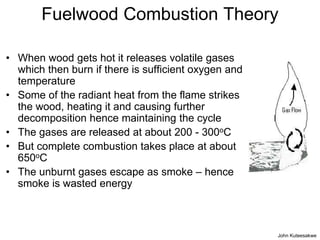
Fuelwood Combustion Theory
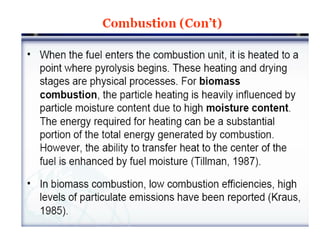
• When wood gets hot it releases volatile gases
which then burn if there is sufficient oxygen and
temperature
• Some of the radiant heat from the flame strikes
the wood, heating it and causing further
decomposition hence maintaining the cycle
• The gases are released at about 200 - 300oC
• But complete combustion takes place at about
650oC
• The unburnt gases escape as smoke – hence
smoke is wasted energy
John Kuteesakwe
Combustion Technologies
Applications
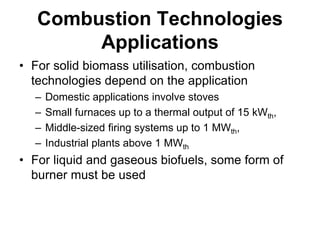
• For solid biomass utilisation, combustion
technologies depend on the application
– Domestic applications involve stoves
– Small furnaces up to a thermal output of 15 kWth,
– Middle-sized firing systems up to 1 MWth,
– Industrial plants above 1 MWth
• For liquid and gaseous biofuels, some form of
burner must be used

Biomass_Direct_Combustion.ppt

  • 1.
    Combustion of Biomass BET1 2017 Jackson Mutegeki, Nyabyeya Forestry College
  • 3.
    3 of 24© Boardworks Ltd 2006 When a substance burns, it is said to combust. A fuel is a substance that reacts with oxygen (combusts) to release useful energy. Combustion- Definition Many fractions obtained from crude oil are used as fuels because they contain hydrocarbons that burn easily and release a large amount of useful energy. Combustion is a rapid reaction between a substance and oxygen that releases heat and light energy.
  • 4.
    4 of 24© Boardworks Ltd 2006 What are the products of the complete combustion of a hydrocarbon? Plenty of air is needed to provide enough oxygen for a hydrocarbon fuel to burn completely. oxygen carbon dioxide fuel + +  water The blue flame of a gas hob or a Bunsen burner is an example of complete combustion of a hydrocarbon (in this case, natural gas). Complete combustion of fuel
  • 5.
    5 of 24© Boardworks Ltd 2006 Example - Complete combustion of propane Propane is a hydrocarbon used in camping gas. What is the equation for its combustion? oxygen carbon dioxide propane + +  water 5O2 3CO2 C3H8 + +  4H20 How would the equations change if wood was used?
  • 6.
    6 of 24© Boardworks Ltd 2006 If there is a shortage of air (oxygen), incomplete combustion of fuel takes place. Instead of producing just carbon dioxide and water, incomplete combustion also produces carbon monoxide and/or carbon (soot). It also releases less energy than complete combustion. Carbon monoxide is a poisonous gas because it reduces the ability of blood to carry oxygen. Incomplete combustion of fuel
  • 7.
    Energy Release • Duringthe free radical reactions, carbon and hydrogen in the fuel react with oxygen to form carbon dioxide and water while liberating useful heat – C+O2 CO2 -111 MJ/kmol – H+ ½O2 H2O -283 MJ/kmol • Oxygen is provided in excess to ensure complete combustion of the fuel. This minimizes the production of CO and maximizes heat generation
  • 8.
    Combustion - Applications •Designed on the basis of different factors: – fuels – fuel particle sizes – moisture contents – ash contents and compositions – application purposes – application sizes – emission regulations – etc.
  • 9.
  • 10.
  • 11.
    Fuelwood Combustion Theory •When wood gets hot it releases volatile gases which then burn if there is sufficient oxygen and temperature • Some of the radiant heat from the flame strikes the wood, heating it and causing further decomposition hence maintaining the cycle • The gases are released at about 200 - 300oC • But complete combustion takes place at about 650oC • The unburnt gases escape as smoke – hence smoke is wasted energy John Kuteesakwe
  • 15.
    Combustion Technologies Applications • Forsolid biomass utilisation, combustion technologies depend on the application – Domestic applications involve stoves – Small furnaces up to a thermal output of 15 kWth, – Middle-sized firing systems up to 1 MWth, – Industrial plants above 1 MWth • For liquid and gaseous biofuels, some form of burner must be used

Editor's Notes

  • #4 Boardworks GCSE Science: Chemistry Combustion and Alternative Fuels
  • #5 Boardworks GCSE Science: Chemistry Combustion and Alternative Fuels
  • #6 Boardworks GCSE Science: Chemistry Combustion and Alternative Fuels
  • #7 Boardworks GCSE Science: Chemistry Combustion and Alternative Fuels