MEHRAN UNIVERSITY OF
ENGINEERING AND TECHNOLOGY
Jamsher Khan 16CH44 (GL)
Sagar Khan 16CH56
Affaque Bhatti 16CH51
Abdul Manan 16CH15
Waqar Amin 16Ch110
Topic
Combustion Principle
Submitted To
Pro. Dr Shaheen
Department Of Chemical Engineering MUET
COMBUSTION PRINCIPLE
 Combustion is a chemical reaction between a
Fuel and Oxygen Which is accompanied by the
production of considerable amount of Heat
 Usually Its an Endothermic Reaction
 The reaction has to be initiated By some Source
Of High Temperature Energy (ignition) l
 Combustion refers to the rapid oxidation results
in large amount of heat is released
 Solid and liquid fuels must be changed to a gas
before they will burn
COMBUSTION PRINCIPLE
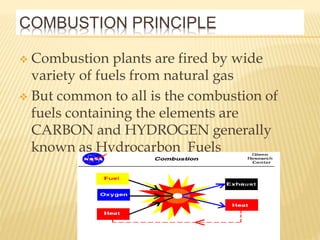
 Combustion plants are fired by wide
variety of fuels from natural gas
 But common to all is the combustion of
fuels containing the elements are
CARBON and HYDROGEN generally
known as Hydrocarbon Fuels
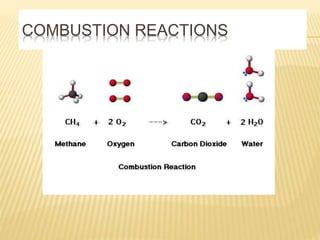
COMBUSTION REACTIONS
COMBUSTION PROCESSES
o There are several processes of combustion Of
Fuel
1. Bringing together the fuel and air
2. Ignition the reaction
3. Ensuring that the flame burns in a stable
manner
4. Extracting useful heat from the process
5. Arranging for the Safe disposal of the products
of combustion
BASIC ELEMENT OF COMBUSTION
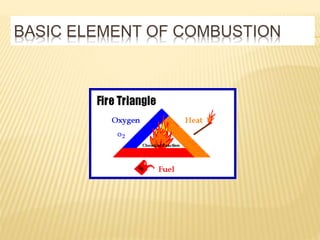
 The fire triangles or combustion triangles
or ″fire diamond″ are simple models for
understanding the necessary ingredients
for most fires.
 The triangle illustrates the three
elements a fire needs to ignite: heat, fuel,
and an oxidizing agent (usually oxygen
BASIC ELEMENT OF COMBUSTION
PHASES OF COMBUSTION
1.Pre-Ignition
 Heat Is required to raise a fuel to ignition
Temperature (600 degree F)
PHASES OF COMBUSTION
2. Ignition
 Process Where A rapid Exothermic reaction
is initiated Which Causes The material to
undergo Changes producing temperature
greatly in excess of ambiet
PHASES OF COMBUSTION
3. Combustion
 Flaming =Volatiles that produced in the
preheating phase ignite to form a visible
flame
 Smoldering =The remaining carbon may
burn as a solid surfaces oxidation
PHASES OF COMUSTION
4. Extinction
 Opposite of ignition
(termination of combustion)
 Moisture Content of fuel can play a large
role
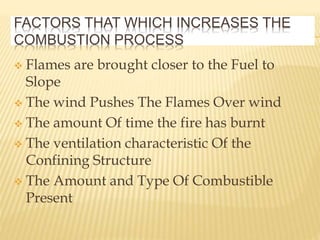
FACTORS THAT WHICH INCREASES THE
COMBUSTION PROCESS
 Flames are brought closer to the Fuel to
Slope
 The wind Pushes The Flames Over wind
 The amount Of time the fire has burnt
 The ventilation characteristic Of the
Confining Structure
 The Amount and Type Of Combustible
Present
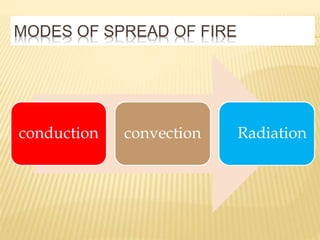
MODES OF SPREAD OF FIRE
conduction convection Radiation
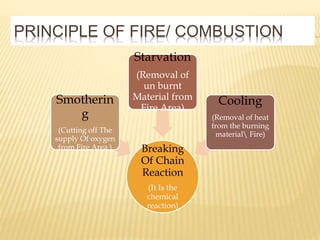
PRINCIPLE OF FIRE/ COMBUSTION
Breaking
Of Chain
Reaction
(It Is the
chemical
reaction)
Smotherin
g
(Cutting off The
supply Of oxygen
from Fire Area )
Starvation
(Removal of
un burnt
Material from
Fire Area)
Cooling
(Removal of heat
from the burning
material Fire)
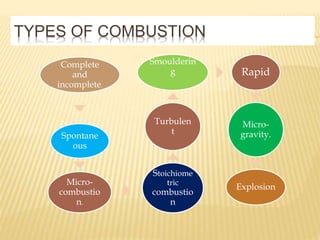
TYPES OF COMBUSTION
Complete
and
incomplete.
Spontane
ous
Micro-
combustio
n.
Stoichiome
tric
combustio
n
Turbulen
t
Smoulderin
g Rapid
Micro-
gravity.
Explosion
INDUSTRIAL COMBUSTION
1. General definition
 combustion is defined as the oxidation of fuels,
typically, but not exclusively, through the rapid
combination of hydrogen and carbon contained
in the fuel with the oxygen contained in
atmospheric air
 This rapid combination releases heat at
relatively high temperature, which may then be
used for the heating of industrial processes,
including the generation of steam and high-
pressure hot water
INDUSTRIAL COMBUSTION
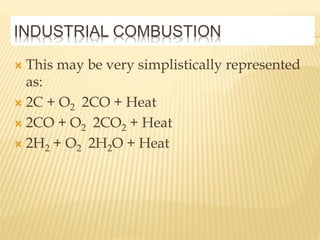
 This may be very simplistically represented
as:
 2C + O2 2CO + Heat
 2CO + O2 2CO2 + Heat
 2H2 + O2 2H2O + Heat
INDUSTRIAL COMBUSTION
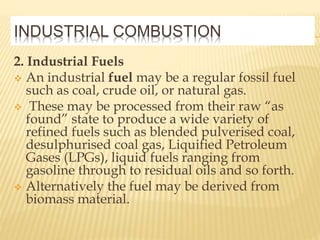
2. Industrial Fuels
 An industrial fuel may be a regular fossil fuel
such as coal, crude oil, or natural gas.
 These may be processed from their raw “as
found” state to produce a wide variety of
refined fuels such as blended pulverised coal,
desulphurised coal gas, Liquified Petroleum
Gases (LPGs), liquid fuels ranging from
gasoline through to residual oils and so forth.
 Alternatively the fuel may be derived from
biomass material.
INDUSTRIAL COMBUSTION
 Traditional firewood is arguably the
“original fuel” used by mankind.
 Alternatively fuels may be derived from
wastes to produce so-called 'Refuse Derived
Fuels”' or RDFs.
INDUSTRIAL COMBUSTION
3. Industrial Comburents
 An industrial Comburent may range from
regular atmospheric air containing
approximately 21% v/v O2,
 The remainder being almost exclusively
molecular nitrogen - N2, through oxygen
enriched air to relatively pure oxygen - Oxygen
containing a very small quantity of impurities.
 Alternatively oxygen depleted (vitiated) air - for
example Gas Turbine or Diesel exhaust gases -
may also be used as a comburent.
INDUSTRIAL COMBUSTION
4. Industrial Combustion Modes
 Traditional industrial combustion processes were
primarily based on the concept of the comburent -
almost always, regular atmospheric air - being
encouraged to rise through a bed of fuel
 Originally containing wood but later various forms of
lump coal and most recently, domestic solid waste.
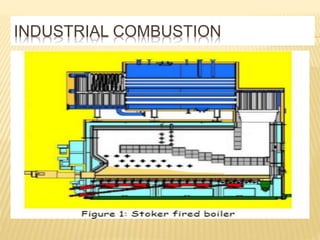
 Such a system is described as a stoker fired boiler of
which there a several basic types. Figure 1 shows an
example of a stoker fired boiler.
INDUSTRIAL COMBUSTION
CLASSIFICATION OF INDUSTRIAL
COMBUSTION
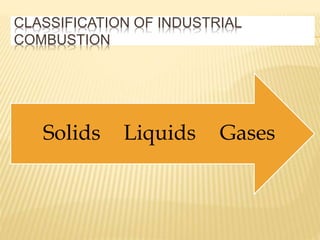
GasesLiquidsSolids
CLASSIFICATION OF INDUSTRIAL
COMBUSTION
1. Solids
 In recent decades such solid fuel combustion
modes, have given way, at least in relatively large
coal fired scale boilers, to pulverised coal burners,
where the coal is milled to a very fine powder -
typically 75% by mass < 75mm
 passed through a burner in suspension in an
atmosphere derived from the coal dryer. This
produces a turbulent diffusion flame, an example
of which is shown in Figure Arrays of such flames
are used to fire boilers of various designs.
CLASSIFICATION OF INDUSTRIAL
COMBUSTION
CLASSIFICATION OF INDUSTRIAL
COMBUSTION
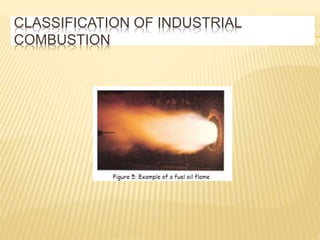
2. Liquids
 Liquid fuels have been traditionally burned in
various forms of pot burners
 Modern liquid fuel burners employ atomising
devices to produced fine droplets of the fuel
 Which initially are evaporated in the throat of a
burner which gives rise to a turbulent diffusion
flame, an example of which is shown in Figure
CLASSIFICATION OF INDUSTRIAL
COMBUSTION
CLASSIFICATION OF INDUSTRIAL
COMBUSTION
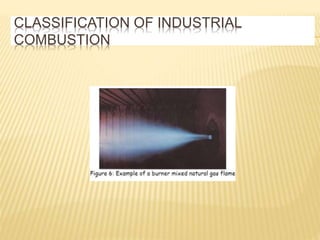
3. Gaseous
 Finally gaseous fuels are exclusively fired in
burners which give rise to flames.
 These may be produced by premixing the
gaseous fuel and the comburent to give a
'premixed' flame.
 Alternatively the gaseous fuel and the
comburent may be mixed in the burner to give a
regular turbulent diffusion flame, as shown in
Figure
CLASSIFICATION OF INDUSTRIAL
COMBUSTION
CONCLUSION
 It is clear from the various examples of
combustion given above, that there is a
variety of combustion modes used in
industry.
 Flames are of considerable importance in
industrial process heating and have formed
the basis of the research of the International
Flame Research Foundation for over 50 years
(Ref to Spirit of IJmuiden)
CONCLUSION
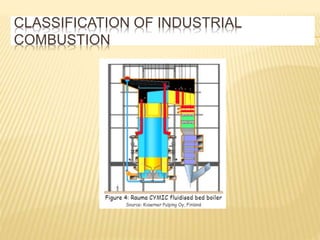
 However the various form of bed stokers,
particularly fluidized beds, are also of
particular importance in industry.
REFERENCES
 Combustion
Handbook
Combustion File no.: 32
Version no.: 1
Date: 16-10-2000
Author: Peter Roberts
Referee: Nick Syred
Sub-editor: Neil Fricker
Source: Author
Domain: Open Domain
Combustion principle

Combustion principle

  • 1.
    MEHRAN UNIVERSITY OF ENGINEERINGAND TECHNOLOGY Jamsher Khan 16CH44 (GL) Sagar Khan 16CH56 Affaque Bhatti 16CH51 Abdul Manan 16CH15 Waqar Amin 16Ch110 Topic Combustion Principle Submitted To Pro. Dr Shaheen Department Of Chemical Engineering MUET
  • 2.
    COMBUSTION PRINCIPLE  Combustionis a chemical reaction between a Fuel and Oxygen Which is accompanied by the production of considerable amount of Heat  Usually Its an Endothermic Reaction  The reaction has to be initiated By some Source Of High Temperature Energy (ignition) l  Combustion refers to the rapid oxidation results in large amount of heat is released  Solid and liquid fuels must be changed to a gas before they will burn
  • 3.
    COMBUSTION PRINCIPLE  Combustionplants are fired by wide variety of fuels from natural gas  But common to all is the combustion of fuels containing the elements are CARBON and HYDROGEN generally known as Hydrocarbon Fuels
  • 4.
  • 5.
    COMBUSTION PROCESSES o Thereare several processes of combustion Of Fuel 1. Bringing together the fuel and air 2. Ignition the reaction 3. Ensuring that the flame burns in a stable manner 4. Extracting useful heat from the process 5. Arranging for the Safe disposal of the products of combustion
  • 6.
    BASIC ELEMENT OFCOMBUSTION  The fire triangles or combustion triangles or ″fire diamond″ are simple models for understanding the necessary ingredients for most fires.  The triangle illustrates the three elements a fire needs to ignite: heat, fuel, and an oxidizing agent (usually oxygen
  • 7.
    BASIC ELEMENT OFCOMBUSTION
  • 8.
    PHASES OF COMBUSTION 1.Pre-Ignition Heat Is required to raise a fuel to ignition Temperature (600 degree F)
  • 9.
    PHASES OF COMBUSTION 2.Ignition  Process Where A rapid Exothermic reaction is initiated Which Causes The material to undergo Changes producing temperature greatly in excess of ambiet
  • 10.
    PHASES OF COMBUSTION 3.Combustion  Flaming =Volatiles that produced in the preheating phase ignite to form a visible flame  Smoldering =The remaining carbon may burn as a solid surfaces oxidation
  • 11.
    PHASES OF COMUSTION 4.Extinction  Opposite of ignition (termination of combustion)  Moisture Content of fuel can play a large role
  • 12.
    FACTORS THAT WHICHINCREASES THE COMBUSTION PROCESS  Flames are brought closer to the Fuel to Slope  The wind Pushes The Flames Over wind  The amount Of time the fire has burnt  The ventilation characteristic Of the Confining Structure  The Amount and Type Of Combustible Present
  • 13.
    MODES OF SPREADOF FIRE conduction convection Radiation
  • 14.
    PRINCIPLE OF FIRE/COMBUSTION Breaking Of Chain Reaction (It Is the chemical reaction) Smotherin g (Cutting off The supply Of oxygen from Fire Area ) Starvation (Removal of un burnt Material from Fire Area) Cooling (Removal of heat from the burning material Fire)
  • 15.
  • 16.
    INDUSTRIAL COMBUSTION 1. Generaldefinition  combustion is defined as the oxidation of fuels, typically, but not exclusively, through the rapid combination of hydrogen and carbon contained in the fuel with the oxygen contained in atmospheric air  This rapid combination releases heat at relatively high temperature, which may then be used for the heating of industrial processes, including the generation of steam and high- pressure hot water
  • 17.
    INDUSTRIAL COMBUSTION  Thismay be very simplistically represented as:  2C + O2 2CO + Heat  2CO + O2 2CO2 + Heat  2H2 + O2 2H2O + Heat
  • 18.
    INDUSTRIAL COMBUSTION 2. IndustrialFuels  An industrial fuel may be a regular fossil fuel such as coal, crude oil, or natural gas.  These may be processed from their raw “as found” state to produce a wide variety of refined fuels such as blended pulverised coal, desulphurised coal gas, Liquified Petroleum Gases (LPGs), liquid fuels ranging from gasoline through to residual oils and so forth.  Alternatively the fuel may be derived from biomass material.
  • 19.
    INDUSTRIAL COMBUSTION  Traditionalfirewood is arguably the “original fuel” used by mankind.  Alternatively fuels may be derived from wastes to produce so-called 'Refuse Derived Fuels”' or RDFs.
  • 20.
    INDUSTRIAL COMBUSTION 3. IndustrialComburents  An industrial Comburent may range from regular atmospheric air containing approximately 21% v/v O2,  The remainder being almost exclusively molecular nitrogen - N2, through oxygen enriched air to relatively pure oxygen - Oxygen containing a very small quantity of impurities.  Alternatively oxygen depleted (vitiated) air - for example Gas Turbine or Diesel exhaust gases - may also be used as a comburent.
  • 21.
    INDUSTRIAL COMBUSTION 4. IndustrialCombustion Modes  Traditional industrial combustion processes were primarily based on the concept of the comburent - almost always, regular atmospheric air - being encouraged to rise through a bed of fuel  Originally containing wood but later various forms of lump coal and most recently, domestic solid waste.  Such a system is described as a stoker fired boiler of which there a several basic types. Figure 1 shows an example of a stoker fired boiler.
  • 22.
  • 23.
  • 24.
    CLASSIFICATION OF INDUSTRIAL COMBUSTION 1.Solids  In recent decades such solid fuel combustion modes, have given way, at least in relatively large coal fired scale boilers, to pulverised coal burners, where the coal is milled to a very fine powder - typically 75% by mass < 75mm  passed through a burner in suspension in an atmosphere derived from the coal dryer. This produces a turbulent diffusion flame, an example of which is shown in Figure Arrays of such flames are used to fire boilers of various designs.
  • 25.
  • 26.
    CLASSIFICATION OF INDUSTRIAL COMBUSTION 2.Liquids  Liquid fuels have been traditionally burned in various forms of pot burners  Modern liquid fuel burners employ atomising devices to produced fine droplets of the fuel  Which initially are evaporated in the throat of a burner which gives rise to a turbulent diffusion flame, an example of which is shown in Figure
  • 27.
  • 28.
    CLASSIFICATION OF INDUSTRIAL COMBUSTION 3.Gaseous  Finally gaseous fuels are exclusively fired in burners which give rise to flames.  These may be produced by premixing the gaseous fuel and the comburent to give a 'premixed' flame.  Alternatively the gaseous fuel and the comburent may be mixed in the burner to give a regular turbulent diffusion flame, as shown in Figure
  • 29.
  • 30.
    CONCLUSION  It isclear from the various examples of combustion given above, that there is a variety of combustion modes used in industry.  Flames are of considerable importance in industrial process heating and have formed the basis of the research of the International Flame Research Foundation for over 50 years (Ref to Spirit of IJmuiden)
  • 31.
    CONCLUSION  However thevarious form of bed stokers, particularly fluidized beds, are also of particular importance in industry.
  • 32.
    REFERENCES  Combustion Handbook Combustion Fileno.: 32 Version no.: 1 Date: 16-10-2000 Author: Peter Roberts Referee: Nick Syred Sub-editor: Neil Fricker Source: Author Domain: Open Domain