IMPROVEMENT IN COMBUSTION
PROCESS
GROUP MEMBERS
 SAMER (2K13-MECH-27)
 TAYYAB
 SAJJID
 ZARGHAM
 Mehr Ali
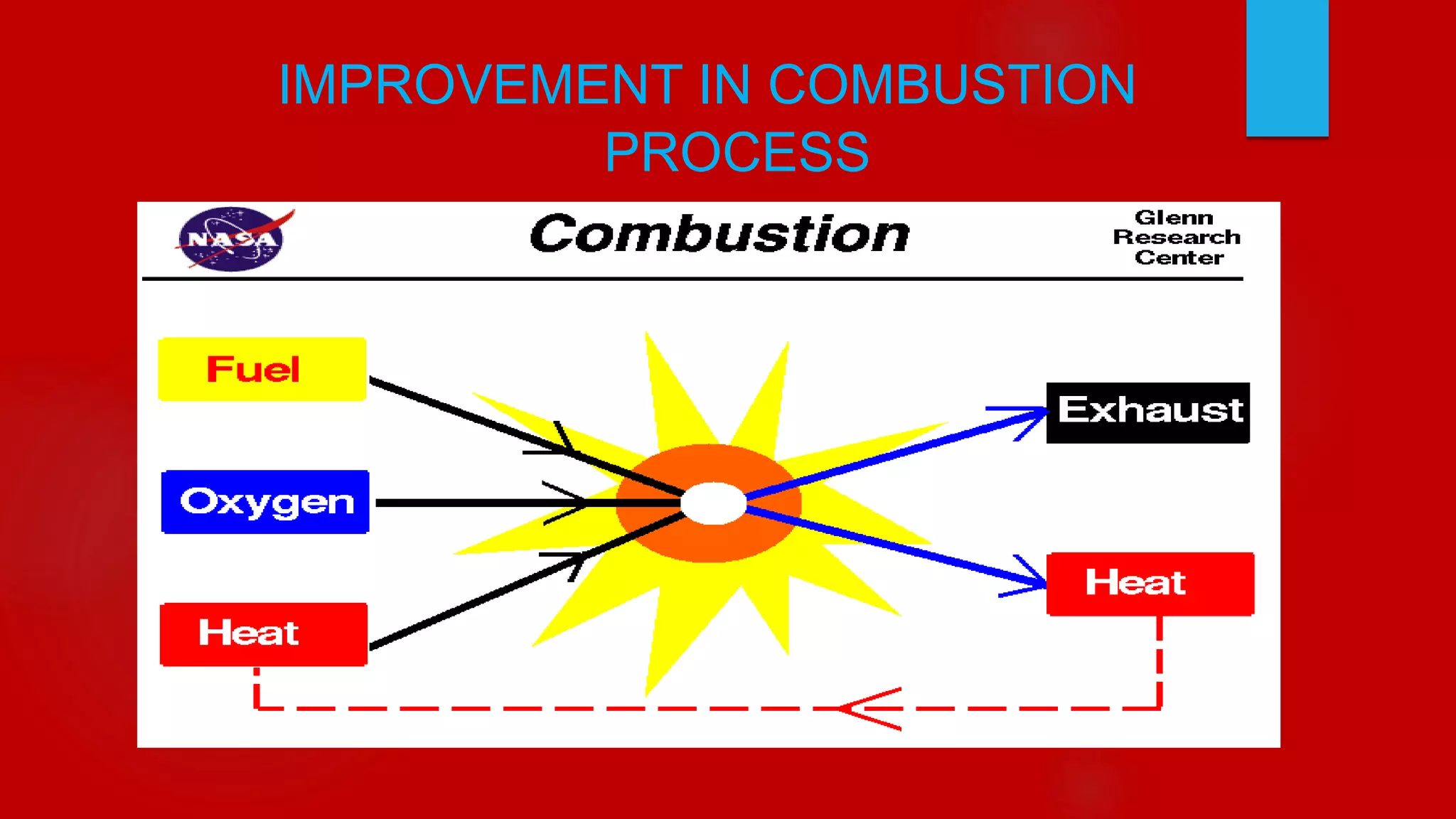
COMBUSTION
Combustion is defined as the burning of a fuel and oxidant to
produce heat and/or work. It is the major energy release mechanism in the
Earth and key to humankind's existence. Combustion includes thermal,
hydrodynamic, and chemical processes. It starts with the mixing of fuel and
oxidant, and sometimes in the presence of other species or catalysts. The fuel
can be gaseous, liquid, or solid and the mixture may be ignited with a heat
source.
EFFECT OF COMBUSTION
The negative effects of combustion on the environment – particularly
greenhouse gas (GHG) emissions released to the atmosphere that contribute
to global warming – have received much attention in recent years. This issue
is addressed in the Kyoto Protocol (1997). Canada, which signed the Protocol,
aims to reduce emissions between 2008 and 2012 by six percent of 1990
levels. Climate change resulting from global warming is one of the greatest
challenges facing not only Canada but also the world. Managing combustion
processes better and improving the efficiency of energy generation and use
are two of the key strategies for reducing atmospheric emissions.
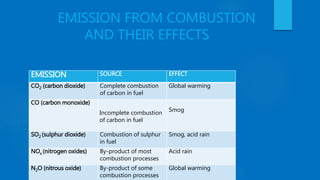
EMISSION FROM COMBUSTION
AND THEIR EFFECTS
EMISSION SOURCE EFFECT
CO2 (carbon dioxide) Complete combustion
of carbon in fuel
Global warming
CO (carbon monoxide)
Incomplete combustion
of carbon in fuel
Smog
SO2 (sulphur dioxide) Combustion of sulphur
in fuel
Smog, acid rain
NOx (nitrogen oxides) By-product of most
combustion processes
Acid rain
N2O (nitrous oxide) By-product of some
combustion processes
Global warming
ACID RAIN
 Acid rain is a result of air pollution. When any type of fuel is burnt, lots of
different chemicals are produced. The smoke that comes from a fire or the
fumes that come out of a car exhaust don't just contain the sooty grey
particles that you can see - they also contains lots of invisible gases that
can be even more harmful to our environment.
 Power stations, factories and cars all burn fuels and therefore they all
produce polluting gases. Some of these gases (especially nitrogen oxides
and sulphur dioxide) react with the tiny droplets of water in clouds to form
sulphuric and nitric acids. The rain from these clouds then falls as very
weak acid - which is why it is known as "acid rain".
GLOBAL WARMING
Global warming is the term used to describe a gradual increase in the average
temperature of the Earth's atmosphere and its oceans, a change that is
believed to be permanently changing the Earth’s climate. The increased
volumes of carbon dioxide and other greenhouse gases released by the
burning of fossil fuels, land clearing, agriculture, and other human activities,
are believed to be the primary sources of the global warming that has
occurred over the past 50 years.
Tayyab Raza Shah
2K13-Mech-37
Combustion process and its types
 Complete vs Incomplete
 Smouldering
 Rapid
 Spontaneous
 Turbulent
 Microgravity
 Micro Combustion
 The degree of combustion can be measured and analysed with test
equipment. HVAC contractors, firemen and engineers use combustion
analysers to test the efficiency of a burner during the combustion process.
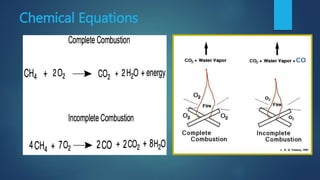
Complete vs Incomplete Combustion
In complete combustion, the reactant burns in oxygen,
producing a limited number of products. When a
hydrocarbon burns in oxygen, the reaction will primarily
yield carbon dioxide and water.
Incomplete combustion will occur when there is not
enough oxygen to allow the fuel to react completely to
produce carbon dioxide and water. It also happens when
the combustion is quenched by a heat sink, such as a solid
surface or flame trap.
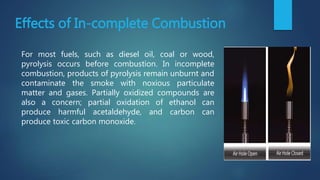
Effects of In-complete Combustion
For most fuels, such as diesel oil, coal or wood,
pyrolysis occurs before combustion. In incomplete
combustion, products of pyrolysis remain unburnt and
contaminate the smoke with noxious particulate
matter and gases. Partially oxidized compounds are
also a concern; partial oxidation of ethanol can
produce harmful acetaldehyde, and carbon can
produce toxic carbon monoxide.
Improvement In Combustion Process
The quality of combustion can be improved by the designs of
combustion devices, such as burners and internal combustion
engines. Further improvements are achievable by catalytic after-
burning devices (such as catalytic converters) or by the simple
partial return of the exhaust gases into the combustion process.
Such devices are required by environmental legislation for cars in
most countries, and may be necessary to enable large
combustion devices, such as thermal power stations, to reach
legal emission standards.
Chemical Equations
Zargham Khan
2K13-Mech-07
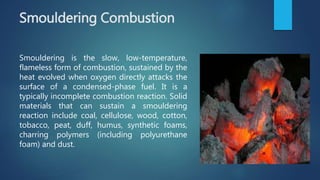
Smouldering Combustion
Smouldering is the slow, low-temperature,
flameless form of combustion, sustained by the
heat evolved when oxygen directly attacks the
surface of a condensed-phase fuel. It is a
typically incomplete combustion reaction. Solid
materials that can sustain a smouldering
reaction include coal, cellulose, wood, cotton,
tobacco, peat, duff, humus, synthetic foams,
charring polymers (including polyurethane
foam) and dust.
Rapid Combustion
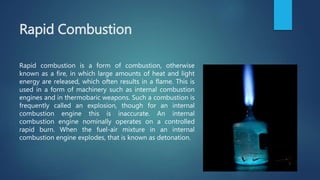
Rapid combustion is a form of combustion, otherwise
known as a fire, in which large amounts of heat and light
energy are released, which often results in a flame. This is
used in a form of machinery such as internal combustion
engines and in thermobaric weapons. Such a combustion is
frequently called an explosion, though for an internal
combustion engine this is inaccurate. An internal
combustion engine nominally operates on a controlled
rapid burn. When the fuel-air mixture in an internal
combustion engine explodes, that is known as detonation.
Spontaneous Combustion
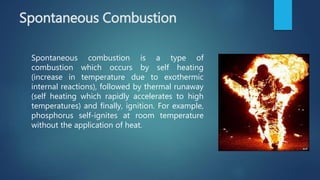
Spontaneous combustion is a type of
combustion which occurs by self heating
(increase in temperature due to exothermic
internal reactions), followed by thermal runaway
(self heating which rapidly accelerates to high
temperatures) and finally, ignition. For example,
phosphorus self-ignites at room temperature
without the application of heat.
Mehr Ali
2K13-Mech-35
Turbulent Combustion
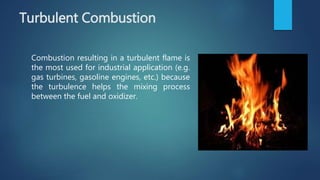
Combustion resulting in a turbulent flame is
the most used for industrial application (e.g.
gas turbines, gasoline engines, etc.) because
the turbulence helps the mixing process
between the fuel and oxidizer.
Micro Combustion
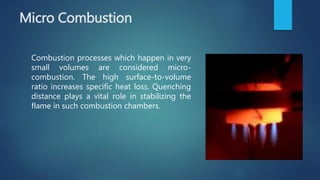
Combustion processes which happen in very
small volumes are considered micro-
combustion. The high surface-to-volume
ratio increases specific heat loss. Quenching
distance plays a vital role in stabilizing the
flame in such combustion chambers.

Improvement in combustion process

  • 1.
  • 2.
    GROUP MEMBERS  SAMER(2K13-MECH-27)  TAYYAB  SAJJID  ZARGHAM  Mehr Ali
  • 3.
    COMBUSTION Combustion is definedas the burning of a fuel and oxidant to produce heat and/or work. It is the major energy release mechanism in the Earth and key to humankind's existence. Combustion includes thermal, hydrodynamic, and chemical processes. It starts with the mixing of fuel and oxidant, and sometimes in the presence of other species or catalysts. The fuel can be gaseous, liquid, or solid and the mixture may be ignited with a heat source.
  • 4.
    EFFECT OF COMBUSTION Thenegative effects of combustion on the environment – particularly greenhouse gas (GHG) emissions released to the atmosphere that contribute to global warming – have received much attention in recent years. This issue is addressed in the Kyoto Protocol (1997). Canada, which signed the Protocol, aims to reduce emissions between 2008 and 2012 by six percent of 1990 levels. Climate change resulting from global warming is one of the greatest challenges facing not only Canada but also the world. Managing combustion processes better and improving the efficiency of energy generation and use are two of the key strategies for reducing atmospheric emissions.
  • 5.
    EMISSION FROM COMBUSTION ANDTHEIR EFFECTS EMISSION SOURCE EFFECT CO2 (carbon dioxide) Complete combustion of carbon in fuel Global warming CO (carbon monoxide) Incomplete combustion of carbon in fuel Smog SO2 (sulphur dioxide) Combustion of sulphur in fuel Smog, acid rain NOx (nitrogen oxides) By-product of most combustion processes Acid rain N2O (nitrous oxide) By-product of some combustion processes Global warming
  • 6.
    ACID RAIN  Acidrain is a result of air pollution. When any type of fuel is burnt, lots of different chemicals are produced. The smoke that comes from a fire or the fumes that come out of a car exhaust don't just contain the sooty grey particles that you can see - they also contains lots of invisible gases that can be even more harmful to our environment.  Power stations, factories and cars all burn fuels and therefore they all produce polluting gases. Some of these gases (especially nitrogen oxides and sulphur dioxide) react with the tiny droplets of water in clouds to form sulphuric and nitric acids. The rain from these clouds then falls as very weak acid - which is why it is known as "acid rain".
  • 7.
    GLOBAL WARMING Global warmingis the term used to describe a gradual increase in the average temperature of the Earth's atmosphere and its oceans, a change that is believed to be permanently changing the Earth’s climate. The increased volumes of carbon dioxide and other greenhouse gases released by the burning of fossil fuels, land clearing, agriculture, and other human activities, are believed to be the primary sources of the global warming that has occurred over the past 50 years.
  • 8.
  • 9.
    Combustion process andits types  Complete vs Incomplete  Smouldering  Rapid  Spontaneous  Turbulent  Microgravity  Micro Combustion  The degree of combustion can be measured and analysed with test equipment. HVAC contractors, firemen and engineers use combustion analysers to test the efficiency of a burner during the combustion process.
  • 10.
    Complete vs IncompleteCombustion In complete combustion, the reactant burns in oxygen, producing a limited number of products. When a hydrocarbon burns in oxygen, the reaction will primarily yield carbon dioxide and water. Incomplete combustion will occur when there is not enough oxygen to allow the fuel to react completely to produce carbon dioxide and water. It also happens when the combustion is quenched by a heat sink, such as a solid surface or flame trap.
  • 11.
    Effects of In-completeCombustion For most fuels, such as diesel oil, coal or wood, pyrolysis occurs before combustion. In incomplete combustion, products of pyrolysis remain unburnt and contaminate the smoke with noxious particulate matter and gases. Partially oxidized compounds are also a concern; partial oxidation of ethanol can produce harmful acetaldehyde, and carbon can produce toxic carbon monoxide.
  • 12.
    Improvement In CombustionProcess The quality of combustion can be improved by the designs of combustion devices, such as burners and internal combustion engines. Further improvements are achievable by catalytic after- burning devices (such as catalytic converters) or by the simple partial return of the exhaust gases into the combustion process. Such devices are required by environmental legislation for cars in most countries, and may be necessary to enable large combustion devices, such as thermal power stations, to reach legal emission standards.
  • 13.
  • 14.
  • 15.
    Smouldering Combustion Smouldering isthe slow, low-temperature, flameless form of combustion, sustained by the heat evolved when oxygen directly attacks the surface of a condensed-phase fuel. It is a typically incomplete combustion reaction. Solid materials that can sustain a smouldering reaction include coal, cellulose, wood, cotton, tobacco, peat, duff, humus, synthetic foams, charring polymers (including polyurethane foam) and dust.
  • 16.
    Rapid Combustion Rapid combustionis a form of combustion, otherwise known as a fire, in which large amounts of heat and light energy are released, which often results in a flame. This is used in a form of machinery such as internal combustion engines and in thermobaric weapons. Such a combustion is frequently called an explosion, though for an internal combustion engine this is inaccurate. An internal combustion engine nominally operates on a controlled rapid burn. When the fuel-air mixture in an internal combustion engine explodes, that is known as detonation.
  • 17.
    Spontaneous Combustion Spontaneous combustionis a type of combustion which occurs by self heating (increase in temperature due to exothermic internal reactions), followed by thermal runaway (self heating which rapidly accelerates to high temperatures) and finally, ignition. For example, phosphorus self-ignites at room temperature without the application of heat.
  • 18.
  • 19.
    Turbulent Combustion Combustion resultingin a turbulent flame is the most used for industrial application (e.g. gas turbines, gasoline engines, etc.) because the turbulence helps the mixing process between the fuel and oxidizer.
  • 20.
    Micro Combustion Combustion processeswhich happen in very small volumes are considered micro- combustion. The high surface-to-volume ratio increases specific heat loss. Quenching distance plays a vital role in stabilizing the flame in such combustion chambers.