Genetic Drift (and Haploid Sex
with Chocolate)
Lady Luck and the M&M’s at her mercy
Drift
•  Genetic drift: change
in allele frequency
over time due to
stochastic effects
•  Independent of
selection
–  does not mean that
fitness is unimportant
•  Can cause
nonadaptive or
maladaptive evolution
0
0.1
0.2
0.3
0.4
0.5
0.6
0.7
0.8
0.9
1
0 20 40 60 80 100
Generations
Frequency
0
0.1
0.2
0.3
0.4
0.5
0.6
0.7
0.8
0.9
1
0 20 40 60 80 100
Generations
Frequency
0
0.1
0.2
0.3
0.4
0.5
0.6
0.7
0.8
0.9
1
0 20 40 60 80 100
Generations
Frequency
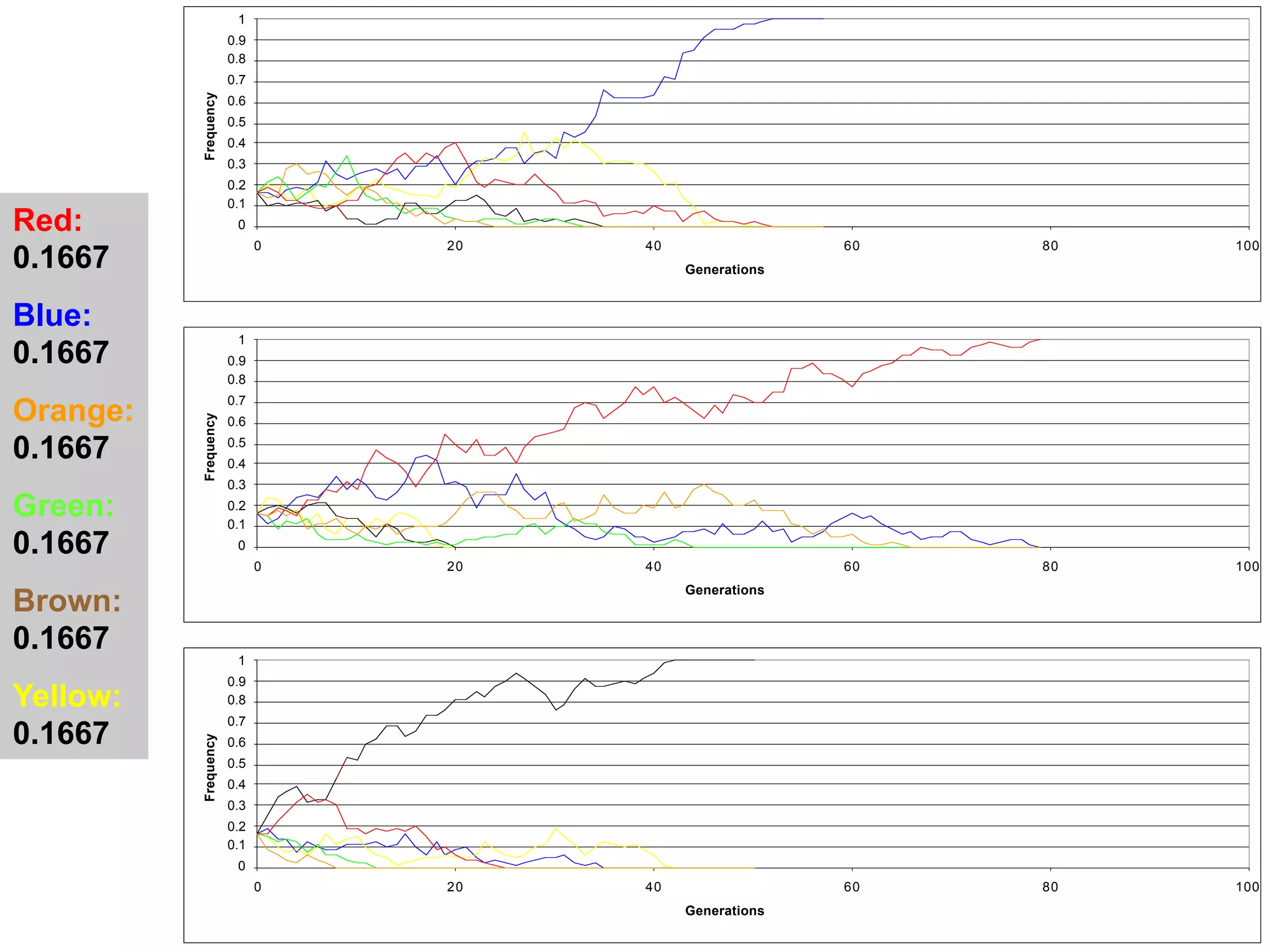
Red:
0.1667
Blue:
0.1667
Orange:
0.1667
Green:
0.1667
Brown:
0.1667
Yellow:
0.1667
0
0.1
0.2
0.3
0.4
0.5
0.6
0.7
0.8
0.9
1
0 20 40 60 80 100
Generations
Frequency
0
0.1
0.2
0.3
0.4
0.5
0.6
0.7
0.8
0.9
0 20 40 60 80 100
Generations
Heterozygosity
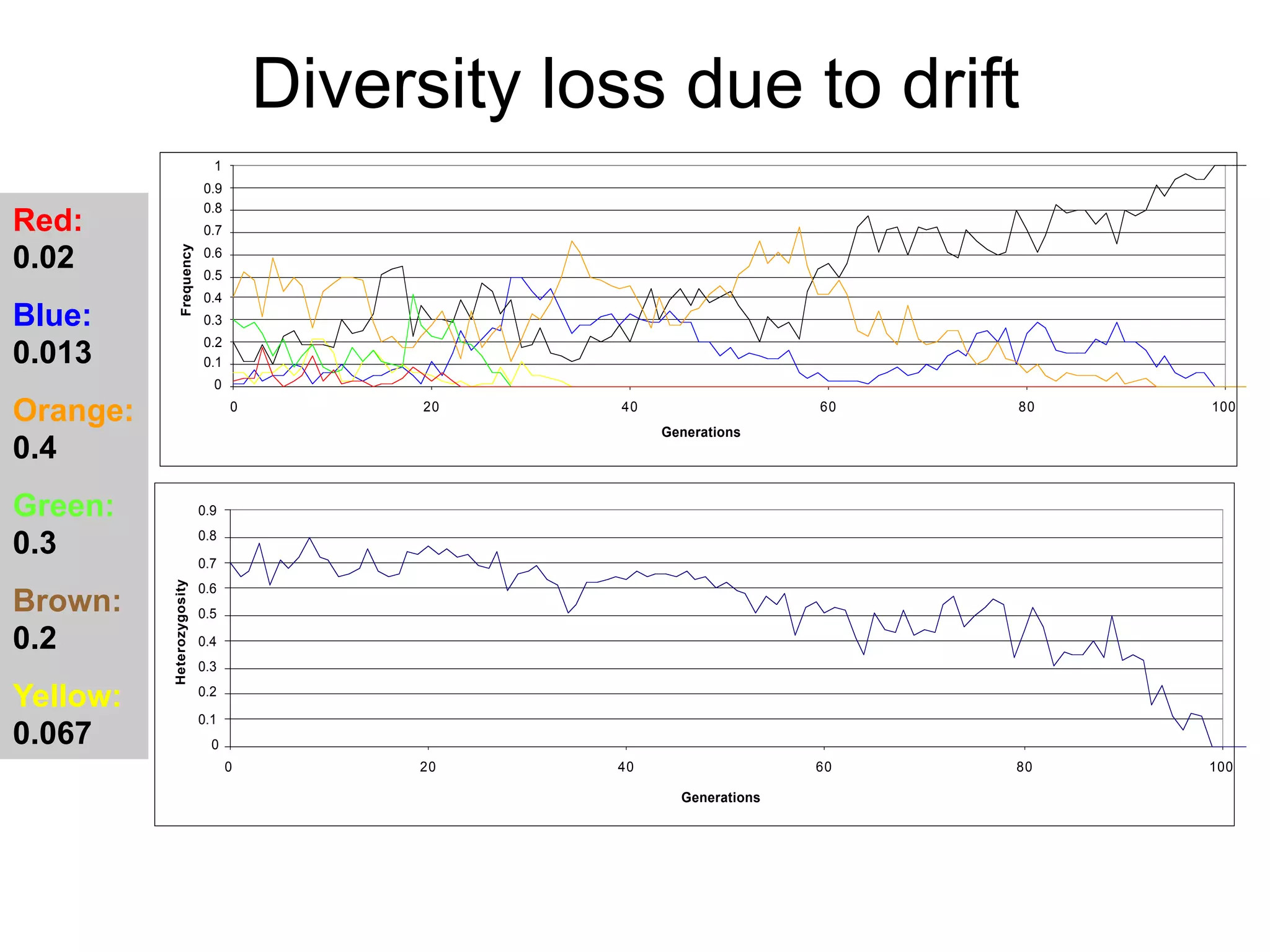
Red:
0.02
Blue:
0.013
Orange:
0.4
Green:
0.3
Brown:
0.2
Yellow:
0.067
Diversity loss due to drift
3 ‘Kinds’ of Drift
•  Drift is generally thought of as acting via
one of three processes, though all are
really examples of the same phenomena
– Bottleneck
– Founder Effect
– Stochastic Sampling
3 ‘Kinds’ of Drift
•  Drift is generally thought of as acting via
one of three processes, though all are
really examples of the same phenomena
– Bottleneck
•  Reduction in population size
– Founder Effect
•  Subset of population founds new population
– Stochastic Sampling
•  Constant effect given finite population size
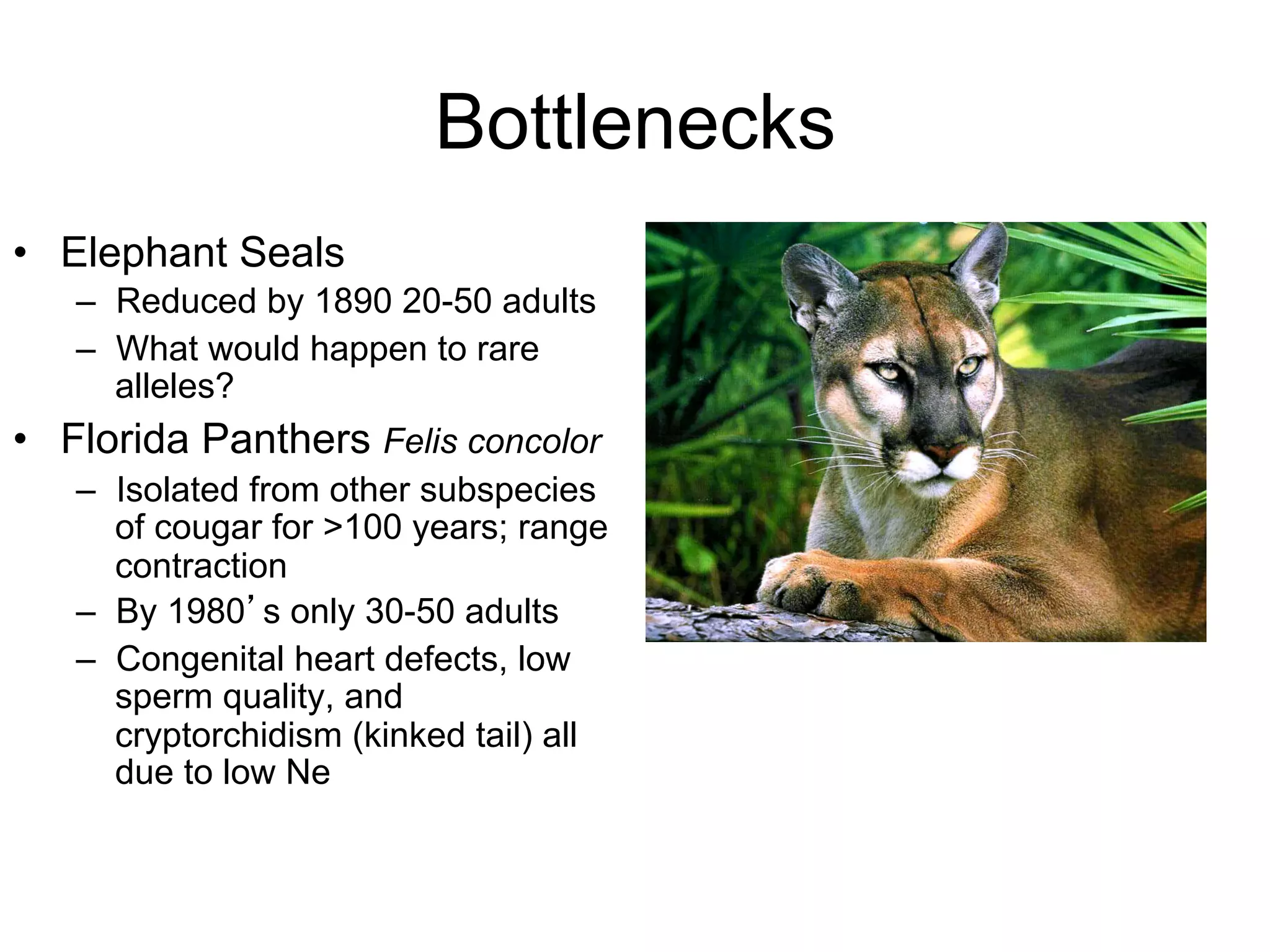
Bottlenecks
•  Elephant Seals
–  Reduced by 1890 20-50 adults
–  What would happen to rare
alleles?
•  Florida Panthers Felis concolor
–  Isolated from other subspecies
of cougar for >100 years; range
contraction
–  By 1980’s only 30-50 adults
–  Congenital heart defects, low
sperm quality, and
cryptorchidism (kinked tail) all
due to low Ne
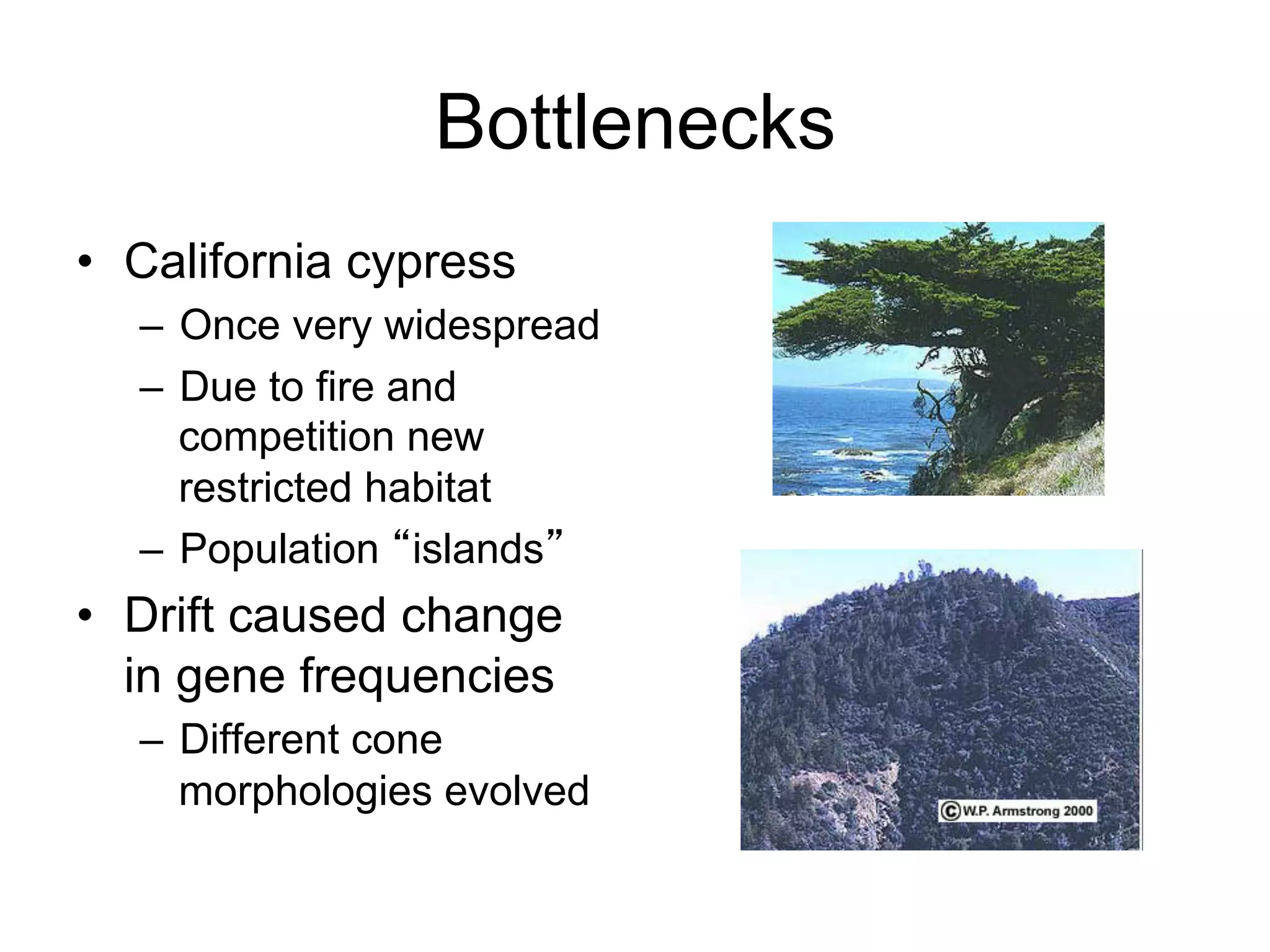
Bottlenecks
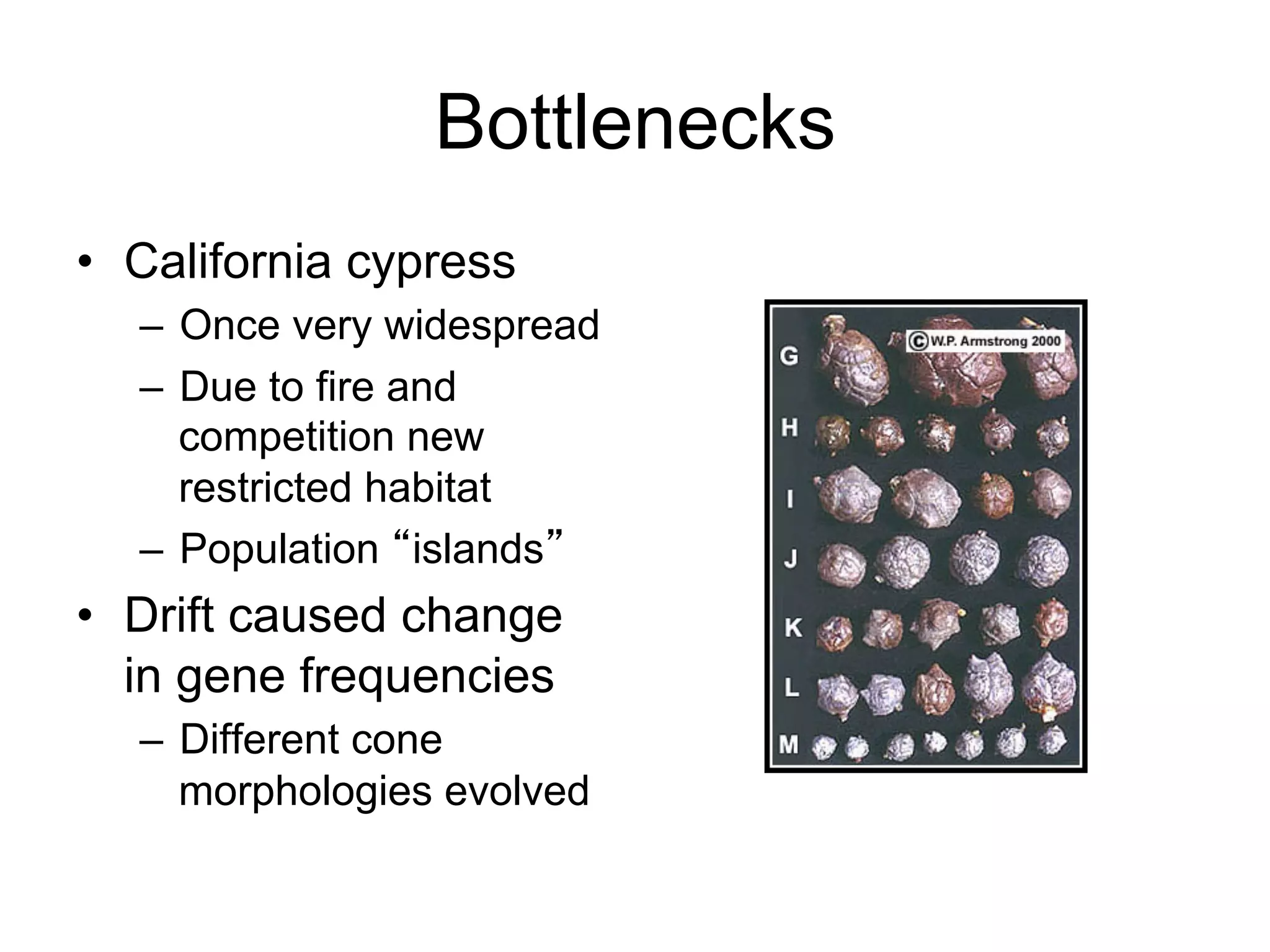
•  California cypress
–  Once very widespread
–  Due to fire and
competition new
restricted habitat
–  Population “islands”
•  Drift caused change
in gene frequencies
–  Different cone
morphologies evolved
Bottlenecks
•  California cypress
–  Once very widespread
–  Due to fire and
competition new
restricted habitat
–  Population “islands”
•  Drift caused change
in gene frequencies
–  Different cone
morphologies evolved
Simulating a Bottleneck
•  Heterozygosity: 0.71
•  Expected loss due to
one generation of
bottleneck: 1%
•  Starting population of
M&Ms:
–  Brown 0.013
–  Orange 0.02
–  Green 0.067
–  Yellow 0.20
–  Blue 0.4
–  Red 0.3
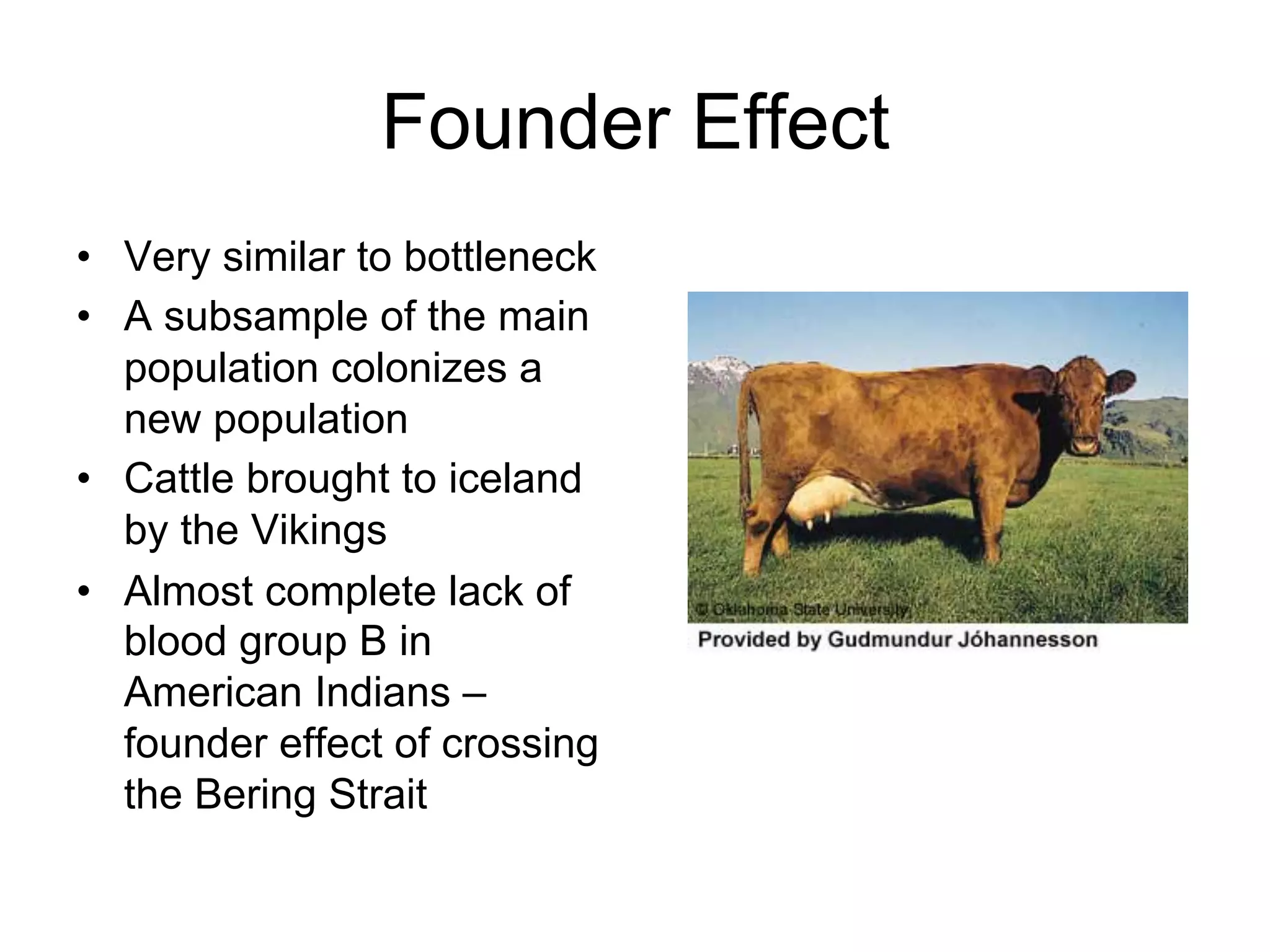
Founder Effect
•  Very similar to bottleneck
•  A subsample of the main
population colonizes a
new population
•  Cattle brought to iceland
by the Vikings
•  Almost complete lack of
blood group B in
American Indians –
founder effect of crossing
the Bering Strait
Founder Effect
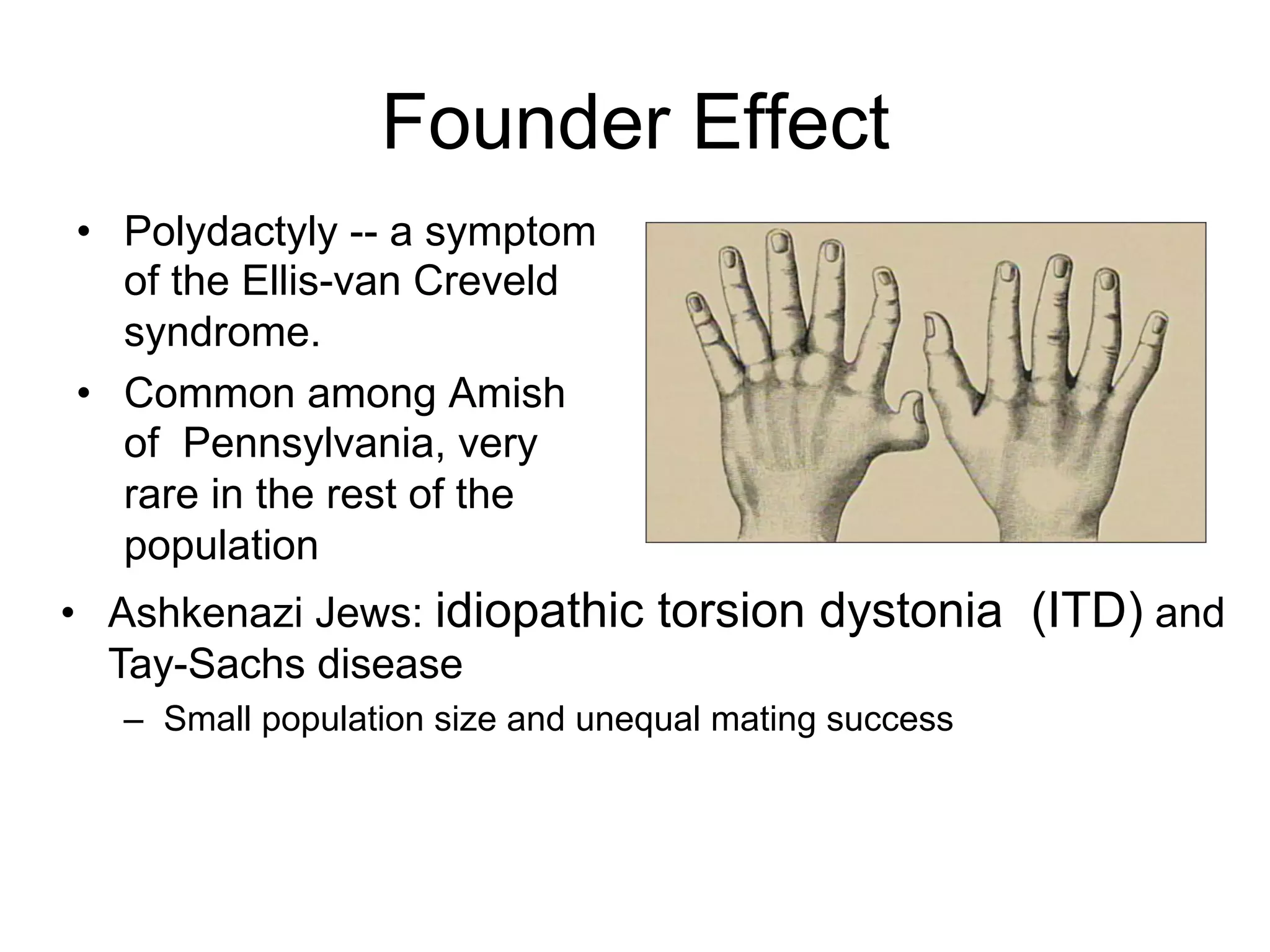
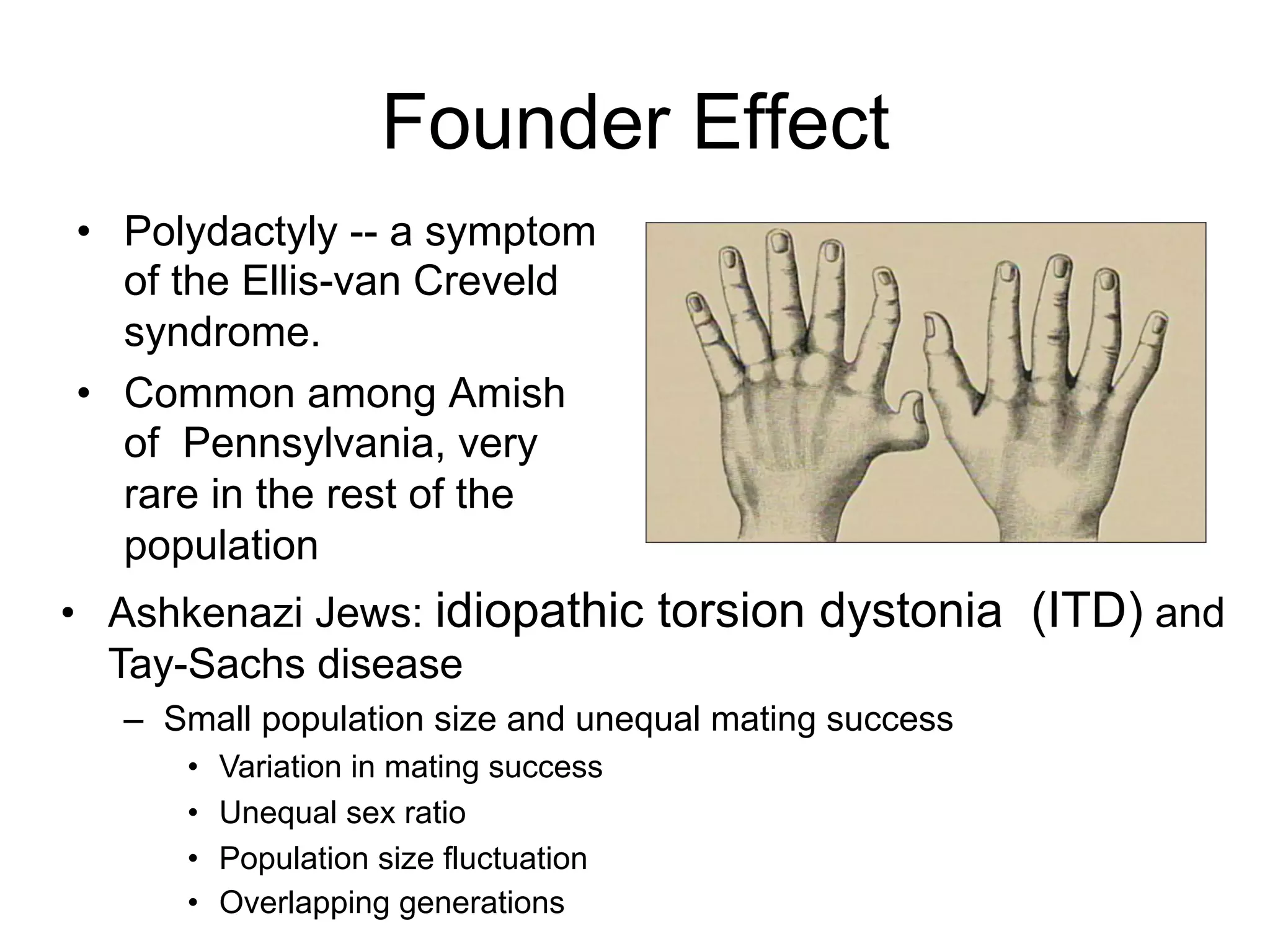
•  Polydactyly -- a symptom
of the Ellis-van Creveld
syndrome.
•  Common among Amish
of Pennsylvania, very
rare in the rest of the
population
•  Ashkenazi Jews: idiopathic torsion dystonia (ITD) and
Tay-Sachs disease
–  Small population size and unequal mating success
Founder Effect
•  Polydactyly -- a symptom
of the Ellis-van Creveld
syndrome.
•  Common among Amish
of Pennsylvania, very
rare in the rest of the
population
•  Ashkenazi Jews: idiopathic torsion dystonia (ITD) and
Tay-Sachs disease
–  Small population size and unequal mating success
•  Variation in mating success
•  Unequal sex ratio
•  Population size fluctuation
•  Overlapping generations
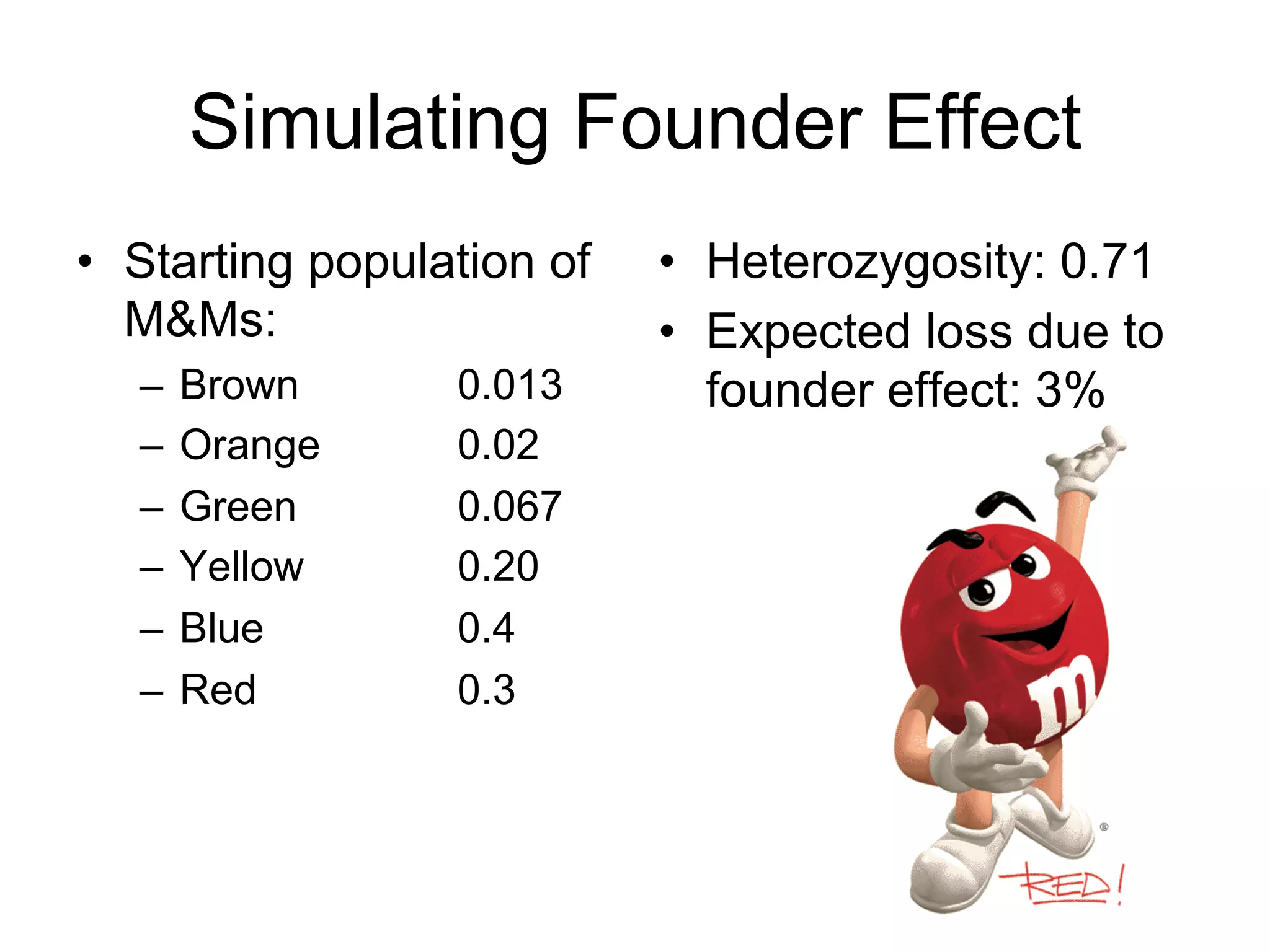
Simulating Founder Effect
•  Starting population of
M&Ms:
–  Brown 0.013
–  Orange 0.02
–  Green 0.067
–  Yellow 0.20
–  Blue 0.4
–  Red 0.3
•  Heterozygosity: 0.71
•  Expected loss due to
founder effect: 3%
Stochastic Loss
•  Happens in ALL finite populations
•  Can cause “neutral” alleles or alleles under little
selection to change in frequency dramatically
over long periods of time
•  Based on the the “bottleneck” that occurs
between generations: the number of gametes is
much greater than the number of individuals
Simulating Stochastic Loss
•  Starting population of
M&Ms:
–  Blue 0.013
–  Red 0.02
–  Yellow 0.067
–  Brown 0.20
–  Green 0.4
–  Orange 0.3
•  Heterozygosity: 0.71
•  Expected loss due to
stochastic loss: 0.5%
•  Each person will take 5 M&Ms of the same color. These
are your gametes (use them wisely).
•  Your genotype is the same as whatever color your
gametes are.
Haploid Sex with Chocolate
•  Each person will take 5 M&Ms of the same color. These
are your gametes (use them wisely).
•  Your genotype is the same as whatever color your
gametes are.
•  All students will get up from their seats and try to fertilize
as many other students as possible.
Haploid Sex with Chocolate
•  Each person will take 5 M&Ms of the same color. These
are your gametes (use them wisely).
•  Your genotype is the same as whatever color your
gametes are.
•  All students will get up from their seats and try to fertilize
as many other students as possible.
•  The Mating Rule: Give out as many gametes as
possible, but you can only accept ONE gamete
Haploid Sex with Chocolate
•  Each person will take 5 M&Ms of the same color. These
are your gametes (use them wisely).
•  Your genotype is the same as whatever color your
gametes are.
•  All students will get up from their seats and try to fertilize
as many other students as possible.
•  The Mating Rule: Give out as many gametes as
possible, but you can only accept ONE gamete
•  At the end of the simulation the new gamete you
accepted becomes your genotype in the next generation.
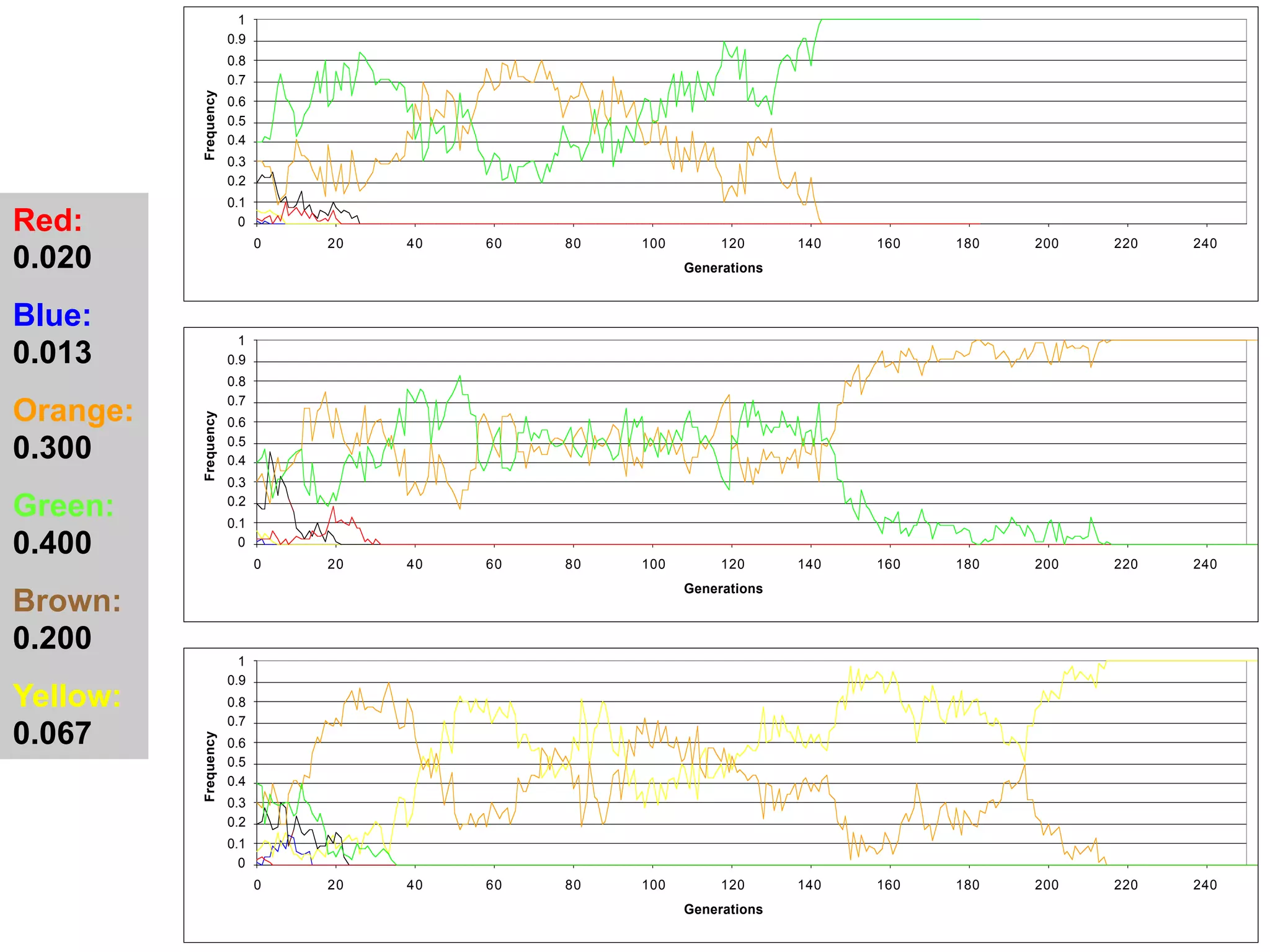
Red:
0.020
Blue:
0.013
Orange:
0.300
Green:
0.400
Brown:
0.200
Yellow:
0.067
0
0.1
0.2
0.3
0.4
0.5
0.6
0.7
0.8
0.9
1
0 20 40 60 80 100 120 140 160 180 200 220 240
Generations
Frequency
0
0.1
0.2
0.3
0.4
0.5
0.6
0.7
0.8
0.9
1
0 20 40 60 80 100 120 140 160 180 200 220 240
Generations
Frequency
0
0.1
0.2
0.3
0.4
0.5
0.6
0.7
0.8
0.9
1
0 20 40 60 80 100 120 140 160 180 200 220 240
Generations
Frequency
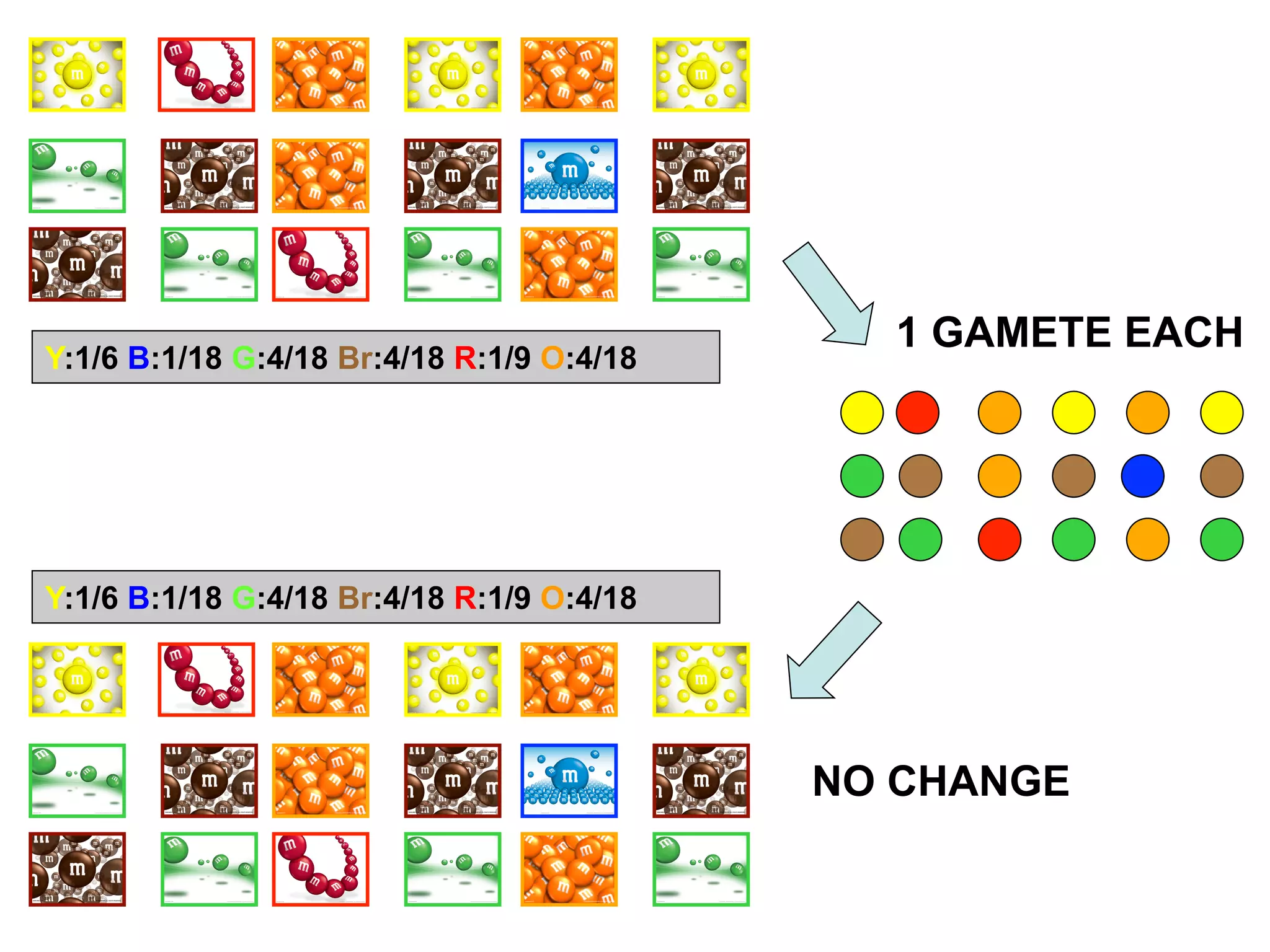
NO CHANGE
1 GAMETE EACH
Y:1/6 B:1/18 G:4/18 Br:4/18 R:1/9 O:4/18
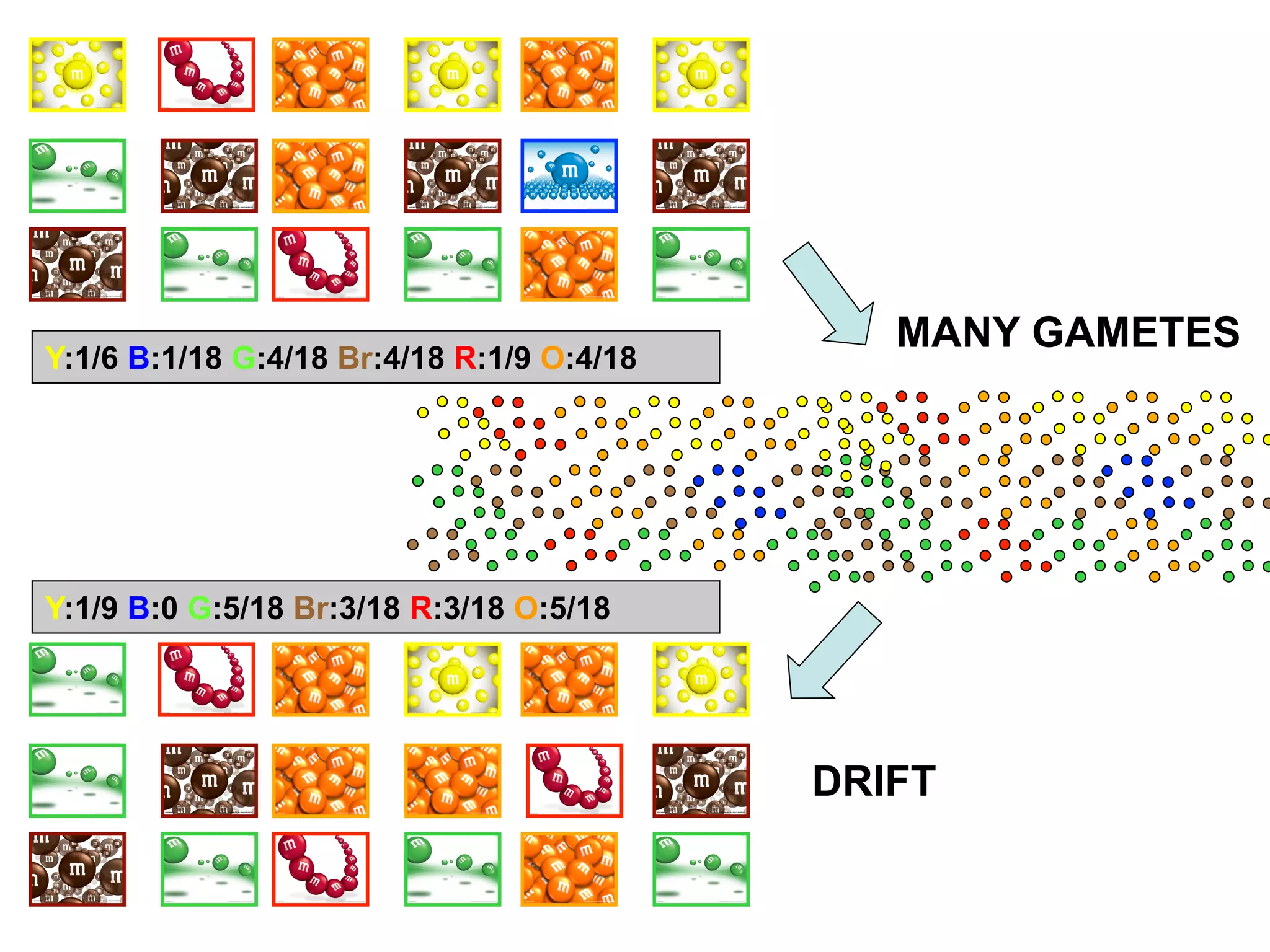
MANY GAMETES
DRIFT
Y:1/6 B:1/18 G:4/18 Br:4/18 R:1/9 O:4/18
Y:1/9 B:0 G:5/18 Br:3/18 R:3/18 O:5/18
Drift
Drift
Drift
Drift
Drift
Drift

Drift

  • 1.
    Genetic Drift (andHaploid Sex with Chocolate) Lady Luck and the M&M’s at her mercy
  • 2.
    Drift •  Genetic drift:change in allele frequency over time due to stochastic effects •  Independent of selection –  does not mean that fitness is unimportant •  Can cause nonadaptive or maladaptive evolution
  • 3.
    0 0.1 0.2 0.3 0.4 0.5 0.6 0.7 0.8 0.9 1 0 20 4060 80 100 Generations Frequency 0 0.1 0.2 0.3 0.4 0.5 0.6 0.7 0.8 0.9 1 0 20 40 60 80 100 Generations Frequency 0 0.1 0.2 0.3 0.4 0.5 0.6 0.7 0.8 0.9 1 0 20 40 60 80 100 Generations Frequency Red: 0.1667 Blue: 0.1667 Orange: 0.1667 Green: 0.1667 Brown: 0.1667 Yellow: 0.1667
  • 4.
    0 0.1 0.2 0.3 0.4 0.5 0.6 0.7 0.8 0.9 1 0 20 4060 80 100 Generations Frequency 0 0.1 0.2 0.3 0.4 0.5 0.6 0.7 0.8 0.9 0 20 40 60 80 100 Generations Heterozygosity Red: 0.02 Blue: 0.013 Orange: 0.4 Green: 0.3 Brown: 0.2 Yellow: 0.067 Diversity loss due to drift
  • 5.
    3 ‘Kinds’ ofDrift •  Drift is generally thought of as acting via one of three processes, though all are really examples of the same phenomena – Bottleneck – Founder Effect – Stochastic Sampling
  • 6.
    3 ‘Kinds’ ofDrift •  Drift is generally thought of as acting via one of three processes, though all are really examples of the same phenomena – Bottleneck •  Reduction in population size – Founder Effect •  Subset of population founds new population – Stochastic Sampling •  Constant effect given finite population size
  • 7.
    Bottlenecks •  Elephant Seals – Reduced by 1890 20-50 adults –  What would happen to rare alleles? •  Florida Panthers Felis concolor –  Isolated from other subspecies of cougar for >100 years; range contraction –  By 1980’s only 30-50 adults –  Congenital heart defects, low sperm quality, and cryptorchidism (kinked tail) all due to low Ne
  • 8.
    Bottlenecks •  California cypress – Once very widespread –  Due to fire and competition new restricted habitat –  Population “islands” •  Drift caused change in gene frequencies –  Different cone morphologies evolved
  • 9.
    Bottlenecks •  California cypress – Once very widespread –  Due to fire and competition new restricted habitat –  Population “islands” •  Drift caused change in gene frequencies –  Different cone morphologies evolved
  • 10.
    Simulating a Bottleneck • Heterozygosity: 0.71 •  Expected loss due to one generation of bottleneck: 1% •  Starting population of M&Ms: –  Brown 0.013 –  Orange 0.02 –  Green 0.067 –  Yellow 0.20 –  Blue 0.4 –  Red 0.3
  • 11.
    Founder Effect •  Verysimilar to bottleneck •  A subsample of the main population colonizes a new population •  Cattle brought to iceland by the Vikings •  Almost complete lack of blood group B in American Indians – founder effect of crossing the Bering Strait
  • 12.
    Founder Effect •  Polydactyly-- a symptom of the Ellis-van Creveld syndrome. •  Common among Amish of Pennsylvania, very rare in the rest of the population •  Ashkenazi Jews: idiopathic torsion dystonia (ITD) and Tay-Sachs disease –  Small population size and unequal mating success
  • 13.
    Founder Effect •  Polydactyly-- a symptom of the Ellis-van Creveld syndrome. •  Common among Amish of Pennsylvania, very rare in the rest of the population •  Ashkenazi Jews: idiopathic torsion dystonia (ITD) and Tay-Sachs disease –  Small population size and unequal mating success •  Variation in mating success •  Unequal sex ratio •  Population size fluctuation •  Overlapping generations
  • 14.
    Simulating Founder Effect • Starting population of M&Ms: –  Brown 0.013 –  Orange 0.02 –  Green 0.067 –  Yellow 0.20 –  Blue 0.4 –  Red 0.3 •  Heterozygosity: 0.71 •  Expected loss due to founder effect: 3%
  • 15.
    Stochastic Loss •  Happensin ALL finite populations •  Can cause “neutral” alleles or alleles under little selection to change in frequency dramatically over long periods of time •  Based on the the “bottleneck” that occurs between generations: the number of gametes is much greater than the number of individuals
  • 16.
    Simulating Stochastic Loss • Starting population of M&Ms: –  Blue 0.013 –  Red 0.02 –  Yellow 0.067 –  Brown 0.20 –  Green 0.4 –  Orange 0.3 •  Heterozygosity: 0.71 •  Expected loss due to stochastic loss: 0.5%
  • 17.
    •  Each personwill take 5 M&Ms of the same color. These are your gametes (use them wisely). •  Your genotype is the same as whatever color your gametes are. Haploid Sex with Chocolate
  • 18.
    •  Each personwill take 5 M&Ms of the same color. These are your gametes (use them wisely). •  Your genotype is the same as whatever color your gametes are. •  All students will get up from their seats and try to fertilize as many other students as possible. Haploid Sex with Chocolate
  • 19.
    •  Each personwill take 5 M&Ms of the same color. These are your gametes (use them wisely). •  Your genotype is the same as whatever color your gametes are. •  All students will get up from their seats and try to fertilize as many other students as possible. •  The Mating Rule: Give out as many gametes as possible, but you can only accept ONE gamete Haploid Sex with Chocolate
  • 20.
    Haploid Sex withChocolate •  Each person will take 5 M&Ms of the same color. These are your gametes (use them wisely). •  Your genotype is the same as whatever color your gametes are. •  All students will get up from their seats and try to fertilize as many other students as possible. •  The Mating Rule: Give out as many gametes as possible, but you can only accept ONE gamete •  At the end of the simulation the new gamete you accepted becomes your genotype in the next generation.
  • 21.
    Red: 0.020 Blue: 0.013 Orange: 0.300 Green: 0.400 Brown: 0.200 Yellow: 0.067 0 0.1 0.2 0.3 0.4 0.5 0.6 0.7 0.8 0.9 1 0 20 4060 80 100 120 140 160 180 200 220 240 Generations Frequency 0 0.1 0.2 0.3 0.4 0.5 0.6 0.7 0.8 0.9 1 0 20 40 60 80 100 120 140 160 180 200 220 240 Generations Frequency 0 0.1 0.2 0.3 0.4 0.5 0.6 0.7 0.8 0.9 1 0 20 40 60 80 100 120 140 160 180 200 220 240 Generations Frequency
  • 22.
    NO CHANGE 1 GAMETEEACH Y:1/6 B:1/18 G:4/18 Br:4/18 R:1/9 O:4/18 Y:1/6 B:1/18 G:4/18 Br:4/18 R:1/9 O:4/18
  • 23.
    MANY GAMETES DRIFT Y:1/6 B:1/18G:4/18 Br:4/18 R:1/9 O:4/18 Y:1/9 B:0 G:5/18 Br:3/18 R:3/18 O:5/18