BIOLOGICAL
SCIENCES
By:
MARIA KRISIA
FAE DELOS
REYES DE ASIS,
BSN-RN
TISSUE LEVEL OF
ORGANIZATION
COVERING AND LINING EPITHELIUM
- classified according to two
characteristics:

1. Arrangement of cells in layers
- Depends on the function
a. SIMPLE EPITHELIUM
- a single layer of cells
that functions in DIFFUSION,
OSMOSIS, FILTRATION,
SECRETION, and ABSORPTION
TISSUE LEVEL OF
ORGANIZATION
b. PSEUDOSTRATIFIED EPITHELIUM
- appears to have multiple
layers of cells because the
cell nuclei lie at different
levels and not all cells reach
the apical surface
- cells that do not extend
to the apical surface may
contain cilia (TRACHEA &
LUNGS); others (GOBLET CELLS)
secrete mucus
TISSUE LEVEL OF
ORGANIZATION
- they are actually simple
epithelium because all cells
are attached to the basement
membrane. However, they appear
like stratified epithelium,
thus the term
pseudostratified; pseudo
meaning “false”
TISSUE LEVEL OF
ORGANIZATION
c. STRATIFIED EPITHELIUM
- consists of two or more
layers of cells that protect
underlying tissues and
locations where there is
considerable wear and tear
HARD PALATE
TISSUE LEVEL OF
ORGANIZATION
2. Cell shapes
a. SQUAMOUS CELLS
- arranged like floor tiles
and are thin, which allows the
rapid passage of substances
b. CUBOIDAL CELLS
- as tall as they are wide
and are shaped like cubes or
hexagons. May have microvilli
at apical surface
(secretion/absorption)
TISSUE LEVEL OF
ORGANIZATION
c. COLUMNAR CELLS
- consists of two or more
layers of cells that protect
underlying tissues and
locations where there is
considerable wear and tear
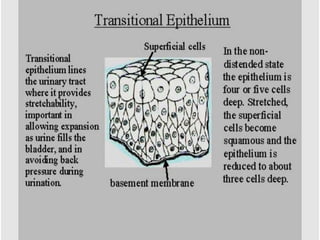
d. TRANSITIONAL CELLS
- change shape from flat to
cuboidal. Ex. Uterus, urinary
bladder
URINARY BLADDER
TISSUE LEVEL OF
ORGANIZATION
- Combining the two
characteristics, the types of
covering and lining epithelia
are as follows:
I. SIMPLE EPITHELIUM
A. SIMPLE SQUAMOUS EPITHELIUM
B. SIMPLE CUBOIDAL EPITHELIUM
C. SIMPLE COLUMNAR EPITHELIUM
(CILIATED AND NON-CILIATED)
D. PSEUDOSTRATIFIED COLUMNAR
EPITHELIUM (CILIATED AND
NON-CILIATED)
TISSUE LEVEL OF
ORGANIZATION
II. STRATIFIED EPITHELIUM
A. STRATIFIED SQUAMOUS EPITHELIUM
(KERATINIZED AND NONKERATINIZED)
B. STRATIFIED CUBOIDAL EPITHELIUM*
C. STRATIFIED COLUMNAR EPITHELIUM*
D. TRANSITIONAL EPITHELIUM

* - based on the shape of the
cells at the APICAL surface
GASTROINTESTINAL
TRACT
Transitional epithelium
Biological sciences6

Biological sciences6

  • 1.
  • 2.
    TISSUE LEVEL OF ORGANIZATION COVERINGAND LINING EPITHELIUM - classified according to two characteristics: 1. Arrangement of cells in layers - Depends on the function a. SIMPLE EPITHELIUM - a single layer of cells that functions in DIFFUSION, OSMOSIS, FILTRATION, SECRETION, and ABSORPTION
  • 5.
    TISSUE LEVEL OF ORGANIZATION b.PSEUDOSTRATIFIED EPITHELIUM - appears to have multiple layers of cells because the cell nuclei lie at different levels and not all cells reach the apical surface - cells that do not extend to the apical surface may contain cilia (TRACHEA & LUNGS); others (GOBLET CELLS) secrete mucus
  • 6.
    TISSUE LEVEL OF ORGANIZATION -they are actually simple epithelium because all cells are attached to the basement membrane. However, they appear like stratified epithelium, thus the term pseudostratified; pseudo meaning “false”
  • 9.
    TISSUE LEVEL OF ORGANIZATION c.STRATIFIED EPITHELIUM - consists of two or more layers of cells that protect underlying tissues and locations where there is considerable wear and tear
  • 10.
  • 11.
    TISSUE LEVEL OF ORGANIZATION 2.Cell shapes a. SQUAMOUS CELLS - arranged like floor tiles and are thin, which allows the rapid passage of substances b. CUBOIDAL CELLS - as tall as they are wide and are shaped like cubes or hexagons. May have microvilli at apical surface (secretion/absorption)
  • 15.
    TISSUE LEVEL OF ORGANIZATION c.COLUMNAR CELLS - consists of two or more layers of cells that protect underlying tissues and locations where there is considerable wear and tear d. TRANSITIONAL CELLS - change shape from flat to cuboidal. Ex. Uterus, urinary bladder
  • 17.
  • 19.
    TISSUE LEVEL OF ORGANIZATION -Combining the two characteristics, the types of covering and lining epithelia are as follows: I. SIMPLE EPITHELIUM A. SIMPLE SQUAMOUS EPITHELIUM B. SIMPLE CUBOIDAL EPITHELIUM C. SIMPLE COLUMNAR EPITHELIUM (CILIATED AND NON-CILIATED) D. PSEUDOSTRATIFIED COLUMNAR EPITHELIUM (CILIATED AND NON-CILIATED)
  • 20.
    TISSUE LEVEL OF ORGANIZATION II.STRATIFIED EPITHELIUM A. STRATIFIED SQUAMOUS EPITHELIUM (KERATINIZED AND NONKERATINIZED) B. STRATIFIED CUBOIDAL EPITHELIUM* C. STRATIFIED COLUMNAR EPITHELIUM* D. TRANSITIONAL EPITHELIUM * - based on the shape of the cells at the APICAL surface
  • 26.
  • 46.