EPITHELIAL TISSUE
BY
DAVID, BEAULAH M.
EPITHELIUM
EPITHELIUM is a tissue composed of cells that lines
the cavities and surfaces of structures throughout the
body
Epithelial tissue is avascular (no blood vessel )
Epithelial tissue receives nutrition by diffusion from
underlying C.T
CLASSIFICATION OF EPITHELIAL TISSUES
can be classified based on:
1. Their basic shape
2. the number of layers (in which the
cells are arranged).
BASED ON SHAPE
Cells can be
Squamous
Cuboidal
Columnar
Squamous: have an appearance of flat plates
The cells, tend to be horizontally flattened, shaped like an egg
Cuboidal: these are cuboid in shape, the cells have spherical
nucleus at the centre
Columnar : these are elongated and column shaped
they are taller as they are wider
BASED ON NUMBER OF CELL LAYERS:
 Simple
 Stratified
 Pseudostratified
Simple epithelium
Epithelium with only one layer
Stratified epithelium: has two or more cell layers
Pseudostratified epithelium: they are not truly
stratified; they look as if they have different cell
layers but it is only one layer.
The epithelium can also be named using
a combination of the two bases
Example
 Simple squamous
 Stratified squamous
 Simple cuboidal
 Simple columnar
SIMPLE SQUAMOUS
EPITHELIUM:
– Single layer of flattened
cells
– Function: secretion,
absorption, and filtration
– Location: lines the
lungs, blood vessels and
heart
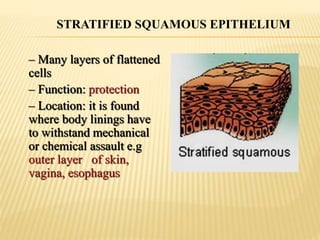
– Many layers of flattened
cells
– Function: protection
– Location: it is found
where body linings have
to withstand mechanical
or chemical assault e.g
outer layer of skin,
vagina, esophagus
STRATIFIED SQUAMOUS EPITHELIUM
► Cells appear to be layered
due to irregularly placed
nuclei but each cell touches
the basement membrane
► May contain cilia – aids in
movement of particles
► Function: protection,
secretion, movement of
mucus and sex cells
► Location: respiratory tract,
reproductive tract
PSEUDOSTRATIFIED EPITHELIUM
►Tissue that changes in
response to tension
►Found in organs that
need to stretch
►Location: urinary
bladder, ureters, urethra
TRANSITIONAL EPITHELIUM
TYPES OF EPITHELIUM AND THEIR LOCATION
EPI LOCATION FUNCTION
SIMPLE SQUAMOUS Air sacs of lungs, blood
vessels
Diffusion and filtration
SIMPLE CUBIODAL EPI Kidney, ovary, duodenum Secretes and absorbs
Simple columnar Digestive tract, gall
bladder, jejunum,
stomach, ileum
Absorbs, secretes
Stratified squamous Esophagus, tongue,
vagina, skin
Protect against abrasion
Transitional epithelium Urinary bladder, ureter
Stratified cuboidal Sweat glands, salivary
glands, mammary glands
secretes
Pseudostratified
epithelium
Trachea, larynx Secretes mucus , has cilia
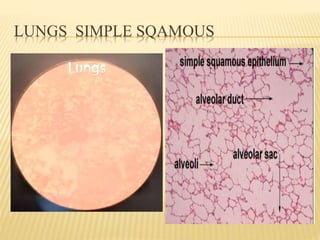
LUNGS SIMPLE SQAMOUS
LARYNX PSUEDOSTRATIFIED
TRACHEA PSEUDOSTRATIFIED
SALIVARY GLAND STRATIFIED CUBOIDAL
ESOPHAGUS STRATIFIED SQUAMOUS
JEJENUM SIMPLE COLUMNAR
GALL BLADDER SIMPLE COLUMNAR
VAGINA STRATIFIED SQUAMOUS NON
KERATINIZED
OVARY SIMPLE CUBOIDAL
STOMACH SIMPLE COLUMNAR
MAMMARY GLAND STRATIFIED CUBOIDAL
ILEUM SIMPLE COLUMNAR
DUODENUM SIMPLE CUBOIDAL

EPITHELIUM-1.pptx

  • 1.
  • 2.
    EPITHELIUM EPITHELIUM is atissue composed of cells that lines the cavities and surfaces of structures throughout the body Epithelial tissue is avascular (no blood vessel ) Epithelial tissue receives nutrition by diffusion from underlying C.T
  • 4.
    CLASSIFICATION OF EPITHELIALTISSUES can be classified based on: 1. Their basic shape 2. the number of layers (in which the cells are arranged).
  • 5.
    BASED ON SHAPE Cellscan be Squamous Cuboidal Columnar Squamous: have an appearance of flat plates The cells, tend to be horizontally flattened, shaped like an egg Cuboidal: these are cuboid in shape, the cells have spherical nucleus at the centre Columnar : these are elongated and column shaped they are taller as they are wider
  • 6.
    BASED ON NUMBEROF CELL LAYERS:  Simple  Stratified  Pseudostratified Simple epithelium Epithelium with only one layer Stratified epithelium: has two or more cell layers Pseudostratified epithelium: they are not truly stratified; they look as if they have different cell layers but it is only one layer.
  • 7.
    The epithelium canalso be named using a combination of the two bases Example  Simple squamous  Stratified squamous  Simple cuboidal  Simple columnar
  • 8.
    SIMPLE SQUAMOUS EPITHELIUM: – Singlelayer of flattened cells – Function: secretion, absorption, and filtration – Location: lines the lungs, blood vessels and heart
  • 10.
    – Many layersof flattened cells – Function: protection – Location: it is found where body linings have to withstand mechanical or chemical assault e.g outer layer of skin, vagina, esophagus STRATIFIED SQUAMOUS EPITHELIUM
  • 11.
    ► Cells appearto be layered due to irregularly placed nuclei but each cell touches the basement membrane ► May contain cilia – aids in movement of particles ► Function: protection, secretion, movement of mucus and sex cells ► Location: respiratory tract, reproductive tract PSEUDOSTRATIFIED EPITHELIUM
  • 12.
    ►Tissue that changesin response to tension ►Found in organs that need to stretch ►Location: urinary bladder, ureters, urethra TRANSITIONAL EPITHELIUM
  • 13.
    TYPES OF EPITHELIUMAND THEIR LOCATION EPI LOCATION FUNCTION SIMPLE SQUAMOUS Air sacs of lungs, blood vessels Diffusion and filtration SIMPLE CUBIODAL EPI Kidney, ovary, duodenum Secretes and absorbs Simple columnar Digestive tract, gall bladder, jejunum, stomach, ileum Absorbs, secretes Stratified squamous Esophagus, tongue, vagina, skin Protect against abrasion Transitional epithelium Urinary bladder, ureter Stratified cuboidal Sweat glands, salivary glands, mammary glands secretes Pseudostratified epithelium Trachea, larynx Secretes mucus , has cilia
  • 14.
  • 15.
  • 16.
  • 17.
  • 18.
  • 19.
  • 20.
  • 21.
  • 22.
  • 23.
  • 24.
  • 25.
  • 26.