PLANT TISSUESPLANT TISSUES
Aiswarya.S.HAiswarya.S.H
Natural scienceNatural science
Roll No:181 14 361 001Roll No:181 14 361 001
EMMANUEL COLLEGE OFEMMANUEL COLLEGE OF
B. Ed TrainingB. Ed Training
VAZHICHALVAZHICHAL
PLANT TISSUESPLANT TISSUES
A group of structurally and functionallyA group of structurally and functionally
similar cells are combined to formsimilar cells are combined to form
tissues.tissues.
The tissue present in plant is called plantThe tissue present in plant is called plant
tissuetissue
TYPES OF PLANT TISSUESTYPES OF PLANT TISSUES
• ParenchymaParenchyma
• CollenchymaCollenchyma
• SclerenchymaSclerenchyma
• XylemXylem
• phloemphloem
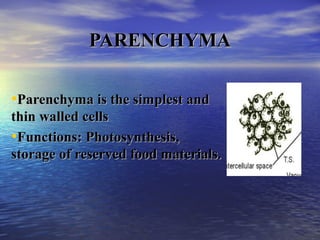
PARENCHYMAPARENCHYMA
•Parenchyma is the simplest andParenchyma is the simplest and
thin walled cellsthin walled cells
•Functions: Photosynthesis,Functions: Photosynthesis,
storage of reserved food materials.storage of reserved food materials.
COLLENCHYMACOLLENCHYMA
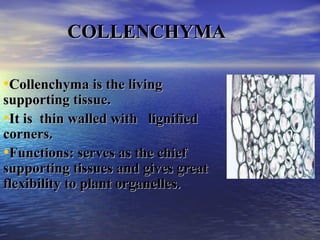
•Collenchyma is the livingCollenchyma is the living
supporting tissue.supporting tissue.
•It is thin walled with lignifiedIt is thin walled with lignified
corners.corners.
•Functions: serves as the chiefFunctions: serves as the chief
supporting tissues and gives greatsupporting tissues and gives great
flexibility to plant organelles.flexibility to plant organelles.
SCLERENCHYMASCLERENCHYMA
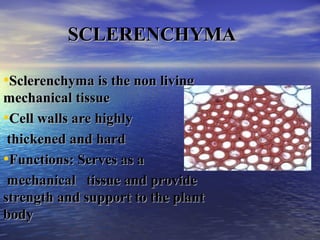
•Sclerenchyma is the non livingSclerenchyma is the non living
mechanical tissuemechanical tissue
•Cell walls are highlyCell walls are highly
thickened and hardthickened and hard
•Functions: Serves as aFunctions: Serves as a
mechanical tissue and providemechanical tissue and provide
strength and support to the plantstrength and support to the plant
bodybody
XYLEM AND PHLOEMXYLEM AND PHLOEM
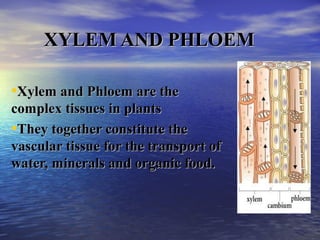
•Xylem and Phloem are theXylem and Phloem are the
complex tissues in plantscomplex tissues in plants
•They together constitute theThey together constitute the
vascular tissue for the transport ofvascular tissue for the transport of
water, minerals and organic food.water, minerals and organic food.

Plant tissues

  • 1.
    PLANT TISSUESPLANT TISSUES Aiswarya.S.HAiswarya.S.H NaturalscienceNatural science Roll No:181 14 361 001Roll No:181 14 361 001 EMMANUEL COLLEGE OFEMMANUEL COLLEGE OF B. Ed TrainingB. Ed Training VAZHICHALVAZHICHAL
  • 2.
    PLANT TISSUESPLANT TISSUES Agroup of structurally and functionallyA group of structurally and functionally similar cells are combined to formsimilar cells are combined to form tissues.tissues. The tissue present in plant is called plantThe tissue present in plant is called plant tissuetissue
  • 3.
    TYPES OF PLANTTISSUESTYPES OF PLANT TISSUES • ParenchymaParenchyma • CollenchymaCollenchyma • SclerenchymaSclerenchyma • XylemXylem • phloemphloem
  • 4.
    PARENCHYMAPARENCHYMA •Parenchyma is thesimplest andParenchyma is the simplest and thin walled cellsthin walled cells •Functions: Photosynthesis,Functions: Photosynthesis, storage of reserved food materials.storage of reserved food materials.
  • 5.
    COLLENCHYMACOLLENCHYMA •Collenchyma is thelivingCollenchyma is the living supporting tissue.supporting tissue. •It is thin walled with lignifiedIt is thin walled with lignified corners.corners. •Functions: serves as the chiefFunctions: serves as the chief supporting tissues and gives greatsupporting tissues and gives great flexibility to plant organelles.flexibility to plant organelles.
  • 6.
    SCLERENCHYMASCLERENCHYMA •Sclerenchyma is thenon livingSclerenchyma is the non living mechanical tissuemechanical tissue •Cell walls are highlyCell walls are highly thickened and hardthickened and hard •Functions: Serves as aFunctions: Serves as a mechanical tissue and providemechanical tissue and provide strength and support to the plantstrength and support to the plant bodybody
  • 7.
    XYLEM AND PHLOEMXYLEMAND PHLOEM •Xylem and Phloem are theXylem and Phloem are the complex tissues in plantscomplex tissues in plants •They together constitute theThey together constitute the vascular tissue for the transport ofvascular tissue for the transport of water, minerals and organic food.water, minerals and organic food.