Biological Nitrogen Fixation
By
Dr. S.SELVARAJ
Assistant professor
Dept. of Zoology
Vivekananda College
1
2
Synopsis
 Introduction
 Types of nitrogen fixation
 Atmospheric nitrogen fixation
 Industrial nitrogen fixation
 Biological nitrogen fixation
 Requirement for biological nitrogen fixation
 Types of biological nitrogen fixation
i) Symbiotic nitrogen fixation
 Nodules formation- stages
ii) Non-symbiotic nitrogen fixation
 Heterocyst-specialised cell
 Conclusion
 References
3
Introduction
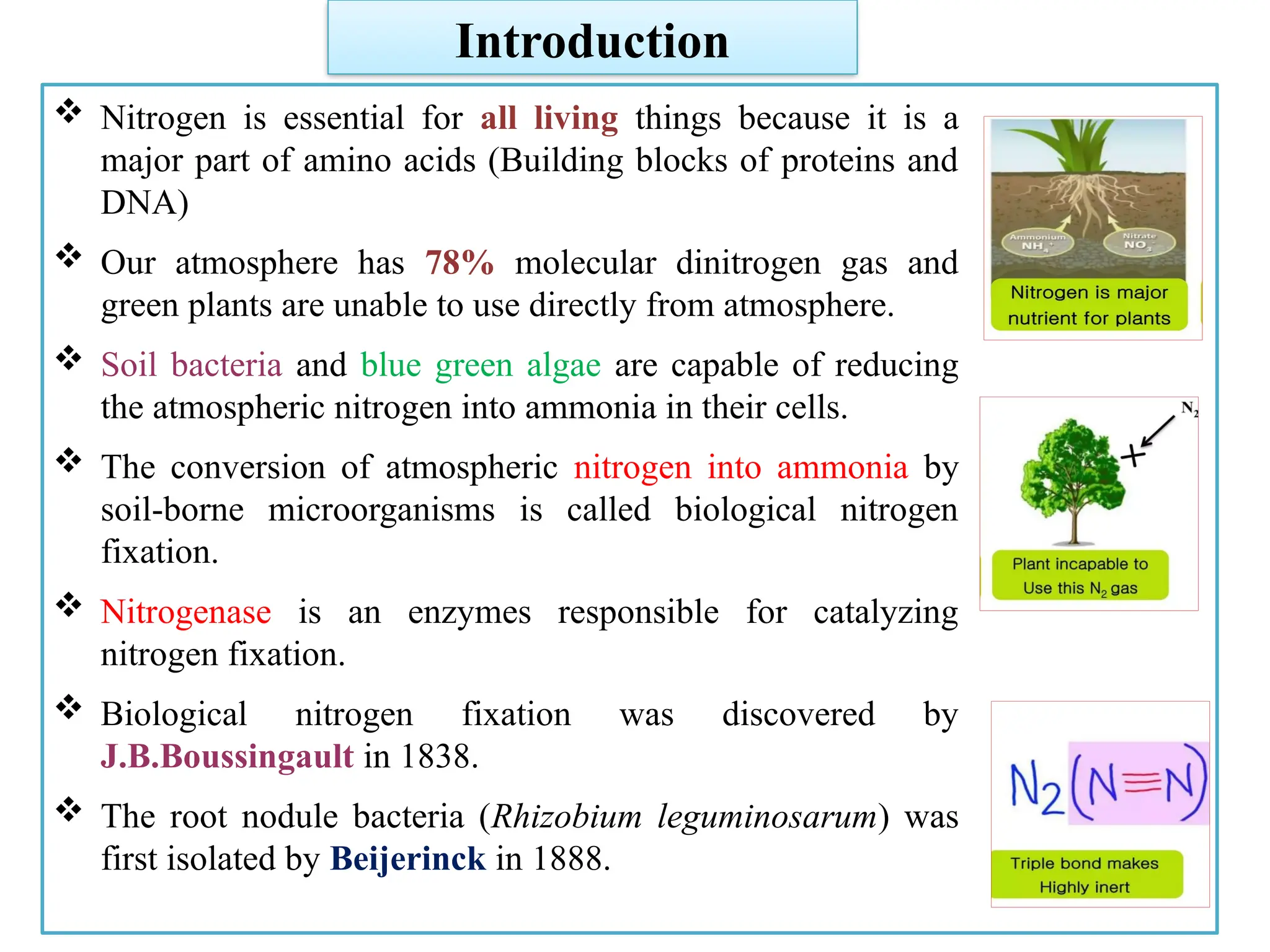
 Nitrogen is essential for all living things because it is a
major part of amino acids (Building blocks of proteins and
DNA)
 Our atmosphere has 78% molecular dinitrogen gas and
green plants are unable to use directly from atmosphere.
 Soil bacteria and blue green algae are capable of reducing
the atmospheric nitrogen into ammonia in their cells.
 The conversion of atmospheric nitrogen into ammonia by
soil-borne microorganisms is called biological nitrogen
fixation.
 Nitrogenase is an enzymes responsible for catalyzing
nitrogen fixation.
 Biological nitrogen fixation was discovered by
J.B.Boussingault in 1838.
 The root nodule bacteria (Rhizobium leguminosarum) was
first isolated by Beijerinck in 1888.
4
Nitrogen cycle
5
Types of nitrogen fixation
1. Atmospheric nitrogen fixation
Lighting breaks nitrogen molecules
Nitrogen combines with oxygen
Nitrogen oxides (N2O) formed
Nitrogen oxides (N2O) dissolved in rain
and change to nitrates (NO3) formed
Nitrates (NO3) are carried to ground
with the rain
Plant use nitrates to grow
(Only 5 to 8% of the fixation process)
6
2.Industrial nitrogen fixation
 The conversion of
molecular nitrogen into
nitrogenous usable
compound through a man
made chemical method
 Haber-Bosch process
 Need high temperature
and pressure to produce
ammonia from nitrogen
1 atm=1013 mbar
7
 The conversion of atmospheric nitrogen into ammonia by soil-borne
microorganisms is called biological nitrogen fixation.
3. Biological Nitrogen Fixation
Types of Biological Nitrogen Fixation
i). Symbiotic Nitrogen fixation
 The fixing of molecular nitrogen by bacteria living
in the roots of leguminous plants. Eg. Rhizobium
(Gram negative, motile, aerobic & rod shaped)
 Occurs in partnership between microorganisms
and plant
 Microorganisms live within root tissues
 Eg. Legume-Rhizobia symbiosis, Frankia-
actinorhizal plant symbiosis
 Crucial for plant growth, especially nitrogen poor
soil
8
 Conversion of atmospheric nitrogen into ammonia by free living
microorganisms. Eg. Bacteria-Azotobacter, Azomonas & Azospirillum and
Cyanobacteria- Anabaena & Nostoc
ii) Non-symbiotic Nitrogen fixation
 Occurs independently, without a direct partnership
 Free living microorganisms
 Free living bacteria in soil and aquatic cyanobacteria
 Both type of nitrogen fixation play essential role for maintaining nitrogen
balance in ecosystem
 The global biological N2 fixation is 135/10 tonnes/year
⁶
9
 Site of symbiotic N2 fixation : Root nodules
 Biochemical components necessary for N2 fixation :
 Rhizobium bacterium
 Nitrogenase enzymes (Molybdenum and ferrous protein)
 Leghaemoglobin- Pink colour pigment, oxygen scavenger (To provide the
anaerobic condition)
 One atmospheric pressure & 25-37 temperature
℃
 N2 fixing gene :
 Nif gene-Nitrogenase enzyme synthesis
 Nod gene- formation of nodule
 Fix gene- fix the atmospheric nitrogen
Requirement for Biological Nitrogen Fixation
N2 fixing gene are present in fast
growing bacteroid (plasmid) and
slow growing bacteria.
10
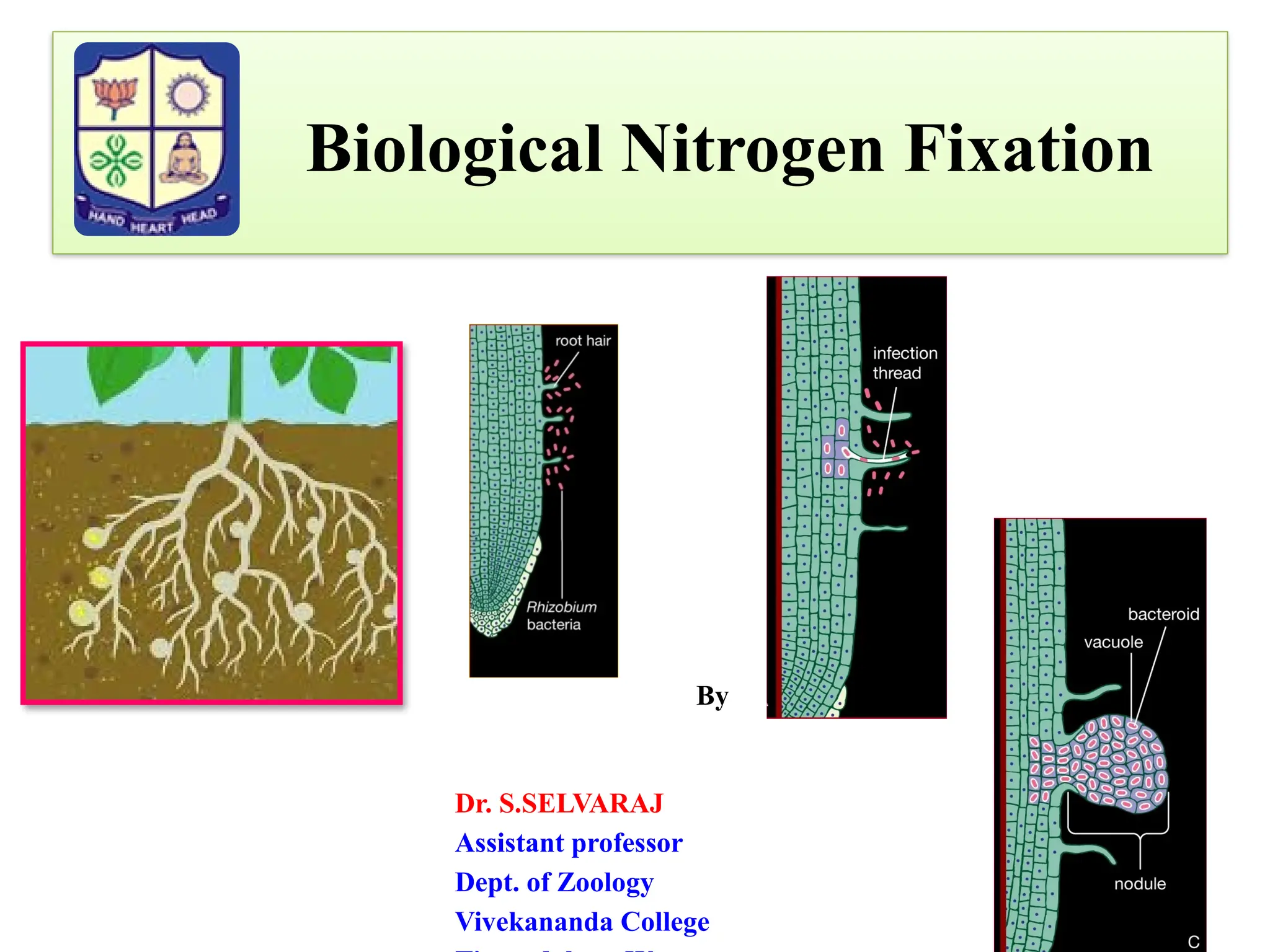
i) Symbiotic Nitrogen fixation- Nodules formation
 Legume plant root
hairs secret the growth
factors (Lectin protein)
into the root zone
 Growth factors attract
host binding of
Rhizobium
a) Recognition
b) Attachment
11
 The Rhizobium bacteria
move and aggregate
around the root hairs and
attached with lectins
c) Penetration
12
 After attachment Rhizobia
produce Indole Acetic Acid
(IAA). (Plant growth
regulator)
 IAA brings about the curling
of the tip of root hairs.
 IAA production by
Rhizobium plays a crucial
role in the interaction
between these bacteria and
their host plant.
d) Travel
13
 Rhizobium penetrates the
root hairs and produces an
enzymes called
polygalacturonase
 Which is easy to penetrate
the root hair to forms a
tubular structure called
infection thread
14
e) Bacteroid formation
• The infection thread grows inwards and
reach the inner cortex of the root.
• The bacteria pass through the infection
thread and are released cytoplasm of the
root cells.
• Bacterial cells multiply and colonize
inside the host cells. They become
dormant cells called bacteroid (irregular,
star shape & clubbed).
• Membrane of the cortical cell enclosing
the bacteroid is known as peribacteroid
membrane.
f) Development of mature nodule
15
 Rhizobium multiplies in the cortical
cells to form nodule.
 Central portion of the nodule is
occupied by a dense mass of Rhizobia.
 Bacteroid float in a reddish pigment
called leghaemoglobin found in the
cytoplasm of host cells.
 Leghaemoglobin act as a oxygen
scavenger
 Leghaemoglobin combines with O2 to form oxyleghaemoglobin &
provides the O2 to the plant cells for respiration.
 O2 level around the bacteria is low & this low content of O2 does not
affect nitrogenase activity for N2 fixation.
Symbiotic ssociation
16
 The bacteria obtain their nutrients and energy from the plant and in turn, fix
atmospheric nitrogen and make it available to the plant.
 N2 fixed by nodules with help of nitrogenase enzymes.
 Here both the bacteria and plant benefit by the association.
N2 2NH3
Nitrogenase
N₂+8e- + 8H+ + 16 ATP 2NH3 + 16 ADP + 16 Pi + H₂
Nitrogenase
b. Non-symbiotic nitrogen fixation
 Conversion of atmospheric nitrogen into ammonia by free living
microorganisms. Eg. Bacteria-Azotobacter, Azomonas & Azospirillum and
Cyanobacteria-Anabaena & Nostoc
N2 + 6H+
+ 6e- 2NH3
17
 In Anabaena, nitrogen fixation takes place
in a specialised cell called heterocyst.
 It provides the anaerobic condition in
which nitrogen fixation takes place.
 N is converted into soluble
₂ ammonia
(Reduction reaction)
Nitrogenase
Conclusion
 Biological nitrogen fixation is a vital natural process
 Maintaining soil fertility and supporting plant growth,
particularly in agricultural systems.
 Conserving the Symbiotic relationships, such as those
between legumes and Rhizobium bacteria.
 Essential for promoting environmentally friendly agricultural
practices and ensuring long-term soil health and productivity.
18
 “Prescott's Microbiology” - Authors: Joanne Willey, Linda
Sherwood, Christopher Woolverton. Publisher: McGraw-Hill
Education (12th edition, 2023 )
 “Microbiology: An Introduction”-Authors: Gerard J. Tortora,
Berdell R. Funke, Christine L. Case. Publisher: Pearson.(12th
edition, 2019)
 "Biological Nitrogen Fixation" (Volume I & II), Editor: Frans J.
de Bruijn, Publisher: Wiley-Blackwell (2015).
 https://www.slideshare.net/slideshow/biological-nitrogen-fixation-
231754247/231754247
19
References
20

Nirrogen Fixation and Biological Nitrogen Fixation.pptx

  • 1.
    Biological Nitrogen Fixation By Dr.S.SELVARAJ Assistant professor Dept. of Zoology Vivekananda College 1
  • 2.
    2 Synopsis  Introduction  Typesof nitrogen fixation  Atmospheric nitrogen fixation  Industrial nitrogen fixation  Biological nitrogen fixation  Requirement for biological nitrogen fixation  Types of biological nitrogen fixation i) Symbiotic nitrogen fixation  Nodules formation- stages ii) Non-symbiotic nitrogen fixation  Heterocyst-specialised cell  Conclusion  References
  • 3.
    3 Introduction  Nitrogen isessential for all living things because it is a major part of amino acids (Building blocks of proteins and DNA)  Our atmosphere has 78% molecular dinitrogen gas and green plants are unable to use directly from atmosphere.  Soil bacteria and blue green algae are capable of reducing the atmospheric nitrogen into ammonia in their cells.  The conversion of atmospheric nitrogen into ammonia by soil-borne microorganisms is called biological nitrogen fixation.  Nitrogenase is an enzymes responsible for catalyzing nitrogen fixation.  Biological nitrogen fixation was discovered by J.B.Boussingault in 1838.  The root nodule bacteria (Rhizobium leguminosarum) was first isolated by Beijerinck in 1888.
  • 4.
  • 5.
    5 Types of nitrogenfixation 1. Atmospheric nitrogen fixation Lighting breaks nitrogen molecules Nitrogen combines with oxygen Nitrogen oxides (N2O) formed Nitrogen oxides (N2O) dissolved in rain and change to nitrates (NO3) formed Nitrates (NO3) are carried to ground with the rain Plant use nitrates to grow (Only 5 to 8% of the fixation process)
  • 6.
    6 2.Industrial nitrogen fixation The conversion of molecular nitrogen into nitrogenous usable compound through a man made chemical method  Haber-Bosch process  Need high temperature and pressure to produce ammonia from nitrogen 1 atm=1013 mbar
  • 7.
    7  The conversionof atmospheric nitrogen into ammonia by soil-borne microorganisms is called biological nitrogen fixation. 3. Biological Nitrogen Fixation Types of Biological Nitrogen Fixation i). Symbiotic Nitrogen fixation  The fixing of molecular nitrogen by bacteria living in the roots of leguminous plants. Eg. Rhizobium (Gram negative, motile, aerobic & rod shaped)  Occurs in partnership between microorganisms and plant  Microorganisms live within root tissues  Eg. Legume-Rhizobia symbiosis, Frankia- actinorhizal plant symbiosis  Crucial for plant growth, especially nitrogen poor soil
  • 8.
    8  Conversion ofatmospheric nitrogen into ammonia by free living microorganisms. Eg. Bacteria-Azotobacter, Azomonas & Azospirillum and Cyanobacteria- Anabaena & Nostoc ii) Non-symbiotic Nitrogen fixation  Occurs independently, without a direct partnership  Free living microorganisms  Free living bacteria in soil and aquatic cyanobacteria  Both type of nitrogen fixation play essential role for maintaining nitrogen balance in ecosystem  The global biological N2 fixation is 135/10 tonnes/year ⁶
  • 9.
    9  Site ofsymbiotic N2 fixation : Root nodules  Biochemical components necessary for N2 fixation :  Rhizobium bacterium  Nitrogenase enzymes (Molybdenum and ferrous protein)  Leghaemoglobin- Pink colour pigment, oxygen scavenger (To provide the anaerobic condition)  One atmospheric pressure & 25-37 temperature ℃  N2 fixing gene :  Nif gene-Nitrogenase enzyme synthesis  Nod gene- formation of nodule  Fix gene- fix the atmospheric nitrogen Requirement for Biological Nitrogen Fixation N2 fixing gene are present in fast growing bacteroid (plasmid) and slow growing bacteria.
  • 10.
    10 i) Symbiotic Nitrogenfixation- Nodules formation  Legume plant root hairs secret the growth factors (Lectin protein) into the root zone  Growth factors attract host binding of Rhizobium a) Recognition
  • 11.
    b) Attachment 11  TheRhizobium bacteria move and aggregate around the root hairs and attached with lectins
  • 12.
    c) Penetration 12  Afterattachment Rhizobia produce Indole Acetic Acid (IAA). (Plant growth regulator)  IAA brings about the curling of the tip of root hairs.  IAA production by Rhizobium plays a crucial role in the interaction between these bacteria and their host plant.
  • 13.
    d) Travel 13  Rhizobiumpenetrates the root hairs and produces an enzymes called polygalacturonase  Which is easy to penetrate the root hair to forms a tubular structure called infection thread
  • 14.
    14 e) Bacteroid formation •The infection thread grows inwards and reach the inner cortex of the root. • The bacteria pass through the infection thread and are released cytoplasm of the root cells. • Bacterial cells multiply and colonize inside the host cells. They become dormant cells called bacteroid (irregular, star shape & clubbed). • Membrane of the cortical cell enclosing the bacteroid is known as peribacteroid membrane.
  • 15.
    f) Development ofmature nodule 15  Rhizobium multiplies in the cortical cells to form nodule.  Central portion of the nodule is occupied by a dense mass of Rhizobia.  Bacteroid float in a reddish pigment called leghaemoglobin found in the cytoplasm of host cells.  Leghaemoglobin act as a oxygen scavenger  Leghaemoglobin combines with O2 to form oxyleghaemoglobin & provides the O2 to the plant cells for respiration.  O2 level around the bacteria is low & this low content of O2 does not affect nitrogenase activity for N2 fixation.
  • 16.
    Symbiotic ssociation 16  Thebacteria obtain their nutrients and energy from the plant and in turn, fix atmospheric nitrogen and make it available to the plant.  N2 fixed by nodules with help of nitrogenase enzymes.  Here both the bacteria and plant benefit by the association. N2 2NH3 Nitrogenase N₂+8e- + 8H+ + 16 ATP 2NH3 + 16 ADP + 16 Pi + H₂ Nitrogenase
  • 17.
    b. Non-symbiotic nitrogenfixation  Conversion of atmospheric nitrogen into ammonia by free living microorganisms. Eg. Bacteria-Azotobacter, Azomonas & Azospirillum and Cyanobacteria-Anabaena & Nostoc N2 + 6H+ + 6e- 2NH3 17  In Anabaena, nitrogen fixation takes place in a specialised cell called heterocyst.  It provides the anaerobic condition in which nitrogen fixation takes place.  N is converted into soluble ₂ ammonia (Reduction reaction) Nitrogenase
  • 18.
    Conclusion  Biological nitrogenfixation is a vital natural process  Maintaining soil fertility and supporting plant growth, particularly in agricultural systems.  Conserving the Symbiotic relationships, such as those between legumes and Rhizobium bacteria.  Essential for promoting environmentally friendly agricultural practices and ensuring long-term soil health and productivity. 18
  • 19.
     “Prescott's Microbiology”- Authors: Joanne Willey, Linda Sherwood, Christopher Woolverton. Publisher: McGraw-Hill Education (12th edition, 2023 )  “Microbiology: An Introduction”-Authors: Gerard J. Tortora, Berdell R. Funke, Christine L. Case. Publisher: Pearson.(12th edition, 2019)  "Biological Nitrogen Fixation" (Volume I & II), Editor: Frans J. de Bruijn, Publisher: Wiley-Blackwell (2015).  https://www.slideshare.net/slideshow/biological-nitrogen-fixation- 231754247/231754247 19 References
  • 20.