Biological Nitrogen
Fixation in Plants
1. Introduction
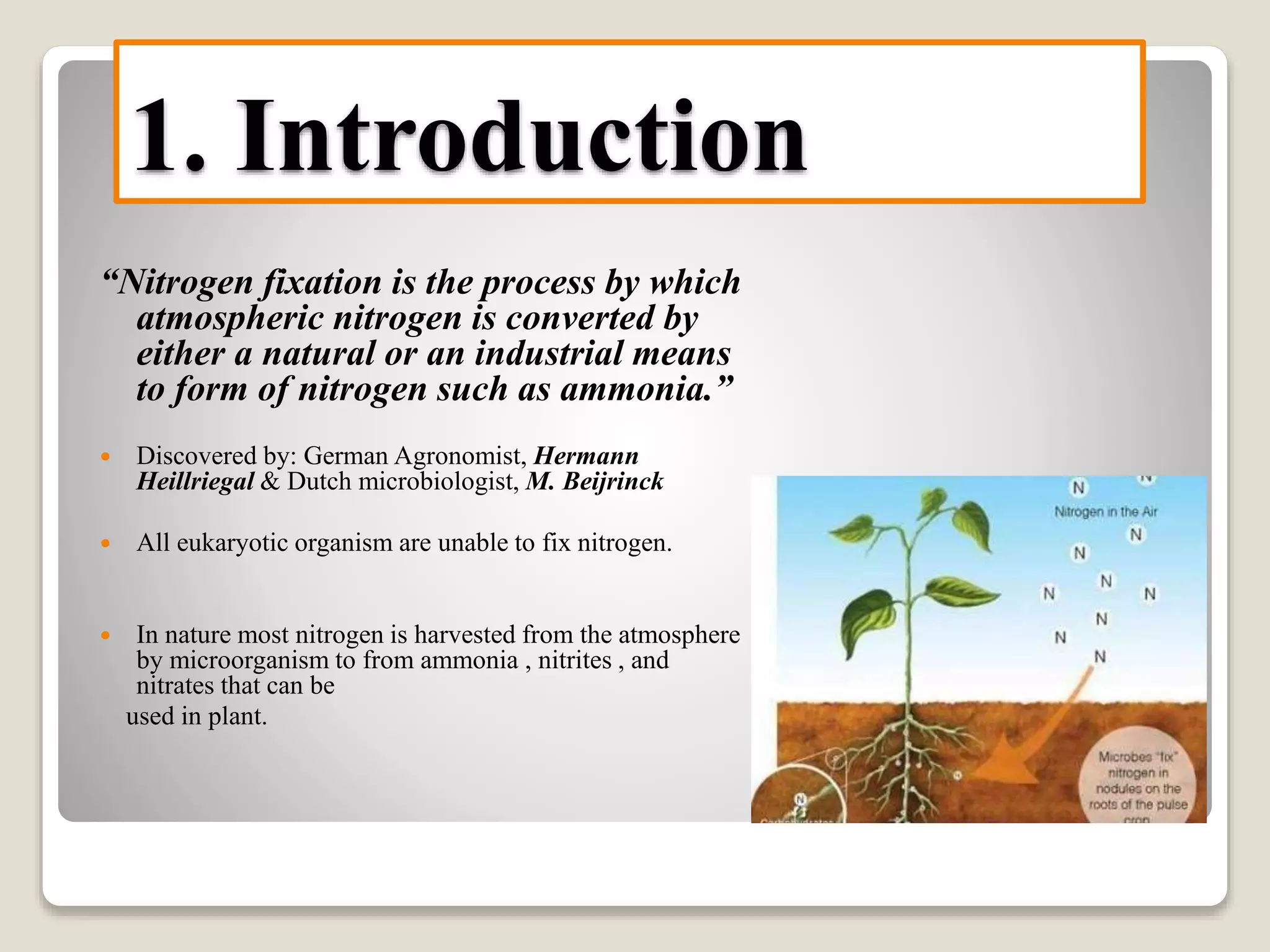
“Nitrogen fixation is the process by which
atmospheric nitrogen is converted by
either a natural or an industrial means
to form of nitrogen such as ammonia.”
 Discovered by: German Agronomist, Hermann
Heillriegal & Dutch microbiologist, M. Beijrinck
 All eukaryotic organism are unable to fix nitrogen.
 In nature most nitrogen is harvested from the atmosphere
by microorganism to from ammonia , nitrites , and
nitrates that can be
used in plant.
Role of Nitrogen in Plants
 Nitrogen is very important and needed for plant
for plant growth.
 It is found in healthy soil, and give plant the energy to
grow , and produce fruit or vegetables.
 Nitrogen is part of the chlorophyll molecule, which
gives plant their green color and is involved in creating
food for the plant through photosynthesis.
 Nitrogen is an essential macronutrient for plant function
and is key component of amino acid ,which from the
building blocks of plant protein and enzymes.
2. Types Of Biological Nitrogen
Fixers
Biological nitrogen fixation: “Fixation of
atmospheric nitrogen into nitrogenous salts with the
help of microorganisms.”
Types: Biological nitrogen fixers are classified on
fixing microorganisms
They are usually two types as follow:
a) Symbiotic
b) Non-symbiotic
Symbiotic Nitrogen Fixers
“Fixation of free nitrogen by microorganism in soil living
symbiotically inside the plants.”
Three categories:
1) Nodules formation in leguminous plants
2) Nodule formation in non-leguminous plants
3) No nodulation
 Nodules formation in leguminous plants
Examples: Beans will generally have fewer than 100 nodules,
soybeans will have several hundred per plant and peanuts may have
1000 or more nodules on a well developed plant.
Cont..
 Nodule formation in non-leguminous plants
some other plants also produces root nodules
Example: Casuarinas, equisetifolia, Myrica gale etc.
 Non-nodulation
Examples:
-Lichen__cynobacteria
-Anthoceros__Nostoc
-Azolla___Anabaena azollae
-Cycas___Nostoc and Anabena
3. Mechanism of Nodule
Formation
“A nodule is a growth of abnormal tissue. Under nitrogen-limiting
conditions, bacteria from the family Rhizobiaceae establish a symbiosis
with leguminous plants to form nitrogen-fixing root nodules. ... Products of
several of these genes show homologies to known regulators of signal
transduction pathways in other plant or animal systems.”
 Nodule Formation
Nodule formation is regulated by chemical signals between plants and
microbes, and is one of the most well-studied chemical communications.
The first step of nodule formation starts with the leguminous bacterium
receiving a signal from the host plant. The result of this symbiosis is to
form nodules on the plant root, within which the bacteria can convert
atmospheric nitrogen into ammonia that can be used by the plant.
Cell Division
Events involved in the initiation of the nodule:
 the root excretes substances;
 these substances attract rhizobia and stimulate them to produce cell-
division factors;
 cells in the root cortex divide to form the primary nodule meristem. Iron is
required for the synthesis of iron-containing proteins in the host,
Stages of infection and nodule formation:
 bacteria attach to the root hair;
 cells in the pericycle near the xylem poles are
 stimulated to divide;
 the infection thread forms and extends inward as the primary nodule
meristem and the pericylce continue to divide;
 the two masses of dividing cells fuse.
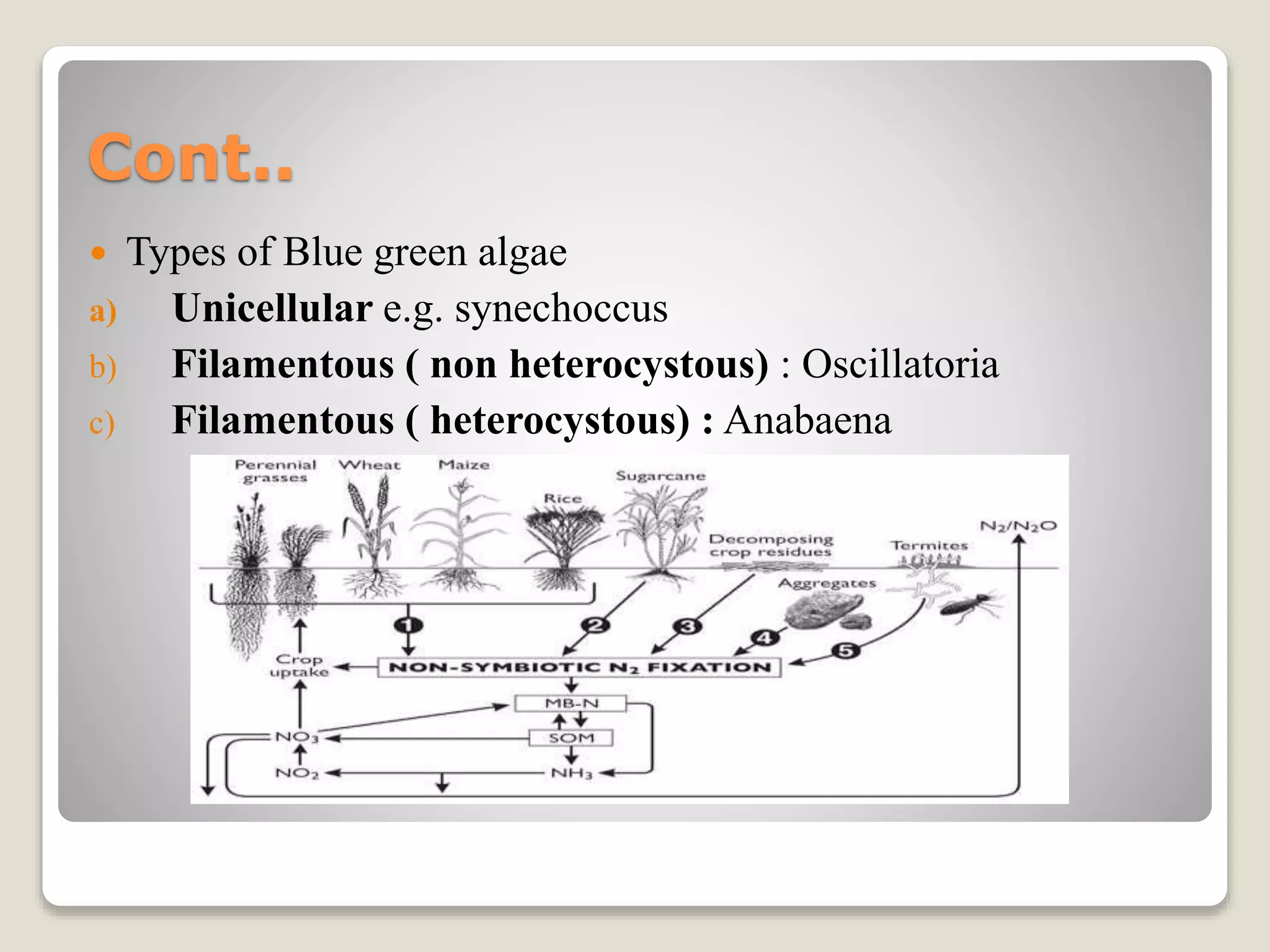
4. Non Symbiotic Nitrogen fixers
“The free living nitrogen fixing organisms are called
asymbiotic organisms or free living nitrogen fixers.”
• They inhabit both terrestrial & aquatic habitat.
• Ammonia ,nitrites & nitrates are formed.
• Non-symbiotic bacteria make nitrogen available in the
soil.
Types of symbiotic nitrogen fixers
1. Free living aerobic: Azotobacter
2. Free living anaerobic : clostridium.
3. Blue green algae: unicellular
Cont..
 Types of Blue green algae
a) Unicellular e.g. synechoccus
b) Filamentous ( non heterocystous) : Oscillatoria
c) Filamentous ( heterocystous) : Anabaena
Cont..
Ability to fix N2 by microorganisms was
confirmed by technique-acetylene to ethylene .
 the conversion is controlled by an enzymatic
complex is known as nitrogenous enzyme .
 Nitrogenase sensitive to O2.
 Oxygen not only inhabits the activity of
Nitrogenase but also regulate biosynthesis.
5. Source of Nitrogen
 Atmospheric nitrogen
 Nitrates Nitrites and Ammonia
 Amino acids in soil
 Organic nitrogenous compound in insects.
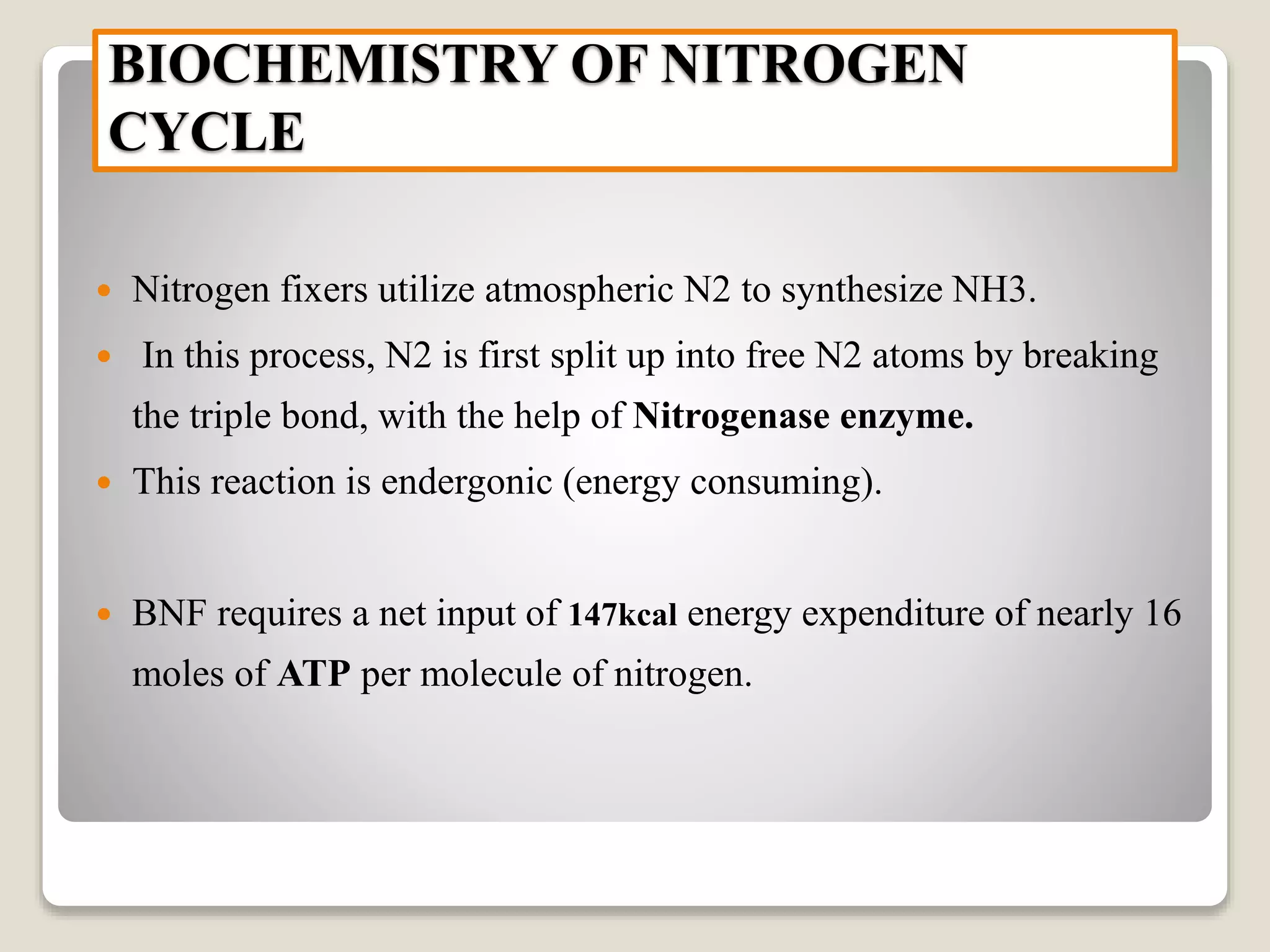
BIOCHEMISTRY OF NITROGEN
CYCLE
 Nitrogen fixers utilize atmospheric N2 to synthesize NH3.
 In this process, N2 is first split up into free N2 atoms by breaking
the triple bond, with the help of Nitrogenase enzyme.
 This reaction is endergonic (energy consuming).
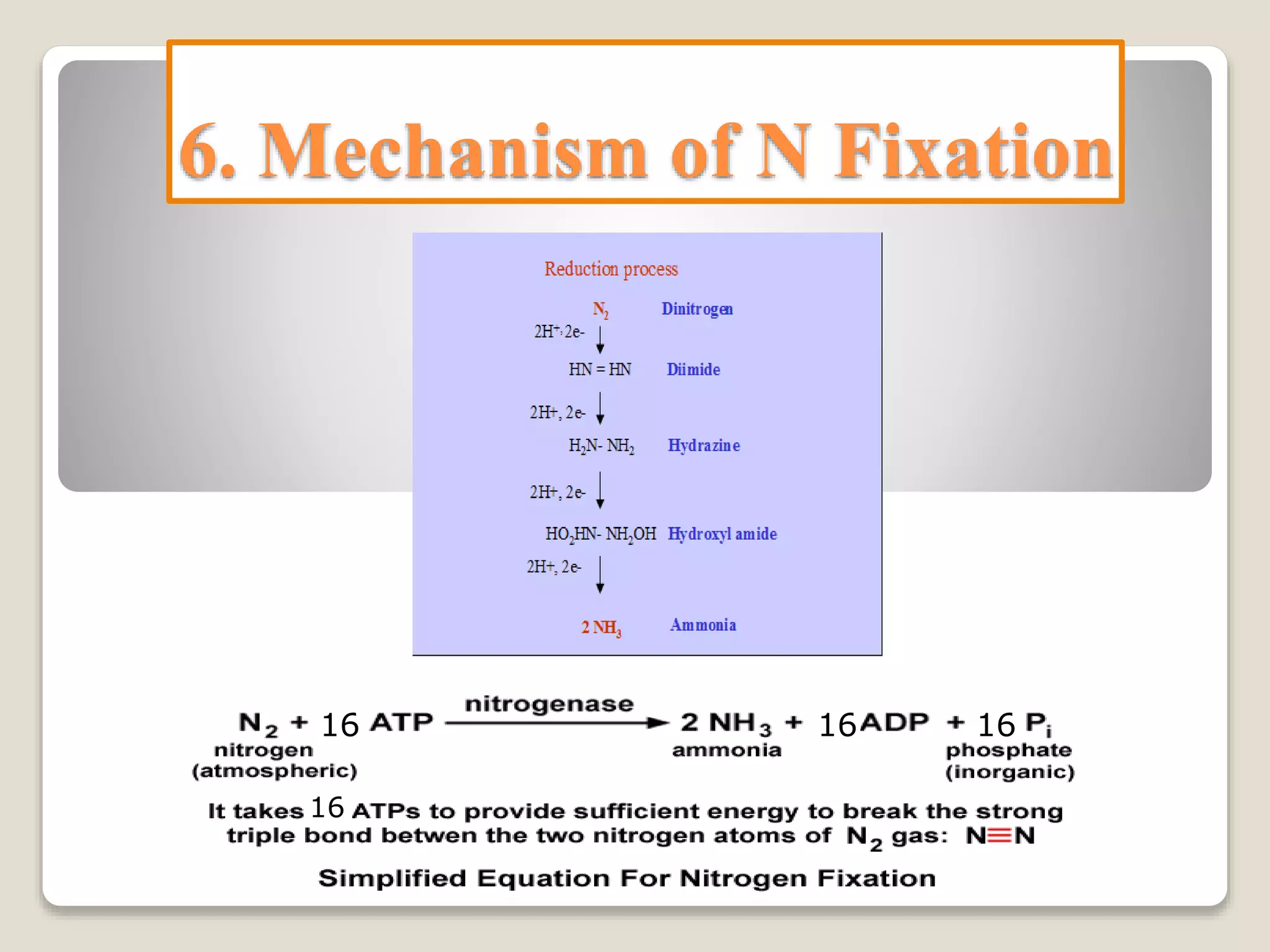
 BNF requires a net input of 147kcal energy expenditure of nearly 16
moles of ATP per molecule of nitrogen.
6. Mechanism of N Fixation
16
16 16 16
Pathway of N Fixation
Nitrogen Cycle


nitrogen fixation

  • 1.
  • 2.
    1. Introduction “Nitrogen fixationis the process by which atmospheric nitrogen is converted by either a natural or an industrial means to form of nitrogen such as ammonia.”  Discovered by: German Agronomist, Hermann Heillriegal & Dutch microbiologist, M. Beijrinck  All eukaryotic organism are unable to fix nitrogen.  In nature most nitrogen is harvested from the atmosphere by microorganism to from ammonia , nitrites , and nitrates that can be used in plant.
  • 3.
    Role of Nitrogenin Plants  Nitrogen is very important and needed for plant for plant growth.  It is found in healthy soil, and give plant the energy to grow , and produce fruit or vegetables.  Nitrogen is part of the chlorophyll molecule, which gives plant their green color and is involved in creating food for the plant through photosynthesis.  Nitrogen is an essential macronutrient for plant function and is key component of amino acid ,which from the building blocks of plant protein and enzymes.
  • 4.
    2. Types OfBiological Nitrogen Fixers Biological nitrogen fixation: “Fixation of atmospheric nitrogen into nitrogenous salts with the help of microorganisms.” Types: Biological nitrogen fixers are classified on fixing microorganisms They are usually two types as follow: a) Symbiotic b) Non-symbiotic
  • 5.
    Symbiotic Nitrogen Fixers “Fixationof free nitrogen by microorganism in soil living symbiotically inside the plants.” Three categories: 1) Nodules formation in leguminous plants 2) Nodule formation in non-leguminous plants 3) No nodulation  Nodules formation in leguminous plants Examples: Beans will generally have fewer than 100 nodules, soybeans will have several hundred per plant and peanuts may have 1000 or more nodules on a well developed plant.
  • 6.
    Cont..  Nodule formationin non-leguminous plants some other plants also produces root nodules Example: Casuarinas, equisetifolia, Myrica gale etc.  Non-nodulation Examples: -Lichen__cynobacteria -Anthoceros__Nostoc -Azolla___Anabaena azollae -Cycas___Nostoc and Anabena
  • 7.
    3. Mechanism ofNodule Formation “A nodule is a growth of abnormal tissue. Under nitrogen-limiting conditions, bacteria from the family Rhizobiaceae establish a symbiosis with leguminous plants to form nitrogen-fixing root nodules. ... Products of several of these genes show homologies to known regulators of signal transduction pathways in other plant or animal systems.”  Nodule Formation Nodule formation is regulated by chemical signals between plants and microbes, and is one of the most well-studied chemical communications. The first step of nodule formation starts with the leguminous bacterium receiving a signal from the host plant. The result of this symbiosis is to form nodules on the plant root, within which the bacteria can convert atmospheric nitrogen into ammonia that can be used by the plant.
  • 9.
    Cell Division Events involvedin the initiation of the nodule:  the root excretes substances;  these substances attract rhizobia and stimulate them to produce cell- division factors;  cells in the root cortex divide to form the primary nodule meristem. Iron is required for the synthesis of iron-containing proteins in the host, Stages of infection and nodule formation:  bacteria attach to the root hair;  cells in the pericycle near the xylem poles are  stimulated to divide;  the infection thread forms and extends inward as the primary nodule meristem and the pericylce continue to divide;  the two masses of dividing cells fuse.
  • 10.
    4. Non SymbioticNitrogen fixers “The free living nitrogen fixing organisms are called asymbiotic organisms or free living nitrogen fixers.” • They inhabit both terrestrial & aquatic habitat. • Ammonia ,nitrites & nitrates are formed. • Non-symbiotic bacteria make nitrogen available in the soil. Types of symbiotic nitrogen fixers 1. Free living aerobic: Azotobacter 2. Free living anaerobic : clostridium. 3. Blue green algae: unicellular
  • 11.
    Cont..  Types ofBlue green algae a) Unicellular e.g. synechoccus b) Filamentous ( non heterocystous) : Oscillatoria c) Filamentous ( heterocystous) : Anabaena
  • 12.
    Cont.. Ability to fixN2 by microorganisms was confirmed by technique-acetylene to ethylene .  the conversion is controlled by an enzymatic complex is known as nitrogenous enzyme .  Nitrogenase sensitive to O2.  Oxygen not only inhabits the activity of Nitrogenase but also regulate biosynthesis.
  • 13.
    5. Source ofNitrogen  Atmospheric nitrogen  Nitrates Nitrites and Ammonia  Amino acids in soil  Organic nitrogenous compound in insects.
  • 14.
    BIOCHEMISTRY OF NITROGEN CYCLE Nitrogen fixers utilize atmospheric N2 to synthesize NH3.  In this process, N2 is first split up into free N2 atoms by breaking the triple bond, with the help of Nitrogenase enzyme.  This reaction is endergonic (energy consuming).  BNF requires a net input of 147kcal energy expenditure of nearly 16 moles of ATP per molecule of nitrogen.
  • 15.
    6. Mechanism ofN Fixation 16 16 16 16
  • 16.
    Pathway of NFixation
  • 17.
  • 18.