BIOLEACHING
LOKESHWARI B
II M. Sc MICROBIOLOGY
SACRED HEART COLLEGE (AUTONOMOUS),
TIRUPATTUR.
DEFINITION
• Bioleaching is the process by which metals are dissolved from ore
bearing rocks using microorganisms.
• Bioleaching is also called microbial leaching.
• Recycling technique.
• Uses bacteria to recover metals from mineral processing wastes.
ORES MICRO -
ORGANIMS
PURE
METALS
HISTORY
• Copper recovery from mine waters in Mediterranean area over 3000 years
ago.
• 1970 - Role of bacteria in bioleaching
• 1950 - Copper dump leaching
• 1960 - First Industrial copper heap leaching
• 1980 - First Industrial Gold bioleaching product
• Now a days 40 plants in industrial use for copper, gold, zinc, cobalt and
uranium.
MICROORGANISMS USED IN
BIOLEACHING
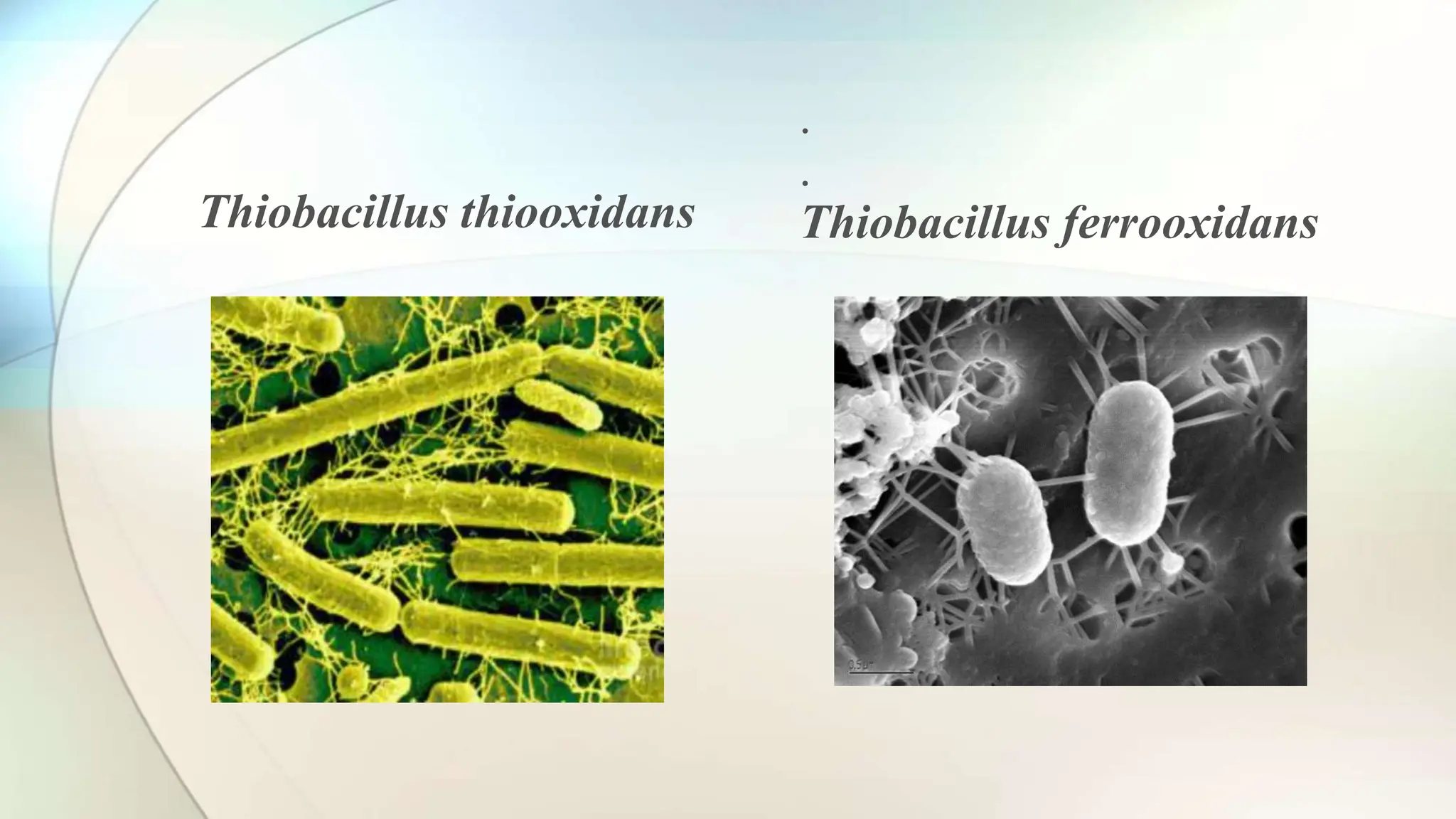
The two most commonly used organisms in microbial leaching
are:
• Thiobacillus thiooxidans
• Thiobacillus ferrooxidans.
Thiobacillus thiooxidans
.
.
Thiobacillus ferrooxidans
EXTRACTION OF METALS
Gold Silver Uranium Nickel Copper Cobalt Zinc
PROCEDURE
• Bacteria helps in regenerating major ore oxidizer mostly ferric ion.
• Reaction usually takes place in the cell membrane of bacteria.
Disulfide is spontaneously oxidized to thiosulfate by ferric
ion (Fe 3+), which in turn is reduced to give ferrous iron
(Fe 2+).
Microorganisms catalyze the oxidation of ferrous
iron and sulphur to produce ferric ion and
sulphuric acid
MECHANISMS OF BIOLEACHING
The reaction mechanisms are of two types;
In - direct
mechanism
Direct
mechanism
DIRECT MECHANISM
• Otherwise known as contact leaching
• In this process, a physical contact exist between bacteria and ores and
oxidation of mineral takes place through enzymatically catalysed steps
• Example: Pyrite is oxidised to ferric sulphate.
2FeS 2 + 7O 2 + 2H 2 O → 2FeSO 4 + 2H 2 SO 4
INDIRECT MECHANISM
• In this process the microbes are not in direct contact with minerals.
• Indirect bioleaching, acidic environment is absolutely essential to ferric iron
and other metals in solution
• Acidic environment maintained by oxidation of iron, sulfur metal sulphides or
by dissolution of carbonate ions
• Example: Bioleaching of uranium
U2O + Fe2 (SO4) → UO2SO4 + 2FeSO4
COMMERICAL PROCESS
• Natural occurring process is very slow.
• For commercial extraction of metals by bioleaching process is
optimized by controlling the pH, temperature, humidity, Oxygen
and carbon di oxide concentrations.
There are three commercial process used in bioleaching.
They are;
Slope
leaching
1 Heap
leaching
2 In – Situ
leaching
3
SLOPE LEACHING
• Ores are first ground to get fine pieces and then dumped into leaching dump.
• Water containing inoculum of thiobacillus is continuously sprinkled.
• Water is collected from the bottom and used to extract metals and generate
bacteria in an oxidation pond
• Finely ground ores are dumped in large piles and sprinkled with water
containing Thiobacillus.
• Water is collected at the bottom and reused after metal extraction and possible
regeneration of the bacteria in an oxidation pools.
HEAP LEACHING
• Ores is arranged in large heaps and treated.
• Here the ore is dumped into large heaps called leach heaps
• Water containing inoculum of thiobacillus is continuously sprinkled
over the ore
• Water is collected from the bottom and used to extract metal and
generate bacteria.
IN – SITU LEACHING
• Ore remains in its original position in the earth
• Surface blasting of earth is done to increase the permeability of water
• Water containing thiobacillus is pumped through drilled passage to the ores
• Mineral is extracted and water is reused after generation of bacteria
• Water containing Thiobacillus is pumped through drilled passages to unextracted ore
which remains in its original location in the earth.
• Permeability of the rock must be first increased by subsurface blasting of the rock.
• The acidic water seeps through the rock and collects in the bottom most cavity from which
it is pumped, the minerals extracted, and the water re-used after regeneration of bacteria.
EXAMPLES OF BIOLEACHING
Copper
Leaching
Uranium
Leaching
Gold and
Silver
Leaching
COPPER LEACHING
• If chalcocite, chalcopyrite, or covellite are used for the production of copper.
• Chalcopyrite contains 26% copper, 25.9% iron, 2.5% zinc, and 33% sulphur.
• Copper leaching plants have been in wide use throughout the world.
• Leaching solution carries the microbial nutrients in and the dissolved copper out.
• The copper containing solution is removed, precipitated, and the water is reused after
readjusting the pH to 2.
• Countries in which microbial leaching of copper has been widely used are United States,
Australia, Canada, Mexico, South Africa, Portugal, Spain, and Japan.
• About 5% of the world copper production is obtained via microbial leaching.
• A single installation in the United States has produced up to 200 tons of copper per day.
URANIUM LEACHING
• Although less uranium than copper is obtained by microbial leaching, the uranium process is more
significant economically.
• Optimal uranium leaching conditions are pH 1.5-3.5, 35oC and 0.2% CO2 in the incoming air.
• In commercial processes, the dissolved uranium is extracted from the leach liquor with organic
solvents such as tributylphosphate and the uranium is subsequently precipitated from the organic
phase.
• In such situations the heap system is often still used commercially for leaching of uranium.
• Areas where uranium leaching has been carried out include the United States, Canada, and South
Africa
GOLD AND SILVER LEACHING
• Microbial leaching of refractory process metal ores to enhance gold
and silver recovery is one of the promising applications
• Bioleaching of arsenopyrite/ pyrite
• Silver is also obtained by bioleaching of arsenopyrite but is more
solubilized than gold during microbial leaching of iron sulphide.
FACTORS AFFECTING
BIOLEACHING
• Suitable bacteria that can survive at high temperatures, acid concentrations, high
concentrations of heavy metals, remaining active under such circumstances
Choice of bacteria
• Affects leaching rate, microbial growth
pH and temperature
• High population density tends to increase the leaching rate
Population Density
• High metal concentration may be toxic to microbes
Metal tolerance
• Needs to be low to obtain the fastest leaching rates and to keep ferric ions
and metals in solution
Surface area
• Rate of oxidation by the bacteria increases with reduction in the size of the
ore and vice versa
Oxidation Reactions compositions and
activity
ADVANTAGES OF BIOLEACHING
 Simple process
 Inexpensive technique
 Cheaper than the chemical extraction
 No need of high pressure and temperature
 Ideal for low grade sulphide ores
 Environment friendly process
DIS – ADVANTAGES OF BIOLEACHING
• Time consuming (takes 6-24 months or longer)
• Have a very low yield of minerals
• Requires a large open area for treatment
• May have no process control
• High risk of contamination
• Inconsistent yield because bacteria cannot grow uniformly
• Heat created from dissolving process that can kill bacteria
THANK
YOU…

BIOLEACHING.pptx MICROBIAL LEACHING, RECYCLING TECHNIQUES

  • 1.
    BIOLEACHING LOKESHWARI B II M.Sc MICROBIOLOGY SACRED HEART COLLEGE (AUTONOMOUS), TIRUPATTUR.
  • 2.
    DEFINITION • Bioleaching isthe process by which metals are dissolved from ore bearing rocks using microorganisms. • Bioleaching is also called microbial leaching. • Recycling technique. • Uses bacteria to recover metals from mineral processing wastes. ORES MICRO - ORGANIMS PURE METALS
  • 3.
    HISTORY • Copper recoveryfrom mine waters in Mediterranean area over 3000 years ago. • 1970 - Role of bacteria in bioleaching • 1950 - Copper dump leaching • 1960 - First Industrial copper heap leaching • 1980 - First Industrial Gold bioleaching product • Now a days 40 plants in industrial use for copper, gold, zinc, cobalt and uranium.
  • 4.
    MICROORGANISMS USED IN BIOLEACHING Thetwo most commonly used organisms in microbial leaching are: • Thiobacillus thiooxidans • Thiobacillus ferrooxidans.
  • 5.
  • 6.
    EXTRACTION OF METALS GoldSilver Uranium Nickel Copper Cobalt Zinc
  • 7.
    PROCEDURE • Bacteria helpsin regenerating major ore oxidizer mostly ferric ion. • Reaction usually takes place in the cell membrane of bacteria. Disulfide is spontaneously oxidized to thiosulfate by ferric ion (Fe 3+), which in turn is reduced to give ferrous iron (Fe 2+). Microorganisms catalyze the oxidation of ferrous iron and sulphur to produce ferric ion and sulphuric acid
  • 8.
    MECHANISMS OF BIOLEACHING Thereaction mechanisms are of two types; In - direct mechanism Direct mechanism
  • 9.
    DIRECT MECHANISM • Otherwiseknown as contact leaching • In this process, a physical contact exist between bacteria and ores and oxidation of mineral takes place through enzymatically catalysed steps • Example: Pyrite is oxidised to ferric sulphate. 2FeS 2 + 7O 2 + 2H 2 O → 2FeSO 4 + 2H 2 SO 4
  • 10.
    INDIRECT MECHANISM • Inthis process the microbes are not in direct contact with minerals. • Indirect bioleaching, acidic environment is absolutely essential to ferric iron and other metals in solution • Acidic environment maintained by oxidation of iron, sulfur metal sulphides or by dissolution of carbonate ions • Example: Bioleaching of uranium U2O + Fe2 (SO4) → UO2SO4 + 2FeSO4
  • 12.
    COMMERICAL PROCESS • Naturaloccurring process is very slow. • For commercial extraction of metals by bioleaching process is optimized by controlling the pH, temperature, humidity, Oxygen and carbon di oxide concentrations.
  • 13.
    There are threecommercial process used in bioleaching. They are; Slope leaching 1 Heap leaching 2 In – Situ leaching 3
  • 14.
    SLOPE LEACHING • Oresare first ground to get fine pieces and then dumped into leaching dump. • Water containing inoculum of thiobacillus is continuously sprinkled. • Water is collected from the bottom and used to extract metals and generate bacteria in an oxidation pond • Finely ground ores are dumped in large piles and sprinkled with water containing Thiobacillus. • Water is collected at the bottom and reused after metal extraction and possible regeneration of the bacteria in an oxidation pools.
  • 15.
    HEAP LEACHING • Oresis arranged in large heaps and treated. • Here the ore is dumped into large heaps called leach heaps • Water containing inoculum of thiobacillus is continuously sprinkled over the ore • Water is collected from the bottom and used to extract metal and generate bacteria.
  • 16.
    IN – SITULEACHING • Ore remains in its original position in the earth • Surface blasting of earth is done to increase the permeability of water • Water containing thiobacillus is pumped through drilled passage to the ores • Mineral is extracted and water is reused after generation of bacteria • Water containing Thiobacillus is pumped through drilled passages to unextracted ore which remains in its original location in the earth. • Permeability of the rock must be first increased by subsurface blasting of the rock. • The acidic water seeps through the rock and collects in the bottom most cavity from which it is pumped, the minerals extracted, and the water re-used after regeneration of bacteria.
  • 17.
  • 18.
    COPPER LEACHING • Ifchalcocite, chalcopyrite, or covellite are used for the production of copper. • Chalcopyrite contains 26% copper, 25.9% iron, 2.5% zinc, and 33% sulphur. • Copper leaching plants have been in wide use throughout the world. • Leaching solution carries the microbial nutrients in and the dissolved copper out. • The copper containing solution is removed, precipitated, and the water is reused after readjusting the pH to 2. • Countries in which microbial leaching of copper has been widely used are United States, Australia, Canada, Mexico, South Africa, Portugal, Spain, and Japan. • About 5% of the world copper production is obtained via microbial leaching. • A single installation in the United States has produced up to 200 tons of copper per day.
  • 19.
    URANIUM LEACHING • Althoughless uranium than copper is obtained by microbial leaching, the uranium process is more significant economically. • Optimal uranium leaching conditions are pH 1.5-3.5, 35oC and 0.2% CO2 in the incoming air. • In commercial processes, the dissolved uranium is extracted from the leach liquor with organic solvents such as tributylphosphate and the uranium is subsequently precipitated from the organic phase. • In such situations the heap system is often still used commercially for leaching of uranium. • Areas where uranium leaching has been carried out include the United States, Canada, and South Africa
  • 20.
    GOLD AND SILVERLEACHING • Microbial leaching of refractory process metal ores to enhance gold and silver recovery is one of the promising applications • Bioleaching of arsenopyrite/ pyrite • Silver is also obtained by bioleaching of arsenopyrite but is more solubilized than gold during microbial leaching of iron sulphide.
  • 21.
    FACTORS AFFECTING BIOLEACHING • Suitablebacteria that can survive at high temperatures, acid concentrations, high concentrations of heavy metals, remaining active under such circumstances Choice of bacteria • Affects leaching rate, microbial growth pH and temperature • High population density tends to increase the leaching rate Population Density • High metal concentration may be toxic to microbes Metal tolerance • Needs to be low to obtain the fastest leaching rates and to keep ferric ions and metals in solution Surface area • Rate of oxidation by the bacteria increases with reduction in the size of the ore and vice versa Oxidation Reactions compositions and activity
  • 22.
    ADVANTAGES OF BIOLEACHING Simple process  Inexpensive technique  Cheaper than the chemical extraction  No need of high pressure and temperature  Ideal for low grade sulphide ores  Environment friendly process
  • 23.
    DIS – ADVANTAGESOF BIOLEACHING • Time consuming (takes 6-24 months or longer) • Have a very low yield of minerals • Requires a large open area for treatment • May have no process control • High risk of contamination • Inconsistent yield because bacteria cannot grow uniformly • Heat created from dissolving process that can kill bacteria
  • 24.