SINGLE CELL PROTEINS
B. LOKESHWARI
II. M. Sc MICROBIOLOGY
SACRED HEART COLLEGE (AUTONOMOUS)
TIRUPATTUR
SINGLE CELL PROTEINS
Protein derived from microorganisms.
Sources of mixed protein extracted from pure or mixed cultures of algae,
yeasts, fungi or bacteria.
Professor Wilson Of the MIT, Cambridge, USA
Used to replace the ‘microbial’ or ‘bacterial’ protein or ‘petroprotein’
SPC was recognized that protein malnutrition than that of other foods and
the world protein deficiency.
Nutritional value of scp depends on the composition of the microbial cells
used especially their protein, amino acid, vitamin, and mineral contents.
SUBSTRATES USED FOR SCP PRODUCTION
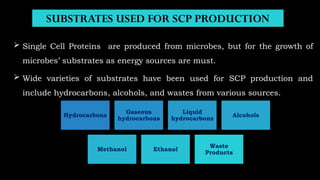
 Single Cell Proteins are produced from microbes, but for the growth of
microbes’ substrates as energy sources are must.
 Wide varieties of substrates have been used for SCP production and
include hydrocarbons, alcohols, and wastes from various sources.
Hydrocarbons
Gaseous
hydrocarbons
Liquid
hydrocarbons
Alcohols
Methanol Ethanol
Waste
Products
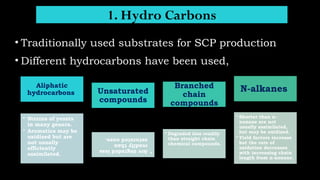
• Traditionally used substrates for SCP production
• Different hydrocarbons have been used,
1. Hydro Carbons
Aliphatic
hydrocarbons
• Strains of yeasts
in many genera.
• Aromatics may be
oxidized but are
not usually
efficiently
assimilated.
Unsaturated
compounds
•
Are
degraded
less
readily
than
saturated
ones.
Branched
chain
compounds
• Degraded less readily
than straight chain
chemical compounds.
N-alkanes
• Shorter than n-
nonane are not
usually assimilated,
but may be oxidized.
• Yield factors increase
but the rate of
oxidation decreases
with increasing chain
length from n-nonane.
Methane has been most widely used as a predominant gas and a
source of SCP.
Others include propane and butane.
In the absence of residual hydrocarbon in the single cell protein
produced from it, unlike the case with liquid hydrocarbons.
One of its major disadvantages is that it is highly inflammable.
2.Gaseous hydrocarbons
The major source of liquid hydrocarbons is crude petroleum.
These hydrocarbons were first studied as a source of microbial
vitamins and lipids.
Many other oil companies and governments all over the world set-
up research and pilot plants.
Crude oil as a substrate for SCP has been used.
3. Liquid Hydrocarbons
• The next substrates used for SCP production
• While work on SCP production from n-paraffin and gas
oil was in progress, alternatives to petroleum-based
substrates were sought.
• Methanol and ethanol alternatives for SCP Production
4. Alcohols
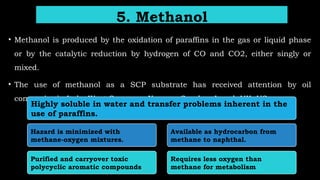
• Methanol is produced by the oxidation of paraffins in the gas or liquid phase
or by the catalytic reduction by hydrogen of CO and CO2, either singly or
mixed.
• The use of methanol as a SCP substrate has received attention by oil
companies in Italy, West Germany, Norway, Sweden, Israel, UK, US.
5. Methanol
Highly soluble in water and transfer problems inherent in the
use of paraffins.
Hazard is minimized with
methane-oxygen mixtures.
Purified and carryover toxic
polycyclic aromatic compounds
Available as hydrocarbon from
methane to naphthal.
Requires less oxygen than
methane for metabolism
• Ethanol may be produced by the fermentative activity of yeasts.
• In the synthetic process however, it is produced by the hydration of
ethylene.
• Although ethanol can be utilized ordinarily by many bacteria and yeasts,
as a substrate for SCP, it is largely used by yeasts.
• Despite this advantage yeast produced from ethanol is being produced and
marketed as a flavor enhancer in baked foods, pizzas, sauces, etc.,
6. Ethanol
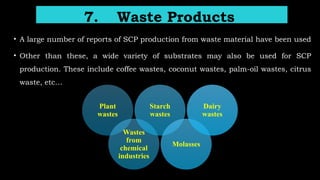
7. Waste Products
• A large number of reports of SCP production from waste material have been used
• Other than these, a wide variety of substrates may also be used for SCP
production. These include coffee wastes, coconut wastes, palm-oil wastes, citrus
waste, etc…
Plant
wastes
Wastes
from
chemical
industries
Starch
wastes
Molasses
Dairy
wastes
MICROORGANISMS USED IN SCP PRODUCTION
• Substrate must be used as carbon and nitrogen source with high specific
growth rates and productivity.
• Show tolerance towards pH and temperature, non - pathogenicity and
absence of toxins.
• The microorganism must be easily available for harvesting with high
protein yield.
• Industrially important microbes may not the suitable organisms. In
addition to the industrial organisms it should also have been used in SCP
production
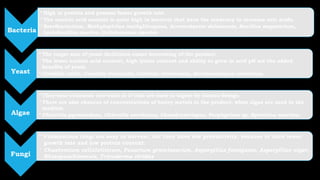
Bacteria
• High in protein and possess faster growth rate.
• The nucleic acid content is quite high in bacteria that have the tendency to increase uric acids.
• Brevibacterium, Methylophilus methylitropous, Acromobacter delvaevate, Bacillus megaterium,
Lactobacillus species, Cellulomonas species
Yeast
• The larger size of yeast facilitates easier harvesting of the product.
• The lower nucleic acid content, high lysine content and ability to grow in acid pH are the added
benefits of yeast.
• Candida utilis, Candida tropicalis, Candida intermedia, Saccharomyces cerevisiae.
Algae
• They bear cellulosic cell walls in it that are hard to digest by human beings.
• There are also chances of concentrations of heavy metals in the product, when algae are used in the
medium.
• Chlorella pyrenoidosa, Chlorella sorokiana, Chondruscrispus, Porphyrium sp, Spirulina maxima.
Fungi
• Filamentous fungi are easy to harvest, but they have low productivity, because of their lower
growth rate and low protein content.
• Chaetomium celluloliticum, Fusarium graminearum, Aspergillus fumigates, Aspergillus niger,
Rhizopuschinensis, Tricoderma viridae
COMMERICIAL PRODUCTION OF SCP
 The estimated yield of 250 tons of protein in 24 hours is achieved by
using 100 lbs of yeast.
 A 1000 lbs steer can synthesize only 1 lb of protein in 24 hrs after
consuming 12 to 20 lbs of plant proteins.
 Algae that are grown in small ponds can produce upto 20 tons of
protein.
• The obtained yield is 10 to 15 times higher than soybean and 25 to
50 times higher than corn.
PROCESS OF SCP
 The production of single cell protein takes place in a fermentation
process.
 This is done by selected strains of microorganisms which are
multiplied on suitable raw materials in technical cultivation process.
6. Safety
Concerns
5. Economic
Consideratio
n / Process
Feasibility
4.
Technology
Development
3. Process
Engineering
and Process
Optimization
2. Choice of
Raw
Materials
1. Microbial
Screening
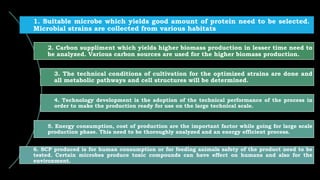
1. Suitable microbe which yields good amount of protein need to be selected.
Microbial strains are collected from various habitats
2. Carbon suppliment which yields higher biomass production in lesser time need to
be analyzed. Various carbon sources are used for the higher biomass production.
3. The technical conditions of cultivation for the optimized strains are done and
all metabolic pathways and cell structures will be determined.
4. Technology development is the adoption of the technical performance of the process in
order to make the production ready for use on the large technical scale.
5. Energy consumption, cost of production are the important factor while going for large scale
production phase. This need to be thoroughly analyzed and an energy efficient process.
6. SCP produced is for human consumption or for feeding animals safety of the product need to be
tested. Certain microbes produce toxic compounds can have effect on humans and also for the
environment.
NUTRITIONAL BENEFITS OF SCP
 To estimate the nutritional value of SCP, factors such as nutrient
composition, amino acid profile, vitamin and nucleic acid content, allergies
and gastrointestinal effects should be considered.
 SCPs are good source of vitamins, particularly B-complex, with modest amino
acid composition furnished with thiamine, riboflavin, glutathione and folic
acid.
 Yeast strains with probiotic properties boost larval survival by colonizing the
gut of fish larvae.
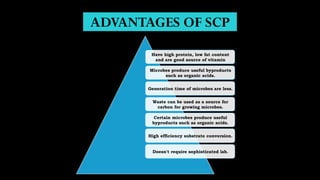
ADVANTAGES OF SCP
Have high protein, low fat content
and are good source of vitamin
Microbes produce useful byproducts
such as organic acids.
Generation time of microbes are less.
Waste can be used as a source for
carbon for growing microbes.
Certain microbes produce useful
byproducts such as organic acids.
High efficiency substrate conversion.
Doesn't require sophisticated lab.
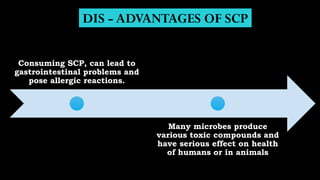
DIS - ADVANTAGES OF SCP
Consuming SCP, can lead to
gastrointestinal problems and
pose allergic reactions.
Many microbes produce
various toxic compounds and
have serious effect on health
of humans or in animals
Single cell proteins and its production.

Single cell proteins and its production.

  • 1.
    SINGLE CELL PROTEINS B.LOKESHWARI II. M. Sc MICROBIOLOGY SACRED HEART COLLEGE (AUTONOMOUS) TIRUPATTUR
  • 2.
    SINGLE CELL PROTEINS Proteinderived from microorganisms. Sources of mixed protein extracted from pure or mixed cultures of algae, yeasts, fungi or bacteria. Professor Wilson Of the MIT, Cambridge, USA Used to replace the ‘microbial’ or ‘bacterial’ protein or ‘petroprotein’ SPC was recognized that protein malnutrition than that of other foods and the world protein deficiency. Nutritional value of scp depends on the composition of the microbial cells used especially their protein, amino acid, vitamin, and mineral contents.
  • 3.
    SUBSTRATES USED FORSCP PRODUCTION  Single Cell Proteins are produced from microbes, but for the growth of microbes’ substrates as energy sources are must.  Wide varieties of substrates have been used for SCP production and include hydrocarbons, alcohols, and wastes from various sources. Hydrocarbons Gaseous hydrocarbons Liquid hydrocarbons Alcohols Methanol Ethanol Waste Products
  • 4.
    • Traditionally usedsubstrates for SCP production • Different hydrocarbons have been used, 1. Hydro Carbons Aliphatic hydrocarbons • Strains of yeasts in many genera. • Aromatics may be oxidized but are not usually efficiently assimilated. Unsaturated compounds • Are degraded less readily than saturated ones. Branched chain compounds • Degraded less readily than straight chain chemical compounds. N-alkanes • Shorter than n- nonane are not usually assimilated, but may be oxidized. • Yield factors increase but the rate of oxidation decreases with increasing chain length from n-nonane.
  • 5.
    Methane has beenmost widely used as a predominant gas and a source of SCP. Others include propane and butane. In the absence of residual hydrocarbon in the single cell protein produced from it, unlike the case with liquid hydrocarbons. One of its major disadvantages is that it is highly inflammable. 2.Gaseous hydrocarbons
  • 6.
    The major sourceof liquid hydrocarbons is crude petroleum. These hydrocarbons were first studied as a source of microbial vitamins and lipids. Many other oil companies and governments all over the world set- up research and pilot plants. Crude oil as a substrate for SCP has been used. 3. Liquid Hydrocarbons
  • 7.
    • The nextsubstrates used for SCP production • While work on SCP production from n-paraffin and gas oil was in progress, alternatives to petroleum-based substrates were sought. • Methanol and ethanol alternatives for SCP Production 4. Alcohols
  • 8.
    • Methanol isproduced by the oxidation of paraffins in the gas or liquid phase or by the catalytic reduction by hydrogen of CO and CO2, either singly or mixed. • The use of methanol as a SCP substrate has received attention by oil companies in Italy, West Germany, Norway, Sweden, Israel, UK, US. 5. Methanol Highly soluble in water and transfer problems inherent in the use of paraffins. Hazard is minimized with methane-oxygen mixtures. Purified and carryover toxic polycyclic aromatic compounds Available as hydrocarbon from methane to naphthal. Requires less oxygen than methane for metabolism
  • 9.
    • Ethanol maybe produced by the fermentative activity of yeasts. • In the synthetic process however, it is produced by the hydration of ethylene. • Although ethanol can be utilized ordinarily by many bacteria and yeasts, as a substrate for SCP, it is largely used by yeasts. • Despite this advantage yeast produced from ethanol is being produced and marketed as a flavor enhancer in baked foods, pizzas, sauces, etc., 6. Ethanol
  • 10.
    7. Waste Products •A large number of reports of SCP production from waste material have been used • Other than these, a wide variety of substrates may also be used for SCP production. These include coffee wastes, coconut wastes, palm-oil wastes, citrus waste, etc… Plant wastes Wastes from chemical industries Starch wastes Molasses Dairy wastes
  • 11.
    MICROORGANISMS USED INSCP PRODUCTION • Substrate must be used as carbon and nitrogen source with high specific growth rates and productivity. • Show tolerance towards pH and temperature, non - pathogenicity and absence of toxins. • The microorganism must be easily available for harvesting with high protein yield. • Industrially important microbes may not the suitable organisms. In addition to the industrial organisms it should also have been used in SCP production
  • 12.
    Bacteria • High inprotein and possess faster growth rate. • The nucleic acid content is quite high in bacteria that have the tendency to increase uric acids. • Brevibacterium, Methylophilus methylitropous, Acromobacter delvaevate, Bacillus megaterium, Lactobacillus species, Cellulomonas species Yeast • The larger size of yeast facilitates easier harvesting of the product. • The lower nucleic acid content, high lysine content and ability to grow in acid pH are the added benefits of yeast. • Candida utilis, Candida tropicalis, Candida intermedia, Saccharomyces cerevisiae. Algae • They bear cellulosic cell walls in it that are hard to digest by human beings. • There are also chances of concentrations of heavy metals in the product, when algae are used in the medium. • Chlorella pyrenoidosa, Chlorella sorokiana, Chondruscrispus, Porphyrium sp, Spirulina maxima. Fungi • Filamentous fungi are easy to harvest, but they have low productivity, because of their lower growth rate and low protein content. • Chaetomium celluloliticum, Fusarium graminearum, Aspergillus fumigates, Aspergillus niger, Rhizopuschinensis, Tricoderma viridae
  • 13.
    COMMERICIAL PRODUCTION OFSCP  The estimated yield of 250 tons of protein in 24 hours is achieved by using 100 lbs of yeast.  A 1000 lbs steer can synthesize only 1 lb of protein in 24 hrs after consuming 12 to 20 lbs of plant proteins.  Algae that are grown in small ponds can produce upto 20 tons of protein. • The obtained yield is 10 to 15 times higher than soybean and 25 to 50 times higher than corn.
  • 14.
    PROCESS OF SCP The production of single cell protein takes place in a fermentation process.  This is done by selected strains of microorganisms which are multiplied on suitable raw materials in technical cultivation process. 6. Safety Concerns 5. Economic Consideratio n / Process Feasibility 4. Technology Development 3. Process Engineering and Process Optimization 2. Choice of Raw Materials 1. Microbial Screening
  • 15.
    1. Suitable microbewhich yields good amount of protein need to be selected. Microbial strains are collected from various habitats 2. Carbon suppliment which yields higher biomass production in lesser time need to be analyzed. Various carbon sources are used for the higher biomass production. 3. The technical conditions of cultivation for the optimized strains are done and all metabolic pathways and cell structures will be determined. 4. Technology development is the adoption of the technical performance of the process in order to make the production ready for use on the large technical scale. 5. Energy consumption, cost of production are the important factor while going for large scale production phase. This need to be thoroughly analyzed and an energy efficient process. 6. SCP produced is for human consumption or for feeding animals safety of the product need to be tested. Certain microbes produce toxic compounds can have effect on humans and also for the environment.
  • 16.
    NUTRITIONAL BENEFITS OFSCP  To estimate the nutritional value of SCP, factors such as nutrient composition, amino acid profile, vitamin and nucleic acid content, allergies and gastrointestinal effects should be considered.  SCPs are good source of vitamins, particularly B-complex, with modest amino acid composition furnished with thiamine, riboflavin, glutathione and folic acid.  Yeast strains with probiotic properties boost larval survival by colonizing the gut of fish larvae.
  • 17.
    ADVANTAGES OF SCP Havehigh protein, low fat content and are good source of vitamin Microbes produce useful byproducts such as organic acids. Generation time of microbes are less. Waste can be used as a source for carbon for growing microbes. Certain microbes produce useful byproducts such as organic acids. High efficiency substrate conversion. Doesn't require sophisticated lab.
  • 18.
    DIS - ADVANTAGESOF SCP Consuming SCP, can lead to gastrointestinal problems and pose allergic reactions. Many microbes produce various toxic compounds and have serious effect on health of humans or in animals